Great quotes by Vladimir Lenin

Last week I posted some quotes by Joseph Stalin. I’m afraid too many people are still misguided by the myth that Lenin was a good leader whose plans were somehow distorted by Stalin. Nothing could be further from the truth. Joseph Stalin had a great teacher, Vladimir Lenin, and brought the plans of his teacher to perfection. Here are some quotes by Lenin, so that we can learn more about international Marxism. Notice that he sounded very reasonable and pacific before 1917, and not so much so when revolution actually came.

On terror:
The Congress decisively rejects terrorism, i.e., the system of individual political assassinations, as being a method of political struggle which is most inexpedient at the present time, diverting the best forces from the urgent and imperatively necessary work of organisation and agitation, destroying contact between the revolutionaries and the masses of the revolutionary classes of the population, and spreading both among the revolutionaries themselves and the population in general utterly distorted ideas of the aims and methods of struggle against the autocracy.
Lenin, Vladimir Ilich (July–August) [1903], “Second Congress of the RSDLP: Drafts of Minor Resolutions”, Collected Works, 6, Marxists.

It is necessary — secretly and urgently to prepare the terror. And on Tuesday we will decide whether it will be through SNK or otherwise.
Memorandum to Nikolay Nikolayevich Krestinsky (3 or 4 September 1918) while recovering from an assassination attempt by Socialist-Revolutionary Fanni Kaplan on 30 August 1918; published in The Mitrokhin Archive: The KGB in Europe and the West (1999) Christopher Andrew and Vasili Mitrokhin, p. 34.

On democracy:
Whoever wants to reach socialism by any other path than that of political democracy will inevitably arrive at conclusions that are absurd and reactionary both in the economic and the political sense.
Lenin, Vladimir Ilich (Summer) [1905], “Two Tactics of Social Democracy in the Democratic Revolution”, Collected Works, 9, Marxists, p. 29.

You cannot do anything without rousing the masses to action. A plenary meeting of the Soviet must be called to decide on mass searches in Petrograd and the goods stations. To carry out these searches, each factory and company must form contingents, not on a voluntary basis: it must be the duty of everyone to take part in these searches under the threat of being deprived of his bread card. We can’t expect to get anywhere unless we resort to terrorism: speculators must be shot on the spot. Moreover, bandits must be dealt with just as resolutely: they must be shot on the spot.
“Meeting of the Presidium of the Petrograd Soviet With Delegates From the Food Supply Organisations” (27 January 1918) Collected Works, Vol. 26, p. 501.

On individual liberty:
Everyone is free to write and say whatever he likes, without any restrictions. But every voluntary association (including the party) is also free to expel members who use the name of the party to advocate anti-party views. Freedom of speech and the press must be complete. But then freedom of association must be complete too.
Lenin, Vladimir Ilich (13 November 1905), “Party Organisation and Party Literature”, Novaya Zhizn (Marxists) (12).

We set ourselves the ultimate aim of abolishing the state, i.e., all organized and systematic violence, all use of violence against people in general. We do not expect the advent of a system of society in which the principle of subordination of the minority to the majority will not be observed.

In striving for socialism, however, we are convinced that it will develop into communism and, therefore, that the need for violence against people in general, for the subordination of one man to another, and of one section of the population to another, will vanish altogether since people will become accustomed to observing the elementary conditions of social life without violence and without subordination.
Lenin, Vladimir Ilich, The State and Revolution, Ch. 4: “Supplementary Explanations by Engels”

On violence:
No Bolshevik, no Communist, no intelligent socialist has ever entertained the idea of violence against the middle peasants. All socialists have always spoken of agreement with them and of their gradual and voluntary transition to socialism.
“Reply to a Peasant’s Question” (15 February 1919); Collected Works, Vol. 36, p. 501.

When violence is exercised by the working people, by the mass of exploited against the exploiters — then we are for it!
“Report on the Activities of the Council of People’s Commissars” (24 January 1918); Collected Works, Vol. 26, pp. 459-61.

Great quotes by Joseph Stalin

Sometimes I like to read quotes by famous intellectuals and leaders. I believe it is a great way to learn one thing or two about several subjects, and specially the thought of said people. I suddenly became curious about Joseph Stalin, and to my surprise he was at times a very reasonable (albeit terribly evil) person. Here are some quotes by Joseph Stalin I subjectively find interesting:

On Social Democracy:
Social democracy is objectively the moderate wing of fascism…. These organisations (ie Fascism and social democracy) are not antipodes, they are twins.
Joseph Stalin, “Concerning the International Situation,” Works, Vol. 6, January-November, 1924, pp. 293-314.

On Anarchism:
We are not the kind of people who, when the word “anarchism” is mentioned, turn away contemptuously and say with a supercilious wave of the hand: “Why waste time on that, it’s not worth talking about!” We think that such cheap “criticism” is undignified and useless.
(…)
We believe that the Anarchists are real enemies of Marxism. Accordingly, we also hold that a real struggle must be waged against real enemies.
Anarchism or Socialism (1906)

On differences within the communist movement:
We think that a powerful and vigorous movement is impossible without differences — “true conformity” is possible only in the cemetery.
Stalin’s article “Our purposes” Pravda #1, (22 January 1912)
He did make a lot of people conform to his ideas.

On diplomacy:
A sincere diplomat is like dry water or wooden iron.
Speech “The Elections in St. Petersburg” (January 1913)

On the press:
The press must grow day in and day out — it is our Party’s sharpest and most powerful weapon.
Speech at The Twelfth Congress of the R.C.P.(B.) (19 April 1923)

On elections:
I consider it completely unimportant who in the party will vote, or how; but what is extraordinarily important is this—who will count the votes, and how.
Said in 1923, as quoted in The Memoirs of Stalin’s Former Secretary (1992) by Boris Bazhanov [Saint Petersburg]

On education:
Education is a weapon whose effects depend on who holds it in his hands and at whom it is aimed.
Interview with H. G. Wells (September 1937)

On Hitler:
So the bastard’s dead? Too bad we didn’t capture him alive!
Said in April 1945 — On hearing of Hitler’s suicide, as quoted in The Memoirs of Georgy Zhukov

On his role as a leader at the USSR:
Do you remember the tsar? Well, I‘m like a tsar.
To his mother in the 1930s as quoted in Young Stalin (2007) by Simon Sebag Montefiore

To finish, a comment by George Orwell about Stalin, and above that, about people in the West who failed to see what the USSR actually was:
I would not condemn Stalin and his associates merely for their barbaric and undemocratic methods. It is quite possible that, even with the best intentions, they could not have acted otherwise under the conditions prevailing there.

But on the other hand it was of the utmost importance to me that people in western Europe should see the Soviet regime for what it really was. Since 1930 I had seen little evidence that the USSR was progressing towards anything that one could truly call Socialism. On the contrary, I was struck by clear signs of its transformation into a hierarchical society, in which the rulers have no more reason to give up their power than any other ruling class. Moreover, the workers and intelligentsia in a country like England cannot understand that the USSR of today is altogether different from what it was in 1917. It is partly that they do not want to understand (i.e. they want to believe that, somewhere, a really Socialist country does actually exist), and partly that, being accustomed to comparative freedom and moderation in public life, totalitarianism is completely incomprehensible to them.

George Orwell, in the original preface to Animal Farm; as published in George Orwell : Some Materials for a Bibliography (1953) by Ian R. Willison

What’s the difference between open borders and Open Borders?

There are two meanings here. I’ll define them below:

  • There are open borders, where borders are open and anyone can move between them
  • There are Open Borders, where borders to rich states are open to people from poor states, but the borders to poor states are closed to immigration

Open borders are fairer than closed borders. If people can move from poor states to rich ones, that’s good. But what about people who want to move from rich states to poor ones? Open Borders addresses the first issue but not the second one. Libertarians are enamored with the second type of open borders these days, for a couple of reasons. The main reason, and the only one I’m going to name here, is that most of us are pragmatic and therefore support any kind of liberalization in labor markets we can get. If we can get our respective polities to open up their borders to poor migrants, so be it. Let’s do this in any way we can.

But what we are advocating for is not open borders. It’s labor market liberalization. I understand the need for sloganeering these days. I get it. Y’all are thinking on the margin. I’m all for Open Borders.

How, though, do we get actual open borders?

How can senior citizens from the US have the freedom to choose retirement in not only Florida or Oregon, but Tamaulipas or Veracruz, too?

How can middle class Californians have the freedom to choose between not only Texas or Colorado for relocation, but Chihuahua or Neuvo Leon?

My answer is, of course, federation, but I also realize my argument is politically unfeasible for the time being (even though it’s an old argument). Any other ideas, or is Open Borders the best we can do for now?

Porque privatizar (ou desestatizar) o ensino é uma das melhores reformas que se pode fazer

Talvez seja somente uma percepção subjetiva sem maior relevância objetiva, mas a impressão que tenho é que a privatização do ensino é um dos maiores tabus da sociedade brasileira. Até onde eu sei nenhum partido, figura política ou figura pública de destaque está defendendo a privatização total do ensino no Brasil. Segundo as notícias que chegam até mim, o recente anúncio de corte de gastos na educação causa uma de duas reações: indignação ou pesar. Alguns reagem com indignação, e não aceitam que qualquer corte seja feito; outros reagem com pesar, mas consideram que os cortes são necessários. Ditas estas coisas, penso que cabe a mim agir como Walter Block e “defender o indefensável”: o governo (ou o estado – use o vocabulário que lhe convir) não deveria ter qualquer papel na educação. Para isso irei expor brevemente o que é economia, como ela funciona, e o que isso tem a ver com governo, indivíduos e educação. É uma exposição breve, e pode deixar alguns pontos pouco desenvolvidos. Para uma exposição mais profunda deste tema, recomendo o livro Educação: Livre e Obrigatória, de Murray Rothbard.

Economia é a gestão de recursos necessariamente escassos que possuímos. Os recursos são necessariamente escassos porque somos seres humanos finitos, e não deuses. Alguns paradigmas econômicos (notoriamente o marxismo) partem de um pressuposto de abundancia de recursos, mas isto é falso e até mesmo perigoso: até mesmo o homem mais rico do mundo tem somente 24 horas no seu dia. Tem somente um corpo, e não pode estar em dois lugares ao mesmo tempo. Tem energia limitada, e fica cansado. Todos nós possuímos recursos limitados (ainda que alguns possuam mais recursos à sua disposição do que outros). A economia é a arte de melhor gerir estes recursos.

A gestão dos recursos limitados que possuímos é feita através de escolhas. O nome que os economistas dão a isso é “custo de oportunidade”: a não ser que você detenha infinitos recursos, gastar em uma coisa significa não gastar na segunda melhor alternativa. Exemplos: comprar o carro A significa não comprar o carro B; morar na cidade X significa não morar na cidade Y; casar com Z significa não casar com W; e escolher a carreira α significa não escolher a carreira λ. Como disse um antigo professor meu, “a vida é feita de escolhas”.

Considerando que possuímos recursos finitos e precisamos fazer escolhas, qual é mecanismo mais eficiente para tomar decisões? Certamente muitas pessoas gostariam de tomar decisões com base nos seus gostos pessoais. Gostariam de escolher aquilo de que mais gostam. Porém, aquilo de que mais gosto nem sempre está ao meu alcance. Exemplos: ainda que eu goste mais de uma Ferrari do que de um fusquinha, talvez eu precise me contentar com a segunda opção. Ou ainda que eu queira viajar, talvez eu tenha que me contentar em pagar o tratamento para um problema de saúde que acabei de descobrir que tenho. É por coisas assim que a economia ficou conhecida como “ciência triste”. Muitas vezes ela está aí para lembrar que nem sempre podemos ter o que queremos. Dito isto, a melhor forma de tomar decisões é pelos preços: os preços nos dizem se aquilo que desejamos é compatível com os recursos disponíveis.

Os preços são geralmente definidos em termos de dinheiro. Dinheiro é melhor definido por aquilo que faz do que por aquilo que é. Muitas coisas podem ser dinheiro: papel, metais preciosos, cigarros, balas ou dígitos num computador. Mas o que dinheiro faz é servir como uma linguagem: o dinheiro transmite de uma pessoa para outra o valor dos recursos envolvidos numa mercadoria ou num serviço. E valor é algo subjetivo. Contrariando a teoria do valor trabalho, é impossível saber de forma objetiva qual é o preço de uma determinada mercadoria ou serviço: é necessário que este valor seja definido por relações de oferta e procura. E é de incontáveis relações de oferta e procura que os preços são feitos. Em outras palavras, os preços nos transmitem de forma simples algo que jamais poderia ser calculado por uma pessoa: uma infinidade de relações de oferta e procura, escolhas e preferências, dentro da economia. Como disse Friedrich Hayek, “a economia somos nós”.

E assim chegamos à educação. Como eu disse acima, escolher a carreira α significa não escolher a carreira λ. Como essa decisão é feita? Certamente que muitas pessoas escolhem sua carreira com base em aptidões que percebem em si mesmas, ou em considerações sobre o que poderá ser uma atividade profissional mais prazerosa. Porém, este é um luxo que não está disponível para todos: muitas pessoas precisam escolher uma carreira com base no que pode dar mais retorno financeiro com menor investimento e menor risco. Posso escolher uma carreira que promete um grande retorno financeiro, mas com grande risco de não conseguir emprego num mercado de trabalho altamente competitivo, ou com um investimento de recursos (em tempo em dinheiro) que não posso arcar. A vida é feita de escolhas, e essas escolhas muitas vezes envolvem riscos. Escolher uma carreira é dizer não (ao menos temporariamente) para todas as outras. Algumas pessoas tem a chance de arriscar mais. Outras não têm o mesmo luxo. Considerações como relação candidato/vaga, salário médio, nível de empregabilidade e outras são semelhantes aos preços, e podem ser bons parâmetros ao se decidir por uma carreira. Mas com o governo criando vagas em universidades, determinando regras de acesso ao mercado de trabalho e adotando outras medidas, os preços não refletem a real relação de oferta e procura. Em outras palavras, a linguagem é distorcida, e as decisões não são as melhores, nem para os indivíduos, e nem para a sociedade.

Compreendo que pensar assim possa soar extremamente cínico, e pode ser um banho de água fria, especialmente para os mais jovens ou mais sonhadores. Muitas pessoas preferem tomar decisões considerando seus gostos pessoais, sua vocação, seu desejo de ajudar o próximo ou outras considerações. Não estou desmerecendo nenhuma destas considerações. Estou apenas dizendo que somos seres humanos limitados que vivem num mundo de recursos limitados. Precisamos fazer o melhor uso possível destes recursos. Embora os recursos sejam limitados, nossa criatividade para aproveitá-los não demonstra um limite óbvio. O uso criativo e sustentável dos recursos necessita de uma bússola, um guia. O sistema de preços é o melhor guia que possuímos. Sem propriedade privada não há formação de preços, e sem formação de preços o cálculo econômico é impossível. Por esta razão os gastos com educação não param de aumentar e a qualidade dos resultados não para de cair: o melhor juiz para determinar como os recursos serão empregados é o individuo fazendo uso de seus próprios recursos. A interferência do governo prejudica ou até desfaz este julgamento.

Em tempo: estou defendendo que o governo precisa sair da educação e deixá-la para a iniciativa individual (até mesmo porque somente indivíduos podem ter iniciativa). Não estou defendendo que educação precisa ser necessariamente paga pelos alunos. Como disse Milton Friedman, “não existe almoço grátis” (mais uma dessas frases que tornam os economistas – especialmente os liberais clássicos e libertários – pessoas pouco populares). Mas quando uma pessoa tem fome e não pode pagar pelo almoço, outra pode fazer isso. O nome disso é caridade, e quero incentivá-la o máximo possível. Caso você se preocupe com os pobres, sugiro que pare de mandar dinheiro para Brasília na forma de impostos, que serão necessariamente mal empregados (segundo tudo que discuti aqui), e procure pessoas que precisam. Com certeza você não terá dificuldade de encontrá-las.

Sweet Skateboard Tales

The words “skateboard” and “sweet” are seldom found together. Skateboarders tend to have a bad reputation because they are mostly male, because they act too male, and because of their lamentable fashion sense. Yet, many or most are both athletes and artists. They do things in the middle of my street of such perilous inventiveness that I am not brave enough even to think about them.

So, the other day, I  am watching the ocean on West Cliff Drive in Santa Cruz. Now, West Cliff is a sea-hugging street with a million dollar view of Monterey Bay. (I mean this literally: Move the same house that has the ocean view one block inland and its value drops by a cool million or more.) West Cliff is a good place for spotting whales but it’s mostly used by many Santa Cruz residents as a walking venue and a place to ride their bikes.

Suddenly, from the corner of my eye, I spot a man on a skateboard. Skateboarders seldom use West Cliff. It’s often crowded, it’s too ordinary, and it offers few opportunities to do tricks. This skateboarder is a bit older than most, perhaps in his early thirties. He is moving quite fast, I think. A six year-old is clinging to his left leg, a four year-old to his right leg. It’s stunning and it’s adorable. The next day one who knows more than I tells me that it must have been an electrically propelled skateboard. I love living in California. The inventiveness here is bracing.

Not a day later, I am standing in from of the Post Office shooting the breeze with my pal, Dennis the Homeless. (Dennis is homeless, not brainless; he knows a lot and he makes bamboo flutes.) My mind can’t believe what my eyes see. If I had been asked, I would have said it couldn’t be done. A boy and a girl are skateboarding together, each with his own board but holding hands. The harmony, the intuitive synchronicity! Ah, young love! The sweet music they must make in bed. Again, I don’t know where else I would be treated to this kind of spontaneous, charming show.

A “don’t rock the boat” theory of political change

You’d think that as long as we’ve known Trump and Clinton it would be more obvious which is better (okay, least bad). But here we are. That said, I largely agree with Brandon’s thoughts: Hilary is the better of the two. If we’re thinking about the trajectory of freedom in this country, it’s like we had been climbing an upward path till 9/11 gave military-industrial complex a new project. Clinton is offering to keep leading us down a gentle incline and Trump is saying “let’s go through that thicket of poison oak!”

I stand by my old advice that a vote for the big two parties is a wasted vote.  People will argue that in swing states it might be close and you might regret your vote. Those people are really arguing that you might regret the vote of hundreds-thousands of strangers. Your vote still is not decisive. Even if you convince a thousand strangers in a swing state to vote your way, you’re still highly unlikely to affect the outcome.

I think, in terms of voting, you do much more good by sending a Johnson signal than you do by slightly increasing the margin by which Clinton wins (or slightly decreasing the margin by which she loses depending on your state).

But my advice is given in the context of a world where Johnson is expected to get 6% of the vote. That affects my cost-benefit calculus. What would it mean for the long-run success of liberty if Johnson were to actually win?

To build on Brandon’s third point (“Clinton is a lawyer and she knows how our government is supposed to work”), this isn’t just a competition to get into the white house. It’s a sales pitch that requires buy in from the electorate. If Johnson won the election, he’d be in the position of some newfangled gadget America bought on a whim. He could catch on, like the microwave, or sink like the Segway.

czgldopviaa-rh
Onward, to freedom!

Truthfully, I’m not sure that scenario would be that good for freedom–I think Johnson is a pretty good voice for liberty, and a great third party candidate. But if he actually won, I think he might be too different from the environment he’d have to operate in. It could turn people off of libertarianism for another generation.

But then, the point of your vote isn’t to pick the winner, it’s to express your political beliefs. You’ll do a much better job of voting by voting your conscience than by trying to vote strategically. So vote for Johnson, but root for Hillary… this time.

O que é socialismo?

Alguns posts atrás fiz uma exposição sobre o que é capitalismo, e também procurei expor e desmistificar alguns equívocos a respeito dele. Nos próximos posts pretendo fazer algo semelhante com o socialismo: explicar o que é e desfazer alguns mitos e equívocos. Falando a respeito de capitalismo, expliquei que esta palavra é utilizada de forma bastante livre, e assim há muitas variedades de capitalismo. Optei por expor um tipo de capitalismo associado ao pensamento de Adam Smith e à tradição liberal, algo que pode ser chamado de liberdade econômica, liberdade de mercado ou liberdade de escolha. O socialismo também aparece em variadas formas. O que exponho aqui é a variedade associada a Karl Marx. Marx foi um historiador, filósofo e sociólogo, mas o que me interessa aqui é principalmente sua teoria econômica.

A teoria econômica de Marx começa com a teoria do valor trabalho. De acordo com esta pressuposição, o que dá valor a um produto é a quantidade de trabalho envolvida na produção. Em outras palavras, o trabalho (trabalho braçal, entenda-se) é a fonte de todo valor. Esta percepção de valor trabalho pressupõe uma ligação entre mais valia e acumulação de capital. Marx argumentou que toda a riqueza é fruto do esforço dos trabalhadores. No entanto, os trabalhadores não recebem um salário correspondente ao valor pelo qual sua produção é vendida. Na percepção liberal, a diferença entre custo de produção e valor de venda é chamada de lucro. Na percepção de Marx, isto é mais valia: os donos das fábricas (ou donos dos meios de produção) enriquecem a custa do esforço dos trabalhadores. Mas esta é uma relação insustentável: para lucrar os empresários precisam pagar aos trabalhadores o mínimo possível, somente o suficiente para garantir a sobrevivência e reprodução dos trabalhadores. Com o tempo, os lucros iriam cair, o capital (ou os recursos de produção) iriam se concentrar em poucas e imensas fábricas (fabricas menores seriam levadas à falência pela competição), haveria dificuldade de transferência de capital (os investimentos seriam cada vez menos rentáveis), o número de desempregados se elevaria, a capacidade de venda cairia, crises cada vez mais profundas e frequentas ocorreriam, todo o sistema iria inevitavelmente chegar ao fim. Uma sociedade socialista, onde os trabalhadores seriam donos dos meios de produção, surgiria.

No coração da teoria econômica de Marx está o conceito de mais valia: os trabalhadores não recebem o que merecem pelo seu trabalho. Ao invés disso, eles são explorados pelos patrões. Acredito que esta noção de exploração comove muitas pessoas, mas ela não faz o menor sentido. Marx não está dizendo que alguns patrões exploram os trabalhadores. Ele está dizendo que, por definição, todos os patrões exploram os trabalhadores, pois retém na mais valia uma riqueza que não lhes pertence.

A pedra fundamental da teoria econômica de Marx é a teoria do valor trabalho: o que confere valor a um produto é o trabalho que se tem para produzi-lo. Daí que necessariamente haja exploração. Mas a teoria do valor trabalho está certa? Ela corresponde à realidade? Acredito que está bem claro que não: posso ter muito trabalho para produzir uma escultura de palitos de fósforo no meu quintal, e nunca conseguir vende-la, pois ela não tem valor para mais ninguém. Todo o meu trabalho, todo o meu esforço, é inútil e sem valor se eu não estiver produzindo algo que seja do interesse de outra pessoa. Além disso, a revolução marginalista do final do século 19, e particularmente a Escola Austríaca, veio demonstrar que valor é algo subjetivo e sujeito a condições de tempo e espaço.

A questão clássica a respeito de valor é: “porque diamantes, que não alimentam, são tão caros, enquanto que água, que é essencial à vida é tão barata?”. A resposta do valor trabalho é que dá muito trabalho conseguir diamantes, enquanto que água literalmente cai do céu. Mas esta resposta é incompleta: em alguns lugares água não cai do céu. No deserto do Saara, morrendo de sede, uma pessoa pode trocar muitos diamantes por copo de água. Em outras palavras, se a teoria do valor trabalho está correta, então há um valor objetivo: é possível calcular com precisão o valor de alguma coisa considerando o trabalho empregado em sua produção. Mas é manifesto que isto não é verdade: produtos tem seu valor afetado por muitas circunstâncias, e o esforço empregado na produção pode não ter qualquer relevância no valor final.

A conclusão é simples: se a teoria do valor trabalho está errada, toda a teoria econômica de Marx está errada. Isto quer dizer que patrões nunca exploram seus empregados? Claro que não! Isto quer dizer apenas que esta exploração não ocorre segundo a explicação de Marx.

As previsões de Marx (salários menores, maior desemprego, crises econômicas recorrentes e profundas) foram desmentidas uma a uma: a Europa do final do século 19, progressivamente marcada pelo liberalismo econômico, experimentou uma prosperidade impar em sua história. Num quadro mais amplo, nações que optam pelo liberalismo econômico prosperam, e principalmente prosperam os trabalhadores. Basta comparar Coreia do Norte e Coreia do Sul, China e Hong Kong, Alemanha Ocidental e Alemanha Oriental, EUA e URSS e assim por diante. Entendo que muitas pessoas se encantam com o marxismo (e como o socialismo) por se apiedarem das condições muitas vezes precárias dos trabalhadores. Porém, não basta ter o coração no lugar certo. É fundamental ter uma compreensão correta da realidade. Caso a exploração dos trabalhadores seja uma preocupação para você, sugiro considerar o capitalismo e esquecer qualquer forma de socialismo.

What is the state of experimental social science?

This is a genuine question: What is the state of experimental social science?

What I know of experimental social science comes largely from Vernon Smith and his colleagues from George Mason and Chapman Universities. From the way the topic was discussed I assumed the field was in its infancy and limited to a few economic departments. During my undergrad I recall my professors discussing a job candidate that specialized in experimental methods, but from their tone it was clear they were skeptical of what could be learned from it. Back then I could hardly believe that experimental methods were being toyed with in the other social sciences.

It was only about a year ago that I learned from a friend that psychology had its own experimental methods movement. From what I could make out experimental psychology was being developed independent of experimental economics. Even then I assumed that experimental methods were on the fringe.

I am genuinely surprised then to find that experimental methods exist in political science and, from what I can make up, part of the mainstream research. As NoL readers may know I recently started my PhD in Political Science at UC Riverside. My training up till now has been in Economics. What I find interesting about the political science literature is that it seems heavily influenced by the experimental psychology field, but not experimental economics.

Here is one of the better examples of experimental political science I’ve come across. In this paper participants role play as bureaucrats who have to distribute $1,500 in funds between two applicants of various race and work ethic, in addition to having the choice of reducing the government deficit. Note the citations include several psychology journals, but no mention of the economics literature.

Also note that, unlike experimental economics, there is no pay off for acting in a given way. This I think is a major error since the researchers are trying to measure degree of racism, but in this experiment there is no ‘cost’ to being racist. In real life though racism comes at a cost. If you’re racist you lose out not on potential trade partners, but potential friends and even lovers. Anyway;

So I ask, especially to those of you with backgrounds outside economics, what is the state of experimental methods in your field? Is it considered mainstream or is it a novel technique? Has it been influenced by experimental methods in another social science? And if so, which one?

Some thoughts on Rio de Janeiro elections

I’m a great fan of the Lord of the Rings, both the books and the Peter Jackson movies. Overall I believe the movies are pretty faithful to the books. There are, of course, some differences, but I generally accept the explanation that adapting a book to a movie is hard and some changes have to be made. There is, however, a whole chapter from the books absent from the movies that I believe shouldn’t be. If you haven’t seen the movies or read the books, be warned, spoiler alert. The said chapter is called “The Scouring of the Shire.” In the movies, when the hobbits return home from the War of the Ring, hardly anything has changed. It seems like the Shire has not been affected by the events in the world around it at all. In the books, however, Saruman the White, the evil wizard, escapes to the Shire after been defeated in the battle of Isengard. He ends up governing the Shire in secret under the name of Sharkey until the events of “The Scouring of the Shire,” when the hobbits return and lead a rebellion, defeating the intruders and exposing Saruman’s role. I believe this chapter is important because it shows that evil is not somewhere far from home. We may fight a war overseas, but evil may end up lurking really close to us.

This last Sunday Brazil had municipal elections. The Workers Party (PT), the political party of impeached president Dilma Rousseff and the almost convict ex-president Luis Inácio Lula da Silva, was the great loser. Some cities will still have a second round of votes, but it is clear that in the process PT will lose a great number of prefectures, city halls, and with it many commissioned positions as well. In sum, the process of rejection that started with the impeachment goes on and well. Or almost. In Rio de Janeiro the elections will be decided in second round between Marcelo Crivella and Marcelo Freixo. Crivella is a licensed bishop of the controversial Universal Church of the Kingdom of God, and Freixo is a member of the Socialism and Freedom Party (PSOL). Crivella was Rousseff’s ally almost until the very end, when his party decided to vote for the impeachment. PSOL is a dissent from PT that left the former party in 2004, believing that Lula was too pro-market in his policies.

Saruman took refuge in the Shire and changed his name to Sharkey. The inhabitants of the Shire were too unaware of the events of the War of the Ring to understand what was going on. Saruman was the White Wizard. He was supposed to be good, but ended up being one of Sauron’s greatest allies. Freixo is Saruman: he may try to hide as much as he wants to, and even change his name, but he is an ally to the worst things in Brazilian politics. He poses as someone pure (or White), but just like Saruman he actually has a robe of many colors, depending on who he wants to impress. PT changed its name to PSOL and is now trying to hide in my Shire. I hope the cariocas will not let it happen.

PSOL is popular mostly among the young, artists, and rich people from rich neighborhoods, so I don’t actually believe Freixo will become mayor. But their plan is, following Antonio Gramsci, to create a cultural hegemony and thus to win elections on the long run. PT did exactly this, but it seems like Brazilians are beginning to understand that socialists care only for other people’s money and little else. PSOL even has liberty in its name, but of course they aren’t going to offer any liberty to the people. Slavery can be defined as forced labor to someone else’s benefit. And that is also the exact definition of socialism: you work, they take your money and they give it to someone else. As Alexis de Tocqueville said it, “socialism is a new form of slavery.” I hope people in Brazil, and especially in Rio, will realize it.

O capitalismo explora os trabalhadores?

Um dos argumentos contra o liberalismo econômico que tenho ouvido recentemente (ou contra a liberdade de mercado, com pouca ou nenhuma intervenção do estado) é que as relações entre patrões e trabalhadores são desiguais, e logo então desfavoráveis para os trabalhadores; cabe ao estado intervir a favor dos trabalhadores; o liberalismo econômico não é bom para os trabalhadores. Tenho dificuldade com este argumento, pois ele passa a ideia de que os patrões não trabalham. Seja como for, acredito que posso aceitar parte do que está sendo dito: é lógico que alguns patrões irão tentar pagar o pior salário possível aos trabalhadores para conseguir os maiores lucros possíveis. É lógico que muitos patrões irão ver qualquer investimento em segurança, bem estar, saúde e outros “direitos” como gastos incômodos, e irão tentar evitar estes gastos. É lógico que o trabalhador está pleiteando a vaga, e neste sentido está à mercê do patrão que a oferece. Tudo isto é não apenas lógico, mas empírico. Pessoalmente já vi estas coisas acontecendo “com estes olhos que a terra há de comer”. Há patrões que irão tentar fazer todas estas coisas e outras ainda, aproveitando-se da situação vulnerável dos trabalhadores. Irão tentar. Mas irão conseguir?

Segundo me parece, uma forma de evitar que patrões se aproveitem da situação vulnerável dos trabalhadores é apelar para a caridade dos patrões. Embora eu suspeite que esta abordagem possa soar romântica para muitos, o fato é que empiricamente ela funciona com alguma frequência. Historicamente, foi o cristianismo de muitos empresários que possibilitou a melhora das condições de trabalho na Europa e Estados Unidos durante o primeiro século de Revolução Industrial. Portanto, esta é uma abordagem que, acredito, não deve ser desconsiderada.

Uma segunda forma de evitar que patrões se aproveitem da situação vulnerável dos trabalhadores é criar leis trabalhistas. Ao invés de esperarmos que os patrões sejam voluntariamente bons, podemos usar a violência legítima do estado para força-los a serem bons. Esta abordagem possui efeitos positivos, mas também muitas consequências inesperadas. Basicamente o objetivo de qualquer lei é tornar os relacionamentos humanos mais padronizados. Uma maneira mais negativa de dizer a mesma coisa é falar que leis engessam a sociedade. Leis trabalhistas criam “direitos”, mas também impedem que trabalhadores e empregadores negociem voluntariamente outras possibilidades de relacionamento. Um exemplo bastante conhecido é o salário mínimo, que contra intuitivamente prejudica os trabalhadores mais do que os ajuda. Finalmente, leis só fazem sentido caso sejam amparadas por um estado. E com mais leis, mais estado. Nossa relação com o estado já é por definição desigual: o estado possui o monopólio do uso legitimo da violência; nós não. Aumentar o tamanho do estado é aumentar nossa vulnerabilidade dentro de uma relação desigual, o que vai contra exatamente o que está sendo discutido aqui.

Uma terceira forma de evitar que patrões se aproveitem da situação vulnerável dos trabalhadores é a liberdade econômica. Sim, como eu comecei dizendo, é lógico e empírico que alguns patrões irão tentar se aproveitar de situações de vulnerabilidade dos empregados. Mas irão conseguir? Numa sociedade orientada pela liberdade de mercado, é mais provável que não. Com liberdade de mercado, a tendência é o surgimento de concorrência, além de uma maior diversidade de atividades econômicas. Neste cenário, patrões que procurem abusar dos trabalhadores correm o rico de perder os trabalhadores para outros patrões. Mesmo no cenário improvável de todos os patrões serem abusivos, tratar bem os trabalhadores torna-se um imperativo para manter os lucros. A alternativa seria um acordo geral dos patrões abusivos, mas isto tornasse empiricamente infactível numa sociedade progressivamente marcada por liberdade de escolha. Uma última observação nesta lista muito longe de exaustiva de benefícios do livre mercado para o trabalhador é que no livre mercado a tendência é de aumento da produtividade. E nada está mais ligado a aumentos de salários do que aumento de produtividade. De fato, onde há liberdade de mercado os salários aumentam, assim como o poder de compra.

Em resumo, sim, há patrões que se aproveitam das relações desiguais com trabalhadores para exercer poder sobre estes mesmos trabalhadores. Isto é não apenas lógico, mas empírico. Mas qual é a melhor solução para este problema? Apelar para a boa vontade dos patrões? Criar leis que deem aos trabalhadores mais direitos? Favorecer uma maior liberdade de mercado? Minha resposta é: criar leis que favoreçam maior liberdade de mercado, e ao mesmo tempo apelar para a boa vontade dos patrões, até porque num cenário de maior liberdade econômica, patrões abusivos estão indo contra seus próprios interesses.


Referências:

O capitalismo explora os trabalhadores?

Inherited wealth and size of government

In the debate over inequality, I have long argued that governments are much better at creating inequality than at reducing them (see my paper here with Steve Horwitz). Through rent-seeking and regulatory capture, interest groups manage to redistribute wealth in the “wrong” direction. There are a great many cases of large fortunes amassed thanks to government favors (think of the Bombardier family in Canada or Carlos Slim in Mexico).

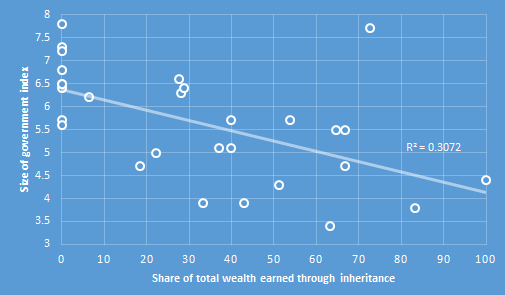
Yet, as many scholars have pointed out, large fortunes can be rapidly consumed by squabbling heirs and poor investments (see this paper here notably). Thus, the fortunes gathered by parents who earned government favors can melt away over time. Nonetheless, governments do protect the fortunes of the heirs if they continue in business. For example, the heirs of the Bombardier family in Canada continued their ancestor’s work and remained relatively well-off. This is in part because governments continue to rescue that firm from its misfortunes. In a way, government may act to limit the erosion of fortunes. We can phrase this differently by asking whether or not the size of government is correlated with the share of wealth from the “ultra-rich” that is gained through inheritance.

Using a working paper from the Peterson Institute for International Economics titled The Origins of the Superrich: The Billionaire Characteristics Database authored by Caroline Freund and Sarah Oliver and the Economic Freedom Index of the World produced by the Fraser Institute (released this week), we can check for the existence of this correlation. The paper by Freund and Oliver documents the share of the total wealth of billionaires that was earned through inheritance.

Unsurprisingly (for me), the lower the index for the size of government, the greater the share of wealth earned through inheritance. Using all OECD and European countries, we can very well see that the size of government is negatively correlated with the share of wealth from inheritance. untitled

Maybe, just maybe, those who believe that the solution to rising inequality is more government redistribution should be willing to reconsider their proposed cure. This is, I believe, an additional cause for skepticism regarding remedies.

Some afterthoughts on Rio Paralympics

Paralympics are over, and with them the cycle of Olympic Games in Rio de Janeiro. Once again the city was able to put up a good show, and thankfully all went well in the Cidade Maravilhosa. But not everything is alright in Rio: even more than the Olympics, the Paralympics were able to show the contradictions between the city where we live everyday and the city of the event: Rio is not welcoming for people with disabilities.

At least in Brazilian Portuguese, political correctness has done a mess with vocabulary concerning the kind of people who compete in Paralympics. We are not supposed to say they are disabled (don’t even think about saying they are crippled!). I think the correct vocabulary today is, as I used, “people with disabilities.” But even that is under political correct scrutiny, so it seems. All this discussion about words springs from cultural Marxism, postmodernism, relativism and the belief that there’s nothing objective beyond our vocabulary. But words can’t hide the reality: Rio is unequal. The way it treats the blind, the lame, and even the elderly or the young, is completely different from the way it treats people in middle-age and more able to walk. And all that despite strong legislation in this area.

One of the greatest debates in political philosophy in the 20th century happened between American philosophers John Rawls and Robert Nozick. Trying to build on classical liberal foundations (but moving to egalitarian liberalism), Rawls pointed out that “equality was supposed to be the moral benchmark for social and political institutions, and that any deviation from equality had to be specially justified.” Nozick answer was that liberty upsets patterns. Even if we have a starting point in society where we have a perfectly equal distribution of goods or assets, the moment that we allow people to be free to make their own choices (as liberalism prescribes) they are going to make choices we cannot possibly predict, and these choices are going to upset any kind of pattern we established in the first place. That happens because each one of us is unique in its own right: each one of us have a specific set of values, preferences and circumstances that upsets any would-be planner. So, if you want to respect human liberty to make choices, you have to give up on any plan for material equality.

Nozick’s answer to Rawls has a lot of Adam Smith in it. In The Theory of Moral Sentiments (1759) (preceding the more famous Wealth of Nations both in time and argument) Smith presented a character called “man of system.” This person sees society as an architect sees a blueprint for a construction. Smith says such person is “apt to be very wise in his own conceit; and is often so enamored with the supposed beauty of his ideal plan of government that he cannot suffer the smallest deviation from any part of it.” The problem is that humans have free will, the ability to make choices. And as such, they will upset any blueprint prepared for them. In other words, “individual people are not chess pieces you can move on a board with their dreams and desires ignored.” To the eyes of the would-be planner, “society must be at all times in the highest degree of disorder.”

So, material equality of outcomes (or at least of opportunities) is totally out of reach? Should we disregard it completely? Should the “invisible hand” prevail in spite of the weakest in our society? I don’t think so. Just the opposite! One of the very reasons I find classical liberalism morally appealing is the fact that no economic or political system ever conceived helps the weakest as it does. In other words, contrary to (what seems to me is) the popular belief, classical liberalism defends social justice more than any of its intellectuals alternatives. Answering John Rawls’s famous claim that “a just society will be one whose rules tend to work to the maximum advantage of the least well-off classes,” Friedrich Hayek pointed out exactly this. In The Constitution of Liberty, Hayek agreed with Rawls about the end at which social institutions should aim: the welfare of the least advantaged. He simply disagreed about the means Rawls thought would get us there.

Instead of thinking of us as chess pieces on a board, when can use the analogy of a soccer game (or football, or basketball – suit yourself). The outcome of the game is the result of the player’s individual abilities, but it is also the outcome of the rules. In other words, in a free society, where people are free to choose, the outcomes are not just the result of the innumerable decisions of countless individuals. They are also the result of the rules enforcing property rights, contracts, taxation, and so on. So, it’s important to think about the justice of these rules, as well as the outcomes they might have. The point is that we can embrace a theory of social justice, but that just tells us the end we are heading to, not the means to get there.

Contrary to egalitarians, progressivists and socialists claims, no theory “tends to work to the maximum advantage of the least well-off classes” as classical liberalism does. And that’s a great reason I support it. As I said in the beginning, Rio is very unequal, despite decades of egalitarian policies in the city and in Brazil as a whole. On the other hand, there’s plenty of evidence that classical liberal policies tend to help the very people others accuse it of ignoring. When it comes to doing social justice, it’s important to have not just the heart, but also the mind in the right place. And I believe classical liberal policies are this place.

References:
What’s Right about Social Justice?
Rawls and Nozick on Liberty & Equality
Adam Smith and the Follies of Central Planning
Fight of the Century

Trump for president?

I will vote for Gary Johnson knowing full well my vote doesn’t matter, since Hillary has a lock on California. But between Trump and Clinton, whom to root for? Trump is an empty suit with a filthy mouth. Clinton is pure evil, hell-bent on extinguishing what remains of our freedom and prosperity. Fascist dictatorship is her goal, draped in red-white-and-blue bunting. Will someone please write an update of the Sinclair Lewis novel, “It Can’t Happen Here”?

Forced to choose, I’d have to go with Trump. His election would be a much needed kick in the teeth to the Eastern establishment. We would have to hope he would listen to cool-headed advisors once in office. Or maybe get bored and resign.

But as I write, I remind myself that there is precious little any president can do, even Gary Johnson, to alter major trends that have so much momentum. You can recite the list as well as I can: government debt and unfunded liabilities, nuclear proliferation, race and class divisions, climate change hysteria to name a few.

To hell with them all. I’m going outside to enjoy the sunshine while I can.

Liberals and Conservatives should stop talking about guns

I’ve come across some great journalism on guns and gun control recently. Here’s the key points:

  • Most gun deaths are suicides. Many of these suicides would have happened were a gun not available, but many of them wouldn’t have.
  • Most gun homicides mostly affect young black men.
  • More guns does not equal less crime.
  • Gun accidents affect very few people.
  • Cost-benefit analysis would likely suggest improving safety other places would save more lives, given limited budgets. (e.g. changing attitudes on vaccinations)

A basic theme seems to be that government can do little on the margin to reduce gun deaths. Crime rates are uncorrelated with number of guns, or regulations in place. Upright citizens do not turn into Rambo when they see dastardly criminals mug little old ladies. Guns are actually sort of boring in practice.

It’s possible that the government could affect gun deaths with a comprehensive gun control policy backed by public opinion (the Australian option). But it would likely cost so much that you’d lose the budget and/or political capital to enact other reforms that would be less controversial and save more lives.

MrPB-prince-Cordova-one-of-amendments.png
We don’t torture people in America, Todd. That’s called one of the amendments.

What about the second amendment? The real argument for the second amendment is that having armed Americans around is pretty practical in general, but also important to prevent tyranny. In practice, guns aren’t half as practical, in terms of personal or national defense as back then. The capability of America’s military is so extraordinary that American’s don’t stand a chance of fighting a corrupt American government.

Let’s acknowledge that the Bill of Rights, though surely important, is ultimately a piece of paper that is neither sacrosanct nor a practical guarantee of anything in particular. The founders were brilliant, but fallible. The constitution is frequently ignored by governments, and citizens often do little to discipline such governments. Second amendment advocacy is mostly a symbolic gesture that probably comes at the expense of using political capital to protect the fourth amendment (the one that should protect you when the government decides to take your guns, cold dead fingers or no).

Conclusion

There are weak arguments to made in favor of gun control and weak arguments to be made in favor of protecting the second amendment. But mostly this whole debate seems like a distraction from more important issues. Symbolically valuable? Sure, but at what cost? The cost is the political will to make a bigger difference somewhere else. There are more valuable freedoms to protect, better interventions to pursue, and more lives to be saved.

O que é capitalismo?

O Brasil é capitalista? O capitalismo é culpado por vários problemas que observamos no Brasil? E outros países? A China é hoje um país de economia capitalista, ainda que com política socialista (ou comunista)? O capitalismo prejudica os mais pobres enquanto beneficia os mais ricos? Estas são algumas questões com as quais me esbarro regularmente. Algumas pessoas mais sofisticadas observam que não há apenas um capitalismo, mas vários: o capitalismo brasileiro é diferente do sueco, que é diferente do japonês, que é diferente do norte-americano, e assim por diante. Vejo alguma pertinência nesta observação, mas penso que ela ainda deixa de lado a questão mais básica e fundamental: o que é capitalismo?

Suponho que sem recorrer a qualquer fonte podemos concluir que capitalismo é algo relacionado a capital. Segundo o Palgrave Macmillan Dictionary of Political Thought, de Roger Scruton, “o capitalismo é um arranjo econômico, definido pela existência predominante de capital e trabalho assalariado”. De acordo com esta definição, no capitalismo alguns ganham salários e outros ganham lucros. Capital por sua vez é definido como “os meios de produção produzidos, ou seja, commodities que foram produzidas e que por sua vez podem ser empregadas na produção de outras commodities”. Em outras palavras: capital são recursos que são empregados na produção de mais recursos. Capitalismo é um sistema econômico (e não predominantemente político ou social ou cultural) que gira em torna da alocação destes recursos.

Partindo de uma forma de pensar semelhante, Milton Friedman observou que todos os países são capitalistas. Os EUA são capitalistas. A China é capitalista. A URSS é capitalista (Friedman estava fazendo esta observação ainda no período da Guerra Fria). Não há país (ou sociedade) onde não haja capital e onde não ocorram decisões sobre como alocar o capital. Há bastante tempo Max Weber fez uma observação semelhante, afirmando que alguma forma de capitalismo esteve presente em todas as civilizações, com a diferença que mais recentemente o Ocidente produziu um capitalismo moderno, com características peculiares. Mas voltando para Friedman: todos os países são capitalistas. A questão é: quem controla o capital?

A pergunta de Friedman lembra uma observação de Friedrich Hayek: durante o período da Guerra Fria era comum afirmar que a economia da URSS era planejada, enquanto que a economia dos EUA não era. Mas esta afirmação está errada: ambas economias eram planejadas. A da URSS por um pequeno grupo de pessoas em Moscou; a dos EUA por milhões de indivíduos espalhados pelo país. O ponto de Hayek é que uma economia necessariamente envolverá decisões sobre como alocar capital (ou recursos). A questão é: quem tomará estas decisões? Um grupo de governantes num comitê centralizado, em nome de toda a população? Ou a própria população, numa esfera mais modesta, dentro de suas próprias vidas?

Adam Smith é popularmente considerado o pai do capitalismo (e também da Economia como disciplina acadêmica, além do liberalismo econômico. Adam Smith teve muitos filhos). Curiosamente, Smith não usou o nome capitalismo em seus escritos (este nome seria cunhado mais tarde por marxistas – o próprio Marx também não usou este nome, ao menos não regularmente), mas falava sobre sociedade de mercado. A observação de Smith era que em tempos recentes mais pessoas estavam se tornando mercadores. Em tempos antigos (sobretudo na Antiguidade Clássica de Grécia e Roma) as relações econômicas eram dominadas por donos de terras e escravos. Havia mercadores (ou comerciantes), mas estes ocupavam um espaço menor na sociedade (e também eram vistos com desconfiança por não produzirem nada – apenas trocarem o que outros produziram). Na Inglaterra do final do século 18 mais pessoas eram comerciantes, isto é, trocavam alguma coisa, ainda que “alguma coisa” fosse sua força de trabalho em troca de salários. Neste sentido, Smith não inventou o capitalismo moderno: apenas observou e descreveu seu nascimento – além de suas vantagens diante de outros arranjos econômicos.

Partindo de Adam Smith e chegando a Friedman e Hayek, podemos observar quatro elementos fundamentais do capitalismo moderno (ou do liberalismo econômico, ou as sociedade de mercado, ou do livre mercado): escolha pessoal; trocas voluntárias; liberdade para competir em mercados; direito de propriedade privada. A escolha pessoal se refere às decisões individuais que se toma a respeito dos recursos individuais (devo sair para trabalhar hoje? Ou devo ficar em casa?). Trocas voluntárias se refere ao fato de que posso livremente trocar meus recursos com outra pessoa que queira fazer o mesmo (havendo uma coincidência de vontades). Liberdade para competir significa que posso oferecer meus serviços (ou produtos, ou talentos) e aguardar que haja interessados. Propriedade privada se opõe a propriedade coletiva ou comunal, geralmente sob controle do estado.

Uma forma mais direta de sistematizar a teoria de Smith (e neste ponto de Friedman e Hayek) é dizer que no livre mercado a propriedade é privada (e não coletiva ou comunal) e o trabalho e assalariado (e não escravo). Mais simples ainda, o livre mercado opera pela máxima de “não faça aos outros o que você não gostaria que fizessem com você”, ou “não mexa com quem está quieto”. No livre mercado os indivíduos são livres para fazer trocas voluntariamente com outros indivíduos – que queiram voluntariamente fazer estas trocas, havendo coincidência de vontades.

Há muitos economistas que consideram que a sociedade de mercado é mais um tipo ideal do que uma realidade. Alguns países estão mais próximos desta ideal do que outros, e neste sentido é válida a observação de que há variedades de capitalismo. O capitalismo praticado no Brasil (ou na China) não é (nunca foi e nunca chegou perto de ser) o capitalismo liberal descrito ou almejado por Smith, Friedman e Hayek. O capitalismo praticado nos EUA está mais próximo disso, embora esteja num franco afastamento deste ideal há várias décadas.

Saber o que é capitalismo é um primeiro passo para sabermos se este é um modelo que desejamos ou não. Pretendo nos próximos posts continuar este assunto. Por ora, digo apenas que quando falo a respeito de capitalismo estou pensando na sociedade de mercado descrita ou almejada pela tradição liberal. Caso o que temos no Brasil seja capitalismo, certamente não é este capitalismo que defendo.