The Gradual, Eventual Triumph of Liberty

Today I’d like to write a few words of hope and encouragement to those who already understand liberty’s value. I read a speech from 1853 that stood out to me. It’s easy to be caught up in the daily news cycle and feel that liberty is constantly under attack and threatened at every hand, that every gain is clawed back as liberties are eroded one at a time. At times like that, it is good to step back and took a better look at the broader history of the world.

The speech I read was by a gentleman named Parley P. Pratt, an apostle of the Church of Jesus Christ of Latter-day Saints in the Utah territory. This was just a few years after the Mormons, including Pratt and his family, had been driven from their homes by mobs and by indifferent and sometimes hostile state and federal governments in the United States proper to find freedom and refuge in the Rocky Mountains. There they still held 4th of July celebrations, honoring the sacrifices for liberty their fathers had made. Pratt, by this point in his life, had traveled through England and parts of Europe, much of the US, Canada, and along the Pacific into Mexico, and met with many people from Asia as well – a remarkably well-traveled man.

Despite the very real failures of the government to protect their individual rights or redress their grievances, he spoke in praise of the Constitution. The main thrust of his address was that the cause of liberty would expand and someday fill the world:

The longer I live, and the more acquainted I am with men and things, the more I realize that … the Constitution of American Liberty was certainly dictated by the spirit of wisdom, by a spirit of unparalleled liberality, and by a spirit of political utility. And if that Constitution be carried out by a just and wise administration, it is calculated to benefit not only all the people that are born under its particular jurisdiction, but all the people of the earth … . It seems broad enough, and large enough, to receive and protect all that may be in any way deprived of the common rights of man. …. [The principles of the Constitution] embrace eternal truths, principles of eternal liberty, not the principles of one peculiar country, or the sectional interest of any particular people, but the great, fundamental, eternal principles of liberty to rational beings – liberty of conscience, liberty to do business, liberty to increase in intelligence and in improvement […]

There is a day coming when all mankind upon this earth will be free. When they will no longer be shackled, either by ignorance, by religious or political bondage, by tyranny, [or] by oppression (Journal of Discourses, Vol. 1, p. 137-143)

Pratt claimed this would not happen predominantly by revolution and violence, but by America being a beacon light to the world. He spoke of throngs of people who would sit in his day enjoying to hear of our freedoms, our institutions, and our scientific and cultural progress. He spoke of the immigrants coming to this country from all parts of the world specifically to find that freedom, and that once enlightened by being allowed to think and reason and act for themselves without the bondage of kings, state religions, or other powers they would blossom and rise up in greatness. Whether they eventually returned to their native lands or not, this would act as an “indirect influence … on those despotic nations” of Europe and Asia.

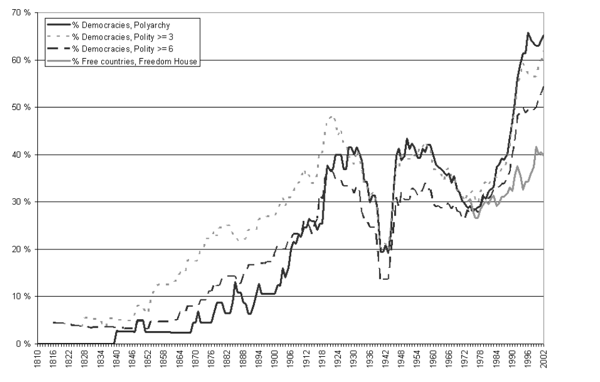
Recognizing that our liberty is remarkably multi-faceted, I will focus on the same categories Pratt mentioned. At the time he spoke, there were exactly 3 nations that were in some measure democracies, where at least some large percentage of the populace had the liberty of choosing their leaders. You can see for yourself how this has grown in the intervening 160+ years:

NOL Watson 1
source: Our World in Data

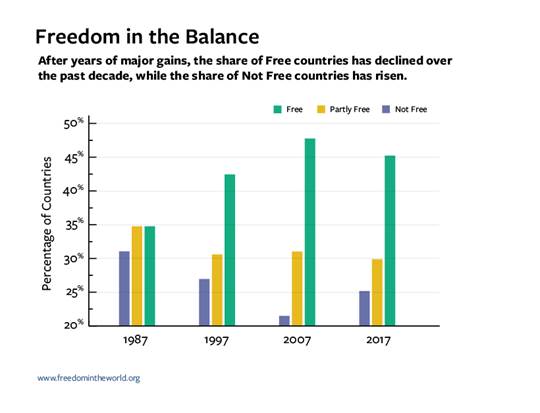
Billias’ 2009 work on how the principles of American constitutionalism were “heard round the world” shows that waves of influence gradually spread the principles of self-determination, liberty, separation of powers, and checks and balances into the freedom movements and constitutions of most of the world. Even while warning that the last ten years have seen declines in liberty overall worldwide, Heritage shows us that the last thirty years still show remarkable improvement:

NOL Watson 2

From a time when the US was one of very few countries to legally protect religious liberty, today nearly three-fourths of all the countries in the world have a constitution that specifically protects freedom of belief, and two-thirds permit some religious proselytism – which preserves freedom of expression (Pew Global Restrictions on Religion). There is still much to do to improve and preserve religious liberty around the world, both in legally acknowledged protections and in fostering an actual peaceful society where religious groups are not subject to violence and persecution.

Despite the distance left to go, the cause of liberty has clearly moved forward in great ways in the last 160 years. Much as Pratt predicted, much of this was accomplished without great revolutions and civil wars, but through the power of example as free nations and free people proved themselves a beacon to the world. There is still good cause to believe in that fundamental converting power from setting the right example and allowing free people to govern themselves.

Secessions that didn’t work out

No, not that secession. It’s the ten most important unsuccessful secessions of the last few decades. That’s the topic of my latest column over at RealClearHistory, anyway. An excerpt:

You already know about Catalonia and its unsuccessful bid to secede from Spain late last year. (Check out our archives if you want to get up to speed.) A comparative approach is useful here. The unsuccessful secession movements in Africa have all been violent. The unsuccessful ones in Europe and North America started out violent but have evolved into democratic movements. The key to understanding this shift is the federative structures that exist, or don’t exist, in different parts of the world. The secessionist movements in Europe and North America are not looking to go it alone any longer. These movements don’t want full sovereignty. Separatists in Europe and North America want more decision-making power in federative structures. In the case of Quebecers, it’s Canada’s unique federation; for Catalonians (and the Scottish, for that matter), it’s the European Union. Once a federative body roots itself in a region of the world, separatist tendencies cease to be violent and they shift to more peaceful forms of resistance. Kurdistan provides a microcosmic example of this evolution, In Turkey, where the Kurds continue to be ignored and oppressed, violence reigns supreme. In Iraq, where the Kurdish region has been given autonomy and self-governance, grievances are aired out in the open, in the form of non-binding referenda and in arguments put forth in a free and open press.

I also spend a good deal of time explaining why the Confederacy is no longer relevant for understanding the world we live in. Please, check it out.

Prices in Canada since 1688

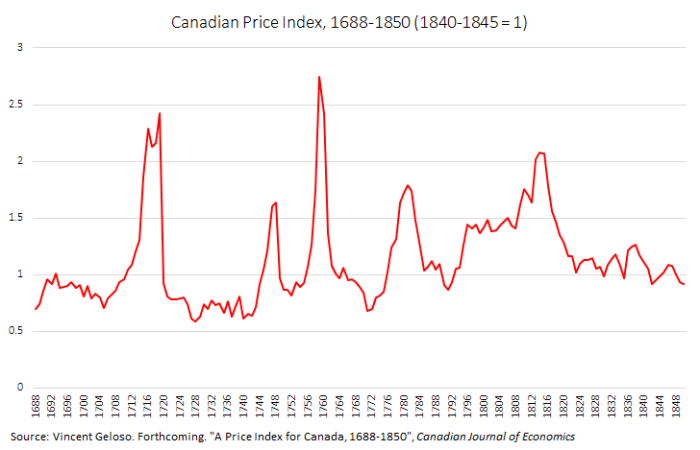
A few days ago, I received goods news that the Canadian Journal of Economics had accepted my paper that constructed a consumer price index for Canada between 1688 and 1850 from homogeneous sources (the account books of religious congregations). I have to format the article to the guidelines of the journal and attach all my data and it will be good to go (I am planning on doing this over the weekend). In the meanwhile, I thought I would share the finalized price index so that others can see it.

First, we have the price index that focuses on the period from 1688 to 1850.  Most indexes that exist for pre-1850 Canada (or Quebec since I assume that Quebec is representative of pre-1850 Canadian price trends) are short-term, include mostly agricultural goods and have no expenditures weights to create a basket. Now, my index is the first that uses the same type of sources continuously over such a long period and it is also the first to use a large array of non-agricultural goods. It also has a weights scheme to create a basket.

PriceIndexCanada

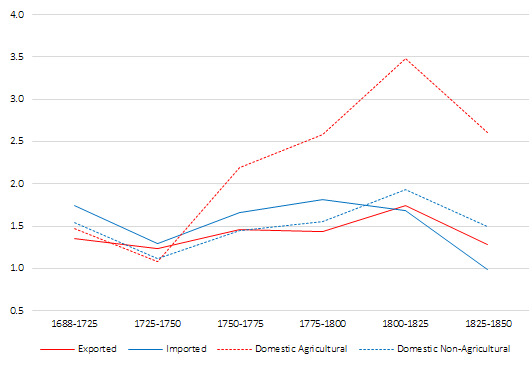
The issue of adding non-agricultural goods was especially important because there were important differences in the evolution of different types of goods. Agricultural goods, see next image, saw their nominal prices continually increase between the 17th and 19th centuries. However, most other prices – imported goods, domestically produced manufactured goods etc. – either fall or remain stable. These are very pronounced changes in relative prices. It shows that reliance on agricultural goods price index will overstate the amount of “deflating” needed to arrive at real wages or incomes.  The image below shows the nominal price evolution of groupings of goods as described above.

PriceIndexCanada2

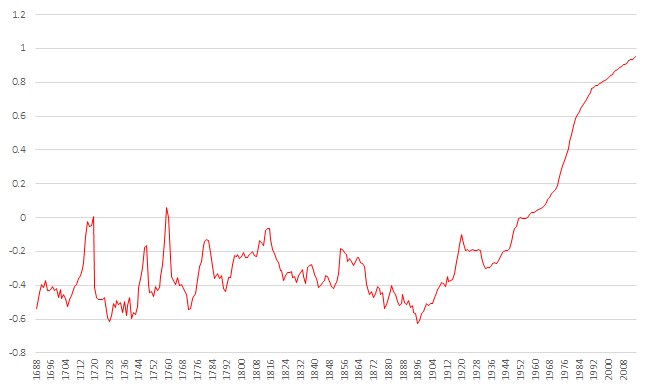
And finally, the pièce de résistance! I link my own index to other existing post-1850 index so as to generate the evolution of prices in Canada since 1688. The figure below shows the evolution of the price index over … 328 years (I ended the series at 2015, but extra years forward can be added). In the years to come, I will probably try to extend this backwards as much as possible at least to 1665 (the first census in Canada) and will probably try to approach Statistics Canada to see if they would like to incorporate this contribution into their wide database of macroeconomic history of Canada.

PriceIndexCanada3

2018 Hayek Essay Contest

The 2018 General Meeting of the Mont Pelerin Society will take place from September 30 – October 6, 2018 at ExpoMeloneras and Lopesan Hotels in Meloneras, Gran Canaria, Canary Islands. As with past general meetings, the Mont Pelerin Society is currently soliciting submissions for Friedrich A. Hayek Fellowships. The fellowships will be awarded through the Hayek Essay Contest.

The Hayek Essay Contest is open to all individuals 36 years old or younger. Entrants should write a 5,000 word (maximum) essay that addresses the quotation(s) and question(s) detailed on the contest announcement (available at the above link). The deadline for submissions is May 31, 2018. The winners will be announced on July 31, 2018. Essays must be submitted in English only. Electronic submissions should be sent in PDF format to this email address (mps.youngscholars@ttu.edu). Authors of winning essays must present their papers at the General Meeting to receive their award. The essays will be judged by an international panel of three members of the Society.

Please feel free to share this announcement with any individuals who may have an interest in submitting an essay for consideration of a fellowship award. All questions may be directed to the MPS Young Scholars Program Committee by email at mps.youngscholars@ttu.edu or phone at +1.806.742.7138.

MPS Young Scholars Program Committee

The best economic history papers of 2017

As we are now solidly into 2018, I thought that it would be a good idea to underline the best articles in economic history that I read in 2017. Obviously, the “best” is subjective to my preferences. Nevertheless, it is a worthy exercise in order to expose some important pieces of research to a wider audience.  I limited myself to five articles (I will do my top three books in a few weeks). However, if there is an interest in the present post I will publish a follow-up with another five articles.

O’Grady, Trevor, and Claudio Tagliapietra. “Biological welfare and the commons: A natural experiment in the Alps, 1765–1845.” Economics & Human Biology 27 (2017): 137-153.

This one is by far my favorite article of 2017. I stumbled upon it quite by accident. Had this article been published six or eight months earlier, I would never have been able to fully appreciate its contribution. Basically, the authors use the shocks induced by the wars of the late 18th century and early 19th century to study a shift from “self-governance” to “centralized governance” of common pool resources. When they speak of “commons” problems, they really mean “commons” as the communities they study were largely pastoral communities with area in commons.  Using a difference-in-difference where the treatment is when a region became “centrally governed” (i.e. when organic local institutions were swept aside), they test the impact of these top-down changes to institutions on biological welfare (as proxied by infant mortality rates). They find that these replacements worsened outcomes.

Now, this paper is fascinating for two reasons. First, the authors offer a clear exposition of its methodology and approach. They give just the perfect amount of institutional details to assuage doubts.  Second, this is a strong illustration of the points made by Elinor Ostrom and Vernon Smith. These two economists emphasize different aspects of the same thing. Smith highlights that “rationality” is “ecological” in the sense that it is an iterative process of information discovery to improve outcomes.  This includes the generation of “rules of the game” which are meant to sustain exchanges. These rules need not be formal edifices. They can be norms, customs, mores and habits (generally supported by the discipline of continuous dealings and/or investments in social-distance mechanisms). On her part, Ostrom emphasized that the tragedy of the commons can be resolved through multiple mechanisms (what she calls polycentric governance) in ways that do not necessarily require a centralized approach (or even market-based approaches).

In the logic of these two authors, attempts at “imposing” a more “rational” order (from the perspective of the planner of this order) may backfire. This is why Smith often emphasizes the organic nature of things like property rights. It also shows that behind seemingly “dumb” peasants, there is often the weight of long periods of experimentation in order to adapt rules and norms in order to fit the constraints faced by the community.  In this article, we can see those two things – the backfiring and, by logical implication, the strengths of the organic institutions that were swept away.

Fielding, David, and Shef Rogers. “Monopoly power in the eighteenth-century British book trade.” European Review of Economic History 21, no. 4 (2017): 393-413.

In this article, the authors use a legal change caused by the end of the legal privileges of the Stationers’ Company (which amounted to an easing of copyright laws).  The market for books may appear to be “non-interesting” for mainstream economics. However, this would be a dramatic error. The “abundance” of books is really a recent development. Bear in mind that the most erudite monk of the late middle ages had less than fifty books from which to draw knowledge (this fact is a vague recollection of mine from Kenneth Clark’s art history documentary from the late 1960s which was aired by the BBC). Thus, the emergence of a wide market for books – which is dated within the period studied by the authors of this article – should not be ignored. It should be considered as one of the most important development in western history. This is best put by the authors when they say that “the reform of copyright law has been regarded as one of the driving forces behind the rise in book production during the Enlightenment, and therefore a key factor in the dissemination of the innovations that underpinned Britain’s Industrial Revolution”.

However, while they agree that the rising popularity of books in the 18th century is an important historical event, they contest the idea that liberalization had any effect. They find that the opening up of the market to competition had little effects on prices and book production. They also find that mark-ups fell but that this could not be attributed to liberalization. At first,  I found these results surprising.

However, when I took the time to think about it I realized that there was no reason to be surprised. First, many changes have been heralded as crucial moments in history. More often than not, the importance of these changes has been overstated. A good example of an overstated change has been the abolition of the Corn Laws in England in the 1840s. The reduction in tariffs, it is argued, ushered Britain into an age of free trade and falling food prices.

In reality, as John Nye discusses, protectionist barriers did not fall as fast as many argued and there were reductions prior to the 1846 reform as Deirdre McCloskey pointed out. It also seems that the Corn Laws did not have substantial effects on consumption or the economy as a whole (see here and here).  While their abolition probably helped increase living standards, it seems that the significance of the moment is overstated. The same thing is probably at play with the book market.

The changes discussed by Fielding and Rogers did not address the underlying roots of the level of market power enjoyed by industry players. In other words, it could be that the reform was too modest to have an effect. This is suggested by the work of Petra Moser. The reform studied by Fielding and and Rogers appears to have been short-lived as evidenced by changes to copyright laws in the early 19th century (see here and here). Moser’s results point to effects much larger (and positive for consumers) than those of Fielding and Rogers.  Given the importance of the book market to stories of innovation in the industrial revolution, I really hope that this sparks a debate between Moser and Fielding and Rogers.

Johnson, Noel D., and Mark Koyama. “States and economic growth: Capacity and constraints.” Explorations in Economic History 64 (2017): 1-20.

I am biased as I am fond of most of the work of these two authors. Nevertheless, I think that their contribution to the state capacity debate is a much needed one. I am very skeptical of the theoretical value of the concept of state capacity.  The question always lurking in my mind is the “capacity to do what?”.

A ruler who can develop and use a bureaucracy to provide the services of a “productive state” (as James Buchanan would put it) is also capable of acting like a predator.  I actually emphasize this point in my work (revise and resubmit at Health Policy & Planning) on Cuban healthcare: the Cuban government has the capacity to allocate large quantities of resources to healthcare in amounts well above what is observed for other countries in the same income range. Why? Largely because they use health care for a) international reputation and b) actually supervising the local population. As such, members of the regime are able to sustain their role even if the high level of “capacity” comes at the expense of living standards in dimensions other than health (e.g. low incomes). Capacity is not the issue, its capacity interacting with constraints that is interesting.

And that is exactly what Koyama and Johnson say (not in the same words). They summarize a wide body of literature in a cogent manner that clarifies the concept of state capacity and its limitations. In doing so, they ended up proposing that the “deep roots” question that should interest economic historians is how “constraints” came to be efficient at generating “strong but limited” states.

In that regard, the one thing that surprised me from their article was the absence of Elinor Ostrom’s work. When I read about “polycentric governance” (Ostrom’s core concept), I imagine the overlap of different institutional structures that reinforce each other (note: these structures need not be formal ones). They are governance providers. If these “governance providers” have residual claimants (i.e. people with skin in the game), they have incentives to provide governance in ways that increased the returns to the realms they governed. Attempts to supersede these institutions (e.g. like the erection of a modern nation state) requires dealing with these providers. They are the main demanders of constraints which are necessary to protect their assets (what my friend Alex Salter calls “rights to the realm“). As Europe pre-1500 was a mosaic of such governance providers, there would have been great forces pushing for constraints (i.e. bargaining over constraints).

I think that this is where the literature on state capacity should orient itself. It is in that direction that it is the most likely to bear fruits. In fact, there have been some steps taken in that direction For example, my colleagues Andrew Young and Alex Salter have applied this “polycentric” narrative to explain the emergence of “strong but limited states” by focusing on late medieval institutions (see here and here).  Their approach seems promising. Yet, the work of Koyama and Johnson have actually created the room for such contributions by efficiently summarizing a complex (and sometimes contradictory) literature.

Bodenhorn, Howard, Timothy W. Guinnane, and Thomas A. Mroz. “Sample-selection biases and the industrialization puzzle.” The Journal of Economic History 77, no. 1 (2017): 171-207.

Elsewhere, I have peripherally engaged discussants in the “antebellum puzzle” (see my article here in Economics & Human Biology on the heights of French-Canadians born between 1780 and 1830). The antebellum puzzle refers to the possibility that the biological standard of living (e.g. falling heights, worsening nutrition, increased mortality risks) fell while the material standard of living increased (e.g. higher wages, higher incomes, access to more services, access to a wider array of goods) during the decades leading to the American Civil War.

I am inclined to accept the idea of short-term paradoxes in living standards. The early 19th century witnessed a reversal in rural-urban concentration in the United States. The country had been “deurbanizing” since the colonial era (i.e. cities represented an increasingly smaller share of the population). As such, the reversal implied a shock in cities whose institutions were geared to deal with slowly increasing populations.

The influx of people in cities created problems of public health while the higher level of population density favored the propagation of infectious diseases at a time where our understanding of germ theory was nill. One good example of the problems posed by this rapid change has been provided by Gergely Baics in his work on the public markets of New York and their regulation (see his book here – a must read).  In that situation, I am not surprised that there was a deterioration in the biological standard of living. What I see is that people chose to trade-off shorter wealthier lives against longer poorer lives. A pretty legitimate (albeit depressing) choice if you ask me.

However, Bodenhorn et al. (2017) will have none of it. In a convincing article that has shaken my priors, they argue that there is a selection bias in the heights data – the main measurement used in the antebellum puzzle debate.  Most of the data on heights comes either from prisoners or enrolled volunteer soldiers (note: conscripts would not generate the problem they describe). The argument they make is that as incomes grow, the opportunity cost of committing a crime or of joining the army grows.  This creates the selection bias whereby the sample is going to be increasingly composed of those with the lowest opportunity costs. In other words, we are speaking of the poorest in society who also tended to be shorter. Simultaneously, fewer tall individuals (i.e. rich individuals) committed crimes or joined the army because incomes grew. This logic is simple and elegant. In fact, this is the kind of data problem that every economist should care about when they design their tests.

Once they control for this problem (through a meta-analysis), the puzzle disappears. I am not convinced by the latter part of the claim. Nevertheless, it is very likely that the puzzle is much smaller than initially gleaned. In yet to be published work, Ariell Zimran (see here and here) argues that the antebellum puzzle is robust to the problem of selection bias but that it is indeed diminished. This concedes a large share of the argument to Bodenhorn et al. While there is much to resolve, this article should be read as it constitutes one of the most serious contributions to the field of economic history published in 2017.

Ridolfi, Leonardo. “The French economy in the longue durée: a study on real wages, working days and economic performance from Louis IX to the Revolution (1250–1789).” European Review of Economic History 21, no. 4 (2017): 437-438.

I discussed Leonardo’s work elsewhere on this blog before. However, I must do it again. The article mentioned here is the dissertation summary that resulted from Leonardo being a finalist to the best dissertation award granted by the EHES (full dissertation here). As such, it is not exactly the “best article” published in 2017. Nevertheless,  it makes the list because of the possibilities that Leonardo’s work have unlocked.

When we discuss the origins of the British Industrial Revolution, the implicit question lurking not far away is “Why Did It Not Happen in France?”. The problem with that question is that the data available for France (see notably my forthcoming work in the Journal of Interdisciplinary History) is in no way comparable with what exists for Britain (which does not mean that the British data is of great quality as Judy Stephenson and Jane Humphries would point out).  Most estimates of the French economy pre-1790 were either conjectural or required a wide array of theoretical considerations to arrive at a deductive portrait of the situation (see notably the excellent work of Phil Hoffman).  As such, comparisons in order to tease out improvements to our understanding of the industrial revolution are hard to accomplish.

For me, the absence of rich data for France was particularly infuriating. One of my main argument is that the key to explaining divergence within the Americas (from the colonial period onwards) resides not in the British or Spanish Empires but in the variation that the French Empire and its colonies provide. After all, the French colony of Quebec had a lot in common geographically with New England but the institutional differences were nearly as wide as those between New England and the Spanish colonies in Latin America. As such, as I spent years assembling data for Canada to document living standards in order to eventually lay down the grounds to test the role of institutions, I was infuriated that I could do so little to compare with France. Little did I know that while I was doing my own work, Leonardo was plugging this massive hole in our knowledge.

Leonardo shows that while living standards in France increased from 1550 onward, the level was far below the ones found in other European countries. He also showed that real wages stagnated in France which means that the only reason behind increased incomes was a longer work year. This work has also unlocked numerous other possibilities. For example, it will be possible to extend to France the work of Nicolini and Crafts and Mills regarding the existence of Malthusian pressures. This is probably one of the greatest contribution of the decade to the field of economic history because it simply went through the dirty work of assembling data to plug what I think is the biggest hole in the field of economic history.
On the “tea saucer” of income inequality since 1917

I disagree often with the many details that underlie the arguments of Thomas Piketty and Emmanuel Saez. That being said, I am also a great fan of their work and of them in general. In fact, I think that both have made contributions to economics that I am envious to equal. To be fair, their U-curve of inequality is pretty much a well-confirmed fact by now: everyone agrees that the period from 1890-1929 was a high-point of inequality which leveled off until the 1970s and then picked up again.

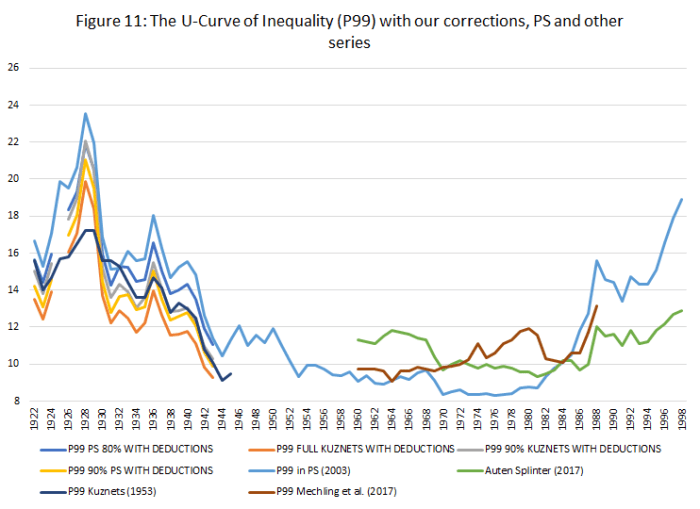
Nevertheless, while I am convinced of the curvilinear aspect of the evolution of income inequality in the United State as depicted by Piketty and Saez, I am not convinced by the amplitudes. In their 2003 article, the U-curve of inequality really looks like a “U” (see image below).  Since that article, many scholars have investigated the extent of the increase in inequality post-1980 (circa). Many have attenuated the increase, but they still find an increase (see here here here here here here here here here). The problem is that everyone has been considering the increase – i.e. the right side of the U-curve. Little attention has been devoted to the left side of the U-curve even though that is where data problems should be considered more carefully for the generation of a stylized fact. This is the contribution I have been coordinating and working on for the last few months alongside John Moore, Phil Magness and Phil Schlosser. 

Blog Figure

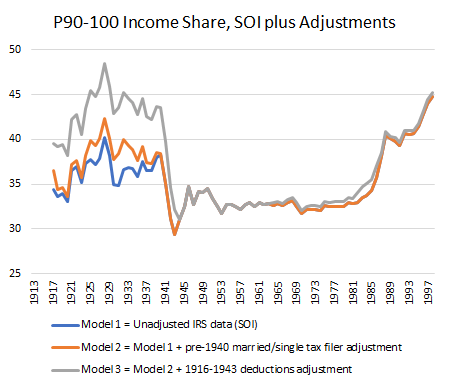
To arrive at their proposed series of inequality, Piketty and Saez used the IRS Statistics of Income (SOI) to derive top income fractiles. However, the IRS SOI have many problems. The first is that between 1917 and 1943, there are many years where there are less than 10% of the potential tax population that files a tax return. This prohibits the use of a top 10% income share in many years unless an adjustment is made. The second is that prior to 1943, the IRS reports net income and reports adjusted gross income after 1943. As such, to link post-1943 with pre-1943, there needs to be an additional adjustment. Piketty and Saez made some seemingly reasonable assumptions, but they have never been put to the test regarding sensitivity and robustness. This is leaving aside issues of data quality (I am not convinced IRS data is very good as most of it was self-reported pre-1943 which is a period with wildly varying tax rates). The question here is “how good” are the assumptions?

What we did is verify each assumption to see their validity. The first one we tackle is the adjustment for the low number of returns. To make their adjustments, Piketty and Saez used the fact that single households and married households filed in different quantities relative to their total population. Their idea is that a year in which there was a large number of return was used, the ratio of single to married could be used to adjust the series. The year they used is 1942. This is problematic as 1942 is a war year with self-reporting when large quantities of young American males are abroad fighting. Using 1941, the last US peace year, instead shows dramatically different ratios. Using these ratios knocks off a few points from the top 10% income share. Why did they use 1942? Their argument was there was simply not enough data to make the correction in 1941.  They point to a special tabulation in the 1941 IRS-SOI of 112,472 1040A forms from six states which was not deemed sufficient to make to make the corrections. However, later in the same document, there is a larger and sufficient sample of 516,000 returns from all 64 IRS collection districts (roughly 5% of all forms). By comparison, the 1942 sample Piketty and Saez used to correct only had 455,000 returns.  Given the war year and the sample size, we believe that 1941 is a better year to make the adjustment.

Second, we also questioned the smoothing method to link net income-based series with adjusted-gross income based series (i.e. pre-1943 and post-1943 series). The reason for this is that the implied adjustment for deductions made by Piketty and Saez is actually larger than all the deductions claimed that were eligible under the definition of Adjusted Gross Income – which is a sign of overshot on their parts. Using the limited data available for deductions by income groups and making some assumptions (very conservative ones) to move further back in time, we found that adjusting for “actual deductions” yields a lower level of inequality. This is contrasted with the fixed multipliers which Piketty and Saez used pre-1943.

Third, we question their justification for not using the Kuznets income denominator. They argued that Kuznets’ series yielded an implausible figure because, in 1948, its use yielded a greater income for non-fillers than for fillers.  However, this is not true of all years. In fact, it is only true after 1943. Before 1943, the income of non-fillers is equal in proportion to the one they use post-1944 to impute the income of non-fillers. This is largely the result of an accounting error definition. Incomes before 1943 were reported as net income and as gross incomes after that point. This is important because the stylized fact of a pronounced U-curve is heavily sensitive to the assumption made regarding the denominator.

These three adjustments are pretty important in terms of overall results (see image below).  The pale blue line is that of Piketty of Saez as depicted in their 2003 paper in the Quarterly Journal of Economics. The other blue line just below it is the effect of deductions only (the adjustment for missing returns affects only the top 10% income share). All the other lines that mirror these two just below (with the exception of the darkest blue line which is the original Kuznets inequality estimates) compound our corrections with three potential corrections for the denominators. The U-curve still exists, but it is not as pronounced. When you look with the adjustments made by Mechling et al. (2017) and Auten and Splinter (2017) for the post-1960 period (green and red lines) and link them with ours, you can still see the curvilinear shape but it looks more like a “tea saucer” than a pronounced U-curve.

In a way, I see this as a simultaneous complement to the work of Richard Sutch and to the work of Piketty and Saez: the U-curve still exists, but the timing and pattern is slightly more representative of history. This was a long paper to write (and it is a dry read given the amount of methodological discussions), but it was worth it in order to improve upon the state of our knowledge.

FigureInequality

On Ronald Coase as an Economic Historian?

Can we consider Ronald Coase as an economic historian? Most economists or social scientists that read this blog must appreciate Coase largely for his Nature of the Firm and the Problem of Social Cost. Personally, while I appreciate these works for their theoretical insights (well, isn’t that an understatement!), I appreciate Coase much more for articles that very few know about.

Generally, after these two articles, most economists do not know what Coase wrote about.  Some might know about Coase’s proviso regarding durability and monopoly (a single firm producing a durable good cannot be a monopoly because it competes with its future self) or about his work on the Federal Communications Commission (which is an application of his two main papers).

Fewer people know about his piece about the lighthouse in economics. While it is not an unknown piece, it is mostly known within the subfield of public economics as it concerns the scope for the private provision of public goods. Generally, I found that those who know about the piece know the “takeaway” which was that lighthouses (which because of their low marginal costs and non-excludability have been deemed public goods ever since J.S. Mill) could be produced privately. While this was indeed Coase’s point, this summary (like that Stigler made of the Coase Theorem) misses the peripheral insights that matter. Coase did the economic history job of documenting the institutional details behind the provision of lighthouses which sparked debates in journals such as Journal of Legal Studies, Cambridge Journal of Economics, European Review of Economic History, Public Choice and Public Finance Review (they still go to this day and I am trying to contribute to that with this piece that me and Rosolino Candela have recently submitted). It seems unclear whether or not the lighthouse can even be considered a public good or if it was merely an instance of government failure rather than market failure (or the reverse). Regardless of the outcome, if you read the lighthouse paper by Coase, you will read an application of theory to history bringing a “boring” topic (i.e. that of maritime safety pre-1900) to life through theory.  The lighthouse paper is an application of industrial organization through the Coasean lenses of transaction costs and joint provision. And it is a fine application if I might say!

But that is not his only piece! Has anyone ever read his article in the Journal of Law & Economics on Fisher Body and vertical integration? Or his piece on the British Post Office and private messengers in the same journal?  In those articles, Coase brings theory to life by asking simple questions to history in ways that force us to question some common day conceptions like “vertical integration was the results of holdup problems” or “postal services need to be publicly provided”.  In both of these articles and the lighthouse article, Coase basically applies simple theoretical tools to cut through a maze of details in order to answer questions of great relevance to economic theory and even policy (i.e. the post office example). And this is why, earlier in 2017, I mentioned that Coase should be considered in the league of the top economic historians.

On Monopsony and Legal Surroundings

A few days ago, in reply to this December NBER study, David Henderson at EconLog questioned the idea that labor market monopsonies matter to explain sluggish wage growth and rising wage inequality. Like David, I am skeptical of this argument. However, I am skeptical for different reasons.

First, let’s point out that the reasoning behind this story is well established (see notably the work of Alan Manning). Firms with market power over a more or less homogeneous labor force which must assume a disproportionate amount of search costs have every incentive to depress wages. This can lead to reductions in growth as, notably, it discourages human capital formation (see these two papers here and here as examples). As such, I am not as skeptical of “monopsony” as an argument.

However, I am skeptical of “monopsony” as an argument. Well, what I mean is that I am skeptical of considering monopsony without any qualifications regarding institutions. The key condition to an effective monopsony is the existence of barriers (natural and/or legal to mobility). As soon as it is relatively easy to leave a small city for another city, then even a city with a single-employer will have little ability to exert his “market power” (Note: I really hate that word). If you think about it simply through these lenses, then all that matters is the ability to move. All you need to care about are the barriers (legal and/or natural) to mobility (i.e. the chance to defect).

And here’s the thing. I don’t think that natural barriers are a big deal. For example, Price Fishback found that the “company towns” im the 19th century were hardly monopsonies (see here, here, here and here). If natural barriers were not a big deal, they are certainly not a big deal today. As such, I think the action is largely legal. My favorite example is the set of laws adopted following the Emancipation of slaves in the United States which limited the mobility (by limiting the chances of Northerners hiring agents to come who would act as headhunters in the South). That is a legal barrier (see here and here). I am also making that argument regarding the institution of seigneurial tenure in Canada in a working paper that I am reorganizing (see here).

What about today? The best example are housing restrictions? Well, housing construction and zoning regulations basically make the supply of housing quite inelastic. The areas where these regulations are the most severe are also, incidentally, high productivity areas. This has two effects on mobility. The first is that low-productivity workers in low-productivity areas cannot easily afford to move to the high-productivity area. As such, you are reducing their options of defection and increasing the likelihood that they will not look. You are also reducing the pool of places to apply which means that, in order to find a more remunerative job, they must search longer and harder (i.e. you are increasing their search costs). The second effect is that you are also tying workers to the areas they are in. True, they gain because the productivity becomes capitalized in the potential rent from selling any property they own. However, they are in essence tied to the place. As such, they can be more easily mistreated by employers.

These are only examples. I am sure I could extend the list to reach the size of the fiscal code (well, maybe not that much). The point is that “monopsony” (to the extent that it exists) is merely a symptom of other policies that either increase search costs for workers or reduce the number of options for defections. And I do not care much for analyzing symptoms.

Tocqueville on the Russians

There was a winter storm that blew through Austin last night. The entire city, which isn’t big population-wise (1.5 million give or take) but large geographically, shut down and I have the day off. So, I am working hard on my weekly column for RealClearHistory, and came across this sociological gem of Alexis de Tocqueville, who wrote the best book on America, ever:

The American struggles against the natural obstacles which oppose him; the adversaries of the Russian are men; the former combats the wilderness and savage life; the latter, civilization with all its weapons and its arts: the conquests of the one are therefore gained by the ploughshare; those of the other by the sword. The Anglo-American relies upon personal interest to accomplish his ends, and gives free scope to the unguided exertions and common-sense of the citizens; the Russian centres all the authority of society in a single arm: the principal instrument of the former is freedom; of the latter servitude.

Keep in mind that Tocqueville’s book was published in 1835. During the Cold War, this passage, which is the last paragraph in Volume 1 of Tocqueville’s 2-volume treatise, this passage was almost a necessary introduction to anything related to Soviet-American interactions.

Now, I fear, my generation must also heed Tocqueville’s prophecy about Russian and American society. Trump is a loudmouthed demagogue, but he is restrained by the people, most of all his base, which, for all its many faults, is democratic in its mores. Free-thinking Russians left Russia en masse while they could, after the collapse of the Soviet Union, for the West and their children and their children’s children will grow up free. The Russian people will continue to serve a despotism they think they need to survive. There is a conspiratorial, somber, and pessimistic tone in the voice of most Russian authors, even those who have managed to make a life for themselves in the West, and I get it.

When I think of Russia, with all its beautiful biodiversity, its people, and its potential, I brood.

From the Comments: the Ottoman Empire, the millet system, and nationalism

Barry has an excellent response to Jacques’ equally good essay on the Ottoman Empire and libertarianism:

Jacques, the Millet system was as much constructed as destroyed in the late Ottoman period. The idea of such a system was itself projected back onto the earlier Ottoman system to reflect modern assumptions about national belonging, which was understood to exist in the Ottoman state through a systematic accommodation of Christian nations.

The classical Ottoman system was very dispersed and irregular in the functioning of power under a sultan who [had] absolute power in certain spheres and certain circumstances. So the contrast of the millet system with emergent Turkish nationalism itself presumes nationalist categories anachronistic to the earlier Ottoman state. The understanding of a millet system does of course coincide with the destruction of said system, since the idea of such a system comes from a kind of nationalism, or at least [an] assumption of a top down administrative state with strongly homogenising tendencies. The greatest massacre of Armenians took place in 1915 under the direction of an element of Young Turks (the general term for reformists) manifested in the most extreme tendencies of the Committee of Union and Progress.

In any case there is some continuity with the policies of Sultan Abdülhamit following a version of Ottoman statism constructing a homogenising administrative state after suspending the constitutional system and its representative assembly. If we apply ‘millet system’ to the early Ottoman system, with the reservations I mentioned, you can of course talk about greater peace for Ottoman Christians than that experienced during the 30 Years War, in exchange for the surrender of young sons for training as ‘janisseries’, new believers serving the sultan as soldiers and administrators. However, the picture is less sunny if we look at the massacres of Alevi, what were known at the time as Qizilbash, that is followers of a rather unorthodox offshoot of Shia Islam. Particularly under Selim I, Yavuz Selim, Selim the Grim (an appropriate moniker) in the 15th century Alevis were massacred by the tens of thousands in connection with his wars against Iranian Shia. Maybe if we compare the Ottoman system with the Christian states of the time, we see more religious peace, but relatively speaking.

In any case by the late nineteenth century the peace was eroded by wars of separation and by persecution of ‘dangerous’ minorities within the remaining Ottoman lands. In terms of Ottomanist ideological legacy, Abdülhamit is a hero to religious-conservative and ultranationalist currents mobilised by an ideal of strong Muslim rulers presiding over a Muslim community and with Abdülhamit taken as a model. Of course they are applying something foreign to the Ottoman system in its earlier years and which even Abdülhamit would have found alien in its commitment to Turkishness. The actions of Abdulhamit and then the trio at the head of the CUP who orchestrated the massacres of 1915 show the dangers of statist modernisation. In both cases though, they would have understood their actions as done to protect the glory of the Ottomans.

Barry has more at NOL here. Jacques has more at NOL here. Both can often be found in a responsive mood in the ‘comments’ threads, too, as long as your comments aren’t too nasty or vulgar…

2017: Year in Review

Well folks, another year has come and gone. 2017 was Notes On Liberty‘s busiest year yet. Traffic came from all over the place, with the most visits coming from the US, the UK, Canada, Australia, and India. (In the past, India and Germany have vied for that coveted 5th place spot, but this year India blew Germany out of the water.)

NOL is a voluntary cooperative, and as such this year saw the introduction of 6 new Notewriters: Kevin Kallmes, Nicolás Cachanosky, Ash Navabi, Tridivesh Maini, Matthew Bonick and Trent MacDonald.

Michelangelo invited Kevin to join, Nicolás is an old grad school buddy of Rick‘s, I reached out to Tridivesh, and Ash and Matthew were invited on Vincent‘s initiative.

Speaking of Vincent, 2017 was his year. He had Tyler Cowen (MarginalRevolution), Mark Thoma (Economist’s View), Anthony Mills (RealClearPolicy), Barry Ritholtz (Bloomberg), Don Boudreaux (Cafe Hayek), John Tamny (RealClearMarkets) and Pseudoerasmus (a well-regarded economic historian) all link to his thoughts multiple times over the course of the year. His Top 10 list for best papers/books in recent economic history (Part 1 and Part 2) were legitimate viral sensations, dominating the top 2 spots on NOL‘s most-read list. Other huge posts included “Did the 30 Glorious Years Actually Exist? (#5),” “The Pox of Liberty – dixit the Political Economy of Public Health (#9),” “James Buchanan on racism,” “The GDP, real wages and working hours of France since the 13th century,” “Did 89% of American Millionaires Disappear During the Great Depression?,” and “A hidden cost of the war on drugs.” My personal favorite was his “Star Trek Did More For the Cultural Advancement of Women Than Government Policies.” Dr Geloso’s thoughts made up 40% of NOL‘s 10 most-read 2017 posts.

My favorite posts from Edwin this year were his analyses of Dutch politics – “Dutch politics, after the elections” and “North Korea at the North Sea?” – but the reading public seemed to enjoy his posts on Ayn Rand, especially her thought on international relations, and his summary of Mont Pelerin Europe more than anything else. Van de Haar’s day job is in the private sector, so his blogging is understandably light (especially given his incredible publishing output in academic journals). I look forward to what looms ahead in 2018.

Federico’s most recent post on artificial intelligence and the law got love from some major outlets, including FT‘s Alphaville blog and 3 Quarks Daily. His question “Does business success make a good statesmen?” and his report on a Latin American Liberty summit are worth reading again, but my personal favorites were his comments on other Notewriters’ thoughts: first jumping in to add some historical clarity to Bruno’s post on Latin American conservatism and then to add layers onto the debate between Mark and Bruno on the Protestant Reformation. Federico has been invaluable to NOL‘s welcoming, skeptical culture and I cannot wait to see what he comes up with in 2018.

Barry was generous enough recount the situation in Turkey after the coup earlier in the year, and fruits of this endeavor – Coup and Counter Coup in Turkey – can be found in six parts:

  1. First of a series of posts on Turkey since 15th July 2016 and background topics
  2. Immediately after the coup and party politics
  3. Gülenists and Kemalists
  4. The Kurdish issue in Turkey
  5. Jacobins and Grey Wolves in Turkey
  6. Presidential Authoritarianism in Turkey

Dr Stocker also began writing an appendix to his six-part series, which resulted in a first post on authoritarianism and electoral fixes. Barry is hard at work on a new book, and of course the situation in Turkey is less than ideal, so I can only hope he has a bit more time in 2018 for NOL.

Michelangelo had a banner year at NOL. His #microblogging has been fun, as were his post analyzing relevant data from his surveys: What libertarians think of climate change, for example, or urban planning in Oregon. Michelangelo also utilized NOL to play around with concepts like race, marriage markets, data, Spanish language services, affirmative action, and freeware, to name a few. My absolute favorite Michelangelo post this year was his excellent “Should we tax churches? A Georgist proposal.” Michelangelo is a PhD candidate right now, too, so if he ever gets some time to himself, watch out world!

Rick also had a banner year at NOL. His post arguing against Net Neutrality was one of the most-read articles of the year here (#4), and many of his wonkier thoughts have been picked up by the sharp eye of Anthony Mills (RealClearPolicy) and the excellent Chris Dillow (Stumbling and Mumbling). Rick is my favorite blogger. Posts on cycling in Amsterdam, subsidies, management and measurement, linguisticsmore subsidies, and my personal favorite of his for the year, “Why do we teach girls that it’s cute to be scared,” always make me think and, more importantly, smile.

Bruno’s blogging was also amply rewarded this year. His thoughts on some of the problems with postmodernism brought in the most eyeballs, but thankfully he didn’t stop there: Articles introducing postmodernism and highlighting the origins of postmodernism also generated much interest. RealClearWorld picked up his post analyzing Brazil post-Rousseff (he had more analysis of Brazilian politics here and here), and his post delving into whether Nazism is of the left or the right provoked quite the dialogue. Dr Rosi was at his best, though, when prompted by Mark to further advance his argument that the Protestant Revolution played an integral role in the rise of the freedom of conscience. Times are tough in Brazil right now, so I can only hope that Bruno continues to play a vital role as a Notewriter in 2018.

Chhay Lin, now in the private sector, had his post about Bruce Lee’s application of Taoist philosophy head to the top of reddit’s philosophy sub, and his post on Catalonia and secession got love from RealClearWorld and Lew Rockwell (Political Theater). I hate to be *that* guy distracting a man from making his money, but I hope to see Chhay Lin pop in at NOL much more often in 2018!

Zak has been busy with a number of different projects, as well as attending Michigan-Ann Arbor full-time. He still managed to have one of his posts, on “libertarian” activist hypocrisy (#10), highlighted in the Guardian, the UK’s premier left-wing mouthpiece. His post on The Nancy MacLean Disgrace earned him plaudits from the online libertarian community and Don Boudreaux (Cafe Hayek), and his posts on open borders and income inequality show just how much of a bad ass he has become. I had a tough time trying to pick out my favorite Zak article of 2017, so I’m just gonna highlight all three of them:

  1. Immigration, Cultural Change, and Diversity as a Cultural Discovery Process
  2. Why I’m No Longer A Christian…
  3. Against Libertarian Populism

They’ve all got great self-explanatory titles, so do yourself a favor and read ’em again! Hopefully Zak can continue to work NOL in to his many successful ventures in 2018.

Jacques continues to amaze me. He’s been retired from academia for – as far as I can tell – at least a decade and he’s still producing great material that’s able to reach all sorts of people and places. His post on the Ottoman Empire and libertarianism (#6), which was featured at RealClearWorld and much-shared in Ottomanist corners of Twitter – took aim at popular American libertarian understandings of decentralization and seems to have landed pretty squarely on target. My favorite post of Dr Delacroix’ this year was about French Africa (also featured at RealClearWorld), but his late-year book review on Christopher De Bellaigue’s 2017 book about Islam might end up being a classic.

Bill’s 2017 here at NOL was productive and he continues to impress. His “Speech in academic philosophy: Rebecca Tuvel on Rachel Dolezal” brought in thousands of readers, but it was not his ability to draw crowds that I found impressive. His ability to tackle tough concepts and tough issues came to the forefront this year: drug use, “vulvæ,” more drug use, party culture (my personal fave), schooling (another personal fave), more schooling, and music (personal fave). Bill’s ability to weave these trends together through the lens of individual freedom is so much fun to read and important for fostering a culture of tolerance and respect in today’s world. I can’t wait to see what 2018 has in store for him!

Nicolás came out firing on all cylinders this year. With excellent dialogues between himself and Vincent, as well as between himself and guest blogger Derrill Watson (who I hope will be back for more in 2018), Dr Cachanosky’s passion for teaching has shown through clearly and brightly. I hope 2018 – his first full year with NOL – is filled with much more hard-hitting but insightful blogging from Nicolás.

Ash brought the heat, too. Check out the subject matter of his first few posts here at NOL: “A Right is Not an Obligation,” “Physical Goods, Immaterial Goods, and Public Goods,” “The Economics of Hard Choices,” “Markets for Secrets?,” “A Tax is Not a Price,” and “A Radical Take on Science and Religion.” Like Nicolás, Ash’s first full year at NOL is coming up, and if 2017 is any indication, readers can look forward to an interesting and engaging 2018.

Mark’s first full year here at NOL was a definite barnburner. His debate with Bruno on the Protestant Reformation (#8) brought in a bunch of eyeballs, including from RealClearHistory, while his “The Return of Cyclical Theories of History” also brought in thousands of readers, thanks in large part to Robert Cottrell’s excellent website, the Browser. Dr Koyama’s review of Aldo Schiavone’s The End of the Past also caught Mr Cottrell’s eye and the attention of his readers. Mark’s post on geopolitics and Asia’s “little divergence” is well worth reading again, too. Like Zak and Bill’s posts, I couldn’t choose just one favorite, so I give you two:

  1. Political Decentralization and Innovation in early modern Europe
  2. Some Thoughts on State Capacity” (an especially good criticism of American libertarian understandings of the “state capacity” literature)

We’re lucky to have Mark here at NOL.

Kevin, like Ash and Nicolás, brought the ruckus for his first few posts here at NOL. Kevin’s very first post at Notes On Liberty – “Rules of Warfare in Pre-Modern Societies” (#3) – ended up on the front page of RealClearHistory while his “Paradoxical geniuses…” earned a spot on the Browser‘s prestigious reading list. Not a bad start. Kevin will be finishing up the second half of his first year of law school (at Duke), so I doubt we’ll see much of him until June or July of 2018. My personal favorite, by the way, was Kevin’s “Auftragstaktik: Decentralization in military command.” His posts on taking over Syria – Roman style, the median voter theorem, and inventions that didn’t change the world also got lots of love from around the web.

Nick’s post on public choice and Nancy MacLean (#7) earned a nod from Arnold Kling (askblog), Don Boudreaux (Cafe Hayek), Chris Dillow (Stumbling and Mumbling), Mark Thoma (Economist’s View), and pretty much the entire online libertarian community, while his post analyzing the UK’s snap election earned a spot at RealClearWorld. Dr Cowen’s thoughts on school choice and robust political economy, as well as a sociological analysis of Trump/Brexit prompted by Vincent, all garnered love from libertarians and scholars around the world. My favorite Cowen post was his question “Is persecution the purpose?

Overall, it was a hell of a year here at Notes On Liberty. I’m really looking forward to 2018. Here’s to a happy, healthy you. Oh, and my proudest piece this year was “North Korea, the status quo, and a more liberal world.” HAPPY NEW YEAR!

*The Islamic Enlightenment* | A critical review

De Bellaigue, Christopher. (2017) The Islamic Enlightenment: The Struggle Between Faith and Reason 1798 to Modern Times. Liveright Publishing Corporation (Norton & Company) New York, London.

In 1798, in view of the Pyramids, a French expeditionary force defeated the strange caste of slave-soldiers, the Mamlukes, who had been ruling Egypt for several centuries. The Mamlukes charged the French infantry squares on horseback, ending their charge with the throwing of javelins. The Mamlukes were thus eliminated from history. The French lost 29 soldiers. In the conventional narrative, the battle woke up the whole Muslim world from its long and haughty slumber. The defeat, the pro-active reforms of Napoleon’s short-lived occupancy, and the direct influence of the French scholars he had brought with him lit the wick of the candle of reform or, possibly, of enlightenment throughout the Islamic world.

De Bellaigue picks up this conventional narrative and follows it to the beginning of the 20th century with a dazzling richness of details. This is an imperfect yet welcome thick book on a subject seldom well covered.

This book has, first, the merit of existing. Many people of culture, well-read people with an interest in Islam – Islam the sociological phenomenon, rather than the religion – know little of the travails of its attempted modernization. Moreover, under current conditions of political correctness the very subject smells a little of sulfur: What if we looked at Muslim societies more closely and we found in them some sort of intrinsic inferiority? I mean by this, an inferiority that could not easily be blamed on the interference of Western, Christian or formerly Christian, capitalist societies. Of course, such a finding could only be subjective but still, many would not like it, and not only Muslims.

Second, and mostly unintentionally, possibly inadvertently, the book casts a light, an indirect light to be sure, on Islamist (fundamentalist) terrorism. It’s simple: Enlightened individuals of any religious background are not likely to be also fanatics willing to massacre perfect strangers. Incidentally, I examine this issue myself in a fairly parochial vein, in an essay in the libertarian publication Liberty Unbound: “Religious Bric-à-Brac and Tolerance of Violent Jihad” (January 2015). With his broader perspective, with his depth of knowledge, De Bellaigue could have done a much better job of this than I could ever do. Unfortunately he ignored the subject almost entirely. It wasn’t his topic, some will say. It was not his period of history. Maybe.

Continue reading

Party politics and foreign policy in Brazil’s early history

Early Brazilian foreign policy was criticized for being too Europe-centered. Brazil declared its independence from Portugal in 1822 in a process unique in the Americas: Dom Pedro I, the country’s first head of state and government, was the son of Dom João VI, king of Portugal. This gave Brazil a sense of continuity with the former metropolis – unique in the Americas. Although Dom Pedro I renounced his rights in the Portuguese succession line to become Brazil’s first Emperor, early Brazilian foreign policy was very much a continuation of late Portuguese policy.

Early in the 19th century Portugal became involved in the Napoleonic Wars on the English side. Portugal and England enjoyed then an already long friendship. When Napoleon invaded the Iberian Peninsula, Dom João, then Prince Regent, decided to move the Portuguese imperial capital to Rio de Janeiro, instead of fighting a war he believed he could not win. This move consolidated the Anglo-Portuguese alliance of that time, as Dom João’s policy was backed up by England.

In South America, Dom João first decision was to finish the colonial exclusivism Portugal enjoyed with its colony, opening Brazil’s ports to friendly nations. With most of Europe at war and occupied by French armies, England was basically the only friend Brazil and Portugal had at the time. But his policies meant that Brazil had a move towards liberalism unknown until that moment. The country’s trade with the outside world rose as English products entered the Brazilian market.

When Dom João returned to Europe, Brazilian elites were unwilling to give up the freedom conquered in the previous years; in that case, something not that different from what happened in Spanish America. With Dom Pedro I as Prince Regent in Brazil, the independence movement grew strong until complete secession in 1822.

With that in mind, it’s possible to understand how early Brazilian foreign policy was mostly a continuation of Dom João’s policy: Dom Pedro I’s first task was to get recognition of Brazil’s independence from Portugal. That happened with English support. The United States was the first country to recognize Brazil’s independence, but this was welcomed coldly in Rio de Janeiro.

In response to English help, Dom Pedro I kept and improved the trade benefits England already enjoyed with Brazil. He also occupied Uruguay, a region disputed between Spain and Portugal, leading to a war with Argentina and, despite renouncing his rights to the Portuguese throne, kept close relations with his family in Portugal.

Dom Pedro I’s foreign policy was a reason for growing opposition. He could not win a war against Argentina and his connection to Portugal was a constant reason for accusations of recolonization plans. Topping that was the perception of Brazilian elites that the trade agreements with England were bad for Brazil. For these and other reasons, Dom Pedro I resigned in 1831 and returned to Portugal, leaving the Brazilian throne to his son, Dom Pedro II.

Dom Pedro II was only five years old when he ascended to the throne, and so despite being the head of state, he could not govern the country. The 1830’s were a period of regencies when few important decisions were made in Brazil’s foreign policy. But in another topic, that was a crucial decade in Brazilian history: the political tendencies present in Dom Pedro I’s reign became more formal political parties in the late 1830’s: the Conservative Party, that defended progress inside of order, and the Liberal Party, that defended more radical changes.

Dom Pedro II’s adulthood was anticipated in 1840, and besides a short period of Liberal rule, the conservatives dominated Brazilian politics for most of the 1840’s to the 1870’s. In domestic politics, conservatives wanted to centralize politics and bureaucracy in Rio de Janeiro and leave little autonomy to the provinces. They claimed to be afraid of the extremes of mob rule, despotism, and oligarchy, and therefore defended progress inside of order. This meant conserving much of the Portuguese heritage. It was up to the state to build the nation and to lead a modernization process. Ironically, many important conservative leaders were former adversaries to Dom Pedro I and accused him of despotism. However, once in power, they said the country needed to be saved from excesses of liberty.

The conservatives talked about the 1830’s as a period of dangerous upheaval in Brazil. Indeed, the country faced several regional revolts that could have fragmented the Empire. Anyway, the conservative answer was to secure the integrity through a stronger government. In their understanding, Brazil was simply not ready for a certain level of liberty.

A feast of classical liberal thought: Mont Pelerin Society in Stockholm

Last week, Stockholm hosted a special meeting of the Mont Pelerin Society (MPS) on the populist threats to the free society. MPS meetings are held under Chatham House rules, which means I cannot report in any detail about the proceedings. Yet a few impressions can be shared.

I have been a MPS member since 2010, when my nomination was accepted at the end of the general meeting in Sydney. In those days the old rules still applied, which meant you had to attend three meetings before you could be nominated for membership. However, this strict rule led to the erosion of the membership base (the MPS was literally starving out), so the rules to join as a member have been made easier.

My first MPS meeting was in Guatemala City, in 2006. I had participated in the essay contest for young scholars which is always organized in the run-up to the bi-annual General Meetings. As a runner-up I won free entry to the meeting. I happened to be in the south of the USA in the weeks before, doing PhD research at the Mises Institute in Alabama, so could easily make the trip to Central America. Because I lived in Manila during those years, I could also easily attend the 2008 meeting in Tokyo.

I had are number of reasons for wanting to join the MPS. First of all, the quality of the meetings offer a great chance to listen to and speak with the leading scholars within current classical liberalism. Increasingly multidisciplinary (back in the old days the economists dominated), the programme committees of the MPS Meetings always succeed in attracting an impressive crowd of high quality speakers and commentators from across the globe. I always find this a great intellectual treat. Second, the meetings are characterized by extremely pleasant and open atmospheres. Everybody mingles with everybody, you can talk with everybody, no matter your age, or academic background. Thirdly, the meetings take place across the globe, so they offer a great opportunity to travel and see places. Although it must be added that even when you do not stay at the conference hotel, the meetings are never very cheap, so it remains an investment. Fourth, for a Hayekian like myself, it feels very good to be a member of the society founded by the master himself, which had and has such an illustrious membership, ever since its beginnings 70 years ago.

Besides the big one week General Meetings held every two years, there are shorter regional or special meetings in the other years. Last week’s MPS meeting in Stockholm was a special meeting, very well-organized by the Ratio Institute. The theme was discussed from numerous angles, through sessions on Russia’s foreign policy, the economic issue of secular stagnation, or the danger of political Islamism. Two sessions were focused on new classical liberal ideas to counter the threats. At the opening day there was a session for young scholars to present papers. This was of course also a way to attract new talent and interest in the MPS. And at the end of the second day there was something different: beer tasting while listening to Johan Norberg. A rather splendid combination!

The speakers and commentators were high level, including MPS chair Peter Boettke (George Mason), David Schmidtz (Arizona), Deirdre McCloskey (Illinois), John Tomasi (Brown), Leszek Balcerowic (former president of Poland’s Central Bank), Russia specialist Anders Aslund, German thinker Karen Horn, Jacob Levy (McGill), Mark Pennington (Kings College London), Paul Cliteur (Leiden), Amigai Magen (Hoover Institution), and the energetic Ralf Bader (Oxford). A lineup like this guarantees a number of new insights, solid arguments, and general intellectual stimulus. Many answers were provided, yet in true academic fashion, many questions remain.

While well represented in this program, International Relations are normally a minor topic at MPS meetings, and there are not many IR scholars around (nor are sociologists or legal scholars, by the way). Personally I am convinced that the future appeal of classical liberal thought also relies on taking into account world affairs. So there is a need to keep on writing and publishing about it, to expand the basis for thought, also in the MPS. To hear about the concerns and insights of other classical liberals in other disciplines helps my thought process, besides remaining up to speed with current classical liberal issues in general.

So it was a great meeting again, And for all you young scholars out there: if you are interested make sure to regularly check the MPS website (www.montpelerin.org) to see if there are opportunities to participate in one of the upcoming meetings.

Libertarian sighted at the Daily Beast

Ooops, I mean cited, not sighted:

Nor was it the case that there was a direct correlation between Protestant countries and prosperity. In a paper published in the journal Social Forces Jacques Delacroix and Francois Nielsen conclude that “there is little empirical support” for the common interpretation of Weber’s Protestant Work Ethic. This idea probably comes “from selected anecdotal evidence fortified… by the perceived well-being of contemporary Protestant countries.” In other words, Protestantism does not make people rich even if, in some cases, Protestants think that it does.

Rest the rest. h/t Uncle Terry

Oh, and Mark has an essay up on institutions over at Aeon that ties in well with the Daily Beast piece.

Don’t forget about the back-and-forth between Mark and Bruno on the Protestant Reformation here at NOL: Part one (Bruno), part two (Mark), and part three (Bruno).