Eye Candy: the Arab world’s administrative divisions

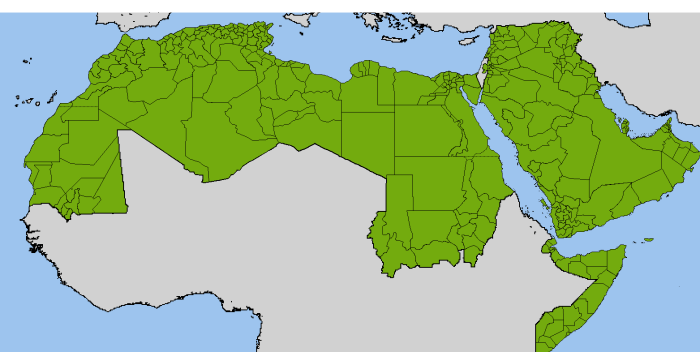
NOL map Arab world admin divisions
Click here to zoom

Imagine if these divisions were all states in a federal republic. Myself, I think some of them,maybe even half of them, could be combined, but if that ever happened, and the resulting combined administrative divisions of the Arab world federated, the region would be in much better shape. (The federation of Arabia would need a Senate, of course.)

What if the OECD did the same? Or simply the US and it’s closest allies?

RCH: the Ottoman Empire

My subject for this weekend’s RealClearHistory column is battles that shaped the Ottoman Empire. Here is an excerpt:

On June 4, 1915, the Third Battle of Krithia was fought between the Ottoman Empire and its Allied enemies, composed of mostly French and British troops. The Ottomans won, handily and somewhat surprisingly. The Allies had to retreat and regroup as a result, and the Balkans campaign had to go through a more careful re-think by Allied strategists.

World War I marked the end of the Ottoman Empire, of course, but the “sick man of Europe” had more fight in it than many Western historians give it credit for. Scholarship on the Ottoman Empire has improved over the years, but there is still plenty of opportunity to do more. The Ottoman Empire spanned three continents, after all, and lasted for 623 years.

The Ottoman Empire was actually one of three multi-ethnic, multi-religious empires in Europe that perished as a result of World War I, along with Austria-Hungary and tsarist Russia. To the east of the Ottomans were two other, long-lasting empires, the Persian empire ruled by the Qajar dynasty (which perished in 1925) and the Mughal empire of India (which perished in 1857). These eastern empires are referred to by many historians as “gunpowder empires” and they controlled the Eurasian trade routes that Chinese and especially European merchants used for exchanging goods and ideas. Here are 10 battles that shaped the Ottoman Empire:

Please, read the rest. And have a good weekend.

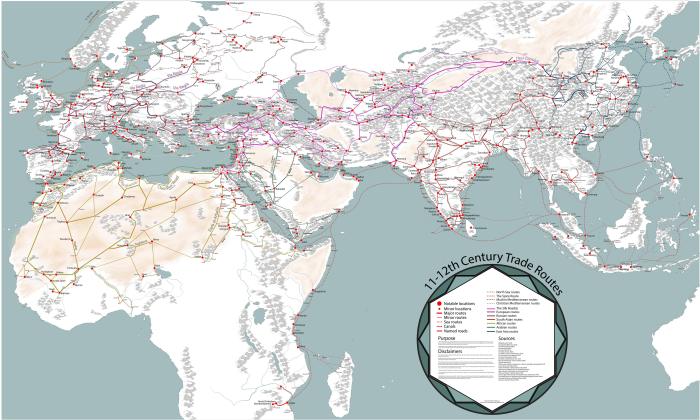
Eye Candy: medieval trade networks

NOL map medieval trade networks
Click here to zoom

‘Nuff said, and don’t forget to zoom in!

On “strawmanning” some people and inequality

For some years now, I have been interested in the topic of inequality. One of the angles that I have pursued is a purely empirical one in which I attempt to improvement measurements. This angle has yielded two papers (one of which is still in progress while the other is still in want of a home) that reconsider the shape of the U-curve of income inequality in the United States since circa 1900.

The other angle that I have pursued is more theoretical and is a spawn of the work of Gordon Tullock on income redistribution. That line of research makes a simple point: there are some inequalities that are, in normative terms, worrisome while others are not. The income inequality stemming from the career choices of a benedictine monk and a hedge fund banker are not worrisome. The income inequality stemming from being a prisoner of one’s birth or from rent-seekers shaping rules in their favor is worrisome.  Moreover, some interventions meant to remedy inequalities might actually make things worse in the long-run (some articles even find that taxing income for the sake of redistribution may increase inequality if certain conditions are present – see here).  I have two articles on this (one forthcoming, the other already published) and a paper still in progress (with Rosolino Candela), but they are merely an extension of the aforementioned Gordon Tullock and some other economists like Randall Holcombe, William Watson and Vito Tanzi. After all, the point that a “first, do no harm” policy to inequality might be more productive is not novel (all that it needs is a deep exploration and a robust exposition).

Notice that there is an implicit assumption in this line of research: inequality is a topic worth studying. This is why I am annoyed by statements like those that Gabriel Zucman made to ProMarket. When asked if he was getting pushback for his research on inequality (which is novel and very important), Zucman answers the following:

Of course, yes. I get pushback, let’s say not as much on the substance oftentimes as on the approach. Some people in economics feel that economics should be only about efficiency, and that talking about distributional issues and inequality is not what economists should be doing, that it’s something that politicians should be doing.

This is “strawmanning“. There is no economist who thinks inequality is not a worthwhile topic. Literally none. True, economists may have waned in their interest towards the topic for some years but it never became a secondary topic. Major articles were published in major journals throughout the 1990s (which is often identified as a low point in the literature) – most of them groundbreaking enough to propel the topic forward a mere decade later. This should not be surprising given the heavy ideological and normative ramifications of studying inequality. The topic is so important to all social sciences that no one disregards it. As such, who are these “some people” that Zucman alludes too?

I assume that “some people” are strawmen substitutes for those who, while agreeing that inequality is an important topic, disagree with the policy prescriptions and the normative implications that Zucman draws from his work. The group most “hostile” to the arguments of Zucman (and others such as Piketty, Saez, Atkinson and Stiglitz) is the one that stems from the public choice tradition. Yet, economists in the public-choice tradition probably give distributional issues a more central role in their research than Zucman does. They care about institutional arrangements and the rules of the game in determining outcomes. The very concept of rent-seeking, so essential to public choice theory, relates to how distributional coalitions can emerge to shape the rules of the game in a way that redistribute wealth from X to Y in ways that are socially counterproductive. As such, rent-seeking is essentially a concept that relates to distributional issues in a way that is intimately related to efficiency.

The argument by Zucman to bolster his own claim is one of the reason why I am cynical towards the times we live in. It denotes a certain tribalism that demonizes the “other side” in order to avoid engaging in them. That tribalism, I believe (but I may be wrong), is more prevalent than in the not-so-distant past. Strawmanning only makes the problem worse.

On Household Size and Economic Convergence

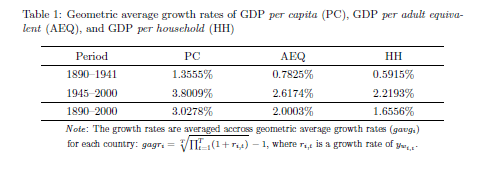
A few days ago, one of my papers was accepted for publication at the Scottish Journal of Political Economy (working paper version here). Co-authored with Vadim Kufenko and Klaus Prettner, this paper makes a simple point which I think should be heeded by economists: household size matter. To be fair, economists are aware of this when they study inequality or poverty. After all, the point is pretty straightforward: larger households command economies of scale so that each dollar goes further than in smaller households. As such, adjustments are necessary to make households comparable.

Yet, economists seem to forget it when times come to consider paths of economic growth and convergence across countries. In the paper, we try to remedy this flaw. We do so because there was a wide heterogeneity of household size throughout history – even within more homogeneous clubs such as the countries composing the OECD.  If we admit, as the economists who study poverty and inequality do, that income per person adjusted for household size is preferable to income per person, then we must recognize that our figures of income per capita will misstate the actual differences between countries. In addition, if households grew homogeneously smaller over a long period of time, figures of income per capita will overstate the actual improvements in living standards. As such, we argue there is value in modifying the figures to reflect changing household sizes.

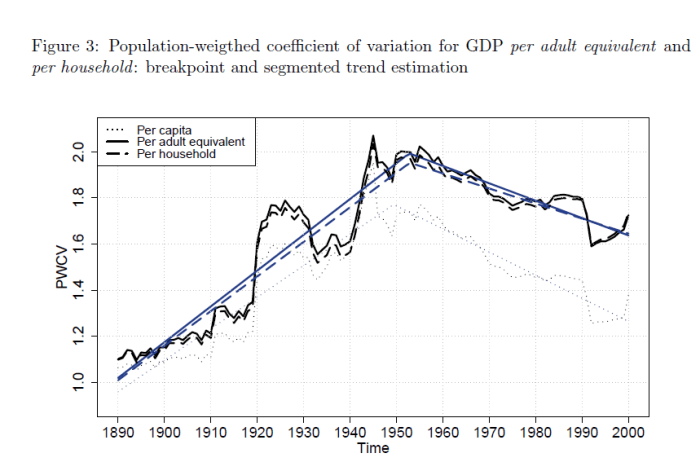
For OECD countries, we find that the adjusted income figures increased a third less than the unadjusted per capita figures (see table below). This suggests a more modest growth trend. In addition, we also find that up to the structural break in variations between countries (NDLR: divergence between OECD countries increased to around 1950) there was more divergence with the adjusted figures than with the unadjusted figures (see figure below). We also find that since the break point, there has been less convergence than previously estimated.

While the paper is presented as a note, the point is simple and suggests that those who study convergence between regions or countries should consider the role of demography more carefully in their work.

GrowthHouseholdSize

ConvergenceHouseholdSize.png

Fogel on economics and ideology

Many, upon reading the conclusions of economists, believe that economics has an ideological bent. I often respond that this is not the case. True, the “window” of political opinions in economics is narrower but that is largely because the adhesion of economists to methodological individualism precludes certain ideological views that rest on holistic approaches or concepts. However, when you consider more complex situations than “party affiliation”, you will find economists all over the place. They will often cross ideological lines or even have a foot in two antagonistic camps.

Recently, I was reading Robert Fogel’s lectures on the “Slavery debates” which retells the intellectual history of American slavery from U.B. Phillips to … well … Fogel himself. One must remember that Fogel was, and remained from what I can tell, a quite strongly left-leaning economist for most of his life (see here). As such, it is hard to consider Fogel as an ideologue preaching for free market economics. Yet, in the lectures, Fogel (p.19) makes a point that supports the contention that I often make regarding economists and ideology that I believe must be shared:

The ability to view Phillips (NDLR: the dominant interpretation of slavery pre-1960) in a new light was facilitated by the sudden intrusion of a large corps of economists into the slavery debates during the 1960s. This intrusion was welcomed by neither the defenders of the Phillips tradition nor the neoabolitionist school led by Stampp (NDLR: Kenneth Stampp, author of The Peculiar Institution). The cliometricians, as they were called, refused to be bound by the established rules of engagement, and they blithely crossed ideological wires in a manner that perplexed and exasperated traditional historians on both sides of the ideological divide.

Given that the source of this quotation is Fogel, I admit that I am particularly fond of this passage. Maybe the distrust towards economists is because economists can be both friend and foes to established interlocutors in a given discussion.

Divergence and Convergence within Italy

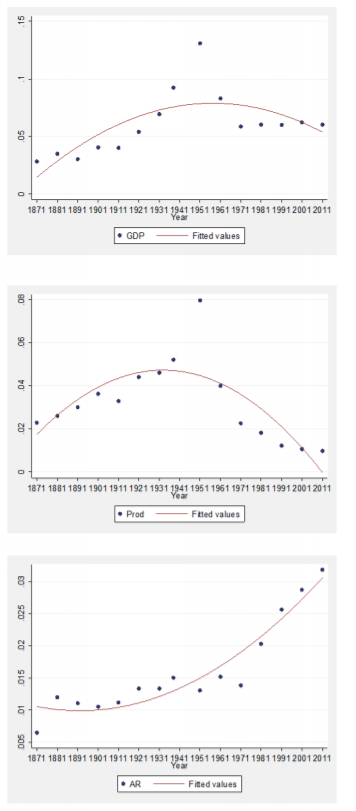
Two years, I wrote a post on this blog on the process of regional convergence in Italy. In that post, I made the observation that it seems that, economically, Italy was as fragmented at the time of the unification as it is today which made it an oddity in terms of regional convergence. To make that claim, I used this table of relatively sparsed out observations produced by Emanuele Felice: which was published in the Economic History Reviewitaliangdp


As one can see, there is a pronounced “lack” of integration for the Italy in terms of living standards. This is reinforced by a more “continuous” set of estimates produced, again, by Emanuele Felice (this time, its a working paper of the Bank of Italy) that now include the 1870s and go to 2011 (as opposed to 2001). This is the result, which I find fascinating. The first graph shows GDP per capita – for which there is divergence to 1951 and then a mild convergence thereafter but still well above the levels at the time of unification.  More fascinating is the fact that productivity is at its most integrated since unification (2nd figure) suggesting a divergence in levels of labor activity (3rd figure). In these three graphs, you have a neat summary of Italian labor markets since 1870.

Italian Convergence

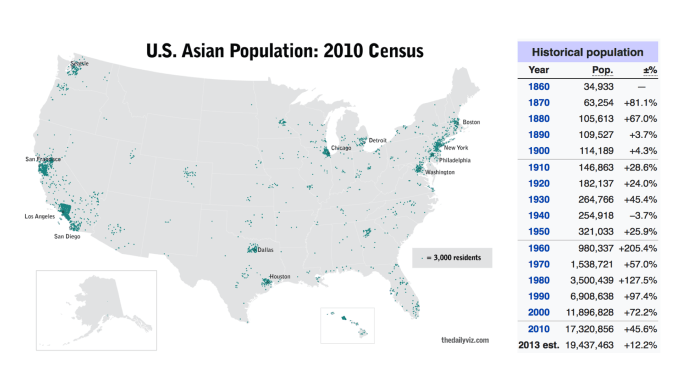
Eye Candy: the US Asian population, circa 2010

NOL map US Asian population
Click here to zoom

“Asian” is a pretty broad term. Racial classifications are, perhaps, the dumbest thing in the world.

Imagine seeing something like this in the press today, or this as an advertisement. There’s been lots of progress in this country, it’s just hard to see sometimes.

The great global trend for the equality of well-being since 1900

Some years ago, I read The Improving State of the World: Why We’re Living Longer, Healthier, More Comfortable Lives on a Cleaner Planet by Indur Goklany. It was my first exposition to the claim that, globally, there has been a long-trend in the equality of well-being. The observation made by Goklany which had a dramatic effect on me was that many countries who were, at the time of his writing, as rich (incomes per capita) as Britain in 1850 had life expectancy and infant mortality levels well superior to 1850 Britain. Ever since, I accumulated the statistics on that regard and I often tell my students that when comes the time to “dispell” myths regarding the improvement in living standards since circa 1800 (note: people are generally unable to properly grasp the actual improvement in living standards).

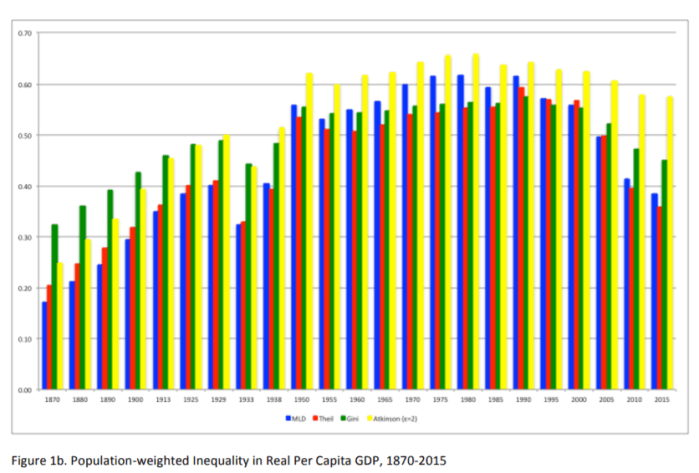
Some years after, I discovered the work of Leandro Prados de la Escosura who is a cliometrician who (I think I told him that when I met him) influenced me deeply in my work regarding the measurement of living standards and who wrote this paper which I will discuss here.  His paper, and his work in general, shows that globally the inequality in incomes has faltered since the 1970s.  That is largely the result of the economic rise of India and China (the world’s two largest antipoverty programs). Figure1Leandro

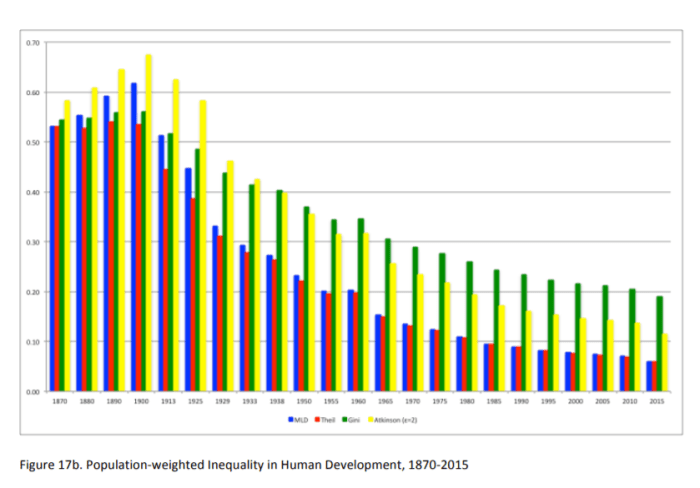
However, when extending his measurements to include life expectancy and schooling in order to capture “human development” (the idea that development is not only about incomes but the ability to exercise agency – i.e. the acquisition of positive liberty), the collapse in “human development” inequality (i.e. well-being) precedes by many decades the reduction in global income inequality. Indeed, the collapse started around 1900, not 1970!

Figure2LEandro.png

In reading Leandro’s paper, I remembered the work of Goklany which had sowed the seeds of this idea in my idea. Nearly a decade after reading Goklany’s work well after I fully accepted this fact as valid, I remain stunned by its implications. You should too.

The State in education – Part I: A History

In Beyond Good and Evil, written after breaking with composer Richard Wagner and subsequently rejecting hyper-nationalism, Friedrich Nietzsche proposed the existence of a group of people who cannot abide to see others successful or happy. Appropriately, he dubbed these people and their attitude “ressentiment,” or “resentment” in French. His profile of the resentful is most unkind, bordering on the snobbish – though Nietzsche had very little personal cause to feel superior (he was part of the minor nobility but always insisted that, due to his father’s premature death and his mother’s lack of connections, his legal rank was never of much benefit to him). Insanely proud of his classical education and remarkable, even for that time, fluency in Ancient Greek and Latin, the philosopher latched onto these languages as symbolic variables in his descriptions of society and its woes.

Much like the French philosopher Simone de Beauvoir who, a century later, attempted to prove that history was made by socio-cultural gender dynamics (Le deuxième sexe), Nietzsche proposed that all of (European) history since the fall of the Roman Empire was a battle between the cosmopolitan, classically-educated aristocracy and the technician, parochial lower classes. Unlike de Beauvoir who saw the world as oppressor-oppressed, the German believed that the lower orders, motivated by jealousy and feelings of exclusion, tried to pull their superiors down, creating a peculiar situation in which those who believed themselves the oppressed engaged in oppressive behavior.

As evidence of his theory, Nietzsche suggested in The Genealogy of Morals that the Protestant Reformation was the ultimate achievement of the resentful classes; functionaries, unable to understand the Latin of the Roman liturgy, read the writings of the ancient and medieval philosophers, or participate meaningfully in the conversations and society of the Renaissance, responded by turning the Church into the personification of all they hated – not unlike a voodoo doll – and then ousted it from their lives and countries. At least, this is what Nietzsche thought had occurred, adding that the cloddish nationalism that he had rejected would not have been possible without first banishing the Catholic Church and the refinement it introduced through fostering Latin, Greek, and Classical literature and philosophy.

On the practical plane, Nietzsche’s primary concern, post-Wagner, was the advent of Prussian hegemony and the loss of autonomy among the German member states. Before his friendship with Wagner, Nietzsche gave a lecture series on education which he intended to collect and publish as a book. The book never materialized [until 2016, when the Paul Reitter compiled the notes and lecture transcripts into book form under the title Anti-Education], but the philosopher did write a preface that he gifted to Cosima Wagner under the title “Five Prefaces to Five Unwritten Books,” which helped precipitate the quarrel since Nietzsche signaled clearly that he rejected the Wagnerian philosophy of the innate nobility of the (German) savage.

Much of Anti-Education is harsh and unyielding, moreover because there is much in it that is true. In it, one can see the early kernels of Nietzsche’s identification of ressentiment and the genesis of ideas concerning individuality and nobility that he returned to later in life. There is also much that is applicable today.

Nietzsche asked,

Why does the state need such a surplus of educational institutions and teachers? Why promote popular enlightenment on such scale? Because the genuine German spirit [that of the Renaissance princes] is so hated – because they fear the aristocratic nature of true education and culture – because they are determined to drive the few that are great into self-imposed exile, so that a pretension of culture can be implanted and cultivated in the many – because they want to avoid the hard and rigorous discipline of the great leader, and convince the masses that they can find the guiding path for themselves … under the guiding star of the state! Now that is something new: the state as the guiding star of culture!

Nietzsche wrote / spoke this on the takeover by the state of the education system, also known as the Prussian public school system, which “reformer” Horace Mann promptly imported to the United States. The false promise of public education, as Nietzsche saw it, was that state schools claimed the laurels and legitimacy of private gymnasia through deceit – speaking to a university audience, he expected everyone to know that pre-state control, there were two types of secondary schools: gymnasium, where the student received a classical education and prepared to enter university, and realschule, where the student learned the three Rs, along with some science, and entered the workforce immediately after graduation. Nietzsche claimed that while the gymnasium curriculum needed a significant overhaul, the only products of the realschule were conformity, obedience, and an inflated sense of achievement. Hence, he believed, when the government took over the education system, officials chose to model the public school on the old realschule, while claiming that graduates had the knowledge and skills of the gymnasium.

It is important to note at this juncture that Nietzsche bore a very visceral hatred of the Prussians in general and of Otto von Bismarck in particular. Viewing the former as unintelligent clods whose threat lay in their stupidity, the philosopher deemed the latter and his eponymous Bismarckian welfare state a greater threat to personal freedom. From 1888 until his nervous breakdown and descent into madness in 1899, Nietzsche called for the trial of Bismarck for treason, along with the removal of Kaiser Wilhelm II, in a sequence of letters and essays which his sister and executors suppressed, both to accommodate their own agendas and to avoid the attention of the censors.

The treason of Bismarck lay in his creation of a nation whose people were unwittingly dependent on the state. The state provided education during infancy and a pension in old age. As Nietzsche correctly saw, when the state controls the beginning of the pipeline and the end, everyone is in its employ. As he also foretold, the situation would end in violence (for Germany specifically; hence his interest in preempting war by removing its figurehead king) and heartbreak for those who placed their faith in the anti-individualistic state.

At a very fundamental level, Nietzsche believed that the public school system, with is inadequate education and contempt for classical learning and languages, was a conspiracy designed to drive a wedge among the social classes, enabling the state to increase control in the ensuing vacuum. The other aspect he identified was the use of public opinion to strip the individual of drive or thirst for a better life through a mixture of flattery and subversion of ambition. The outcome would be war and resentment, he predicted, for any country foolish enough to have faith in the Prussian system. Next week, we will examine whether Nietzsche’s predictions have come true in modern American education.
Nixon to Moscow, slavery’s toll on the economy

My latest is up over at RealClearHistory. An excerpt:

Nixon’s anti-Communist credentials were so sound that he could spend political capital making inroads with Communist enemies. His actions were viewed as safe by the American electorate because, for better or worse, the public saw Nixon as somebody who would not betray American values at the negotiating table with the Soviets. Nixon’s hawkishness provided moral cover for America’s withdrawal from Vietnam, and its peaceful overtures to the two most powerful and aggressively anti-capitalist regimes in the world (China and the USSR).

Please, read the whole thing.

Vincent has a great review up on Robert Wright’s new book about slavery, too. It’s at EH.net, a website dedicated to economic history, and here is an excerpt:

All of these amount to the same core point, those who reap the private benefits of slavery are content with their gains even though they come at a larger social cost and they will work to find ways to drive a wider wedge between the two by shifting costs onto other parties. Hence, slavery as pollution.

More here.

Eye Candy: Japanese anti-Russian propaganda

NOL map Japanese anti-Russia
Click here to zoom.

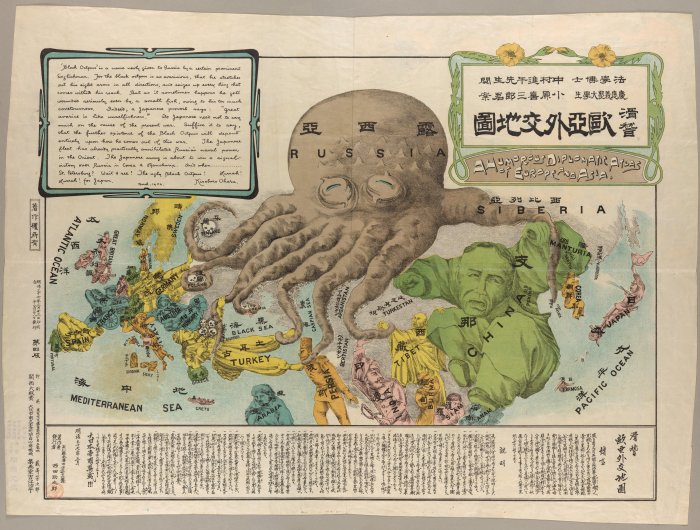
This dates from the late 19th or early 20th century. The Japanese won the Russo-Japanese War, but a quick glance at the casualties suggests it was more a pyrrhic victory for the Japanese.

Dictators who gave up power?

That’s the topic of my weekend column over at RealClearHistory, thanks to an extended email with Andrei. Here’s an excerpt:

10. King Juan Carlos I. Juan Carlos should be a household name in the West. The monarch of Spain upon dictator Francisco Franco’s death, Juan Carlos was expected to continue Franco’s legacy of authoritarian rule. After all, he received a military education in Spain under the Franco regime and had a clear claim to the throne (although the throne itself was a complicated legal matter). Furthermore, Juan Carlos was an active member of Franco’s staff, even stepping in to fill Franco’s void when the fascist began to fall ill due to old age. When Franco died, Juan Carlos began to dismantle the Franco regime and helped usher a smooth transition to democratic rule.

Please, read the rest.

Cities in capitalism are more beautiful

The other day I wrote about some of the reasons why I love capitalism. One of them is that cities in capitalism are more beautiful. I am convinced of this when I think about some cities I am more familiar with, including their geography and history.

Most foreigners I know have difficulty to answering correctly, when asked, “What is Brazil’s national capital?”. Most people answer Rio de Janeiro, but it is actually Brasilia. Many people say that beauty is in the eyes of the beholder, but I am very inclined to say that this is not so. I am still not 100% sure about this, but I believe that there is something objective about beauty. Maybe it is not something so strict, like a point. Maybe it is something broader, like an area. But still, I am inclined to say that there is something objective about it. At least for me, Brasilia is one of the ugliest cities conceivable. I am really glad to say that. Its architecture was designed by Oscar Niemeyer and Lucio Costa. Growing up in Brazil, questioning that Niemeyer was a genius is almost anathema, almost like saying that Maradona was better than Pelé or that Ayrton Senna was not the best Formula One pilot ever. Because of that, I was always happy to say that Niemeyer’s buildings are among the ugliest things on the surface of this planet. It was like shouting that the king is naked.

Brasilia is very beautiful from the sky. Its shape resembles an airplane or a cross. But that is the problem: the city is beautiful from heaven, but not for the people walking in it. It was made for God to see from up there. But, as Niemeyer was a convinced atheist, I am not sure who is watching his creation. My guess is that Niemeyer thought that he was a god. A very mean god, who didn’t care about people having to spend lots of time in cars driving long distances.

Niemeyer was also related, with Lucio Costa, to Barra da Tijuca, a neighborhood in Rio de Janeiro where I spent lots of time growing up. Lucio Costa, as far as I’m concerned, was not a communist. I believe he was closely connected to the Brazilian version of positivism. Because positivism and communism are basically the same, it doesn’t make much of a difference. Barra da Tijuca is very similar to Brasilia: very beautiful if looked at from the sky, but very unpleasant for the pedestrian. Very long distances to walk. Cars are mandatory.

The most pleasant neighborhoods in Rio de Janeiro are the result of spontaneous order. As Hayek noticed, spontaneous order is one of the central features of capitalism. People usually contrasted between planned economies (such as the USSR) and unplanned economies (such as the US in some moment of its history). But Hayek observed that all economies are planned. Some are centrally planned. Others are planned by several individuals who are not following a specific central plan.

I am convinced that cities that follow no plan, or a very simple plan, are more beautiful than cities that follow a very specific central plan. New York, as far as I know, followed a simple plan, a grid. But other than that, there was a lot of freedom in the use of the space for much of its history. It’s a city that I just love. I am more comfortable talking about Rio de Janeiro. It is a city that was at its best before modern architecture, positivism, socialism, Developmentalism, and other isms. It was better when Brazil had a little more classical liberalism.

“The Dutch Empire”

That’s the subject of my weekend column over at RealClearHistory. An excerpt:

6. The Dutch Empire vied for supremacy with the Portuguese empire, which, beginning in 1580 with the Iberian Union of Spain and Portugal, was a rival Catholic state attempting to establish a global hegemony of its own. The Portuguese were actually the first Europeans to establish trading forts throughout the world, but the aforementioned Iberian Union severely weakened Lisbon’s plans for global hegemony due to the fact that the union made Portugal the junior partner. The Dutch conquered and then established colonial rule at Portuguese colonies on four different continents, and unlike the Portuguese, focused on commercial interests rather than converting the natives to Catholicism and creating a politically connected empire. Because of the commercial nature of the Dutch project, many of the indigenous factions were happy to switch from Portugal to the Netherlands as business partners. And partners they were. Both the Portuguese and the Dutch (as well as the British and French later on) paid rent to local political units on the trading forts they built throughout the world. Such was the nature of power on the world scene before the end of the Napoleonic Wars in the early 19th century.

Please, read the rest.