Well, it wasn’t so unsuspected, how many people want us to think. Over 60% of 30-35% of voted citizens were against euro-association with Ukraine. Ukrainian politicans traditionally speaking about “russian hand” and other weird stuff, russian trolls experiencing huge wave of a butthurt from their ukrainian colleagues in the political articles comment sections. Everything as always. I personally think, that NO is better that YES in this particular situation:
Law base is poor. Ukrainian Government should rise quality of anti-corruptional laws and deal somehow with unempoyment.
Donbass civil war isn’t over yet. And it’s like a red flag before EU bull’s eyes.
In my own humble opinion, euro-association means “total victory” for Ukraine and an approvement, that Ukraine itself passed all the requirements of EU and “Maidan quest” is completed. I personally afraid that after association Ukrainian Government will forget about current problems listed above and citizens will live worse. Economical situation will get worse too. “Hey, people, what else do you want? We passed the association test and it by default means that everything is ok”. When first wave of total euphoria will come to an end, the understanding will come: for simple worker, or miner, or vaiter, etc. nothing changed. People suffered before – and they will suffer after. Dealing with unstable situation and unemployment, brother-killing war and corruption are the only ways to EU.
In California, 70% of eligible voters are registered, and 47% of those turned out in a recent election. Thus about a third of those who could vote do so. These are dismaying numbers.
Dismaying because they are too high.
Why? First, some more dismaying numbers:
When Newsweek recently [2011] asked 1,000 U.S. citizens to take America’s official citizenship test, 29 percent couldn’t name the vice president. Seventy-three percent couldn’t correctly say why we fought the Cold War. Forty-four percent were unable to define the Bill of Rights. And 6 percent couldn’t even circle Independence Day on a calendar.
Too many ignorant fools are casting votes. People who believe that minimum wage laws create wealth, free trade destroys wealth, or clergymen should be forced to marry gay couples, to pick just a few examples. We need to bar these ignoramuses from the voting booth.
How? For starters, ditch the 26th amendment to the Constitution and the raise the voting age to at least 30. Get the 20-somethings out of the way; too many still believe in free lunches.
Second, change the 24th amendment to require poll taxes rather than forbid them. There is no justice in forcing non-voters to pay election costs.
Third, institute stiff qualification exams. Voters need know the vice president’s name, understand the Cold War, identify July 4 as Independence Day, and a whole lot more. Informed voters would be mostly immune from pandering demagoguery.
Disenfranchisement will lead to alienation and rebellion, some will say. Perhaps, and this could be alleviated by a phase-in of the changes. But then voting will become a privilege that young people can aspire to, as they might aspire to a corporate management position.
Another objection: my proposal is elitist. Of course it is! If there’s one thing we desperately need in this country, it’s a reversal of the egalitarian sentiments that have poisoned so much public discourse. We need to encourage and acknowledge the best and the brightest. Ignorant fools should not be allowed to operate dangerous machinery or pull levers in voting booths.
News item: the Georgia governor has just vetoed a bill that would, among other things, have allowed ministers to decline to wed gay couples.
What a tangle. Let’s see if we can sort things out.
First of all, many decent people, your humble servant included, find the concept of “gay marriage” troubling. I believe any two adults (or three or more) should be free to make any contract they like regarding sharing assets, pledging fidelity, and so forth. I just wish they wouldn’t call it “marriage.” That term is taken.
Second, hate is not a crime. Some people express repugnance or hatred for homosexuality. Ayn Rand called the practice immoral, an attitude that is hard to fathom in this day and age but perhaps understandable given the tenor of her times. Some go farther and express hatred for homosexuals per se. But as long as these people refrain from initiating force or fraud, they should not be molested. Boycotts, shunning, and criticism are legitimate responses to such people, but forcible restraint is not.
Third, rights are not granted by governments. Rights derive from our basic nature as humans, as thinkers such as Ayn Rand and Murray Rothbard have so eloquently demonstrated. Contractual “rights” should have a different name, perhaps “privileges.” These are actions that have been legitimized by a voluntary agreement. Thus for example, no one has free speech “rights” on a campus. Students may have free speech “privileges” on a campus if the owners of the campus have granted that privilege in a written or implied contract.
Fourth, freedom of association is a basic human right, and includes freedom of dissociation, whether in personal or business relations. Some years ago I posted a defense of the late Lester Maddox who famously attempted to exclude blacks from his chicken restaurant. My post generated considerable blowback, but I stand by it and note that in this day and age, anyone who tried to exclude blacks would not be elected governor of Georgia as Maddox was, but instead lose most of his customers and close his doors.
In summary, no minister needs permission from the state to deny wedding services to a gay couple. And religion has nothing to do with it. Anyone should free to decline business or personal relationships with anyone, for any reason whatever, or for no reason at all.
John T. Flynn’s As We Go Marching was written in 1944, but there isn’t a line in this excerpt that doesn’t fit today’s situation perfectly. I read the book many years ago and will pull it out and read it again.
Fascism will come at the hands of perfectly authentic Americans who have been working to commit this country to the rule of the bureaucratic state; interfering in the affairs of the states and cities; taking part in the management of industry and finance and agriculture; assuming the role of great national banker and investor, borrowing billions every year and spending them on all sorts of projects through which such a government can paralyze opposition and command public support; marshaling great armies and navies at crushing costs to support the industry of war and preparation for war which will become our nation’s greatest industry; and adding to all this the most romantic adventures in global planning, regeneration, and domination, all to be done under the authority of a powerfully centralized government in which the executive will hold in effect all the powers, with Congress reduced to the role of a debating society.
HT: Jacob Hornberger, Future of Freedom Foundation
It is always hard to start again from the vacuum, but I’ll try to do my best. Today we all survived another act of animal-like agression in Belgium. Our thoughts should be with ones who didn’t make it out alive and with their families. I still remember attacks in Volgograd in late 2013. What can I see now? While police and army trying to deal with situation, politicans make their loud announcements. Traditionally, weird things come from Ukraine: “There may be a trace of russians!”. I really try to understand, but I can’t. What should be in your head, that you let yourself to say such a nonsense?
Demonic face of Russia and russians – it’s like a stamp now, a cliche. When something happens somewhere – it’s our fault. Your kitty pooped on your new carpet? Just check under it! Probably there’s a russian flag forgotten, or Putin’s portrait. It’s hard to live and understand, that even if you a gardener or an engineer – you can read disturbing content about yourself when something happens, and it’s unacceptable. Why can’t we find a terrorists first, and then make a conclusions?
Why can’t we live and trust each other a priori. I know, that in some ways our politic decisions are wrong (from western position), but try to understand us too, as we trying to understand you.
I have a new paper that has just been published in Asian Affairs. Here is an excerpt:
Questions over the India-China border are not a new phenomenon. They are asked whenever there is a Sino-Indian state visit. Despite having close to $100 billion of trade between them, China and India have failed to bring their frontier disputes to an end. In the 1980s and 1990s it was thought that the increasing economic cooperation between the two countries would act as a prompt to resolve their political disputes, but it has not. Military stand-offs and confrontations between border guards from India and China occur at regular intervals. To address their boundary disputes, they have engaged in frequent dialogues (17 rounds of focused dialogues can be counted between 1988 and 2015), but nothing substantive has yet been yielded through such engagements.
The boundary disputes between India and China have their ultimate origin in the ‘Great Game’ played during the British Empire. At present, the two main areas of dispute along the Himalayan frontier are the western sector (Aksai Chin around 37,250 sq km/14,380 square miles) and the eastern sector (Arunachal Pradesh, around 83,740 sq km/32,330 sq mile). This article traces the roots of the boundary disputes between India and China and attempts to discuss sources of tensions and probable solutions.
The link to the whole paper can be found here [pdf].
You heard it here first. At some point soon the two populist campaigns will join forces and take the White House with Donald Trump as the president. The odd-couple reality show residuals will foist Bernie to the top of Forbes’ “Lamest Billionaires” list before he’s even sworn in.
By 2018 the supreme will be hearing disputed disputes over MLB umpires’ decisions. By 2024 they will be the official referees of Wrestlemania. Incidentally, Wrestlemania 42 is where Bernie Sanders will peacefully shuffle of this mortal coil. Conspiracy theorists will insist that he was killed before the event by a Russian assassin and that his aides carried his dead corpse in so that they could attend the event. After that it will only be another 5 years before the last Facebook (by then a branch of the Social Security Administration) comment using the phrase “Feel the Bern” which by then will understood to be a reference yeast infections.
In fact, lots of good, funny, and interesting things will happen in the future! CSPAN will final get watchable. Even better news: selling the broadcast rights to the State of the Union Address will finally put a dent in the debt. And as budgets shift away from bureaucracies towards more explosive, entertaining, and big-data-y ventures, red tape will whither away. With a good dose of good luck, the world going to hell in a hand basket might be the best thing that’s ever happened to us.
Slow labor market adjustments are not a cause of free trade: If anything, they are the results of a series of government intervention. Countries like Denmark, which may have large governments combined with fewer regulations on businesses, are very well able to adapt to free trade. The ability to start businesses is basically the ability to properly channel inputs towards more valued output. If you prevent an entrepreneur from doing just that while you open your borders to more efficient producers, it is quite obvious that free trade could be “less” beneficial. This point can be well seen in the role of states with “right to work (RTW) laws”. Although there is a debate as to whether or not RTW laws increase wages (James Sherk at Heritage says yes, the good people at the Employment Policy Institute say no and I say that both don’t get it, we should care about regionally adjusted real wage growth), it does seem that it helps industrial activity while boosting employment levels (see here too). Unions would hinder adjustments to changes in trade patterns. In fact, its worth pointing out that of the 11 states that had RTW laws before 1948 – in only three of those states did the income share of the top 10% exceed that on the whole United States (see the data here) in 2013. While the entire country has seen an increase in income inequality, the RTW states have seen the share of all income of the top 10% increase by only 26% (1947 to 2013) compared to 42% nationwide. This suggests that RTW laws are probably helping workers adjusts to changes caused by free trade (otherwise, there would be a state-level increase in inequality). This finding seems to conform to large section of the literature on the links between RTW and inequality (here and here). I am sure that if the Autor, Dorn and Hanson study (on which Noah Smith relies) was to be redone with attempts to control for right to work laws, the effect would be concentrated in non-RTW states. Thus, if the problem is labor laws, don’t blame free trade for the poor adjustments!
Nobody said that free trade was “costless” to adapt to. I do economic history. I see cases of industries being protected for decades. Protectionism not only raise prices, but it changes relative prices between different inputs. It incites the adoption of an artificially profitable production method. It is profitable to do so, but it is by no means the most efficient approach. It was made profitable only by the artifice of regulation and duties. Once you eliminate that artifice by removing the barriers, you still have “time to build” problem and a need to change production methods. That takes time. However, governments are very good at making sure this takes more time than needed (see point 1)
Trade agreements with China are not free trade agreements: this is the point I keep repeating (and the point that actually make Paul Krugman interesting), free trade agreements should normally fit on a napkin. If it takes 10,000 pages, it is free trade with 10,000 exceptions. Noah Smith should realize that he may be looking at a case of such “managed trade”.
Steve Horwitz has a great piece in the Freeman that I wish I’d written. The tl;dr: Voting isn’t all there is to political participation. This is an idea that’s been bouncing around in my head as I’m constantly remound that I’m now an American citizen (sorry everyone else in the world…) and that this November I’ll be eligible to vote for who I think should foster anti-American sentiments internationally (Republicans) or domestically (Democrats).
The other day I said I’d consider voting but I couldn’t recall whose name I’d write in (turns out it’s Willie Nelson*). But my usual response to any question about whether I’ll vote is “No, it just encourages the bastards.” When that’s countered with “blah blah blah civic engagement blah blah” I retort with,essentially, Horwitz’s point: My vote is not going to change the outcome**, but I can contribute value by trying to convince my students that economics matters and that a vote for third party candidate (even a Green Party vote) does more good than a vote for the big two.
I don’t know where I picked up that idea, but if I’d remembered, I would have posted his piece here before he did. Even better would be if I could just list a repository of everything I’ve ever read (or heard) in some public place and just write and write without worrying about citing anything.
Many of you already know that two of NOL‘s Senior Editors are associated with Econ Journal Watch, thus making its publication a family affair. Fred is on the editorial board and Warren is its math reader. Here are some of the highlights I found worth noting in the latest issue:
Eli Heckscher’s Ideological Migration Toward Market Liberalism: Benny Carlson explores the intellectual evolution of a great Swedish economist.
Symposium: Classical Liberalism in Econ, by Country: Authors from around the world tell us about their country’s culture of political economy, in particular the vitality of liberalism in the original political sense, historically and currently, with special attention to professional economics as practiced in academia, think tanks, and intellectual networks.
The latest issue of Reason Papers, vol. 37, number 2 is now out; officially, it’s the Fall 2015 issue, but we only just managed to put it up on the website last night. This link will take you to a monster-size PDF to the whole issue (almost 250 pages). This link will take you to the journal’s Archive page, where you can access individual articles for this or any past issue (you have to scroll down a bit). Finally, this link will take you to three (time sensitive) Calls for Papers issued by the journal’s editors: one on “the philosophy of play” (March 1, 2016); one a fifteen-year retrospective on 9/11 (July 1, 2016); and one an Authors-Meet-Critics symposium on Douglas Den Uyl and Douglas Rasmussen’s forthcoming book The Perfectionist Turn: From Meta-Norms to Meta-Ethics (February 1, 2017).
My own small contribution to Reason Papers can be found here (pdf).
Sean McFate, a political scientist at National Defense University in Washington, DC, has a fascinating article in Aeon about the reemergence of mercenary and quasi-mercenary security firms throughout the world. The whole article is fulfilling throughout, especially if you’re a well-read anarchist or a history buff, but I wanted to highlight this tangent:
With the fall of the South African apartheid regime, unemployed soldiers from special forces units such as the 32nd Battalion and the Koevoet (‘crowbar’ in Afrikaans) special police formed the first modern private military company, appropriately named Executive Outcomes. Unlike WatchGuard, Executive Outcomes was not a military enterpriser but a true mercenary firm, waging war for the highest bidder. It operated in Angola, Mozambique, Uganda and Kenya. It offered to help stop the genocide in Rwanda in 1994, but Kofi Annan – then head of UN peacekeeping – refused, claiming ‘the world may not be ready to privatise peace’. Annan’s was an expensive ideology, given the fact that 800,000 people died. By 1998, the company closed its doors, but the mercenary market for force surged.
Two aspects are important here, one said and one unsaid. First, the unsaid. If this mercenary outfit was “waging war for the highest bidder,” why did it offer to go in to Rwanda to stop the bloodshed? I think scholars assume the worst when it comes to stateless actors and warfare. Why has Anheuser-Busch begun shipping free cans of water into Flint, MI?Why does Wal-Mart donate billions of dollars to charity? When it comes to reputation, costs may sometimes not make sense to outside observers who don’t have a sufficient understanding of benefits. Why on earth would a corporation built solely to wage war for the highest bidder be interested in offering its services to a country that would not be able to afford its services? To ask the question is to answer it, of course, but understanding incentives using a costs-benefits framework requires more effort than you might suspect.
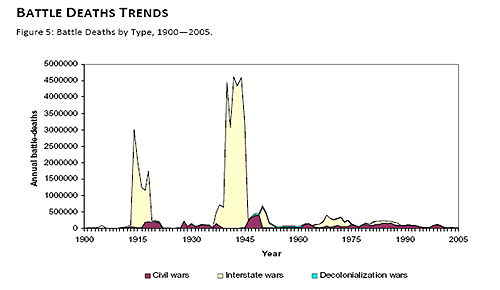
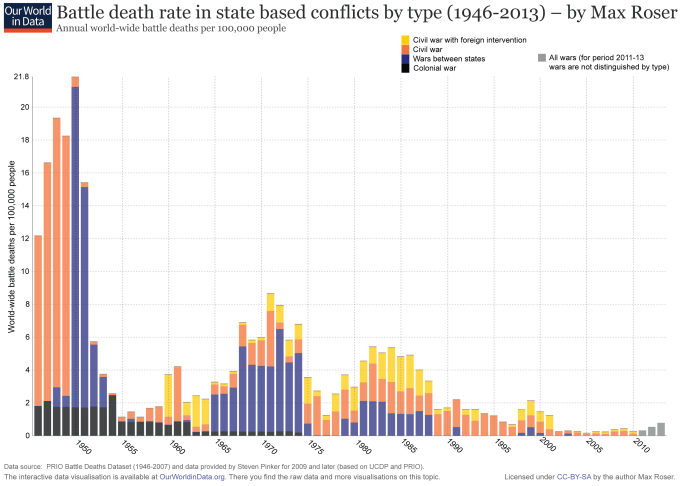
There is simply no logical coherence to the idea that, in a world where stateless mercenary firms are the prominent form of security, violence and lawlessness will reign supreme; nor is there any evidence whatsoever to suggest that “[m]ore mercenaries means more war, as they are incentivised to start and expand wars for profit, and turn to criminality between contracts.” Indeed, as McFate notes in his excellent article, the market for security is already becoming freer and while he ends his piece on a depressing note, lamenting this indisputable fact of the present-day world, I couldn’t help but remember the now-famous graph on battle death trends produced by political scientist Jay Ulfelder (using data from the Uppsala Conflict Data Program [UCDP]), which illustrates nicely the overall decline in deaths due to warfare violence around the world:
Notice that the most deadly conflicts are the ones involving states with armies that had been nationalized?
Now, two graphs showing that deaths from warfare have been in decline for half a century does not necessarily mean that a freer market in security services has led directly to this overwhelmingly good news. I am confident in claiming, though, that the freeing up of security services markets, combined with the steady presence of a few, still-powerful nationalized armies has led to a reduction in war-related deaths (and violent conflict in general). Both graphs illustrate well what happens when there are too many nationalized armies vying for power and prestige. (It is worth noting here that the main goal of diplomats and policymakers everywhere, no matter their ideological orientation or citizenship status, is still to avoid another world war.)
Second, the said. Annan’s refusal to decriminalize mercenary activities led directly to the 800,000 Rwandan deaths. How is this moral failing any better than when a mercenary firm breaks its contract and ends up killing a few dozen more people than it was supposed to? Again, the graphs are useful here: When conflict is nationalized, everybody suffers; when it is privatized, atrocities happen but not on the same scale we have seen with nationalized conflicts. It’s not even close. Annan’s short-sightedness reminds me of economist Scott Sumner’s 2012 summary of Hillary Clinton’s view of the War on Drugs:
[…] in response to a final question on drugs (from a Latin American reporter), she said drug legalization would do no good because drug dealers are really bad people, and they would simply do other crimes. No discussion of how America’s murder rate fell in half after alcohol was legalized in 1933.
Like drug use, the privatization of security services causes many people, well-educated or otherwise, to bristle at the notion without quite thinking through its logical implications. While ugly, mercenary firms are far more efficient and effective at quelling “bush wars” than are nationalized armies and, in turn, mercenary outfits are far less capable of sowing the type of destruction that nationalized armies routinely carry out.
I don’t think that a world with a few nationalized armies and an abundance of mercenary firms is necessarily the best option going forward, though. It is, however, a better option than most scholars and analysts give it credit for. In fact, it’s the best option at the moment, and while the status quo may sometimes be ugly, remember the graphs. Privatization of security services has contributed, at least in part, to a more peaceful and less violent world.
In order to move forward from this status quo it is best not lament the way things are going, but to acknowledge that things are the way they are for a reason, and then look for avenues to alter the status quo without falling back on a blanket policy like nationalizing security services again. The horrors of the World Wars should still be fresh in our minds, and the horrors of those wars were enabled and encouraged by nationalized security forces.
The best way to move forward is by looking at where these “bush wars” are taking place and begin thinking about ways to incorporate these regions into the global order (such as it is). This policy represents a departure from traditional post-war thinking about international relations, but it doesn’t make it radical or unfeasible. Indeed, there is a long tradition of republican thinking in Western thought pertaining to international relations. The West needs to start recognizing the legitimacy of secessionist sentiments in the post-colonial world, even if it means friction with Russia and China.
Washington and Brussels will have to endure charges of hypocrisy when it comes to ignoring the lobbying efforts of places like Tibet and Dagestan, but Biafra should have become a member state of the United Nations long ago. Baluchistan should have access independent of Pakistan and Iran to the IMF and World Bank. Two or three soccer teams from the region known as Kurdistan could easily be present in all major FIFA tournaments. Examples abound throughout the world. The West should also be open to recognizing arguments made by Russia and China for the independence of regions. There is no good reason why Western diplomats should ignore Moscow’s recognition of places like South Ossetia and Donetsk; doing so only hardens Russia’s stance on recognizing secession in parts of the world where its influence is limited or non-existent and forces the West into bed with unsavory post-socialist regimes.
The West needs to start being more inclusive when it comes to its own federal and republican institutions, too. Morocco, for example, should have had its 1987 application to join the European Union taken seriously (same goes for Turkey). The US federation needs to be actively courting polities like Puerto Rico, Coahuila, Alberta, and Micronesia to join the union. Both the EU and US are contracts designed to dampen violent conflict by fostering diplomatic, economic, and cultural intercourse between provincial polities. The reasoning behind exclusionary policies simply doesn’t answer why these republican, supranational organizations should not be actively recruiting neighboring or geopolitically useful administrative units into their representative systems.
Without this change in mindset the status quo will continue, which again if we remember the graphs is not all that bad, but something worse may happen: There could be a reversion to the blanket nationalization of security services that we saw during World Wars I and II.
It is an interesting read indeed but there are two or even more sides to every story. What we are also noting is that many of these groups that hate Western interventionist policies also hate their own people for being different in one way or the other. However, I agree that the misplaced perception of democracy as the superior form of governance overlooks the essential internal historical and socio-political factors behind the politics of the different countries that have become victims of Western ‘sanctification’ processes fronted by bombs after daring to opt not to embrace democracy. Libya and Iraq were stable before Western intervention.
Tam’s point strikes at the heart of the difference between military interventionists and non-interventionists, I think. Libya and Iraq were indeed stable, but not everybody was free. In Iraq, Shias, Kurds, liberals, and religious Sunnis were all brutally suppressed, and this oppression stood in stark contrast to the freedoms that secularists, women, union members, some socialists, and the politically apathetic enjoyed. The sociopolitical dynamics in Libya were the same, though with different local actors.
This reality is something that both sides of the interventionist debate recognize, though the interventionist side seems to place much more faith in government when it comes to “doing something.” Jacques and Edwin, for example, have both argued that bombing ambiguous factions in Iraq, Syria, and Libya would contribute to the freedoms of the oppressed factions in those countries. Looking back on the debate makes it clear that they weren’t wrong, but look at what those freedoms have produced. Those freedoms have come at the expense of the freedoms of the factions that the dictators were protecting.
What this situation shows me is that the states of the post-colonial world are unviable. Stability comes at too steep a price (dictatorship), and democracy’s unpredictability only leads to predictably violent results in the post-colonial world.
This impasse, which I cannot be the only one in the world who recognizes, has led me to take a hard glance at two specific peace processes in the Western world: The diplomatic efforts of Europeans after the Napoleonic Wars (“Concert of Europe”) and the founding of the American republic, which is, in my mind, the most successful endeavor in the history of international relations. Neither of these efforts led to the complete abolition of war, but both have helped to maintain a relatively peaceful co-existence between large numbers of factions for long periods of time.
The Concert of Europe bought time for factions in the region to solidify their legitimacy at home, culminating in both the creation of Germany and Italy in the late nineteenth century and the infamous overseas imperial domains of France, the UK, and the Netherlands (among a few others). While this peace process brought about prosperity for Western Europe, it was not inclusive and it still adhered to the Westphalian notion of state sovereignty. What state sovereignty means is that each state, in the context of international affairs, has a right to do whatever it pleases within the confines of its own borders (such as massacre hundreds of thousands of people in the name of stability). The Concert of Europe was also the precursor to the post-1945 peace process that created the state system that we all live with today, though I would argue that there are some elements that could be republican, such as the IMF and World Bank, provided some changes in mindset.
Aside from the problems produced by the notion of state sovereignty, the states of the post-colonial world today suffer from an issue of legitimacy, both from domestic populations and from foreign ones. Domestically, all of the factions that stability-inducing dictatorships oppress do not buy in to the argument that the states purporting to govern them are legitimate. In foreign affairs, many factions do not believe that these post-colonial states are legitimate either. Hence the calls for bombing campaigns, proxy wars, or outright invasions and occupations of states like Iraq and Libya by states like the US or France (even if these invasions come at the expense of domestic and international rule of law).
This situation, where post-colonial states claim to have sovereignty within an international state system but where domestic and international factions ignore such claims, is where we’re at today. It’s the status quo, and while it worked relatively well in a small part of the world for about hundred years or so, it’s obviously failing today.
Enter the founding of the American republic. Unlike the Concert of Europe, self-determination à la breaking away from the UK was a guiding principle of the federal system, rather than state sovereignty. Like the Concert of Europe, the statesmen who crafted the American republic were concerned about invasion, hegemony, and all of the other bad stuff that happens in the international arena. So they set up an inclusive, republican system of states rather than attempt to balance power off on each other, like they did in Europe. The republican, or federal, system tied each state up into the affairs of the other states, whereas the balance of power system contributed to the formation of rival blocs within the system. This is why Europe switched from trying to maintain yet another balancing act to building an actual confederation (though one that is far too complex than it has to be) after World War II.
From a strictly war and peace view, the republican state system has led to one war so far (dating from 1789). From the end of the Napoleonic Wars, in 1815, to today, the balance of power state system has led to numerous wars.
Now, I know what you’re thinking: Woodrow Wilson’s foreign policy was based on self-determination, and his foreign policy was a disaster. This is true, though I would argue that Wilson was simply confused about what self-determination actually implied. For Wilson, recognizing the self-determination of various groups within empires would lead to state sovereignty for these groups, and that this state sovereignty would then be protected by the institutions trying to maintain a balance of power. Wilson never entertained the notion of republicanism when it came to recognizing the self-determination of peoples living in empires, he simply thought empires were undemocratic. Thus, he was actually a proponent of state sovereignty rather than self-determination.
What I am not arguing for here is a Concert of Europe-type effort for Middle Eastern actors. I think it would be a disaster, largely because regional efforts at peace-building (rather than, say, trade agreements) are useless in today’s globalized world. The Middle East needs the West, and vice-versa. Peace will only be achieved if self-determination is embraced (by not only large swathes of Mideast factions, but Western ones as well) and the new polities can be incorporated into existing republican-esque institutions. This way, more factions have a voice, and bad actors can be more easily isolated. I am not necessarily arguing that the US or EU should welcome burgeoning Mideast states into their federations, but policymakers and statesmen from these countries should at least start thinking about how to encourage and embrace the notion of a Middle East that looks a lot like our own republican world and less like the one we gave them following the destruction of the Ottoman Empire.
Much controversy rages over campus speech these days. Examples abound; here’s one from George Washington University about students hanging flags from their dorm windows. What legitimate free speech rights do students enjoy on campus? The answer is: it depends.
Before examining the dependency, let’s distinguish natural rights from contractual rights. Natural rights are entitlements that stem directly from our humanity. It’s often said that freedom of religion and freedom of speech are natural rights but they aren’t. The only genuine natural rights are property rights: control of our own body, control of our own material and intellectual creations, and control of things we have acquired through voluntary transactions.
Contractual rights arise from an exchange that plays out over time. If I’m a student at GWU, a private University, I may have been promised that in return for my tuition, I will acquire a number of entitlements including freedom of speech on campus, within limits (no yelling “fire!” in a crowded lecture hall). That’s the only freedom of speech I have on campus. If GWU should want to forbid pro-Israel speeches on campus, for example, and I accept that as a condition of admission, then I have no right to lobby for Israel on campus.
Things get complicated when the institution is publicly owned.[1] Who owns San Jose State University? Not “the people”—that would be meaningless. The owner is the person or group who has final say over campus property and policies. That might be the Board of Trustees of the California State University, but how much of their control have they relinquished to what other parties? Hard to say, and in particular it’s hard to say who gets to set restrictions on campus speech—and of course all manner of such restrictions are necessary if the business of the University is to go forward. No blocking hallways, no disrupting classes, etc. In the case of a public university, somebody has to decide what sort of speech is allowed, usually according to what is politically palatable to the loudest voices.
To repeat, the only genuine natural rights are property rights. Freedom of speech or religion are not fundamental rights but are contingent on the ownership of property involved in any particular speech or religious activity.
[1] “Public ownership” is actually an oxymoron because ownership means some people are excluded while public means everybody is included.
Folks, NOL is coming up on 5 years as a cooperative venture. It’s been a lot of fun and it wouldn’t have the feel it has without your continued support and encouragement. I’d like to extend a warm welcome to two new members of the consortium: Dr Vincent Geloso and William Rein. Behold:
Vincent Geloso has recently completed his PhD dissertation at the London School of Economics and Political Science in the field of economic history. He specializes in law and economics, development economics, and economic demography. He has published articles in Journal of Population Research, Essays in Economic and Business History and Economic Affairs.
Vincent was my roommate at a FEE summer seminar back in 2009 (the same summer I met Rick at an IHS summer seminar). He’s from Quebec but is a Canadian first and foremost. You can start checking out his non-NOL work here. If you are considering a non-profit to give to for this holiday season, I highly recommend IHS and FEE. Just look at what their work has done in regards to NOL. And:
William Rein is a sophomore studying Philosophy and Criminal Justice at Chico State University. He married jurisprudence a long time ago, starting seeing modern physics on the side, and just recently has been hooking up with phenomenology. Every now and then he gets caught up in journalism and opinion writing.
You can start checking out his non-NOL work here. I have many a fond memory of Chico State (and some not-so-fond ones too). Please, be on your best behavior for at least their first couple of posts!
 Well, it wasn’t so unsuspected, how many people want us to think. Over 60% of 30-35% of voted citizens were against euro-association with Ukraine. Ukrainian politicans traditionally speaking about “russian hand” and other weird stuff, russian trolls experiencing huge wave of a butthurt from their ukrainian colleagues in the political articles comment sections. Everything as always. I personally think, that NO is better that YES in this particular situation: