- Lost in translation: Native American mascots in Europe Andrew Keh, NY Times
- Zanele Muholi: The dark artist of South Africa Mark Gevisser, 1843
- Aristocrats have always been internationalist Blake Smith, Aeon
- Frayed transatlantic ties are weakening NATO Azita Raji, War on the Rocks
Author: Brandon Christensen
Eye Candy: the US Asian population, circa 2010

“Asian” is a pretty broad term. Racial classifications are, perhaps, the dumbest thing in the world.
Imagine seeing something like this in the press today, or this as an advertisement. There’s been lots of progress in this country, it’s just hard to see sometimes.
Nightcap
- Chinese view of Germany’s rise Francis Sempa, Asian Review of Books
- The lost kingdom of Kush James MacDonald, JSTOR Daily
- Purges and Paranoia in Erdoğan’s ‘new’ Turkey Ella George, London Review of Books
- The British Empire strikes back Colin Kidd, New Statesman
Nightcap
- Modernism without industrialism Nick Nielsen, The View from Oregon
- Adam Smith’s suspicions about democracy Branko Milanovic, globalinequality
- Left-wing nostalgia Sean Cashbaugh, H-socialisms
- The importance of Richard Pipes (RIP) Jacob Heilbrunn, National Interest
Nightcap
- Antarctica’s long, dark winter Sarah Laskow, Atlas Obscura
- The worst volcanic eruption in US history Rick Brownell, Historiat
- Aftershocks from the 2008 Sichuan earthquake Ian Johnson, NY Review of Books
- Put the “human” back into human capital Parag Khanna, Strait Times
Nightcap
- Leaving Saigon Peter Gordon, Asian Review of Books
- On neoliberalism Chris Dillow, Stumbling and Mumbling
- Obama’s legacy has already been destroyed Andrew Sullivan, Daily Intelligencer
- Harmless or harassment? Conor Friedersdorf, the Atlantic
Lucas Freire: 2018 Novak Award winner
Edwin just alerted me to this announcement from the Acton Institute:
GRAND RAPIDS, Mich., May 23, 2018—In recognition of Professor Lucas G. Freire’s outstanding research in the fields of philosophy, religion, and economics in the ancient Near East, the Acton Institute will be awarding him the 2018 Novak Award.
Despite Michael Novak’s passing in February 2017, his memory will continue to be honored every year with the presentation of the Novak Award. This recognizes new outstanding research by scholars early in their academic careers who demonstrate outstanding intellectual merit in advancing understanding of the relationship between religion, the economy, and economic freedom. Recipients of the Novak Award make a formal presentation at an annual public forum known as the Calihan Lecture. The Novak Award comes with a $15,000 prize.
Lucas G. Freire is an assistant professor at Mackenzie Presbyterian University in São Paulo, Brazil, and a fellow at the university’s new Center for Economic Freedom. He is also a postdoctoral fellow at North-West University in Potchefstroom, South Africa. He received his PhD in politics from the University of Exeter. Previously, he also served as a research associate with the Kirby Laing Institute for Christian Ethics in Cambridge, UK.
Professor Freire has commented on political and economic issues drawing on Christian thinking in the Reformed tradition. He has published on political theory and philosophy in journals such as Philosophia Reformata and Acta Academica. His current research focuses on the connection between religion, politics and economics in the ancient Near East and the biblical world. He lives in São Paulo with his wife and two children.
Congratulations Lucas!
Here are his posts at NOL so far. Now that he’s got a bit more money in his pocket, perhaps he will have some time to spare for blogging…
Nightcap
- Siege of Acre a monstrous blot on the Crusades Sean McGlynn, Spectator
- The origins of globalization Nick Nielsen, The View from Oregon
- Racism and the pure, white elephant Ross Bullen, Public Domain Review
- Against hijacking utopia Scott Alexander, Slate Star Codex
Nixon to Moscow, slavery’s toll on the economy
My latest is up over at RealClearHistory. An excerpt:
Nixon’s anti-Communist credentials were so sound that he could spend political capital making inroads with Communist enemies. His actions were viewed as safe by the American electorate because, for better or worse, the public saw Nixon as somebody who would not betray American values at the negotiating table with the Soviets. Nixon’s hawkishness provided moral cover for America’s withdrawal from Vietnam, and its peaceful overtures to the two most powerful and aggressively anti-capitalist regimes in the world (China and the USSR).
Please, read the whole thing.
Vincent has a great review up on Robert Wright’s new book about slavery, too. It’s at EH.net, a website dedicated to economic history, and here is an excerpt:
All of these amount to the same core point, those who reap the private benefits of slavery are content with their gains even though they come at a larger social cost and they will work to find ways to drive a wider wedge between the two by shifting costs onto other parties. Hence, slavery as pollution.
More here.
Nightcap
- Delacroix and his followers? Joe Lloyd, 1843
- Cortés and his allies Álvaro Enrigue, NY Review of Books
- God and the mathematicians Josephine Livingstone, New Republic
- Comey and the libertarians Stephen Cox, Liberty Unbound
Nightcap
- The abolitionist hero ahead of his time Marcus Rediker, Aeon
- On guilt by association Chris Dillow, Stumbling and Mumbling
- The newest right-wing assault on federalism Ilya Somin, Volokh Conspiracy
- The Conquest of the World as Globe Soni Wadhwa, Asian Review of Books
Eye Candy: Japanese anti-Russian propaganda
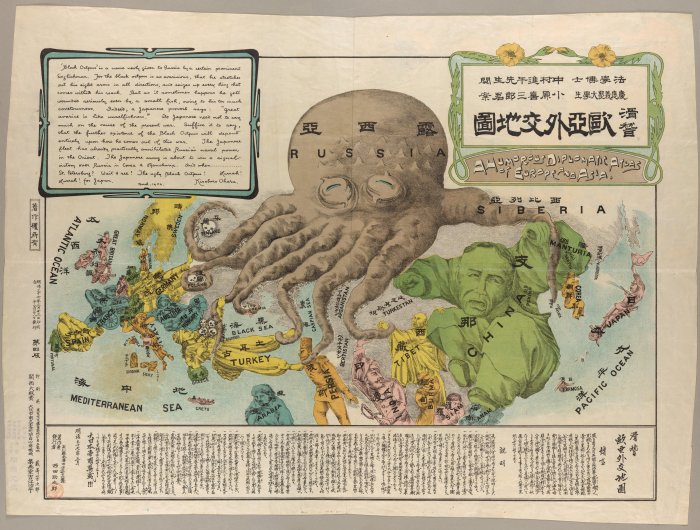
This dates from the late 19th or early 20th century. The Japanese won the Russo-Japanese War, but a quick glance at the casualties suggests it was more a pyrrhic victory for the Japanese.
Nightcap
- Responding to the challenge of modernization Branko Milanovic, globalinequality
- The Victorian Achievement Nick Nielsen, The View from Oregon
- The Warriors and Rockets win with defense Chris Herring, FiveThirtyEight
- An ignored, scary development in Israeli politics Michael Koplow, Ottomans and Zionists
Nightcap
- Gonzo philosophy Scott Bradfield, New Statesman
- Three contrarian opinions Scott Sumner, EconLog
- The dark, complicated reality of Tibetan Buddhism Mark Hay, Aeon
- AI and the limits of deep learning Robert Richbourg, War on the Rocks
Dictators who gave up power?
That’s the topic of my weekend column over at RealClearHistory, thanks to an extended email with Andrei. Here’s an excerpt:
10. King Juan Carlos I. Juan Carlos should be a household name in the West. The monarch of Spain upon dictator Francisco Franco’s death, Juan Carlos was expected to continue Franco’s legacy of authoritarian rule. After all, he received a military education in Spain under the Franco regime and had a clear claim to the throne (although the throne itself was a complicated legal matter). Furthermore, Juan Carlos was an active member of Franco’s staff, even stepping in to fill Franco’s void when the fascist began to fall ill due to old age. When Franco died, Juan Carlos began to dismantle the Franco regime and helped usher a smooth transition to democratic rule.
Please, read the rest.
 Notes On Liberty