- The rule of robots in Stiglitz and Marx Branko Milanovic, globalinequality
- Freud and property rights Bill Rein, NOL
- China at its limits: beyond its borders Joshua Bird, Asian Review of Books
- Who’s Afraid of Tribalism Blake Smith, Quillette
Author: Brandon Christensen
Nightcap
- Why did Israel attack the USS Liberty? Rick Brownell, Historiat
- Slouching toward Bethlehem Joyce Chaplin, Times Literary Supplement
- Looking back on the festivals of the Revolution Mike Follert, Age of Revolutions
- Beasts of Rebellion Jonathan Saha, Colonizing Animals
Nightcap
- The case against deporting immigrants convicted of crimes Ilya Somin, Volokh Conspiracy
- What happens when photographers turn their cameras on society’s outcasts? Joe Lloyd, 1843
- Trump’s dangerous game David Henderson, EconLog
- Indonesia clamps down on independence effort in Papua Joe Cochrane, NY Times
Eye Candy: the Arab world’s administrative divisions
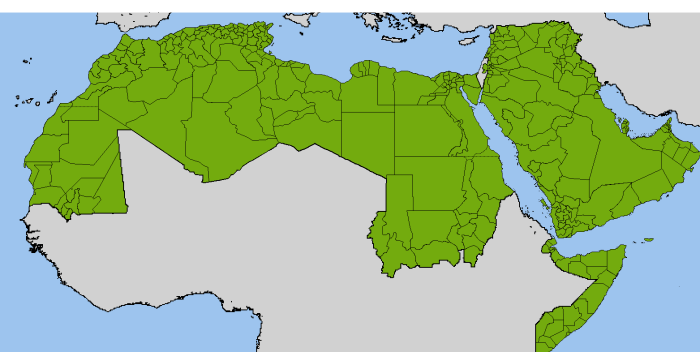
Imagine if these divisions were all states in a federal republic. Myself, I think some of them,maybe even half of them, could be combined, but if that ever happened, and the resulting combined administrative divisions of the Arab world federated, the region would be in much better shape. (The federation of Arabia would need a Senate, of course.)
What if the OECD did the same? Or simply the US and it’s closest allies?
Nightcap
- The Art of War re-translated and reconsidered Peter Gordon, Asian Review of Books
- Interview with Svetlana Alexievich (life behind the Iron Curtain) Julian Tompkin, Deutsche Welle
- Mutually nonconsensual sex (Title IX is a joke) Caitlin Flanagan, the Atlantic
- Reagan’s Right Turn George Nash, Modern Age
Nightcap
- Exquisite Rot: Spalted Wood and the Lost Art of Intarsia Daniel Elkind, Public Domain Review
- Classic books: Like ice in children’s hands Alberto Manguel, Times Literary Supplement
- Our aquatic universe Tim Folger, Aeon
- From eternity to here: the Rome we have lost Ingrid Rowland, Commonweal
RCH: the Ottoman Empire
My subject for this weekend’s RealClearHistory column is battles that shaped the Ottoman Empire. Here is an excerpt:
On June 4, 1915, the Third Battle of Krithia was fought between the Ottoman Empire and its Allied enemies, composed of mostly French and British troops. The Ottomans won, handily and somewhat surprisingly. The Allies had to retreat and regroup as a result, and the Balkans campaign had to go through a more careful re-think by Allied strategists.
World War I marked the end of the Ottoman Empire, of course, but the “sick man of Europe” had more fight in it than many Western historians give it credit for. Scholarship on the Ottoman Empire has improved over the years, but there is still plenty of opportunity to do more. The Ottoman Empire spanned three continents, after all, and lasted for 623 years.
The Ottoman Empire was actually one of three multi-ethnic, multi-religious empires in Europe that perished as a result of World War I, along with Austria-Hungary and tsarist Russia. To the east of the Ottomans were two other, long-lasting empires, the Persian empire ruled by the Qajar dynasty (which perished in 1925) and the Mughal empire of India (which perished in 1857). These eastern empires are referred to by many historians as “gunpowder empires” and they controlled the Eurasian trade routes that Chinese and especially European merchants used for exchanging goods and ideas. Here are 10 battles that shaped the Ottoman Empire:
Please, read the rest. And have a good weekend.
Nightcap
- Tech platforms and the knowledge problem Frank Pasquale, American Affairs
- Exploring the New Science of Psychedelics Mick Brown, Literary Review
- A new history of Islamic mysticism Kamal Gasimov, Voices on Central Asia
- Within the triangle of politics, philosophy, and religion Aurelian Craiutu, Law & Liberty
Nightcap
- Britain’s Open Doors Policy Chris Dillow, Stumbling and Mumbling
- About those Ancestry dot com commercials… Ryan Anderson, Anthro{dendum}
- The Unfinished World Nick Nielsen, The View from Oregon
- “State Capacity” is Sleight of Hand Bryan Caplan, EconLog
Nightcap
- The secrets of Katyn Louis Proyect, CounterPunch
- Europe’s curse of wealth Branko Milanovic, globalinequality
- The new Europeans Christopher de Bellaigue, NY Review of Books
- Nuclear diplomacy between Brazil and Argentina Sara Kutchesfahani, War on the Rocks
Nightcap
- When New York became a global metropolis Francis Morrone, City Journal
- Asia everywhere Peter Miller, Views
- The artist who was too empathic Kito Nedo, artnet
- Berlin’s Jewish revival Matthew Engel, New Statesman
Nightcap
- How Alan Shepard Became First American in Space Rick Brownell, Historiat
- Public Debt: a global perspective Livio di Matteo, Worthwhile Canadian Initiative
- Italian voters head for euro showdown Alberto Mingardi, Politico EU
- What good is religion? Manini Sheker, Aeon
Eye Candy: medieval trade networks
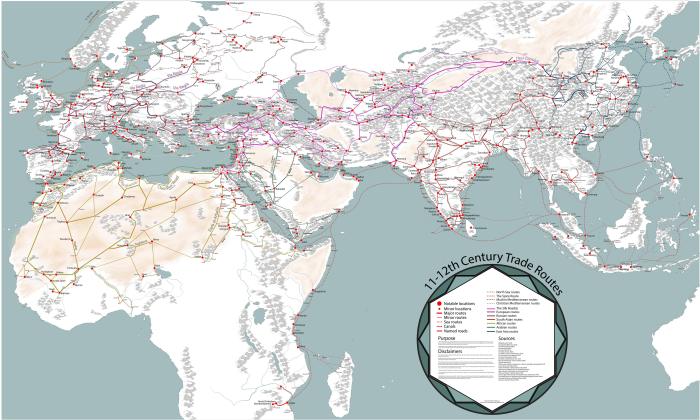
‘Nuff said, and don’t forget to zoom in!
Nightcap
- Are the “educated elite” even educated, or elite? David French, National Review
- Fired anti-Trump employee might have a First Amendment case Ken White, Popehat
- Just enough tears for Jean-Michel Basquiat Stuart Klawans, the Nation
- Indifferently Spacefaring Civilizations Nick Nielsen, Centauri Dreams
Nightcap
- Neo- and other liberalisms David Glasner, Uneasy Money
- How neoliberalism seeks to limit the power of democracies Patrick Iber, New Republic
- The Unacknowledged Success of Neoliberalism Scott Sumner, Econlib
- From oligarchy to republic: Lessons from the American South James H. Read, Law & Liberty

