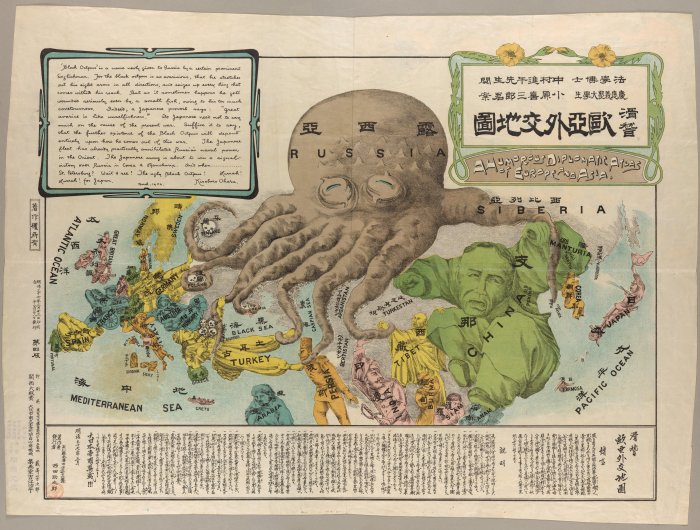
This dates from the late 19th or early 20th century. The Japanese won the Russo-Japanese War, but a quick glance at the casualties suggests it was more a pyrrhic victory for the Japanese.
This dates from the late 19th or early 20th century. The Japanese won the Russo-Japanese War, but a quick glance at the casualties suggests it was more a pyrrhic victory for the Japanese.
That’s the topic of my weekend column over at RealClearHistory, thanks to an extended email with Andrei. Here’s an excerpt:
10. King Juan Carlos I. Juan Carlos should be a household name in the West. The monarch of Spain upon dictator Francisco Franco’s death, Juan Carlos was expected to continue Franco’s legacy of authoritarian rule. After all, he received a military education in Spain under the Franco regime and had a clear claim to the throne (although the throne itself was a complicated legal matter). Furthermore, Juan Carlos was an active member of Franco’s staff, even stepping in to fill Franco’s void when the fascist began to fall ill due to old age. When Franco died, Juan Carlos began to dismantle the Franco regime and helped usher a smooth transition to democratic rule.
Please, read the rest.
My topic over at RealClearHistory today is the Mexican-American War and slavery, so be sure to show me a little extra love and have a peek. An excerpt:
The British, for their part, played an ingeniously devious role. London convinced Mexico to finally recognize Texas independence in 1845, as long as Texas agreed to avoid annexation by another sovereign polity. This put enormous pressure on factions in Washington, Austin, and Mexico City, so much so that Tyler, by then a lame-duck, urged Congress to put aside its differences and offer statehood to the Republic of Texas (which it did). In Austin, the process was a little trickier. The Congress of the Texan Republic had to vote on whether to be independent or to be annexed, but so did a newly-formed convention of elected delegates, which was one of the requirements imposed on Texas by the United States. (Washington felt that a convention of elected delegates better fit the profile of an incoming state than a Congress that had been independent for 10 years.) Both the Congress and the convention of delegates voted in favor of annexation over independence. The convention of delegates then drew up a state constitution, turned it over to the people of Texas to be ratified, and then sent it to Washington for Congressional acceptance. On Dec. 29, 1845, the U.S. Congress finally ratified statehood for Texas.
Please, read the rest. Annexation is a topic I will continue to explore, albeit from NOL rather than RealClearHistory, so stay tuned. “Entrance” is just as important as “exit” in libertarian theory, even though the latter gets all of the fame and fortune these days.
Speaking of entrances, I’d like to officially, warmly welcome Shree Agnihotri to the consortium and highlight her first thoughts with NOL: “Role of a Citizen in Hegemonic Authoritarianism.” I’m not going to spoil it for you, but it’s about Hannah Arendt, so if you haven’t read it yet, now would be a good time (don’t forget to say ‘hi’ while you’re at it). Here is her bio. Here is more from NOL on Hannah Arendt. I’m stoked to see what she has to say over the years!
Given all the time I wasted reading Marx, I’d say I lost big time. If I had it to do over again I’d read Grundrisse and stop.
This is from Terry Amburgey, a now-retired Professor of Management from the University of Toronto’s business school. He got his PhD from the same sociology program as Jacques.
Here is a link to Grundrisse (pdf), and note that Marx spends a good deal of time near the end of his manuscript on “the Frenchman,” Frédéric Bastiat. Oh, and Grundrisse has over 800 pages of reading in it.
That’s the subject of my weekend column over at RealClearHistory. An excerpt:
6. The Dutch Empire vied for supremacy with the Portuguese empire, which, beginning in 1580 with the Iberian Union of Spain and Portugal, was a rival Catholic state attempting to establish a global hegemony of its own. The Portuguese were actually the first Europeans to establish trading forts throughout the world, but the aforementioned Iberian Union severely weakened Lisbon’s plans for global hegemony due to the fact that the union made Portugal the junior partner. The Dutch conquered and then established colonial rule at Portuguese colonies on four different continents, and unlike the Portuguese, focused on commercial interests rather than converting the natives to Catholicism and creating a politically connected empire. Because of the commercial nature of the Dutch project, many of the indigenous factions were happy to switch from Portugal to the Netherlands as business partners. And partners they were. Both the Portuguese and the Dutch (as well as the British and French later on) paid rent to local political units on the trading forts they built throughout the world. Such was the nature of power on the world scene before the end of the Napoleonic Wars in the early 19th century.
Please, read the rest.