- James Madison won the shutdown Greg Weiner, Law & Liberty
- A Marxist defense of Venezuela Louis Proyect, Unrepentant Marxist
- Emergent complexity in a multi-planetary ecology Nick Nielsen, The View from Oregon
- Christian martyrs, marriage, and the Middle East Christian Sahner, Aeon
Author: Brandon Christensen
RCH: MacArthur’s rule over Japan
That’s the subject of my latest over at RealClearHistory. An excerpt:
The relative graciousness of the American occupation of Japan led to the most peaceful and prosperous era in Japanese history. MacArthur’s governing strategy for a conquered people was so successful that it was aped by Washington in 2001 and 2003 when the United States invaded and occupied Afghanistan and Iraq. What went wrong? You could write a dissertation trying to answer that question, but the most straightforward answer is that Iraq and Afghanistan were not conquered. The governments of Kabul and Baghdad never officially surrendered to Washington, and they never really had the capacity to wage war the way that Japan was able to wage war on the United States.
As always, I appreciate the clicks…
Nightcap
- Anthony de Jasay, RIP Alberto Mingardi, EconLog
- A grim portrait of human nature Lou Marinoff, Footnotes to Plato
- The last Englishman Soni Wadhwa, Asian Review of Books
- What can history tell us about the future of international relations? Sørensen & Møller, OUPblog
Afternoon Tea: No Kakinomoto Hitomaro (1835)
From Japanese artist Katsushika Hokusai:
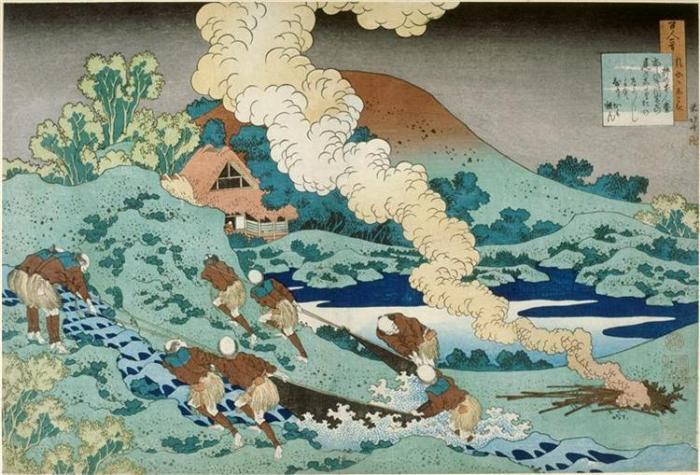
This one can be found at the Guimet Museum in Paris, in case you’re ever there…
Nightcap
- China’s foreign fighters problem Mathieu Duchâtel, War on the Rocks
- Your failure of imagination is not my problem Zoe Todd, anthro{dendum}
- Sustainable dystopia: a form of permanent stagnation Nick Nielsen, Grand Strategy Annex
- French is an Indian language Blake Smith, the Wire
Nightcap
- The plight of the political convert Corey Robin, New Yorker
- Fine grain futarchy zoning via Harberger taxes Robin Hanson, Overcoming Bias
- What happens to cognitive diversity when everyone is more WEIRD? Kensy Cooperrider, Aeon
- StarCraft is a deep, complicated war strategy game. Google’s AlphaStar AI crushed it. Kelsey Piper, Vox
Nightcap
- The internationalist disposition and US grand strategy Stephen Pampinella, Disorder of Things
- Let’s be blunt: classical liberalism is losing Johnathan Pearce, Samizdata
- On top tax rates Chris Dillow, Stumbling & Mumbling
- Are recessions about employment? Scott Sumner, Money Illusion
Afternoon Tea: Portrait of pianist and professor of Saint Petersburg Conservatory Sophie Menter (1887)
From Ilya Repin, a painter from the Russian Empire:

Nightcap
- Was Hayek a One-Worlder? Garreth Bloor, Law & Liberty
- George Washington’s maritime world BJ Armstrong, War on the Rocks
- Cable TV really does matter for political outcomes Tyler Cowen, Marginal Revolution
- Sovietology Sheila Fitzpatrick, London Review of Books
Freire’s book (in Portuguese) is up and it’s open access; Van de Haar’s glowing profile
Lucas had a busy, productive 2018 elsewhere, but he assures me that 2019 will be the year he gets back on track for blogging. I’ve uploaded his 2013 book on the rise of the state in the early modern period (“Do Império ao Estado: Morfologias do sistema internacional”) to the side bar, or you can access the whole thing here (pdf).
I don’t know about you, but I am really looking forward to Dr Freire’s thoughts!
Elsewhere, Garreth Bloor has paid a glowing tribute to Edwin’s lifelong work on international relations over at Law & Liberty. The context is in a review of Yoram Hazony’s recent book on nationalism, and I don’t actually agree with much of what Bloor says, but it’s really cool to see Edwin’s important work getting the attention it deserves.
Nightcap
- Don’t believe the myth that this is a nation of Little Englanders Alex Massie, CapX
- The American Greatness narrative: a look under the hood Samuel Goldman, Law & Liberty
- In South Africa, minorities are at risk (even though it’s Not Yet Genocide) Mpiyakhe Dhlamini, Rational Standard
- Military dictatorship in Brazil: was it worth it? Bruno Gonçalves Rosi, NOL
Afternoon Tea: The Calling of Saint Matthew (1600)
From Caravaggio, one of Jacques’ favorites:

Nightcap
- The marvel of the human dad Anna Machin, Aeon
- No exit? Scott Sumner, EconLog
- Big Water and Latin American borderlands Benjamin Nobbs-Thiessen, H-Borderlands
- The material power of ideas and knowledge Henry Farrell, Crooked Timber
RCH: Annexation of the Hawaiian islands
That’s the topic of my latest over at RealClearHistory. An excerpt:
That is to say, there are theoretical lessons we can draw from the American annexation of Hawaii and apply them to today’s world. The old Anglo-Dutch playbook turned out to serve American imperial interests well, especially when contrasted with the disastrous Spanish-American War of 1898, when the United States seized the Philippines, Cuba, Guam, and Puerto Rico from Spain in an unwarranted act of aggression. Hawaii, now an American state, has one of the highest standards of living in the world (including for its indigenous and Japanese citizens), while the territories seized by the U.S. from Spain continue to wallow in relative poverty and autocratic governance.
Please, read the rest.
Nightcap
- The Chinese governance system: impressive strengths and appalling flaws Pradnab Bardhan, 3 Quarks Daily
- Time to make good on the US-Philippine alliance Poling & Sayers, War on the Rocks
- Secession and international alliances go together Edwin van de Haar, NOL
- Maps and legends John Holbo, Crooked Timber
 Notes On Liberty