On the popularity of economic history

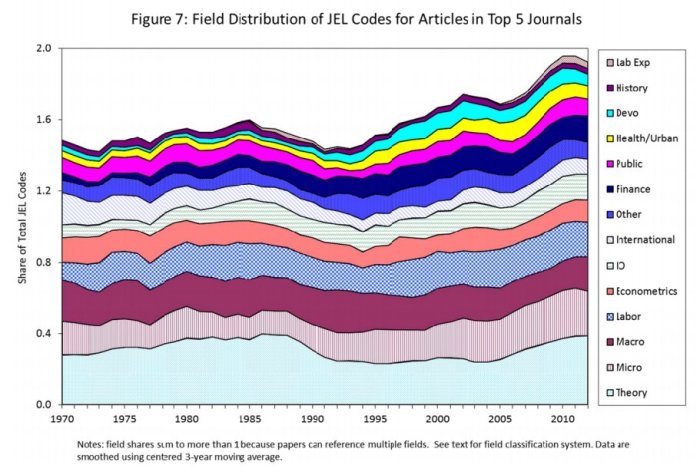
I recently engaged in a discussion (a twittercussion) with Leah Boustan of Princeton over the “popularity” of economic history within economics (depicted below).  As one can see from the purple section, it is as popular as those hard candies that grandparents give out on Halloween (to be fair, I like those candies just like I do economic history). More importantly, the share seems to be smaller than at the peak of 1980s. It also seems like the Nobel prize going to Fogel and North had literally no effects on the subfield’s popularity. Yet, I keep hearing that “economic history is back”. After all, the Bates Clark medal went to Donaldson of Stanford this year which should confirm that economic history is a big deal.  How can this be reconciled with the figure depicted below?
EconomicHIstoryData

As I explained in my twittercussion with Leah, I think that there is a popularity for using historical data. Economists have realized that if some time is spent in archives to collect historical data, great datasets can be assembled. However, they do not necessarily consider themselves “economic historians” and as such they do not use the JEL code associated with history.  This is an improvement over a field where Arthur Burns (former Fed Chair) supposedly said during the 1970s that we needed to look at history to better shape monetary policy. And by history, he meant the 1950s. However, while there are advantages, there is an important danger which is left aside.

The creation of a good dataset has several advantages. The main one is that it increases time coverage. By increasing the time coverage, you can “tackle” the big questions and go for the “big answers” through the generation of stylized facts. Another advantage (and this is the one that summarizes my whole approach) is that historical episodes can provide neat testing grounds that give us a window to important economic issues. My favorite example of that is the work of Petra Moser at NYU-Stern. Without going into too much details (because her work was my big discovery of 2017), she used a few historical examples which she painstakingly detailed in order to analyze the effect of copyright laws. Her results have important ramifications to debates regarding “science as a public good” and “science as a contribution good” (see the debates between Paul David and Terence Kealey on this in Research Policy for this point).

But these two advantages must be weighted against an important disadvantage which Robert Margo has warned against in a recent piece in Cliometrica.  When one studies economic history, one must keep in mind that two things must be accomplished simultaneously: to explain history through theory and bring theory to life through history (this is not my phrase, but rather that of Douglass North). To do so, one must study a painstaking amount of details to ascertain the quality of the sources used and their reliability.  In considering so many details, one can easily get lost or even fall prey to his own prior (i.e. I expect to see one thing and upon seeing it I ask no question). To avoid this trap, there must be a “northern star” to act as a guide. That star, as I explained in an earlier piece, is a strong and general understanding of theory (or a strong intuition for economics). To create that star and give attention to details is an incredibly hard task and which is why I argued in the past that “great” economic historians (Douglass North, Deirdre McCloskey, Robert Fogel, Nathan Rosenberg, Joel Mokyr, Ronald Coase (because of the lighthouse piece), Stephen Broadberry, Gregory Clark etc.) take a longer time to mature. In other words, good economic historians are projects that have have a long “time to build problem” (sorry, bad economics joke).  However, the downside is that when this is not the case, there are risks of ending up with invalid results that are costly and hard to contest.

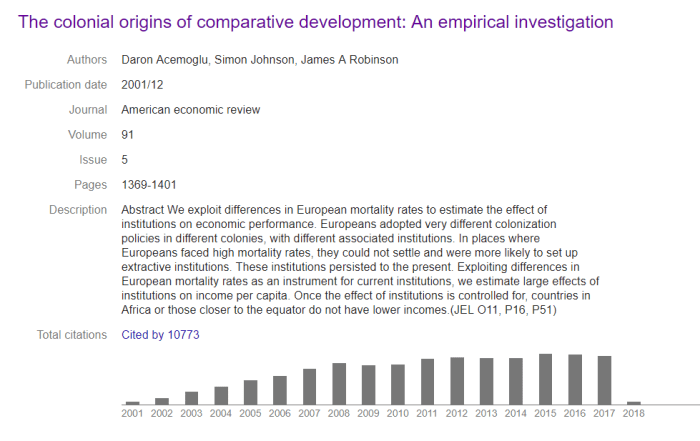
Just think about the debate between Daron Acemoglu and David Albouy on the colonial origins of development. It took more than five years to Albouy to get his results that threw doubts on Acemoglu’s 1999 paper. Albouy clearly expended valuable resources to get the “details” behind the variables. There was miscoding of Niger and Nigeria, and misunderstandings of what type of mortalities were used.  This was hard work and it was probably only deemed a valuable undertaking because Acemoglu’s paper was such a big deal (i.e. the net gains were pretty big if they paid off). Yet, to this day, many people are entirely unaware of the Albouy rebuttal.  This can be very well seen in the image below regarding the number of cites of the Acemoglu-Johnson-Robinson paper on an annual basis. There seems to be no effect from the massive rebuttal (disclaimer: Albouy convinced me that he was right) from the Albouy piece.
AcemogluPaperCites

And it really does come down to small details like those underlined by Albouy. Let me give you another example taken from my work. Within Canada, the French minority is significantly poorer than the rest of Canada. From my cliometric work, we now know that there were poorer than the rest of Canada and North America as far as the colonial era. This is a stylized fact underlying a crucial question today (i.e. Why are French-Canadians relatively poor).  That stylized fact requires an explanation. Obviously, institutions are a great place to look. One of the institution that is most interesting is seigneurial tenure which was basically a “lite” version of feudalism in North America that was present only in the French settled colonies. Some historians and economic historians argued that there were no effects of the institutions on variables like farm efficiency.  However, some historians noticed that in censuses the French reported different units that the English settlers within the colony of Quebec. To correct for this metrological problem, historians made county-level corrections. With those corrections, the aforementioned has no statistically significant effect on yields or output per farm. However, as I note in this piece that got a revise and resubmit from Social Science Quarterly (revised version not yet online), county-level corrections mask the fact that the French were more willing to move to predominantly English areas than the English were willing to predominantly French areas. In short, there was a skewed distribution. However, once you correct the data on an ethnic composition basis rather than on the county-level (i.e. the same correction for the whole county), you end with a statistically significant negative effect on both output per farm and yields per acre. In short, we were “measuring away” the effect of institutions. All from a very small detail about distributions. Yet, that small detail has supported a stylized fact that the institution did not matter.

This is the risk that Margo speaks about illustrated in two examples. Economists who use history merely as a tool may end up making dramatic mistakes that will lead to incorrect conclusions. I take this “juicy” quote from Margo (which Pseudoerasmus) highlighted for me:

[EH] could become subsumed entirely into other fields… the demand for specialists in economic history might dry up, to the point where obscure but critical knowledge becomes difficult to access or is even lost. In this case, it becomes harder to ‘get the history right’

Indeed, unfortunately.

On the point of quantifying in general and quantifying for policy purposes

Recently, I stumbled on this piece in Chronicle by Jerry Muller. It made my blood boil. In the piece, the author basically argues that, in the world of education, we are fixated with quantitative indicators of performance. This fixation has led to miss (or forget) some important truths about education and the transmission of knowledge. I wholeheartedly disagree because the author of the piece is confounding two things.

We need to measure things! Measurements are crucial to our understandings of causal relations and outcomes.  Like Diane Coyle, I am a big fan of the “dashboard” of indicators to get an idea of what is broadly happening.  However, I agree with the authors that very often the statistics lose their entire meaning. And that’s when we start targeting them!

Once we know that this variable becomes the object of target, we act in ways that increase this variable. As soon as it is selected, we modify our behavior to achieve fixed targets and the variable loses some of its meaning. This is also known as Goodhart’s law whereby “when a measure becomes a target, it ceases to be a good measure” (note: it also looks a lot like the Lucas critique).

Although Goodhart made this point in the context of monetary policy, it applies to any sphere of policy – including education. When an education department decides that this is the metric they care about (e.g. completion rates, minority admission, average grade point, completion times, balanced curriculum, ratio of professors to pupils, etc.), they are inducing a change in behavior which alters the significance carried by this variable.  This is not an original point. Just go to google scholar and type “Goodhart’s law and education” and you end up with papers such as these two (here and here) that make exactly the point I am making here.

In his Chronicle piece, Muller actually makes note of this without realizing how important it is. He notes that “what the advocates of greater accountability metrics overlook is how the increasing cost of college is due in part to the expanding cadres of administrators, many of whom are required to comply with government mandates(emphasis mine).

The problem he is complaining about is not metrics per se, but rather the effects of having policy-makers decide a metric of relevance. This is a problem about selection bias, not measurement. If statistics are collected without an intent to be a benchmark for the attribution of funds or special privileges (i.e. that there are no incentives to change behavior that affects the reporting of a particular statistics), then there is no problem.

I understand that complaining about a “tyranny of metrics” is fashionable, but in that case the fashion looks like crocs (and I really hate crocs) with white socks.

A free press, the Left, and the FBI

I taught for thirty years. That makes me an expert on verbal dishonesty. I can tell the difference between a student who let the dog eat his assignment and a student who made his dog eat his assignment.

And, I am saying this in connection to?

I am eager to read the Democrats’ and, perhaps, the FBI’s rejoinder to the memo they described as riddled with falsehoods and with omissions. I have some expectation that they will dig themselves in deeper when they try to make up for the omissions. You read it here first; please, give me credit.

The NYT and the Washington Post are on editorial record asking for prior censorship on the famous memo. It’s unheard of in times of peace. Two major leftist newspapers asked the government to violate the First Amendment, the very constitutional disposition that guarantees freedom of the press. The rank and file “liberals” I know and pay attention to in real life and on Facebook also fought transparency, in this case. Myself, and the conservatives I know, want the full sunlight on this and related matters.

I saw on CNN that House Representatives oppose releasing the Democrats’ rejoinder or version of the same memo. If that’s true (if), I am totally against this stance. I want to know everything; I don’t need babysitting of any kind.

In health care, expenditures to GDP may be misleading!

In debates over health care reform in the US, it is frequent for Canada’s name to pop up in order to signal that Canada is spending much less of its GDP to health care and seems to generate relatively comparable outcomes. I disagree.

Its not that the system presently in place in the US is so great, its that the measure of resources expended on each system is really bad. In fact, its a matter of simple economics.  Imagine two areas (1 and 2), the first has single-payer health care, the other has fully-private health care.

In area 2, prices ration access to health care so that people eschew visits to the emergency room as a result of a scraped elbow. In area 1, free access means no rationing through price and more services are consumed. However, to avoid overspending, the government of area 1 has waiting lists or other rationing schemes. In area 2, which I have presented as an ideal free market for the sake of conversation,  whatever people expend can be divided over GDP and we get an accurate portrait of “costs”. However, in area 1, costs are borne differently – through taxes and through waiting times. As such, comparing what is spent in area 1 to what is spent in area 2 is a flawed comparison.

So when we say that Canada spends 10.7% of GDP on health care (2013 numbers) versus 17.1% of GDP in the US, is it a viable comparison? Not really.  In 2008, the Canadian Medical Association produced a study evaluating the cost of waiting times for four key procedures : total joint replacement surgery, cataract surgery, coronary artery bypass
graft (CABG) and MRI scans. These procedures are by no means exhaustive and they concern only “excessive” waiting times (rather than the whole waiting times or at least the difference with the United States). However, the CMA found that, for the 2007 (the year they studied), the cost of waiting was equal to 14.8$ billion (CAD).  Given the size of the economy back in 2007, this represented 1.3% of GDP. Again, I must emphasize that this is not an exhaustive measure of the cost of waiting times. However, it does bring Canada closer to the United States in terms of the “true cost” of health care.  Any estimate that would include other wait times would increase that proportion.

I know that policy experts are aware of that, but it is so frequent to see comparisons based on spending to GDP in order to argue for X and Y policy as being relatively cheap.  I just thought it was necessary to remind some people (those who decide to read me) that prudence is mandatory here.

What should universities do?

The new semester is here so it’s time for me to figure out what the hell I’m supposed to be doing in the weird world of modern American university life. Roughly speaking, the answer is going to be “do the stuff that professors do to help universities do what universities do.” So what do universities do? What are they supposed to do?

Universities occupy a few different niches in society. I’m usually tempted to think of universities like a business. And in that framework, I justify my salary by providing something of value to those students. At my school, something like 90% of the operating budget comes out of students’ pockets.

But that’s an overly narrow view. Students pay to go to school because they expect they’ll get value from it, but they also go to school because them’s the rules–if you want to enter adult society, university is the front gate. In this framework, I justify my salary by serving as a gatekeeper. Even though it’s students paying, the (nebulous) principal I’m obliged to is the collection of people already inside the walls.

But wait! There’s more! Universities are (in no particular order):

  • A repository of knowledge,
  • A generator of new knowledge,
  • A place people go to learn,
  • A place people go to prove themselves,
  • A place people make friends and have fun (in a way that may be hard to replicate),
  • A business (engaging in mutually beneficial exchange),
  • A special interest group,
  • An institution that holds a particular (privileged) position in a wider cultural landscape.

Any one of these functions is a can of worms in its own right. When we start to consider tradeoffs between each function (and the many less visible functions I’ve surely missed), it gets downright intractable. I’m going to focus on the student-focused aspects of university life.

The mainstream view:

University is a place students get educated. This education helps them get jobs because employers value it. Students might also learn things that help them be better citizens.

The mainstream view doesn’t seem far off from what I’ve got in mind until you get your hands dirty and start disentangling what that view says. Here are three big problems inherent in that mainstream view:

  1. The education-for-job myth.
  2. The definition problem.
  3. The one-size-fits-all problem.

The Job-training myth

We’re told that students go to school to learn valuable skills. I think that’s true, but not in the usual way. Any specific skills students learn in school are a) incredibly general, or b) out of date. My students might learn some interesting ways of looking at the world (general knowledge), but a lot of what I teach is completely useless in the workforce (“Johnson, draw me a demand curve, stat!”). But students do learn valuable skills incidentally. They learn to manage their time (ideally), how to be conscientious, and in general they’re socialized so that they can fit in with adult society.

Lately I’ve been thinking of college as a form of upfront consulting. Instead of going to school when you’ve got a specific problem to solve, go when you’re young and have nothing better to do. Since you’re getting the consulting before you know what sort of problems you’ll face in the future, we couldn’t possibly give you exactly the right bundle of knowledge.

College exposes students to lots of different ideas that might combine in unexpected ways. Your class in underwater basket weaving might seem like a waste of time until some day 30 years later you are trying to solve some problem that turns out to make a lot more sense if you think of it like wet wicker (I’m looking at you civil engineers!).

Some of what I (and my colleagues) do helps prepare students for their careers, but mostly I’m trying to help them be better–better thinkers, better able to understand and appreciate, better able to enjoy life.

The definition problem

The word “Education” means a lot of things to a lot of people. More often than not, people use the word without being clear about what they mean. Often it means “job training.” Sometimes it means “enlightening.” Other times it means “making you agree with me.” In practice, it means surviving enough classes that you get a piece of paper indicating as much.

It should be recognized as a vague and nebulous word instead of being pigeonholed. It isn’t a binary state (I was ignorant, now I’m educated). It’s helpful to think of people as being more or less educated, but the state of your education isn’t something we can really objectively compare to my state of education.

There are lots of important but nebulous things in our lives: health, happiness, moral worth. Their vagueness makes them difficult, but it isn’t going away.

It isn’t hard to convince people that education is nebulous, but it is hard to get people to behave as though they really understand that.

Homogenization and commodification

Once people start thinking of education as some objective thing we can pull off a shelf and give to someone, we run into the real problems. This unexamined view leads to bureaucracies that attempt to standardize and commodify education.

Don’t get me wrong, I get why people would try to do this. We want everyone to get education (and moral training, and good health, and…). And as long as we’re worried about that, we’re going to worry about making sure everyone gets the best education possible. But “the best” gives the false impression that there’s one right answer.

A top-down approach isn’t the right way to achieve the goal of widespread education. Attempting to systematically scale up education provision kills the goose that lays the golden eggs. We should fight against attempts to commodify university (which currently happens via accreditation-as-gateway-to-subsidy and the general expansion of bureaucracy through administration).

So what should universities do?

There are different margins on which we can justify our existence, but it’s not obvious how to balance our tasks: teaching, researching, advocating, etc.. Given the high degree of uncertainty, I’d argue for pluralism… different schools (and professors) should be trying different things. As universities adapt to the future, it’s important that they don’t all try to adapt in the same way at the same time.

I think a big part of the problem is that we’ve been too successful at rent seeking. All money/privilege/goodies comes with strings attached, and more money comes with more strings. We’re always going to get a little tangled up in those strings, but in the last couple generations we’ve hamstrung ourselves. Accreditation and assessment have become the most important things a modern university does, which distracts from our more fundamental goals.

A bottom up approach doesn’t mean less education, just different education. A more modest education system would change the mix of costs and benefits faced by stakeholders. Employers might rely less on degree signalling, which means hiring managers and potential employees exercising more judgement in sending and evaluating quality signals. I don’t know exactly what would happen, but flexibility is valuable for the nebulous goals universities are supposed to be pursuing.

But at the moment we seem to be in an equilibrium. Students are expected to go to school, schools are expected to deliver on promises they can’t really fulfill, and we go through the motions of keeping schools accountable in a way that basically misses the point.

So what will I do this semester? I’m going to keep talking about interesting stuff to students. I’m going to keep working towards getting tenure. But I’m also going to quietly subvert attempts to commodify university.


Lunchtime Links

  1. Nation-Building, Nationalism and Wars [pdf] | Would A Libertarian Military Be More Lethal?
  2. Formal or Informal, Legal or Illegal: The Ambiguous Nature of Cross-border Livestock Trade in the Horn of Africa [pdf] | A note on the police or – “Why I don’t trust the police.”
  3. Political Cleavages and Changing Exposure to Trade [pdf] | Slowly debunking the trade leads to peace fallacy
  4. Realism, Liberalism and the Iraq War [pdf] When Should Intellectuals be held Accountable for Popular Misrepresentations of their Theories?
  5. High-Value Work and the Rise of Women: The Cotton Revolution and Gender Equality in China [pdf] | When (Where and Why) Women Were More Literate than Men

On Monopsony and Legal Surroundings

A few days ago, in reply to this December NBER study, David Henderson at EconLog questioned the idea that labor market monopsonies matter to explain sluggish wage growth and rising wage inequality. Like David, I am skeptical of this argument. However, I am skeptical for different reasons.

First, let’s point out that the reasoning behind this story is well established (see notably the work of Alan Manning). Firms with market power over a more or less homogeneous labor force which must assume a disproportionate amount of search costs have every incentive to depress wages. This can lead to reductions in growth as, notably, it discourages human capital formation (see these two papers here and here as examples). As such, I am not as skeptical of “monopsony” as an argument.

However, I am skeptical of “monopsony” as an argument. Well, what I mean is that I am skeptical of considering monopsony without any qualifications regarding institutions. The key condition to an effective monopsony is the existence of barriers (natural and/or legal to mobility). As soon as it is relatively easy to leave a small city for another city, then even a city with a single-employer will have little ability to exert his “market power” (Note: I really hate that word). If you think about it simply through these lenses, then all that matters is the ability to move. All you need to care about are the barriers (legal and/or natural) to mobility (i.e. the chance to defect).

And here’s the thing. I don’t think that natural barriers are a big deal. For example, Price Fishback found that the “company towns” im the 19th century were hardly monopsonies (see here, here, here and here). If natural barriers were not a big deal, they are certainly not a big deal today. As such, I think the action is largely legal. My favorite example is the set of laws adopted following the Emancipation of slaves in the United States which limited the mobility (by limiting the chances of Northerners hiring agents to come who would act as headhunters in the South). That is a legal barrier (see here and here). I am also making that argument regarding the institution of seigneurial tenure in Canada in a working paper that I am reorganizing (see here).

What about today? The best example are housing restrictions? Well, housing construction and zoning regulations basically make the supply of housing quite inelastic. The areas where these regulations are the most severe are also, incidentally, high productivity areas. This has two effects on mobility. The first is that low-productivity workers in low-productivity areas cannot easily afford to move to the high-productivity area. As such, you are reducing their options of defection and increasing the likelihood that they will not look. You are also reducing the pool of places to apply which means that, in order to find a more remunerative job, they must search longer and harder (i.e. you are increasing their search costs). The second effect is that you are also tying workers to the areas they are in. True, they gain because the productivity becomes capitalized in the potential rent from selling any property they own. However, they are in essence tied to the place. As such, they can be more easily mistreated by employers.

These are only examples. I am sure I could extend the list to reach the size of the fiscal code (well, maybe not that much). The point is that “monopsony” (to the extent that it exists) is merely a symptom of other policies that either increase search costs for workers or reduce the number of options for defections. And I do not care much for analyzing symptoms.

Worth a gander

  1. the term ‘hippie trail’ began to circulate in the late 1960s: it referred principally to the long route from London (or sometimes Amsterdam) to Katmandu.| The Protestant Reformation and freedom of conscience

  2. Flags, Chinese Pirates, and the American Navy | Naval power and trade

  3. Xi Jinping is looking more and more like Mao | The legacy of autocratic rule in China

  4. that time when North Korea saved Benin from a coup led by mercenaries | The re-privatization of security

  5. how Brexit has reopened old Irish wounds | Credit and the Great Famine of Ireland

Paul Romer, the World Bank and Angus Deaton’s critique of effective altruism

220px-Paul_Romer_in_2005

Last week Paul Romer crashed out of his position as Chief Economist at the World Bank. He had already been isolated from the rest of the World Bank’s researchers for criticizing the reliability of their data. It seems there were several bones of contention, including the accusation that Chile’s current social democratic government falsified data contributing to some of its development indicators. Romer’s allergic reaction to the World Bank’s internal research processes has wider implications for how we think about policy research in international NGOs.

Continue reading

Is Trump turning the US into the Biggest Loser?

US President Donald Trump has been quick to change his stance on complex issues like US relations with other countries, including China. Trump has also been unpredictable in his approach towards important multilateral organizations like the North Atlantic Treaty Organization (NATO) and US ties with important allies in the Indo-Pacific, especially Japan and South Korea.

The most recent instance of Trump yet again changing his views was his statement on the Trans Pacific Partnership (TPP) during the Davos Summit, saying that the US was open to a rethink, provided the provisions were fair. While the US pulled out of the TPP agreement much to the chagrin of other signatories, eleven countries (they are, in alphabetical order, Australia, Brunei, Canada, Chile, Japan, Malaysia, Mexico, New Zealand, Peru, Singapore and Vietnam) have agreed on signing the deal in March in Chile.

While speaking at Davos, Trump said that the US was not averse to negotiating trade deals with its TPP partners. In an interview with CNBC, on the eve of his address, the US President had said:

….we would do TPP if we were able to make a substantially better deal. The deal was terrible, the way it was structured was terrible. If we did a substantially better deal, I would be open to TPP.

The US President sensed the pitch at Davos, which was firmly in favor of globalization and a more open economic world order. During his address, while speaking of American interests, Trump made it a point to state that watching out for US interests did not imply that his administration would prefer America to become more insular. Said the US President:

America First does not mean America alone. When the United States grows, so does the world. American prosperity has created countless jobs all around the globe and the drive for excellence, creativity, and innovation in the US has led to important discoveries that help people everywhere live more prosperous and far healthier lives.

Mr Trump is not the only world leader to have won competitive elections by appealing to insularity, only to realize that economic interdependence between countries today is incredibly entrenched. For instance, Indian PM Narendra Modi, while arguing in favour of globalization, had said:

Instead of globalization, the power of protectionism is putting its head up.

Modi had gone to the extent of saying that inward looking tendencies were an important challenge, arguing that:

 …such tendencies can’t be considered lesser risk than terrorism or climate change.

Interestingly, Modi’s remarks on globalisation were welcomed by the Chinese, with the Chinese Foreign Ministry spokesman, Hua Chunying, arguing in favour of China and India working together to promote globalisation. Said Hua:

China would like to enhance coordination and cooperation with all countries including India to steer the economic globalisation towards benefiting world economic growth and well-being of all countries.

Last year in his address at the Davos Summit, Chinese President Xi Jinping had spoken in favour of globalization, saying:

Pursuing protectionism is like locking oneself in a dark room […] Wind and rain may be kept outside, but so is light and air.

While some flexibility is welcome, excessive unpredictability and Trump’s woolly approach on serious issues is confusing the outside world. A business-like approach is good to an extent, but to deal with complex geostrategic issues purely from the prism of US short-term financial interests as opposed to long term geopolitical interests is a disastrous idea.

Every country has to watch its own interests, and the US is no exception, and there is absolutely no doubt that domestic public opinion cannot be ignored. Yet if the US wants to be a leader, it cannot be as transactional as Trump. US dreams of a “Free and Open Indo-Pacific” – a key aim of the US Defense Strategy – will remain a mere dream if the US sends confusing signals to its allies in the region and is not willing to take a clear leadership role. While the Strategy identifies China as a threat, Trump’s continuous somersaults on relations with US allies are only emboldening Beijing.

While it is unfair to single out Trump for being insular he has been the mascot for inward looking protectionist economic policies and an anti-immigration sentiment. While the US President did tell the global audience at Davos that “America First does not mean America alone,” it will indeed end up alone if he does not start thinking like a US President.

Currently he is thinking purely like the head of a company, and running a business is different from running a country, which has long sought to be the flag bearer of democratic, liberal values and globalization. While Trump’s isolationism and short sightedness may cause some discomfort for other countries, and groupings like the TPP, the latter will find other alternatives as has been the case with the signatories of the TPP, and America will be the bigger loser.

The US Immigration Lottery

As I write, Democrats and Republicans are gearing up for a battle to transform an American immigration system that has changed little in fifty years. President Trump seems eager to alter both the number of immigrants and the nature of qualifications for immigration. His Democratic opponents call him “racist.” (Democratic extremists call anyone they don’t like “racist,” perhaps because they have exhausted all normal political insults.) The so-called “lottery” door to immigration is attracting special scorn from the president and from other high-ranking Republicans. Many in the general public, not well versed in matters of immigration, listen to the president’s attacks with perplexity or disbelief: a “lottery”? This short essay aims to throw light on the topic with a small number of figures.

In 2016 there were 1,200,000 admissions to permanent residency in the US. That’s the granting of the famous “green card” which gives one full rights to work, to go in and out of the country, but no political rights, no right to vote, and no right to be elected – until now. Permanent residency is not citizenship. This must be obtained later, separately after five or three years (the latter, for spouses of US citizens) in almost all cases. Nearly all legal residents who wish to eventually become American citizens.

“Admission” is a legal-bureaucratic term. Many of those so admitted have already been in the US, some for years, while their case was being processed. The number physically arriving in the US on that year is much larger because it includes tourists, students, and others who are supposed to be visitors staying only for a stated length of time. Immigrants are admitted on the basis of one of five broad categories:

Occupational/business qualification, family relationship to someone already legally in the US. (The latter actually includes two legal-bureaucratic categories. The distinction between the two need not concern us here.) This family-based category accounts for the bulk of legal immigration, 67% of the total in 2016. Refugees (and “asylees”) account for another large number that is variable from year to year. There is also a category “Others” which gathers a small number of odds and ends admissions otherwise not fitting into another category.

The most interesting basis for admission is the quaintly called “Diversity.” It’s an actual lottery. It’s a lottery without admission fee where one can play as often as one cares to. It contributed 50,000 admissions in 2016, or 4% of the total admitted. The number is so small that it hardly would seem to be worth the attention of policy makers, except perhaps when a lottery winner engages in spectacular criminal acts as happened in New York in the fall of 2017.

Once, in the late 80s, Senator Ted Kennedy discovered that immigration to the US included practically no Irish people. He got angry and, on the spot, devised a remedy that became – through his influence in Congress – the diversity lottery. I can’t guarantee this story is true but it’s plausible and its spirit explains well the existence of this strange anomaly.

The main reason some parts of the globe send few immigrants to the US is that most opportunities to do so are sucked up by the prevalence of immigration based on family status in other areas. It’s the result of a quasi-random starting point combined with chain immigration. Suppose a single young Mexican male manages to move to the US legally (worry not how). Within a couple of years he goes back to Mexico to get married. He brings his wife to the US. It turns out he already had a son in Mexico, from another woman. He brings the son over too. The couple has several children, all US born. Soon, they would like to have built-in babysitters. They bring in both of the wife’s parents and the husband’s surviving mother. So, in this unremarkable story, we go – in the space of less than ten years – from one immigrant from Mexico, to six. After a few more years, any of the foreign born adults may bring one or two more immigrants, including brothers and sisters. The US-born children can also bring in their Mexican uncles, aunts, and cousins, though it would take a long time. There is a natural snowball effect built into the system.

To the extent that Congress wishes to cap the total number of immigrants brought in (excluding refugees), national contingents that happened to be numerous early may monopolize a very large number of available immigration opportunities. This leaves the door almost closed to other nationalities that were not present in large numbers early. The purpose of the lottery is to improve the US immigration chances to people living in areas of the world that have been under-served for a little while. Accordingly, lottery slots are allocated among regions observed to be contributing a small number of immigrants by other means. The drawing occurs individual under-served region to under-served region. Each region corresponds more or less to a continent (distinguishing between South America and North America).

The lottery products are interesting. First, the lottery results in a frequency distribution of admissions by country of origin that would be difficult to predict in general. Second, it would be hard to forecast which countries would end up still undeserved. In 2016, lottery admissions included people from 152 countries. Only six countries passed the (arbitrary) bar of “diversity” lottery of 2,000 immigrants into the US. They were, by order of the magnitude of their immigrant contingent:

  • Egypt, Nepal, Iran, Congo (formerly Zaire), Uzbekistan, and Ethiopia.
  • Ukraine, with 1,915, almost made the cut.
  • In 2016 also, four Uruguayans qualified under the lottery (that’s 4, four units.)

Together, the core western European countries of Belgium, Denmark, France, Germany, Italy, Ireland, the Netherlands, Portugal, Spain, the United Kingdom, Sweden, and Norway, sent a grand total of 1,390 to the US under this qualification. That’s between 2 and 3% of the total diversity lottery winners. Although European countries do send immigrants to the US under other programs, Europe is classified as one of the under-served regions. It also turns out to be under-served by the lottery. In 2016, about one per thousand of the immigrants admitted to the US came from the conventionally defined core western European areas under an admission program intended to correct for under-representation. The Republic of Ireland produced 51 winners. Sen. Kennedy hardly got his way.

Anybody who calls the current American immigration system racist is out of his mind, probably dishonest as well as ignorant and, more likely, dishonestly ignorant. Inevitably, any forthcoming reform of American immigration laws is going to give results that will seem racist in comparison. Brace yourselves with facts!

All data from Homeland Security: Immigration Statistics and Data


I am an American sociologist by training, with a doctorate from a good university. I am also an immigrant and married to another immigrant, from another country. Together, we have two adopted children, both born abroad. I have lived in the US for fifty years. During that time, I have rarely been out of touch with immigration issues although they are not one of my subjects of systematic scholarly inquiry. Many other essays are here in Notes On Liberty and also on my blog: factsmatter.wordpress.com.

In the Search for an Optimal Level of Inequality

Recently, the blog ThinkMarkets published a post by Gunther Schnabl about how Friedrich Hayek’s works helped to understand the link between Quantitative Easing and political unrest. The piece of writing summarized with praiseworthy precision three different stages of Friedrich Hayek’s economic and political ideas and, among the many topics it addressed, it was mentioned the increasing level of income and wealth inequality that a policy of low rates of interest might bring about.

It is well-known that Friedrich Hayek owes the Swedish School as much as he does the Austrian School on his ideas about money and capital. In fact, he borrows the distinction between natural and market interest rates from Knut Wicksell. The early writings of F.A. Hayek state that disequilibrium and crisis are caused by a market interest rate that is below the natural interest rate. There is no necessity of a Central Bank to arrive at such a situation: the credit creation of the banking system or a sudden change of the expectancies of the public could set the market interest rate well below the natural interest rate and, thus, lead to what Hayek and Nicholas Kaldor called “the Concertina Effect.”

At this point we must formulate a disclaimer: Friedrich Hayek’s theory of money and capital was so controversial and subject to so many regrets by his early supporters – like said Kaldor, Ronald Coase, or Lionel Robbins – that we can hardly carry on without reaching a previous theoretical settlement over the apportations of his works. Until then, the readings on Hayek’s economics will have mostly a heuristic and inspirational value. They will be an starting point from where to spring new insights, but hardly a single conclusive statement. Hayekian economics is a whole realm to be conquered, but precisely, the most of this quest still remains undone.

For example, if we assume – as it does the said post – that ultra-loose monetary policy enlarges inequality and engenders political instability, then we are bound to find a monetary policy that delivers, or at least does not avoid, an optimal level of inequality. As it is explained in the linked lecture, the definition of such a concept might differ whether it depends on an economic or a political or a moral perspective.

Here is where I think the works of F.A. Hayek have still so much to give to our inquiries: the matter is not where to place an optimal level of inequality, but to discover the conditions under which a certain level of inequality appears to us as legitimate, or at least tolerable. This is not a subject about quantities, but about qualities. Our mission is to discover the mechanism by which the notions of fairness, justice, or even order are formed in our beliefs.

Perhaps that is the deep meaning of the order or equilibrium that it is reach when, to use the terminology of Wicksell and Hayek’s early writings, both natural and market interest rates are the same: a state of affairs in which the most of the expectancies of the agents could prove correct. The solution does not depend upon a particular public policy, but on providing an abstract institutional structure in which each individual decision could profit the most from the spontaneous order of human interaction.

In foreign affairs, don’t ignore “soft power”

Israeli Prime Minister Benjamin Netanyahu, during his 6 day visit to India (January 14-19, 2018), made some interesting points. While arguing in favor of the advantages of hard power over soft power, Netanyahu stated:

I like soft power, but hard power is usually better. You need F-35s (fighter jets), cyber, a lot of intelligence… Where does the power for hard power come from? It comes from economic power.

Interestingly, India in recent years, under current Prime Minister Narendra Modi, has been focusing on promoting its Soft Power through a number of ways such as popularizing Yoga (The United Nations declared June 21st as International Yoga Day), Ayurveda, reaching out to its Diaspora, and rekindling Buddhist linkages with neighbours in South Asia as well as South East Asian and East Asian countries including China.

Modi has reiterated the relevance of “soft power” on more than one occasion. Even in the context of India-Israel relations, soft power has played a key role. There have been efforts toward renovating historical sites of Jews in India, and there has been an outreach towards Jews of Indian origin now settled in Israel. There have been efforts to strengthen educational linkages between both countries. During the visit of Israeli President Reuven Rivlin in November 2016, MOU’s were signed between the Hafia University of Israel and the Welingkar Institute of Management (WeSchool), and IDC Herzliya, Israel with the SP Jain School of High Technology. The joint statement issued during Netanyahu’s visit to India also made references to the importance of people-to-people linkages, the opening of an Indian cultural centre in Israel in 2018, and an MOU in film co-production.

The point made by Netanyahu has been made by a number of realists. Joseph Nye, who first put forward the concept of “soft power” as being the ability to influence outcomes without the use of force, later on argued in favour of the right blend of “hard power” and “soft power,” dubbing it as “smart power”. Along with Richard Armitage, Nye even set up a Commission on Smart Power. The concept was of course popularized by Former Secretary of State Hillary Clinton, who at the confirmation hearing before the Senate Foreign Relations Committee in 2009, stated:

We must use what has been called smart power, the full range of tools at our disposal—diplomatic, economic, military, political, legal, and cultural—picking the right tool, or combination of tools, for each situation. With smart power, diplomacy will be the vanguard of our foreign policy.

While there is absolutely no doubt that economic and hard power does give an impetus to soft power, it is also a bit of a stretch to totally dismiss “soft power.” Many would argue for instance that apart from geopolitical factors, soft power did give an edge to the US over the USSR, and later on over China, for a very long time. In recent years, China has been trying to focus on “soft power,” so much so that in the past decade, a large number of Confucius Institutes have come up in different parts of the world (over 500 in around 140 countries) including roughly 100 in the US. Apart from this, China has been trying to attract foreign students, and also tourists from across the world. Even its ambitious connectivity project, One Belt One Road, which has clear economic motives, is being packaged as part of its “soft power.”

In conclusion, “soft power” cannot be a determining factor, but it does play a significant role in strengthening bilateral relations, as well as building a positive image for countries. While we live in an age where being transactional is confused with being a pragmatist/realist. US President Trump too has been dismissive of “soft power,” and by his insular approach towards immigration, and indifference towards democratic values he has given up on two of the essential components of American Soft Power. Dismissing “soft power” because it does not help in achieving any tangible outcomes is one of the shortcomings of such transactionalism, and is an excessively simplistic view of a very complex debate.

BC’s weekend reads

  1. What equivalent claims (if they could be established) would falsify your political position?
  2. White males may enjoy a great deal of privilege, but they still have rights, and when those rights are violated, they ought to be rectified.
  3. […] actually, the whole country of France is like an attractive museum that would have a superlative cafeteria attached.
  4. They worked hard to look like they weren’t working too hard.

SMP: The Macro Bifurcation

One of the major issues in contemporary macroeconomics concerns monetary policy since the 2008 crisis. For many, if not most, of the major central banks, the conventional channels through which the money supply changes do not work anymore. For instance, by paying interest on reserves, the Federal Reserve has moved from adjusting the money supply to influencing the banks’ money demand. Some central banks have even maintained that money supply does not affect inflation anymore.

Continue reading at the Sound Money Project.