New issues of Econ Journal Watch, Reason Papers out

Many of you already know that two of NOL‘s Senior Editors are associated with Econ Journal Watch, thus making its publication a family affair. Fred is on the editorial board and Warren is its math reader. Here are some of the highlights I found worth noting in the latest issue:

Eli Heckscher’s Ideological Migration Toward Market Liberalism: Benny Carlson explores the intellectual evolution of a great Swedish economist.

Symposium:
Classical Liberalism in Econ, by Country: Authors from around the world tell us about their country’s culture of political economy, in particular the vitality of liberalism in the original political sense, historically and currently, with special attention to professional economics as practiced in academia, think tanks, and intellectual networks.

New contributions:

Young Back Choi and Yong Yoon: Liberalism in Korea

Pavel Kuchař: Liberalism in Mexican Economic Thought, Past and Present

(All of the papers from this symposium, which has carried across multiple issues of EJW, are collected at this page.)

You can download the whole issue here (pdf).

Dr Khawaja, an Editor-at-Large for Reason Papersreports (2/2/16) on the latest issue over at Policy of Truth:

The latest issue of Reason Papers, vol. 37, number 2 is now out; officially, it’s the Fall 2015 issue, but we only just managed to put it up on the website last night. This link will take you to a monster-size PDF to the whole issue (almost 250 pages). This link will take you to the journal’s Archive page, where you can access individual articles for this or any past issue (you have to scroll down a bit). Finally, this link will take you to three (time sensitive) Calls for Papers issued by the journal’s editors: one on “the philosophy of play” (March 1, 2016); one a fifteen-year retrospective on 9/11 (July 1, 2016); and one an Authors-Meet-Critics symposium on Douglas Den Uyl and Douglas Rasmussen’s forthcoming book The Perfectionist Turn: From Meta-Norms to Meta-Ethics (February 1, 2017).

My own small contribution to Reason Papers can be found here (pdf).

The High Wage Economy: the Stephenson critic

A recent trend has emerged in economics. The claim is that high wages can have a dynamic positive effect on market economies.  The intuition is that high wages increase productivity because they incite management to find new techniques of production. In essence, its an argument about efficiency wages: efficiency wages increase incentives to innovate on the part of managers, they can also incite workers to acquire more human capital and work harder and more diligently.

In economic history, this claim has been taken up by scholars like Robert Allen (see his work here for the general public) who argues that the Industrial Revolution took place in England because of high wages. The high-wages of England in the 17th and 18th centuries (relative to all other areas in Europe), together with cheap energy, created an incentive for capital-intensive methods of production (i.e. the industrial revolution). In fact, a great share of the literature on the desirability of high wages for economic development has emanated from the field of economic history.

I have always been skeptical of this argument for two reasons. The first is that efficiency wages is a strange theory that relies on debatable assumptions about labor (strangely, I have been convinced of this point by Austrian scholars like Don Bellante and Pavel Ryksa). The second is that numerous scholars have advanced large criticisms of the underlying data. Robert Allen – the figurehead proponent of the high wage argument – has been constantly criticized by historians like Jane Humphries (see here) for the quality of the data and assumptions used. Allen defends himself on numerous occasions and many of his replies (mainly those on the role of family size in living standards) show that his initial case might have been too conservative (i.e. he is more “correct” than he claims).

Until a year or two ago, I was agnostic on the issue even though I was skeptical. That was until I met Judy Stephenson – a colleague at the London School of Economics. Judy did what I really like to do – dig for data (yes, I am weird like that). She went to the original sources of data used by Allen and others and she looked at what any Law-and-Economics buffs like me like to look at – transaction costs and contracting models.

She recently published her work as a working paper at the LSE and what she found is crucial! Labor was not hired directly, it was hired through contractors who charged costs on the basis of days worked. But this did not translate into wages actually paid to workers. The costs included risks and overheads for contractors. Somewhere between 20% and 30% of the daily costs were not given to workers as wages. Thus, the wage series used to claim that England (Stephenson concentrates on London though) had high wages are actually 20% to 30% below the level often reported. They are also substantially close to those in western Europe.

Thus, the high wage story for England seems weaker. This little piece of historical evidence brought about by Judy is something to think about carefully when one makes the argument that high wages are conducive to growth. Since most of the argument brought to the public was informed largely by this argument in economic history, it makes sense to be cautious when thinking about it in the future.

From the Comments: Sovereignty, the Commons, and International Relations

There have been a number of excellent discussions in the ‘comments’ threads these days. Dr Khawaja adds more depth to the discussion on Iran and foreign policy. Me and Chhay Lin are in the midst of a debate on democracy and libertarianism. Michelangelo’s post on splitting up California generated a good discussion. You can see what’s hot in the threads by looking to your right, of course. I wanted to highlight this ‘comment’ by Rick in the threads of Edwin’s recent post on liberalism and sovereignty:

“[S]overeignty is a constitutional idea of the rights and duties of the governments and citizens or subjects of particular states.”

To me, a constitution is like a contract. It’s close to set in stone and it lays out these rights and duties. But the idea of sovereignty Jackson is pointing toward in that quote would be better understood as laying out a sort of meta-prize; it’s a delineation of the commons that potential groups within that area may compete over or cooperate in. To be fair, a constitution is a similar sort of commons (especially when that constitution includes the right to collect tax and lead armies). The question of how to govern the commons is *the* question on the domestic side.

On the international end of things, anarcho-capitalism calls for muddying the borders of these commons. This has obvious costs and benefits: it makes the emergence of a productive polycentric order easier, but it also opens access to what would have been relatively closed commons. I think the missing piece in the world governance question, whether from a classical liberal, minarchist, or anarchist perspective is the question of how a polycentric order would emerge and function (e.g. standards associations, norms of arbitration/dispute resolution, etc.).

More discussion is needed on this point…

“Conflicts in South Asia Will Go On and On”

That is the title of my recent article (pdf) on the long-term effects that the British partition of its Indian colony has had on South Asia. Here is the abstract:

This brief article, an extended review of two recent important publications, problematises the continuity of inter-state and intra-state conflicts since the partition of British India in 1947. Territory and identity are the main triggers of those conflicts, many of which will remain, while others will take on new forms relating to resource scarcity, mainly water. Conflicts are unlikely to be settled fully through various interventions, as sub-dimensions will linger on, develop new roots and new issues will constantly crop up. The article argues that past, present and future are visibly and invisibly connected through the fallout of patterns of myth and memory, dissatisfaction with the status quo and present conditions and often completely unrealistic expectations of a better future. Identifying elements of interconnectedness as central, the review assesses the contributions these two new studies make for a deeper understanding of the scenario of continuing conflict within the context of South Asian Studies.

It’s been published by South Asia Research, and is pessimistic throughout…

NOL Foreign Policy Quiz, Part One

The goal of this post is to discuss the purpose of a NOL Foreign Policy Quiz. It is the first in a series of posts discussing the details of how to actually devise and distribute this quiz. Reader input is encouraged.


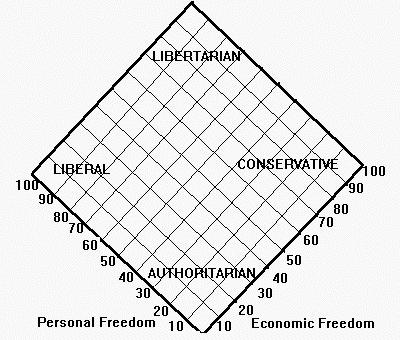
The Nolan Chart is a short political quiz developed by David Nolan, the Libertarian Party founder. The Nolan quiz plots individuals along two axes, asking them their preferences towards issues of personal and economic freedom (both Rick and Warren have blogged about the Nolan Chart here at NOL, too). Libertarians are those individuals who favor both personal and economic freedom.
nolanchart

The benefit of the Nolan Chart is that it moves us away from the left–right spectrum and towards a two-dimensional understanding of politics. The limitation of the Nolan Chart is that it only views politics through these two limitations. The Nolan Chart at best tells us what end policies we favor, but it fails to address how to achieve these goals.

This is problematic, as even political groups that agree on end goals differ substantially on how to best achieve them. Among libertarians, the largest debate is probably between those who believe a minimal state is needed (minarchists), and those who believe no state can be tolerated (market anarchists) to achieve maximum liberty. There is also, to a lesser extent, a debate on the form of government* and foreign policy.

It is possible to be a libertarian and believe that monarchy is superior to republicanism or democracy in upholding the law and maximizing liberty. Likewise, it is possible to be a libertarian and desire an active foreign policy beyond promoting free trade agreements. I know that I stir controversy with my latter comment, but give me a moment to defend it.

The standard libertarian foreign policy is one of non-intervention. It is a policy of wishing to sever military ties with foreign nations and instead promoting free trade with all. It is a policy consistent with the non-aggression principle.

However, this standard policy is not the only policy consistent with libertarianism. It is possible to believe that, although the loss of any human life is horrible and that the state is illegitimate, the best option to minimize human life and protect liberty is to attack, embargo, or annex another state.

I do believe that there are several tests that must be met before one adopts a foreign policy beyond the standard libertarian creed. Specifically:

  1. Loss of human life and liberty must be weighed for both sides.
    1. Discounting should not occur on national basis.
  2. All reasonable peaceful solutions must be acted on beforehand.
  3. The long-term consequences of the action must be considered and weighed for both sides.

Additionally, if actions are taken, then all precautions must be taken to minimize loss of human life and liberty on both sides.

Minarchist libertarians may see the state as a tool to maximize freedom, but I do not believe this grants them the authority to kill others. There may be a scenario where the murder of one man is outweighed by it leading to the protection of ten men, but the one man has still been murdered and his death must be felt as a regrettable action. The value of a man is not dependent on whether he was born in New York City or Tehran. A libertarian cannot be a jingoist.

At no point may a foreign policy action be taken if a reasonable peaceful action is still available. If a man enters your home with a gun and clearly intends to harm you, by all means it is justified to attack him, even if he has not yet shot or aimed at you.

And finally, the long-term consequence of a foreign policy action must be considered. Even if the first two rules are met, if there is not a long-term plan that is likely to succeed, no action should be taken.

For a long time, I wrestled with my stance on the Iraq war. I believed in the past that the first two requirements had been met and that the US invasion of Iraq was justified despite the loss of life and liberty on both sides. The Iraq war did not, however, meet the third hurdle. There was no viable long-term plan, and the latest consequence of this is the rise of ISIS and other militant groups in the MENA region.

Meeting these three conditions is difficult, but possible.

For example, I believe that expanding the US to include South Korea and Japan would be a proactive foreign policy stance consistent with my the rules I outlined above. Such an expansion would harm Okinawan residents, whose land is currently used for US bases. Such an expansion would also lead to retaliation from the PRC and North Korea. It would, however, lead to a net win for liberty. South Koreans and Japanese residents would have a stronger defense against a rising PRC seeking to dominate the region militarily. US residents would benefit from having defense costs, both in monetary and human life terms, more equitably shared. Although I am hopeful the PRC will liberalize in the future, its actions towards Hong Kong makes me doubtful that that will occur in the foreseeable future.

It is possible that I am wrong of course, and that adding South Korea and Japan would lead to a great loss of life and/or liberty. I am still a libertarian, however. I am not discounting the lives or liberty of non-US residents. I am not ignoring another peaceful solution – the current foreign policy scenario in East Asia is not sustainable for much longer, the PRC has clear intent to assert itself in the region, and it’s extremely doubtful that it will liberalize in the foreseeable future. I am considering the future: the PRC and North Korea are sure to retaliate, but I do not see either of them going to war over it. I do see the PRC being more likely to go to war over annexing Taiwan, even if not immediately, or otherwise I would promote Taiwanese annexation as well.

Hopefully I have successfully shown that it is possible to be a libertarian and favor a policy beyond the standard libertarian foreign policy. In which case, there is merit in discussing foreign policy beyond this standard.

There have been proposals to incorporate a foreign policy dimension to the extant Nolan Chart, but these proposals take it for granted that a non-interventionist policy is the only libertarian prescription. Over at FEE, Richard Fulmer proposes the following five questions:

  1. The United States should cease serving as the world’s policeman.
  2. The United States should not engage in nation building.
  3. The United States should not pledge to defend other countries.
  4. The United States should withdraw its troops currently stationed around the world.
  5. U.S. foreign policy should not be tied to that of the United Nations.

Unless one believes only a non-interventionist foreign policy is compatible with libertarianism, it is clear that these questions are insufficient. They also highlight that a NOL foreign policy quiz should seek to complement, but be independent of, the Nolan Chart. Otherwise, any attempt to add a foreign policy dimension will end with in fighting over who is a libertarian and who is a statist.

Again, the standard non-interventionist libertarian foreign policy view is a consistent and legitimate view point. It is however possible to favor foreign policy interventions under certain conditions and still be a consistent libertarian.

In the next post I will be proposing the foundation for a NOL foreign policy quiz.


Foot Notes:

*Even market anarchists who reject the need for a state debate on what type of organizations would exist and how the law would operate. For example, Murray Rothbard’s early vision for market anarchism presumed that a unitary law would exist, and that private defense associations (PDAs) would compete to best to carry out this unitary law. This unitary law would be based on ‘natural law.’ David Friedman’s vision for market anarchism does not presume a unitary law, and instead imagines competition for the law, as opposed to competition for the application of the law itself. My understanding is that there are also Rothbardians who have moved away from PDAs and towards dispute resolution organizations (DROs). It has been quite some time since I actively followed this debate among market anarchists, so I will defer to anyone who has more up-to-date information.

Further Reading:

Ian Bremmer’s American Foreign Policy Quiz [NOL Post] – The post that initiated the idea of a NOL Foreign Policy

A Three Dimensional Nolan Chart Extension Focusing on Form of Government (e.g. Anarchy v. Monarchy)
On the Canadian economy: the “real” problem

In Canada, the state of the economy has everyone worried. The fall in oil prices is causing the oil sector in the western provinces and in some of the Atlantic provinces to contract. As a result, everyone has the impression that Canada is sliding towards a recession and governments should act.

I disagree. My disagreement is fueled by two factors. The first is that we should never reason from a price change. The fall in the price of oil is mostly the result of increasing supply of oil. Such a price change is actually a good thing for the Canadian economy. The slowdown in economic activity is merely the result of frictions in the reallocation of resources. The second reason is that the slowdown is caused by “real factors” – policy decision affecting key regions of the Canadian economy. Any government action would worsen a situation caused by too much interference in the first place.

A fall in oil prices can indeed affect the Canadian economy. The oil produced in Canada is generally profitable when prices are relatively high (they require very capital-intensive methods of extraction and refining). An increase in the world oil supply (which is the case right now) would indeed affect the Canadian oil industry. However, Canadians win through lower oil prices – one important input has gotten cheaper. The problem is that once such a slowdown happens, resources are not reallocated without frictions. Business plans are positively affected by the lower oil prices and numerous firms are laying out new plans to expand production. Employment and output will fall in the oil industry before they will pick up in other industries. Eventually, there might even be greater output and employment because of the greater worldwide supply of oil. Right now, Canada is in-between those two situations.

My second reason for dissenting from the majority opinion is that certain regions of the Canadian economy are plagued by poor policy. To make my argument, consider a two-region (West and East) and two-industry economy (oil and manufacturing/services). In the West, the dominant industry is oil. In the East, the dominant industry is manufacturing/services.  The West economy has a more flexible market for inputs (limited regulation, freer labor market and low taxes on capital). The East economy suffers from greater rigidity in its market for inputs – high taxes, burdensome regulation and stringent labor laws.

In a way, this describes the Canadian economy. The provinces of Alberta, Saskatchewan, Manitoba and British-Columbia have been pulling the rest of the Canadian economy for the last twenty years. That’s the West. In the East, the historically poorer province of Quebec has been constantly pulling everyone behind, but less so in recent years as the province of Ontario (the most populous of Canadian provinces) began to slow down. Ontario dramatically expanded the size of its public sector, implemented important regulations and raised taxes – straight in the middle of the recession. In fact, if you exclude Ontario from the rest of Canada, you find (as Philip Cross did) that Canada’s performance is actually quite decent. So in the East, you have Quebec whose policies have not changed and you have Ontario who has adopted increasingly anti-growth policies. The East also has consistently higher taxes. The West has lower taxes. Etc.

Given the accuracy of this stylized description, imagine the effect of a shock on the western economy through a shock on its oil industry. Normally, firms in the East could adapt to lower oil prices by expanding their output in the manufacturing/services sector (thanks to cheaper inputs) while firms in the West contract their output and liberate inputs. However, in the presence of government-imposed frictions, this reallocation of resources is much harder and output has a harder time expanding in the East.

No demand-side policy can solve this problem! You could have easy money and a massive stimulus program, but if firms are discouraged from increasing output, little will happen. In Canada, the current slowdown is explained by “real factors”. Improving provincial policies would be the best channel for improving the state of the Canadian economy.

The Re-Privatization of Security (World Peace edition)

Sean McFate, a political scientist at National Defense University in Washington, DC, has a fascinating article in Aeon about the reemergence of mercenary and quasi-mercenary security firms throughout the world. The whole article is fulfilling throughout, especially if you’re a well-read anarchist or a history buff, but I wanted to highlight this tangent:

With the fall of the South African apartheid regime, unemployed soldiers from special forces units such as the 32nd Battalion and the Koevoet (‘crowbar’ in Afrikaans) special police formed the first modern private military company, appropriately named Executive Outcomes. Unlike WatchGuard, Executive Outcomes was not a military enterpriser but a true mercenary firm, waging war for the highest bidder. It operated in Angola, Mozambique, Uganda and Kenya. It offered to help stop the genocide in Rwanda in 1994, but Kofi Annan – then head of UN peacekeeping – refused, claiming ‘the world may not be ready to privatise peace’. Annan’s was an expensive ideology, given the fact that 800,000 people died. By 1998, the company closed its doors, but the mercenary market for force surged.

Two aspects are important here, one said and one unsaid. First, the unsaid. If this mercenary outfit was “waging war for the highest bidder,” why did it offer to go in to Rwanda to stop the bloodshed? I think scholars assume the worst when it comes to stateless actors and warfare. Why has Anheuser-Busch begun shipping free cans of water into Flint, MI? Why does Wal-Mart donate billions of dollars to charity? When it comes to reputation, costs may sometimes not make sense to outside observers who don’t have a sufficient understanding of benefits. Why on earth would a corporation built solely to wage war for the highest bidder be interested in offering its services to a country that would not be able to afford its services? To ask the question is to answer it, of course, but understanding incentives using a costs-benefits framework requires more effort than you might suspect.

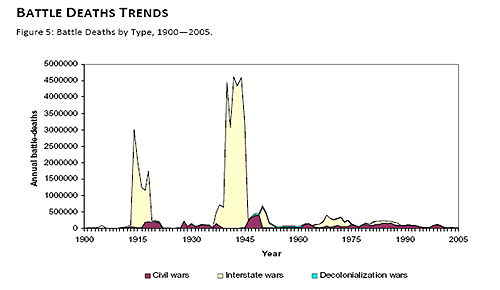
There is simply no logical coherence to the idea that, in a world where stateless mercenary firms are the prominent form of security, violence and lawlessness will reign supreme; nor is there any evidence whatsoever to suggest that “[m]ore mercenaries means more war, as they are incentivised to start and expand wars for profit, and turn to criminality between contracts.” Indeed, as McFate notes in his excellent article, the market for security is already becoming freer and while he ends his piece on a depressing note, lamenting this indisputable fact of the present-day world, I couldn’t help but remember the now-famous graph on battle death trends produced by political scientist Jay Ulfelder (using data from the Uppsala Conflict Data Program [UCDP]), which illustrates nicely the overall decline in deaths due to warfare violence around the world:

blog battle deaths
Notice that the most deadly conflicts are the ones involving states with armies that had been nationalized?

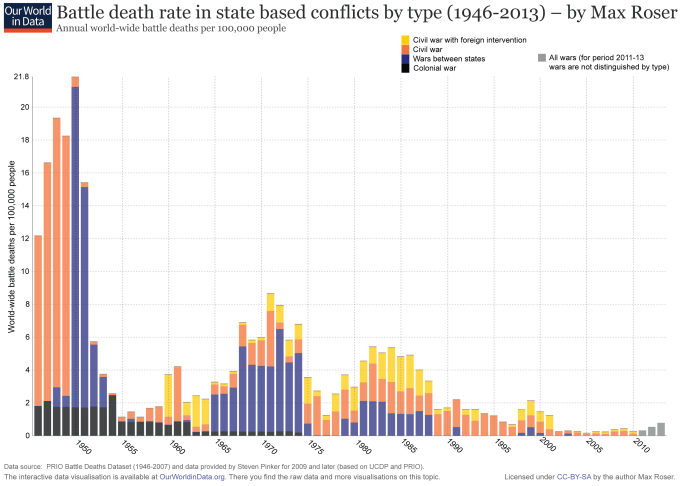
The always excellent Max Roser and his Our World in Data project has another graph worth highlighting, with this one using data from Steven Pinker’s The Better Angels of Our Nature… and the UCDP:

blog battle deaths pinker data

Now, two graphs showing that deaths from warfare have been in decline for half a century does not necessarily mean that a freer market in security services has led directly to this overwhelmingly good news. I am confident in claiming, though, that the freeing up of security services markets, combined with the steady presence of a few, still-powerful nationalized armies has led to a reduction in war-related deaths (and violent conflict in general). Both graphs illustrate well what happens when there are too many nationalized armies vying for power and prestige. (It is worth noting here that the main goal of diplomats and policymakers everywhere, no matter their ideological orientation or citizenship status, is still to avoid another world war.)

Second, the said. Annan’s refusal to decriminalize mercenary activities led directly to the 800,000 Rwandan deaths. How is this moral failing any better than when a mercenary firm breaks its contract and ends up killing a few dozen more people than it was supposed to? Again, the graphs are useful here: When conflict is nationalized, everybody suffers; when it is privatized, atrocities happen but not on the same scale we have seen with nationalized conflicts. It’s not even close. Annan’s short-sightedness reminds me of economist Scott Sumner’s 2012 summary of Hillary Clinton’s view of the War on Drugs:

[…] in response to a final question on drugs (from a Latin American reporter), she said drug legalization would do no good because drug dealers are really bad people, and they would simply do other crimes. No discussion of how America’s murder rate fell in half after alcohol was legalized in 1933.

Like drug use, the privatization of security services causes many people, well-educated or otherwise, to bristle at the notion without quite thinking through its logical implications. While ugly, mercenary firms are far more efficient and effective at quelling “bush wars” than are nationalized armies and, in turn, mercenary outfits are far less capable of sowing the type of destruction that nationalized armies routinely carry out.

I don’t think that a world with a few nationalized armies and an abundance of mercenary firms is necessarily the best option going forward, though. It is, however, a better option than most scholars and analysts give it credit for. In fact, it’s the best option at the moment, and while the status quo may sometimes be ugly, remember the graphs. Privatization of security services has contributed, at least in part, to a more peaceful and less violent world.

In order to move forward from this status quo it is best not lament the way things are going, but to acknowledge that things are the way they are for a reason, and then look for avenues to alter the status quo without falling back on a blanket policy like nationalizing security services again. The horrors of the World Wars should still be fresh in our minds, and the horrors of those wars were enabled and encouraged by nationalized security forces.

The best way to move forward is by looking at where these “bush wars” are taking place and begin thinking about ways to incorporate these regions into the global order (such as it is). This policy represents a departure from traditional post-war thinking about international relations, but it doesn’t make it radical or unfeasible. Indeed, there is a long tradition of republican thinking in Western thought pertaining to international relations. The West needs to start recognizing the legitimacy of secessionist sentiments in the post-colonial world, even if it means friction with Russia and China.

Washington and Brussels will have to endure charges of hypocrisy when it comes to ignoring the lobbying efforts of places like Tibet and Dagestan, but Biafra should have become a member state of the United Nations long ago. Baluchistan should have access independent of Pakistan and Iran to the IMF and World Bank. Two or three soccer teams from the region known as Kurdistan could easily be present in all major FIFA tournaments. Examples abound throughout the world. The West should also be open to recognizing arguments made by Russia and China for the independence of regions. There is no good reason why Western diplomats should ignore Moscow’s recognition of places like South Ossetia and Donetsk; doing so only hardens Russia’s stance on recognizing secession in parts of the world where its influence is limited or non-existent and forces the West into bed with unsavory post-socialist regimes.

The West needs to start being more inclusive when it comes to its own federal and republican institutions, too. Morocco, for example, should have had its 1987 application to join the European Union taken seriously (same goes for Turkey). The US federation needs to be actively courting polities like Puerto Rico, Coahuila, Alberta, and Micronesia to join the union. Both the EU and US are contracts designed to dampen violent conflict by fostering diplomatic, economic, and cultural intercourse between provincial polities. The reasoning behind exclusionary policies simply doesn’t answer why these republican, supranational organizations should not be actively recruiting neighboring or geopolitically useful administrative units into their representative systems.

Without this change in mindset the status quo will continue, which again if we remember the graphs is not all that bad, but something worse may happen: There could be a reversion to the blanket nationalization of security services that we saw during World Wars I and II.

Liberalism and Sovereignty

More than a year ago I promised Jacques a post on sovereignty and while I am not always able to follow up very quickly, I tend to do what I promise. So here it is! Jacques’ main cri de coeur was why (classical) liberals should care about sovereignty at all.

When it comes to the theoretical discussion about sovereignty (the literature is huge), I think there is no better start than the work of international relations theorist Robert Jackson. Or better and broader: any thinking about international relations benefits from this Canadian, former Boston University professor, especially his magnum opus The Global Covenant: Human Conduct in a World of States (Oxford University Press, 2000). But this is a side step.

In his 2008 book Sovereignty: Evolution of an Idea (Polity Press) he argues that:

sovereignty is an idea of authority embodied in those bordered territorial organizations we refer to as states, and is expressed in their various relations and activities, both domestic and foreign. It originates from the controversies and wars, religious and political of sixteenth and seventeenth century Europe. It has become the fundamental idea of authority of the modern era, arguably the most fundamental.

Also in regions where other kinds of arrangements existed before Western imperialism.

It is at the same time both an idea of supreme authority in the state, and an idea of political and legal independence of geographically separate states. Hence, sovereignty is a constitutional idea of the rights and duties of the governments and citizens or subjects of particular states. It is also an international idea of multiple states in relation to each other, each one occupying its own territories and having foreign relations and dealing with others, including peaceful and cooperative relations as well as discordant relations and periodical wars.

Of course a lot of popular and academic discussion follows from this, for example about the particular form of sovereignty (popular, or not), the relation between power and sovereignty, sovereignty and globalization, or if and when sovereignty may be breached to protect others through intervention. Yet here I solely  focus on the relation between sovereignty and liberal political theory.

Concerning the domestic supremacy side of sovereignty a lot has been written by liberals. Most liberals (classical, social, and even libertarian minarchists, such as Ayn Rand or Robert Nozick; see my Degrees of Freedom for the precise definitions) realize some form of state is needed to protect individual rights. A state embodied with sovereignty. At the same time most liberals (social liberals less so, because they favor a relatively large state) recognize the state is also the largest danger to individual freedom. How to balance the two is the perpetual question of liberal political thought, one also without a definitive answer or solution, so far.

Less attention has been given to the international side of sovereignty. There are a number of libertarians, such as the anarcho-capitalist Murray Rothbard, or his intellectual successor Hans-Hermann Hoppe, who think there should not be states, hence no issues of sovereignty exist once their stateless world has materialized (they remain largely silent about how to reach that situation). Yet it seems to me the thinking should not stop there. These same thinkers romanticize the idea of secession, yet seem to overlook that those seceded groups or communities also need to deal with other seceded groups and communities. They are a bit lazy when stating everybody should look after themselves, and only defend themselves in case of attack by others. If everything would be nice and neat among people this might be ok. Yet of course history shows (also in those areas where sovereignty never played a big role before Western imperialism) that people interfere all the time in each others affairs, some rulers may have malign intentions, others belief some parts of the seceded lands belong to their community, let alone issues about religion, et cetera. In short, chances on a peaceful world with the occasional conflict that can be solved by self defense are zero.

Funnily enough, social liberals share the idea of the possibility of a world peace and cosmopolitan harmony. They also favor the abolition of sovereign states, not through secession but through the pooling of sovereignty at the transnational level, with the European Union as an example and a world federation as the ultimate end goal. This seems just as unrealistic, as even the EU is still mainly governed from the member states, as the current refugee crisis and the possible dissolution of the Schengen agreement illustrates. More generally, the pooling of sovereignty proves rather difficult, also in other parts of the world. ASEAN in South East Asia is an example.

More realistic are classical liberals, such as Hume, Smith, and Hayek, who acknowledged an emotional tie between the individual and his country, as well as the constant need to defend individual property rights against invasion by others, through standing armies, diplomacy, some international treaties, the balance of power, et cetera.  Human nature does not allow for starry eyed fantasies about international harmony, let alone international peace. Hence, it is rather normal to care about external sovereignty, as it is foremost a means of protection.  Not the sole means, but an important and fundamental institution of international relations.

What is the proper role of government? Galactic Edition

Mordanicus of Fascinating Future, a sci-fi blog, is musing over the purpose of galactic government. As Mordanicus points out, galactic empires are a staple of science fiction. They can be found in the Star Wars, Star Trek, Dune, Firefly and Foundation universes.

…the feasibility of a galactic empire is questionable.

In Asimov’s description of the galactic empire, it consists of 25 million inhabited planets and 500 quadrillion people, 20 billion per planet on average. It is hard to even imagine a planetary empire, and no such thing has ever existed in human history, let alone such enormous empire.

The fundamental issue with an empire of this size is effective control by the central government. Its sheer size makes it inevitable to delegate many administrative powers to “local” planetary official. But the more power is transferred to individual planets, the less power remains with the central government. The question is then what is the proper function of the imperial government?

What is the purpose of these empires though? In those sci-fi universes with aliens these empires serve some defensive role for our Milky Way galaxy, but in many sci-fi universes there is no clear visible external threat.  What is the purpose of the empire then? Or is it simply a way for wealth distribution by those living in the Saturn beltway?

I personally view merit in a galactic empire if it were able to maintain internal peace. I have no doubt that in a space faring civilization there will be pirates and I believe that there are economies of scale in galactic trade route policing.

There is also merit in an empire that can keep rogue planetary governments in check. A galactic empire would be restrained in its ability to govern on its own given the largess of space and would need to delegate many functions to different layers of government. An empire would however still serve as a last layer of resort for those petitioning against their planetary government.

What about NOL readers? Are you convinced that space piracy warrants an empire? Or would a space faring civilization be better government by planetary or sub-planetary governments?

Read the full post from Mordanicus here.

How to split up California?

The idea of splitting up California has been previously discussed on NOL (see here, here, and most recently). In this post I wish to consider how California could be split up.

California has a large population of 38.8 million. For comparison Canada has 35.1 million residents distributed among its 10 provinces and the New England states house 14.7 million yankees in six states. With such a large population it is not surprising that the state has several regions with distinct cultures. This in itself is not sufficient merit to split up the state. One of the wonders of a liberal republican form of government is that diverse populations can coexist so long as they are treated equally before the law and have the freedom to exercise their various cultures. The problem is when these cultural differences lead to different public policy demands.

Consider for example the issue of abortion. In most matters of religion it is sufficient to allow different faiths to practice their beliefs so long as they keep to themselves. Why should non-Jews care if Jews must follow kosher dietary restrictions? The same cannot be done with abortion though. Those who believe, often due to their religious inclinations, that abortion is murder cannot tolerate its practice among those of other faiths or atheists. What is to be done?

One option would be to break up California. Although those on both sides of the abortion debate exist across California, there is also quite a bit of spatial correlation. See here. The Central Valley and Inland Empire counties both have significant portions of their populations favoring abortion limitations. Both regions also have low support for same sex marriage, see here, so it is safe to assume that their cultural differences with the rest of California is not on just one issue but several important public policies.

I would caution those who propose splitting up California between its inland and coastal regions. Both the Central Valley and Inland Empire may be culturally conservative, but the inland northern counties do not seem to fall in line. Nor would I recommend the Coastal/Inland split for those concerned about partisanship, see here. The San Francisco Bay Area, Northern Coast and Los Angeles are liberal strongholds but the Central Coast and Orange-San Diego region aren’t.

Similarly a North/South split would do little to help address regional cultural differences. The North/South split would usually split the state apart at San Luis Obispo-Kern-San Bernardino county lines. This would lead to the conservative Central Valley being lumped into the same state as ultra-liberal San Francisco. Meanwhile the Inland Empire and Orange-San Diego counties would find themselves sharing a state with blue Los Angeles.

What would be a good split then?

I personally favor the creation of four new states. Jefferson (the northern coastal and inland counties), San Francisco (the bay area states), Los Angeles (LA County), Central Valley (everything between Fresno and Bakersfield roughly) and the rest of southern California.

Given that any division would have to be approved by Congress the new states of Jefferson, San Francisco, and Los Angeles would have to be gerrymandered in such a way as to ensure they are blue states and maintain as many electoral votes from old California as possible. The Central Coast would likely be gobbled up between LA and San Francisco.  This gerrymandering would be needed to get Democrat votes who would otherwise be against losing all those electoral votes. Although Democrats would get two more seats in the Senate the Republicans could favor the deal in order to sweep extra electoral votes from the Central Valley and Southern California.

Although the split would be less than perfect, it would still grant greater say over public policy to the conservation counties.

Thoughts? Further maps on Californian public policy opinions can be found here.

P.S. In regards to the water issue, I like to think that the split of California would lead to a revision of the Colorado River Compact and related laws in order to create a more market oriented process for water allocation. I can dream can’t I?

BC’s weekend reads

  1. Bohumil Hrabal: the life, times, letters and politics of a Czech novelist
  2. What Davos Missed by Excluding North Korea
  3. The Rise and Fall of the Soviet ‘Death Star’
  4. Searching for Vadim Kozin, the Soviet tango king
  5. Are we likely to see new nation-states emerge this century?
  6. Historical Methodology and the Believer (of Islam)

Is government decentralization the right answer to differences across regions?

That’s the main question being asked by Federico Boffa, Amedeo Piolatto, and Giacomo A. M. Ponzetto, all economists. I cruised through the whole paper (pdf) and have some superficial thoughts. One snippet:

Western California is more liberal, even among Republican voters and politicians; Eastern California considerably more conservative […] At a first glance, such a political divide might suggest that a break up of coastal and inland California would be optimal on preference-matching grounds […]

[H]owever [this is a] superficial assessment. [Eastern California] contain[s] a large Hispanic population that overwhelmingly prefers the Democratic party. This group is much less educated, less politically knowledgeable, and less likely to vote than Republican supporters in the region, who are on average older, whiter, and wealthier. At the same time, the left-wing Hispanic working class in the Valley shares the political leanings of highly educated liberals on the coast. This ideological alignment goes beyond mere partisanship and includes shared preferences over policies.

As a consequence, our model suggests that the political integration of California is welfare maximizing. For relatively uneducated inland minorities to have a government corresponding to their preferences, it is essential that they share a state with ideologically aligned liberal elites in the Bay area. Right-wing Californians, instead, are sufficiently educated and influential to have a voice in state-wide politics, despite being in the minority: California had a Republican governor for twenty-one of the past thirty years.

[This lesson] applies more broadly. Disadvantaged ethnic minorities— which are less educated and often politically underrepresented— should belong whenever possible to the same polity as better educated and higher-status voters having similar political preferences. Only then are politicians effectively held accountable to both groups. (29-30)

California is “welfare maximizing”? Somebody help me out here. Isn’t it also possible that poor Hispanics and rich liberals form a voting bloc in California as it is because of how the GOP is patched together? If California split into an East/West, current coalitions would be shattered and it doesn’t follow that rich liberals and poor Hispanics would share the same voting preferences in the new arrangement. It doesn’t follow that rich conservatives and poor Hispanics in a hypothetical East would be at odds, either.

The biggest weakness in the paper, if you can call it that, is that the authors are focused on the fiscal aspects of federalism rather than the diplomatic, cultural, and political aspects. Federalism binds people together and forces them to at least try to come to an agreement about some issues. That’s a big deal, though it’s obviously not sexy.

The paper is focused on the EU and the US. There are lots of interesting insights into the European Union but the US angle is kinda boring (I’m sure is vice-versa for readers living and working in Europe). (h/t Mark Koyama)

Can we use tax data to measure living standards (part 2)?

Yesterday, my post on the differences in per capita income and total income per tax unit caused some friends to be puzzled by my results. To their credit, the point can be defended that tax units are not the same as households and the number of tax units may have increased faster than population (example: a father in 1920 filled one tax unit even though his household had six members, but with more single households in the 1960s onwards the number of tax units could rise faster than population for a time).

The problems regarding the use of tax units instead of households is not new. In fact, it is one of the sticking point advanced by skeptics like Alan Reynolds (see his 2006 book) and, more recently, by Richard Burkhauser of Cornell University (see his National Tax Journal article here).

Could it be that all the differences between GDP per person and income per tax unit are caused by this problem? Not really.

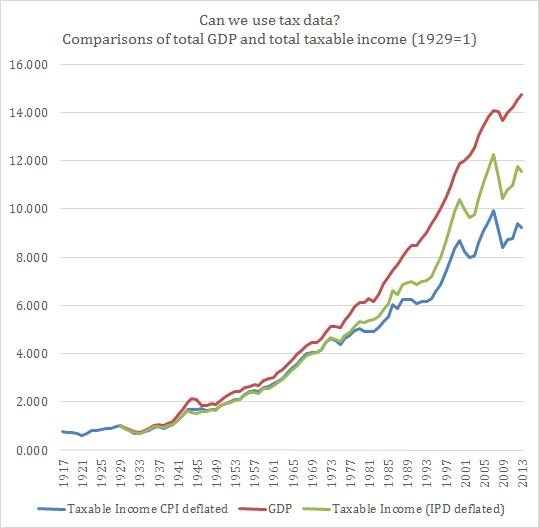
There is an easy to see if the problem is real. Both measures are ratios (income over a population). Either the numerator is wrong or the denominator is wrong. Those who view tax units as the problem argue that the problem is the denominator. I do not agree since I believe that the numerator is at fault. The way to see this is simply to plot total income reported by all tax units and compare this with real GDP. What’s the result?

Even with tax-reported income being deflated with the Implicit Price Deflator (IPD) instead of the consumer price index, we end up with a difference (in 2013) of roughly 3 orders of magnitude between GDP and tax-reported income relative to the 1929 base point. Basically, GDP has increased by a factor of 14.749 since 1929 while IPD-deflated tax-reported income has only increased by a factor of 11.546.

TaxData

As a result, I do not believe that the problem is the tax unit issue. The problem seems to be that tax data is not capturing the same thing as GDP is!

Can we use tax units to measure living standards?

In the debate on inequality, I am a skeptic of how large a problem the issue is. Personally, I tend to believe that worries of inequality only increase when growth is stagnant. In fact, I also believe that there are numerous statistical biases causing us to misidentify stagnation as rising inequality. Most of the debate on inequality is plagued with statistical problems of daunting magnitudes (regional convergence in income, regional price levels, demographic changes, increasing heterogeneity of preferences, increasing heterogeneity of personal characteristics, income not being purely monetary, the role of taxes and transfers etc.)

One of them centers around the use of tax data. This has been the domain of Thomas Piketty and Emmanuel Saez. I can understand the appeal of using tax data since it is easily available and usable. Yet, is it perfect?

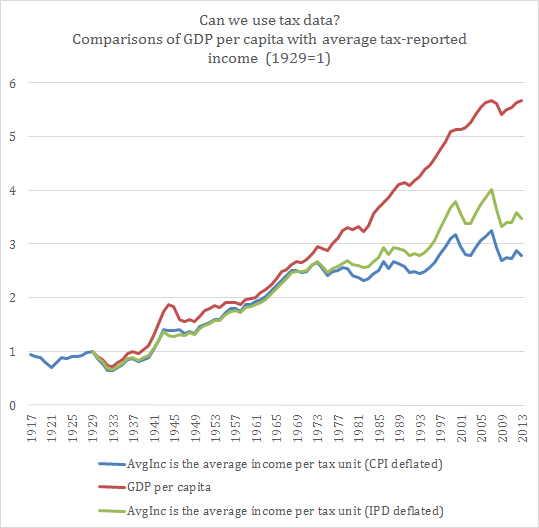
A year or two ago, I would have been inclined to simply say “yes” and not bother with the details. Theoretically, taxes should be an “okay” proxy for the income distribution and should follow average income even if at different levels. Yet, after reading the article of Phil Magness and Robert Murphy in the Journal of Private Enterprise I confess that I am no longer accepting anything as “granted” in the inequality debate. So, I simply decided to chart GDP per capita with the average taxable income per tax unit. Just to see what happens. Both are basically averages of the overall population, they should look pretty much the same (theoretically).  The data for the tax units is made available in the Mark W. Frank dataset based on the Piketty-Saez data (see here) and I deflated with both the CPI and the implicit price deflator available at FRED/St-Louis.

The result is the following and it shows two very different stories! Either the GDP statistics are wrong and we have average stagnation (which does not mean that there is no increase in inequality) or the taxable income data is wrong in estimating the trend of living standards and the GDP are closer to reality (which does not that there is no increase in inequality).  In the end, there is a problem to be assessed with the quality of the data used to measure inequality.

Tax Data

Down All Your Markets

The US stock market had its worst ever initial trading weeks in 2016. Speculators are alarmed by the fall in the stocks of China. The economy of China has been growing more slowly, if at all. Also, most of the economies of the world are in growth recessions, a reduction in the rate of growth. The US dollar is high relative to other currencies, which reduces exports.

The government of China has yet to learn that interventions into financial markets often backfire. The Chinese chiefs have halted stock transactions when the market average falls to seven percent. They also have not allowed sales by investors who own more than five percent of a company. One problem with financial “circuit breakers” – a halt of trading – is that when stocks start to fall, speculators will panic and sell more quickly before trading halts. Restrictions on selling stocks create uncertainty when buying them. A speculator will fear being unable to sell shares later.

There is enough inherent uncertainty in markets without government adding to it. Uncertainty makes it important to let the market set the prices. Markets are a discovery process in which prices and quantities evolve through the bids of buyers and offers of sellers. When government interferes, we cannot know the price. Since the leaders of China have decided to have a market economy in goods, input factors, and financial assets, they should allow the market to do its job of setting the prices.

When I visited China three times, I saw a forest of cranes in all the cities I went to. Construction has driven the economy of China, along with exports. But, similar to real estate booms elsewhere, this construction was propelled by governmental policy. Throughout the world, cheap credit and fiscal subsidies to real estate have fueled unsustainable speculation.

Now China has much excess building capacity, and the halt in construction reduces related goods such as furniture and raw materials. The slow-down in China and sluggish growth elsewhere has resulted in a collapse of commodity prices.

The chiefs of China seek to move the country’s economy towards more domestic consumption. But they interfere with domestic spending by imposing a value-added tax of 17 percent on most goods other than real estate. The government of China probably chose to impose a VAT because the World Trade Organization allows the VAT to be subtracted from the price of exports, unlike an income tax. But Chinese consumers suffer a higher cost of living.

The Chinese leaders could have instead enacted LVT, land-value taxation, which would not add to the cost of goods. A tax on land value reduces the purchase price but not the land rent, so also not the price of goods. A tax on most of the rent or land value would stop the land speculation that has made a few people rich at the expense of the public.

The government of China still maintains tight control over the banking system. All the markets – real estate, financial, goods – would be more efficient if interest rates too were set by the market supply and demand for loanable funds. Of course the central banks of Europe, Japan, and the USA also are not letting their markets set the money supply and interest rates. But common practice does not imply optimal policy.

I don’t think the big drop in stock market averages imply impending economic doom. For 200 years, the US economy has had a real estate cycle of an average duration of 18 years. The current cycle began with the depression of 2008. The recovery has been slow, but the expansion has continued as employment and output have grown. Real estate construction has contributed to the expansion, and land values have recovered. The economy seldom has a recession while interest rates and commodity prices are low.

The economy of China has some severe long-run problems, but its economy is still developing and catching up. The government seems ready to let the currency trade more freely, and the coming acceptance of the currency (the yuan or renminbi) into the “special drawing rights” of the International Monetary Fund will boost the economy.

In the short run, the US stock market could fall some more, as markets often overreach, but over the next few years, financial markets will be consistent with the economic reality of restored world-wide economic growth, if there are no major destructive attacks. What we should be worried about is the unsustainability of debt and the next real estate speculative boom. The next economic disaster is about a decade into the future, and nobody is yet alarmed about that.