This is in response to Brandon’s earlier post asking for literature on the EU’s effect on promoting liberalization. The short reply is the EU promotes liberalization – sometimes. Below are two pieces of the literature on the issue.
On a quick aside, I have mixed feelings towards the recent Dutch referendum on the Ukraine-EU Association Agreement. I don’t think that the EU should extend a hand to Ukraine. Namely because I think the Russians are much more willing to use force over the issue than West Europeans. Secondly, because I think it gives peripheral countries the idea that they don’t need to join/remain in the EU to receive its protection. Moral hazard if you will.
However I disagree with co-blogger Evgeniy Grigorjev that Ukraine, and other peripheral nations, should be denied EU affiliation until they reach certain benchmarks. I’m sure that Ukrainian politicians would consider EU association a victory and feel less compelled to act. However the long term effect of EU membership would be greater trade in goods, people, and ideas. With any luck liberal ideas. I would welcome the EU expanding into North Africa and parts of the Near East if it meant the expansion of liberal ideas to those regions.
The Effect of Labor Migration on the Diffusion of Democracy: Evidence from a Former Soviet Republic{LINK}
This empirical paper looks at the effect of return migration on political attitudes in Moldova. The basic idea is that return migrants bring with them new political ideas from abroad.
In the late 1990s Moldova experienced financial trouble that encouraged many of its laborers to migrate temporarily to Russia and the west (largely Italy) in search of work. Regions with more return migrants from Italy were found to have the least support for the Communist Party in future Parliamentary elections. Regions where migrants went to Russia had increased (albeit sometimes small and/or statistically insignificant) support for the Communist Party.
There are two take aways here:
(1) Trade in ideas matter.
(2) The type of ideas you trade matter.
The EU, and the Schengen area, can promote idea trading but what makes the EU important is that it is a liberal institution. An institution that needs reform, but one worth keeping.
Anchoring Democracy from Above? The European Union and Democratic Backsliding in Hungary and Romania after Accession{LINK}
This paper looks at the different responses the EU took towards Hungary and Romania when the national governments of both respectively introduced illiberal measures. Discusses some of the weak points in the EU and how it can be reformed to improve its ability to react to similar future events. As Evgeniy points out, the EU has a weakened ability to punish illiberal policies once EU membership has been granted. Intra-EU coordination is also difficult to achieve to use those tools it does have. The EU is not however impotent and reforms could be introduced to rectify this.
Well, it wasn’t so unsuspected, how many people want us to think. Over 60% of 30-35% of voted citizens were against euro-association with Ukraine. Ukrainian politicans traditionally speaking about “russian hand” and other weird stuff, russian trolls experiencing huge wave of a butthurt from their ukrainian colleagues in the political articles comment sections. Everything as always. I personally think, that NO is better that YES in this particular situation:
Law base is poor. Ukrainian Government should rise quality of anti-corruptional laws and deal somehow with unempoyment.
Donbass civil war isn’t over yet. And it’s like a red flag before EU bull’s eyes.
In my own humble opinion, euro-association means “total victory” for Ukraine and an approvement, that Ukraine itself passed all the requirements of EU and “Maidan quest” is completed. I personally afraid that after association Ukrainian Government will forget about current problems listed above and citizens will live worse. Economical situation will get worse too. “Hey, people, what else do you want? We passed the association test and it by default means that everything is ok”. When first wave of total euphoria will come to an end, the understanding will come: for simple worker, or miner, or vaiter, etc. nothing changed. People suffered before – and they will suffer after. Dealing with unstable situation and unemployment, brother-killing war and corruption are the only ways to EU.
In California, 70% of eligible voters are registered, and 47% of those turned out in a recent election. Thus about a third of those who could vote do so. These are dismaying numbers.
Dismaying because they are too high.
Why? First, some more dismaying numbers:
When Newsweek recently [2011] asked 1,000 U.S. citizens to take America’s official citizenship test, 29 percent couldn’t name the vice president. Seventy-three percent couldn’t correctly say why we fought the Cold War. Forty-four percent were unable to define the Bill of Rights. And 6 percent couldn’t even circle Independence Day on a calendar.
Too many ignorant fools are casting votes. People who believe that minimum wage laws create wealth, free trade destroys wealth, or clergymen should be forced to marry gay couples, to pick just a few examples. We need to bar these ignoramuses from the voting booth.
How? For starters, ditch the 26th amendment to the Constitution and the raise the voting age to at least 30. Get the 20-somethings out of the way; too many still believe in free lunches.
Second, change the 24th amendment to require poll taxes rather than forbid them. There is no justice in forcing non-voters to pay election costs.
Third, institute stiff qualification exams. Voters need know the vice president’s name, understand the Cold War, identify July 4 as Independence Day, and a whole lot more. Informed voters would be mostly immune from pandering demagoguery.
Disenfranchisement will lead to alienation and rebellion, some will say. Perhaps, and this could be alleviated by a phase-in of the changes. But then voting will become a privilege that young people can aspire to, as they might aspire to a corporate management position.
Another objection: my proposal is elitist. Of course it is! If there’s one thing we desperately need in this country, it’s a reversal of the egalitarian sentiments that have poisoned so much public discourse. We need to encourage and acknowledge the best and the brightest. Ignorant fools should not be allowed to operate dangerous machinery or pull levers in voting booths.
In my new article at FEE, “The Myth of Primitive Communism,” I argue that hunter-gatherers like the Ju/’hoansi share food with each other, not because they are selfless communists, but because favors and obligations are their most valuable commodities.
Please take a look. I’d be very interested in my fellow Notewriters’ erudite responses.
This week’s episode of EconTalk was fantastic, and in particular drew an important parallel between the complexity of the human brain and the complexity of market economies. The guest was discussing radical nanotechnology (basically the idea that engineers could out do bacteria by applying good design principles in place of random mutation and natural selection), and Russ pointed out that the logic is basically the same as in Socialism. Radical nanotechnology runs into a fundamental problem as long as it ignores the emergent processes occurring at the molecular/cellular level.
Later, the guest discusses the issue of artificial intelligence and points out that the fundamental unit of biological computing is not the neuron (which we simulate on computers using neural networks), but the molecule. In other words, natural intelligence is the outcome of a complex process that isn’t simple enough for us to easily replicate on a computer.
All that in mind, the idea of socialism* is like the idea that we could replace a brain with a pocket calculator. Yes, the idea is to get a very powerful calculator, but the problem is that it’s replacing a computer that’s far more complex and sophisticated.
* i.e. Centralized control of the means of production… socialism has nothing to do with sharing (you’re thinking “Egalitarianism”) and everything to do with control, and particularly the attempt to rationalize complex systems.
Did you know that in 1987 the government of Morocco formally submitted an application to become a member of the European Union?
Brussels flatly rejected the application, arguing publicly that Morocco was not a European country and also that Morocco had a poor human rights record. This rejection marks one of the biggest mistakes that Brussels has ever made in its short-but-brilliant history (along with instituting a central bank).
Does anyone know of any scholarly literature showing that the admittance of authoritarian states to the EU or other federal-esque institutions will have the effect of liberalizing the political regimes of such states, as long as the republics admit these states one or two at a time? I did a blog post on it awhile back, but a blog post is not a peer-reviewed journal article.
The best counter-example of federalism-as-a-path-to-liberty that I can think of is the pre-Civil War US. The US federal system was made up, in part, of a number of authoritarian states that promoted and enforced chattel slavery. This example does not address the EU model, however, where Brussels admits neighboring poor states and a gradual liberalizing effect takes place.
In the US example, factions within the slave states benefited economically from the use of slaves, and this economic prosperity was tied up directly to the political institutions of the US. So, the US Senate had a number of pro-slavery representatives that not only made sure slavery could not be attacked politically, but also that the interests of slaveholders were advanced at the expense of the non-slaving states (and, of course, the slaves themselves). In other words, a powerful minority with interests very different from the general intent of the classical liberal framework of Madison’s constitution.
Once the number of free states became great enough to overcome the number of slave states in the Senate, a war became much more likely. It became more likely because the interests of the (illiberal) slaveholders were directly challenged by the numerical superiority of free state representatives in both houses.
In short, the pre-Civil War US was made up of two factions – one liberal and one illiberal – that were almost equal in power. The EU does not have to worry about this, though. It should be much bolder in admitting despotic, neighboring states into its apparatus. (The same goes for the US.) Imagine if Morocco had been admitted into the EU in 1987. There would likely be representatives in Brussels bitching about austerity instead of representatives of the King torturing and imprisoning Moroccan citizens for reasons unknown.
The notion of the person is constantly renegotiated and is at stake between groups situated within the same political entity as well as between neighboring political entities. With advent of [France’s colonial] district register and the resulting written registration of identity, the notion of a person acquired a greater fixity. It became much more difficult to change identity or even to modify the spelling of one’s first or last name. Since it could no longer affect the components of the person, the negotiation of identity shifted, as in the case of the West, onto other sectors of social and individual life. (135)
This is from the French anthropologist (and high school friend of our own Jacques Delacroix) Jean-Loup Amselle, in his book Mestizo Logics: Anthropology of Identity in Africa and Elsewhere. The book is hard to read. The English translation (the one I’m reading) was published by Stanford University Press in 1998, but the original French language version came out in 1990. Between the translation and the fact that the book was written for specialists in the field of political anthropology and the region of French Sudan, strenuous effort was required on my part to stay focused and motivated to finish the book. The preface alone is worth the price of admission, though, especially if you’ve been following my blogging with any great interest over the years.
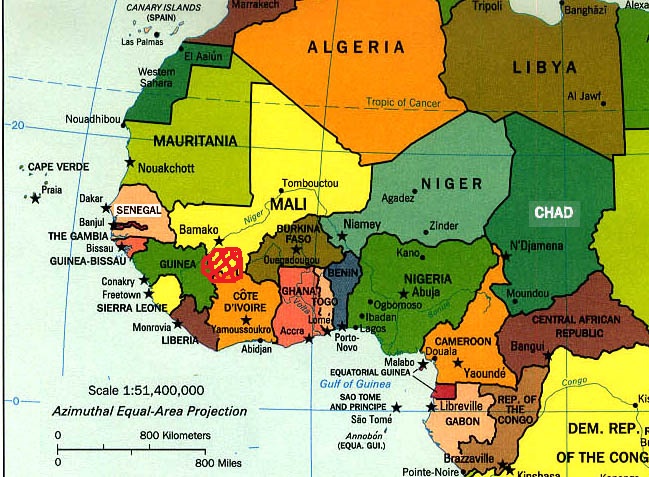
My intent is not to write a review, but rather to build off Amselle’s work and present some of my efforts in blog form here at NOL. But first, a map of the region, Wasolon, that Amselle specializes in:
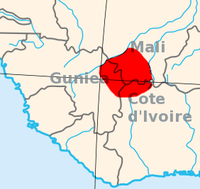
Wasolon is that big red marking that I’ve drawn on the map. You can see that it’s about as big as Sierra Leone. Just for clarity’s sake, here is a second map with a closer view of Wasolon:
Notice the rivers? source: wikipedia
Amselle’s argument for why his approach to identity is superior to others’ is convincing. He performed all of his fieldwork (15 years’ worth as of 1990) in Wasolon, or briefly in neighboring areas, reasoning that “research within numerous regions of a well-circumscribed area […] has allowed me to observe systems of transformation [in] societies that have been in contact for centuries. This has protected me from being forced into large analytical leaps and from engaging in [the current anthropological trends of] abstract comparativism and the identification of structures (xii-xiii).” This defense of his methodology, coupled with his insights on French colonial administration in the late 19th and early 20th centuries, gives me reason to believe that Amselle’s work is an excellent blueprint for better understanding the complete and utter failure of post-colonial states and the violence these collective failures have produced.
I want to take a specific route using the introductory quote, even though I could take a number of different routes using that passage. I could, for example, focus on the invention of the individual and muse about its consequences in regards to the rise of the West. I could go on and on about how other societies had writing – but not the individual- and therefore did not have the institutions necessary for “capitalism” that the West did around the 16th century. Et cetera, et cetera. Instead, I’m going to take a geopolitical route (the West is still practicing colonialism) that has a decidedly philosophical direction to it (nationalism and ethno-nationalism are both bullhooey).
First, the geopolitical context. Wasolon was basically a war zone in the 18th and 19th centuries. It was an important producer of cotton, a minor producer of rubber and ivory, and a net exporter of slaves. Wasolon was unfortunate enough to be caught between Saharan empires backed by Arabic culture, money, and technology, and coastal empires recently enriched through cultural, economic, and technological exchange with rapidly-expanding European populations. Caught between these two geographic poles, polities in Wasolon oscillated between being decentralized chiefdoms, small independent states, empire builders themselves, and vassals of empires. In such an uncertain setting, the identity of people themselves necessarily oscillated as often as their political systems did.
When the French arrived militarily on the scene (there was already a long history of economic, political, and cultural exchange between the “French” and Wasolonians; I put French in quotation marks because, of course, many Europeans found it to be much easier to use “French” as an identity in French Sudan rather than their own), Wasolon was home to many decentralized chiefdoms, and they were all in the midst of a protracted and brutal war with the Samori Empire, a Saharan polity that rose quickly and ruthlessly to prominence in the late 19th century.
The Samori Empire – which the French military was in contact with due to its centralized political structure (it had a bureaucracy and an organized military, for example) – claimed Wasolon as a vassal state and the French, out of ignorance or expediency (to attribute it to malice gives French central planners too much credit), simply took Samori at its word (a policy that continues to play out to this day in international affairs, but more on this below).
The French military commanders and, later, colonial administrators eventually figured out that Wasolon was not a loyal vassal. From the French perspective, the resisting chiefdoms in Wasolon had formed an alliance against the Samori Empire, and this alliance was based on an ethnic solidarity shared by all Fulani. Amselle labors to make the point that this alliance was based on a “mythical charter” long prominent in Fula oral traditions (and has some basis in the historical accounts of Arab and European travelers). This “mythical charter” served as the basis for the French colonial understanding of the Fula and eventually for the notion of a Fulani ethnic identity. The problem here is that the “mythical charter” was just that: a myth.
As we saw in Chap. 5, colonial ethnology merely reproduces this local political theory by taking it literally, thereby assimilating these “mythical charters” to a real historical process. Such a reproduction is what makes this ethnology truly colonial. (179)
In the Chapter 5 that Amselle alludes to in his footnotes, Mestizo Logics explains how the Fula people of Wasolon adopted fluid political identities over the centuries, depending on who was in power and who was about to be in power. This fluidity played, and continues to play, a much more important role in how people identified themselves politically (“local political theory”) than either culture or language.
Amselle illustrates this point best by pointing out that a number of chiefdoms in Wasolon claimed to be Fula at the time of the French conquests in the late 19th century, but that the populations spoke a different language than the Fula and were culturally distinct from the Fula (these Wasolon chiefdoms claiming Fulaniship were Banmana and Maninka in language and culture rather than Fula). Amselle then points out that Fula chiefdoms existed outside of Wasolon that don’t claim to be Fula – even though they are culturally and linguistically Fula – and instead identified as something more politically expedient (he doesn’t elaborate on what those non-Fula Fulani identify as, only that they did, and still do).
The French state’s act of writing down and categorizing this “mythical charter” as a distinct feature of Wasolon’s Fulani thus created the Fula ethnic group and, through imperial governance, ensconced this new group into its empire’s hierarchy based on traits that ethnographers, colonial administrators, historians, and managers of state-run corporations had recorded (accounts written by merchants not connected to the state in some way could not be trusted, of course).
Basically, when the French showed up to build their empire in west Africa they bought the narrative espoused by a couple of the factions in the region and based their empire (which was only feasible with the advent of peace in Europe after the Napoleonic Wars) on that narrative. The results of this policy are eye-opening. Aside from the fact that the present-day states of Mali, Cote d’Ivoire, and Guinea are failures, the old rules of fluid identity used by Wasolonians for political and economic reasons were erased and new rules, based on bureaucratic logic (“ethnicity”), were wrested into place by the French imperial apparatus. These new ethnic identities soon took on characteristics, ascribed to them by others, that quickly became stereotypes. The ethnic groups with good stereotypes (like being hard-working) ended up – you guessed it – in positions of power, first in France’s imperial apparatus and then for a short time after independence.
Sound familiar?
If it doesn’t, think about international governing institutions (IGOs) like the United Nations or the World Bank for a moment. Why don’t these institutions recognize the likes of Kurdistan, Baluchistan, or South Ossetia? Is it because these IGOs are evil and oppressive, or simply because these bureaucracies cannot adapt quickly enough to a world where identity and the necessities of political economies are always in flux?
This phenomenon is not limited to post-colonial Africa, either. Think about African-Americans here in the United States and the stereotypes attributed to them. Those stereotypes – good and bad – are a direct result of bureaucracy.
Individualism, to me, is the best way to tackle the long-standing problem created by colonial logic abroad, and racism at home. Government programs that seek to help groups by taking from one and giving to another are just an extension of the bureaucratic logic revealed by Amselle’s work in French West Africa. But what is a good way to go about implementing a more individualized world? Open borders?Federation?

 Notes On Liberty