AEM Europe and PCPE in Prague, April 21-24 2016

I have recently returned home from 4 days of Prague, Czech Republic, where I attended two conferences: Austrian Economics Meeting Europe and the Prague Conference on Political Economy. After having been secluded from Austrian economists and Libertarians for almost 2 years, it felt like a homecoming to be surrounded again by people who share similar thoughts. This was after all the only place in the last two years where I was able to fully express my (´controversial´) ideas about society. Being surrounded by tremendously smart people – you have to be rather smart and geeky to give up part of your free time or professional work in order to visit conferences and discuss philosophy, politics and economics – within the beautiful city of Prague made it a wonderful experience.

The AEME came about after the summer of 2014 when those from Europe who visited Mises University that year decided to come together again to discuss classical liberal ideas in the spirit of Carl Menger, Ludwig von Mises, Friedrich von Hayek and Murray Rothbard. The first AEME event took place in 2015 in Vienna, Austria, the city where the Austrian School of economic thought emerged from the works of Carl Menger, Eugen von Böhm-Bawerk, Friedrich von Wieser, and others. The Austrian School is famous for its methodological struggle against the Prussian Historical School and their idea that economics is culture- and time-specific and therefore does not contain universal validity. The Austrian School is also famous for such theoretical contributions as the subjective theory of value (as opposed to Marx’ labour theory of value), theory of marginal utility, opportunity cost doctrine, Austrian business cycle theory, the time structure of production and consumption, methodological individualism and the economic calculation problem that was first formulated by Ludwig von Mises in 1920 and later expanded upon by Friedrich von Hayek to show that pricing systems in socialist economies were necessarily deficient. From a socio-political perspective, the School argues for limited government and some even for libertarian anarchism.

AEME pub
AEME participants sharing their last evening in Prague in a local pub

What was great about the second AEME is that it took place right before the PCPE conference at the CEVRO Institute. Most of us who attended AEME have stayed two extra days to attend the PCPE conference as well. The CEVRO Institute is a private university founded in 2005 that is located in the very centre of the city of Prague. The university prides itself in its emphasis on freedom, markets, and its innovative character that is for example manifested in its PPE (Philosophy, Politics, Economics) programme taught by such international illustrious professors as Michael Munger who is also director of Duke University’s PPE programme, Peter Boettke who is the director of the F.A. Hayek Program at George Mason University, David Schmidt who is director of the Center for the Philosophy of Freedom at the University of Arizona, Boudewijn Bouckaert who was the former dean of the Faculty of Law at the University of Ghent, and Josef Sima who is the president of the CEVRO Institute. The institute has invited several prominent speakers for its conference. Prof. Mark Pennington (London School of Economics) was for example invited to present “Why most things should probably be for sale”. Prof. Benjamin Powell who is the director of the Free Market Institute at Texas Tech University, the University to which I almost applied to to pursue my PhD in the academic year of 2015 but eventually decided to work as a software engineer, was there as well to speak about “Migration, Economic Calculation, and the European Situation.” Prof. Mario Rizzo (New York University) had the honour to be the keynote speaker and spoke about “The four pillars of new paternalism” which was followed by commentaries from Prof. Pascal Salin, former president of the Mont Pelerin Society.
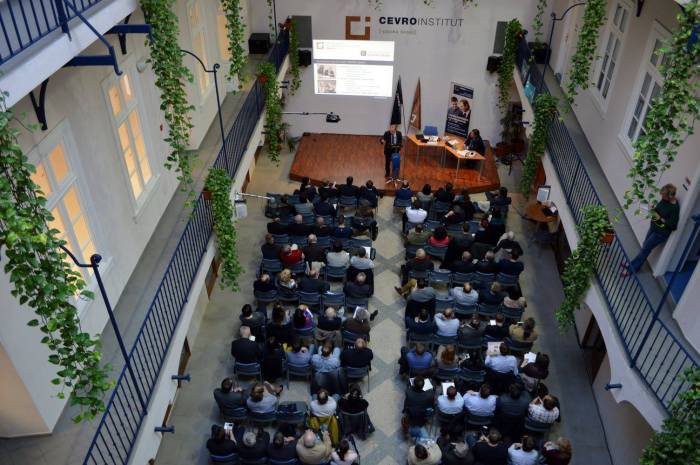
PCPE 2016
Mario Rizzo’s welcome speech to PCPE

The second day of the PCPE conference, there were 27 speakers spread over 9 sessions on such topics as economic theory, anarcho-capitalism, the Austrian School, entrepreneurship, cryptocurrencies, the role of family and more. I was one of the speakers and spoke on the “Philosophical investigation of seasteading as the means to discover better forms of social organization”. The thesis of my talk was that one core focus of political philosophy is to deal with the realities of value pluralism and political disagreements. I contended that the most common form of social organization, representative democracy, does not satisfactorily deal with these realities. Therefore, we should look for political possibilities beyond representative democracies and that in order to discover these possibilities, we should experiment with new forms of social organizations. By approaching the issue from a meta-system level perspective and realizing that governments are resistant to structural societal changes we should then introduce competition into the industry of governments. Seasteading, the creation of habitable dwellings on the oceans, could serve as a means to introduce more competition in the industry and lessen political tensions between citizens who hold different comprehensive doctrines.
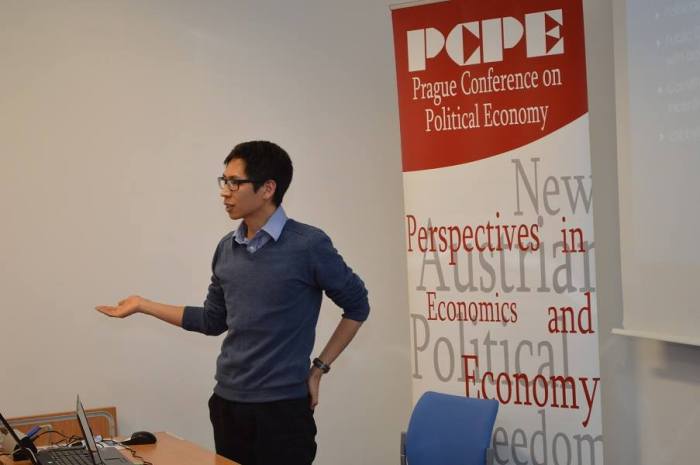
Chhay Lin - PCPE
Me speaking at PCPE about Seasteading as the means to deal with such political realities as value pluralism and political disagreements

If I could mention one thing that has made the most remarkable impression on me, it would be the warning issued by Prof. Stephen Baskerville (Patrick Henry College, USA) that the most immediate threat to our liberties is feminism and the social justice movement. He maintained in his talk that there is an ensuing crisis of the family which is perpetuated by the state. According to Prof. Baskerville, family courts can enter homes uninvited, take away people’s children, confiscate their property, and incarcerate them without trial, charge or counsel. With over 50% of all first marriages ending in divorce and more than half of all these divorces involving children, the greatest threat to our liberties is the colluding social work state bureaucracies with radical feminism. These groups have colluded to suppress information on such injustices. Listening to Baskerville’s talk, I felt the great urgency to engage in an intellectual battle against feminism and the social justice movement.

Other than the many intellectually invigorating moments, the city itself provided many magnificent sites. To mention several sights: we visited a beer garden, experienced a classical music concert at the Mirror Chapel, walked over the Charles Bridge, and visited the Prague Castle.
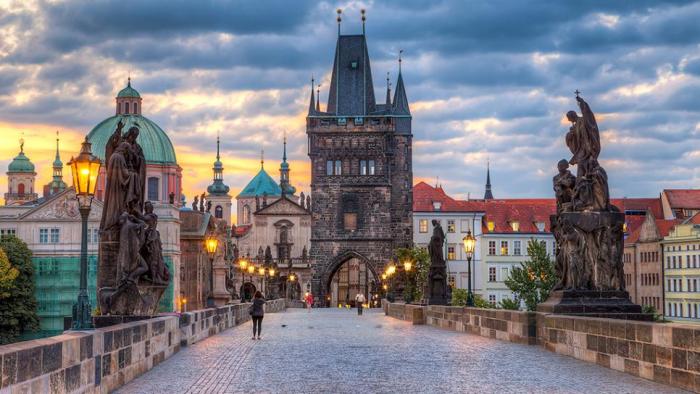
Prague Charles Bridge
The beautiful Charles Bridge crossing the river Vltava

All in all, the city of Prague, AEME and PCPE were an unforgettable experience! It has already been decided that next year’s AEME conference will take place in Krakow, Poland. The conference will be open for anyone who is interested in Austrian economics and libertarianism. For more information on AEME and the papers that were presented in the previous editions, you can find our website here. In case you are interested in studying at the CEVRO Institute and its MA PPE programme with specializations in “Austrian Economics”, “Studies of Transition”, and “International Politics”, you can visit their website here.

BC’s weekend reads

  1. China’s Legalist Revival
  2. Does Europe need a new Warsaw Pact?
  3. Daniel Larison (PhD in Russian History) on Trump’s foreign policy speech
  4. The Anti-Trumplodytes
  5. Why Popular Sovereignty requires the due process of law

Vote Different. Be A Libertarian. Let Life Live

John McAfee’s latest political campaign ad is inspiring as it asks voters to vote libertarian. It is an homage to Apple’s “Think Different” ad as well as to individual freedoms, creativity and intellect.

The video shows ‘rebels’ and game-changers who have moved the world forward. You do find Steve Jobs, Elon Musk, Edward Snowden, Julian Assange, Peter Thiel, Bradley Manning, Ross Ulbricht, Martin Luther King, Ayn Rand and many more. You even see Bitcoin and crypto-capitalism which is simply another form of libertarian anarchism. Ending with the lift-off of a spaceshuttle, the ad presents a message of hope for libertarians and a message of progress as long as we “let life live”.

The same celebration of human individualism and message of hope was also apparent in McAfee’s earlier campaign ad that was released two weeks ago.

Coase’s “Nature of the Firm”: An Anthropological Critique

But is it a good one? Is it even made in good faith? I need help.

From American anthropologist John D Kelly’s The American Game…:

Ronald Coase’s theory of the nature of the firm rescued, for neo-classical economics, the existence of firms or corporations as rational entities […] Markets always come first, and the problem of the existence of firms is depicted as the problem of why a rational manager would rely on employees rather than markets. State planning and private firms are taking over what already exists, integrated by the price mechanism of markets, and are successful to the extent that they lower costs, since there are a variety of costs involved in market transactions. Thus marginalist analysis implies that an equilibrium will always be found between planning structures and integration by price mechanism, especially since, as Coase says in “The Nature of the Firm,” “businessmen will be constantly experimenting, controlling more or less” and “firms arise voluntarily because they represent a more efficient method of organizing production.” The rise of the firm, as Coase imagines it, is always a movement from many pre-existing contracts to a controlling structure, “For this series of contracts is substituted one.” (94)

The emphasis is mine. Kelly continues:

This imaginary fits poorly the situations that were precisely the actual origins of firms, as when banks gave mortgages to planters, or stock markets funded companies of young agents, prepared to cut plantations into captured wilderness for tropical commodities […] usually employing labor moved long distances and disciplined by direct violence. There is more in the universe than Coase’s imagination, more motives for controlling powers of firms than their cost efficiencies. (94-95)

Kelly goes on to give a brief account of 1) how corporations created commodity production out of thin air, 2) how these corporations were tied to European imperialism, and 3) how they used slaves and indentured servants even when it would have been cheaper to hire the locals.

I want to address Kelly’s summary of Coase’s paper (here is a pdf, by the way, in case you want to follow along), mostly because I’ve never read it although I know it’s important, but first I want to make a couple of digressions. Libertarians would more or less answer Kelly’s three charges listed above as follows: 1) yes, and this is a good thing, 2) state-sponsored corporations and private firms are two distinct entities with two very different incentive structures, and 3) see #2. There is also an issue of accuracy in regards to Kelly’s brief summary of world history since 1600. I don’t want to get into the details here, but I do want you to recognize that I am reading Kelly critically. My last digression is simply to point out that libertarians and Weberian Leftists like Kelly have more in common than we think.

To get back to Coase’s paper, and Kelly’s critique of it, I want to highlight one sentence from Kelly’s book in particular and then turn it over to the peanut gallery in the hopes of gaining some insight:

Markets always come first, and the problem of the existence of firms is depicted as the problem of why a rational manager would rely on employees rather than markets.

Is this the puzzle Coase was trying to grapple with in his paper? I ctrl+f’d Coase’s paper (“employe” – not a typo) and couldn’t find anything that actually confirms Kelly’s summary, but it would be an interesting project (if I am right in stating that Kelly’s summary of Coase’s paper is not accurate) to follow this line of thought and delve into Kelly’s insight about the reliance that entrepreneurs/firms have on employees (rather than markets)…

The Case Against Galactic Government?

Samuel Hammond, a friend of a friend, has recently written a blog post musing about whether trade between Mars and Earth should be discouraged. The basic premise is that the case for colonizing Mars is to decrease the likelihood of a catastrophe leading to the extinction of humanity due to a black crow event.

Inter-planetary trade would allow both planets to minimize the harms of minor to moderate events, Samuel seems to acknowledge this. This is how international trade today helps nations minimize the harms of localized events. The harm of the ongoing drought in California has been lessened due to ability of consumers to tap into markets elsewhere to meet their demands.  What Samuel is concerned about is those events whose danger increases in proportion to the inter-connectivity of markets. Samuel gives the example of financial markets, but allow me to introduce another similar danger: the Mule.

2-mule-foundation
The Mule, primary antagonist in I. Asimov’s Foundation & Empire

In Isaac Asimov’s sci-fi universe much of the known galaxy in the distant future comes under the rule of the Foundation Federation. The Foundation is a liberal galactic government that promotes intra-galactic trade, but grants each planet wide freedom to settle its internal matters. It has waged wars of defense, but is notable in that it has never waged a war of conquest and its members have all joined voluntarily. I would go as far to say it is an ideal form of galactic government. However the Foundation’s promotion of galactic inter-connectivity backfires when the Mule, a mutant human with the ability to influence minds, takes control of the government elite. The Mule is a single man but, due to the hyper-connectivity of the Foundation, can assume control with a few well placed followers. Almost overnight the Mule transform the liberal Foundation into his personal dictatorship. The last bastions of freedom are those regions of space controlled by pirates free traders.

Eventually the Mule is defeated and liberal government restored, but only because of the efforts of those polities outside the Foundation’s control. If the Foundation had been a monopolis, a government that controlled all of humanity, then it is doubtful the Mule would have been defeated. Inter-connectivity can yield significant benefits, but as outlined above it can also maximize the damage of black crow events.

Does this mean that Samuel is correct and that any further space colonies must be separated from Earth in terms of trade and governance? Not quite. Although I think Samuel’s concerns serve as an argument against extreme inter-connectivity between worlds, I do not think it is sufficient to justify actively building barriers between worlds. Rather I interpret black crow events as arguments in favor of tolerating the existence of rogue nations, such as North Korea, Somalia, and other contemporary nations that exist outside the primary world system.

As space exploration becomes a reality I think all efforts should be made to promote inter-connectivity between the various worlds. We should promote Earth-Mars relations. We should not however oppose those who wish to live in the asteroid belt and minimize their contact with the rest of us. This break away colonies will arise naturally and need not be actively created, only tolerated. These break away colonies will be founded by an assortment of pirates, religious zealots, political dissidents, and other outcasts. By tolerating their existence we will reap the benefit of space exploration while minimizing the likelihood of black crow events to destroy all of humanity.

Rick comments on the latest news

While googling a phrase to see if I’m creative (I don’t know if “Hayekian leisure class” is uniquely mine, but the first page of Google’s 78,000 results indicates yes), I found this interesting tidbit: Thorstein Veblen’s house sold (way back in 2004) for $1 million.

The developer is going to (already has? Already started to then went bust?) tear it down and build some sort of luxurious suburban palace. Ironic, but not as ironic as it could have been. Far more Veblenesque would have been leaving it standing as a conspicuously authentic status item.

I can’t find the specific house, but narrowing down to its area on Zillow (based on Internet commentary) leads me to believe that the property has been folded together into a larger lot, but would hypothetically be worth about $2 million today.

Objective Moral Rules

“Moral realism” is the proposition that objective moral rules exist. A moral rule assigns a moral value (good, evil, or neutral) to an act done by a person. A moral rule, such as “theft is evil,” is intended as a fact.

Moral realism is non-nihilist and non-relativist. Nihilists and relativists believe that no act is inherently good or evil, that there is no morality beyond personal and cultural beliefs. Moral realism is based on an ontology, a way to show that an objective morality exists.

The existence of an objective and universal ethic cannot be based on intuition. Intuition consists of ideas believed without conscious thinking. What people think of as intuition is heavily influenced by the prevailing culture. One person’s intuition may tell him that gambling is bad, while other may think that gambling is harmless fun.

Many ontologies of morality have been proposed. The one I think is warranted in reason is the natural moral law proposed by John Locke, although he did not present a derivation. In my judgment, the ontology consistent with Locke is as follows.

1. There are criteria that are necessary for the existence of a universal ethic. The ethic has to be universal to all persons, comprehensive to all acts, non-arbitrary in its premises, and logically consistent. If one presents an ethic which fits these criteria, then the universal ethic exists.

2. The premises of natural moral law are the biological independence of individual thinking and feeling, the moral equality of persons, and the existence of a personal ethic in each person’s mind. The first two were proposed by John Locke in his Second Treatise of Government. The equality premise is based on the common observation that there is in human nature no inherent basis for one group of persons to be superior masters over a second, inferior, group.

3. The derivation of natural moral law, as expressed by the universal ethic, provides rules for the three moral values (good, evil, and neutral). Good acts are welcomed benefits. Evil acts coercively harm others, as invasions, in contrast to merely offensive acts that depend only on the beliefs and values of those affected. All other acts are morally neutral.

Those who reject moral realism ask about the fact-value problem, the proposition that one cannot derive a moral value from any observed fact. The answer is that the universal ethic does not create any values. The values are held by individuals, in accordance with the third premise, the existence of personal ethics. The universal ethic is a production function which inputs individual moral values (good, evil, and neutral) and transforms them into universal ethic moral values. For example, if a theft takes place, the individual moral value is that it is evil, and since the theft is an invasion, a coercive harm, this individual value becomes a universal ethic value.

If, in contrast, a person observes someone who is walking naked on his property, and judges that to be evil, the universal ethic inputs that value and makes it neutral for the universal ethic, since that is an offense rather than an invasion into another’s property.

Therefore, the natural moral law does not generate values from facts, but rather, produces natural moral law values by inputting personal values and then applying its rules to output universal-ethic values.

Some skeptics reject natural-law moral realism because its premise of personal equality cannot be proven true the way that, say, the law of gravity is shown to be true. The proposition that there is in human nature no inherent master/slave relationships can be observed and inferred, but the conclusion is not apodictic, i.e. absolutely certain. However, the alternative is either supremacism, the alleged superiority of some religion or creed, or else nihilism, the absence of any transcendent morality, and either one leads to war.

The purpose of the universal ethic is the moral basis of proper governance, and since to my knowledge, nobody has come up with a superior moral idea, the ontology is good enough for the practical purpose of providing social peace and harmony with nature.

Mohammad Iqbal’s writings on Islam and on the partition of India

That is the topic of a paper of mine that has just been published in the Journal of Punjab Studies. Here is the abstract:

Iqbal was a poet, religious philosopher, political activists, and supporter of autonomy to Muslim majority provinces in British India, but cannot be regarded as the ‘main’ architect of Pakistan. His basic concern was over the falling status of Muslims of India during British rule and ways to arrest the situation. His speech in 1930 at Allahabad session of the All India Muslim League is being always cited as his support to Pakistan, but later on he never made his position very clear over the issue of partition of British India. Yet his contribution to the formation of Pakistan cannot be entirely ruled out because he was speaking out the minds of the Muslim minorities who, by 1920s, not not only raised the demand, but started whispering about having a separate socio-political space. He was a towering figure of Islamic modernism, a great poet and also a religious philosopher, whose thinking still has considerable significance. His writings are still being read and researched in India and Pakistan.

The link to the whole paper can be found here [pdf].

The State versus Society, Part 12,908

Taken together, the evidence suggests that the Kuba state is associated with a deterioration of intrinsic motivations to follow the rules. This does not mean that the Kuba Kingdom was not a successful and well-functioning state. From the historical and anthropological literature, we know that it was. Although the state was prosperous and orderly, the evidence suggests that it eroded the intrinsic propensity of its subjects to follow rules even when enforcement is absent. (28)

Here (pdf)

The Moral Case for Fossil Fuels

If you’re interested in energy and environmental issues, especially climate change, have a look at this 15-minute appearance by Alex Epstein before the Senate Environment and Public Works committee. In a pressure-cooker atmosphere, he argues persuasively for the benefits of fossil fuels and for a sensible approach to climate issues.

I also highly recommend his book, The Moral Case for Fossil Fuels.  He reasons carefully about fossil fuels, alternative energy, and climate change.

Unanimous direct democracy

I was recently introduced to a few positive arguments for this in R. P. Wolff’s In Defense of Anarchism. Lacking the book to cite, he was absorbed with the problems of democracy, namely, the triumphant majoritarian democracy, in the manner that the minority suffers exclusion from representative processes and alienation in their laws. Philosophically he thinks contemporary liberalism leads to an illegitimate government, and anarchism is the only legitimate form of governance.

He proposed a possible method in which unanimity might be lost (as is the case in any large enough governed society), but directness and egalitarianism sustained and an authentic “rule by the people” enacted: socially-funded television sets, installed at large community centers or subsidized for private homes, with featured debates at every election season. Specialists, e.g., in fields like economics, American history and foreign policy, could feature, from various recesses of the political spectrum, to explain the more complicated issues in a collaborative, unpedantic effort. Middle Eastern history, for example, could be briefly clarified before candidates discuss their stances. (Of course, biases would find an entry point through specialists. Further discussion is necessary for this.) At the end of the week of debates, once issues are clarified and nominees understood, the remote control could be used to cast a vote for each member of the household according to the census. This system would greatly increase voter participation, and make domestic politics worthwhile for the average citizen, returning policy-making to everyone affected.

This is an idea of working within the current society on a system for better voter say: it should be judged on these merits as such.

Is it feasible? Is it at all admirable? Discuss.

Liberty and the Novel II (Austen and After)

(Click for Part I) In Austen’s novels, we find something ‘unheroic’ in that they are concerned with the search of upper class women, bound by codes of gentility, for both a satisfying place in the world and emotional authenticity through marriage. Though there is none of the religious fervour of Pilgrim’s Progress, the message is sent that an ideal community is a small rural community guided by sincerely godly priest, concerned with the daily lives of his congregation.

There is none of the extremism of Quixote’s fantasies and adventures, but the simultaneous process of  triumph over illusion and the growth of inner authenticity, is there in Pride and Prejudice, Sense and Sensibility, Mansfield Park, Emma, Persuasion, and Northanger Abbey, as the characters find marriages worthy of their growing ethical capacities in self-judgement and judgement of others.

Ethical growth means confirming a place in the landowning classes and taking a decidedly ambiguous attitude to making new money in trade. Landed property and religion are the starting points of an ethically tolerable community for Austen. We can see the growth there of what we might now think of as social and political values based on self-ownership and individual responsibility though somewhat constrained by respect for earlier aristocratic expression of these values.

We can see a version of Lukács’ split between heroic progressive bourgeoise and backward looking conformist bourgeoise there. Though it is absurdly crude to take 1848 as the line of of separation between the two tendencies, it is useful to think about the distinction as it evolved over time, including the events of 1848. Over time the basic bourgeois goals of rule of law, individual rights, representative government, and free trade tend to be achieved. The word radical is used less and less for the advocate of bourgeois individualism and more and more for advocates of a socialist state.

In literature the themes of the individual triumphing over circumstances, enduring disaster, awaking from illusions, developing individual moral strength, and finding some moment of authenticity continues. The novel keeps developing as a form, but in many people’s opinion, including my own, it reaches a peak in the early twentieth century (James Joyce, Franz Kafka, Marcel Proust, Virginia Woolf, Thomas Mann) which it has never matched, though ambitious and admirable novels continue to be written.

The more straight forward kinds of heroism are not so prevalent as in earlier novels, but the irony and ambiguity about heroism develops what was already in the genre and intensifies individualism, even while questioning it. Some of these writers were sympathetic to socialism though born into a largely bourgeois liberal world, at least compared with developments after World War One.

Coincidentally or not, this coincides with the transitions from a limited-state individualist nineteenth century liberal politics to the welfarist-administrative state we now know and which is stronger than ever, despite all the cries of ‘neoliberalism’ and ‘market fundamentalism’ that arise in reaction to any attempt to limit the statist drift.

There is a danger of rivaling Lukács’ tendency towards a moralising tendentious Marxism from a pro-liberty point of view, but I am anyway tempted to say that the reduction of the significance of the novel is a symptom of societies which aim to remove individual responsibility in the struggle with circumstances. Or I can put it in terms more amenable to those who welcome the welfarist-administrative tendency. The novel has lost some part of its significance as individualist ways of thinking are less influential in politics.

In fact I can wholly agree with this stereotypical imaginary progressive that Ayn Rand’s attempts to revive the grand individualist heroic aspects of the earlier novel are rather embarrassing. The Peruvian novelist Mario Vargas Llosa (Aunt Julia and the ScriptwriterThe War of the End of the World, The Feast of the Goatetc), who is an eloquent liberty advocate, is a far better novelist, and is as good as anyone currently active, so still not rising to the level of the Modernist greats of about one hundred years ago. Liberty advocates are also part of this cultural shift or loss, however you prefer to see it.

(crossposted at Stockerblog)

Economics in the ancient world?

Part of my research is located between philosophy and specific disciplines in the humanities and social sciences. I’m currently working on a project on several facets of economic life in the ancient Near East. I’m very serious about it, and even did some study in Akkadian, Sumerian, and Hebrew to understand some of the debates on the interpretation of primary sources.

Some crucial questions that anybody in my situation have to ask relate to theory: Was there any such thing as an economy, to begin with? Okay, the answer is straightforward: people were indeed allocating scarce resources, trading them, producing them, and so on. I don’t know of anyone who doubts that, and in case anyone tries, I’d point them to the enormous amount of ancient Mesopotamian contracts, receipts and court cases dealing with the issue, not to mention the famous “law codes” of Hammurabi and other kings.

The answer to next question, though, is less obvious: Can we apply contemporary economic theory to interpret, understand, explain, model, etc. economic behaviour in the ancient world? So far, I’ve identified three schools of thought on this matter in the field of Ancient Near Eastern Studies.

First, there are those who focus on particulars on the “micro” level. Their research is predominantly concerned with the publication, translation, and commentary on hundreds and hundreds of inscribed clay tablets containing valuable information about everyday life in the ancient world. These scholars won’t have much to say in terms of generalisation, because the questions they address are a degree further removed from the questions we tend to ask, say, in economics or sociology.

A common type of research in this line (and, frankly, a type of research I wouldn’t mind executing someday) looks at the complete set of cuneiform tablets found in a specific place and tries to elucidate some patterns within that set of texts. I’ve heard, for example, of someone who did his PhD on the archives of a certain family in Babylon which was involved in trade. That scholar didn’t stop at telling the story of that family, but also synthesised a considerable amount of information about economic transactions and the everyday struggles for that town in that particular period. He also pointed out some interesting linguistic features present in the contracts, letters, and receipts that he transcribed, translated and published as part of his thesis.

In this kind of research, the emphasis is on detailed observation and description, and on a modest type of generalisation to a mid-range view of the local situation. It doesn’t really deal with the economy in general and, arguably, doesn’t make much room for any of today’s economic theories to be used.

The second school of thought borrows from economic sociologists and anthropologists the idea that any economy is intrinsically linked to the way a specific society operates in a given period of history. The works of Karl Marx, Max Weber and, more recently, Karl Polanyi and Immanuel Wallerstein are examples of broad statements of this thesis. Polanyi, in particular, has applied some of this thinking to ancient economies, arguing that, in the ancient Near East, there was no such thing as a “market” in the modern sense. If that’s indeed the case, then the task is to develop a new economics (or at least a new economic theory) to account for phenomena which are particular to that historical context.

In this second kind of research, a key procedure is to ask what the ancients thought they were doing when they were engaged in economic activity. This is analogous to the anthropologist’s “thick description” of a culture in its own terms. Hermeneutics and interpretation should play a major role. We’d need to read those primary sources in search for clues about the ancient view of the economy. Did they imagine the economy as we imagine it today? Or was it something different in their view? What were the words and notions they used to describe economic activity? And so on.

However, how would we know what to look for in the first place? Wouldn’t the very notion of an “economy” be alien to the ancient mind, at least until much later with the Greeks and Romans? Because of this tricky implication, people in this line of research may choose to ignore any subjective or discursive features and may opt instead for a reduction of ideas to material factors, perhaps driven by a Marxist philosophy.

Then, thirdly, there’s the view that presupposes the applicability of contemporary economics to ancient economies. So far, I’ve come across two lines of research, both of which seem underexplored because of the lack of interest of economists in the ancient world, or lack of ability to tackle primary sources. The first line of research looks at the relationship between institutions and the general operation of the economy. I’d place this within the broader approach of neo-institutional economics, or also the so-called law and economics tradition of economic thought.

One interesting question that has been asked in this line of research has to do with the impact of government regulations in the everyday functioning of the economy. For example, how clear were property rights? If we look at the “law codes” of ancient Mesopotamia, we see a large number of definitions of what was allowed and what was forbidden, but were those rules enforced? Were they simply a suggestion? Sometimes, there’s a contrast between what the law code says and what local judges decided in a concrete court case. This way of researching ancient economies, in my view, is more productively executed as teamwork, with an economist and a specialist in ancient texts, languages, and archaeology joining forces.

A second way of applying contemporary economic science to ancient economies resembles the mainstream way of doing research. A model is constructed on the basis of some initial hypothesis, and then the hypothesis is tested against “data”. An important problem with this is that there’s a dearth of concrete and unambiguous information amenable to this sort of treatment. However, this is not the case for all periods. As a matter of fact, we do happen to have access to sizeable sets of information about prices and wages for Babylonia in the Hellenistic period. The crucial source is a set of records that people made correlating the position of the stars and planets with all sorts of information, including economic information. Some preliminary analysis of those series has suggested that prices, for example, behaved more or less like a mainstream economist would expect them to behave.

This issue of the dearth of data leads me to the following thought. I believe that even a mainstream economist should be open to the possibility of another style of economics in the study of ancient economies. I don’t think economists should give up studying them altogether. Some cross-theoretical dialogue with those engaged in other ways of thinking about ancient economies may be in order. However, I understand that many on both sides of the attempted dialogue will feel uncomfortable. After all, a mainstream economist and a Marxist don’t just disagree on method. They also disagree on politics, ethics, the meaning of life, and a number of other issues.

As a possible avenue of research, then, I’d like to suggest a more deductive approach in theory construction and a more discursive approach in the study of historical patterns. From the deductive system we’d know how an economy works in general, even if there are historically-specific possibilities to tackle. From the discursive approach we’d be able to make the most of the “data” that we do have in abundance – thousands of clay tablets with textual information – and with that illustrate the general points.

In my view, this would look like a combination of Austrian political economy with rigorous philological use of primary sources. It would be the sort of research programme to be tackled with a team of people, good libraries, near a museum and in constant dialogue, learning, and interaction. Both fields could potentially benefit from the original interdisciplinary research programme that would emerge.

Liberty and the Novel I (Before Austen)

I’ve been working on Jane Austen and ethics recently. These ethical investigations have overlapped with considerations of politics and liberty, with regard to the progress of such ideas in the early nineteenth century when Austen was writing, along with the immediately preceding and following periods.

There is a well known Marxist view of the history of literature, which is that the novel (and other literary genres, but mostly the novel) can be seen as developing along with the development of the bourgeoisie, so that is progressive and emancipatory until the turning point year of 1848 when the bourgeois class at least in part turns against the progressive-democratic, working class, and national revolutions of the European Springtime of the Nations.

At this point the capitalist class flees from democracy, allying with the royalist and aristocratic forces to prevent a revolution that might overturn property relations as well as pre-democratic political forms. After 1848, the novel largely becomes inward looking and alienated from social reality, because of the ties of writers and readers to a bourgeois class trying to hold back socialist working class politics, or at least fears to ally with it.

The classic exponent of this view is the Hungarian philosopher Georg Lukács who was born into the Habsburg Empire and so wrote in German, very much continuing themes from German language philosophy, literary studies, and social science. The relevant texts include The Historical Novel and Studies in European Realism.

I do not write to advocate Lukács’ literary history and of course even less do I advocate his Leninist politics. However, he undoubtedly makes an important contribution. Not many people now, Marxist or otherwise, would advocate the more schematic elements of his literary history. Nevertheless he was continuing ideas he had before his turn to Marxism, as expressed in Theory of the Novel and Soul and Form and he was onto something with regard to the heroic and less heroic phases of literature.

The novel itself has non-heroic and even anti-heroic aspects. If we take Miguel de CervantesDon Quixote (1605 and 1615) as the starting point of the modern novel, a debatable proposition but not outrageously so, then the novel is something that starts with the mockery of the heroes of medieval knightly romance through a character trying to imitate them in real life Castile. It is a crude piece of social history to say this, but nevertheless it is roughly true that Don Quixote coincides with the growth of commercial Europe, trading across the Mediterranean and the Atlantic, as there is a growth of cities along with the increase in membership of the merchant and financial classes.

This is the sweet commerce rightly advocated by Charles-Louis de Secondat, Baron Montesquieu, but also the violent consolidation of European states and the growth of their overseas empires. This is not all pleasant, but then that makes it to some degree ‘heroic’, as heroism refers to struggle and triumph with limited regard for other concerns. The ‘heroism’ of Quixote is to observe the Spain of his time in his bizarre adventures, learning from experience and awakening from his illusions, if only on the point of death. He becomes disillusioned by experience so achieving a more inner awareness freed from the illusions of romances in an idea of authenticity which has its own romance. A romance that is very visible in the subsequent development of the novel.

Other inputs into the development of the novel include John Bunyan’s The Pilgrim’s Progress (1678), a religious story from England of salvation in an allegory focused on a hero called Christian. There was nothing new about texts of salvation, but this is a novel length narrative devoted to individual struggles with externalised representations of distractions from faith. It was read very widely in the English speaking Protestant world, turning theological concerns into a popular heroic narrative of release of the self from ungodly illusions, and references to it abound in later literature of a kind less guided by strict Reformation Protestantism. (to be continued)

Also posted at Stockerblog

Another unintentional argument for Hayek’s spontaneous order

The institutionalization of the Standestaat did not proceed smoothly. It was the result of almost continuous internal and interstate conflicts. Its ultimate beneficial results in strengthening the independence of towns and in providing a legal-constitutional basis for state power were neither anticipated nor necessarily desired by many of the participants in the conflicts, who would have preferred to gain absolute power. But benefits there were: Arbitrary government power was reduced; separation of powers between church and state were formalized; disruptive local feudal lords were controlled; highly specialized legal codes to regulate economic and fiscal exchanges were developed; and finally there began to emerge a loyalty to state structures which went beyond faithfulness to any particular king or ruling house. (186)

This is from sociologist Daniel Chirot’s 1985 article (pdf) “The Rise of the West” in the American Sociological Review. Hayek is not cited in the bibliography. I am reminded of this old tweet by economist Bill Easterly…