The Importance of Literature

I’ve got two long-form posts in my queue that are not quite finished. One is on how individuals rent-seek identity, and the other is on political labels and dialogue. In the mean time, here is an excerpt from an insightful essay on the (supposed, in my opinion) decline of arts and the humanities in American universities:

Democracy depends on having a strong sense of the value of diverse opinions. If one imagines (as the Soviets did) that one already has the final truth, and that everyone who disagrees is mad, immoral, or stupid, then why allow opposing opinions to be expressed or permit another party to exist at all? The Soviets insisted they had complete freedom of speech, they just did not allow people to lie. It is a short step, John Stuart Mill argues, from the view that one’s opponents are necessarily guided by evil intentions to the rule of what we have come to call a one-party state or what Putin today calls “managed democracy.” If universities embody the future, then we are about to take that step. Literature, by teaching us to imagine the other’s perspective, teaches the habits of mind that prevent that from happening. That is one reason the Soviets took such enormous efforts to censor it and control its interpretation.

This is from Gary Saul Morson, who teaches literature at Northwestern, writing in Commentary. This essay, for reasons I cannot fathom, reminded me of two recent posts by two prominent libertarians, economist Bryan Caplan and philosopher Jason Brennan, that deride the arts and humanities. Here is Caplan:

I’m an academic.  A university library is supposed to be a warehouse of great thoughts.  But the vast majority of the books seemed literally indefensible.  Lame topics, vague theses, and godawful writing abounded.

Brennan’s post is more tongue-in-cheek but still worth reading.

Just replace ‘evil’ with ‘stupid’ or ‘lame’ or ‘useless’ and…voila.

Now, I’ve been around libertarian circles long enough to know that these critiques, of the arts and humanities, put forth by libertarian academics are more about debunking Leftist narratives (“you can, and should, do what you want because you, simply by being alive, have a right to whatever you want, including access to the arts and humanities”) than they are about trashing the arts and humanities, but I am a bit worried that the newest readers to old libertarian arguments are not as familiar with the subcontext of Caplan’s and Brennan’s arguments. These newer readers might not be as familiar with the old Leftist arguments about the arts and humanities being something that everybody should have access to, and as a result these newer libertarians might become anti-education, or worse: anti-democratic, though not anti-democratic as in being critical of the democratic process as it stands today, but anti-democratic as in becoming intolerant to views that are shown to be less superior in some way to our own.

I wish the more prominent libertarians among us would remember to include reminders that the ultimate target of their attacks are Leftist narratives that ignore reality, and not education.

California Dreaming

Facts first: California, the state, is so far into the red, so overwhelmed with unfulfillable retirement obligations that only a major earthquake can save us. I mean a major earthquake taking place during a Democrat administration that would be eager to make the money of non-California taxpayers pour into our Golden State. Nor is the disaster affecting only the state bureaucracy. Many of us would secretly gloat if it, and only it, just went bankrupt. I wouldn’t even be surprised if one of our artsy craftsy conservatives (you would be surprised) were making ready a new flag for the occasion. Perhaps, it would show a grizzly bear with its foot in a bear trap.

The truth is that private business does not seem to have really recovered since 2008 either. If it had, I reason, you would notice it here in Santa Cruz, Silicon Valley Beach. Nothing further from the truth. There are still many empty window fronts right downtown. And new businesses don’t seem to last. The turnover is higher than it used to be, as if those that tried shouldn’t have because they have financial feet of clay. Just yesterday, a new restaurant left its door ajar before actual opening, for deliveries and such. It occupies a really good spot where a popular drinking hole stood for twenty years. The owner of the new place, a Palestinian immigrant, told me that I was the sixth person in thirty minutes to walk in spontaneously to wish the new business good luck. We are that eager for good economic news.

Anyway, Sunday and Saturday was the annual Cabrillo street music festival and fair. It was surprisingly good. It’s surprisingly good each year; no one should be surprised, really.

Among the street fair exhibitors, you found, of course, the usual insipid watercolors and second year art students’ plein air art of the California hills all in shocking primary colors. I mean boring paintings, of course. And then, there are the pretty non-discriminate earrings from no one knows where that sell only because of the nature of women’s eyes: You put anything on women’s ears, including little broke pieces of mirror, and their eyes shine and sparkle. Yet, yet, there are good surprises, because this is California, I think. Someone is offering earrings and other jewelry made of sea glass, original, at least. (Sea glass is made up of pieces of broken bottles and such that have been rolled by the ocean until their shape, texture, and color have been radically modified for the better.) Further down the street, an older lady is selling colorful birds nesting boxes made of old food cans. A young couple is doing a brisk business in incredible objects. They are attractive belts, laptop cases, and even frankly elegant purses made entirely with old bicycle inner tubes (recycled, I think). Yes, there is a common theme here. Although I am skeptical of the economic rationality of most recycling, I am in love with the ingenuity involved in turning old into new, seeming nothing into something. California for you, even if the original impulse is rooted in the insane fallacies of the climate change cult!

And then, there was music non-stop on an outdoor stage from 10 am to 8 pm. My old friends of Aza gave their usual brilliant performance. They play Amazigh music with a Santa Cruz twist. The Amazigh are the original inhabitants of North Africa, before the Arab conquest. (Saint Augustine was a romanized Amazigh.) They are the same people we often call “Berber” (but we shouldn’t because it really means “barbarians.”) The Amazigh have their own language that is unrelated to Arabic. Their culture is extraordinarily vivacious, especially in Morocco where they are probably a majority of the population though divided into several subgroups. Anyway, these two young Moroccan Amazigh guys, both trained musicians, emigrated to Santa Cruz, separately twenty years ago. They bumped into each other and began playing together. Then, they recruited local musicians to round off their band, to include more instruments. The locals were steeped in rock and roll and some, in (Western) classical music. Several played instruments never heard in North Africa before, such as saxophones. What comes out is profoundly original music. It’s Amazigh music with a zing and a bang and spitting fire. Last summer, they got first prize at an all-Amazigh music festival in the Atlas mountains of Morocco. You might say this Santa Cruz, California-grown ensemble are the world champions of Amazigh music.

There was also a group performing Carnataka stylized dance from South India. Only two of about twenty dancers appeared to me to be of Indian origin. (I am a kind of expert on Indian appearances, don’t ask.) The dance seemed perfectly accomplished to me. (But what do I know?) I didn’t catch where the group hailed from. Might have been Silicon Valley, someplace in California, for sure. One of the last numbers was West African drumming and singing. There were two energetic West African guys on stage beating traditional African drums very loudly and singing in Wolof (I think) plus a pretty African woman dancer. They were accompanied by a white woman on the drum set, I mean the Western-style drum set. Couldn’t have been less “authentic” and, that’s a key to success, to inventiveness, I believe. It’s one of the reasons nearly bankrupt California remains a beacon to the world. Within minutes, the drummers has thirty people dancing on stage with them, nearly all white. (No Mexicans though, Mexicans are a dignified, reserved lot. Perhaps, their California-born children will join later.)

I ended the lovely day a couple of miles away from the festival, near a restaurant at the harbor, having a smoke. A guy in his early fifties was standing nearby puffing away too. He was in very good shape. He wore a t-shirt of a light blue color matching precisely the blue of his eyes. Athletic gay guy for sure, right? He introduced himself as a former Army drill sergeant, which I believed immediately. Nowadays, he said, he was making his living teaching art at San Francisco State. California dreaming never ending!

Myths of Sovereignty and British Isolation XVII: Common and Civil Law

The last post referred to the need to investigate ideas about law and related ideas in discussing Britain’s relation both with the Anglosphere (USA, Canada, Australia, New Zealand) and with the rest of Europe. The big issue here is Anglosphere common law tradition versus Roman or civil law tradition in the European mainland and indeed most of the world outside the Anglosphere. Common law in this context refers to judge-made law based on precedent versus civil law referring to statute laws based on the will of the sovereign. Statute laws are laws instituted by the state, in writing, in public explicit acts of law making.

Judge-made laws based on precedent refers to the ways in which judges, using a general sense of justice, make judgements according to that sense of justice with the precedents of previous relevant judgements shaping the sense of justice along with the whole set of laws and their general principles. Civil law judges look at the text of statutes, as do common law judges, but apparently the latter category of judges are also concerned with the mixture of precedents and general spirit of the laws.

There are certainly some real differences between common law and civil law traditions, but how straight forward are these difference? The phrase ‘common law’ itself comes from the codification and national harmonisation of laws undertaken by French-speaking kings of England, after William, Duke of Normandy, conquered England. So the phrase ‘common law’ itself refers to the opposite of what common law has come to mean: the English legal tradition since the High Middle Ages has come out of conquest by an external power. We can argue about how far Anglo-Saxon laws and judicial formalities survived the Norman and Angevin re-codification, but there is no denying that the re-codification happened and that nothing now survives from the Anglo-Saxon era.

England started off in the earlier Middle Ages where all of post-Roman Europe stood, that is Roman law had collapsed and Germanic tribes introduced their own laws in conquered territories, where some elements of Roman law survived in the canon law of the church. The Roman law system itself reached a peak with the final codification undertaken under the Emperor Justinian in Constantinople during the sixth century. The transformation of the eastern part of the Roman Empire into a Greek empire included a decline in knowledge of Latin so understanding of the definitive law text was limited, but survived in the Empire including the last Roman-‘Byzantine’ holdings in Italy.

Knowledge of Roman law increased in the thirteenth century, in association with the growth of new universities where legal education played a very large role. England was not outside this process, but it is fair to say that it was less influenced by it than some continental powers, particularly France. The process of Revolution and Bonapartist rule, from 1789, produced a large scale deliberate construction of law as a unified system based on the will of the sovereign (whether elected assembly or absolute monarch) with regard to the laws, which was exported to other parts of Europe in the Revolutionary and Napoleonic wars.

The British commitment to common law was not entirely consistent since Scotland has always retained some differences from England in its legal system, which place it closer to the civil law tradition, at least compared with England. In the United States, there was a parallel to the French republican and Bonapartist experience of redesigned institutions in the process of adopting first the Articles of Confederation and then the Constitution of the United States, which unified the thirteen British colonies in a common structure.

The difference between French and American constitution making is often held to be that the French constitutions claimed that laws are the will of the people and the product of nature, while the American constitution is designed to disperse any idea of a single political law-making will between the different branches of federal government and the ‘several states’. However, the preamble to the US Constitution refers to ‘we the people’ and therefore asserts that it is the product of a single political will of the people in the union.

While the US Constitution does not refer directly to good laws as the work of nature, there were shared underlying assumptions in France and the US concerning the ‘natural’ status of good laws, good political institutions, and justice. It is at least true that the US constitution federalises rather than centralises, while the French process of about the same time ended in a very centralised state. This cannot be the difference between common and civil law systems though, since there are federal civil law states like Germany and Switzerland and unitary common law states like the UK and New Zealand, though the UK has been evolving in a more federal direction, if in a rather ad hoc and limited way, since the turn of the century.

Next, laws, charters and constitutions

Silent Majorities: Mass Incarceration Edition

What vexed [political scientist Michael] Fortner was that The New Jim Crow seemed to be two different books. One did a powerful job showing how mass incarceration undermines black communities and perpetuates racial inequality. The other — and this was the vexing part — advanced a political theory about how we got here. That history stressed the resilience of white supremacy. First came slavery; when slavery ended, a white backlash brought Jim Crow segregation; when Jim Crow crumbled, a backlash to the civil-rights movement spawned yet another caste system, mass incarceration. Each time, writes Alexander, an associate professor of law at Ohio State University, proponents of racial hierarchy achieved their goals “largely by appealing to the racism and vulnerability of lower-class whites.”

“I remember feeling like, where are the black folks in this story?” Fortner says. “Where are their voices? They’re constantly victimized. They’re not powerful. And then I thought about, well, who the hell brought down the original Jim Crow? It was black power. It was black folk organizing, mobilizing successfully against racial structures in the South, in the North. And what happened to all that power? What happened to all that agency? It sort of disappeared.”

Except it didn’t. By examining historical records, Fortner found that black people had retained their power when it came to crime policy. At one place, in one moment, their voices were critical: Harlem in the years leading up to the Rockefeller drug laws. It was there that residents were besieged by heroin addiction and social disorder — what a late-1960s NAACP report called a “reign of criminal terror.” And it was there that a “black silent majority” of working- and middle-class residents rallied to reclaim their streets. New York’s ambitious governor seized on their discontent to push for harsh narcotics policies that would enhance his standing within the Republican Party. The result: some of the strictest drug statutes in the country, mandating long minimum sentences for a variety of drug crimes.

More here. By Marc Perry writing in the Chronicle Review.

The blatant fascism of Bernie Sanders

Ezra Klein, a Bruin and also a journalist, recently interviewed Bernie Sanders, an American Senator currently challenging Hillary Clinton for the Democrat Party’s 2016 presidential nomination. Sanders is an old, extremely rich white man who describes himself as a “democratic socialist.” Check this out:

Ezra Klein: You said being a democratic socialist means a more international view. I think if you take global poverty that seriously, it leads you to conclusions that in the US are considered out of political bounds. Things like sharply raising the level of immigration we permit, even up to a level of open borders. About sharply increasing …

Bernie Sanders: Open borders? No, that’s a Koch brothers proposal.

Ezra Klein: Really?

Bernie Sanders: Of course. That’s a right-wing proposal, which says essentially there is no United States. …

Ezra Klein: But it would make …

Bernie Sanders: Excuse me …

Ezra Klein: It would make a lot of global poor richer, wouldn’t it?

Bernie Sanders: It would make everybody in America poorer —you’re doing away with the concept of a nation state, and I don’t think there’s any country in the world that believes in that. If you believe in a nation state or in a country called the United States or UK or Denmark or any other country, you have an obligation in my view to do everything we can to help poor people. What right-wing people in this country would love is an open-border policy. Bring in all kinds of people, work for $2 or $3 an hour, that would be great for them. I don’t believe in that. I think we have to raise wages in this country, I think we have to do everything we can to create millions of jobs.

You know what youth unemployment is in the United States of America today? If you’re a white high school graduate, it’s 33 percent, Hispanic 36 percent, African American 51 percent. You think we should open the borders and bring in a lot of low-wage workers, or do you think maybe we should try to get jobs for those kids?

I think from a moral responsibility we’ve got to work with the rest of the industrialized world to address the problems of international poverty, but you don’t do that by making people in this country even poorer.

There is much, much more stupidity here. The choice between Hillary Clinton or Bernie Sanders – who is supposedly the representative of a new Left – illustrates well why the American Right is currently the faction of Ideas. This is so stupid that I’m flabbergasted. I am literally flabbergasted.

There is no way this guy represents the future of the American Left. No. Way.

Myths of Sovereignty and British Isolation XVI, Britain’s Significant Others: France and Germany (2)

Continuing from here.

The French, or at least the dominant part of its elites, together with a more ambiguous but largely assenting public opinion, sees the chance to maintain a large European role and an accompanying global role through the EU, using the EU to maintain the importance of French as an administrative language and the influence of France on European affairs without war, and ideally without aggressive winner-takes-all attitudes to diplomacy. It is a matter of reasonable debate whether this has worked well, it is not reasonable to think that France has given up on being France.

There is a strong steak of grandiose French ambition and memories of the more universal moments of the French state, under Bourbon monarchs who tried to dominate Europe, the French Revolution, and the Bonapartist Empire. Despite what some sovereigntist-Euroseptics claim, France is not obviously less global than Britain in its history or current attitudes. France had the second biggest overseas empire after Britain, there are many French speakers outside France, even though some parts of what was the empire have lost the Francophone legacy. France is just as much of a country of immigration as Britain.

The residual overseas territories from the empire are more integrated into the French state then the British equivalents are integrated into the British state. Of course Britain had the bigger empire, English is the more global language, and a global financial role lacking for France, but none of this makes France less of a country to some degree tied to its non-European legacies, or that France is less integrated and less nationally-oriented than Britain. In fact France looks a lot less likely to break up between component parts than Britain. The devolution of power to Scotland, Wales, and Northern Ireland is not matched in even the most distinct French regions and there seems little chance of any part of France matching Scotland in the success of a separatist party and near success of a separatist referendum.

The same applies to Germany. Germany has a briefer history as an important country of self-image construction for Britain than France, but the sense that Britain is more liberal than the Prussian-German state tradition and more patriotic than current federal Germany is a major factor in Britain. The sense that Germany has a less strong sense of national identity combines for British Eurosceptics, or alternates, with the sense that it is trying to dominate Europe.

There is no doubt that Germany has a more traumatic relation with its recent history than Britain, and that it is the leading country in the EU. Nevertheless, there is no sign at all of bits of Germany seceding, while there is every sign that German state rebirth through democracy and European identity has been a great success. The relations of Germany with the rest of the EU is a rather large question, but it is worth remarking here that most of the supposed German dominance and domineering attitudes in the EU is a mask for the hopes of other EU countries, on the French model, to improve themselves through:

  • institutional influence on Germany;
  • importing German fiscal discipline and associated economic successes through a common currency;
  • a willingness to put the burden of blame on Germany for tough policies resulting from the imbalances that emerged as a result of excessively low interest rates in the less robust Eurozone economies;
  • a preference for related ‘externally imposed’ German influenced reforms over exit from the EU and a reassertion of strong national sovereignty.

At the heart of these choices is the belief that Germany is too big to ignore and that where states have had difficulty in economic reform, institutional constraints designed in the hope of importing German economic success, within a system of pooled sovereignty, offer more hope of economic success than supposedly pure national sovereignty. This may or may not work for the best in the long term, but it is not an example of German aggression; and given that no one state has genuinely pure and absolute sovereignty, no one state can exist unrestrained by the attitudes of other nations and the international consequences of its own policies, so pooling of sovereignty with Germany should not be seen as unpatriotic countries surrendering an unvalued national existence.

Anyway, the sovereigntist-Eurosceptics who put forward, or rely on, the dangerous German domination claim, are themselves generally oriented towards an Anglosphere conception of an alliance between the UK, the USA, Canada, New Zealand, and Australia. This can draw on the enhanced levels of intelligence and security co-operation between these countries, along with the ‘Special Relationship’ between the UK and the USA that developed during the Second World War. The obvious issue here from a sovereigntist point of view is that the USA is very dominant in this relationship, whether that of the Anglosphere or of the ‘special relationship’. The language of the ‘special relationship’ has declined anyway in the UK, particularly since the invasion and occupation of Iraq. The reality has always been in any case that the USA has pursued close relationships with countries outside the Anglosphere with little if any common decision making in the ‘Anglosphere’. The Anglsophere idea also refers to ideas about law, which will be discussed in the next post.

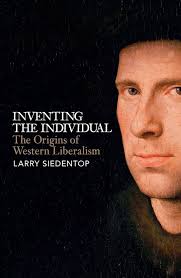
Larry Siedentop’s Straw Dog

I finally had the chance to finish reading Larry Siedentop’s Inventing the Individual: The Origins of Western Liberalism.

download

It is a great book, and especially informative for those not well-versed in the intellectual history of political ideas within (mainly) Christian thought. The arguments starts with the Ancient traditions, to the early years of Christianity, all the way to the fifteenth century. According to Siedentop (p. 332) the main goal of the book is:

‘to show that in its basic assumptions, liberal thought is the offspring of Christianity. It emerged as the moral intuitions generated by the Christianity were turned against an authoritarian model of the church. The roots of liberalism were firmly established in the arguments of the philosophers and canon lawyers by the 14th and 15th centuries: belief in the fundamental equality of status as the proper basis for a legal system; belief in that enforcing moral conduct is a contradiction in terms; a defense of individual liberty, through the assertion of fundamental or ‘natural rights’ and, finally, the conclusion that only a representative form of government is appropriate for  a society resting on the assumption of moral equality’.

Siedentop clearly succeeds in making this point. As said, the book can be warmly recommended. The question is, however, why does he care about this issue? Siedentop (pp. 334-338) clarifies that he wants to fight the dominant idea that liberalism sprang from the Renaissance, and that liberalism almost equates secularism, or is even anti-religion, at least in the public sphere.

You do not need to be a scholar of the liberal history of ideas to raise more than a few eyebrows here. What liberalism is Siedentop taking up for argument? He is unclear about this, as he does not care to define this liberalism, nor does he provide references to liberal thinkers. That is where the trouble starts.

Undoubtedly there are some modern social-liberals who claim that liberalism is secular and that the state and lawmaking should be strictly neutral in religious terms. Arblaster in The Rise and Decline of Western Liberalism even explicitly refutes any liberal traces before the Renaissance. Unclear is how dominant these voices are, especially outside academia. One thing is certain, these do not comprise classical liberals.

In the Scottish Enlightenment, in many ways the birth grounds of classical liberalism, the place of religion in life, and religion as a source of morality, was discussed. In contrast to most other thinkers, -Smith included- Hume even criticized religion, albeit most openly  after his death in Dialogues concerning Natural Religion. Yet to my knowledge, no thinker actually denied the role of Christianity as a source of  important ideas, certainly not the  role of individuality.

Modern writers, who are more aware of classical liberalism as a tradition do not deny this either. Let me give a few examples.

Hayek in an essay on liberalism (in New Studies in Politics, Philosophy Economics and the History of Ideas) writes that it traces back to classical antiquity and certain medieval traditions. He actually attacks ‘some nineteenth century writers’ who denied ‘that the ancient knew individual liberty in the modern sense’. In his general overview entitled Liberalism, John Gray (then still in his liberal days), also neatly points to the pre-modern and early modern times for the development of liberal ideas as we now know them. David Schmidtz and Jason Brennan pay their due respect to these older sources in A Brief History Of Liberty and the same goes for George H. Smith in The System of Liberty, and David Boaz in The Libertarian Mind.

Of course, none of them made detailed studies of these influences because their books had different purposes than Siedentop’s. Yet all deal with it in a few paragraphs or even a separate chapter, making clear to their readers that (classical) liberalism has older roots then the Renaissance, that there are important Medieval and Ancient thinkers who all left their mark on the development of (classical) liberal thought.

Siedentop wrote a great book, that unfortunately is a straw dog as well: his portrayal of ‘liberalism’ is erroneous, either deliberately or not. It denies the views of the founding and one of the main liberal variants. That is sloppy, to say the least, for such a learned and experienced scholar. With the use of these general terms Siendentop’s attack is simply off target. He should have taken far more time to define the ‘liberalism’ and the liberal scholars subjected by his attack.

Myths of Sovereignty and British Isolation XVI, Britain’s Significant Others: France and Germany (1)

Moving on from the narrative of British history concluded in the last post, some thoughts about the way that Britain has existed as a European nation in comparison with other nations, mostly Germany and France. Britain has been defining itself in comparison with these two, in more or less friendly ways since Germany emerged as a modern unified state in 1871. The comparisons with France go back further, as has been partly explored in the narrative posts from Æthelred II’s (the Unready) marriage to a French princess to the Tudor loss of Calais.

The attitude to Germany has been coloured by the pre-1870 Prussian monarchy which became the imperial family of Germany, while retaining the Prussian royal title, in 1871. Even the Prussian monarchy, though, is new compared with the French state. The Prussian kingdom only goes back to 1701, as an elevated form of the Margravate of Brandenburg in which the Hohenzollern family had been the Margraves since 1415, and even that is rather recent compared with the beginning of the history of France. Anyway, we cannot think of Brandenburg-Prussia as a pre-formation of the German state until the early nineteenth century when it took lands on the Rhineland and emerged as the joint leading power in Germany, along, with Austria, after the European  settlement at the end of the Napoleonic wars.

It is not entirely clear when we can date the beginning of the French state, since the earliest form, or preformation, of it was the Frankish kings who became rulers of some part of what is now France in the fifth century with the collapse of Roman rule in what had been Gaul. The Franks were German and the sense that the aristocracy of France had a different national origin from the common people lingered into the nineteenth century. It is only in the ninth century that Old French emerges as a written language of state business while the title of King of the Franks was separated from that of the dominant ruler of Germany, holding the title of Emperor of the Romans since the Frankish king Charlemagne was crowned by the Pope in 800.

The official title King of France only stated to replace King of the Franks in the late twelfth century, but it is safe to say that something like a swell defined the French state with a very broadly defined sense of shared culture between king and French speaking subjects goes back to the ninth century, after a preformation going back to the fifth century. Of course it should be remembered in relation to that it was only in the nineteenth century that a shared mass competence in the French of Paris prevailed across France including communities which were historically Basque, Flemish, Breton, German, Italian and Occitan (southern versions of French including Povençal), though a linguistic unity of the educated goes back much further.

One aspect of the sketches of French and German history above, is that the history of the dominant power in western Europe is often the history of France and Germany in various sometimes overlapping forms. This continues into the European Union which is at its heart a Franco-German union and that can be seen in the Euro which comes out of the French belief that it could import German economic success and discipline through a common currency, as well as the belief that it could mitigate German influence in Europe after post-Cold War unification though a shared monetary mechanism. One problem with British membership, maybe the most important, is a lack of interest in the French and German belief in a shared destiny best managed by some pooled sovereignty in a unified Europe, largely if not entirely consisting of countries strongly influenced in their history by contacts with France and Germany.

The most important issue in this post, though, is that France has a history as old and as grandiose as that of Britain, in fact preceding the unified British state history of England and Scotland only going back to 1603. The reason for emphasising this is the British sovereigntist-Eurosceptic tendency to regard France, like all European nations other than Britain in their view, as somehow less proud of their nationality, less patriotic, and less real as nations than Britain.

Really this is preposterous nonsense, and it should not be said that all British eurosceptics hold to this view, but it is hard to imagine the Eurosceptic current existing in Britain without this aspect of its culture, and hard to imagine even many of the more fastidious Eurosceptics do not believe this in their guts. The apparent willingness of France to share sovereignty with Germany in the EU even when Germany has become clearly the dominant EU country may to some degree explain this, but does not justify it.

More on this in the next post

Revolution by Tiny Steps

Now, the city council in the People’s Socialist Green Republic of Santa Cruz where I live does not do everything wrong, just many things, like making sleeping illegal. Many more of its decisions are just goofy, like red parking meters to donate to the homeless or declaring the city a “nuclear free zone.” Sometimes, however, it takes intelligent initiatives such as replacing much “ornamental” city -owned shrubbery with real plants including various kinds of attractive cabbage, artichokes and odoriferous, low maintenance plants such as lavender.

There is a restaurant downtown that offers “Mediterranean ” fare. I don’t know exactly what it is but I like the sound of it. The other day,  I am in my car and I have to stop because I see a man in a white cook’s jacket behaving strangely. He is bent over  what appears to be the sidewalk, intent on some task or other. Quickly, I park my car and approach to spy on him. It turns out he is foraging in one of the city’s mini-plantations, between two files of traffic, cutting lavender with small scissors. He is working twenty yards from the Mediterranean restaurant. Thanks to this inventive lawbreaker soon, someone is going to enjoy sherbet flavored with fresh lavender.

California is in a bad drought. The city leads by example. It has practically stopped watering its shrubbery, especially the plants located in ill-favored, non-touristy areas. Two days after catching the lavender thief in the act, I am driving by a large hardware store. Outside a crowd of day laborers – mostly Mexican, 100% illegals, I would guess – gather every day in the hope of scoring some work. Again, I see a man bent over the sidewalk. I slow down enough to also catch him in the act. He looks like a Mexican laborer. He is holding a water bottle in his hand. He uses it to water a single, tiny, unrecognizable plant in what used to be a city sidewalk lawn. He and the survivor plant may have become acquainted during the long hours of fruitless wait for a job.

I wish thousands of my fellow Republicans on automatic trigger about illegal aliens had seen the guy. It would have reminded them of their shared humanity. It might have helped some recognize that yes, you are right and they have no right to be here but sometimes, you are just wrong to be right.

Little individual acts of harmless rebellion like these two give me hope.

Cultural Adaptation to Climate Change? Requesting Feedback

I am currently working on adaptation to climate change and would appreciate a bit of feedback. I find feedback can be useful, if only to get me out of the ivory tower.

A brief background: When addressing climate change the popular idea is to reduce carbon emissions through a carbon tax, cap-and-trade or regulations. However focusing on emission reductions alone:

  1. Ignores the political difficulties of trying to reduce emissions. Regions that rely heavily on coal use are not going to be in favor of reducing its use or paying extra to use it, see the chart. Notice that states like California or Washington, which are trying to reduce their emissions independently, don’t use much coal anyway to meet their energy needs and would be minimally harmed by a carbon tax.
  2. Reductions today would not address the climate change that will occur even if we stopped all emissions today. Even if

We therefore need to adapt to climate change. We can adapt:

  • Individually by adopting technologies (e.g. air conditioning) or migrating to locations we expect to have better climates.
  • At the urban level by investing in the necessary infrastructure (e.g. seawalls to counter sea level rises), or by allowing cities to ‘move’ by letting old buildings deteriorate and focusing new development inland or building up near the coasts depending on local conditions.
  • At the (inter)national level by sharing technical information.

Economics, my home field, has plenty to say about the above three forms of adaptation. It is however lacking in discussing cultural adaptation.

For example, in Spain and other Mediterranean countries, it is customary to take a long mid-afternoon break to take a long lunch at home or take a nap. To compensate for this break work may end later than is customary elsewhere, and family-friendly social life is active well into the late evening. This custom was transplanted, to varying degrees, in Latin America; I am most familiar with the Mexican version due to family stories and personal experience. This custom helps to avoid working during the hottest time of the day and shifts activity towards the cooler part of the day. My understanding is that a similar custom exists in the warmer southeast Asian countries, but my personal knowledge is limited.

Are there any other examples of cultural adaptation to climate change that my fellow note writers can think of? Examples don’t need to be in regard to contemporary climate change and can be adaptations that took place during the Medieval Warm Period, the Little Ice Age, etc etc.


US States by % of Electricity Produced from Coal.
Source: The U.S. Energy Information Administration, 2013.
Note: Rhode Island, Vermont, and D.C. excluded due to minimal coal use for electricity production.

WV 95.28% KS 61.41% NC 37.38% HI 13.67%
KY 92.83% IA 58.76% TX 34.47% MA 12.04%
WY 88.48% MT 53.74% GA 33.26% AK 9.61%
IN 83.94% MI 53.40% AL 31.25% NH 7.40%
MO 83.06% AR 52.86% SD 28.19% OR 6.28%
UT 80.64% MN 45.85% VA 27.52% WA 5.90%
ND 78.46% MD 43.34% SC 25.62% NY 3.45%
NE 72.14% IL 43.31% FL 20.84% NJ 3.12%
OH 68.88% TN 40.78% LA 20.43% CT 1.91%
NM 67.31% OK 40.72% DE 19.90% ID 0.60%
CO 63.67% PA 39.00% MS 16.48% ME 0.45%
WI 61.62% AZ 38.38% NV 14.42% CA 0.41%
US 38.89%

From the Comments: Debunking Myths About Islam and Violence

Jacques, a retired sociologist and university professor, has been repeating himself over and over again for the past fifteen years or so. His gripe? The imminent danger of Islam. Or Islamism. It depends on when you began reading him. Until recently, until the time that Delacroix decided to try and pick on me, Jacques’ venom was directed at Islam. Nowadays, it seems his poisonous arguments are directed at Islamism, the political movement. This is a step in the right direction. And yet, though his target his changed, his argument has not. The argument runs something like this:

  • Most, or much, of the violence in the world today is associated with Muslim groups of some kind or other.
  • Therefore, Islam, or Islamism, has an inherently violent penchant that needs to be removed using any method at the West’s disposal (including torture, a separate judicial system for Muslims suspected of being terrorists, and outright war).
  • In addition, Muslims who are not inherently violent (notice: Islam has an inherently violent penchant, except when it does not) are still responsible for terrorism because they do not snitch to government authorities when their fellow Muslims begin growing beards, and they do not speak out against Muslim extremists.

I have already gone the rounds with Delacroix on this narrative. He has been nothing but obstinately ignorant about his own argument, including the pseudo-facts that they rest upon. Maybe I shouldn’t be taken seriously. I’m just a lowly blog editor, after all, and a self-admitted libertarian to boot. The ‘comments’ of the two guys I’m about to highlight should be taken seriously, though. They are both college professors, and both do not self-identify as libertarians (though I think they are). Here is Dr Khawaja attempting to talk some sense into Jacques:

The first point is predictability versus explanation-in-retrospect, and I think you’re proving my point. I agree with your general account of the traits and biographical trajectory of terrorists. They’re often just as you say they are. The problem is, there are lots of non-violent losers with identical traits and trajectories, and no way to sort out the violent from the non-violent before the fact. The explanatory patterns typically emerge after the fact, which is when people tend to jump from explanation-after-the-fact to predictability-ex-ante. I guess I’m just flatly denying that the trajectory of the non-Islamist crazy is–in Western countries–all that different (ex ante) from the Muslim ones. The only “distinguishing” feature is that the latter are Muslim, and alienated from traditional Islam, and born again into something radical. But an enormous number of people have those traits, and simply waste their lives on being born-again Muslims of that sort without ever doing anything violent. My point is, when people–typically young men–start to move in that direction, it usually causes some concern. But “concern” is not the same as alarm at an imminent or even pending attack, and contrary to your suggestion, there is almost no way to predict those unless you’ve been taken into confidence by the would-be perpetrator. And of course, given what he wants to perpetrate, he’d have to be very incompetent to take a would-be snitch into his confidences.

Proviso: what I’m saying above refers to Muslims in Europe and North America. Things are different elsewhere. In the West Bank, if X’s brother, father, uncle, or cousin has been killed by the IDF, X is likely to commit a terrorist act, and if X becomes very religious, you can infer that he’s a member of Hamas. Similar moves are open to someone living in Pakistan. But those are different contexts than France of the US.

I’m not dogmatic enough to insist that the French cleric you quoted must absolutely be wrong. Maybe he has some way of detecting jihadists. But I really doubt it. The problem with French clerics of that sort is precisely their proximity to the government. They tend to speak with a view to pleasing this or that constituency, and what your cleric says is what the French government and people want to hear.

On immigration, granted that you didn’t literally come out and oppose all immigration by Muslims. But that isn’t quite what I accused you of, either. My point is: here we have a humanitarian crisis involving refugees who want asylum in this country. I’m the first to admit that if we admit a large number, some of this number will be terrorists and will perpetrate attacks on us that wouldn’t otherwise have happened (if we hadn’t let them in). My point is: now that we have this crisis, Americans have suddenly decided that a mass influx of refugees has to be constrained by border controls that would ensure that the mass influx remains a trickle. Imagine facing a potential influx of Syrian refugees and applying your stricture that none of them be Muslim literalists. By the time you operationalized that policy, and hired the border control staff to operate it, the year would be 2023, and the refugee crisis would be over. Or to take your other policy: can you really imagine teaching Syrian (or any other) refugees First Amendment law at their point of entry into the US? It can’t be done. It’s just not the way refugee operations work or can work. Imposing strictures like that on refugees is just a way of ensuring that the US never becomes a sanctuary during refugee crises.

I wouldn’t mind that attitude if only it were accompanied by a little bit of candor about history and politics. The US is committed never to become a large-scale sanctuary for, say, Syrian refugees. But now listen to the way politically conscious Americans talk about refugee crises elsewhere. The Arabs of Mandate Palestine were reluctant to open the borders of Palestine to European Jews? Well, that makes them anti-Semites. Common assertion: “The Palestinians remain in UNRWA camps to this day because the surrounding Arab countries, in their greed, refuse to take them in.” This comes from Americans who would never dream of taking them in. Israel, of course, has a very generous refugee policy (for Jews); that gets praise without any recognition that the refugees then function as demographic chips in the settlement game. West Bank settlements are full of Russian “Jews” who know less about the celebration of shabbos than I do.

Do I think the US has a Muslim problem? What makes the question difficult to answer is not any reluctance on my part to tackle the issue head-on, but an ambiguity in the phrase “a Muslim problem.” In one sense, it means “any significant problem stemming from Muslims.” In another sense, it means “a high priority issue facing the country as a whole and stemming from Muslims.” My view is that it has the first, not the second. There are several million Muslims in the country, and on the whole they don’t constitute a political problem. There are pockets of fanatics among them that do constitute a political (security) problem. France may well be different, but I think things are essentially in good shape in the US, despite this or that conspicuous Muslim atrocity.

To come at your question slightly differently: there is a sense in which Islam has a problem, the problem of reconciling itself to modernity. Given that, wherever you have Muslims who haven’t reconciled themselves to modernity, you’re going to get a problem (or problems). So yes, even if we had an isolationist foreign policy, that problem would remain. But that problem is least pronounced in the US, where Muslims basically run the same gamut as Reform to Conservative to Orthodox Jews. Literalist Muslims are no more (or less) a national problem than Orthodox Jews. I don’t mean to deny that they’re both a problem. But I wouldn’t say we have an Orthodox Jew Problem any more than I’d say we have a Muslim or Literalist Muslim Problem. Some places might, but we don’t.

Sorry, I said something confusing: “I don’t mean to deny that they’re both a problem.” I meant to say, “I don’t mean to deny that they’re both problematic,” i.e., give rise to problems. What I’m denying is that the problems are the equivalent of a high-level security threat.

Dr Khawaja blogs over at Policy of Truth and teaches philosophy at Felician College. Dr Amburgey tries to talk some sense into Jacques using a different angle:

“I said “probability.” It’s the concept we use, consciously or not, to approximate rational decisions in our daily lives: Select this birth clinic, rely on this baby food, travel by car, get vaccinated or not, go for this class rather than another. etc.”

I agree with Jacques. I’ll go further, I agree wholeheartedly with Jacques. I don’t subscribe to silly notions of human rationality like some of my colleagues but doing the best we can to make rational decisions is desirable both individually and in matters of public policy. As a consequence it’s useful to consider probabilities in our consideration of Jacques proposals.

Firstly, how does terrorism stack up against other risks in a probabilistic sense?

“Indeed – as we’ve previously documented – you’re more likely to die from brain-eating parasites, alcoholism, obesity, medical errors, risky sexual behavior or just about anything other than terrorism.”
http://www.globalresearch.ca/non-muslims-carried-out-more-than-90-of-all-terrorist-attacks-in-america/5333619

Even if we set aside the consequences of our choices [lifestyle or otherwise] terrorism is dwarfed by other things that kill us. Is it rational to spend more on the military than every other form of discretionary spending combined?
https://www.nationalpriorities.org/budget-basics/federal-budget-101/spending/

Secondly, given that terrorism is a risk how do different forms stack up compared to one another.
According to Jacques…

“We have terrorists of all inspirations in America, I know. The white murderer of black church people in Charleston was a terrorist, pure and simple. He was home bred and home grown. However, we have many, many more terrorists of foreign extraction, almost all with ties to Islam.”

This is, to put it politely, a counterfactual statement. The various public datasets have different observation windows and methodologies. Right now I’m going to use the 1980-2005 FBI data simply because there is a handy pie chart that I can copy from. In decreasing order…

Latino-42%, Extreme left-wing groups-24%, Others-16%, Jewish extremists-7%, Islamic extremists-6%, Communists-5%

The USA certainly has problems. Does it have a ‘muslim problem’? I’d say the numbers speak for themselves.

Dr Amburgey teaches in the business school of the University of Toronto. He doesn’t blog.

Jacques has still not addressed my questions regarding the implications of his policy proposals, by the way, namely that they echo those implemented by the Third Reich. Political Correctness is a corrupting influence on the free and open society (I suspect, in my infinite kindness and generosity, that Political Correctness is Jacques’ real target when he writes about Islam), but so is cultural chauvinism. Two wrongs don’t make a right!

Myths of Sovereignty and British Isolation XV, From Dutch Model to German Kings

Continuing from the last post, the story of the temporary Anglo-Dutch fusion and then moving onto the German kings of Britain.The invasion of late October was not strongly resisted, James fled London and then England, giving Parliament the pretext to declare that James had abdicated. His son was ignored with the falsehood pretext that he was not the son of James and his wife, but a baby smuggled into the royal chambers. All this evasion and pretence should not be allowed, in Burkean fashion, to conceal the reality that Parliament had asserted itself as the sovereign power in the country, and accordingly that the monarch reigned at its pleasure, which could be withdrawn. This was not a restoration but a very radical innovation.

On the conservative side, it was designed to maintain a religious settlement in which only members of the state church were full citizens, removing rights James had given to Catholics and also Protestant Dissenters. The immediate impact then was a major loss of religious freedom, though partly based on fear that ‘tolerance’ was a tactic only for James on the road to state enforcement of Catholicism. We will never know the truth of that.

William’s Dutch invasion did not inspire much of a war as James II’ authority collapsed quickly, but further violence was to come in Ireland until 1691 featuring sieges and major battles, with the French helping the Catholic Irish against the Dutch prince turned English monarch. There was war in Scotland until 1692, featuring one of the infamous events of Scottish history, the Glencoe Massacres of Scottish Jacobites (supporters of James). The massacre was partly the result of clan rivalry, but was certainly also the consequence of state policies.

The Dutch connection disappeared with William’s death, as he had no children and the throne passed to Mary’s sister Anne, ignoring of course the claims of ‘James III’, the exiled son of James II. However, the impact of the Dutch connection was not just in the person of William. His reign as William III (1688 to 1702) coincides with the foundation of the Bank of England in 1694, which took place in the context of Dutch investments in London and a strong Dutch influence as a model of Protestantism, science, crafts, public finances, naval and merchant fleets, trade and colonialism which preceded 1688, including the exile of the liberal political philosopher John Locke in the Netherlands from 1683 to 1688, and was intensified by the Dutch invasion/Glorious Revolution.

The Dutch Republic had shown how to fight wars through a reliable, credible form of public debt which Britain was able to use in eighteenth century wars. Generally, the temporary relationship between the two states, which was somewhere between mere alliance and full fusion, was important in enabling Britain to become the leading eighteenth century power in Europe for all the things associated with the Dutch Republic in the seventeenth century.

The temporary semi-fusion of course had a drastic impact on British foreign and defence policy, which was now heavily oriented towards Dutch aims in northwestern Europe, and even the whole of Europe. Britain was heavily engaged in European politics, including wars, particularly the War of Spanish Succession (1701 to 1714), which led to Britain’s still current acquisition of Gibraltar on the southern tip of Spain and included one of the most famous victories of British military history, Blenheim, under on the most famous British generals, John Churchill (ancestor of Winston Churchill), Duke of Marlborough on German territory. The main aim of British participation was to prevent French domination of Europe, which was threatened by a French claim to the Spanish throne, and the possibility of over generous compensation to France if it gave up Spain, with regard to Spanish colonies and the parts of Italy dominated by Spain.

Moving back briefly to the period before James II, his brother Charles II, had a secret treaty with Louis XIV of France which meant that state policy was covertly guided by the French who were subsiding Charles. So the temporary semi-fusion with the Dutch Republic was itself nothing new in terms of British state policy coming under the influence of a European power, it was simply a more open form of it. Looking forward, William was succeed by Mary’s sister Anne.

Parliament then legislated for a Protestant only succession, which went to the Elector Prince of Brunswick-Lüneburg, generally known as the Elector of Hanover. This family supplied British monarchs from 1714 to 1837. The legislation of Queen Anne’s time precluded military commitments to Hanover, but inevitably in practice the defence of Hanover and the protection of Hanover’s interests in Germany were a major consideration of state during that period. The first two Hanoverian monarchs were more German than English, though the third of the Hanoverian Georges, George III established himself as a largely popular archetype of supposed British character.

Next post: Britain in relation to some European nations

Liberty or “Security”: An Old Debate, A Familiar Straw Man

Ho hum. Jacques wants his government to do three things in the name of fighting Muslim terrorism (not to be confused with other, more numerous kinds of terrorism): 1) allow for an armed, perpetually-on-alert military to be active on US soil, 2) allow for a surveillance state that can do as it pleases in regards to Muslims only, and 3) initiate ideological quotas for Muslim immigrants.

The entire ‘comments’ thread is well worth reading, too. Dr Amburgey, who came from the same doctoral program as Jacques, brings the quantitative fire; Dr Khawaja, the qualitative. Jacques has responded to each of them.

The absurdity of Delacroix’ argument speaks for itself. I will come back to it shortly, but first I want to address a couple of his points that are simply made in bad faith. Observe:

(Yes, Mohammed did behead every man of a vanquished enemy tribe on the battlefield. Incidentally, they were Jews. The Prophet then “married ” their wives, he raped them, in others words. Bad example? Talk about this genuine part of Muslim tradition?)

Murdering and raping Jews is a “Muslim tradition”? I am sure this is news to Uighurs in China and the Javanese of Indonesia. I think there is a good case to be made for a present-day Arab cultural chauvinism that rests in part on what could be called “Muslim tradition,” but this is not a nuance that Jacques – the retired college professor – cares to address. I wonder why. If we’re going to go back to the 7th century to find cultural defects, can anybody think of something nasty that was going on in what is now France at the time? In what is now the US? What an odd historical anecdote to include in an argument.

Here, too, is another whopper:

One article of faith among literalist Muslims is that government must come from God. That’s why the Supreme Leader of the Shiite Islamic Republic is explicitly a cleric, couldn’t be an elected civilian or a general. This belief also explains the search for a Caliphate among Sunni jihadists, a polity where administrative and religious powers are one and the same.

What is a “literalist Muslim”? Nevermind. The government of Iran, its structure, is based on Plato’s Republic, not the Qur’an. The “Supreme Leader” Jacques identifies is based on the notion of a philosopher-king, not a Shiite cleric. This was done to protect the new dictatorship from its many enemies, including those loyal to the old dictatorship (the one supported by the United States; the one that Washington installed after helping to remove a democratically-elected Leftist government during the Cold War). The rhetoric of the Iranian dictatorship is explicitly religious, but in reality it’s just plain, old-fashioned despotism.

In a similar vein, “Sunni jihadists” (to use Jacques’ term) do not search for a Caliphate because of a belief that government should come from God, but instead look to a mythical Caliphate that they believe existed from the 7th to early 20th centuries as inspiration for creating a society that cannot be pushed around by murderous Western governments. Pretending that Arab Sunnis want to create a Caliphate in order to strengthen the link between government and God can only be described as “dishonest” when it comes from the mouth of a sociologist with a doctorate from Stanford.

At best, it could be argued that Jacques is simply making these types of points because they are pervasive throughout American society, and thus we – as libertarians of all stripes – have our work cut out for us. Now that I think about it, Jacques’ argument is so silly that it has to be an exercise in critical thinking. Nobody of his stature could say something so stupid, right?

Those are just two examples of, uh, the misrepresentation of reality by Jacques. There are many more, and I don’t think he got those myths from an academic journal. He got them from Fox News. That’s not good. That means libertarians are not taking advantage of their right to free speech, like conservatives and Leftists do. Why aren’t you blogging more often?

I’d like to turn back to his policy proposals. Here they are again:

  1. an armed, perpetually-on-alert military on US soil,
  2. a surveillance state that can do as it pleases in regards to Muslims only, and
  3. ideological quotas for Muslim immigrants.

The first two proposals look like they were copied directly from the playbook of the Third Reich (I hope you’ll reprimand me in the ‘comments’ section if you think I am being overly dramatic, or strawmanning Jacques’ argument). Just replace “US” with “Germany” and “Muslims” with “Jews” and voila, you have an answer for your Muslim (“Jewish”) problem. (RE Policy #3: National socialists, of course, don’t like anybody immigrating to their territories, whereas Jacques, in his infinite kindness and wisdom, seeks only to allow those who think like him into his territory.)

Again, Jacques’ argument is silly. It is both vulgar and unintelligent. It is misinformed. And yet I have to ask: Who is winning the PR battle here, conservatives on the one side or left-liberals and libertarians on the other?

Everyone carries a part of society on his shoulders; no one is relieved of his share of responsibility by others. And no one can find a safe way out for himself if society is sweeping toward destruction. Therefore, everyone, in his own interests, must thrust himself vigorously into the intellectual battle. None can stand aside with unconcern; the interest of everyone hangs on the result. Whether he chooses or not, every man is drawn into the great historical struggle, the decisive battle into which our epoch has plunged us.

That’s from Ludwig von Mises, the libertarian Austrian (and Jewish) economist who had to flee his homeland as the Third Reich took power. Speak your mind!

America’s Muslim Problem: What To Do.

There are many people in the US who possess normal common sense and who also have a liberal disposition, “liberal” in the old meaning of the word. I mean before the word came to designate a propensity to force others to do what they don’t want to do, accompanied by intellectual hypocrisy. The word used to mean something like: “well disposed toward others;” it used to refer to habits of tolerance, adding up to giving the other guy the benefit of doubt. I think I am one of those. I am lucid; I see what I see and I don’t pretend I don’t see it; I have no trouble finding something to like in others who are unlike myself. Nevertheless, I draw the line at institutionalized brutality (such as the genital mutilation of little girls) and at intentional cannibalism. The latter means that if you eat your dead to survive (as a Uruguayan rugby team plane-wrecked in the high Andes famously did about thirty years ago); it’s acceptable but if you go a-hunting humans explicitly for the table, I think it’s not cool.

Well, people like me have been struggling to hold their tongues since 9/11 in order to avoid stating the obvious about terrorism , and in order to not be forced to draw the policy consequences of what their eyes behold. We are caught between the rock and the proverbial hard place, largely, I speculate because we wish to avoid bad intellectual company. On the one side, we have paralyzing and contagious political correctness, on the other hand, there is the embarrassing torrent of abuse issuing from political allies who are both uninformed and ill-disposed, so ill-disposed that they are unable to see the obvious contributions of Islamic culture. I mean by this that you don’t have to be a Christian, or to love the Inquisition, or to believe that Christ resurrected to recognize that if Christianity had contributed nothing but Gothic cathedrals, that would still be a lot. Similarly, you don’t have to like Islam the religion to appreciate Arabic calligraphy and the Blue Mosque of Istanbul. Anyway, the pseudo-secret we have been unwilling to admit openly is this: We have a Muslim problem in this country.

We have terrorists of all inspirations in America, I know. The white murderer of black church people in Charleston was a terrorist, pure and simple. He was home bred and home grown. However, we have many, many more terrorists of foreign extraction, almost all with ties to Islam.

The man who murdered four Marines in cold blood in Chattanooga and wounded several several others was an immigrant. Somali refugees and their children have often been implicated in attempted terrorist acts in this country. The convicted and jailed underwear bomber is a Nigerian. We may not be able to do much about US-born terrorists such as Major Hassan (in prison) and preacher Al-Awlaki (pulverized by a drone in Yemen), but we can stem the flow of those with the greatest probability of slaughtering us at home. I said “probability.” It’s the concept we use, consciously or not, to approximate rational decisions in our daily lives: Select this birth clinic, rely on this baby food, travel by car, get vaccinated or not, go for this class rather than another. etc.

There is a young Muslim woman I know well and whom I love like a favorite niece. “Uncle,” she says,” Islamist terrorists are not more my problem than yours.” I disagree because I don’t believe that venomous seeds grow into poisonous plants on their own. They need water and they need good soil. No water, no plant; bad soil, no plant. The water for Islamist terrorism is provided by hundreds or thousands of preachers who preach irresponsibly, good Muslims all who don’t believe they have to be bothered about the effect of their equivocal words once they have left their mouth. (Yes, Mohammed did behead every man of a vanquished enemy tribe on the battlefield. Incidentally, they were Jews. The Prophet then “married ” their wives, he raped them, in others words. Bad example? Talk about this genuine part of Muslim tradition?)

The soil of Islamist terrorism is the passivity of otherwise blameless Muslim communities who cannot help but see fanatics grow before their eyes and decide to keep mum and to do nothing. Here is a simple example of what I mean. The killer of four Marines wore a beard, not any kind of beard, not a Hollywood-inspired beard, not a chic beard, not an old man’s beard like mine. His untrimmed, wide beard is worn only by imitators of the Prophet Mohammed. Few Muslims even wear such a beard. Muslims of all stripes know and recognize this. It take a few weeks to grow such a beard. If your son or your neighbor shows up with one, it should give you pause, if you are a Muslim. You should make a mental note that that young man bears watching. Why would anyone want to imitate the seventh century prophet in the 21st century. Who is wearing robes like Jesus? I am guessing (Guessing) that members of the particular terrorist’s community may have whispered some but just let the matter drop.

Some nation-wide reforms are obviously necessary toward domestic Islamist terrorism. Here are three.

Donald Trump is mostly a rich buffoon but once in a while, he forcefully states the obvious. As he proclaimed, it’s wrong that the people charged with our defense are not themselves allowed to be armed for their own defense. This silly policy should be reversed and all qualified military personnel (and I don’t see why a single one would be unqualified) should be allowed and encouraged to carry a personal weapon. If rural sheriffs’ deputies with three weeks training can carry a weapon, I expect members of our military to be qualified to do the same, strictly for self-defense and as a deterrent, of course. This change from current policy could be tried for a given period and its effects studied. If it were found out that members of the military fall into the habit of gunning one another, or civilians down then, the policy of a defenseless military could always be re-instated. Our society is taking worse risks every day. That was my first point.

Second, romantic libertarians (including many of my friends) have to come to terms with the need for widespread domestic electronic surveillance aimed at preventing domestic terrorism. As is usually the case, the assassin of the Marines in Chattanooga had given signals. He had spent months in Jordan and then made ominous noises on the social media. Of course, most of those who talk big on Twitter never take the next step to real mass killing. The minority who do should be discovered by monitoring the lot in a cheap, economical way because there are so many. To oppose this kind of step is like declaring that the protection of our civil liberties is worth a few massacres each year – which could easily turn into many massacres. Yes, there is a slippery slope there. And yes, such surveillance creates a precedent that might lead to the intimidation of legitimate dissent. Two responses. First, a climate of widespread insecurity also undermines our personal liberties. Witness the creation – with hardly a murmur against – of that very intrusive and yet grossly ineffective Homeland Security apparatus in the aftermath of 9/11. Second, attacks on civil liberties take many forms and are not dependent on the particular bugaboo of electronic surveillance. Witness the still unpunished persecution of conservative political organizations by the Internal Revenue Service.

Civil libertarians, including libertarians would do better and they would be more effective in the long run if they insisted on two things: real effective, strict judicial oversight of surveillance; more restrictive aiming than has prevailed in that area. This would require frank profiling. (More on profiling below.)

The third measure needed is to slow down the growth of Muslim immigration into this country. Islamist terrorists come exclusively or almost exclusively from Muslim communities. The larger the Muslim communities, roughly, the greater the number of potential Islamist terrorists on American soil. This is true both directly and demographically. Some Muslim immigrants become terrorists, others raise American children who become terrorists. Muslim communities everywhere turn a blind eye to the the transformation among some of their members in a radical direction that is the prelude to embracing terrorism. Now, we want to do this in a way that avoids stigmatizing a billion people worldwide, many of whom have a view of Islam that makes no room for social aggression, many of whom are lukewarm faithful, an unknown number of whom are frankly indifferent, no more Muslim that I am. I repeat, in passing, that Muslims globally supply most of the victims of Islamist terrorism but this is not my topic here, I am writing about improving Americans’ safety.

Yes, I know, nearly everyone knows by now that not all Muslims are terrorists (exceedingly few are) and not all terrorists are Muslims. Let’s put this behind us for good. My point is that for practical purposes almost all domestic terrorists are Muslims.

We have to develop a selective tool for keeping out of the country the narrower category of Muslims most likely to become terrorists. I am speaking here of profiling before the fact. Although “profiling” has a bad name, rational action requires it. Here is an example. Looking for car thieves in a particular area, the local police will ignore older church-going black ladies while focusing on white males in their twenties who dress in dirty t-shirts. Profiling! It turn out that one way to interpret Islam insists on its literal relevance in today’s society. The highest Muslim theological authorities including the Grand Mufti of Cairo and religious authorities from Al Azar University periodically remind the faithful that Muslim tradition must be interpreted in the context of our times. This modernizing perspective is equally rejected by ISIS, which practices slavery because it’s explicitly allowed in the Koran itself, and by the Islamic Republic of Iran, which pointedly keeps the stoning of adulterous women on its books for the same reason. (In addition, many Muslims are like their Christian counterparts: They don’t know much about their own religion and what they know is disorganized and often incoherent, what I call “religious bric-à-brac” in an article in Liberty Unbound with a title that includes this word. “Religious bric-a-brac and the Tolerance of Violent Jihad,”).

It turns out that Islamists are also all literalists, strict constructionists, when they are not simply hoodlums. If you prevent literalist Muslims from entering the country , you have gone a long way toward reducing the number of potential terrorists in the US. One article of faith among literalist Muslims is that government must come from God. That’s why the Supreme Leader of the Shiite Islamic Republic is explicitly a cleric, couldn’t be an elected civilian or a general. This belief also explains the search for a Caliphate among Sunni jihadists, a polity where administrative and religious powers are one and the same. But, of course, separation between Church and State, between religion and government is central to our constitutional arrangements. And, there is no compelling reason to accept immigrants, or even visitors, who think of a central tenet of our constitution as anathema. We have every moral right to sift them out. This can be done at low cost and with a fair degree of effectiveness.

Few countries accept everyone without condition; the US does not, never has. It would be a simple matter to make all immigrants, all refugees seeking asylum and, I think all visitors sign a document asserting that they support all features of the US Constitution, including specifically everything that has to do with the relationship between religion and government. These comprise the non-establishment of religion (including Christianity they may be reminded) and an absolute right to blasphemy. As I said, all entrants would be asked to sign a statement to this effect, and they would be told that the list of signatories could be published at any time, anywhere and in any language. Latin Americans would sign because their constitutions are copied largely from ours; Europeans would sign because thy are almost all religiously indifferent or lukewarm; the largest immigrant group, the Chinese wouldn’t care. The only group from which you would expect a significant reluctance to sign would be Muslims, not all Muslims, but Muslims with literalist, fundamentalist tendencies that is, precisely the category most worth excluding. Some would simply cheat, of course, and pretend to agree to what is to them anathema but the possibility of seeing their name publicized would act as a partial deterrent. In addition, such perjury would provide easy ground to prosecute those signing under false pretenses.

Some would protest that such exclusion would be “unfair.” I think that the issue of unfairness dos not arise. This immigrant believes that no one has a right to enter the US.

Arm our defenders; ferret out the wild beasts before they can bite; don’t allow the alligator swamp to become larger. It’s all obvious; it’s all doable. It’s much more than we are doing now.
Myths of Sovereignty and British Isolation XIV, Revolution and the Dutch Model in the Late 17th Century

The last post in this series looked at the impact of Dutch republicanism on constitutional innovation and revolution in mid-seventeenth century Britain. Now on to Dutch influence on the Glorious Revolution of 1688.

Britain, or what was still three kingdoms (England, Scotland and Ireland) only unified in the person of the monarch did not have just one revolution connected with the Dutch model in the seventeenth century, but two. Furthermore the second of those revolutions required invasion by a Dutch prince to happen. The Glorious Revolution, as that second revolution is known, established something like the modern British political system in 1688 in establishing that the monarch could not legislate or even nullify legislation without parliament, could not govern without parliamentary consent and that parliament had the right to decide who could inherit the monarchy.

That this fundamental reorientation of the state system took place through violence and foreign intervention is not the sort of thing that sovereigntist believers in a British special path separate from mainland Europe, since Edmund Burke like to emphasise. Edmund Burke, a remarkable parliamentarian and writer on various topics including philosophical aesthetics, of the latter half of the eighteenth century, is introduced here, because his way of presenting British history is very connected with his assertions of British superiority in Reflections on the French Revolution, his most widely read book.

Of course there were things to condemn in the French Revolution, and Burke was a very acute observer of the violent polarising tendencies within it before they reached their extreme points, but his assumptions about British history are absurd. Given the importance of the Glorious Revolution for the British polity within which he played a distinguished role (though never in government), and his wish to condemn revolution, he reacts by denying a real revolution in 1688, presenting it as essentially restorative rather than innovative and as an essentially peaceful consensual event. It was of course presented in that way at the time, but then the French Revolution was influenced by ideas of restoration.

Evaluating Burke’s attitude will require going back to those events. Inevitably there are debates about the real causes of the Glorious Revolution, but it is anyway undeniable that it was a reaction against the rule of James II, who had only come to the throne three years previously suggesting remarkably poor powers of persuasion and conciliation.

The collapse of his reign was in some important part the result of religious issues going back to the simple fact that he was a Catholic monarch in a Protestant country. This would have been tolerable for Parliament and everyone else participating in political life if James had left the state religious settlement alone and if he was to die without a Catholic heir.

James was, however, very busy with changing the state religious settlement letting Catholics into powerful positions, and more seriously institutionalising the Catholic church in ways that suggested that at the very least he intended to give it equal status with the Protestant Church of England. This could be defended on grounds of religious tolerance at the time and still is.

Unfortunately for him James was not successful at persuading many Protestants, even those subject to discrimination themselves, that he had good intentions, and his methods of enforcing changes in the state religious settlement did not suggest someone willing to limit his general powers as Parliament expected. These methods included the assertion of a Dispensing Power, in which laws were suspended at will, and measures to manipulate parliamentary elections.

At the beginning of the reign he benefited from an extravagantly royalist Tory Parliament, but in a short period became mistrusted and feared. The birth of a son in June 1688 brought opposition to a new peak as it suggested that what James II had done would last beyond his own lifetime and it was not enough for those who disliked his policies to simply wait for his death, which would bring his Protestant daughter Mary to the throne, if he had no male heirs and she lived long enough. The outcome was that the Immortal Seven, seven prominent parliamentarians invited Princess Mary’s husband, Prince William of Orange to invade England.

The title ‘Orange’ refers to territory in France, but the Orange family was Dutch. They had a rather complicated and changing status as the first family of a country with no monarchy, tending to lead the army and to some degree provide a focus for central executive power in a  very decentralised system. The invitation to William enabled him to become King by will of parliament, but as he was the husband of the next in line to James, apart from his son, the hand over to William could be concealed as Mary taking her inheritance.

The next post will look at the steps from Dutch model to German kings linking Britain with Hanover.