Once, Cubans were (maybe) richer than Americans

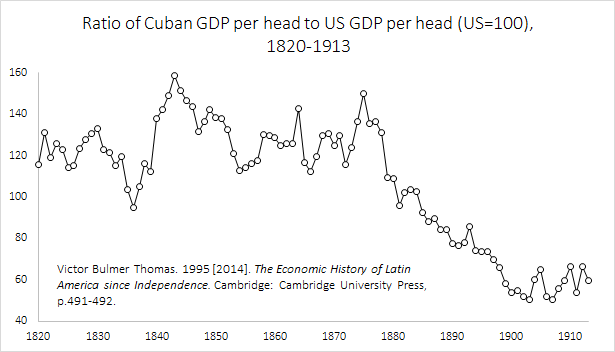
In light of what we see today, this is hard to believe. However, as a result of Castro’s death, I accidentally became interested in the history of this fascinating island and the more I discover, the more shocked I am at “the path” that Cuba has taken. One of these reasons is provided below by Victor Bulmer Thomas in his Economic History of Latin America since Independence. Now, Thomas uses a different approach than the commonly used Maddison data (he believes the assumptions are too heroic). He uses indicators correlated with GDP per capita to fill in the gaps and he finds that Cuba was generally richer than the United States for most of the 19th century (see below):

cubaus

Now, I am not convinced by the figure Thomas presents. However, I am also skeptical of the levels presented by Maddison (where Cuba is roughly 60% as rich as the US in 1820). In between are some more reasonable estimate (see this great discussion in this book as well as this discussion by Coatsworth).  Moreover, there is the  issue of slavery which distorts the value of using GDP per capita because of high levels of inequality (however, it distorts both ways since the US was also a slave economy up to the Civil War).

Nonetheless, this tells you about the “path not taken” by Cuba.

Joaquim Nabuco, a Brazilian visionary in Washington

During most of the 19th century Brazil and the United States showed little mutual interest. Brazilian foreign policy was initially directed to Europe (mainly England) and then to border problems in South America (particularly with Argentina and Paraguay). Meanwhile, the US was concerned about its expansion to the west and its internal tensions between north and south. With little convergence in these priorities, the two countries basically ignored each other.

However, this picture began to change at the end of the century, especially because Brazilian coffee found in the USA an excellent consumer market. The definitive change occurred in the first decade of the 20th century, when Barão do Rio Branco, Brazil’s foreign minister for 10 years (1902-1912) decided that the country should privilege relations with the US in its foreign policy. The Baron understood that after Africa and Asia, South America (especially the unprotected Amazon) would be the target of European imperialism. Without an army and a navy that could deal with Europeans, Brazil needed US protection.

Fortuitously, this was also the period in which Theodore Roosevelt gave his corollary to the Monroe Doctrine. Roosevelt had already made clear his intention to keep Europeans away from the American continent, particularly in his intervention to build the Panama Canal. An unwritten alliance was formed between the two countries: the convergence of interests caused Brazil and the United States to experience an unprecedented approach in history. To consolidate the new paradigm of foreign policy the Baron elevated the Brazilian diplomatic representation in Washington to the level of embassy. In the diplomatic gesture of the time this was a clear indication of the preference that the country gave to the USA. The Baron chose Joaquim Nabuco to be Brazil’s first ambassador to Washington.

Nabuco is a well-known personage to the scholars of Brazilian history. When he became ambassador to Washington he was already famous for his struggle against slavery in Brazil and for his work as a historian. Like the Baron, Nabuco believed that Brazil would be the target of European imperialism, and that it needed US help to protect itself. Unlike the Baron, however, Nabuco saw an opportunity at the time to do something more: to turn America into a zone of peace, a continent with international relations essentially different from those of Europe.

The Baron saw international relations only as a zero-sum game. He also did diplomacy thinking in terms of a balance of power. Nabuco was not unaware of these aspects, but he believed that through regular international conferences and open trade, America could avoid the wars that were so characteristic of Europe. But for that the US leadership was essential, and should be supported by all. The Baron sought the US punctually: he wanted the protection of a stronger country while Brazil was not able to protect itself. Nabuco wanted a permanent alliance. In his foreign policy the Baron was a kind of conservative: changes do not occur easily. The story simply repeats itself. The 20th century would simply repeat the 19th. Nabuco believed that change is possible. He believed in universal principles linked to classical liberalism.

Nabuco passed away in 1910, only five years after assuming the position of ambassador. Perhaps if he had been more successful in his foreign policy we would have had a very different twentieth century. The United States would not have become involved in Europe, as it did in World War I. America would be a continent of peace, contrasting with the Old World. America would lead by example, not intervention. And many problems we face today, the fruits of American interventionism, would be avoided.

A Common Conservative Fallacy

I believe folly serves liberals better than it serves conservatives. Our way is the rational way while liberals tend to rely on their gut-feelings and on their sensitive hearts which make them comparatively indifferent to hard facts. That’s why they voted for  Pres. Obama. That’s why they voted for Mrs Bill Clinton against all strong evidence (known evidence, verifiable, not just suppositions) of her moral and intellectual unsuitability. That’s why many of them still can’t face emotionally the possibility of buyer’s remorse with respect to Mr Obama. That’s why they can’t collectively face the results of the 2016 election. So, conservatives have a special duty to wash out their brains of fallacy often.

It’s the task of every conservative to correct important errors that have found their way into fellow conservatives’ mind. Here is one I hear several times a week, especially from Rush Limbaugh (whom I otherwise like and admire). What’s below is a paraphrase, a distillation of many different but similar statements, from Limbaugh and from others I listen to and read, and from Internet comments, including many on my own Facebook:

“Government does not create jobs,”

and

“Government does not create wealth (it just seizes the wealth created by business and transfers it to others).”

Both statements are important and both statements are just false. It’s not difficult to show why.

First, some government actions make jobs possible that would not exist, absent those actions. Bear with me.

Suppose I have a large field of good bottom land. From this land I can easily grow a crop of corn sufficient to feed my family, and our poultry, and our pig, Gaspard. I grow a little more to make pretty good whiskey. I have no reason to grow more corn than this. I forgot to tell you: This is 1820 in eastern Ohio. Now, the government uses taxes (money taken from me and from others under threat of violence, to be sure) to dig and build  a canal that links me and others to the growing urban centers of New York and Pennsylvania. I decide to plant more corn, for sale back East. This growth in my total production works so well that I expand again. Soon, I have to hire a field hand to help me out. After a while, I have two employees.

In the  historically realistic situation I describe, would it not be absurd to declare that the government gets no credit, zero credit for the two new jobs? Sure, absent government tax-supported initiative, canals may have been built as private endeavors and with private funds. In the meantime, denying that the government contributed to the creation of two new jobs in the story above is not true to fact.

Second, it should be obvious that government provides many services, beginning with mail delivery. Also, some of the services private companies supply in this country are provided elsewhere by a branch of government. They are comparable. This fact allows for an estimation of the economic value of the relevant government services. Emergency services, ambulance service, is a case in point. Most ambulances are privately owned and operated in the US while most ambulances are government-owned and operated in France. If you have a serious car accident in the US, you or someone calls a certain number and an ambulance arrives to administer first aid and to carry you to a hospital if needed. Exactly the same thing happens in France under similar circumstances. (The only difference is that, in France, the EM guy immediately hands you a shot of good cognac. OK, it’s not true; I am kidding.)

In both countries, the value of the service so rendered is entered into the national accounting and it does in fact appear in the American Gross Domestic Product for the year (GDP) and in the French GDP, respectively. The GDP of each country thus increases by something like $500 each time an ambulance is used. Incidentally, the much decried GDP is important because it’s the most common measure of the value of our collective production. One version of GDP (“PPP”) is roughly comparable between countries. When the GDP is up by 3,5 % for a year, it makes every American who knows it, happy; also some who don’t know it. When the GDP shrinks by 1%, we all worry and we all feel poorer. If the GDP change shrinks below zero for two consecutive quarters, you have the conventional definition of a recession and all hell breaks lose, including usually a rise in unemployment.

Exactly the same is true in France. The government-provided French ambulance service has exactly the same effect on the French GDP.

Now think of this: Is there anyone who believes that the equivalent service supplied in France by a government agency does not have more or less the same value as the American service provided by a private company? Would anyone argue that the ambulance service supplied in France, in most ways identical to the service in America, should not be counted in the French GDP? Clearly, both propositions are absurd.

Same thing for job creation. When the French government agency in charge of ambulances hires an additional ambulance driver, it creates a new job, same as when an American company hires an ambulance driver.

By the way, don’t think my story trivial. “Services” is a poorly defined category. It’s even sometimes too heterogeneous to be useful (not “erogenous,” please pay attention). It includes such disparate things as waitressing, fortune-telling, university teaching, and doing whatever Social Security employees do. Yet it’s good enough for gross purposes. Depending on what you include, last year “services” accounted for something between 45% and 70% of US GDP. So, if you think services, such as ambulance service, should not be counted, you should know that it means that we are earning collectively about half to three quarters less than we think we do. If memory serves, that means that our standard of living today is about the same as it was in 1950 or even in 1930.

Does this all imply that we should rejoice every time the government expands? The answer is “No,” for three reasons. These three reasons however should only show up after we have resolved the issue described above, after we have convinced ourselves that government does provide service and that it and does create real jobs, directly and indirectly. Below are the three questions that correspond to the three reasons why conservatives should still not rejoice when government enlarges its scope. Conservatives should ask these three questions over and over again:

1 Is this service a real service to regular people or is it created only, or largely, to serve the needs of those who provide it, or for frivolous reasons? Some government services fall into this area, not many, I think. Look in the direction of government control, inspection, verification functions. Don’t forget your local government.

Often, the answer to this question is not clear or it is changing. Public primary and secondary education looks more and more like a service provided largely or even primarily to give careers to teachers and administrators protected by powerful unions. It does not mean that the real, or the expected service, “education,” is not delivered, just that it’s often done badly by people who are not the best they could be to provide that particular service; also people who are difficult or impossible to replace.

2   Is this particular service better provided by government or by the private sector? Is it better provided by government although the provision of the service requires collecting taxes and then paying out the proceeds to the actual civil servants through a government bureaucracy? That’s a very indirect way to go about anything, it would seem. That’s enough reason to be skeptical. The indirectness of the route between collecting the necessary funds and their being paid out to providers should often be enough to make government service more expensive than private, market-driven equivalent services. Note that the statement is credible even if every government employee involved is a model of efficiency.

The US Post Office remains the best example of a  situation where one would say  the private sector can do it better.

Only conservatives dare pose this question with respect to services one level of government or other has been supplying for a long time or forever. The Post Office is inefficient; if it were abolished, the paper mail would be delivered, faster or cheaper, or both. Some paper mail would not be delivered anymore. Many more of us would count it a blessing than the reverse. While there is a broad consensus across the political spectrum that children should be educated at collective expense, there is growing certitude that governments should not be in the business of education. In many parts of the country, the public schools are both expensive and bad. Last time I looked, Washington DC was spending over $20,000 per pupil per year. Give me half that amount and half the students or better will come out knowing how to read, I say. (It’s not the case now.)

3   This is the most serious question and the most difficult to answer concretely: Does the fact that this service is provided by government (any level) have any negative effect on our liberties? This is a separate question altogether. It may be that the government’s supply of a particular service is both inefficient and dangerous to freedom. It may be however that government supply is the most efficient solution possible and yet, I don’t want it because it threatens my freedom. As a conservative, I believe that my money is my money. I am free to use it to buy inefficiently, in order to preserve liberty, for example. I am not intellectually obligated to be “pragmatic” and short sighted.

To take an example at random, if someone showed me, demonstrated beyond a reasonable doubt, that Obamacare would reduce the cost of health care without impairing its quality, if that happened, I would still be against it because of the answer I would give to the third and last question above.

I don’t want a any government bureaucracy to make decisions that are ultimately decisions of life and death on my behalf. The possibility of blackmail is too real. Even thinking about it is likely to make some citizens more docile than they otherwise would be. So much power about such real issues must have a chilling effect on the many.

The rule of thumb is this: Every expansion of government reduces individual freedom. That’s true even if this expansion creates and efficient and effective government agency, say, a real good Post Office we don’t even know how to dream of. And this is not an abstract view. The well-intentioned and in other ways laudable recognition of homosexual marriage was followed in short order by threats and fines against a hapless baker who declined to bake a cake for a gay wedding. We must keep in mind at all times that, of course, the power to fine, like the power to tax, is the power to destroy.

An efficient but ethically objectionable government service is not something I worry much about, in the case of Obamacare specifically, by the way. It is inefficient, ineffective and dangerous to individual liberty all at once.

Conservatives don’t do enough to proclaim that their opposition to big government has an ethical basis, that it’s a moral position independent of the quality of big government. This silence makes if easy for liberals to caricature conservatives as just selfish grouches who don’t want to pay taxes.

Most of the time, I don’t want to pay taxes because I don’t want to be forced. I would gladly give away twice the amount of my taxes if there were a way to do it voluntarily instead of paying taxes.

I am so opposed to this kind of force that I think even the undeserving and obscenely rich should not be despoiled by the government. It’s an ethical position, not a pragmatic one. And, it sure cannot be called “selfish.” (WTF!)
Immigrants’ Complaints

I can’t watch or listen to the liberal media without hearing reports of immigrants complaining about how badly they are treated by the wider American society. (Yes, I listen to National Public Radio nearly every afternoon. It’s my intellectual duty and also my secret vice.) Something does not add up in the oppressed immigrant narrative though. First, before I explain, forgive me in advance because I am about to transgress on good manners in two different ways.

First transgression first. I spent much of five years of my youth in graduate school learning not much more than the following: My own experience, basically a collection of anecdotes, proves nothing. Point well taken. But the anecdotes within my reach can sometimes pile up to the point that they make some questions unavoidable. Below is one such question.

I know many immigrants, and different kinds of immigrants. First, like everyone else who lives in California, I know many Mexican immigrants. I understand Spanish perfectly. (I mean, as well as English; you be the judge.) I speak it well because, like French, my native language, it’s just a dialect of Latin. I hang around the abundant Spanish language media often. If Mexican immigrants complained, it would have come to my attention. I only remember one such case, a young woman who had come to this country as a child. She confided that she thought my colleagues, her professors, favored “Caucasians” in grading. She was actually failing because her English was poor. I made her do an assignment in Spanish and I understood why she was frustrated. My colleagues were not unfair to her. Her English language self’s IQ was stuck at room temperature  (in F degrees) while her Spanish self must have been jumping around the 120 mark. No one had bothered to tell her the obvious: “You need to learn English better.” Not American society’s fault, except for having tolerated her without adequate language training, and for the university that had admitted her, ditto. (Incidentally that school’s affirmative action program was a success overall, I thought.)

The foreign-born Hispanics I know and meet are all in a wonderful mood in public. Of course earning in one hour what would take you a day in Mexico and two days in El Salvador would put anyone in a good mood. There are three or four bastards of them, Hispanics, who force me to wake at 6 every morning because they walk under my window guffawing and laughing loudly. As I have written elsewhere, on this blog, the evidence for Hispanics’ satisfaction is easy to find.

I also know Asian and European immigrants, who are mostly middle-class, and a handful of Middle Easterners. The latter, mostly Muslims, feel under siege, of course; it would be a miracle if they did not. It’s not really American society’s fault that nearly all the mass murderers of civilians in recent years insisted on shouting “Allahu Akbar.” Yet, even those immigrants sure as hell are not packing their bags, or, if they do, it’s in minute numbers. I would bet there is no exodus out of the country.

The Asian and Europeans I know tend to exult in their American residence; they often act smugly about it although all of them miss something from their country of origin, at least their relatives. (For me, it’s not so much relatives as blanquette de veau; look it up.) Nevertheless, many of those middle-class immigrants find a political home on the left of the American spectrum because they have never been exposed to the ideal of small government. Even the smart ones usually don’t realize that government is a predator. More anecdotic transgression: If I ask myself who seems to be happier, on the average of those I meet more or less daily, immigrants or native born Americans, the answer comes loud and clear: the immigrants.

So, I am seriously beginning to consider if the reporting of widespread complaints by immigrants is not fabricated, with the help of a handful of fairly sophisticated minority members of the media. I mean, for example, the blond, lying CNN Mexican-born anchor who can’t open his mouth without proffering a vicious untruth.

Here is my second violation of convention. I am only doing it because being an immigrant gives me special privileges (and being old also does). If there are really, really many immigrants with serious grievances I don’t worry much because they are all citizens, citizens of some other country, that is. It seems to me, most of them could pack up and leave and go home to where they are citizens. That’s except for the refugees from war. The latter don’t have much of a leg to stand on however. Whatever shortcomings American society has, at least, here, we don’t kill you on purpose unless we know you personally.

That’s a real advantage.

I wish we had a national program to pay for one-way tickets for disgruntled immigrants. It might not even require taxpayer money. There must be tens of thousands like me. I give money voluntarily to save tigers in the wild. Sending back bad immigrants into the wilderness is a good cause too. So, it could be done by free public subscription. Or this country could institute a small tax on in-coming immigrants to constitute a fund that finances one-way tickets on demand. It would be fair, like an assigned risk insurance pool is fair. My guess is that it would be one of the few government programs that does not overspend its budget. It would have, at least ,the merit of putting an end to the BS* in the liberal media.

Ah, but the Democratic Party won’t allow it! It would never permit such practical innovativeness because malcontents are its bread and butter.

Incidentally, the ambitious guy inside me wonders if we couldn’t have a second one-way ticket program, one for native-born Americans who hate America. Of course, I am thinking only about a voluntary program. It would have the merit of ranking all the dissatisfied who don’t avail themselves of the offer of  a one-way ticket as at least moderately satisfied. It would stop some of the implicit blackmail of America. It’s not a cruel proposal, I think the Canadians would take them.

* Note for my overseas readers: B.S. are the discreet initials for “bullshit” a colloquial term for an argument without merit. It’s unfair to bulls  that mostly mind their business and don’t argue much.

Pornography, virtual reality and censorship [I]: presidents and feminism

Oculus Rift, recently purchased by Facebook and partnered with Samsung, and HTC Vive, manufactured by HTC with Valve technology, have lead the 2010 wave in developing virtual reality headsets. These technologies, innovative by today’s standards but primitive by science fiction’s, mark the beginning of a differently structured society. They also mark a starting point for a new debate about privacy, the social affects of videogames, and especially censorship in media.

Virtual reality (in its not-too-distant actuality) offers an opportunity to behave outside of social norms in an environment that is phenomenologically the real world. The only comparable experience for humankind thus far is lucid dreaming, for which the rewards are less intense and the journey less traversible than the quick promises of virtual reality machines. One inevitable development for these machines is violent, sexually explicit experiences, available for cheap and accessible 24/7. To see how VR might be received, the closest industries to analyze are the videogame and pornography industries.

Interestingly, pornography has a very liberal history, in comparison to other “societal ills,” like drugs. Erotica dates back to ancient cultures — notably, the Kama Sutra, hardcore by today’s standards, is still a staple of contemporary sexual experimentation — and today’s perversions were common themes: bestiality, pedophilia, etc., although pornography with an emphasis on violence might be a more modern trend. This isn’t to ignore, however, the roles typically played by women in ancient Western folklore and mythology, which are degrading by today’s feminist standards.

The case could be made that today’s censorial views on pornography come from a far more malevolent or oppressive stance toward women than two millennia ago. The free expression that pornographic media once enjoyed was severely deflated over the 20th century. Only two years ago, a plethora of activities were banned from pornography in the United Kingdom. Reacting to the legislation, commentators were quick to criticize what was seen as policy that was specifically anti-female pleasure. Female ejaculation, fisting, face-sitting, and many forms of spanking or role-play were among the restrictions. There are puritanical, “moral outrage” elements to the restriction, but many noticed the absurdity of banning face-sitting: said one producer, “Why ban face-sitting? What’s so dangerous about it? … Its power is symbolic: woman on top, unattainable.” (There has been well-intended censorship as well. Los Angeles county passed Measure B in 2012 to require condom use during any pornographic scene with anal or vaginal contact, to combat the spread of venereal disease.)

Nowadays, there are plenty of porn directors that have learned to focus on both male and female pleasure, and reintroduced artistic merit to their directions. With the equalizing force gaining momentum in porn, it’s curious what the vehement, persistent condemnation springs from, when not focused exclusively on abusive sex scenes. In addition, the negative effects of pornography’s presence in society are still being debated. Just the other day, a study which led to headlines like “Porn doubles the risk of divorce” and “porn signifies a death knell for marriage” was criticized by Reason magazine for failing to address important underlying factors that more plausibly contribute to both pornography consumption and an unhappy marriage leading to divorce. There seems to be an obsession on behalf of the great majority of the public in assigning pornography to some sort of social harm.

Research on photographic pornography’s effect on society began early and aggressively. The Meese Report (1986), commissioned by Reagan and still frequently cited by anti-pornography advocates, determined pornography to be detrimental to society and family relations, and especially for women and children. Arguments built on similar reports attempt to connect sexually explicit material with rapes and domestic violence, alleging that the desensitization to rough sex carries over from the depictional world into the real one. Henry E. Hudson, the Chairman of the Meese Commission, alleged that pornography “appears to impact adversely on the family concept and its value to society.” The Meese Report, however, has been challenged extensively for bias, and is not taken seriously as a body of research any longer. One criticism by writer Pat Califia, concluding a traditionalist narrative embedded in the research, states that the report “holds out the hope that by using draconian measures against pornography we can turn America into a rerun of Leave It to Beaver.

The United States’ Commission on Obscenity and Pornography, preceding the Meese Report and commissioned by Lyndon B. Johnson and Nixon, was unable to find evidence of any direct harm caused by pornography. (Although Nixon, despite the evidence under his administration, believed porn corrupted civilization.) It is curious that a new federal study was requested only sixteen years after the first extensive one, but maybe not too unusual given the growth of porn with technology (from adult stores and newsstands to unlimited free online access; the internet just celebrated its quarter-centennial birthday); also not too unusual given the absurd and expensive studies already undertaken by the federal government. It is also worth pointing out that pornography, though often connected to feminism, is a divisive issue within 20th century and contemporary feminism: some thinkers, like Andrea Dworkin, condemned it as intrinsically anti-women; others feminists like Ellen Willis argued for pornography as liberating and its suppression as moral authoritarianism. The debate along lines of sexuality, online or otherwise, culminated in the feminist “sex wars,” with groups like Feminists Against Censorship and Women Against Pornography popping up. Thus, the debate is open across every ideological camp, and support of pornography is neither necessarily liberal nor necessarily feminist.

[In the next post, I discuss violent pornography’s cross-media transformation into videogames, more sociological research and the general point, and insecurity, of prohibitory measures.]

The Dark Side of Polycentricity

Who’da thunk?!

This raises the question: would anyone pay attention if the federal government wasn’t such a mess? I don’t think so. Oh well… can’t win ’em all.

From the Comments: The Contribution of American Allies to Pax Americana

Dr Stocker answers my concerns about free-riding and rent seeking with this gem:

Good points Brandon. On the rent seeking, I think you are broadly correct, but I would offer two qualifications. European nations/the EU often foot a lot of the bill/take on associated civilian tasks where America has taken military action, so that the US is not subsidising the defence and security needs of Europe quite as much as it might seem. So for example, in the Yugoslav breakup led to US military operations and a comparatively passive role for Europe, but a lot of the afterwork was taken on by Europe and there is no point in military intervention without work on building civil society to create long term security and stability. Going back a bit further to the first Gulf War/expulsion of Saddam from Kuwait, Germany and Japan did pay a lot towards the cost in return for not participating. Despite [this] they got a lot of abuse in the US Congress from politicians who don’t appear to understand that their non-intervention in the Gulf owed a lot to constitutions and attitudes which the US encouraged/imposed during post-World War II occupation. Recently, though European govts have been cautious in what they say in public about the Ukraine crisis and containing Putin, there is a growth in military spending and co-operation done in fairly quiet ways largely with the aim of deterring Putin from adventurism in the Baltic states. Just one example, Germany has recently taken 100 Leopard II tanks out of retirement and work is underway for the Leopard III. Moving to the Pacific, Japan is enhancing its military and weakening constitutional restrictions on the deployment of the military (imposed by the US in the post-war Constitution) in reaction to Chinese assertiveness.

While I think it is broadly correct that the US has been paying for a military burden which should be born by Europe and Japan, the situation is not as extreme as it often assumed in the US and as far as I can see is moving in a more balanced direction. In general while it is true that the US has a very impressive military machine with some impressive technology and officers, I think some Americans are a bit over confident about this. A lot of Americans, at least amongst those who take an interest in military kit, appear very convinced that the Abrams 2 is the best tank anywhere, I would suggest that in military capacity, for cost, the Leopard II is probably better (it certainly does much better in export markets) and even in absolute terms ignoring cost, the French Leclerc (which is extremely expensive) has a good claim to be the best tank around, and the Korean K2 is another strong but very expensive candidate. The Abrams is expensive, heavy, difficult to transport and difficult to keep in sufficient fuel, though it can certainly do a very good job. A lot of Americans appear to be incapable of thinking of France as anything other than a surrender monkey joke in military terms, which is really very far from the reality, as can be seen by the very strong role that France is now taking in northwest Africa against violent Islamist fundamentalists. The US military may well be able to have the same military capacity for lower cost if it moves away from the Abrams II model of a tank that is expensive to run and transport as well as build.

So broadly a correct point Brandon, but I think the situation is a bit better than is often understood in America and is moving in the right direction as Japan and Europe are getting used to the idea of taking responsibility for dealing with new threats from China, Putinist Russia and the hydra of Islamist fundamentalists.

A very good point, and an even better angle with which to view the world.

My only quibble is that the right direction American allies are moving can easily be changed without a more fundamental shift in institutional arrangements between us. Some sort of federal or confederal arrangement would go a long way toward addressing this issue, and would further deepen the economic and cultural ties between constitutional democracies.

Or am I just looking for problems where there are none, in order for my arguments to gain ground?

Ian Bremmer’s American Foreign Policy Quiz

Ian Bremmer, a political scientist at NYU (and numerous think tanks), has teamed up with Time to put together this quiz on what you think the proper role for the US (“America”) is in the world today. According to Bremmer, a neoconservative, there are three basic points of view with regard to the US’s role in the world: Independent, Indispensable, and Moneyball (you can read his explanation for these three types, as well as his analysis of how major presidential candidates fit into these categories, here).

I ended up being “caught between Independent and Moneyball America,” just like Rand Paul. Leave your scores in the ‘comments’ thread! Bremmer got his PhD in political science from Stanford back in 1994.

Myths of Sovereignty and British Isolation XVII: Common and Civil Law

The last post referred to the need to investigate ideas about law and related ideas in discussing Britain’s relation both with the Anglosphere (USA, Canada, Australia, New Zealand) and with the rest of Europe. The big issue here is Anglosphere common law tradition versus Roman or civil law tradition in the European mainland and indeed most of the world outside the Anglosphere. Common law in this context refers to judge-made law based on precedent versus civil law referring to statute laws based on the will of the sovereign. Statute laws are laws instituted by the state, in writing, in public explicit acts of law making.

Judge-made laws based on precedent refers to the ways in which judges, using a general sense of justice, make judgements according to that sense of justice with the precedents of previous relevant judgements shaping the sense of justice along with the whole set of laws and their general principles. Civil law judges look at the text of statutes, as do common law judges, but apparently the latter category of judges are also concerned with the mixture of precedents and general spirit of the laws.

There are certainly some real differences between common law and civil law traditions, but how straight forward are these difference? The phrase ‘common law’ itself comes from the codification and national harmonisation of laws undertaken by French-speaking kings of England, after William, Duke of Normandy, conquered England. So the phrase ‘common law’ itself refers to the opposite of what common law has come to mean: the English legal tradition since the High Middle Ages has come out of conquest by an external power. We can argue about how far Anglo-Saxon laws and judicial formalities survived the Norman and Angevin re-codification, but there is no denying that the re-codification happened and that nothing now survives from the Anglo-Saxon era.

England started off in the earlier Middle Ages where all of post-Roman Europe stood, that is Roman law had collapsed and Germanic tribes introduced their own laws in conquered territories, where some elements of Roman law survived in the canon law of the church. The Roman law system itself reached a peak with the final codification undertaken under the Emperor Justinian in Constantinople during the sixth century. The transformation of the eastern part of the Roman Empire into a Greek empire included a decline in knowledge of Latin so understanding of the definitive law text was limited, but survived in the Empire including the last Roman-‘Byzantine’ holdings in Italy.

Knowledge of Roman law increased in the thirteenth century, in association with the growth of new universities where legal education played a very large role. England was not outside this process, but it is fair to say that it was less influenced by it than some continental powers, particularly France. The process of Revolution and Bonapartist rule, from 1789, produced a large scale deliberate construction of law as a unified system based on the will of the sovereign (whether elected assembly or absolute monarch) with regard to the laws, which was exported to other parts of Europe in the Revolutionary and Napoleonic wars.

The British commitment to common law was not entirely consistent since Scotland has always retained some differences from England in its legal system, which place it closer to the civil law tradition, at least compared with England. In the United States, there was a parallel to the French republican and Bonapartist experience of redesigned institutions in the process of adopting first the Articles of Confederation and then the Constitution of the United States, which unified the thirteen British colonies in a common structure.

The difference between French and American constitution making is often held to be that the French constitutions claimed that laws are the will of the people and the product of nature, while the American constitution is designed to disperse any idea of a single political law-making will between the different branches of federal government and the ‘several states’. However, the preamble to the US Constitution refers to ‘we the people’ and therefore asserts that it is the product of a single political will of the people in the union.

While the US Constitution does not refer directly to good laws as the work of nature, there were shared underlying assumptions in France and the US concerning the ‘natural’ status of good laws, good political institutions, and justice. It is at least true that the US constitution federalises rather than centralises, while the French process of about the same time ended in a very centralised state. This cannot be the difference between common and civil law systems though, since there are federal civil law states like Germany and Switzerland and unitary common law states like the UK and New Zealand, though the UK has been evolving in a more federal direction, if in a rather ad hoc and limited way, since the turn of the century.

Next, laws, charters and constitutions

Flag Burning, the Bill of Rights, and Leaving America Behind: Fourth of July Special

Yes, the American Revolution was special. It’s not yet uncool to recognize facts. You are entitled to your mistaken and unsupported opinions, however; this is a free country. (Not thanks to you!)

First, there were no massacres. It may have been different if Britain had won, I don’t know. The Loyalists were treated harshly in many places. Many lost their property. Many became the English-speaking root of that milder version of ourselves, Canada. Americans were so generous-minded however that they even allowed Hessian (from Germany) mercenaries from the defeated British army to settle among them. Try to imagine any of the formerly occupied countries in Europe in 1945 allowing Russian SS from the German armed forces to stay behind and prosper! (Yes, there were Russian SS, thousands of them.)

Second, the US Constitution was and probably remains the most clear, exemplary embodiment of the healthy political idea of separating powers, a major step in uprooting the habit of despotism. (I may be wrong but I think the desirability of the separation of powers my have been enunciated earliest by the French philosopher Montesquieu. The French themselves mostly made a mess of the idea.)

Third, it took an embarrassingly long time but American constitution-builders eventually produced a wise list of specifically enunciated rights. A bill of rights is a necessity to protect political, intellectual, and religious minorities and, especially, individuals from the potential, and the very real, threat of tyranny of the majority.

The next to try a bill of rights, the French, did it only a few months later, also in 1789. With the privilege of having Ben Franklin right there in Paris to lend a hand, with Lafayette – who understood the idea well – involved, they also screwed up that one. Most of them don’t know it to this day, I think, but the insertion of one sentence in their Bill has the potential to nullify the whole: “Art. 6. La Loi est l’expression de la volonté générale.* “The Law, is the expression of the general will.” This general will, the will, the will of all, has the power to eradicate any of the individual rights carefully enunciated elsewhere in the same document. Correspondingly, today in France, there are concrete limitations on freedom of speech, for example, although freedom of speech is specifically guaranteed by the French Bill. These limitations were imposed in a carefully legal manner via acts of parliament, and signed by the president yet, they are still a form of despotism and a slippery slope. The little sentence above makes a constitutional challenge on these restrictions on speech difficult, if not impossible.

Incidentally, and going back to the US, there have been recent episodes of US flag burning by activists protesting – somehow – the Charleston church massacre. Go ahead, burn away, it’s your right so long as you don’t accidentally set afire a neighbor’s or public property! I feel forced to link this kind of petulant, childish behavior to a poll I saw recently that describes 50% of millennials as wishing to emigrate, to leave this country.** So, after voting massively for Mr Obama seven years ago, they want to escape the massive failures of his administration instead of staying put and contributing to reverse them. One the failures imputed to Mr Obama is wage stagnation. It has frozen many thirties-something in place, economically speaking. I am not sure it’s fair to blame Mr Obama but it’s done to every administration.

I know quite a bit about emigration/immigration as you might guess. So, I will presume to give potential emigrants advice: You may move to Australia, my friends. Australia will be glad to have you. The country is an admirably successful redneck project. You will enjoy the Australians’ great pubs. Of course, there is a good chance that the first night out to one of the pubs, you will open your mouths too wide. Then you may well end up beaten to a pulp in some dark alley. I don’t wish you such a fate; I disapprove of such rowdy behavior. If it comes to my attention, in the news or in the newspaper, I will not laugh openly. There will just be a little smirk on my face.  Have a good trip.

* 1789 Déclaration universelle des droits de l’homme et du citoyen

** Ordinarily, I am the first one to point out that fewer than two convergent polls from respected sources is nothing. So, take this with two grains of salt.

From the Comments: Types of Federalisms, Good and Bad

Adrián‘s response to responses by me and Michelangelo on his initial response to a comment by Michelangelo that I highlighted in a post of mine (whew!) deserves a closer look:

Guys, thanks for your comments, and apologies for the delay in responding!

1. I share your love for idle speculation. I’d say my fundamental difference with you lies elsewhere: you grew up/are very familiar with a country where federalism has worked pretty well (with notable exceptions, such as slavery and the Jim Crow laws), while I came from another where federal institutions are full of perverse incentives. So, whenever somebody proposes a federal arrangement, I immediately perceive the costs, while you’re more open to the potential benefits.

2. That said, I think an useful way for thinking about federal structures is to analyze the incentives faced by subnational governments. (a) Some subnational governments are accountable to domestic audiences, and thus they seek a federal structure where subnational governments retain considerable autonomy, including autonomy over taxation. This is the kind of federation that fosters tax competition and experimentation, with the US and the EU as good examples. (b) In other contexts, subnational governments are not fully accountable to domestic audiences (even with elections) and thus they devise federal institutions as mechanisms for extracting and distributing rents among themselves, and they use these rents to perpetuate themselves in power. Rather than keeping authority over taxation, they purposefully delegate their tax authority in the federal government to collect taxes for themselves. In other words, the federal government acts as a enforcer of a cartel: it establishes the same tax rate everywhere, collects the money, and distributes it between the states according to some highly politicized formula. This is the kind of federalism that predominates in Latin America: Argentina, Mexico, and to a lesser extent Brazil.

In sum, my point is that creating a federation among governments that are not responsive to voters will lead to the second type of federation. I don’t see the Middle East creating a fully functional federal system unless governments in the region become fully responsive to voters, which will require much more than competitive elections.

3. Michelangelo: I agree with 95% of what you say about Turkey and Israel, especially the EU part, and I obviously believe that it is a good thing these countries trade more and develop better relationship with each other. That said, the main reason why I don’t see these countries forming a federation is a more fundamental one: (a) that neither Turkish nor Israeli politicians have anything to win by creating a federal arrangement, and (b) given Turkey’s enormous size with respect to Israel, this problem is especially important from the Israeli point of view.

There is more on federalism at NOL here. Check out Adrián’s posts here, and Michelangelo’s are here.

The Framework Agreement on Iranian Nuclear Everything: Questions

Today, the day after President Obama announced in the Rose Garden a “framework agreement” intended to limit the Islamic Republic of Iran’s pursuit of nuclear weapons, I read the Wall Street Journal account carefully but it did not help. I don’t understand it. It may just be too early for a good analysis. In the meantime several questions loom large in my mind.

  1. If I don’t understand the details, do I believe in an agreement with a hostile country described by a man who promised that “you could keep your doctor”?
  2. Do I believe that this agreement is to the advantage of the United States? The question arises because it was negotiated principally by two men with a track record. The first, Pres. Obama, succeeded in exchanging five terrorist generals for a single American soldiers who is a deserter according to those who were on the battlefield with him. The second, the current Secretary of State, demonstrated that you could leave the Palestinian/Israeli relationship in an even worse state than you found it.
  3. The President and the Secretary of State did not manage, as a part of this supposedly momentous agreement, to get three Americans held by Iran released. One of them is a former Marine. It should have been a tiny footnote to the main text. Ah, well, there is no text, just an oral argument! Frankly, in the bigger picture the freeing of three people is a small, symbolic thing. Symbols matter a lot though when you don’t have access to the hard facts. I don’t, you don’t.
  4. Is the mullahs’ government – that always cheated in the past – going to abstain from lying, this time? If it does not, is this agreement going to be the cause of the death of thousands of innocent Iranians (as collateral damage)? I ask because, the next administration may not have the current administration’s difficult-to-believe indulgence. It may just decide to take care once for all of a sore festering for twenty years. If an American administration does no such thing, what is the likelihood that a future (future) government of Israel will take the chance to see millions of Jews murdered? This is not gratuitous fear mongering. Two days before the announcement, an Iranian general was on TV affirming that Israel has no right to exists.
  5. Do I believe that our European partners will stand firm and renew their sanctions if Iran is caught cheating? The question arises because they were salivating on all their national TV at the prospect of selling, selling anything in Iran once the sanction were lifted.

On the bright side, the lifting of some sanctions will unleash a torrent of Iranian oil on the world market. This will further depress of global oil prices. One more thorn in the foot of the gangster Putin.

A History of Regional Governments (Part 1)

Cities have historically been compact hyper-dense communities. This is because cities have been constrained in size by the average resident’s capacity to reasonably travel throughout the city within a day. Cities built before the dawn of the automobile are often noted for being walkable. It is doubtful that the walkability of these cities is due to any planned attempt to make them so as the urban planning profession is a relatively new discipline. Rather older cities are walkable because they had to be. For most of history the average man could only travel as far as his own legs could take him. Horses and other beasts of burden substantially increased one’s travel range, but even up to the 19th century ownership of such beasts was beyond the reach of the every man. Any real estate developer who attempted to build outside a city’s natural growth boundary would as such find it difficult to attract the necessary foot traffic to make his endeavor economically feasible.

This constraint in outward growth also led to older cities being easily dominated by a single local authority. This changed with the creation of the automobile. As noted above, a beast of burden was already capable of extending the effective range of their owner. The automobile similarly would have done little to influence the growth of cities if it were inaccessible to the average man. What made the automobile such a game changer to the future of cities was that it was within the reach of the average man’s finances.  In their early days, as in our own, automobiles presented a serious financial investment but were nonetheless cheap enough to afford.

With the advent of the economic automobile the general public was no longer constrained to the urban core. Attracted by cheap land prices in the periphery an increasing portion of the city settled in the periphery region – the so called suburbs. The development of suburbs had several immediate effects, but of interest to us is its effect on local government. At first cities attempted to annex the suburb regions but it was not before long that some suburbs rejected annexation. One of the first such cases was in when Brookline, a wealthy suburb of Boston, rejected annexation in the late 19th century. Even some suburbs which originally agreed to annexation changed their minds and fought to regain their independence.

Suburb residents had been driven to migrate from the cities in search for cheap housing, but they also valued their new found independence from urban politics.  Many suburbs elected to instead incorporate as cities by their own right. Despite their political independence the suburbs remained economically tied to the mother cities. It did not take long for the limits of this style of organization to be realized. In the greater New York metropolitan area New York and New Jersey local governments found themselves unable to settle basic questions regarding their common port. Meanwhile in Los Angeles the various local governments were unable to efficiently synchronize their electric current systems. Los Angeles proper synchronized its electrical system with the rest of the nation in 1936 but the rest of the metro didn’t make the switch for another twelve years. In greater Boston the suburbs found themselves unable to provide for quality running water and other basic utilities. These problems only increased as population growth increasingly favored suburbs and urban sprawl intensified.

Early reformers suggested the creation of a new layer of government, between state and local government, which would preserve the independence of the suburbs whilst creating a central authority capable of providing for regional needs.  Attempts to create regional governments were retarded by the actions of local governments who jealously guarded their own powers. It is unclear what would have happened if things would have been allowed to play out without federal intervention.

It was at the height of the New Deal era that the modern regional government was born. The Roosevelt administration began to encourage regions to form councils of government and other regional government associations if they wished preferential federal aid. The Truman and Eisenhower administrations codified this policy with the Housing Act of 1949 and 1954 respectively. Section 701 of the 1954 Housing Act in particular would serve as the benchmark for years to come in promoting the creation of regional governments. As a result of these actions almost one hundred regional governments were formed. The regional governments formed tended to be in name only. Local governments agreed to their formation in order to secure federal funding but granted their regional counterparts little actual control in day to day affairs. Regional governments were relegated to providing technical advice to local government and to aiding state government with paperwork, but were unable to pursue their own objectives. Meanwhile the growth of the suburbs continued strong, aided in part due to the return of WW2 veterans and the preferential mortgage packages offered to them.

The federal government attempted to bolster the strength of regional governments with the passage of the Highway Act of 1962. Thus far federal legislation had merely given preferential treatment in aid allocations towards regional governments. The Highway Act of 1962 made federal aid contingent on having areas with a population greater than 50,000 create a regional development plan. In practice the act gave regional governments little power as the language was broad enough to allow state and local governments to circumvent them. Once more regional governments found themselves with little teeth and better termed advisory bodies.

From the Footnotes: Ignorance of Islam and of the Decentralization of Power

There are widespread calls for an Islamic reformation such as Christianity experienced in the sixteenth century, but the Reformation cleaved Christianity into two major traditions and many splintered sects; each grew independently of the others, eroding any hope of a Christian center that could rein in extremes. After its early division into Sunni and Shi’a, Islam has come to suffer enough from this segmentation without a modern reformation. Indeed, Islam is a democratic religion, so thoroughly decentralized that even muftis are elected. Many Muslims are interested not in further schisms but rather in reconciliation among the competing doctrines and their extremist messengers, ultimately reducing the violence carried out against each other and other civilizations. As Gilles Kepel argues, though the rise of militant Islamism has been spectacular, its hyperviolence has proved to be a liability rather than an asset. (243)

This is from Parag Khanna’s 2008 book The Second World: Empires and Influence in the New Global Order. This footnote is in most respects a microcosm of the book as a whole: it’s on the cusp of providing theoretical insight into how the world works but just can’t seem to shake a certain type of dogma associated with the technocratic Left (I think he has done a better job of shaking this dogma post-2008).

This footnote is also in most respects why I’ll never be a Leftist again, even as a sleek, trade-friendly technocrat.

This footnote says to me that Khanna is arguing for a hands-off approach to Islam on the part of the West. Khanna is saying that Islam does not need a Christianity-style reformation. So far, so good. Khanna and I are in agreement. Then he goes off his rocker, though, by arguing that Christianity (and by implication European society) became a net loser because there was no Christian center to temper extremists.

What?

Correct me if I am wrong, but doesn’t Christian Europe have higher standards of living/tolerance/pluralist values today than anywhere else in the Old World? And isn’t Christian Europe the one place in the Old World where it is awfully hard to find Christian religious extremists? Wouldn’t you have a better argument if you stated that is was the lack of a Christian center which has been responsible for the dramatic increase in standards of living/tolerance/pluralist values in the West?

Maybe Khanna is thinking of medieval Europe, with its devastating series of religiously-inspired wars, but somehow I don’t think this is the case.

The Muslim world is decentralized culturally (like Europe) and is trying to decentralize politically (again, like Europe). The political decentralization is being hastened by trade liberalization and global economic integration. This same decentralization is being resisted by the international order (including, especially, Russia and China) due to nefarious but understandable interests of state but also to the severe lack of understanding that Western intellectuals like Khanna have of social organization. A center of cultural or political or economic power does not guarantee a waning of extremes. In fact, in some cases (in most?) such a center of power actually contributes to extremes.

Khanna was so blinded (and, again, I think he’s changed his tune post-2008) by technocratic Left-wing theory that he could not see what he was arguing: that a decentralized Christianity gave rise to Europe as we know it, therefore the West should step back so that the Muslim religion can build a monolithic consensus in order to combat “extremes.” Am I mischaracterizing Khanna’s footnote? Am I knocking down a straw man?

Khanna’s latest stuff has been much better than what I found in his 2008 book. He still doesn’t go far enough, though. He needs to undertake Brandon-style libertarianism in order to really be a bad ass: let the process of decentralization happen, but (but) recognize new states where it is smart and safe to do so (Kurdistan? The Islamic State? Baluchistan?) and then integrate them into the imperfect but important international order that the West has slowly been building for the last hundred years or so.

Khanna’s incoherence on geopolitical matters is not limited to interesting footnotes. Check out what he wrote in the introduction (again, this is from 2008):

Many believe that the emerging world order is polycentric: China will remain primarily a regional power, Japan will assert itself more nationalistically, the EU will lack influence beyond its immediate region, India will rise to rival China, Russia will resurge, and an Islamic Caliphate will congeal as a geopolitical force. (xviii)

This is basically what has happened so far, and it largely falls in line of where I would bet my money (but not place my dreams) on future events (the Muslim world excepted; see above). Khanna has none of it though:

All these views ignore a much deeper reality: The United States, the European Union, and China already possess most of the total power in the world. (xviii)

I think this argument, if anything, reveals Khanna’s (and, by implication, the technocratic Left’s) authoritarian impulses and desires. The United States is the world’s sole hegemon, and it will be for a long, long time. The EU is a basketcase and China’s GDP (PPP) per capita stands at Intl$ 11,907 in 2013, just below the Dominican Republic, Serbia, the world average, and Iraq. Khanna’s inclusion of the EU – with the social democratic values that technocratic Leftists mistakenly believe Europe harbors – and China – an ode to both the condescending identity politics of the same technocratic Left and its fixation with centrally-planned but privately-run enterprises (“corporatism”) – in the troika of world powers illustrates nicely the weaknesses of the Left.

Khanna’s dogma gets him in more trouble (still on the same introductory page):

Russia, Japan, and India cannot assert themselves globally, militarily or otherwise […] In fact, they are being gradually outmaneuvered by the United States, the EU, and China in their own regions. (xviii)

Don’t cry for Khanna. Last time I checked, he was on the board of several prominent think tanks.

Khanna’s best chapter is on the Middle East (it starts with a useful map on p. 168 and ends on p. 253). His treatment of post-Soviet Europe is laughable (“Ukraine: From Border to Bridge”) and his treatment of China (“Asia”) is overly laudable. India gets just three dismissive pages.

Would I recommend reading it?

Yeah, sure. I like the concept of “second world” that Khanna tries (but fails) to convey. I like the way he thinks and his post-2008 work is especially good. There are a lot of facts that aren’t really facts in the book though, and he applies those facts to theories that I think are weak at explaining how the world works. Then again, when has reading a book ever hurt you?

The Most Embarrassing Factions of the US-Cuba detente

I can only list, in order of magnitude, three: 1) Republican hawks, 2) condescending Leftists, and 3) anti-Americans abroad.

In some ways none of this is surprising. All three of these factions hate each other, mostly because they are the least libertarian factions in the world (familiarity breeds contempt, it is often said).

Republican hawks are first on my list because they are the most dangerous. This is a deeply reactionary faction that does not care one iota about the national interest. It is a vulgar mob that has no need for nuance or depth. One of the state of Florida’s Senators, Marco Rubio, exemplifies this isolationist faction. This is demagoguery at its finest. It also goes a long way toward explaining why I will never, ever be a Republican, despite the honest efforts of courageous statesmen like Ron and Rand Paul.

Condescending Leftists are second because of their reactions to the beginnings of the end of a vicious, self-defeating embargo: Decrying the fact that Starbucks and McDonald’s will soon be forcing poor, naive Cubans into becoming customers with actual choices in an actual marketplace. According to the worldview of these Leftists: the lives of Cubans have been better than those of Westerners because of its simplicity (this simplicity was brought about, of course, by the heavy-handed tactics of the Castro dictatorship, but somehow this always fails to make the final cut of the condescending Leftist’s narrative). Capitalism will put an end to the simple lives of the Cuban people, and this is a bad thing for both the world and the Cubans themselves.

Embarrassing and disgusting.

The last faction on my list, anti-Americans abroad, have taken the Obama administration’s decision to reach out to Cuba as an excuse to lie to domestic factions everywhere. They have seized upon the fact that the US sometimes pursues bad policies, and have turned it into a soapbox preaching session for all of the gullible schoolboys and girls in the world who instinctively hate the world’s liberal hegemon. What is lost (or, more likely, ignored) in these preachers’ message is the fact that the US is changing its bad policy. The same cannot be said for the tired tropes wielded by aging anti-Americans in the name of some variant of socialist (whether national or international) revolution.

Some notes in the margins:

  • Cuba will not become free or (or) democratic overnight.
  • It will not become wealthy overnight, either. In fact, there is bound to be a whole lot of cronyism in the near future, as Castro’s butchers and henchmen gobble up much of the wealth that will inevitably flood Cuba’s markets. Remittances will likely increase as well, which means that the cronysim of Castro’s henchmen will be offset by the influx of cash from the US. This, in turn, means that the Castro dictatorship is likely to be around for a lot longer than anticipated.

Peggy Noonan’s piece in the Wall Street Journal is well-worth reading. Observe:

A closing note: I always thought, life often being unfair, that Fidel Castro would die the death of a happy monster, old, in bed, a cigar jutting out from the pillows, a brandy on the bedside table. My dream the past few years was that this tranquil end would be disturbed by this scene: American tourists jumping up and down outside his window, snapping pictures on their smartphones. American tourists flooding the island, befriending his people, doing business with them, showing in their attitude and through a million conversations which system is, actually, preferable. Castro sees them through the window. He grits his teeth so hard the cigar snaps off. Money and sentiment defeat his life’s work. He leaves the world knowing that in history’s great game, he lost.

Open the doors, let America flood the zone and snap those pictures. “Fidel! Look this way!” Snap. Flash. Gone.