Wiener Moderne and Austrian Economics – A product of times of turmoil

There are some certain incredibly rare constellations of time and space which result in one of a kind decades. The peak of Greek civilization from 5th to 4th century BC, the Californian Gold Rush from 1848–1855 and the Fin de Siecle from 1890-1920. The latter one is of specific interest to me for a long time. Some of the most worlds most famous painters (Gustav Klimt, Oskar Kokoschka), philosophers (Ludwig Wittgenstein, Karl Popper, Edmund Husserl) or authors (Georg Trakl, Hugo von Hofmannsthal, Arthur Schnitzler) coined the decade. Even more intriguing for me is that the Viennese intellectual live happened in very close circles. All intellectuals being witnesses of the downfall of one of the greatest empires of the 19th century, each discipline coped with this fate in their very own way. Especially if one compares the movements of that time in literature and economics, it becomes clear that the self-imposed demands of the authors and scientists on their science differ considerably.

The Wiener Moderne:  Flight into the irrational

Driven by the predictable crumbling of the Austro-Hungarian empire, the anticipated increasing tensions in the multi-ethnic empire and the threating of financial recession, the civil society was teetering on an abyssal edge. Furthermore, the Halleyscher comet was predicted to “destroy” the world in 1910, the titanic sunk in 1912, a European war was lingering just around the corner. Concerning the breakdown of stable order, people sought a way out of ruins of what once has been a stable authoritarian order. When existential threats become more and more realistic, one would expect cultural life to totally drain or at least decrease sufficiently. However, the complete opposite was the case.

At first, art merely revolted against the prevailing naturalism. Why would anybody need a detailed, accurate depiction of reality if reality itself is flawed with incomprehension, irrationality and impenetrability? Missing a stable external framework, many writers turned the back against their environment and focused on the Ego. To express the inner tensions of most contemporary people, many authors sought to dive deep into the human consciousness. Inspired by the psychoanalytical insights provided by Sigmund Freund, who had vivid relationships with many important authors such as Arthur Schnitzler, human behaviour and especially human decision making became a topic of increasing interest. Therefore, news ways of narrating such as interior monologue were founded.

Many writers such as Albert Schnitzler, Hugo von Hofmannsthal and Georg Trakl found in transcendence a necessary counterbalance to supra-rational society. Reality and dream blurred into a foggy haze; rational preferences gave way to impulsive needs; time horizons shortened, emotions overcame facts. The individual was portrayed without any responsibility towards society, their family or other institutions. In the Dream Story (By far my favourite book) by Arthur Schnitzler, the successful doctor Ferdinand risks his marriage and his family to pursue subconscious, mysterious sexual needs. If you have the time, check out the movie based on the novel “Eyes Wide Shut” by Stanley Kubrick, truly a cinematic masterpiece.

Karl Kraus, on the other hand, founded the satirical newspaper “The Torch” in 1899 and offered often frequented point of contact for aspiring young talented writers. The content was mostly dominated by craggy, harsh satirical observations of the everyday life which sought to convince the public of the predictable mayhem caused by currents politics. Franz Wedekind, Adolf Loos and Else Lasker-Schüler could use the torch as a stepping stone for their further careers.

What they have in common is their understanding of their craftmanship: It is not of the concern of art to save civilization or to convince us to be better humans, but to describe, document and in a way aestheticize human behaviour. This does by no way means that the Viennese authors of the early 20th century were not politically or socially involved: Antisemitism (Karl Kraus & Arthur Schnitzler), Free Press (Karl Kraus), Sexuality (Franz Wedekind and Arthur Schnitzler) were, for example, reoccurring themes. However, in most works, the protagonist struggles with these problems on an individual level, without addressing the problem as a social problem. Also, the authors seemed to lack the entire puzzle picture: Although many individual pieces were criticized, the obvious final picture was rarely recognized (Especially Schnitzler).

Economics – Role of the scientist in society

Meanwhile in economics another exciting clash of ideas took place: The second wave of the Historical School economist, mainly Gustav Schmoller, Karl Büchner and Adolph Wagner, were waging a war against Austrian School of Economics, mainly Carl Menger. The Historical School sought to identify the patterns in history through which one could deduce certain principles of economics. Individual preferences are not the result of personal desires, but rather the sum of social forces acting on the individual depending on space and time, they asserted. Thus, instead of methodological individualism, methodological collectivism must be used to conduct economic research. To determine the historical-temporal circumstances, one must first collect an enormous amount of empirical material, based on which one could formulate a theory. Austrian Economists, in turn, claim that individual preferences stem from personal desires. Although the Austrian emphasize the constraints emerging from interpersonal interactions, they rejected the idea, that free individuals are confined in their will through culture and norms. Thus, economics is a science of aggregated individual preferences and must be studied through the lens of methodological individualism.

As Erwin Dekker (Dekker 2016) has argued, the works of Austrian Economists must be seen as an endeavour to understand society and civilization in the first place. One must carefully study human interaction and acknowledge the ridiculously small amount of knowledge we actually possess about the mechanism of a complex society before one can “cure” the many ills of humankind. With the socialist calculation debate, Austrian Economist tried to convince other academics of the impossibility of economic calculation in the absence of prices.

Apart from their academic debates, they were very much concerned with the development of common society: Authoritarian proposal, the constant erosion of norms as a foundation for civil society, the increasing overall hostility lead them to the decision to leave the ivory tower of economics and argue for their ideas in public discourse. “The road to serfdom” is THE peak of this development. Hayek impressively explains to the general public the fragility of liberal democratic order and how far-reaching even well-intended governmental interferences can eventually be. Joined by Karl Popper’s masterpiece “The open society and its enemies”, Austrian Economist were now defending the achievements of liberal democracy more vigorously than ever.

Conclusion

It would be exaggerated to claim that the literary-historical “flight into the irrational” had excessive influence on the economic debate between the historical school and the Austrian school. Nevertheless, it has already been proven that intellectual Viennese life took place in a few closely networked interdisciplinary circles. There is no direct connection between the Viennese literary circles and famous contemporary economic circles such as the Mises-Kreis. However, the intellectual breadth of contributions and the interwoven relationships of many contributors became an important point of study in recent years (See: Dekker 2014). Especially Sigmund Freud could have been a “middle man” between Austrians (especially Hayek) and the authors of the Wiener Moderne (especially Schnitzler).

What definitely is remarkable is how different the various scientists and artist reacted to the existential threats of the early 20th century.
Resignation? Internal Exile? Counterattack? There were many options on the table.

The “flight into the irrational” pursued by many, by far not all, authors of Wiener Moderne was a return to surreality, irrationality and individualism. Austrian Economist, however, went from individualism to social responsibility. According to them, scientists had an obligation to preserve that kind of liberal democratic system, which fosters peaceful human cooperation. To achieve this shared goal, many Austrian Economists left the ivory tower of academic debates, where they also fought for the same purpose, and temporarily became public intellectuals; starting a much more active defence of liberal democracy.

Perspective and riches

Sometimes working in the arts can be quite disorienting, especially in terms of what comes out of the mouths of colleagues. For example, a close friend was in rehearsal and an ensemble member, having spent the first hour staring at her, suddenly demanded: 

“Are those real diamonds [pointing at a simple crystal strand bought at H&M]?” 

“What?! These?! No.”

“Oh, okay. I was trying to figure out how rich you are.” 

There were so many things wrong with this actual exchange that it is hard to know where to start. The main, collective reaction was: “Who openly admits to sitting there thinking things like that?” The episode embarrassed everyone except the person who asked the offensive question. Aside from the immediate disruptive effect it had, the incident was indicative of a greater socio-cultural problem, a shameless voyeurism that, while not new, has reached a fevered pitch today.

While one could easily say that reality TV and Instagram are primary causes, there are plenty of examples which predate these media, most memorably Gustave Flaubert’s Madame Bovary and its prescient view of tabloid and celebrity culture. What is new, though, is the idea that the envious and their curiosity have any legitimacy. We have come from Flaubert’s view that Emma Bovary was a colossal idiot to articles published by the BBC lamenting “invisible poverty.” The BBC writer’s examples of “invisible poverty” were an inability to afford “posh coffee,” a qualifier which he declined to define, and neighbors wondering if a “nice car” was bought on auto loan or owned outright. Like the question about diamonds, not only should such matters be outside the concern of others, to think that they are appropriate, or even a valid source of social strife, is disgusting and disturbing. 

In his book Down and Out in Paris and London, George Orwell complained about being sent to Eton, where he spent his school years feeling as though everyone around him had more material wealth. The essence of his lament was that he wished his parents had sent him to a small grammar school where he could have been the richest student. He also claimed, in a wild generalization, that his feelings on the matter were universal through the British upper-middle class. Further, he said that it was his time in secondary school, not as commonly claimed his time as a civil servant, which fueled his turn toward Marxism, following the traditional logic of grabbers – “they have so much and therefore can spare some for me.” 

The most baffling part for Orwell was the way that the upper-middle class, which included his family, was willing to move to far-flung corners of the globe and live in conditions the lowest British laborer would not accept in exchange for educational opportunity for their children and a high-status, reasonably wealthy retirement for themselves. For a comprehensive analysis of the phenomenon of self-sacrifice, its role in the development of capitalism, and why only the century upper- and upper-middle classes were the ones willing to make such exchanges, see Niall Ferguson’s Colossus

It is important today for us to become more critical regarding complaints about society and anecdotes that are presented as proof regarding unfair societal mechanisms that prevent social mobility. An example of the reason we must be careful is art recent article published by written by a Cambridge undergraduate for The Guardian, who identifying as working class and having many problems along those lines, cited as her biggest complaint the Cambridge Winter Ball. Her problem was not that she hasn’t been able to attend, but that she had had to work for an hour in order to get into the Ball for free. This is a questionable example of social immobility. Her complaint about the Ball was that there were others who could pay the £100 entrance fee upfront. From this, she assumed a level of privilege that might not necessarily exist, i.e. “the other students could part with 100 pounds.” 

Another example of failure to understand the availability of resources and extrapolating a false conclusion of social immobility is the Columbia University FLiP (First-generation, Low-income People) Facebook page, which was, through 2018, their primary platform. In response to Columbia University’s study on their first-generation low-income population, many of the complaints related to books and the libraries. FLiP students didn’t know that books were available in the library, and so they had purchased study materials while their “wealthier” peers simply borrowed the library copy or spent the necessary number of hours in the library working. Ironically, this complaint is not valid if you also consider that Columbia does an immersive orientation in which new students are taken into the libraries and are shown the basics of the book search system, card operations, checkout procedure, etc. In response to the publicity surround the FLiP drive[1] the university opened a special library for these people where there is no official checkout; all loans are on the honor system. On a hilarious side note, in the middle ages libraries would chain books to lecterns to keep the students from walking away with them.

While we may have moved away from a society that encouraged living modestly to avoid arousing the envy of one’s neighbors, we now live in a culture in which our neighbors’ jealousy is too easily aroused. Chaos is the natural resting state of existence, but people have lost the ability to construct order for themselves out of it. It is possible to argue that modern people have not been taught to do so; after all, no one comes into the world knowing the underlying skills that are the foundation of the “invisible poor” complaints, e.g. social interactions, sartorial taste, self-sacrifice, etc. To tell the truth, mankind’s natural state is closer to the savages of the middle ages whose covetous inclinations necessitated the chaining of library books. On the one hand, we have progressed tremendously past such behavior and in doing so created order from chaos; but on the other hand, the external signs of progress are now under fire as symbols of privilege. Chillingly, the anti-civilization narrative, because that is ultimately what it is, is being incorporated into an anti-capitalist agenda through the conflation of “civilized” with “privileged,” which in turn is conflated with “rich.” 


[1] It is also revealing that the sign off for these people while the drive lasted was FLiP [school name]. Yes, one must wonder if even the acronym was picked for its stunning vulgarity. 

On Translating Earnings From The Past

A few days ago, John Avery Jones published a great piece on the Bank of England blog (“Bank Underground”), investigating how much Jane Austen earned from her novels in the early 1800s. By using the Bank’s own archives and tracking down Austen’s purchases of “Navy Fives” (Bank of England annuities, earning 5%), Avery Jones backed out that Austen’s lifetime earnings as a writer was probably something like £631 – assuming, of course, that the funds for this investment came straight from the profits of her novels.

Being a great fan of using literature to illustrate and investigate financial markets of the past, I obviously jumped on this. I also recently looked at the American novelist Edith Wharton’s financial affairs and got very frustrated with the way commentators, museums, and scholars try to express incomes of the past in “today’s terms”, ostensibly vivifying their meaning.

For the Austen case, both Avery Jones and the Financial Times article that followed it, felt the need to “translate” those earnings via a price index, describing them as “equivalent to just over £45,000 at today’s prices”.

Hang on a minute. Only “£45,000”? For the lifetime earnings of one of the most cherished writers in the English language? That sounds bizarrely small. That figure wouldn’t even pay for the bathroom in most London apartments – and barely get you a town-house in Newcastle. The FT specifically makes a comparison with contemporary fiction writers:

“[Austen’s] finances compare badly even with those of impoverished novelists today: research last year by the Authors’ Licensing and Collecting Society found that writers whose main earnings came from adult fiction earned around £37,000 a year on average”

Running £631 through MeasuringWorth’s calculator yields real-price estimates of £45,910 (using 1815 as a starting year) – pretty close. But what I think Avery Jones did was adjusting £631 with the Bank’s CPI index in Millenium of Macroeconomic Data dataset (A.47:D), which returns a modern-day price of £45,047 – but that series ends in 2016 and so should ideally be another 7% or so from 2016 until May 2019.

 “This may not be the best answer”

Where did Avery Jones go wrong in his translation? After all, updating prices through standard price indices (CPI/RPI/PCE etc) is standard practice in economics. Here’s where:

untitled-1

The third line on MeasuringWorth’s result page literally tells researchers that the pure price number may not reflect the question one is asking. The preface to the main site includes a nuanced discussion about prices in the past:

“There is no single ‘correct’ measure, and economic historians use one or more different indices depending on the context of the question.”

When I first estimated Mr. Darcy’s income, this was precisely the problem I grappled with; simply translating wealth or incomes from the past to the present using a price index severely understates the meaning we’re trying to convey – i.e., how unfathomably rich this guy was. There is no doubt that Mr. Darcy was among the richest people in England at the time (his annual income some 400 times a normal worker’s salary), a well-respected and wealthy man of elevated rank. However, translating his wealth using a price index doesn’t even put him on the Times’ Rich List over the thousand wealthiest Britons today. Clearly, that won’t do.

Because we are much richer today in real terms, price indices alone do not capture the meaning we’re trying to communicate here. Higher real income – by definition – is a growth in incomes above the rise in prices. We therefore ought to use a more tangible comparison, for instance with contemporary prices of food or mansions or trips abroad; or else, using real income adjustments, such as GDP/capita or average earnings.

MeasuringWorth provides us with three other metrics over and above the misleading price-index adjustment:

Labour Earnings = £487,000
using growth in wages for the average worker, it reports how large your wage would have to be today to afford what Austen could afford on £631 in 1815. Obviously, quality adjustments and technological improvements make these comparisons somewhat silly (how many smartphones, air fares and microwaves could Austen buy?), but the figure at least takes real earnings into account.

Relative Income = £591,300
Like ‘Labour Earnings’, this adjustment builds on the insight above, but uses growth in real GDP/capita rather than wages. It more closely captures the “relative ‘prestige value’” that we’re getting at.

Both these attempt are what I tried to do for Mr. Darcy (Attempt #2 and #3) a few years ago.

Relative Output = £2,767,000
This one is more exciting because it captures the relationship to the overall economy. If I understand MeasuringWorth’s explanation correctly, this is the number that equates the share of British GDP today with what Austen’s wealth – £631 – would have represented in 1815.

Another metric I have been experimenting with is reporting the wealth number that would put somebody in the same position in the wealth distribution of our time. For example, it takes about £2,5m to qualify for the top-1% of British wealth (~$10m in the United States) distribution today. What amount of wealth did somebody need to join the top 1% in, say, 1815? If we could find out where Austen’s wealth of £631 (provided her annuities were her only assets) rank in the distribution of 1815, we can back out a modern-day equivalent. This measure avoids many of the technical problems above for how to properly adjust for a growing economy, and how to capture inventions in a price index – and it gets to what we’re really trying to convey: how wealthy was Austen in her time?

Alas, we really don’t have those numbers. We have to dive deep into the wealth inequality rabbit hole to even get estimates (through imputed earnings, capital stocks or probate records) – and even then the assumptions we need to make are as tricky and inexact as the ones we employ for wage series or prices above.

The bottom line is pretty boring: we don’t have a panacea. There is no “single correct measure”, and the right figure depends on the question you’re asking. A reasonable approach is to provide ranges, such as MeasuringWorth does.

But it’s hard to imagine the Financial Times writing “equivalent of between £45,000 and £2,767,000 at today’s prices”…

“People perish for cold metal”

The interrogators did not write up charge sheets because no one needed their papers. And whether or not a [prison] sentence would be pasted on was of very little interest. Only one thing was important: Give up your gold, viper! The state needs gold and you don’t.

This is all from Aleksandr Solzhenitsyn’s Gulag Archipelago. There’s more:

If you in fact had no gold, then your situation was hopeless. You would be beaten, burned, tortured, and steamed to the point of death or until they finally came to believe you. But if you had gold, you could determine the extent of your torture, the limits of your endurance, and your own fate.

It’s a good book, so far, but trying to compare the Soviet Union after World War I and a brief civil war to the present-day United States is a bridge too far. The only Americans today who might share the Gulag experience are the black ones, and even then their situation is less of a gulag archipelago and more of a traditional oppressed ethnic minority.

Mr. Darcy’s Ten Thousand a Year

On popular demand, I’m reviving a reoccurring theme of mine: teaching economic history through the lens of popular culture. Today: bonds, yields and 18th century English financial planning.

In what is probably my favourite piece ever written, I tried to estimate exactly how rich Mr. Darcy was – Mr. Darcy, of course, of Jane Austen’s classic novel Pride & Prejudice. I showed that whatever method you use to translate incomes to the present, all characters in Austen’s captivating story are astonishingly rich. But, as we well know today, there are large differences even among the superrich; compare Bernie Sanders (small-time millionaire) with George Lucas and Steven Spielberg (single-digit billionaires) or Jeff Bezos (wealthiest man alive).

Using Pride & Prejudice to illustrate some economic point is hardly unconventional (Piketty did this in his Capital in the Twenty-First Century), so let me similarly discuss 18th and 19th century British financial markets using the characters in this well-known tale.

The starting point is the following musing, courtesy of former Oxford Economist Martin Slater’s (2018: 52) The National Debt; how come “female characters in nineteenth-century novels always seem to have a suspiciously exact income of ‘so many pounds per year'”? Where does this money come from? Why is it so exact? And what’s the reason Piketty uses this particular literary example to illustrate the permanence and steady stream of income that capital somehow just throws off?

Consols and Financial Markets

Financial markets are truly awesome – not just in their impressive scope or potential devastation, but in the many different needs they simultaneously fulfil for many different people. Slater ably guides us through the confusing mishmash that is the 17th and 18th century English public finance, but what emerges by 1757, after Henry Pelham’s consolidation of government debt, is two main – and for our purposes, equivalent – securities: the Consolidated 3% Annuities (and the ‘Reduced annuities’), affectionately named ‘Consols’. These were permanent government bonds with annual interest payments of 3%. This means that they had no maturity date, i.e. the holder of the security could expect the government to keep paying 3% of the face value for all future (a Churchill-issued subsequent Consol was actually repaid and retired just a few years ago, after almost a century in service).

Two cool things happen. First, the “initial value” – the face value – of debt running in perpetuity becomes almost irrelevant, since all that matters for the issuer is the ability to maintain interest rate payments; there is no presumption of future repayment. Second, creditors – that is, holders of the Consols who receive the regular interest payments – may trade that asset on financial markets. Since the plethora of different debt assets were now condensed into a single, credible, identical and easily-identified asset, the market for 3% Consols in London developed into a very large and liquid market. With such ease of access and predictable and stable payoffs, the Consols became the instrument of saving for well-off families in Austen’s time.

A note on yields

The Consols, essentially a piece of paper with a face value of £100, entitled the owner to a perpetual stream of payments by the government, in this case 3% – or £3. Now, the actual price at which this paper could be sold in London fluctuated extensively depending on the conditions of the financial market and, most prominently in Austen’s lifetime, the Napoleonic wars. As the £3 annual pay was serviced by the British government, and financial strain during the war increased the risk for defaults (through a foreign invasion or British government itself), the price of Consols was chiefly reflecting the military success.

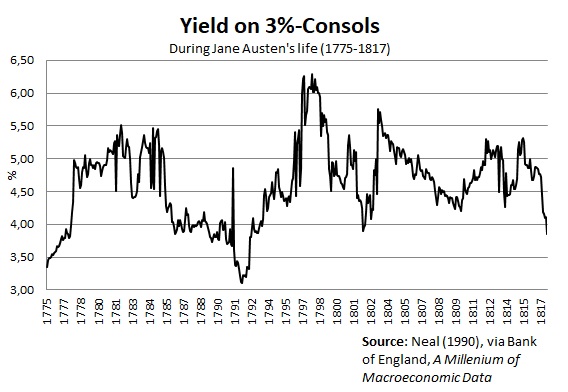
When the market price of a debt falls below its face value, the effective interest rate (the “yield”) that a prospective investor receives increases; paying £50 for a Consol with face value of £100 and a £3 perpetual interest payment, effectively earns the investor 6% interest instead of 3% (3/50 = 0.06). Since the Consols were the most dominant asset on the largest financial market in the world, their price became “the single most important asset price in the world economy” as Klovland (1994: 165) called it. Here’s the yield on Consols during Austen’s life:

JA, yield on 3%

It reached a low of 3.11% in 1792 (almost at par), and a high of 6.22% in 1798 (below £50) after the suspension of the gold standard.

The Bennets and the fortunes of handsome young men

The families of Pride & Prejudice made good use of this thriving financial market – not specifically for trading but for financial planning (others, such as British economist David Ricardo, and the banking families of Rothschild and Barings, made some of their fortune trading Consols).

In the novel, Mr. Bennet – the protagonist Lizzy’s father – has an income of £2,000 a year (again, see my 2016 piece for three different attempts at “translating” these sums into today’s money). It is not clear what his income comes from, but it’s a fair guess that it stems, like many other landed gentry of the time, from renting out farm lands belonging to the family home Longbourne. In addition, we know that Mrs. Bennet’s portion to the family home is a £5,000 contribution which is the sole inheritance the (five) Bennet daughters are entitled to.

Now, the way well-off families like the Bennets would make use of Consols was to ensure that non-inheriting children had at least some source of income after the passing of their father. The underlying concern in Pride & Prejudice, causing Mrs. Bennet to worry so about fortunate marriages for her daughters, is that the Bennet estate is entailed away to Mr. Collins – and with it the presumed rental income of £2,000 a year. That would leave the girls homeless, reduced to living off Mrs. Bennet’s inheritance of £5,000.

Austen began writing First Impressions (the initial title for Pride & Prejudice) in October 1796. During the decade leading up to this, the yield on Consols had been firmly within the interval 3.5-4.5%, hovering around 4% for years. It should thus not surprise us that Mrs. Bennet’s fortune of £5,000 presumably consisting of Consols, would have been purchased at around £75, predictably yielding the family an annual return of 4%. Indeed, the characters of Pride & Prejudice seem to be squarely set on 4% being the general norm. For instance, in a desperate attempt to enhance his already-inane proposal to Lizzy, Mr. Collins explicitly says:

“To fortune I am perfectly indifferent, and shall make no demand of that nature on your father, since I am well aware that it could not be complied with; and that one thousand pounds in the 4 per cents, which will not be yours till after your mother’s decease, is all that you may ever be entitled to.”

(Chapter 19, p. 133 in the 2009 HarperCollins edition)

Here we see the great use that Consols offered families like the Bennets. Once the Bennet parents pass away, the £5,000 of Consols could be divided equally among her children; Lizzy’s share would be a thousand pounds, which earns her an annual 4% interest return, or £40 (although maybe several year’s earnings for a regular worker, this was a rather small sum for such rich families – in contemplating Lizzy’s sister Lydia’s imprudent marriage, we learn that Mr. Bennet spent almost £100/year on Lydia’s purchases and pocket money alone). Being liquid financial assets, dividing up the Consols among children was very easy, and their steady income stream ensured that they would have at least some income. Bar Napoleonic conquest, the interest payment on the Consols would reliably show up year after year.

As for the handsome young men, Mr. Bingley’s case is easier than Mr. Darcy’s. We know that Bingley’s income is not agricultural, but investments from a fortune of almost  £100,000 inherited from his father, who had not yet acquired an estate. The fortune was “acquired by trade”, where (being from the North) cotton or shipping are prime candidates, but the slave trade is also a possibility. We also know that the ambiguity of his annual income (£4,000 or £5,000) lies well within the return from a fortune of that size invested in Consols. Indeed, for Bingley to hold that kind of fortune, earn that income and still not have an estate of his own, suggests that his financial wealth consists predominantly of Consols – perhaps complemented with some other stock (Bank of England or East India Company stock are plausible candidates). Clearly, new money.

Mr. Darcy, on the other hand, is plainly old money. And a lot of it. There are subtle hints in the novel that Pemberley has been in the Darcy family for generations. What we don’t know is precisely how his £10,000 a year is earned. When visiting Pemberley in Derbyshire with her aunt and uncle, Lizzy is told by the housekeeper that Mr. Darcy is such a generous and fair man: “ask any of his tenants”, she says, which indicates that Mr. Darcy, has a fair number of them – as one would expect from a sizeable estate like Pemberley. Now, what we don’t know is if the entirety of his £10,000 a year is reaped from rental income; it could be that some of his income is financial – or that either his financial or rental income is excluded from this rumoured number. Beyond a mention of his sister, Georgiana’s, fortune of £30,000 – which for convenience would likely be held in Consols – we know very little about the personal finances of Mr. Darcy.

The use and abuse of Consols

The financial market for government debt in the late-18th and early 19th century was not created with financial planning in mind, but by incremental improvements to previous government funding problems. The outcome, however, was a striking success for Britain, whose thriving financial market in no small part accounted for Britannia’s Century until WWI.

Moreover, as contemporary economists from Ricardo and John Stuart Mill to Malthus and Lauderdale observed, the recurring interest payments, funded by taxes, may have had quite large macroeconomic consequences. Taxing ‘productive’ investments and trade in order to fund ‘unproductive’ holders of government debt was, it was argued, harmful to the country – and in a time where government expenditures largely consisted of the military and debt maintenance, the impacts of funding the debt was of prime political interest.

Piketty’s use of Austen’s England (and Balzac’s France) was used for precisely the same distinction. Wealth, in Piketty’s view, perpetuates itself, and effortlessly earns its return (never mind the work, risk and selection issues involved). By continually paying the interest on its debt, the governments of Austen’s Britain financed the leisurly lifestyles of the rich, just as the “natural” return of the modern-day rich contribute and maintain today’s inequality.

The Consol was a revolutionary invention, but it is possible that it was not part of Mr. Darcy’s Ten Thousand a Year.

Semiotics in national dialogue: an observation

One thing the Notes on Liberty community may not know about me is that I worked for a while as a research (and writing) extern for the Victims of Communism Memorial Foundation. Because of my academic background in history and the arts, most of my work focused on historical communism, especially as related to propagandist representations from inside communist countries. The experience provided me with an opportunity to immerse myself in the documentation and wording of communism.

Most people know how the Soviet and Maoist propagandists portrayed their own people: the moral, brave underdogs who are hated and despised by rich, corrupt weaklings. Any of the sufferings connected to communism – famines, shortages, economic instability – these were all the fault of external forces. Except in the case of the Chinese, to whom Mao refused to offer explanation and simply told the people that their sufferings were glorious and were sacrifices to the revolution. Hua Yu in his memoir China in Ten Words conveys quite poetically exactly how “glorious” everyone’s sufferings were. Even today, we are still treated to a modern iteration in the form of Nicolás Maduro and his wild accusations regarding the cause of Venezuela’s collapse. Most of the time, the perpetrators are the White House and CIA, though in August 2018 he blamed Colombia and some unidentified Floridians and in December 2018 he threw in Brazil, along with the traditional “White House did it” trope.

What is less commonly known – outside of film and literature aficionados – about Cold War era portrayals is their representation of those who live on the other side of the divide, i.e. in capitalism. Across the board, the portrayals were fairly simplistic – the rich were evil, the poor were good. The premise was always that the former were useless and the latter were meritorious, belonging in a socialist workers’ paradise, instead of in a system that metaphorically chewed them up and spat them out. The propagandists were masters of imposing this interpretive paradigm universally, from traditional Western literature (or even their own traditional literature in the case of China) to news items. For example, the failed yachtsman and minor-league conman Donald Crowhurst became a proletariat hero in the Soviet film Race of the Century in which he is driven to his death by a greedy, capitalist sponsor (in real life, Crowhurst’s angel investor). The propaganda point being that in capitalism human life is expendable. One has only to read Alexander Solzhenitsyn’s Gulag Archipelago to see under which system an indifference to human life was, and still is, ingrained.

There is a reason that Marxist and post-structuralist theory and criticism focus on the concept of “the other.” It is because communism can only arise from chaos and conflict. In order to justify its existence and explain its ills and failures, there must be an “other” which opposes it. The other can be the White House, foreign intelligence services, or foreign bankers. “Othering” can be imposed on practically any person or group of people, and the dynamic can be read into any relationship. If one wants to find an “other” in Solzhenitsyn, a very good candidate is Fetyukov from One Day in the Life of Ivan Denisovich. For a literary criticism standpoint, Ivan Denisovich Shukov’s contempt for Fetyukov is a case of the former “othering” the latter. “Othering,” while a development of Marxist thought, is not a domain exclusive to communist writing. Ian Fleming used the paradigm, consciously or unconsciously, in his James Bond series, with their black-and-white portrayals of who was the good and who was the bad party.

Study of the language and structures of Marxist thought and propaganda is both lacking and overwhelming today. Yes, on the one hand, our universities have been overtaken with grievance studies and criticism classes. But on the other, the tropes and thought processes of Marxism have subtly appeared in contemporary American dialogue. More insidiously, they are not coming necessarily from the overt socialists, such as Alexandria Ocasio-Cortez, but from figures that identify as center and right. Ocasio-Cortez and her idol Bernie Sanders might be pardoned for regurgitating Marxist tropes, given that at least these politicians have had the decency to acknowledge their ideological leanings, but for “Conservative” [note the big “C”] intellectuals to do so is indicative of either ignorance or manipulation, both of which are unforgivable.

Consider what Michael Lind, a prominent neo-conservative, wrote in an article titled “Classless utopia versus class compromise,”published in American Affairs in summer 2018,

Democracy, then, requires strategically strengthening institutions that working-class people can control or at least influence. That means, among other things, defending the institutional independence of diverse religious communities, while sometimes favoring pragmatic municipal socialism. Whatever form an authentic grassroots working-class movement might take in the twenty-first-century United States, it is likely to look like historic precedents, including old-fashioned Milwaukee-style “sewer socialism” (municipal ownership of public utilities) and the Salvation Army. It will not look like the campus-based social justice and climate-change NGOs of progressive upper-middle-class professionals or, for that matter, free-market agitprop groups funded by the libertarian rich.

Lind has had a decades-old, well-publicized bugbear with libertarian thought, and to some extent his language reflects this. What is concerning about his words is the justification of localized socialism (history shows that this would not remain local for long) using the language of agency. The entire argument is built upon the fundamental Marxist assumption that the proletariat has no agency, wants it, and must collectivize to have it. In Marxist speak, Lind’s acceptance of the laborer-has-only-his-labor paradigm effectively “others” everyone on the other side of an indeterminate class line – upper-middle-class professionals (progressive or not), college students, free-marketeers, oh, and rich libertarians (one wonders where poor student classical liberals and middle-class libertarians fall in this equation).

In old fairy tales, a common theme is a beloved plant, usually a tree, that begins to wither away. The tree is externally healthy, and no one can discern a logical reason for it to be dying. After a long search, consulting of necromancers, and other typical fairy tale activities, the hero digs around the tree’s roots and discovers that there is a repulsive, venomous animal, usually a snake or a toad, living there, and it is the cause of the plant’s slow decline. Marxist thought and paradigms, not Marxism as an ideology, have become that snake for American Conservatism and center-right politics. Its poison is exacerbated by the fact that its acolytes and proselytizers appear to be unconscious of its presence as they argue that their only desire is to preserve the American Republic through preventing class conflict. But if they are doing is to hurl us faster and faster, more inexorably toward this very breakdown, as their ideas begin to overlap with those of the acknowledged far-left.

Fantasy and politics

I wish fantasy novels offered more political diversity. I adore fantasy, but I’ve begun to chafe at the ironic lack of creativity when it comes to political regimes. The genre may be missing a great opportunity. Or maybe I’m reading the wrong books.

While I don’t really mean this as a criticism so much as an observation, monarchy and feudalism abound in most other-world fantasies. Or the politics are indistinct. Despite my deep love for Tolkien, he falls into this category as well–either political control is unclear in regions like the Shire, or the region is ruled by an absolute ruler. His most well-known series culminates with the return of the benevolent dictator to the throne, Aragorn King of all the Dunedain (granted, there is intentional Christian symbolism here).

Modern fantasists follow a similar trend. Brandon Sanderson’s books, while wonderful, tend to involve worlds replete with absolute rulers. In fact, in the original Mistborn trilogy, a naive emperor tries to impose a more representative system of government, fails, and then decides that a firm hand is what’s called for. He and other authors like Robert Jordan dabble with some interesting political ideas and do provide a great deal of political detail, but they ultimately tend toward absolutism of some variety. Terry Pratchett’s main city-state on Discworld, Ankh-Morkpork, is ruled over by an absolute ruler, but Pratchett at least takes plenty of opportunity to poke fun at the masses’ constant yearning for a noble king to tell them what to do. Really, all these books are splendid, and politics are typically not their centerpiece–I just think some more variety may be valuable to the genre. (I’m not pointing fingers, as I’m guilty of the same problem–my forthcoming fantasy novel takes place in an empire with an absolute ruler and a largely meaningless parliament).

Fantasists could perhaps take a page from their science fiction comrades, where experiments with politics seem more common. Fantasy authors could do more than tinker with small tweaks to the monarchy and mercantilism of a pre-enlightenment age.  I can’t help but roll my eyes when I hear Tyrion Lannister on Game of Thrones gushing about how Daenaerys Targaryen is the only person who can swoop in and save the Seven Kingdoms from itself. That’s remedial polisci–surely we can do better. Who wouldn’t want to read about an anarcho-capitalist Iron Islands or a post-communist King’s Landing?

If you have any good recommendations for other-world fantasies that take up this challenge, I’d love to hear them!

New Books: Philosophy of the Novel, French conquests

Just wanted to call your attention to Barry‘s newest book, Philosophy of the Novel. Here’s a description:

This book explores the aesthetics of the novel from the perspective of Continental European philosophy, presenting a theory on the philosophical definition and importance of the novel as a literary genre. It analyses a variety of individuals whose work is reflected in both theoretical literary criticism and Continental European aesthetics, including Mikhail Bakhtin, Georg Lukács, Theodor Adorno, and Walter Benjamin. Moving through material from eighteenth century and ancient Greek philosophy and aesthetics, the book provides comprehensive coverage of the major positions on the philosophy of the novel. Distinctive features include the importance of Vico’s view of the epic to understanding the novel, the importance of Kierkegaard’s view of the novel and irony along with his other aesthetic views, the different possibilities associated with seeing the novel as ‘mimetic’ and the importance of Proust in understanding the genre in all its philosophical aspects, relating the issue of the philosophical aesthetics of the novel with the issue of philosophy written as a novel and the interaction between these two alternative positions.

Barry has more on liberty and the novel here and here.

Jacques has a new book out, too, titled Indecent Stories by Decent Women. It’s under a pen name, John René Adolph, for obvious reasons. Here is a 2014 essay by Jacques titled “Why Young Women Are Stupid (If They Are): A Scientific Inquiry.”

Main Street in Gopher Prairie (and elsewhere)

…but there are also hundreds of thousands, particularly women and young men, who are not at all content. The more intelligent young people (and the fortunate widows!) flee to the cities with agility and, despite the fictional tradition, resolutely stay there, seldom returning even for holidays. The most protesting patriots of the towns leave them in old age, if they can afford it, and go to live in California or the cities.

This is from Main Street, the 1920 classic by American Nobel Prize winner Sinclair Lewis. Lewis won his Nobel Prize for his 1925 work, Arrowsmith, and was so upset about not winning the Prize for Main Street that he refused his award for Arrowsmith and publicly complained that he should have won the award for Main Street rather than Arrowsmith (he eventually accepted his prize, years later).

Main Street is a mean book about small town life (Gopher Prairie, Minnesota) in the United States of America. It’s mean because it’s true. It’s amazing and worth reading and blogging about nearly 100 years later because it still resonates powerfully with today’s reader. The more things change, technologically, the more they stay the same, sociologically.

Lewis was a dissatisfied left-liberal who never quite could make the transition over to socialist, though he was sympathetic to their views and aims. In Main Street, in fact, he lambastes the dissatisfied rural gentry (left-liberals, all) for their condescending dismissal of socialist arguments without ever actually considering them fully. Lewis grew up in a small town in Minnesota, where the majority of the plot of Main Street takes place, and was the son of a country doctor. His privileged, rural upbringing no doubt weighed heavy on his mind when he attacked the American small-town way of life.

He (Lewis) wasn’t an America hater, and neither are most left-liberals. Their conservatism betrays their progressive senses. They don’t want or desire revolution, they want change, and they believe the founders, most of whom were slaveholders, instituted a government that could be run by the people. Left-liberals often come across as bitter and hate-filled, and this essence can seem especially true when contrasted with the thoughts of a conservative-liberal. Lewis was certainly a bitter man (he died of alcoholism in Rome in the 1951), but his mean-spirited attacks on American society were, to him and his fans, the work of a patriot (that most conservative of citizen).

If you haven’t read Main Street yet, I recommend doing so. It’s nearly 100 years old now, a fact that made me smile to myself as I realized I was reading a 98-year old novel. (Sinclair Lewis is somewhat fashionable again due to the popular quote “if fascism comes to America…” being misattributed to his name. The freshness of seeing his name on a bumper sticker just makes the reality of how old his works are that much more interesting.) If you don’t, at some point in your life, read one of Lewis’ major works (Babbitt, Main Street, or Arrowsmith), you will die a philistine.

I finally read Main Street after years of it taunting me on the bookshelf. It was worth it, all the more so because I am dissatisfied with where I am at in life. I don’t quite live in a small town, but I do live in a college town after spending the last 7-8 years or so of my life in major American cities that also happen to be sexy American cities, and the culture shock has been hard to confront. Contrary to popular belief, college towns don’t have all that much “culture” in them. Instead, you have a small population of seasonal migrants and a larger (but still small) population of “locals” who live off of the migrants and off of the few industries that have manged to take root in the community. In order to have any sort of leisure in the American college town you must be either a professional or a shopkeeper. Otherwise, you’re shit out of luck.

Main Street reminded me of the streak of dissatisfaction that runs deep in American society. There’s a plan in motion, here in Waco, that involves professionalizing my wife, so I cannot be bitter, but I am dissatisfied. The large Baptist university here is too practical. Its students (Rand Paul is an alum) are dull, and most are philistines, replete with all the usual stories about traveling “abroad” (to western Europe, where the drinking age is 18…) and not knowing a lick of the region’s rich history. There are no Jews, no Koreans, no South Asian Muslims, and few homosexuals. There is a relatively large black population here, but it is, alas, just as conservative as the white one.

Naturally, Californians are reviled. As are college graduates. As are liberals of any kind.

One bright spot here is, of course, the food. Bar. Bee. Q. Even this, though, the one lone bright spot so far, is brought down despairingly by the fact that pants in my size are rare, if you get my drift. My inner celebration of the stereotype of the parochial and bumbling Southerner, now reinforced by real life, coupled with Main Street‘s piercing insights, have provided me solace in an otherwise empty period of intellectual stimulation in my life.

Nightcap

  1. One of 2018’s best essays about Putin’s Russia Cathy Young, Reason
  2. How the Left abandoned the working class Simon Wren-Lewis, mainly macro
  3. A new (old) political theory about the American Civil War Allen Guelzo, Claremont Review of Books
  4. A Danish Tolstoy? Morten Høi Jensen, New York Review of Books

Naipaul (RIP) and the Left

The most interesting reflection on V.S. Naipaul, the Nobel Prize winner who died earlier this week, comes from Slate, a low-brow leftist publication that I sometimes peruse for book reviews. Naipaul, a Trinidadian, became loathed on the left for daring to say “what the whites want to say but dare not.”

The fact that Slate‘s author tries his hardest to piss on Naipaul’s grave is not what’s interesting about the piece, though. What’s interesting is what Naipaul’s wife, a Pakistani national and former journalist, has to say about Pakistan:

[…] she smiled and asked if I knew what Pakistan needed. I informed her that I did not. “A dictator,” she replied. At this her husband laughed.

“I think they have tried that,” I said, doing my best to stay stoic.

“No, no, a very brutal dictator,” she answered. I told her they had tried that, too. “No, no,” she answered again. Only when a real dictator came in and killed the religious people in the country, and enough of them that the streets would “run with blood,” could Pakistan be reborn. It was as if she was parodying a gross caricature of Naipaul’s worst views—and also misunderstanding his pessimism about the ability of colonial societies to reinvent themselves, even through violence—but he smiled with delight as she spoke.

“That’s so American of you,” she then blurted out, before I had said anything. My face, while she had been talking, must have taken on a look of shock or disgust. “You tell a nice young American boy like yourself that a country needs a brutal dictator and they get a moralistic or concerned look on their face, as if every country is ready for a democracy. They aren’t.”

Damn. This testy exchange highlights well what the developing world is facing, intellectually. Religious conservatives heavily populate developing countries. Liberals, on the left and on the right, in developing countries are miniscule in number, and most of them prefer, or were forced, to live in exile. Liberty is their highest priority, but the highest priority of Western elites, whose support developing world liberals’ desperately need, is democracy, which empowers a populace that cares not for freedom.

So what you get in the developing world is two kinds of autocracies: geopolitically important autocracies (like Pakistan), and geopolitically unimportant autocracies (think of sub-Saharan Africa).

That Naipaul and his wife had the balls to say this, for years, is a testament to the magnificence of human freedom; that Leftists have loathed Naipaul for years because he had pointed this out is a bitter reminder of why I left the Left in the first place.

By the way, here is Naipaul writing about the GOP for the New Yorker in 1984. And here is my actual favorite piece about Naipaul.

Animation Review #1: Burn the Witch

I am a big fan of animation, but I often have to ‘turn my brain off’ to enjoy a comic trying to make political commentary. With rare exceptions, like the Incredibles series, the industry has a strong statist bent. The industry is so statist that Superman: Red Son, a story line with the premise that Superman landed in the Soviet Union instead of the United States, ends with the message that communism would work if only it were a bit more democratic. Note that I say statist bent, as opposed to leftist bent. They are smaller in number, but there are several conservative comics (e.g. the Kingsman) that leave a statist aftertaste.

I can’t do much on the supply side of liberty-friendly comics, but I can at least highlight those comics that I think fellow libertarians might enjoy via blog posts.

First off is Burn the Witch, a new comic series published by Shonen Jump. I was pleasantly surprised when I read through Tite Kubo’s Burn the Witch. Tite Kubo is best known for authoring Bleach, a comic about Japanese school children fighting demons in fantasy Mexico.

Dragons.png

Burn the Witch is about Anglo-Japanese school children fighting demons in fantasy Britain. The twist? Unlike their counterparts in fantasy Mexico, the British demons (referred to as ‘Dragons’ in-series) aren’t killed outright. Instead they are raised for the resources they provide. Only ‘bad’ demons who are killing humans or otherwise causing destruction are killed. It is noteworthy that the protagonists refer to themselves as ‘conservationists’. They kill the occasional demon, providing the story with action scenes when doing so, but their primary purpose is to conserve them. In an off hand comment the protagonists note that their fantasy Mexican counterparts are barbaric and indiscriminately kill their demons.

Contrary to the protagonist’s comments, it isn’t that individual fantasy Mexicans are barbaric so much that fantasy Mexico doesn’t recognize property rights in demons. Since no one has a property right in demons, no one has an incentive to conserve, much less domesticate, them in fantasy Mexico. Fantasy Britain enjoys strong property rights and consequently has minimal problems associated with its demons. One of the protagonists is ethnically from fantasy Mexico, but seems to be thriving under fantasy Britain’s rules. The story’s lesson? Property rights matter.

Only one chapter of Burn the Witch has been published thus far, and it’s unclear if it’ll become a recurring series, but I like what I’ve seen so far.

Thoughts? Comments? As always, write in the comments below. If you’re a fan of animation and a fellow libertarian, consider joining the anime libertarian alliance facebook group.

Nightcap

  1. Icelandic fiction: a family affair Fríða Ísberg, Times Literary Supplement
  2. Icelandic sagas of the middle ages Barry Stocker, NOL
  3. Identity politics and patchwork Xenogoth
  4. Keeping it cool: worshipping the goddess Shitala Amrapali Saha, Coldnoon

Liberty and the Novel II (Austen and After)

(Click for Part I) In Austen’s novels, we find something ‘unheroic’ in that they are concerned with the search of upper class women, bound by codes of gentility, for both a satisfying place in the world and emotional authenticity through marriage. Though there is none of the religious fervour of Pilgrim’s Progress, the message is sent that an ideal community is a small rural community guided by sincerely godly priest, concerned with the daily lives of his congregation.

There is none of the extremism of Quixote’s fantasies and adventures, but the simultaneous process of  triumph over illusion and the growth of inner authenticity, is there in Pride and Prejudice, Sense and Sensibility, Mansfield Park, Emma, Persuasion, and Northanger Abbey, as the characters find marriages worthy of their growing ethical capacities in self-judgement and judgement of others.

Ethical growth means confirming a place in the landowning classes and taking a decidedly ambiguous attitude to making new money in trade. Landed property and religion are the starting points of an ethically tolerable community for Austen. We can see the growth there of what we might now think of as social and political values based on self-ownership and individual responsibility though somewhat constrained by respect for earlier aristocratic expression of these values.

We can see a version of Lukács’ split between heroic progressive bourgeoise and backward looking conformist bourgeoise there. Though it is absurdly crude to take 1848 as the line of of separation between the two tendencies, it is useful to think about the distinction as it evolved over time, including the events of 1848. Over time the basic bourgeois goals of rule of law, individual rights, representative government, and free trade tend to be achieved. The word radical is used less and less for the advocate of bourgeois individualism and more and more for advocates of a socialist state.

In literature the themes of the individual triumphing over circumstances, enduring disaster, awaking from illusions, developing individual moral strength, and finding some moment of authenticity continues. The novel keeps developing as a form, but in many people’s opinion, including my own, it reaches a peak in the early twentieth century (James Joyce, Franz Kafka, Marcel Proust, Virginia Woolf, Thomas Mann) which it has never matched, though ambitious and admirable novels continue to be written.

The more straight forward kinds of heroism are not so prevalent as in earlier novels, but the irony and ambiguity about heroism develops what was already in the genre and intensifies individualism, even while questioning it. Some of these writers were sympathetic to socialism though born into a largely bourgeois liberal world, at least compared with developments after World War One.

Coincidentally or not, this coincides with the transitions from a limited-state individualist nineteenth century liberal politics to the welfarist-administrative state we now know and which is stronger than ever, despite all the cries of ‘neoliberalism’ and ‘market fundamentalism’ that arise in reaction to any attempt to limit the statist drift.

There is a danger of rivaling Lukács’ tendency towards a moralising tendentious Marxism from a pro-liberty point of view, but I am anyway tempted to say that the reduction of the significance of the novel is a symptom of societies which aim to remove individual responsibility in the struggle with circumstances. Or I can put it in terms more amenable to those who welcome the welfarist-administrative tendency. The novel has lost some part of its significance as individualist ways of thinking are less influential in politics.

In fact I can wholly agree with this stereotypical imaginary progressive that Ayn Rand’s attempts to revive the grand individualist heroic aspects of the earlier novel are rather embarrassing. The Peruvian novelist Mario Vargas Llosa (Aunt Julia and the ScriptwriterThe War of the End of the World, The Feast of the Goatetc), who is an eloquent liberty advocate, is a far better novelist, and is as good as anyone currently active, so still not rising to the level of the Modernist greats of about one hundred years ago. Liberty advocates are also part of this cultural shift or loss, however you prefer to see it.

(crossposted at Stockerblog)

Liberty and the Novel I (Before Austen)

I’ve been working on Jane Austen and ethics recently. These ethical investigations have overlapped with considerations of politics and liberty, with regard to the progress of such ideas in the early nineteenth century when Austen was writing, along with the immediately preceding and following periods.

There is a well known Marxist view of the history of literature, which is that the novel (and other literary genres, but mostly the novel) can be seen as developing along with the development of the bourgeoisie, so that is progressive and emancipatory until the turning point year of 1848 when the bourgeois class at least in part turns against the progressive-democratic, working class, and national revolutions of the European Springtime of the Nations.

At this point the capitalist class flees from democracy, allying with the royalist and aristocratic forces to prevent a revolution that might overturn property relations as well as pre-democratic political forms. After 1848, the novel largely becomes inward looking and alienated from social reality, because of the ties of writers and readers to a bourgeois class trying to hold back socialist working class politics, or at least fears to ally with it.

The classic exponent of this view is the Hungarian philosopher Georg Lukács who was born into the Habsburg Empire and so wrote in German, very much continuing themes from German language philosophy, literary studies, and social science. The relevant texts include The Historical Novel and Studies in European Realism.

I do not write to advocate Lukács’ literary history and of course even less do I advocate his Leninist politics. However, he undoubtedly makes an important contribution. Not many people now, Marxist or otherwise, would advocate the more schematic elements of his literary history. Nevertheless he was continuing ideas he had before his turn to Marxism, as expressed in Theory of the Novel and Soul and Form and he was onto something with regard to the heroic and less heroic phases of literature.

The novel itself has non-heroic and even anti-heroic aspects. If we take Miguel de CervantesDon Quixote (1605 and 1615) as the starting point of the modern novel, a debatable proposition but not outrageously so, then the novel is something that starts with the mockery of the heroes of medieval knightly romance through a character trying to imitate them in real life Castile. It is a crude piece of social history to say this, but nevertheless it is roughly true that Don Quixote coincides with the growth of commercial Europe, trading across the Mediterranean and the Atlantic, as there is a growth of cities along with the increase in membership of the merchant and financial classes.

This is the sweet commerce rightly advocated by Charles-Louis de Secondat, Baron Montesquieu, but also the violent consolidation of European states and the growth of their overseas empires. This is not all pleasant, but then that makes it to some degree ‘heroic’, as heroism refers to struggle and triumph with limited regard for other concerns. The ‘heroism’ of Quixote is to observe the Spain of his time in his bizarre adventures, learning from experience and awakening from his illusions, if only on the point of death. He becomes disillusioned by experience so achieving a more inner awareness freed from the illusions of romances in an idea of authenticity which has its own romance. A romance that is very visible in the subsequent development of the novel.

Other inputs into the development of the novel include John Bunyan’s The Pilgrim’s Progress (1678), a religious story from England of salvation in an allegory focused on a hero called Christian. There was nothing new about texts of salvation, but this is a novel length narrative devoted to individual struggles with externalised representations of distractions from faith. It was read very widely in the English speaking Protestant world, turning theological concerns into a popular heroic narrative of release of the self from ungodly illusions, and references to it abound in later literature of a kind less guided by strict Reformation Protestantism. (to be continued)

Also posted at Stockerblog