On Translating Earnings From The Past

A few days ago, John Avery Jones published a great piece on the Bank of England blog (“Bank Underground”), investigating how much Jane Austen earned from her novels in the early 1800s. By using the Bank’s own archives and tracking down Austen’s purchases of “Navy Fives” (Bank of England annuities, earning 5%), Avery Jones backed out that Austen’s lifetime earnings as a writer was probably something like £631 – assuming, of course, that the funds for this investment came straight from the profits of her novels.

Being a great fan of using literature to illustrate and investigate financial markets of the past, I obviously jumped on this. I also recently looked at the American novelist Edith Wharton’s financial affairs and got very frustrated with the way commentators, museums, and scholars try to express incomes of the past in “today’s terms”, ostensibly vivifying their meaning.

For the Austen case, both Avery Jones and the Financial Times article that followed it, felt the need to “translate” those earnings via a price index, describing them as “equivalent to just over £45,000 at today’s prices”.

Hang on a minute. Only “£45,000”? For the lifetime earnings of one of the most cherished writers in the English language? That sounds bizarrely small. That figure wouldn’t even pay for the bathroom in most London apartments – and barely get you a town-house in Newcastle. The FT specifically makes a comparison with contemporary fiction writers:

“[Austen’s] finances compare badly even with those of impoverished novelists today: research last year by the Authors’ Licensing and Collecting Society found that writers whose main earnings came from adult fiction earned around £37,000 a year on average”

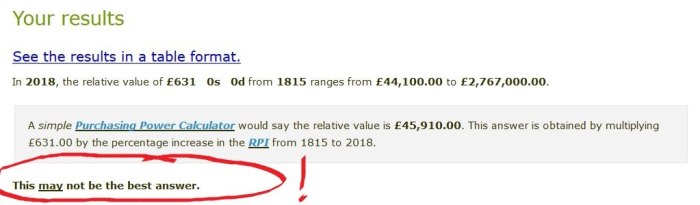
Running £631 through MeasuringWorth’s calculator yields real-price estimates of £45,910 (using 1815 as a starting year) – pretty close. But what I think Avery Jones did was adjusting £631 with the Bank’s CPI index in Millenium of Macroeconomic Data dataset (A.47:D), which returns a modern-day price of £45,047 – but that series ends in 2016 and so should ideally be another 7% or so from 2016 until May 2019.

 “This may not be the best answer”

Where did Avery Jones go wrong in his translation? After all, updating prices through standard price indices (CPI/RPI/PCE etc) is standard practice in economics. Here’s where:
untitled-1

The third line on MeasuringWorth’s result page literally tells researchers that the pure price number may not reflect the question one is asking. The preface to the main site includes a nuanced discussion about prices in the past:

“There is no single ‘correct’ measure, and economic historians use one or more different indices depending on the context of the question.”

When I first estimated Mr. Darcy’s income, this was precisely the problem I grappled with; simply translating wealth or incomes from the past to the present using a price index severely understates the meaning we’re trying to convey – i.e., how unfathomably rich this guy was. There is no doubt that Mr. Darcy was among the richest people in England at the time (his annual income some 400 times a normal worker’s salary), a well-respected and wealthy man of elevated rank. However, translating his wealth using a price index doesn’t even put him on the Times’ Rich List over the thousand wealthiest Britons today. Clearly, that won’t do.

Because we are much richer today in real terms, price indices alone do not capture the meaning we’re trying to communicate here. Higher real income – by definition – is a growth in incomes above the rise in prices. We therefore ought to use a more tangible comparison, for instance with contemporary prices of food or mansions or trips abroad; or else, using real income adjustments, such as GDP/capita or average earnings.

MeasuringWorth provides us with three other metrics over and above the misleading price-index adjustment:

Labour Earnings = £487,000
using growth in wages for the average worker, it reports how large your wage would have to be today to afford what Austen could afford on £631 in 1815. Obviously, quality adjustments and technological improvements make these comparisons somewhat silly (how many smartphones, air fares and microwaves could Austen buy?), but the figure at least takes real earnings into account.

Relative Income = £591,300
Like ‘Labour Earnings’, this adjustment builds on the insight above, but uses growth in real GDP/capita rather than wages. It more closely captures the “relative ‘prestige value’” that we’re getting at.

Both these attempt are what I tried to do for Mr. Darcy (Attempt #2 and #3) a few years ago.

Relative Output = £2,767,000
This one is more exciting because it captures the relationship to the overall economy. If I understand MeasuringWorth’s explanation correctly, this is the number that equates the share of British GDP today with what Austen’s wealth – £631 – would have represented in 1815.

Another metric I have been experimenting with is reporting the wealth number that would put somebody in the same position in the wealth distribution of our time. For example, it takes about £2,5m to qualify for the top-1% of British wealth (~$10m in the United States) distribution today. What amount of wealth did somebody need to join the top 1% in, say, 1815? If we could find out where Austen’s wealth of £631 (provided her annuities were her only assets) rank in the distribution of 1815, we can back out a modern-day equivalent. This measure avoids many of the technical problems above for how to properly adjust for a growing economy, and how to capture inventions in a price index – and it gets to what we’re really trying to convey: how wealthy was Austen in her time?

Alas, we really don’t have those numbers. We have to dive deep into the wealth inequality rabbit hole to even get estimates (through imputed earnings, capital stocks or probate records) – and even then the assumptions we need to make are as tricky and inexact as the ones we employ for wage series or prices above.

The bottom line is pretty boring: we don’t have a panacea. There is no “single correct measure”, and the right figure depends on the question you’re asking. A reasonable approach is to provide ranges, such as MeasuringWorth does.

But it’s hard to imagine the Financial Times writing “equivalent of between £45,000 and £2,767,000 at today’s prices”…

More tariffs on Vietnam would be great news for China

There is a clear consensus with regard to the fact that Vietnam has been one of the economic success stories of recent years.

The country has witnessed robust economic growth (GDP growth rate for 2018 was estimated at 7.15%, while the growth rate for 2019 is estimated at 6.6%) and has been successful in poverty reduction. Foreign Direct Investment (FDI) for the first five months of 2019 reached a four year high of over $16 billion (a year on year increase of over 69%).

If one were to look at a sectoral break up of the FDI, manufacturing and processing came right on top, receiving over $10 billion.

US appreciation for Vietnam’s economic achievements

US President Donald Trump, who recently imposed tariffs on steel imported from Vietnam, stated at the APEC CEO Summit in 2017 that:

Today, an opening Vietnamese economy is one of the fastest-growing economies on Earth. It has already increased more than 30 times over, and the Vietnamese students rank among the best students in the world.

In 2019, on the sidelines of his Summit with North Korean leader Kim Jong Un, the US President, while acknowledging Vietnam’s progress, stated that North Korea could emerge as another Vietnam if it denuclearized.

US Secretary of State Mike Pompeo had made a similar point while addressing a meeting of the US-Vietnamese business community in 2018.

Increasing FDI and factors which have contributed to it

It would be important to point out that FDI in Vietnam is also not restricted to any one particular region or city. While Hanoi (the Vietnamese capital), which drew well over $2.7 billion, and Bin Doung province in South Vietnam, are on top, North Vietnam too, is managing to draw significant investments. The shipping hub of Haiphong has witnessed significant economic growth since, after the imposition of US tariffs, a number of Chinese companies have shifted to the Shenzhen-Haiphong Economic and Trade Cooperation Zone.

Economic reforms (dubbed as Doi Moi) which began in 1986 have played a crucial role in Vietnam’s economic success. The main advantages which Vietnam has over its competitors are relatively low labor costs (though the country has witnessed a significant year on year growth in minimum wages between 2015 and 2019), increasing consumption as the result of a burgeoning middle class (currently 13% of its total population; it is estimated, by the World Bank, that in 2026 over one quarter of Vietnam’s population will be part of the middle class), and its geographical location.

Vietnam a beneficiary of the US-China Trade war and the CPTPP

Vietnam has benefited significantly from the US-China Trade war. A number of companies have shifted manufacturing operations from China to Vietnam, and others like Apple (which plans to shift anywhere between 15% and 30% of it’s iPhone production), Microsoft, Amazon, Sony, Nintendo, and Dell are likely to shift in a big way to Vietnam.

The Southeast Asian country is also gaining significantly by being part of the CPTPP. Exports to both Japan and Canada have risen significantly in the first quarter of 2019, if one were to look at the year on year figures.

US-Vietnam ties

In the past two decades ties between the US and Vietnam have improved significantly. The foundations were laid by Bill Clinton; during his first tenure, the Vietnam Foreign Ministry opened its office in Washington DC (1993), and the US State Department opened its office in Hanoi in the same year. Similarly, the US lifted its trade embargo on Vietnam in 1994. Vietnam also figured importantly in Obama’s ‘Pivot to Asia’ and was part of the Trans Pacific Partnership (TPP) that the US abandoned.

US President Donald Trump has given mixed signals on Vietnam. Trump has, though, referred to the geopolitical relevance of Vietnam, and it is for this reason that the US President articulated his vision for a free and open Indo-Pacific in Vietnam in 2017 (while speaking at the APEC CEO Summit at Da Nang).

In March 2018, U.S. Navy aircraft carrier USS Carl Vinson visited the port city of Da Nang for the first time since the end of the Vietnam war in 1975. Former Defence Secretary Jim Mattis visited Vietnam twice in 2018, and reiterated on both visits the increasing relevance of the Washington-Hanoi relationship.

The fact that the US President chose Hanoi for his 2nd summit with North Korean leader Kim Jong Un was significant not just in terms of symbolism, but also in sending a message that the Southeast Asian country was strategically relevant. During his visit in 2019, Trump of course praised Vietnam for its economic success, but a number of trade deals (Boeing inked a deal of over $12 billion to sell 100 planes to Vietnamese budget carrier, Viet Jet, for example) were also arranged.

Imposition of Trade Tariffs

As a result of trade wars, Vietnam’s exports to US have also witnessed a sudden rise. Exports for the period January-June 2019 rose 27.4% year on year. The US trade deficit with Vietnam for the first six months was estimated at $25.3 billion (in 2018, this was $40 billion).

US has recently imposed tariffs of 456% on certain steel products which were imported from Vietnam. According to the US Commerce Department, certain corrosion resistant steel products and cold-rolled steel which were supposed to be manufactured in Vietnam actually underwent only minor processing in the Southeast Asian country, but used substrate of Taiwanese and South Korean origin (duties on these South Korean and Taiwanese products had been imposed in 2015 and 2016 respectively).

Imposition of tariffs by the US is not likely to end here. There are strong indicators that the US could impose further tariffs on Vietnam, citing the reason that a number of Chinese goods are rebranded there to avoid tariffs (this is dubbed as transshipment). Trump had made some harsh remarks, including in an interview with Fox News:

Vietnam is almost the single worst — that’s much smaller than China, much — but it’s almost the single worst abuser of everybody.

It remains to be seen as to what impact the imposition of tariffs will have not just on Vietnam’s economy (the increase in bilateral trade and exports), but also on the bilateral relationship which has witnessed significant improvement due to the efforts of successive US Presidents. Vietnam’s growth and prosperity is also important from a strategic perspective, as it is one of the countries which has been strengthening defense ties with the US, Japan, and India. While Vietnam does have robust economic ties with China, it also has serious differences over the South China Sea (only recently, tensions between both countries had escalated when a Chinese survey ship and coastguard vessels had entered disputed waters near the Spratly Islands).

Conclusion

Vietnam provides a good lesson for many other countries. It has stuck to the basics, and so far has been very astute in balancing out economic relationships between China and other countries. Vietnam’s real test lies in how it deals with Trump’s unpredictability, and deals with the turbulence resulting out of Trump’s brash decisions. If the US President actually slaps more tariffs on Vietnam, not only will it have an adverse impact on bilateral ties and undo all the good work of previous US and Vietnamese administrations, but fissures between Hanoi and Washington will also have an adverse impact on efforts towards promoting a Free and Open Indo Pacific. On the other hand, Beijing, the biggest loser of the China-US trade war, would certainly not mind tensions between Washington and Hanoi (which has been a big beneficiary of the trade war).

Nightcap

  1. The coming automation of propaganda Adkins & Hibbard, War on the Rocks
  2. It’s been 25 years since Apartheid ended Zeb Larson, Origins
  3. Protest is not enough to topple a dictator Jean-Baptiste Gallopin, Aeon
  4. In defense of 1980s British pop music Sophie Ratcliffe, 1843

Nightcap

  1. Why do Ron Paul’s racist newsletters from the 80s and 90s still matter? Steve Horwitz, Bleeding Heart Libertarians
  2. A great profile of Pakistan’s Prime Minister Christopher Sandford, Modern Age
  3. Hayek’s tragic capitalism Edward Feser, Claremont Review of Books
  4. An observation on semiotics in national dialogue Mary Lucia Darst, NOL

Nightcap

  1. Axialization and institutionalization Nick Nielsen, The View from Oregon
  2. Google’s political problems are getting worse Shirin Ghaffary, Recode
  3. Who wrote Ron Paul’s racist newsletters? (Lew Rockwell and Jeffrey Tucker) The Economist
  4. Trump is not coming for Jews, but somebody is Michael Koplow, Ottomans and Zionists

Nightcap

  1. The Taliban of San Francisco Serge Halimi, Le Monde Diplomatique
  2. Citizens of the State Maeve Glass, University of Chicago Law Review
  3. A wake-up call the woke won’t read J Oliver Conroy, Guardian
  4. The man behind national conservatism Daniel Luban, New Republic

Link: The Most Controversial Tree in the World

https://psmag.com/ideas/most-controversial-tree-in-the-world-gmo-genetic-engineering

Tending an ecosystem is hard. With all the interconnections it’s impossible to do just one thing. We should absolutely be skeptical of calls to engineer the environment from the top down, but we should also recognize that we’ve already been unintentionally doing so.

To me, the linked article raises interesting questions about the sort of common law restrictions on GMO that seem reasonable. Default infertility seems like an efficient Coasian compromise for industrial GMO. But the case of the American chestnut seems like an exciting opportunity to reverse an ecological tragedy.

This case seems like a good polar opposite to Jurassic Park on the spectrum of GMO threat/promise.

Nightcap

  1. The missing backlash against finance Chris Dillow, Stumbling & Mumbling
  2. A contrarian take on the Trump tariffs Scott Sumner, MoneyIllusion
  3. Brave Nuclear World Emma Ashford, InkStick
  4. A classic in Persian literature is relevant again Joobin Bekhrad, Los Angeles Review of Books

Nightcap

  1. Antisemitism was anti-capitalist and anti-communist Colin Schindler, History Today
  2. The invention of money John Lanchester, New Yorker
  3. Why do we look to Science as a guide for living? Ronald Dworkin, Law & Liberty
  4. Salman Rushdie’s hyperloquacity Matt Hill, Literary Review

Nightcap

  1. Victorian values, libertarian legacy David Loner, JHIBlog
  2. Tyler Cowen interviews Kwame Anthony Appiah
  3. How I met Paul Samuelson and Milton Friedman Branko Milanovic, globalinequality
  4. The Christian origins of religious liberty Francis Oakley, Commonweal

Nightcap

  1. Against revenge porn Belle Waring, Crooked Timber
  2. Americans’ declining mobility Charles McElwee, City Journal
  3. A global age of amnesia Joel Kotkin, Quillette
  4. The land question in China Salvatore Babones, Asian Review of Books

One weird old tax could slash wealth inequality (NIMBYs, don’t click!)

yesnoimputedrent

What dominates the millennial economic experience? Impossibly high house prices in areas where jobs are available. I agree with the Yes In My Back Yard (YIMBY) movement that locally popular, long-term harmful restrictions on new buildings are the key cause of this crisis. So I enjoyed learning some nuances of the issue from a new Governance Podcast with Samuel DeCanio interviewing John Myers of London YIMBY and YIMBY Alliance.

Myers highlights the close link between housing shortages and income and wealth inequality. He describes the way that constraints on building in places like London and the South East of England have an immediate effect of driving rents and house prices up beyond what people relying on ordinary wages can afford. In addition, this has various knock-on effects in the labour market. Scarcity of housing in London drives up wages in areas of high worker demand in order to tempt people to travel in despite long commutes, while causing an excess of workers to bid wages down in deprived areas.

One of the aims of planning restrictions in the UK is to ‘rebalance’ the economy in favour of cities outside of London but the perverse result is to make the economic paths of different regions and generations diverge much more than they would do otherwise. Myers cites a compelling study by Matt Rognlie that argues that most increased wealth famously identified by Thomas Piketty is likely due to planning restrictions and not a more abstract law of capitalism.

Rognlie also inspires my friendly critique of Thomas Piketty and some philosophers agitating in his wake just published online in Critical Review of International Social and Political Philosophy: ‘The mirage of mark-to-market: distributive justice and alternatives to capital taxation’.

My co-author Charles Delmotte and I argue that for both practical and conceptual reasons, radical attempts to uproot capitalism by having governments take an annual bite out of everyone’s capital holdings are apt to fail because, among other reasons, the rich tend to be much better than everyone else at contesting tax assessments. Importantly, such an approach is not effectively targeting underlying causes of wealth inequality, as well as the lived inequalities of capability that housing restrictions generate. The more common metric of realized income is a fairer and more feasible measure of tax liabilities.

Instead, we propose that authorities should focus on taxing income based on generally applicable rules. Borrowing an idea from Philip Booth, we propose authorities start including imputed rent in their calculations of income tax liabilities. We explain as follows:

A better understanding of the realization approach can also facilitate the broadening of the tax base. One frequently overlooked form of realization is the imputed rent that homeowners derive from living in their own house. While no exchange takes place here, the homeowner realizes a stream of benefits that renters would have to pay for. Such rent differs from mark-to-market conceptions by conceptualizing only the service that a durable good yields to an individual who is both the owner of the asset and its consumer or user in a given year. It is backward-looking: it measures the value that someone derives from the choice to use a property for themselves rather than rent or lease it over a specific time-horizon. It applies only to the final consumer of the asset who happens also to be the owner.

Although calculating imputed rent is not without some difficulties, it has the advantage of not pretending to estimate the whole value of the asset indefinitely into the future. While not identical and fungible, as with bonds and shares, there are often enough real comparable contracts to rent or lease similar property in a given area so as to credibly estimate what the cost would have been to the homeowner if required to rent it on the open market. The key advantage of treating imputed rent as part of annual income is that, unlike other property taxes, it can be more easily included as income tax liabilities. This means that the usual progressivity of income taxes can be applied to the realized benefit that people generally draw from their single largest capital asset. For example, owners of a single-family home but on an otherwise low income will pay a small sum at a small marginal rate (or in some cases may be exempted entirely under ordinary tax allowances). By contrast, high earners, living in large or luxury properties that they also own, will pay a proportionately higher sum at a higher marginal rate on their imputed rent as it is added to their labor income. Compared to other taxes on real estate, imputed rent is more systematically progressive and has significant support among economists especially in the United Kingdom (where imputed rent used to be part of the income tax framework).

This approach to tax reform is particularly apt because a range of international evidence suggests that the majority of contemporary observed increases in wealth inequality in developed economies, at least between the upper middle class and the new precariat, can be explained by changes in real estate asset values. Under this proposal, homeowners will feel the cost of rent rises in a way that to some extent parallels actual renters.

For social democrats, what I hope will be immediately attractive about this proposal is that it directly takes aim at a major source of the new wealth inequality in a way that is more feasible than chasing mirages of capital around the world’s financial system. For me, however, the broader hope is the dynamic effects. It will align homeowners’ natural desire to reduce their tax liability with YIMBY policies that lower local rents (as that it is what part of their income tax will be assessed against). If a tax on imputed rent were combined with more effective fiscal federalism, then homeowners could become keener to bring newcomers into their communities because they will share in financing public services.

“Crisis in the Public Square: A Kuyperian Response”

That’s the title of Lucas‘ 2018 Calahan Lecture, which he presented after receiving the 2018 Novak Award. You can catch the entire lecture here, on YouTube.

Nightcap

  1. The Reciprocal Transit (aliens might be watching us) Caleb Scharf, Life, Unbounded
  2. No government, no problem Leonid Bershidsky, Bloomberg
  3. Syria and Arabia: The great divide Robert Carver, History Today
  4. The French Left catches up to our own Jacques Delacroix Andrew Hussey, New Statesman

Nightcap

  1. The conservative revolutionary and the archaic progressive Arnold Kling, Medium
  2. Epistemological anarchism to anarchism Bill Rein, NOL
  3. Against adaptation Chris Dillow, Stumbling & Mumbling
  4. Evolutionary drift Federico Sosa Valle, NOL