An update from Memphis (Russo-Baltic edition)

Dr Znamenski (bio, posts) sent me an email updating me on his recent shenanigans:

I also appreciate your remark that we need to reach out to other libertarian-leaning people rather than singing to only a libertarian chorus. Even though I am notorious for not contributing to NOL, I devoted this summer to reach out to liberty-minded people in Europe by going to St. Petersburg, Russia, and delivering there a public talk (in Russian) on “Heroics of the New Deal and Its Critics” at a downtown hotel and afterwards I met with the audience for a free-style interactive talk on current challenges to individual liberty. Then I proceeded to Tallinn, Estonia, where I met a group of Estonian libertarians and delivered a talk (in English) on geopolitical imagination of Russian nationalism (used current Alaska-related Russian patriotic rhetoric as an example). Then proceeded back to Russia, where at Samara University again I gave a talk on the mythology of FDR and New Deal Keynesianism and how it was appropriated in 2003-2008 by the Putin regime that was building the “vertical” of its power. My argument was that politico-economic regime whose “validity” was “scientifically” proven by Keynes in 1936 by now became a kind of a fetish that is associated with a good government. Hence, the “Heroics of the New Deal” title. The Estonian visit was especially pleasant and inspiring.

I also met an informal leader of Estonian libertarians […] Very productive and charismatic guy. I need to navigate him to you and to NOL, which will greatly benefit from his contributions (if any). His English is impeccable too. See his picture attached to this letter (they have Mises Institute of Estonia) in addition to a few other images from Estonia (the country where all paper work exists only in electronic form and a flat tax return occupies only one page!). The country [Estonia] was the first in Europe to introduce universal flat tax (1994), which replaced three tax rates on personal income and one on corporate profits. The flat tax rate was on 26%, which later was reduced to 20%. Several countries of Europe followed the suit and benefited from this. Very simple system, which helped this tiny backwater country of 1 million plus something people to dramatically raise its well-being. To their frustration, even Russian nationalists, who remain quite influential in Estonia due to the presence of a large Russian minority, have little economic discontent among Russians to chew on. The latter simply compare their economic situation in their historical homeland where average salary is $500 and Estonia where this salary is $1150.

Dr Znamenski has some excellent ideas brewing (on US-Russian relations in the Arctic, Crimean secession, and Foucault), and hopefully he can find the time to post them in the very near future. Notice, too, that Dr Znamenski refers to Russians as Europeans (or, at least, considers St Petersburg to be European). A small observation, I know, but one that I suspect has big sociological implications. Check out these pictures he sent me:

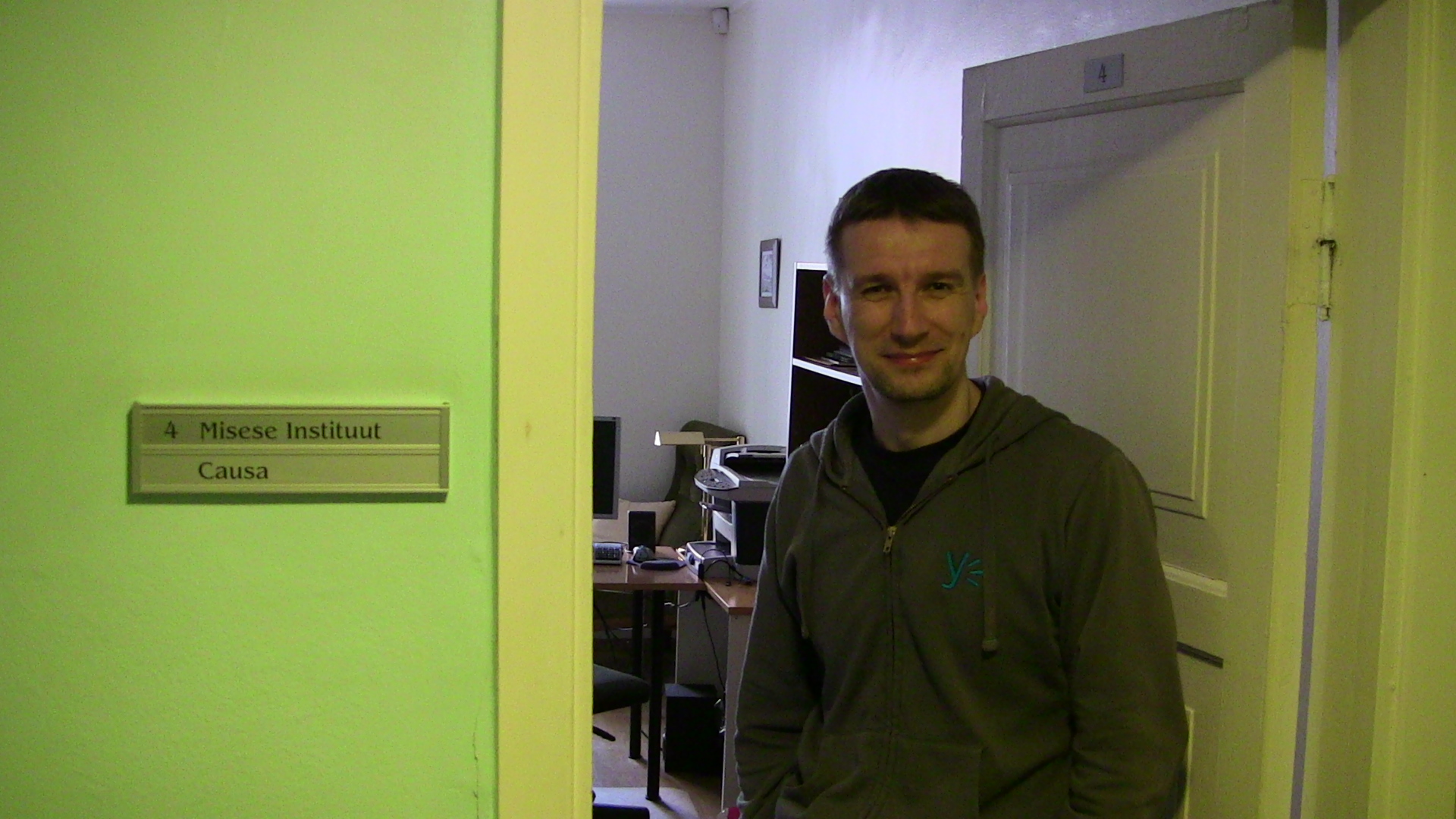
This is the Estonian libertarian Dr Znamenski mentions above. I hope to someday meet him.
This is a photo from the Museum of the 20th century in Tallinn (the capital city of Estonia).
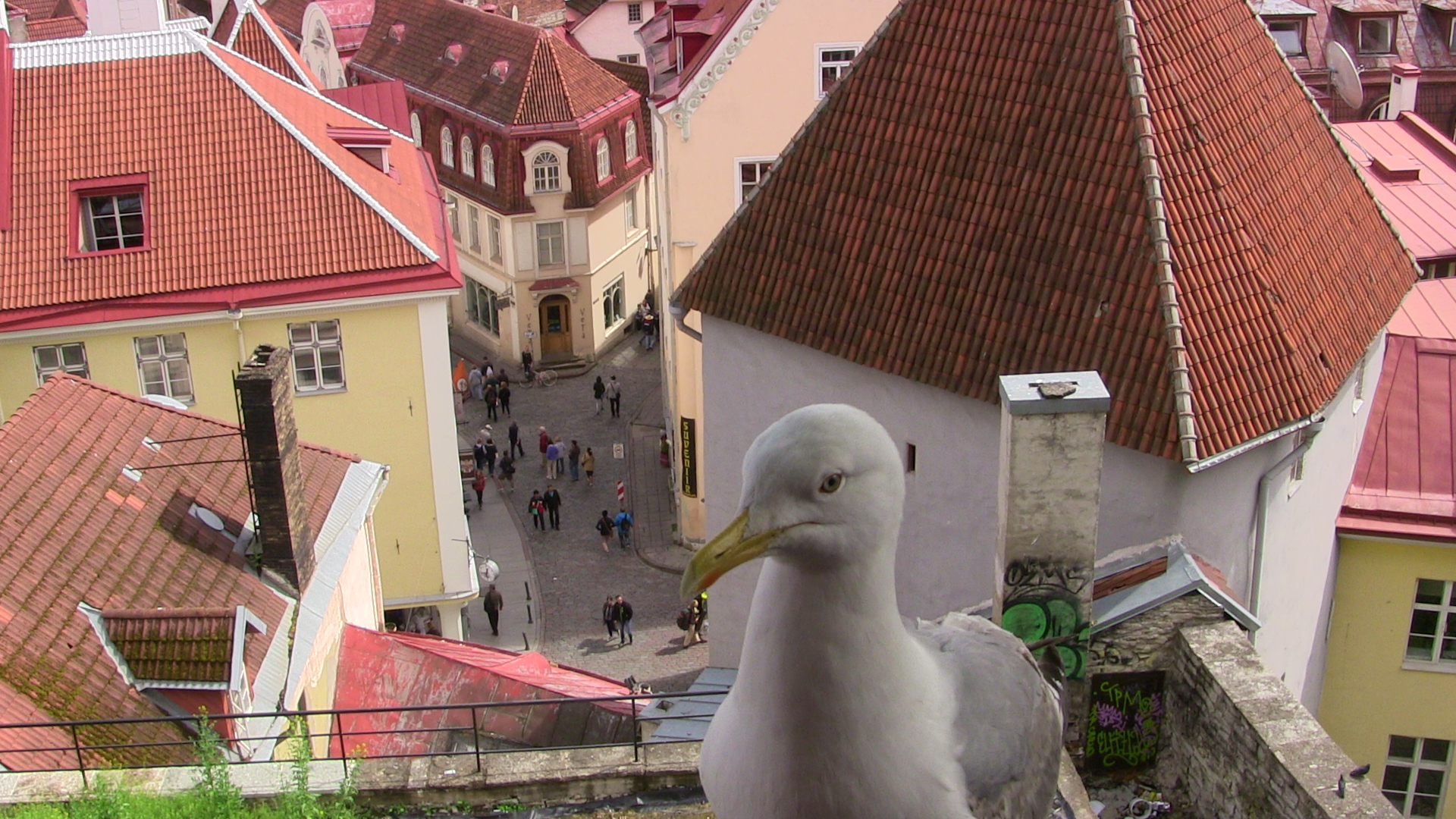
This is my favorite picture. It’s a view of Tallinn with a curious visitor, and highlights Dr Znamenski’s sense of humor, which I greatly appreciate.

Hypocrisy!

Yes, I am alive, thank you for asking.

I have been away from this blog for two reasons. First, the little boy who hated the end of summer and going back to school is still alive and well inside the old man. I combat the corresponding end of summer melancholy by trying to cram outdoors activities into my life until the days become too short. Second, my hands hurt enough to keep me away from the keyboard most of the time. I am considering switching to one of the voice recognition softwares such as Dragon. I am not too worried about accuracy. Mostly, I don’t want to have to junk my old Samsung because of space requirements or some other software feature I don’t even know exists. I listen to advice from my betters (practically everybody in this case). Ideally – ideally – I would like a program that does more than one language.

I had much trouble writing the essay below because the topic of mass migrations has so many ramifications and because it touches so many different sensitive subjects. In a way, it’s just too rich a topic. And, the more I waited, the more complicated the situation became on the ground. Please, bear with me.

Like most or many people, I have observed with grief in my heart the fast-rolling disaster of the migrants crisis in Europe. I have several reactions, not all compatible with one another.

As I wrote, on about 9/5/15 Hungary was unaccountably preventing thousands of migrants from leaving its territory. This is strange because most of them don’t want to stay in Hungary; they want to go to Germany and to Sweden. Besides, Hungary, which is relatively poor, has a fairly big anti-immigrant political party, lots of voters who want as few immigrants inside as possible. A major Hungarian politician even declared that Hungary does not want any Muslim refugees because of its history of strife with the Ottoman Empire. Something does not add up: If you don’t want them, let them go elsewhere, even give them a lift! Later (09/14/15) Hungary built a fence to keep migrants out. Smart move!

What is confusing is that the current crisis is only in part new. We have heard for years, we have seen pictures of people drowning trying to reach the Italian island Lampedusa for a long time now. Three hundred and fifty drowned there in one 2103 day alone. This first European Union territory is only day-excursion distance from Tunisia. Several years ago, I saw pictures of hundreds of black Africans acting in concert to swamp the wall of Spanish enclaves in North Africa. The two enclaves of Ceuta and Melilla are also, practically, part of the European Union. I could tell from their appearance that the fence climbers were not Syrian families but sub-Saharan Africans. Some were from Senegal, a poor but peaceful and orderly country. So, there have always been illegal emigrants to Europe motivated by the search for better economic opportunity, people who left their countries not out of desperation but drawn by hope. This first category of migrants resembles closely immigrants from Mexico, for example, who daily come into the US illegally.

So, it seems to me that there are right now two main categories of migrants (would-be immigrants) that are intermixed on the ground and on the sea and that the American press is not doing a good job of separating them, conceptually. I am possibly getting a clearer picture by superimposing on one another American and French language reports. The new migrants, a recent category – are going to Europe because they feel that they literally have no place to live. They are properly refugees; they seek refuge in an absolute sense. This is the case, no doubt, with many Syrians. Their area of origin has been destroyed by the Assad government, much of the rest of their country is aflame or under the brutal tyranny of the so-called Islamic Caliphate. The livable areas are shrinking fast. Many belong to the wrong sect and are suspected of being natural enemies irrespective of their actions or inaction. They are not welcome in the shrinking areas of livability within their country or they are unable to reach them. From interviews in both English and French and from the quality of their clothes, I deduce that a large percentage of these new migrants are solidly middle-class, well educated, with defined skills. I mean “middle-class” by my standards, not middle-class by some other, lower exotic standards. The impression is strong and clear with respects to Syrians, less so for Iraqis.

Many Syrian migrants are young men who are simply trying to escape the draft in a murderous on-going war. (The fact that they are young and male has implications for the receiving countries that I hope to consider in a related essay, following.) But migrations are always complicated. Once the path is opened by the desperate refugees just described, once bridges are built, simple economic migrants of the old style who would not have thought of moving will join the exodus. Things will not sort themselves out soon. It will become increasingly difficult to separate real refugees from traditional, conventional economic migrants. Both target principally Western countries.

The new migrants from Syria, but also from Iraq, calculate, probably correctly, that their neighbors have reached the point where they can’t or won’t take them in. Lebanon and Jordan are groaning under a disproportionate demographic burden. Two out of eight residents of Lebanon today are recent Syrian refugees. The situation is more nebulous in Jordan but the figure there appears to be about one in ten. (Think of 32 million recent refugees in the US.) Many citizens of these countries of asylum think without being able to say it aloud that the fragile political ethnic-religious equilibrium of their countries is compromised forever. Turkey says it has taken in two million Syrians. It’s not that impressive given its population of 77 million. There is a possibility it’s not just the total number of refugees that gives Turkey cold feet but the prospect that those refugees will include many Kurds from Syria whose very presence will cause more unrest among the long rebellious Turkish Kurds.

The other neighbors of Syria and Iraq, its Arab neighbors, specifically, Saudi Arabia, Kuwait, Qatar, and the UAE, seem to have given away a lot of money but they show no sign of opening their doors. It’s astonishing when you think of the ease and safety with which refugees could reach there as compared to their perilous journey to Western Europe. It’s even more interesting that there seems (seems) to be no great clamor from refugees to be admitted into these prosperous countries anyway. It appears that there is a consensus among Muslim Arabs: Muslim Arab refugees are not welcome in most Muslim Arab countries and they don’t want to go there anyway. Interesting! The new migrants, the real refugees believe, probably correctly too, that refugee camps in the Middle East lead nowhere, that they are still going to be there in twenty years. And, why not? Some Palestinian refugee camps are now reaching age seventy. Iraqis are in the same situation. Afghans who are the right kind of Muslim (Sunni) but who don’t speak Arabic don’t even try to go there. Instead, like everyone else, like Syrians and Iraqis, they head for Germany and Sweden because most of them are fluent in German or in Swedish or both. (Just a bitter joke.)

It’s not clear what the other neighbor, Iran, is doing. I am guessing it’s taking in Afghans in the east, same as it has done for twenty years. A country with a population size similar to that of Turkey – and of Germany, by the way – 78 million, appears to have opened its doors to no (zero) Syrian refugees. There are Iraqis living there but it’s always been so; it’s not a humanitarian response to the current crisis.

No one is asking why India, Pakistan, Indonesia, Malaysia, with over 600 million Muslims between them, have not offered asylum to 10,000 Middle East refugees, or even to 5,000. No one even dare think the thought that China, Japan, and, of course Russia, have done nothing. The Pope has drawn attention loudly and clearly to the plight of the Middle Eastern refugees. The Vatican is an independent sovereign state with the legal capability to issue visas. I have been there: There are many underused buildings and extensive gardens suitable for a tent city. The Vatican city-state already possesses all the requisite municipal services. Yet, to-date, the Vatican has taken in zero refugees although its head of state, the Pope, has urged Catholic families and parishes everywhere to open their door. Like fish, organizations rot from the head.

Notably, so far, the US has announced that it will take only 10,000 Syrians. (But in the past twenty years, the US absorbed about 70% of all defined as refugees by the UN who did find asylum. We have credibility money in the bank, so to speak.) As I write, no country of Latin America – with its surprisingly large minority of Arab descendants who enjoy much influence – has made any significant offer. Perhaps, the countries of the Western Hemisphere are too far removed from the scene of the main disaster to be prompt. We will find out in the next few days.

It’s now obvious that compassion, simple humanity is disproportionately lodged in the West, that is, in Christian and in formerly Christian societies. Not all such societies are helping but the bulk of those now helping concretely right now, except for Jordan, Lebanon and Turkey (see above) are such countries.

The refugees themselves know this, and are stalwartly heading for Western European countries – that have experienced mediocre economic growth for many years – in preference to non-European countries routinely growing at more than 6% for years. So, China and India are not taking them in which is fine because they don’t want to go there anyway. Japan has not even begun to think about it. The refugees have not asked anything from Japan. It might just as well be on another planet. Again: Refugees are trying desperately to find room in Western societies that are not even doing very well themselves, Greece, of course, but also Italy, and Spain, and France, with its rate of economic growth that may well reach 0.6 % this year, the French hope fervently. (Incidentally, it was a pleasure seeing the French Socialist government, that paragon of solidarité shamed into giving a hand by a German conservative politician. It had not lifed a finger until then. Sorry if you missed it.)

What politically correct opinion in the West does not want to say too loud is also obvious: most, almost all of the migrants are Muslims. To admit this obvious fact forces you to ask what happened. The migrant crisis is a dramatic manifestation of the widespread institutional, economic and moral failure of Muslim societies. In fact, voices of conscience in the Arab world have been more forthcoming in their remarks than have Western commentators. (And no, I am not using “Muslim” and “Arab” interchangeably. Don’t insult me, please. There may also be non-Arab Muslim voices denouncing Muslim passivity toward the crisis that I have missed. I welcome responsible additions to this essay.)

Muslim societies with one big exception (Indonesia) and several small ones (Senegal, Mauritania, etc.) have been generous in their provision of war, massacres, ethnic cleansing, and other atrocities. They have mostly failed to provide work for their young. Those that don’t sit on a cushion of hydrocarbons rarely display economic growth surpassing their demographic growth. The resource rich states are well, dependent, on factors which they cannot control, on capricious facts that discourage both collective and individual planning. Only a handful, literally a handful, of Muslim countries has been able to sustain anything resembling a democracy, any form of democracy, even using the term loosely. With the exception of Indonesia again, the most stable, Saudi Arabia, Kuwait, Qatar, but also Algeria, are old fashioned despotic states. When it comes to charity, the care of those more unfortunate, assistance to brethren in distress, the Muslim world is a straightforward disaster although such care and such assistance are explicit moral obligations under Islam. Muslim societies are failures on most counts. Important fractions of their populations are on a perilous march seeking a new life in the Crusaders’ heartland.

The shame, the hypocrisy!

I know, I know, it must all be America’s fault. I will have to write a part two to this essay.
European Union: Creative Destruction Wave?

Some thoughts in reply to Edwin’s recent very interesting piece on the European Union.

The Greek crisis, the refugees crisis and the recently announced German suspension of the Schengen agreement on free movement are all very testing for the European Union. I certainly agree with Edwin that ideas of a highly integrated European Union superstate are in a bad state, but that has been the case for some time now, it is just that some European Commission people and ‘federalist’ enthusiasts have been very slow to realise this. I put ‘federalist’ in the scare quotes because ‘federalist’ can mean so many things as a form of relation between existing states and should not be only identified with highly integrated forms of federation in which the central state is dominant. Any such idea was effectively killed off  years ago by a mixture of British opt outs from the Maastricht Treaty and the Danish referendum rejection of that treaty.

Of course these were thought by some to be secondary events which could be given temporary ad hoc solutions while the integrated superstate juggernaut rolled on. It is worth remembering that the phrase ‘ever closer union’ was in the Maastricht Treaty as a substitute for ‘federalism’ at the insistence of John Major (the then British Prime Minister) as a way of signalling the end of federalist ambitions. Since ‘ever closer union’ is open to not just integrated federalist meanings, but even unitary state interpretation, this is perhaps a bit strange, but the fact is the phrase signalled an end to integrationist federalist dreams in which John Major was probably quietly supported by some other states (including the Netherlands I believe) which did not want to stand out as anti-superstate. All this created the illusion of a process that only the UK and Denmark were standing aside from and they could be expected to join in later.

However, the integrated superstate model of federalism was already a paper tiger, a rhetoric only used as a way of legitimising a Franco-German dominated Europe, in which EU unity was heavily dominated by the wish to keep the French-German partnership going and offer everyone else the hope of a voice in an essentially Franco-German dominated process in which the two key states sought trade offs between individual national goals. Events since then have unravelled the superstate ideology as the French-German partnership has been reduced in importance by German unification, with some help from French failures at internal reform. The emergence of a reality concealed by the older sort of ‘federalist’ language can be seen in the referendum ‘no’ to the Lisbon Constitution in a few countries and the move to a Treaty. The Lisbon process was one of shifting power to the Council, to the place where intergovernmental decisions are made. The Eurozone upheavals have made it clear that Germany has a role in the EU unmatched by France.

On the current refugee crisis, the suspension of Schengen free movement is very disappointing, but an unavoidable response to such a massive tide of refugees. To my mind it may well be possible to integrate them, but clearly it is a challenge and clearly it is a challenge that public opinion does not seek, or not beyond some defined number of the most ‘real’ refugees. Anyway, this is not a completely new problem for the EU, France for example, has previously imposed border controls to deal with migrant influxes and deported unemployed migrants from eastern EU member states. This is a crisis situation which would exist with or without the EU and would lead to exceptional measures with regard to external border controls and internal security measures, including checks on identity papers. So I suggest it is not in itself an end to free movement within the EU, but more an indication that free movement will be subject to qualification in any foreseeable future. That still leaves the very real achievement of the EU in making movement between states easier, with all the attendant benefits for individual liberty and prosperity.

The Greek crisis has emphasised a form of economic integration in the Eurozone dominated by Germany, which is not what anyone would have put on paper as a federalist dream, but the reality is that the Eurozone was always about turning the Deutschmark into a European currency in which all members would benefit from the German reputation for sound finances and a strong currency, and therefore a de facto agreement to be subject to German economic discipline. No one used those words in public and everyone hoped that the crisis situation in which someone would have to impose order would never arise, but it has and we can see what was really been agreed to in the first place. That arrangement has worked at least moderately well so far. Ireland has actually done very well out of going along with German economic discipline. Italy, Spain and Portugal at the very least seem to have got past the worst. Greece is the most dubious case, but wild left populism has now receded in that country and that must be a success for the German led Eurozone. We are waiting to see whether the deal works in the long term in Greece. This does not have to be a complete German hegemony. In defence and foreign affairs, for example France and the UK are still strong compared with Germany.

The current regional tensions make it unlikely to my mind, as Edwin suggests, that the EU will not develop in the foreign and defence spheres. It would be more accurate, I believe, to say that the EU will develop an opt in personality in these areas in which not all states participate, but the core makes the EU more important in that field. Putin’s direct and indirect provocations, the nightmare in Syria and Iraq, and the threat of Islamist fundamentalism in west Africa, have all pushed EU states and previously neutral European states to become more engaged with security and defence issues. Now of course NATO is important here, but US willingness to look after Europe’s security for it is in decline and rightly so.

A response to the dangers I’ve just mentioned requires increased defence spending and and co-operation for European states and we can see this happening. Some of it cuts across the EU, as in co-operation between Nordic countries including Norway, which is outside the EU, but does not separate defence from the EU sphere. The membership of previously neutralist Sweden and Finland in the EU is clearly helping them co-operate with NATO countries. EU states are increasingly working with regard to a total European defence presence in which smaller states will limit the military spheres which the operate so that there is a co-ordinated division of labour. The UK is engaged in co-operation with the EU states on the border and hinterland problems in eastern Europe and the Middle East and this is likely to be a way over time in which the UK becomes more European oriented. This is a gradual process in which we will not see a Euro-army and a treaty in which the EU becomes sovereign in security matters, but we will see the EU mattering more in the defence and security sphere. One of the factors contributing to this is the refugee crisis.

Edwin raises some issue of (classical) liberal thinking in these areas and that is the final topic I will address, hopefully providing a framework for addressing the public policy and institutional issues above. Edwin is correct to say that voters want to see some important issues addressed on the national level and feel remote from the EU level, but let us be clear about what this means in reality. No individual voter has more influence over national policy that EU policy. Even in Luxembourg any one voter has no real voice, does not make a difference, in a community of three hundred thousand. There is no real difference between Luxembourg and the 500 million of the EU on this issue.

What people like when they think of the national level is that decisions are made by people like them, people with whom they can identify. Immigration and other forms of social change which undermine notions of self-contained homogeneity, such as the Internet, increased travel, decreasing identity with national religion, and regionalist movements, do not put am end to national identity, but they do qualify it. The recent EU crises have increased the visibility of European leaders across the continent, Angela Merkel must be more familiar to most Europeans than all but a handful of their own national politicians. The national level will  not disappear and we will probably seem more shifts towards national and inter-governmental decision making, but let us not ignore the qualifications and opposite tendencies.

The point of the above paragraph is that we are not returning to the time of absolutely sovereign national governments in Europe (and of course the sovereignty was always limited in practice, particularly for the smaller and poorer countries) and I dispute what I take to be Edwin’s assumption that this is what is happening and should be welcomed. Apologies for any misunderstanding, but it looks very much to me as if he is saying that classical liberalism has preferred and should continue to prefer interaction between sovereign states over federalisation of any kind. He mentions David Hume, Adam Smith and Friedrich Hayek in this context.

However consider this quotation from Adam Smith: ‘Were all nations to follow the liberal system if free exportation and free importation, the different states into which a great continent was divided would so far resemble the different provinces of a great empire.’ (An Inquiry into the Nature and Causes of the Wealth of Nations. IV.v.b). Surely this contradicts Edwin’s claim. Hayek was the author of ‘The Economic Conditions of Inter-State Federalism’, which advocates federation between democracies to entrench free trade and basic rights. Similar comments can be found in The Road to SerfdomNow maybe Hayek did not mean to advocate something like the EU as it is now, and even less what the most pure advocates for integrationist federalism wish for, but he did offer support to federation and constraints on national sovereignty.

Going back to the Enlightenment, Immanuel Kant, a liberal advocate of market economies, limited government and freedom under law, wrote essays favouring ‘federation’ or ‘confederation’ to enforce world peace. We can take it that Kant meant a kind of European federation as like most of the time he did not really regard non-Europeans as equals, even if he should have according to his own philosophical principles. Anyway, he had liberal arguments for constraints on national sovereignty, even if very limited in scope.

Edwin may perhaps feel that what Smith, Kant and Hayek said fits with what appears to be his desire for a European Union limited to free trade issue. However, it is important to establish that classical liberalism is open to federation or ’empire’ (which for Smith can be a confederation) and furthermore that a federation for very limited purposes is likely to spill over into other spheres. How do you guarantee peace, security and free trade without a lot of other connected  government functions. It could be argued that classical liberal federation is limited to pure minarchist functions of national defence, and enforcement of laws, but why should we expect transnational  federal states to stay limited within such a sphere when national states never do.

Liberal economics leads us to regard upheaval, change and destruction as healthy, within the limits of law and contract, as this is how there can be innovation and prosperity. We can think of politics in the same way. Current crisis conditions will change the EU but are at least as likely to do so in ways which reconstruct its various activities, and the ways in which they are conducted, to the benefit of its health, as to lead to an EU restricted to free trade or in a state of complete collapse.

Is the European Union Collapsing?

Lately, the European Union (EU) stumbles from crisis to crisis. After a long hot spring dominated by the financial crisis in Greece, we now see the collapse of the system based on the Schengen Treaty, which secures the free movement of people within most countries of the EU. The upheaval is the result of the huge numbers of refugees entering the EU, mostly from Syria, Eritrea and Sudan. It is expected that Germany alone will offer asylum to approximately 1 million people this year. With no end of the refugee wave in sight more and more countries are either closing their borders, building fences, or reintroducing border patrols. The situation in Hungary seems worst, especially in the temporary refugee camps. This weekend we saw footage of guards throwing food into the hungry crowds, just like zoo keepers do when feeding the wild beasts. An absurd lack of civilization.

Both crises have at least two factors in common, namely issues of sovereignty and property rights. Sovereignty is claimed back by European politicians, who previously made arrangements at the European level, yet are now confronted by their electorates who want to end the infringements of their property rights. In the case of Greece it was about (mostly) Northern European leaders who were pressed by public opinion to stop paying for the support of what was seen as an almost bankrupt country. Certainly in Germany and The Netherlands it was seen that Greece made a mess of things which itself needed to sort out (this was the dominant perception, I underline that I do not say this is also the right presentation of all relevant facts). In the current refugee crisis public opinion also welcomes large numbers of people who –again as it is widely perceived- are seen a poor sods fleeing from a terrible war. Yet at the same time the people understand that the refugees, no matter how well educated some of them are, also need to receive all kinds of welfare arrangements and will go through an often hard process of integration into society. This against the background of more than a decade of heated debate about immigration and integration in most (Western) EU countries.

In both questions the politicians eventually tend to back out, by reclaiming national sovereignty. Not directly, as this would be embarrassing. So Greece got its third support package, and in the refugees crisis it is underlined that ‘temporary border patrols’ and even ‘border closings’ are still within the letter of the Schengen Treaty. There is also talk of centralizing the intake of refugees at the European level, instead of the current principle of ‘first country of entry is the country where asylum should be requested. This may well be a good idea given the fact that refugees will  arrive (as the US experience also makes clear). Yet it is hard to predict how the negotiations will end, because there are large objections against the European Commission spreading refugees among the EU member states at its own peril.

The bigger picture however could well reveal that both events mark the end of the movement towards ‘ever closing union’, the old purpose mentioned in the Treaty Of Rome (1957), the most important founding treaty of European integration. That is significant, because if I am right in my assessment it means we are experiencing a real turning point. There are a number of contributing factors, most of which have been identified before, but that does not make them less significant, such as a lack of European identity among the European people, and the desire to accept only a minimum amount of European policy, due to the much stronger desire to make national decisions, which are easier to correct by the electorates. This, by the way, is fully in line with classical liberal thinkers such as Hayek, Hume or Smith.

Does this mean the EU is about to collapse? Hardly likely. The economic basis is still strong and while large the current problems can be paid for and sorted out eventually. Yet if integration stops here it will also mean that the EU will never get a serious common foreign policy or a common defense policy either, both of which have been tried –and failed- over the past decades. So the EU will then only be a ‘super free trade zone’, with a common trade policy, and strong legal apparatus also spreading out over many non-economic issues.  This raises many more issues, but that goes beyond the purpose of this contribution. For one thing: these are once again exciting times in Europe!

Assisted Suicide and the Catholic Church

News item: the California legislature has passed a bill loosening prohibition of assisted suicide. No word from the governor as to whether he’ll sign the bill. I expect he will. I certainly hope so.

I trust no one on this site favors drug prohibition. To be consistent, we must oppose restrictions on medicinal drugs (commonly called “ethical”), not just recreational drugs. As things stand, the government forcefully suppresses purchases of certain drugs. We in the U.S. are forbidden from buying any medicinal drug that is deemed to require FDA approval but has not yet gotten it. Approved drugs are available only if prescribed by a licensed physician. And of course some drugs are freely available over the counter.

Our opposition to drug prohibition is grounded in the most basic human right: control of our own bodies. As competent adults, our choice of what we ingest is nobody else’s business, period. It matters not whether we take drugs to counter illness, enjoy a high, or indeed, to end it all.

Of course, suicide is not something to take lightly. If someone close to us is contemplating suicide, we have an ethical duty to reach out to them and help them find alternatives, if they exist. But we have no right to use violence to restrain them, nor do government agents.

The Catholic Church is leading the opposition to this bill, and has shown its seamiest side in doing so. They are perfectly happy to see terminally ill people forced to endure agony. This is Exhibit A for Ayn Rand’s characterization of the Catholic Church as profoundly anti-life.

The death knell of Open Borders?

The world of the 1990s and aughts is now gone. A borderless, wall-less world will be relegated to the musty, threadbare realm of academia and on the white papers of a few brave think tanks. The flood of war refugees from Syria has been overwhelming Europe’s political and cultural sensibilities (Europe’s political sensibilities are quite innovative, but it is stagnating culturally; not a good combination for societies trying to manage large influxes of mostly unwelcome refugees). In the US, demagogues on the Right and the Left have been trashing immigrants and the freedom of movement in the name of the Worker.

The freedom of movement of individuals is a fundamental right that I will advocate on behalf of for the rest of my life, and yet I have been cautious in embracing the trendy calls for Open Borders by technocrats and non-paleo libertarians. My caution had less to do with my disdain for the cultures of those respective factions than it did with my inability to imagine a world of Open Borders as the prominent factions presented it. The Open Borders trend brought too many questions to my mind. For example, what if only a few countries recognize Open Borders? Why should people be free to move to one area but not to another? What is fair about any of that?

Open Borders was, in my mind, a short-sighted cultural campaign aimed at furthering freedom. There is nothing wrong with this, of course, as some such campaigns end up furthering freedom in the long run (though these campaigns can also damage the push for more freedoms, too). In this respect, Open Borders was a big success. It brought technocratic Leftists around to the idea of loosening restrictions not only on labor but capital as well. It brought lots of non-Europeans into the libertarian fold. The Open Borders campaign made the unspoken nationalisms of trade protectionism and immigration restriction taboo for smart people.

Yet, as current events so blatantly illustrate, freedom of movement is not in the same camp as, say, freedom of speech. Freedom of speech is culturally sacred to Westerners. Every individual in the West believes that her freedom of speech is inalienable. This, even though free speech is always under political and legal attacks from factions vying for power over others. (These political and legal attacks, of course, are a necessary evil for a free and open society. If this doesn’t make sense, recall that “freedom of speech” is a right protected so well by states like North Korea and Cuba that the rulers of those countries consider it a crime to claim otherwise.) For those who want a world where freedom of movement is in the same camp as freedom of speech, more hard work and more critical thinking is required. My small contribution is below.

If there had been political bonds – a la (con)federation of some kind – between Syria and EU states (or other Arab states), then the horrific violence that has been tearing Syria apart could have been avoided. The opposing parties would have had to spell out their differences in a parliamentary setting, and if they could not come to any kind of agreement then the opposing parties could have hashed out their differences in a legal setting, either by suing each other in the courts or by pursuing secession options (which would have likely led all parties back into parliamentary negotiations). In fact, the legal and political jostling could have been done simultaneously.

Look at the EU. Just look! Open Borders is possible because the states involved in the confederation are bonded together politically. They had come to an agreement about Open Borders (amongst other policies) and how to recognize, respond, and respect such a policy.

Look at the US. Open Borders is possible because the states involved in the federation are bonded together politically. They had come to an agreement about Open Borders (amongst other policies) and how to recognize, respond, and respect such a policy.

Now look at Syria and the EU. Open Borders is not possible because these states have no political bonds. Instead, people are being murdered and driven from their homes. People are being harassed by policemen and bused from one country to another. People are being barred from riding trains. People are dying at sea.

Open Borders is a watered down policy prescription that is too Western-centric (ask me how). It’s better than nothing, mind you (like free trade agreements), but it’s worth reminding ourselves that it’s not a comprehensive answer to the question of freedom of movement. As such, it’s easier to attack or dismiss when things go wrong. Here is yours truly blabbing at the mouth back in May of 2014:

I think that there is a way to incorporate open borders into a One Big Change-style reform while also leaving room for other improvements such as financial competition in the markets (rather than between governments) and competing tax regimes. I’d dig deeper and go a little more structural. I’d federate the entire world, and I wouldn’t make the federation out of the current agglomeration of nation-states, either. I would destroy the states currently in place and federate the administrative units that currently operate underneath the nation-state.

This, I think, would do a great job of incorporating open borders (everyone is part of the same federal union now), financial competition (no more national banks), tax regimes (you can more easily vote with your feet), and a common legal system that protects individual rights such as private property and freedom of religion.

Now, you wouldn’t want to do this in a ‘top-down’ manner. The best way to get the ball rolling on such a proposal would be to tack on a constitutional clause of some sort that merely opens the door to dialogue on closer political ties between peoples. So, in the case of the US, a clause could be adopted that makes it possible for states or disgruntled sub-states to approach the US about collaborating more intimately. An even better option would be to find an already existing clause in the constitution that allows for such a thing. Maybe nothing comes of it. Maybe people balk at American pomposity. At least, at least that is until their strong man starts bombing their neighborhoods or their social democracy starts adding a few extra zeros to its currency…

Holla back!

UPDATE: Re-reading through this made me realize that I’m addressing a different aspect of freedom of movement than the Open Borders crowd. They’re focused on the ‘why’ whereas I’m focused on the ‘how’.

“Just Leave Me Alone Goddammit!”*

The basic argument I want to make is that we’ve been thinking about labor and human capital imprecisely,** and we would do better to think of labor as the selective application of attention, and habit (which economizes on attention) as the basic essence of human capital.

Attention

The kernel of this idea was planted when I read Pragmatic Thinking and Learning a few years ago. An important point it makes is that whenever our work is interrupted it takes something like 15 minutes to get back to work. Mental work is like barbecuing (or what the uninitiated erroneously call “smoking”). After 8 hours of cooking your guests are impatient (and drunk) and want you to check the meat. So you open up the barbecue and a plume of smoke billows out. You put in a meat thermometer and sure enough, the meat isn’t done. But now it’s going to take another 15 minutes for enough to smoke to build up to get the process moving again. 20 minutes later people want you to check again. (And that’s why our parties back in San Jose so often dragged on so long.) Showing up to work for 8 hours a day isn’t sufficient for getting your work done; sometimes you just need your boss to leave you alone long enough for you to focus deeply enough to solve the problem you’re facing.

Or we could think of work like juggling. Working on some difficult problem, you’ve got a few pieces of mental material in the air. When someone knocks on your door (or you take notice of an email notification on your phone) you drop the balls. Getting them going again takes some effort, so even a one second interruption sets you back a few minutes. Those of us who work at desks are familiar with how difficult thinking can be. Managing our attention takes effort. But with practice we can get better at coping with distractions and skipping the easy, but unproductive paths offered to us.

And what about grunt work? There’s less attention necessary (perhaps rhythm serves a role in maintaining that minimal bit of attention), but nobody gets paid for not doing what they’re told. Your job is to keep applying effort in the appropriate way. The only human capital you really need is what is necessary to get out of bed and get to work every day.

Habit Capital

People who smoke cigarettes, they say “You don’t know how hard it is to quit smoking.” Yes I do. It’s as hard as it is to start flossing.

Mitch Hedberg

Habit offers a means of economizing on attention. Instead of using up our mental capacity to decide to brush my teeth every day, I just do it automatically. Flossing is not so easy… except that I was able to make it a habit by piggybacking it on an existing habit.

Many of the skills we have are built on a collection of complex little habits, whether it’s muscle memory (you must watch the video above), understanding how to read graphs, or bearing in mind that everything has an opportunity cost.

(Obviously) getting a college degree is not the same as accumulating human capital. What college does (we hope) is inculcate students with critical thinking habits and some basic knowledge deemed necessary or particularly helpful for navigating the world. Learning on the job is similarly about providing workers with habits, and both positive and normative knowledge (i.e. factual knowledge and norms/beliefs/corporate culture). Growing up is about building up human capital largely in the form of internalized norms (moral habits). Habits are everywhere and they’re at the core of what we mean when we use the term human capital.

Habit capital allow us to direct our attention to critical areas in the same way physical capital allows us to leverage (and ultimately replace) our physical effort. By establishing habits we can get certain things done (teeth brushed, books read, etc.) while conserving attention. This takes more attention upfront just as physical capital requires upfront investment.

Anticapital

Economists generally don’t think much about bombs as an investment. Bombs require foregoing current consumption, but once they’re made, they’re intended to get a negative return by destroying something of value. Physical anticapital, as a social scientific idea, falls primarily in the domain of International Relations. Which isn’t to say economists haven’t thought about investments that destroy value. The idea of rent seeking is an important one, but it’s one that has been rationalized.

There’s probably not much to gain by thinking about rent seeking as investment in anticapital.*** But we can bring bad habits out of the purview of irrationality and bring it into the warm, rational glow of economics with the concept of human anticapital.

Just like in biological evolution, we’re satisficing, not optimizing. Habits may initially be adaptive and turn bad as circumstances change. We should expect a tendency towards “good” habits–and how those habits propagate is certainly an interesting question–but we should also expect the odd bizarre byproduct, misfire, and obsolete habits to emerge.

“We are still very close to our ancestors who roamed the savannah. The formation of our beliefs is fraught with superstitions–even today (I might say, especially today). Just as one day some primitive tribeman scratched his nose, saw rain falling, and developed an elaborate method of scratching his nose to bring on the much-needed rain, we link economic prosperity to some rate cut by the Federal Reserve Board, or the success of a company with the appointment of the new president “at the helm.”

Nassim Taleb

tl;dr:

Attention matters more than time. Habit economizes on attention. Mental work involves applying mental tools to particular problems and habit allows us to do so more or less automatically. In other words, habit is human capital.****

*That’s one possible title for the next paper I want to write. A more boring but descriptive possibility is “Habit Capital.” Another with more regional flavor is “Hey! I’m Working Here!” Maybe I’m not very good at titles…

**This follows in a similar vein as my entrepreneurship research which basically boils down to: entrepreneurship theory is good, but our empirical measures suck.

***Although I should mention that thinking about rates of depreciation will surely shed light on rent seeking questions.

****I’ll leave it for the comments to sort out whether it’s the only sort of human capital. Maybe you can also help me sort out how to wrap belief, understanding, and learning into this view.

Four of my papers on South Asia

The following two are downloads:

And these two are pdfs that can also be found on my ‘About…‘ page:

I hope they can be widely circulated.

Migration from Bangladesh: Causes and Challenges

Migration and emigration from Bangladesh is a regular phenomenon. Historically, large scale migration from the region constituting present-day Bangladesh started after the tea plantation was introduced in Assam by the British rulers in the early nineteenth century. Large numbers of coolies (porters) were needed for the tea gardens. To fulfil that demand the Assam Company began to import labourers from Bengal (especially from its eastern part) in 1853. In contemporary times, the first batch of emigrants from Bangladesh were the ‘refugees’ seeking shelter in a foreign country, after atrocities started by the Pakistan Army in East Pakistan in 1971. This phenomenon did not stop even after the East Pakistan was liberated and Bangladesh was formed in 1971. Instead, since then many Bangladeshis have been migrating to Europe, West Asia, India, and East Asia. Migration has its impact on the demographic composition of the host countries. For example in some cities of Italy, like Lazio, Lombardy, and Veneto, the migrants from Bangladesh comprise a significant number of the population. In developed countries most of these migrants are engaged in service sector jobs like souvenir selling, or being a vendor, shop worker, restaurant waiter, or domestic maid.

Causes for large scale Migration from Bangladesh

Although its economy is stable, maintaining between 5-6 percent Gross Domestic Product (GDP) growth for the last two decades, it is not viable enough to occupy all skilled, semi-skilled, and non-skilled workers in the country. Statistically, only 26 percent of its population lives below the national poverty line of US$ 2 per day, but a substantive percentage remains unemployed or underemployed. To evade poverty, unemployment, and under employment, many Bangladeshi migrate to other countries. Often, they do so even at the cost of their lives. Many times, such a desperate act has lead them to be trapped in a situation like the one happened in May 2015, when about 8,000 people consisting of Rohingyas from Myanmar and Bangladeshis were stranded at sea close to Thailand. While moving illegally, many Bangladeshis have even lost their lives. The most recent high profile case of death of Bangladeshi migrants occurred on 28 August 2015 in North Africa, where at least twenty four Bangladeshis, including two minor children, died after two boats carrying up to 500 migrants sank off the coast of Libya. The first boat, which capsized early on 27 August 2015, had nearly 100 people on board. The second, which sank later, was carrying about 400 passengers.

As 80 percent of Bangladesh’s geographic area is situated in the flood plains of Ganges, Brahmaputra, Meghna, and many other small rivers, a contributing push factor to the migration is the character of these deltaic rivers. They often change their course, forcing many inhabitants to move to new settlements. The submergence of chors (silt areas) during the flood season forces many inhabitants, deliberately or out of sheer ignorance, to migrate into India. Out of these total number of environmental migrants, only a few return after the normalisation of the situation; others look out for ways to earn their livelihood in their ‘acquired ‘or ‘adopted’ land.

Changing Gender Pattern and Consequences of Migration

Gender-wise, like other countries from the developing world, the migration-related statistics of Bangladesh too is tilted in favour of males, of which there are around three million working in different parts of the world. But in last few years there has been a constant increase in the number of female migrants, who can migrate either alone or as a spouse. As reported in the Daily Star (a well-respected English language daily in Bangladesh), according to the June 2015 statistics of Bangladesh’s Bureau of Manpower, Employment and Training (BMET), a total of 37,304 female workers had gone to different countries in 2012; it has increased to 76,007 in 2014. One country which stands out in terms of employment of female workers from Bangladesh is the United Arab Emirates (UAE). According to the BMET statistics, the UAE is home to 27 percent of the total female migrant workers of Bangladesh. Two basic reasons can explain this rising trend. Firstly, the demand for female workers in the UAE is higher than that of other countries. Secondly, attractive salary in the UAE draws more female migrant workers there than other countries. After the UAE, Lebanon hires a large number of female migrant workers. While the country has only 1.3 percent of total Bangladeshi migrants, it nevertheless has the second highest percentage of female migrants (24.3 percent) compared to all other countries. About 97,000 female workers reside in Lebanon.

Host countries remain hostile to the migrants. Sometimes, under pressure from political and economic constituencies, the host country (ies) restricts its visa policy for the citizens of a particular country or even denies issuing it to them altogether. The migrants are accused of ‘cultural invasion’ through demographic transition. They are also blamed for taking away job opportunities from the locals. Quite often, the migrants face violence from the locals, which is a sign of an extreme form of hatred towards them. Bangladeshi migrants have faced both situations. In 2014 Saudi Arabia stopped issuing visas for Bangladeshis even for the Umrah (a pilgrimage to Mecca performed by Muslims; it can be undertaken at any time of the year, in contrast to the Hajj). The Saudi officials claimed that in 2014 many Bangladeshis for whom Umrah visas were issued did not return to their country after performing the ritual. The Umrah visa was restored on August 5, 2015, after Bangladeshi foreign minister Md Shahriar Alam’s visit to Saudi Arabia, where a request was made to the Saudi State Minister for Foreign Affairs (Nizar bin Obaid Madani) for Umrah visas to be resumed.

Termed as ‘illegal’, the Bangladeshi migrants have faced violence in the Indian states bordering Bangladesh. The radical groups in the area have centuries-old grievances against them. They are considered to be an economic and cultural threat to the region. Many contrasting figures are being presented by these groups to justify their position; in reality, according to the United Nations data of 2013, the number of Bangladeshi in India is around 3.2 million. Migrants from Bangladesh have faced violence not only in India, but in other parts of the world too. In Thailand there have been rampant cases of exploitation of Bangladeshi women working in various sectors, including the flesh trade. In West Asian countries, the women workers are forced to work in many houses as a maid and beaten when they demand salary from their ‘masters’. In Malaysia, too, the cases of abuse of maids is on the rise. Most of these maids are from Bangladesh. In February 2015 Bangladeshi workers faced targeted violence in Rome, Italy.

Conclusions

Remittances play a crucial role in pushing the Bangladeshi economy. According to the World Bank, total remittance received by Bangladesh in 2013 was $14.5 billion, which has increased to $ 15.0 billion in 2014-15. In 2014, the remittances constituted 8.21 % of the GDP of Bangladesh. In January-March 2015 quarter Bangladesh earned $ 3771.16 million of remittance, which is 8.49 percent higher than the previous year. These remittances have helped Bangladesh’s economy maintain its 5.5- 6 percent GDP growth.

Though the migrants are important to Bangladesh’s economy, many serious ill effects of migration too have emerged. Under the guise of migration, human trafficking is taking place from Bangladesh to many parts of the world. Women and children from Bangladesh are trafficked into India, East Asia, and West Asia for commercial sexual exploitation and to serve as bondage labour. To check this activity, especially human trafficking of females, the government of Bangladesh issues licences to the recruiting agencies, which are renewed at regular intervals of time and maintained by the concerned agency. Also, in 2013 the Government of Bangladesh revised the Overseas Employment and Migration Act which includes Emigration Rules, Rules for Conduct and Licensing Recruiting Agencies, and Rules for Wage Earner’s Welfare Fund. Despite all such steps migrants are being exploited by the domestic agencies and they face umpteen challenges in the host country they end up in.

The Poverty Of Democracy

I have been a strong proponent of democracy until the Spring of 2012 when I picked up Hans-Hermann Hoppe’s Democracy: The God That Failed. Since then, I have never looked at democracy with the same warm feelings again. Now, in this post, I would like to explore why democratic political representation is an impossibility and why it deals poorly with value pluralism – the fact that society holds various fundamental values that are in conflict with each other. In addition, I would like to urge that we should look for other political possibilities and stop maintaining that democracy is the end of all forms of social organization.

What most people find attractive about democracy is its underlying idea that the electorate is an embodiment of the general will of the public as if the public has reached some kind of general agreement on public policies and legislation. It is believed that with regular elections, the rulers are in power for a limited time and they “will be compelled by the threat of dismissal to do what public opinion wants them to do” (Popper, 1963, p. 345). Gerard Casey writes in Libertarian Anarchy (2012) that “[T]he central characteristic of representation by agency is that the agent is responsible to his principal and is bound to act in the principal’s interest” (Casey, 2012, p. 125). It is however questionable to what extent the electorate can truly represent the constituency and to what extent the public voice can be considered univocal. We must also beware of attributing “to the voice of the people a kind of final authority and unlimited wisdom” (Popper, 1963, p. 347). When society holds a vox populi vox dei attitude, it can easily slip into a tyranny of the majority. A society ruled by public opinion by no means guarantees social justice.

It is important to realize that the notion of representation is highly questionable. According to public choice theory, political agents cannot possibly truly represent their constituencies when members of a society have different comprehensive doctrines, hold different values, and have different interests. Public choice theory applies economic methods in the field of political theory and provides some interesting insights that are relevant for political philosophy. It maintains that politics is ruled by clashing opinions among policy makers and clashing opinions among members of the constituency. One may for example desire to build new roads with public funds, another may want to use public funds for the modernization of the military and defense, a third may desire to spend more on social welfare, a fourth on education etc.

Given that we live in a world of value pluralism, it is difficult for policy makers to pursue and represent the ‘public interest’. Furthermore, special minority interest groups may have incentives to organize themselves in order to influence public policies through lobbying. When the expected gain of lobbying of such minority interest groups is greater than the cost of lobbying efforts, they have greater incentive to influence legislators. Large interest groups, such as taxpayers in general, have fewer incentives to campaign for particular legislations, because the benefits of their actions, if they are successful, are spread much more widely among each individual taxpayer.

When the principal believes that the cost of being politically active – keeping oneself up-to-date with political actualities and being involved with political campaigns – is not worth the benefits, the principal may become ‘rationally ignorant’ of politics. This gives representatives more incentives not to pay attention to the public interests. Rationally ignorant principals do not know who their representatives are or what they do. This consequently discourages the politicians’ feeling of accountability for their actions and it encourages the politicians to sell themselves to donors and to pursue personal agendas. Different interests, incentives, and ideologies among principals and political agents therefore result in unequal representation.

I believe that Casey is right when he asserts that there is

“no interest common to the constituency as a whole, or, if there is, it is so rare as to be practically non-existent. That being the case, there is nothing that can be represented” (Casey, 2012, p. 125).

Imagine that there is a piece of legislation that our representatives can either pass or not with 35 per cent of the public in favour of the legislation and 65 per cent who oppose it. If our representatives pass the legislation, they will represent the 35 per cent and ignore the interests of the 65 per cent. If they do not pass the legislation, they will represent the 65 per cent and cease to represent the interests of the 35 per cent.

“In this very normal political scenario, it is not that it is difficult to represent a constituency – it is rather that it is impossible” (Casey, 2012, p. 125).

A representative democracy is therefore actually quite inadequate in dealing with a pluralistic society as it cannot fulfill its promise: representing the will of the peoples. Democracy is moreover a system that is inherently violent, because it divides people along the lines of their comprehensive doctrines. People with similar political thoughts organize themselves into groups to campaign against people who hold conflicting ideas. In a democracy, these people then vote for their preferred ruler to rule over people who may have contrasting views or who may be indifferent to political issues at all. It has never happened that the turnout at elections is 100 per cent. According to Eurostat.com, the average turnout rate in Europe is around 43 per cent. Nonetheless, the 43 per cent are choosing political agents who are expected to represent the 57 per cent of the non-voting constituency. The violent nature of democracy is that with every vote the voter attempts to enforce their preferred rulers or legislation unto others. This basically makes it a system in which people lose their political autonomy to other voters.

I believe that in order to deal more adequately with value pluralism we have to look for political possibilities that lie beyond a representative democracy. Instead of considering democracy as the end of all forms of social organization, we should ask ourselves how we could discover better forms of social organization.

References
Popper, K. (1963). Conjectures and Refutations. London: Routledge.

Casey, G. (2012). Libertarian Anarchy: against the state. London: Continuum International Publishing Group.

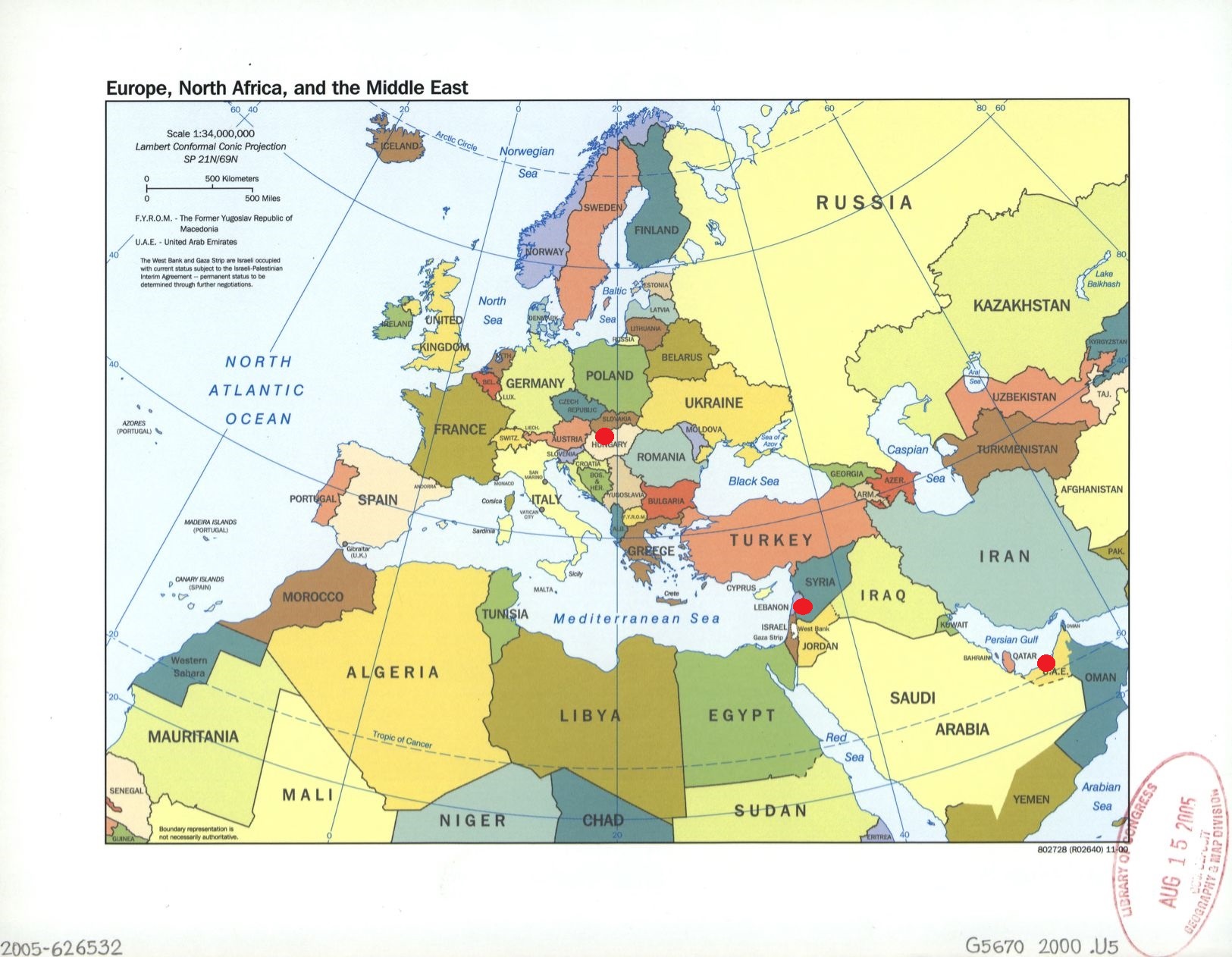
What is the distance between Damascus and Budapest?

According to distancecalculator.com, it’s 2,123 km (or 1,319 miles).

The distance between Damascus and Abu Dhabi? 2,021 km (or 1,256 miles).

If I had to flee a war zone on foot to a wealthy cosmopolitan city I’d rather go through Turkey and Romania than Iraq and Saudi Arabia, too. The West is on the precipice of a damnable moral failure (link, in case you’ve been living under a rock). In the name of fairness, though, a regional perspective ought to be adhered to.

I have a slight digression. Can anybody here imagine what the plight of the war refugees would be like going through post-socialist states like Romania and Bulgaria if they had not been a part of the EU? Let me put this into context a bit more. In order to join the EU, post-socialist states in Eastern Europe had to reform their political and legal systems in a manner that was satisfactory to the traditional Western states of the confederation. A major aspect of these reforms was making sure that governments have a harder time assaulting individual rights. This clause, or whatever you want to call it, for joining voluntarily the EU was less about a cultural chauvinism on the part of the core EU states and more about tempering the overt racist and nationalistic undertones of the post-socialist societies in Eastern Europe. Context matters, especially when there’s a lot of finger-pointing going on.

Here is a map I’ve edited for you:

map west eurasia 2015


The three big red dots represent the cities of Budapest in Hungary, Damascus in Syria, and Abu Dhabi in the United Arab Emirates (UAE). Visual perspectives are great. I already added my two cents about what needs to be done, in fact I did so around this time last year.

Marriage Licenses Should Not Be Granted to Gay Couples

Marriage licenses should not be granted to gay couples nor to straight couples. Marriages should be private consensual agreements between any two competent, consenting adults. Or three or more, for that matter. Governments should not be involved: no licenses, no special privileges, and no special obligations for married couples.

However, the fact that an action is legitimate and non-coercive does not mean any term can be used to describe it. Gay couples should not call their agreements “marriage” because that term is taken. For centuries, it has stood for heterosexual unions in almost all cultures. Marriage might be called a “trade mark.”

Kim Davis is a hero. She is the county clerk in Kentucky who was jailed for contempt because she refused to issue marriage licenses to gay couples.

She bases her stand on her religious beliefs, but that’s not why she is a hero. If she were acting on secular philosophical grounds, her case would be just as strong. She is a hero for standing up to a central government that is smothering civil society, reaching its tentacles into all areas of life and strangling spontaneous freely evolved social order.

Of course, she is guilty of contempt. That’s only right, because the process that has led to her imprisonment is in fact contemptible. She is following a course of civil disobedience that I must admire, and I wish her well.

Words and Brain Damage

I am starting my own war against empty, silly slogans and presumptuous words. I think they are the brick and mortar of political correctness which is smothering our brains. Living in Santa Cruz, California and dutifully listening to National Public Radio every day sure raise my awareness of brain cell destruction. (See endnote.)

Somebody had to do it, to start this war, I mean. And it’s in the best of human traditions that old men admonish the rest of the tribe to behave itself. (It’s “itself,” not “themselves;” tribe is singular. There are uses for a plural singular. This is not one. Pay attention. Learn English. I did.)

First thing first: If you call yourself an “educator,” you are not fit to educate anyone, especially children; I mean that you are not cultured enough. Learn to read, please!

If you believe that “educator” gives you gravitas (look it up) because the word rhymes with “doctor,” think again. Medical science exists, incurable warts and all. There is no science behind education. The mistaken belief that there is has led this country to waves after waves of destructive fads. These have left whole generations unable to write simple declarative sentences or to divide 144 by 12.

In twenty-five years of teaching in an expensive university, I met several graduating seniors, Spanish majors, who were illiterate in two languages including their own. (Reality surpasses fiction!) Education science indeed!

The proper word is not the pretentious “educator,” it’s “teacher.” If that does not sound noble enough for you, you should not be teaching. Good teaching requires a degree of humility. I refer to the humility to be ready to get another job if you can qualify for one.

Everyone in the world remembers his best teacher: He or she was enthusiastic yet calm, humane yet rigorous, encouraging yet demanding. There is no science in any of this. These qualities never add up to anything anyone would pompously call an “educator.”

My brain feels better already.

USA President Elections. View from Russia

Hello, NOL! Long time no blog. Now I want to share my thoughts on upcoming USA president elections in 2016. This event is very important for me, because I’m interested in American culture and history. I also think that this can be a trigger for reloading relationships between both our countries. So, I watch at pre-election race from position of a free thinker, who want to live in peaceful and secure world. It’s stupid to think about futurecoming President as about pro-Russian activist. It’s impossible, because, as we say in Russia, “your own shirt is closer to your body” which means “do good for yourself and your interests, and after all – for the rest of the world”. A kind of egoistic, but it works well. So I hope that President at least will not drag our relationships back in the times of Cold War.

Propaganda works well. A lot of people in Russia don’t even think about “spring” in relationships. More to say, some kind of russian patriots think that USA is a “territory of evil” and don’t want to have any relationships at all. Quite stupid position. Mono-polar world came to end with the Soviet Union and the truth is simple. We can’t develop without each other. It’s bright as day that we can’t affect on USA president elections, it’s USA business. It’s important for all russians to understand position of every single candidate and to have own opinion on this case: what can be done to improve our relationships and who can do that. Who will chose the path of collaboration and consolidation instead of self-destructive isolation?

Your opinions in comments area are always welcome!

From the Comments: The Contribution of American Allies to Pax Americana

Dr Stocker answers my concerns about free-riding and rent seeking with this gem:

Good points Brandon. On the rent seeking, I think you are broadly correct, but I would offer two qualifications. European nations/the EU often foot a lot of the bill/take on associated civilian tasks where America has taken military action, so that the US is not subsidising the defence and security needs of Europe quite as much as it might seem. So for example, in the Yugoslav breakup led to US military operations and a comparatively passive role for Europe, but a lot of the afterwork was taken on by Europe and there is no point in military intervention without work on building civil society to create long term security and stability. Going back a bit further to the first Gulf War/expulsion of Saddam from Kuwait, Germany and Japan did pay a lot towards the cost in return for not participating. Despite [this] they got a lot of abuse in the US Congress from politicians who don’t appear to understand that their non-intervention in the Gulf owed a lot to constitutions and attitudes which the US encouraged/imposed during post-World War II occupation. Recently, though European govts have been cautious in what they say in public about the Ukraine crisis and containing Putin, there is a growth in military spending and co-operation done in fairly quiet ways largely with the aim of deterring Putin from adventurism in the Baltic states. Just one example, Germany has recently taken 100 Leopard II tanks out of retirement and work is underway for the Leopard III. Moving to the Pacific, Japan is enhancing its military and weakening constitutional restrictions on the deployment of the military (imposed by the US in the post-war Constitution) in reaction to Chinese assertiveness.

While I think it is broadly correct that the US has been paying for a military burden which should be born by Europe and Japan, the situation is not as extreme as it often assumed in the US and as far as I can see is moving in a more balanced direction. In general while it is true that the US has a very impressive military machine with some impressive technology and officers, I think some Americans are a bit over confident about this. A lot of Americans, at least amongst those who take an interest in military kit, appear very convinced that the Abrams 2 is the best tank anywhere, I would suggest that in military capacity, for cost, the Leopard II is probably better (it certainly does much better in export markets) and even in absolute terms ignoring cost, the French Leclerc (which is extremely expensive) has a good claim to be the best tank around, and the Korean K2 is another strong but very expensive candidate. The Abrams is expensive, heavy, difficult to transport and difficult to keep in sufficient fuel, though it can certainly do a very good job. A lot of Americans appear to be incapable of thinking of France as anything other than a surrender monkey joke in military terms, which is really very far from the reality, as can be seen by the very strong role that France is now taking in northwest Africa against violent Islamist fundamentalists. The US military may well be able to have the same military capacity for lower cost if it moves away from the Abrams II model of a tank that is expensive to run and transport as well as build.

So broadly a correct point Brandon, but I think the situation is a bit better than is often understood in America and is moving in the right direction as Japan and Europe are getting used to the idea of taking responsibility for dealing with new threats from China, Putinist Russia and the hydra of Islamist fundamentalists.

A very good point, and an even better angle with which to view the world.

My only quibble is that the right direction American allies are moving can easily be changed without a more fundamental shift in institutional arrangements between us. Some sort of federal or confederal arrangement would go a long way toward addressing this issue, and would further deepen the economic and cultural ties between constitutional democracies.

Or am I just looking for problems where there are none, in order for my arguments to gain ground?