Trump, Liberty and Pizza
These are my obligatory thoughts about this Trump fiasco;
These past twenty four hours have been an emotional roller coaster for me.
I am an illegal alien. I have been able to do accomplish some great things these past few years because I was granted deferred action, a temporary suspension of deportation, and work authorization by the Obama administration. This has allowed me to work with the Cato Institute, the Reason Foundation, the Property and Environment Research Center, among others. I have been able to meet several of my intellectual heroes. I went from having been stuck to Los Angeles to travelling through most of the United States (with the notable exception of the south). I have formed countless friendships that would have been unimaginable to me a few years prior. I am today one of a handful of illegal aliens who have gone to do their doctoral study. If you read through NoL’s archives you’ll quickly realize I’m not terribly bright and I have a long way to go intellectually, but I’ve done well for myself I think.
Prior to deferred action I was in a dark place mentally. I was about to finish my undergraduate studies, but had no work experience unless you counted under the table odd jobs. How could I have any experience? Up till then it had been illegal to employ me. Once I graduated I had no idea what I could do. Become a gardener? I had no future. It didn’t help me that the longest romantic relationship I had been in ended because my significant other couldn’t stand my (lack of) legal status anymore. Deferred action gave me the chance to give my life meaning.
It is highly likely that, due to its discretionary nature, Trump will cancel deferred action once he enters the White House. I honestly don’t know what I will do. It is very likely that my life has reached a dead end. Upon hearing that Trump had won I spent several hours crying. I wept for all the things that I am likely to never have. I wept for the fact that I am unlikely to ever become a US citizen. I wept for the fact that I am unlikely to ever find a wife or have children. After crying though I decided that it was pointless to let myself be consumed by it any further.
I think it better to concentrate on counting my blessings.
I am not a US citizen, and I am likely to never become one. Truth be told though I don’t feel like a stranger in this country. I have friends, family, and work colleagues that have extended a helping hand to me in the worst of times. I am grateful beyond words for that. Thank you. I love you all for it.
I may never be recognized as a son of America and I cannot claim to be a blood descendant from American heroes like Thomas Jefferson, Frederick Douglas, or Milton Friedman. I am however an intellectual descendant of them. I am a son of liberty.
Mind you an American conception of liberty. I think that government, in so far as it exists, should exist to minimize social conflict by promoting disputes to be resolved through non-violence. I think that society should judge people by their actions, not incidents of birth. I think that the market is the best mechanism for peaceful coordination of production of goods, services, ideas, and love. I emphasize that word because love only matters when it is felt voluntarily. Forced love is not love.
The common interpretation of Trump’s victory is that his supporters were a collection of racists, bigots, and pigs. While I am sure there are genuine racists mixed among his supporters, I think such a view too simplistic because it fails to consider why this racism has fermented.
Racism, in its many forms, is an inherit condition of man. Due to evolution we human beings have a built-in system of distinguishing between in and out groups, between those who are ‘us’ and those who are alien. This trait was necessary to allow early hunter-gatherers to form bands and survive. I do not pretend to be exempt from this; I’ve told my share of racist jokes over the years and am more inclined to help others that share similarities to myself. Racism, to the extent we see currently, however is not due to natural conditions.
I think that today’s level of racism is due to us forcing fake love down people’s throats. There is nothing wrong with celebrating diversity. Pizza, one of mankind’s greatest achievements, is the ultimate symbol of diversity. It’s core ingredients could not have been combined until relatively recently. Pizza is born of the union of the old world (Europe, Africa and Asia) and the new world (the Americas). There is nothing wrong with praising pizza.
The problem is that when we try to force others to eat a specific type of pizza. If someone won’t eat pineapple with their pizza we consider them bigots and exclude them from our social group. We tell them they’re subhuman and banish them far away. Should we be surprised then if, upon being ostracized, they come to resent pineapple pizza? In the past they simply didn’t care for pineapple, but now they hate it because it reminds them of how they were rejected in the past for holding unpopular views.
In our pursuit of celebrating pizza we ended up forgetting the great thing about pizza – choice. Pizza comes in countless varieties from plain cheese to pepperoni or a mix of vegetables and meats. Pizza doesn’t even need to have tomato sauce or cheese to be a pizza. Pizza is the ultimate manifestation of choice. It is no wonder that we Americans, in our love for liberty, love pizza.
Diversity is great. However if someone doesn’t like to be around blacks, homosexuals, or Jews we are not advancing the cause by making them feel like awful people. They may come from a background where they only interacted with others like themselves. They may feel uncomfortable in diverse environments, but we should not presume it to be because of bigotry. It is better to give them the benefit of the doubt. If diversity is great it will win them over time – they will voluntarily come to love diversity.
If we force them to love something however we deny them the opportunity to fully understand why diversity matters. We also force them to be hypocrites that claim to love something they don’t care for. We set up the groundwork for someone to come along and offer them a chance to get back at those who dehumanized them if they vote for him.
It is easy to want to punch people and force them to agree with you. I know full well the temptation of violence. Again, in the past day my life has come to an end. It would be easy to fuel my emotions into anger. It wouldn’t solve things though.
If we want to live in a better world we need to break this cycle of hatred and concentrate on what brings us together, our love for pizza.
Lifehacks: How to use Facebook better
Despite disagreeing with many (most?) of my friends on political issues I don’t think I’ve lost any Facebook friends this election. Let me share my secrets.
Step 1: Empathize. Life is hard, and few of us are trained for political life.
Step 2: Listen. We all have the same goal… getting other people to agree with us. You’re not going to be successful by telling people their stupid. You’ll get lots of Internet points… but only from people who already agree with you. You’re actually making things worse because fewer people will listen to people who are apparently incapable of treating them like a decent human being (and most people outside the Beltway are, in fact, decent and human).
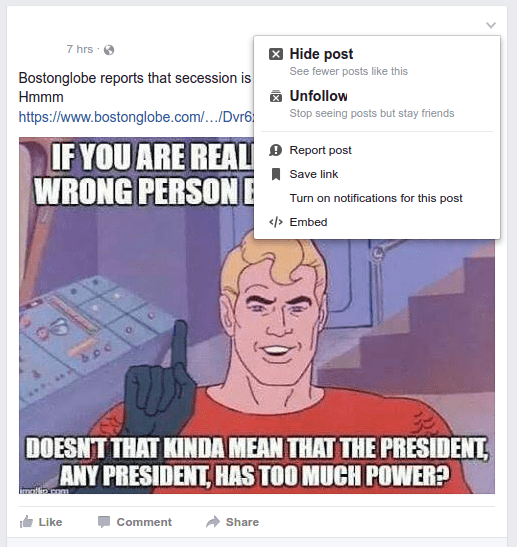
Step 3: Filter. (This is the big one.) You’re not going to convince everyone. For good or ill, morality isn’t about rationality for most people. So click that little “V” in the top right of your idiot friend’s post and tell Facebook to hide it.
Step 4: Relax. This stuff works by osmosis. You’re not going to change anyone’s mind over night (certainly not anyone over the age of 25). Be like the Colorado river. You don’t get a Grand Canyon of tolerance by refusing to trickle over land that doesn’t already agree with you.
Step 5: Step back. The government is about 20% of the economy. Try not to let it be more than 20% of your life. Your attention is scarce. Political life matters, but don’t let it get out of proportion. The Internet isn’t just for getting angry, it’s also for adorable gifs and pictures of pigs wearing boots.
Meta-intolerance doesn’t work. Take the worst case scenario: you’re Facebook friends with actual Hitler. You’ve got three options: A) Argue with him constantly. B) Unfriend him. C) Ignore his hateful posts and like his posts about his art. Which will do the most good for the world? Alright, potential employers and friends would probably prefer to avoid Hitler’s friends. But they’ll be more tolerant of your crazy uncle Rudy and you’ll do more good by being an occasional voice of reason in his feed than by stepping out of his Internet bubble entirely.
Most people are basically good even if they’ve got silly opinions about how to be good. And communication is hard. We speak different languages when we talk about politics and few of us have the tools to properly express ourselves. When people support politicians or policies you dislike, it might just be that they think that’s the lesser of two evils. (I’ve got opinions on why it’s sad that people think they’re “wasting” their vote by voting with their conscience, but I can hardly be mad at them for learning the fallacious reasoning that’s been foisted on them since high school civics. Let me add that if Vermonters had voted Stein and New Hampshirtonians had voted Johnson, then maybe next cycle we’ll get better options and we might push out of this two party system so many people dislike.)
I promised you Facebook lifehacks. They all boil down to this: tend your Internet bubble. You can do this with three easy steps:
- Like more non-controversial stuff than controversial stuff.
- Ignore and hide infuriating posts from people you’d rather respect (and imagine that you live in a world of respectable but flawed people instead of a world of evil charlatans).
The US elections: good, bad, and ugly
Good
Media will finally start doing its job after 8 years of hanging all over Obama’s nuts.
Bad
The GOP has control of the executive branch and both houses of Congress.
Ugly
The ugly part is over. Trump won’t be as bad as the Left wants him to be (the Left might even like his protectionism), but he’ll still be plenty bad by libertarian standards. We’ve got a lot of work to do, if we’re to make his job as president as hard as possible.
Have a good day!
Brazil: the country of slavery yesterday is the country of socialism today
Although President Dilma Rousseff was impeached, and the PT (the Worker’s Party) suffered great losses in the municipal elections some weeks ago, it is still clear that PT in particular and socialism at large still has strong support among the population, especially in intellectual, cultural, and political circles. The Brazilian political spectrum often intrigues observers both from inside and outside the country: among the 35 registered political parties, almost none presents itself consistently as liberal or conservative. The only one to do so is the newly created Partido Novo (literally New Party). Other parties present themselves as socialist, social democrats, or don’t talk about this at all. To use the infamous left-to-right political spectrum, all political parties present themselves either as left or center. To present itself as right is still taboo for Brazilian political parties. Things surely seem to be changing as the already mentioned Partido Novo enters the scene and some individual politicians, such as Jair Bolsonaro, present themselves openly as right-wing. Also, social movements such as Movimento Brasil Livre and think tanks such as and Instituto Von Mises Brasil help create momentum for a new right in the country. It is possible that in future elections conservative and liberal candidates will gain seats, especially in the legislative chamber, but as parties are concerned, the right is still mostly a wasteland in Brazil. But why is that so?
Many analysts blame two factors for the lack of party representation for the Brazilian right. First, there’s the military government, from 1964 to 1985. Although statist both in political and economical terms (as it would be expected in a military government), this period was consistently identified as “right.” Therefore, to identify someone as right is still usually understood as to identify as a supporter of the military regime. Second, there is the successful work of the left, especially in the propaganda arena. The main reason for the 1964 coup was the threat of a communist revolution, such as in Cuba. The military was successful in fighting the communist guerrilla insurgency in the countryside, but were mostly unaware of the intellectual struggle in schools, universities, and other places (despite much talk of censorship to this day). Related to that or not, the fact is that the right is still underrepresented in intellectual and cultural spheres.
I’m not saying that either of the above explanations is wrong, but I’d like to suggest an alternative that goes much further in the past: Brazil is the country of socialism today because it was the country of slavery yesterday. When slavery was abolished in 1888, Brazil was the last country in the Western world to do so. An estimated four million slaves had been imported from Africa to Brazil, 40% of the total number of slaves brought to the Americas. This is ten times as many as were trafficked to North America and far more than the total number of Africans who were transported to all of the Caribbean and North America combined. According to the only national census accomplished during the monarchy, in 1872, Brazil had a population of about 10 million people. 15.24% were slaves, and 84.8% were free. It is most likely that this census doesn’t reflect the reality of the whole monarchical period, as successive laws against slavery, immigration, and other factors moved these percentages over time.
José Bonifácio de Andrada e Silva, a major figure in Brazilian politics of the time, praised freedom in his writings, but kept slavery in place, even with British pressure to abolish it and subsequent promises to help. He did that because he needed the slave owners’ money and thought that abolition wasn’t politically wise. Bernardo Pereira de Vasconcelos, founder of the Conservative Party, was a slave owner and even rented his slaves for public works. Many subsequent leaders of the Conservative Party, such as Paulino José Soares de Sousa, were part of the Fluminense slave-owning aristocracy either by birth or by marriage. Anyway, the Conservative Party wasn’t in a hurry to abolish slavery. The lack of revenue and the political implications were matters of much greater concern than the humanitarian cause. When they finally passed the gradual laws for abolition (and ironically they passed them all) it was to appease the liberal opposition, not for the sake of the cause. Conservatives were also unwilling to employ the Africans as free workers or to treat immigrants as free individuals: their plan was to gradually abolish slavery and to substitute it with a cheap immigrant labor force in large estates through laws restricting access to land. To their surprise, this plan never succeeded. Their last effort, to bring supposedly naïve Chinese in to substitute slaves, was barred by the liberals.
The legacy is that the country of slavery yesterday is the country of socialism today. As Herbert Spencer once said, “All socialism involves slavery.” Even better, Alexis de Tocqueville said that “Socialism is a new form of slavery.” Both share the same thought: slavery is forced labor of one individual to another. Socialism is forced labor of everyone to everyone else. When “rights” abound, it’s worth asking how they will be paid. Brazil is a country of rights, but not of duties or responsibilities. Just as it was the right of the elites of the past to have the slaves working for them, it’s the right of people today to receive social benefits from everyone else. People can (maybe naïvely) defend socialism as much as people in the past defended slavery, but to treat adults as infants is neither moral nor wise. Sure, Brazil still has a population that suffers from the mistakes of the past. But two wrongs don’t make a right.
To Women Voters:
I take the liberty to point out a small number of issues that I am told are important to women. I do it because I used to be a respectable social scientist and because I have been retired for ten years which gives me plenty of time to stay informed.
Women voters have been misled for years by propaganda explicitly pointed at them. It wasn’t necessarily a conspiracy though but a kind of uncritical cultural convergence. Many of those who spread misinformation believe it themselves. So, in a way, they are morally innocent. That’s no reason to follow them down the wrong path, and down the cliff. Below are five topics about which you may have received false information that has been repeated over and over until it sounded true.
The first female president
There is a widespread feeling among American women that it’s time finally to elect a female president. For some, it’s a sort of symbolic restitution. I can’t speak to this because I am only a man. Other voters, both females and males, seem to think that a female presidency would result in significant improvements in the lives of American women. A relevant reminder: Eight years ago, Americans elected the first African-American president. For many, it was a vote filled with hope for positive change in the area of race. After two Obama administrations, almost eight years later, it’s time to take stock. However you evaluate the Obama administrations in general, two facts stand out. First, race relations in American have not improved (to say the least). Second, African-Americans are not better off than they were eight years ago. In fact, they are slightly worse off economically. (My own position on having a woman President is straightforward: I would vote for Stanford Professor Condoleeza Rice, for President, in a heartbeat.)
Abortion
The 1973 Roe vs Wade decision made abortion on demand available throughout the territory of the United States. Candidate Trump has provided a list of potential nominees to the Supreme Court . Some of those nominees are pro-life. This raises the question of what would happen in the unlikely event that Roe vs Wade were overturned by a new Supreme Court. You may have been led to believe that abortion would become illegal. That’s simply not true. Legislation on abortion – if any – would revert to the individual states as the Constitution requires (same as murder, theft, sequestration, and spitting on the sidewalk). The likelihood that all fifty states would forbid abortion on demand is simply zero. The likelihood that half of them would is also zero, I believe. The worst case scenario is that abortion would become geographically inconvenient. (In case you wonder, I believe, just like former President Bill Clinton, that abortion should be legal, safe, and rare.) There is no chance that not electing Mrs Clinton will make abortion illegal.
Pay disparities
We have been told that women received interior pay for equal work for so long that it has almost become the truth. Even my local female Republican candidate for Congress uses this line. It’s not the truth. The reality is that women receive unequal pay for unequal work. There are various reasons why this is. (A broader treatment of this matter is on my blog and accessible through these two links.) In fact, paying women unequal pay for equal work has been against federal law for more than thirty years. Doing it is an invitation to costly class action suits. It’s probably important not to vote for someone on the basis of “facts” that are not facts at all. And then, there is the issue of why anyone would mislead you so badly. (Myself, I am going to vote for the Republican lady candidate for Congress although I think she should check her facts better.)
Immigration
Candidate Clinton has said clearly that she is is for open borders. This may come from a generous heart. Yet there are too many people from poor countries who want to come to the US to live. Even, if all of them are good people, the USA is like a lifeboat: If too many climb aboard, the boat capsizes and everybody drowns, the original passengers (Americans as well as existing immigrants) and the newcomers (would-be immigrants). To remain a decent society, a generous society, the US has to somehow restrict admission. Open borders is not a possible policy, it’s a dangerous fantasy. (In case you are wondering: I am an immigrant myself, so is my wife.)
Civility
Candidate Trump bragged – thirteen years ago – about making crude sexual gestures. There has not been a single formal complaint or any charge brought against him on this account. That’s although – unlike former Pres. Bill Clinton at the same stage – he has temptingly deep pockets, the kind of pockets that would give fighting courage to any moderately aggressive attorney. Candidate Trump often also has a filthy mouth, and he occasionally uses sexist language, that’s a fact. Candidate Clinton is good friends with and approves of, and patronizes artists who routinely sing of perpetrating gross sexual violence on women (including in the last days of her campaign). They too use obscene words. They do so routinely, every time they perform. (I don’t use such language myself but my wife of forty years does, another story, obviously.)
Please share this and ask your friends to share.
Early childhood memories of a Cambodian refugee camp
In 1991, sixteen Khmer families from Cambodian refugee camps (mostly from Khao I Dang) received asylum in the Netherlands. This Saturday, November 5, we will celebrate the 25th anniversary. To commemorate our stay in the Netherlands, I would like to share some of my early childhood memories about being born in a Cambodian refugee camp in 1986.
I understand that my story is just one small, but essential part of my family’s overall journey for safety from the civil war (1967-1975), Khmer Rouge (1975-1979) regime, and the subsequent Vietnamese occupation. According to some estimates, 2 million out of 8 million people died during this long period. This figure has been contested many times. I don’t think anyone knows how many people have actually died, but if I look at the family members of my parents’ households: 40% from my mum’s side died and 25% from my dad’s side.
Khao I Dang, the refugee camp where I was born
My parents were forced to work in labour camps in the countryside in Battambang by the Khmer Rouge. They eventually met each other while fleeing from Battambang to the Thai border when the Vietnamese invaded Cambodia. As with most fleeing Cambodians, my parents decided to get together – not out of love, but more out of the need and desire to share their hardships. This was after all, a months-long journey through the heart of the Cambodian jungle in which my father lost his father, the granddad I never came to know. My mother lost her brother and her father. As my mother was separated from her brother early on during the Khmer Rouge regime and never witnessed his death, she had always held hope that one day she would find him again.
My parents’ long journey towards Thailand brought them to the Sa Kaeo camp which was the first organized refugee camp that opened in 1979. Within just 8 days, the refugee population grew to 30,000. The camp eventually closed down half a year later, because of unfavorable conditions. The drainage in the campsite was for example so poor that several refugees, too weak to lift their heads, drowned from a flood as they laid on the floor in tents made of plastic sheets.
One month after the opening of Sa Kaeo, the Khao I Dang camp was opened and many people were repatriated into Khao I Dang. My parents eventually ended up there as well.

Khao I Dang was a refugee camp on the Thai-Cambodian border where I was born. It was a bamboo village with dirt roads, barbed wire, and armed guards. Within just 5 months, the camp’s population reached 160,000. Population wise, this would make the camp the 11th largest municipality in the Netherlands.
Although the camp gave us more safety, violence and theft ran rampant.
Religion and death
People continued their religious activities and some houses were transformed into places for Buddhist ceremonies. In this picture you see my two brothers, my father, and I wearing our best clothes. We just came back from a visit to a local ‘temple’. The husband of my aunty, who had just been allowed to find refuge in Australia, had recently died in the camp.

Behind me is a grave of him. My father hired a photographer to take this picture so that he could send it to my aunty. I am the one barefooted.
Hospital
My father worked at the hospital. The hospital was a large hall with beds placed next to each other. I remember that I visited the hospital where I was given a doctor’s gloves to play with. I would blow it and enjoy a child’s kick out of it.

Night raids
I remember that during some nights, rebels with guns would raid people’s houses to steal their belongings. Often, the word about night raids spread faster than the rebels themselves, and so most of the times we were warned before the rebels reached us. I remember very well one incident when we did not flee early enough.
My brothers and I ran after my father, while my mother took my baby sister in her arms to flee in separate directions. My father brought us into a nearby canal to hide there. When the Thai patrolling soldiers within the camp arrived at the scene, shooting between the two groups erupted. When I think back to this moment, I can still clearly feel the fear I had. I wanted to cry, but my father put his hands tightly on my mouth so that I would not make any sound. We then fled to the hospital where my father was working, and stayed there during the night. We were too afraid to go back home, and waited until the next morning.
In another incident, our neighbors were too late to flee and somehow for reasons unknown, a rebel threw a hand grenade inside their little home that killed the whole family.
Kindergarten
Despite the violence and misery, people tried to rebuild their normal lives. I went to kindergarten and remember so well one incident that I played hooky.
I was 4 years old and walking to school by myself, I stopped and decided to return home to my mother’s small shop. This is an incident that I am personally extremely proud of. As long as I can remember, I have always detested school. I hated to sit still and to be told what to do and what not to do. I took this attitude with me to the Netherlands, and still today I am very critical of schooling. My mother, a soft young woman, let me stay with her at the shop. But then my father came by, got angry with me, and spanked me for not going to school. Until this day I still don’t think that I did anything wrong.
Our little shop
Trade went on. Although it was illegal, industrious people were trying to make money by starting small businesses. This shows to me that entrepreneurship is natural to us human beings, and that economics and trade are naturally emerging processes as people are always looking for ways to improve their lot and to fulfill their needs.
Thai merchants would come to the fences, away from the Thai soldiers who were patrolling, in order to sell food to the refugees inside. Such activities occurred during night-time. When Thai soldiers would find out that we were trading with outsiders, they would beat us and take away our belongings. We, refugees, were also not allowed to get outside of the camp or we would risk being shot dead by Thai soldiers.

During day-time, people inside the camp would expose their new belongings and small shops would emerge. My mother sold small products of convenience. Some of it was smuggled by Thai people into the camps that we, Cambodians, were selling to other Cambodians. Other things like oil and sugar were given to us as part of a food relief program that we used sparingly so that we could sell it further. With the money we earned, we could then buy other goods that we needed more.
Other ways through which we made money was by brewing alcohol made from rice and apples. Although alcohol was illegal, it did not stop my parents from brewing it. Whenever a Thai soldier would come to our house for inspection – I don’t think you can really hide the alcoholic odor that was surrounding our little house when we were brewing alcohol – my parents would bribe him with money so that he would leave us alone.
Continuing story
These are some of my childhood memories of our lives in Khao I Dang. Maybe next time I can tell more about our life in the camp, share some of my older brothers’ memories, our cat that was lost, killed and eaten by someone or my first encounter with inspiring Superman and Spider-Man comic books. Maybe, I will also write about our continuing journey to the Netherlands and the psychological impact my experiences in Khao I Dang had on me. I can tell about the nightmares that haunted me until my teenage years, how I always felt alienated from the people here and the inferiority complex towards Dutch people that I developed as a little child for feeling different. Feeling different made me feel insecure. Every time I met someone, and I think it lasted until my later teenage years, I would always ponder whether the person would kill me if he would be put in similar circumstances as those many killers from the Khmer Rouge period. In other words: as a child, I already wondered excessively about the “banality of evil”. These thoughts were of course extremely unhealthy, especially when you are as young as 4 or 5 years old.
The biggest lesson I have learned from my childhood is that both good and bad experiences are important in our lives. Happiness, in my opinion, is very much overrated and hardship is at least as valuable.
I have not written this so that people pity me. Pity, and in particular self-pity, is an extremely damaging emotion. It multiplies our suffering and reveals an extremely pathological egoism. When I look back at the hardships my family has overcome, I like to remind myself of Haruki Murakami’s saying that “only assholes feel sorry for themselves”.
BC’s weekend reads
- Madonna offers oral sex for those who vote Hillary Clinton
- Trump-inspired ‘pussy’ ad banned in San Francisco subway
- The poverty of democracy
- The battle for the Arctic
- Countries rush for upper hand in Antarctica
- Why not world government? (Part 2)
- Meet China’s state-approved Muslims
- The good, the bad, and the ugly of Somaliland secession
An undignified part of me (of which I am ashamed)
There is a part of me, an undignified part of me of which I am ashamed. That part thinks that it would be poetic justice for Mrs Bill Clinton’s lifelong presidential ambitions, intricately tied to primitive feminism, awkwardly paired with her husband’s sexual assaults, to founder because of the actions of a notorious public penis shaker.
It would be a twisted take on the Gospel according to Matthew:
“Put your sword in its place, for all who take the sword shall perish by the sword” (Matthew 26: 52).
Some Thursday afternoon love
I’ve been busy with real life for so long that I haven’t been able to produce shorter blog posts that give you a snapshot into my daily thinking routine. That should change now, but for today I wanted to give a shout-out to a bunch of bloggers who have put NOL on their blog rolls. Please be sure to check them out and add them to your daily feeds!
- Catallaxy Files: “Australia’s leading libertarian and centre-right group blog”
- Farmer Hayek: A group blog of agricultural economists based out of the American midwest
- Maggie’s Farm: A group blog of non-conformists based out of the American northeast
- The Money Illusion: The infamous-though-prestigious economist Scott Sumner’s personal blog
- Policy of Truth: Irfan, David, and the gang discuss philosophy, Israel/Palestine, and American politics and culture (amongst other interesting things)
- Popehat: a law blog that is much more than that
- Samizdata: A (mostly) British group blog of libertarian-ish bad asses
These guys are all on our blog roll, too, so don’t feel like you have to save this page in order to find them in the future.
These guys are also really cool, obviously, so feel free to jump into their ‘comments’ threads and introduce yourselves. They’ll talk back.
I’ve noticed a trend over the past few years of blogs getting rid of their blog rolls altogether, and I think it’s stupid. People think it makes their blog look sleeker, and that blogging as a form of communication between like-minded people has come to an end, but that’s all hogwash.
Show these guys some love!
A quick update on life in ATX
Hey all,
I just put in my two weeks’ notice at the bar I’ve been working at for the past 13 months. I’ve had a lot of fun, even though I took the job seriously, and am looking forward to my next adventure in life. Right now, though, I’ll just be chillin’ in ATX and reading and writing as much as possible. That means more blogging from me! (Hopefully my fellow Notewriters will follow suite…)
Austin is described by intelligent locals as a “blue dot in a sea of red,” meaning it’s a liberal city in a very conservative state. During the primaries, I saw mostly Bernie Sanders signs in the areas of Austin I frequent (east side, Riverside, downtown; i.e. the poor, fun parts). Ron Paul is a popular figure in Austin, too, but he has long since faded away from the politico-electoral scene.
The south and west sides of Austin are much more affluent, and therefore more conservative, and I have a feeling that if I were to end up in those neighborhoods I would see a lot of “Hillary” signs. It’s the strangest thing, the be living in a state that is known culturally in the US as the conservative state (and made to be diametrically opposed to California, which is the liberal one), and see nothing but support for thoughtful candidates within the two major political parties.
There is not much knowledge or support for 3rd party candidates in Austin. The LP and the Green parties get superficial nods of approval whenever they are brought up in conversation, but for the most part Texas Leftists and millennials support “the little guy” of the major parties. Again, it is weird. But so, too, am I and with that I’ll sign off for the day…
UPDATE: Speaking of weird, check out this review by Bryan Caplan of a new biography about Brigham Young.
Does academia have a diversity problem?
As those of you who have me on Facebook may know, I’ve spent the past few months running around in a Trump costume at various comic conventions. I did so for the simple reason that I found it humorous for a Mexican to be running around as Trump. To my surprise the experience was surprisingly enlightening.
When dressed in Trump I got a range of reactions from people wanting a comedic photo with/of me, being attacked by a pair of Hispanics dressed as ‘cholo’ Mario and Lugio, and Bernie supporters saying they hated my guts until I explained I didn’t support Trump.
Yesterday though, when dressed as Trump for Halloween, I got the strangest reaction when walking around my university campus. A meek boy came up to me and asked me if I identified as a Republican, I responded that I did but that I had actually supported Jeb in the primaries*, and his eyes light up. He began to shake my hand and talk about how great it was to find someone else after looking for so long.
The incident really hit home for me since I recall my own undergraduate years of feeling politically isolated from my peers. I had resigned myself to biting my tongue whenever politics were discussed. This didn’t work though since I was often in social sciences and my leanings quickly showed when we had freedom to elect subjects for our assignments. So I just kept shut and tried to produce as bland as possible papers so that I wouldn’t be singled out.
This didn’t change until I discovered there were a few conservative/libertarian professors sprinkled across the university. I didn’t become a chatter box in their classes, but I felt an immense weight off my shoulders knowing that I could voice an opinion outside the mainstream Democratic party line and not have to defend myself from claims of being a racist one-percenter.
Unfortunately, as Landberg et al.’s recent paper shows, there just aren’t many non-Democratic professors in academia. Does academia have a diversity problem? Yes it has an intellectual diversity problem, but its not clear what can be done about it.
Thoughts? Have others had similar experiences?
*This is of course relative to my disdain for the Democratic Party.
Great quotes by Vladimir Lenin
Last week I posted some quotes by Joseph Stalin. I’m afraid too many people are still misguided by the myth that Lenin was a good leader whose plans were somehow distorted by Stalin. Nothing could be further from the truth. Joseph Stalin had a great teacher, Vladimir Lenin, and brought the plans of his teacher to perfection. Here are some quotes by Lenin, so that we can learn more about international Marxism. Notice that he sounded very reasonable and pacific before 1917, and not so much so when revolution actually came.
On terror:
The Congress decisively rejects terrorism, i.e., the system of individual political assassinations, as being a method of political struggle which is most inexpedient at the present time, diverting the best forces from the urgent and imperatively necessary work of organisation and agitation, destroying contact between the revolutionaries and the masses of the revolutionary classes of the population, and spreading both among the revolutionaries themselves and the population in general utterly distorted ideas of the aims and methods of struggle against the autocracy.
Lenin, Vladimir Ilich (July–August) [1903], “Second Congress of the RSDLP: Drafts of Minor Resolutions”, Collected Works, 6, Marxists.
It is necessary — secretly and urgently to prepare the terror. And on Tuesday we will decide whether it will be through SNK or otherwise.
Memorandum to Nikolay Nikolayevich Krestinsky (3 or 4 September 1918) while recovering from an assassination attempt by Socialist-Revolutionary Fanni Kaplan on 30 August 1918; published in The Mitrokhin Archive: The KGB in Europe and the West (1999) Christopher Andrew and Vasili Mitrokhin, p. 34.
On democracy:
Whoever wants to reach socialism by any other path than that of political democracy will inevitably arrive at conclusions that are absurd and reactionary both in the economic and the political sense.
Lenin, Vladimir Ilich (Summer) [1905], “Two Tactics of Social Democracy in the Democratic Revolution”, Collected Works, 9, Marxists, p. 29.
You cannot do anything without rousing the masses to action. A plenary meeting of the Soviet must be called to decide on mass searches in Petrograd and the goods stations. To carry out these searches, each factory and company must form contingents, not on a voluntary basis: it must be the duty of everyone to take part in these searches under the threat of being deprived of his bread card. We can’t expect to get anywhere unless we resort to terrorism: speculators must be shot on the spot. Moreover, bandits must be dealt with just as resolutely: they must be shot on the spot.
“Meeting of the Presidium of the Petrograd Soviet With Delegates From the Food Supply Organisations” (27 January 1918) Collected Works, Vol. 26, p. 501.
On individual liberty:
Everyone is free to write and say whatever he likes, without any restrictions. But every voluntary association (including the party) is also free to expel members who use the name of the party to advocate anti-party views. Freedom of speech and the press must be complete. But then freedom of association must be complete too.
Lenin, Vladimir Ilich (13 November 1905), “Party Organisation and Party Literature”, Novaya Zhizn (Marxists) (12).
We set ourselves the ultimate aim of abolishing the state, i.e., all organized and systematic violence, all use of violence against people in general. We do not expect the advent of a system of society in which the principle of subordination of the minority to the majority will not be observed.
In striving for socialism, however, we are convinced that it will develop into communism and, therefore, that the need for violence against people in general, for the subordination of one man to another, and of one section of the population to another, will vanish altogether since people will become accustomed to observing the elementary conditions of social life without violence and without subordination.
Lenin, Vladimir Ilich, The State and Revolution, Ch. 4: “Supplementary Explanations by Engels”
On violence:
No Bolshevik, no Communist, no intelligent socialist has ever entertained the idea of violence against the middle peasants. All socialists have always spoken of agreement with them and of their gradual and voluntary transition to socialism.
“Reply to a Peasant’s Question” (15 February 1919); Collected Works, Vol. 36, p. 501.
When violence is exercised by the working people, by the mass of exploited against the exploiters — then we are for it!
“Report on the Activities of the Council of People’s Commissars” (24 January 1918); Collected Works, Vol. 26, pp. 459-61.
BC’s weekend reads
- NATO sends a message to Russia
- Iraq doesn’t need to break up to be successful (so says a scholar at Brookings)
- Benedict Anderson (political science) reviews Clifford Geertz (anthropology)
- The Muddled Mystique of Karl Polanyi
- The prison house of gender
- Investigating Madison’s Political Religion (central planning is hard to do)
Great quotes by Joseph Stalin
Sometimes I like to read quotes by famous intellectuals and leaders. I believe it is a great way to learn one thing or two about several subjects, and specially the thought of said people. I suddenly became curious about Joseph Stalin, and to my surprise he was at times a very reasonable (albeit terribly evil) person. Here are some quotes by Joseph Stalin I subjectively find interesting:
On Social Democracy:
Social democracy is objectively the moderate wing of fascism…. These organisations (ie Fascism and social democracy) are not antipodes, they are twins.
Joseph Stalin, “Concerning the International Situation,” Works, Vol. 6, January-November, 1924, pp. 293-314.
On Anarchism:
We are not the kind of people who, when the word “anarchism” is mentioned, turn away contemptuously and say with a supercilious wave of the hand: “Why waste time on that, it’s not worth talking about!” We think that such cheap “criticism” is undignified and useless.
(…)
We believe that the Anarchists are real enemies of Marxism. Accordingly, we also hold that a real struggle must be waged against real enemies.
Anarchism or Socialism (1906)
On differences within the communist movement:
We think that a powerful and vigorous movement is impossible without differences — “true conformity” is possible only in the cemetery.
Stalin’s article “Our purposes” Pravda #1, (22 January 1912)
He did make a lot of people conform to his ideas.
On diplomacy:
A sincere diplomat is like dry water or wooden iron.
Speech “The Elections in St. Petersburg” (January 1913)
On the press:
The press must grow day in and day out — it is our Party’s sharpest and most powerful weapon.
Speech at The Twelfth Congress of the R.C.P.(B.) (19 April 1923)
On elections:
I consider it completely unimportant who in the party will vote, or how; but what is extraordinarily important is this—who will count the votes, and how.
Said in 1923, as quoted in The Memoirs of Stalin’s Former Secretary (1992) by Boris Bazhanov [Saint Petersburg]
On education:
Education is a weapon whose effects depend on who holds it in his hands and at whom it is aimed.
Interview with H. G. Wells (September 1937)
On Hitler:
So the bastard’s dead? Too bad we didn’t capture him alive!
Said in April 1945 — On hearing of Hitler’s suicide, as quoted in The Memoirs of Georgy Zhukov
On his role as a leader at the USSR:
Do you remember the tsar? Well, I‘m like a tsar.
To his mother in the 1930s as quoted in Young Stalin (2007) by Simon Sebag Montefiore
To finish, a comment by George Orwell about Stalin, and above that, about people in the West who failed to see what the USSR actually was:
I would not condemn Stalin and his associates merely for their barbaric and undemocratic methods. It is quite possible that, even with the best intentions, they could not have acted otherwise under the conditions prevailing there.
But on the other hand it was of the utmost importance to me that people in western Europe should see the Soviet regime for what it really was. Since 1930 I had seen little evidence that the USSR was progressing towards anything that one could truly call Socialism. On the contrary, I was struck by clear signs of its transformation into a hierarchical society, in which the rulers have no more reason to give up their power than any other ruling class. Moreover, the workers and intelligentsia in a country like England cannot understand that the USSR of today is altogether different from what it was in 1917. It is partly that they do not want to understand (i.e. they want to believe that, somewhere, a really Socialist country does actually exist), and partly that, being accustomed to comparative freedom and moderation in public life, totalitarianism is completely incomprehensible to them.
George Orwell, in the original preface to Animal Farm; as published in George Orwell : Some Materials for a Bibliography (1953) by Ian R. Willison

