In Search of Firmer Cosmopolitan Solidarity: The Need for a Sentimentalist Case for Open Borders

Most arguments for open borders are phrased in terms of universalized moral obligations to non-citizens. These obligations are usually phrased as “merely” negative (eg., that Americans have a duty to not impede the movement an impoverished Mexican worker or Syrian refugee seeking a better life) rather than positive (eg., that the first obligation does not imply that Americans have a duty to provide, for example, generous welfare benefits to immigrants and refugees), but are phrased as obligations based on people in virtue of their rationality rather than nationality nonetheless.

Whether they be utilitarian, moral intuitionist, or deontological, what these arguments assume is that nation of origin isn’t a “morally relevant” consideration for one’s rights to immigrate and rely on some other view of moral relevance implicitly as an alternative to try and cement a purely moral solidarity that extends beyond national border. They have in common an appeal to a common human capacity to have rights stemming from something metaphysically essential to our common humanity.

Those arguments are all coherent and possibly valid and are even the arguments that originally convinced me to support open borders. The only problem is that they are often very unconvincing to people skeptical of immigration because they merely beg the question of that moral obligation is irrelevant with respect to nationality. As one of my critics of one of my older pieces on immigration observed, most immigration skeptics are implicitly tribalist nationalists, not philosophically consistent consequentialists or deontologists. They have little patience for theoretical and morally pure metaphysical arguments concluding any obligation, even merely negative, to immigrants. They view their obligations to those socially closer to them as a trump card (pardon the pun) to any morally universalized consideration. So long as they can identify with someone else as an American (or whatever their national identity may be) they view their considerations as relevant. If they cannot identify with someone else based on national identity, they do not view an immigrant’s theorized rights or utility functions as relevant.

There are still several problems with this tribalist perspective, given that nation-states are far from culturally homogenous and cultural homogeneity often transcends borders in some important respects, why does one’s ability to “identify” on the basis of tribal affiliation stop at a nation-state’s borders? Further, there are many other affinities one may have with a foreigner that may be viewed as equally important, if not more important, to one’s ability to “identify” with someone than national citizenship. They may be a fellow Catholic or Christian, they may be a fellow fan of football, or a fellow manufacturing worker, or a fellow parent, etc. Why is “fellow American” the most socially salient form of identification and allows one to keep a foreigner in a state tyranny and poverty, but not whether they are a “fellow Christian” or any of the many other identifiers people find important?

However, these problems are not taken seriously by those who hold them because tribalist outlook isn’t about rational coherence, it is about non-rational sentimental feelings and particularized perspectives on historical affinities. Even if a skeptic of immigration takes those problems seriously, the morally pure and universalizing arguments are no more convincing to a tribalist.

I believe this gets at the heart of most objections Trump voters have to immigration. They might raise welfare costs, crime, native jobs lost, or fear of cultural collapse as post-hoc rationalizations for why they do not feel solidarity with natives, but the fact that they do not feel solidarity due to their nationalist affinities is at the root of these rationalizations. Thus when proponents of open borders raise objections, be it in the form of economic studies showing that these concerns are not consistent with facts or by pointing out that these are also concerns for the native-born population and yet nobody proposes similar immigration restrictions on citizens, they fall on deaf ears. Such concerns are irrelevant to the heart of anti-immigrant sentiment: a lack of solidarity with anyone who is not a native-born citizen.

In this essay, drawing from the sentimentalist ethics of David Hume and the perspective on liberal solidarity of Richard Rorty, I want to sketch a vision of universalized solidarity that would win over tribalists to the side of, if not purely open borders, at least more liberalized immigration restrictions and allowance for refugees. This is not so much a moral argument of the form most arguments for open borders have taken, but a strategy to cultivate the sentiments of a (specifically American nationalist) tribalist to be more open to the concerns and sympathies of someone with whom they do not share a national origin. The main goal is that we shouldn’t try to argue away people’s sincere, deeply held tribalist and nationalist emotions, but seek to redirect them in a way that does not lead to massive suffering for immigrants.

Rorty on Kantian Rationalist and Humean Sentimentalist Arguments for Universalized Human Rights

In an article written by American pragmatist philosopher Richard Rorty called “Rationality, Sentimentality, and Human Rights,” he discusses two strategies for expanding human rights culture to the third world. One, which he identifies with philosophers such as Plato and Kant, involves appealing to some common faculty which all humans have in common—namely rationality—and claim all other considerations, such as kinship, custom, religion, and (most importantly for present purposes) national origin “morally irrelevant” to whether an individual has human rights and should be treated as such. These sort of arguments, Rorty says, are the sort that try to use rigorous argumentation to answer the rational egoist question “Why should I be moral?” They are traced back to Plato’s discussion of the Ring of Gyges in the Republic through Enlightenment attempts to find an algorithmic, rational foundation of morality, such as the Kantian categorical imperative. This is the sort of strategy, in varying forms, most arguments in favor of open borders try to pursue.

The second strategy, which Rorty identifies with philosophers such as David Hume and Annette Baier, is to appeal to the sentiments of those who do not respect the rights of others. Rather than try to answer “Why should I be moral?” in an abstract, philosophical sense such that we have a priori algorithmic justification for treating others equal, this view advocates trying to answer the more immediate and relevant question “Why should I care about someone’s worth and well-being even if it appears to me that I have very little in common with them?” Rather than answer the former question with argumentation that appeals to our common rational faculties, answer the latter with appealing to our sentimental attitudes that we do have something else in common with that person.

Rorty favors the second Humean approach for one simple reason: in practice, we are not dealing with rational egoists who substitute altruistic moral values with their ruthless self-interest. We are dealing with irrational tribalists who substitute more-encompassing attitudes of solidarity with less-encompassing ones. They aren’t concerned about why they should be moral in the first place and what that means, they are concerned with how certain moral obligations extend to people with whom they find it difficult to emotionally identify. As Rorty says:

If one follows Baier’s advice one will not see it as the moral educator’s task to answer the rational egoist’s question “Why should I be moral?” but rather to answer the much more frequently posed question “Why should I care about a stranger, a person who is no kin to me, a person whose habits I find disgusting?” The traditional answer to the latter question is “Because kinship and custom are morally irrelevant, irrelevant to the obligations imposed by the recognition of membership in the same species.” This has never been very convincing since it begs the question at issue: whether mere species membership is, in fact, a sufficient surrogate closer to kinship. […]

A better sort of answer is the sort of long, sad, sentimental story which begins with “Because this is what it is like to be in her situation—to be far from home, among strangers,” or “Because she might become your daughter-in-law,” or “Because her mother would grieve for her.” Such stories, repeated and varied over the centuries, have induced us, the rich, safe and powerful people, to tolerate, and even to cherish, powerless people—people whose appearance or habits or beliefs at first seemed an insult to our own moral identity, our sense of the limits of permissible human variation.

If we agree with Hume that reason is the slave of the passions, or more accurately that reason is just one of many competing sentiments and passions, then it should come as no surprise that rational argumentation of the form found in most arguments for open borders are not super convincing to people for whom reason is not the ruling sentiment. How does one cultivate these other sentiments, if not through merely rational argumentation? Rorty continually comments throughout his political works that novels, poems, documentaries, and television programs—those genres which tell the sort of long sad stories commented on above—have replaced sermons and Enlightenment-era treatises as the engine of moral progress since the end of the nineteenth century. Rational argumentation may convince an ideal-typical philosopher, but not many other people.

For Rorty, the application of this sentimental ethics had two main purposes, the first of which is mostly irrelevant for present purposes and the second of which is relevant. First, Rorty wanted to make his vision of a post-metaphysical, post-epistemological intellectual culture and a commonsensically nominalist and historicist popular culture compatible with the sort of ever-expanding human solidarity necessary for political liberalism; a culture for which the sort of algorithmic arguments for open borders I mentioned in the first half of this article would not seem convincing for more theoretical reasons than the mere presence of nationalist sentiment. Though that is an intellectual project with which I have strong affinities, one need not buy that vision for the purposes of this article—that of narrowly applying sentimental ethics to overcome nationalist objections to immigration.

The second, however, was to point out a better way to implement the liberal cultural norms to prohibit the public humiliation of powerless minorities. The paradigmatic cases Rorty says such a sentimental education has application are how Serbians viewed Muslims, how Nazis viewed Jews, or how white southern Confederates viewed African-American slaves. Though those are far more extreme cases, it is not a stretch to add to that list the way Trump voters view Muslim refugees or Mexican migrant workers.

A Rortian Case against Rortian (and Trumpian) Nationalism

Though Rorty was a through-and-through leftist and likely viewed most nationalist arguments for restricting immigration and especially keeping refugees in war-zones with scorn, there is one uncomfortable feature of his views for most radical proponents of immigration. It does leave very well open the notion of nationalism as a valid perspective, unlike many of the other arguments offered.

Indeed, Rorty—from my very anarchist perspective—was at times uncomfortably nationalist. In Achieving Our Country he likens national pride to self-respect for an individual, saying that while too much national pride can lead to imperialism, “insufficient national pride makes energetic and effective debate about national policy unlikely.” He defended a vision of American national pride along the lines of Deweyan pragmatism and transcendentalist romanticism as a nation of ever-expanding democratic vistas. Though radically different from the sort of national pride popular in right-wing xenophobic circles, it is a vision of national pride nonetheless and as such is not something with which I and many other advocates of open borders are not sympathetic with.

Further, and more relevant to our considerations, is he viewed national identity as a tool to expand the sort of liberal sentiments that he wanted. As he wrote in Contingency, Irony, and Solidarity:

Consider, as a final example, the attitude of contemporary American liberals to the unending hopelessness and misery of the lives of the young blacks in American cities. Do we say these people must be helped because they are our fellow human beings? We may, but it is much more persuasive, morally as well as politically, to describe them as our fellow Americans—to insist it is outrageous that an American to live without hope. The point of these examples is that our sense of solidarity is strongest when those with whom solidarity is expressed are thought of as “one of us,” where “us” means something smaller and more localized than the human race.

It is obvious why many critics of immigration restrictions would view this attitude as counterproductive. This type of description cannot be applied in many other scenarios at all relevant to questions of immigration at all. Liberalism, in the sense Rorty borrowed from Shklar (and also the sense which I think animates much of the interest in liberalized immigration policies), as an intense aversion to cruelty is concerned with merely ending cruelty as such. It wants to end cruelty whether it be the cruelty of the American government to illegal immigrants or suffering of native-born African-Americans as a result of centuries of cruelty by racists. This is surely something with which Rorty would agree as he writes elsewhere in that same chapter:

[T]here is such a thing as moral progress and that progress is indeed in the direction of greater human solidarity. But that solidarity is not thought of as recognition of a core self, the human essence, in all human beings. Rather, it is thought of as the ability to see more and more traditional differences (of tribe, religion, race, customs, and the like) as unimportant when compared to the similarities with respect to pain and humiliation—the ability to think of people wildly different from ourselves in the range of ‘us.’

Surely, that moral progress doesn’t stop at the unimportant line of a national border. The problem is that appeals to national identity of the sort Rorty uses, or of mythologized national histories, do stop at the border.

Rorty is right that it is easier for people to feel a sense of solidarity with those for whom there are fewer traditional differences, and that no amount of appeal to metaphysical constructions of human rationality will fully eclipse that psychological fact. However, the problem with forms of solidarity along national identity is it is much easier for people to stop there. In modern pluralistic, cosmopolitan societies such as America, it is hard for someone to stop their sense of solidarity at religion, tribe, custom and the like. This is because the minute they walk out the door of their home, the minute they arrive at their workplace, there is someone very close to them who would not fit that sense of solidarity yet someone for whom they would still feel some obligation, just based off of seeing the face of that person, off of mere proximity.

Stopping the line at national identity is much easier since many Americans, particularly those in the midwestern and southeastern states which gave Trump his presidency, will rarely interact with non-nationals on a regular basis while they will more likely interact with someone who is more distant from them in other ways. While other forms of solidarity are unstable for most because they are too localized, nationalism is stable because it is too general to be upset by experience of others while not general enough to be compatible with liberalism. Moral progress, if we pursue Rorty’s explicitly nationalist project, will halt at the national borders and his liberal project of ending cruelty will end with it. There is an inconsistency between Rorty’s liberalism and his belief in national pride.

Further, insisting “because they are American” leads people to ask what it means to “be American,” a question which can only be answered, even by Rorty in his description of American national pride, by contrast with what isn’t American (see his discussion of Europe in “American National Pride). It makes it difficult to see suffering as the salient identifier for solidarity, and makes other ‘traditional’ differences standing in the way of Rorty’s description of moral progress as more important than they should be. Indeed, this is exactly what we see with most xenophobic descriptions of foreigners as “not believing in American ideals.” Rorty’s very humble, liberalized version of national pride faces a serious danger of turning into the sort of toxic, illiberal nationalism we have seen in recent years.

Instead, we should substitute the description Rorty offers as motivating liberal help for African-Americans in the inner city ,‘because they are American,’ with the redescription Rorty uses elsewhere: ‘because they are suffering, and you too can suffer and have suffered in the past.’ This is a sentimental appeal which can apply to all who are suffering from cruelty, regardless of their national identity. This is more likely to make more and more other differences seem unimportant. As Rorty’s ideas on cultural identity politics imply, the goal should be to replace “identity”—including national identity—with empathy.

Thus, in making an appeal to Rorty’s sentimentalism for open border advocates, I want to very clearly point out how it is both possible and necessary to separate appeals to solidarity and sentiment from nationalism to serve liberal ends. This means that the possibility of nationalist sentiments of seeming acceptable to a non-rationalist form of ethics should not discourage those of us skeptical of nationalism from embracing and using its concepts.

Sentimental Ethical Appeals and Liberalized Immigration

The application of this form of sentimental ethics for people who merely want to liberalized immigration should be obvious. Our first step needs to be to recognize that people’s tribalist sentiments aren’t going to be swayed by mere rationalist argumentation as it merely begs the question. Our second step needs to be to realize that what’s ultimately going to be more likely to convince them aren’t going to get rid of people’s tribalist sentiments altogether, but to redirect them elsewhere. The goal should be to get people to see national identity as unimportant to those sentiments compared to other more salient ones, such as whether refugees and immigrants are suffering or not. The goal should be for nationalists to stop asking questions of immigrants like “Are immigrants going to be good Americans like me?” and more “Are they already people who, like me, have suffered?”

This does not mean that we stop making the types of good academic philosophical and economic arguments about how immigration will double the global GDP and how rights should be recognized as not stopping with national identity—those are certainly convincing to the minority of us to whom tribalism isn’t an especially strong sentiment. However, it does mean we should also recognize the power of novels like Under the Feet of Jesus or images like the viral, graphic one of a Syrian refugee child who was the victim of a bombing which circulated last year. The knowledge that Anne Frank’s family was turned down by America for refugee status, the feelings of empathy for Frank’s family one gets from reading her diary, the fear that we are perpetuating that same cruelty today are far more convincing than appeals to Anne Frank’s natural rights in virtue of her rational faculties as a human being.

Appeals to our common humanity in terms of our “rational faculties” or “natural rights” or “utility functions” and the like are not nearly as convincing to people who aren’t philosophers or economists as appeals to the ability of people to suffer. Such an image and sentimental case is far more likely to cultivate a cosmopolitan solidarity than Lockean or Benthamite platitudes.

References:

Rorty, Richard. “American National Pride: Whitman and Dewey.” Achieving our Country: Leftist Thought in Twentieth Century America. Rpt. in The Rorty Reader. Ed. by Christopher J. Voparil and Richard J. Bernstein. Malden: Blackwell Publishing Ltd, 2010. 372-388. Print.

Rorty, Richard. “Human Rights, Rationality, and Sentimentality.” On Human Rights: The Oxford Amnesty Lectures. Rpt. in The Rorty Reader. Ed. by Christopher J. Voparil and Richard J. Bernstein. Malden: Wiley-Blackwell Publishing Ltd, 2010.
352-372. Print.

Rorty, Richard. Contingency, Irony, and Solidarity. Cambridge: Cambridge University Press, 1999. Print.

 

The Economics of Hard Choices

In economics, there are two types of numbers that we use. Cardinal numbers express amounts. For example, “one”, “two”, “three”, etc. are all cardinal numbers. You can add them, subtract them, or even take them to an exponent.

Money prices are cardinal, which is why you can calculate precise profits and loss.

On the other hand, ordinal numbers express ranks. For example “first, “second”, “third”, etc. are all ordinal numbers. It doesn’t really make sense to talk about adding (or subtracting or exponentiating) ranks.

Almost all economists believe that utility is ordinal. This means your preferences are ranked: first most preferred, second most preferred, and so on. Here is a made up value scale:

1st. Having a slice of pizza
2nd. Having $2 in cash
3rd. Having a cyanide pill

Someone with the above preferences would give $2 in cash in order to get a slice of pizza. But would rather keep their $2 than to have a cyanide pill. By the same principle, they would also prefer to have a slice of pizza to a cyanide pill.

This is in contrast to cardinal utility, which requires the existence of something like “utils”. It’s just as nonsensical to say that “Sally gets twice as many utils from her first preferred good than the next best thing,” as it is to say “I like my first best friend twice as much as my second best friend.”

Usually, this is where most discussions of ordinality as it applies to economics end. But I believe I have a new extension of this concept that affect utility theory.

A New Perspective on Ordinal Preferences

Some people are dissatisfied with the ordinal approach to utility. “Sure, I prefer pizza over cyanide,” they’ll say, “but I really, really prefer pizza. You can’t show this intensity of preferences ordinally!” In other words, they believe the ordinal approach is lacking something real that a cardinal approach could approximate.

Well, it’s true that in a specific moment when I observe you choosing pizza over cyanide, I can’t really tell “how much” you preferred it.

But one way I can model it is that in your mind, you have a value scale of all things you wanted in that moment. And that the thing that you “really, really” wanted is ranked “much, much” higher relative to the other thing.

Let’s say pizza was first on your value scale, and cyanide was 1000th. So while it’s wrong to say you preferred pizza “one thousand times” as much as cyanide, it would be correct to say you would have preferred 999 other things to cyanide.

In other words, you would rather have any one of these 999 other things instead of instead cyanide—with pizza being chief among them. This is the sense in which you “really, really” prefer pizza to cyanide. We’ve been able to express the “intensity” sentiment without resorting to cardinal numbers.

Let’s extend the example. If your choice was between pizza and sushi, and sushi was your 2nd ranked good, then we can say several equivalent things: (i) you’re closer to indifference (i.e., viewing them as the same good) between pizza and sushi than pizza and cyanide; (ii) your preference for pizza over cyanide is stronger than your preference for pizza over sushi; (iii) you prefer pizza less intensely to sushi than to cyanide; and (iv) it’s easier for you to choose between pizza and cyanide than it is to choose between pizza and sushi.

Of course, we don’t walk around with an exhaustive list of all the goods we could possibly want at any time. This fact may make it virtually impossible to empirically test this account of psychology. But this way of thinking about “intensity of preferences” is at least consistent with ordinal preferences, meaning we can better understand this phenomena using mental tools we’re already familiar with.

I believe this way of thinking is also useful in interpreting “hard choices”. Everyone is familiar with being in a situation where you don’t know what to choose between to seemingly attractive alternatives. An easily relatable example might be choosing a drink at the self-serve cola machines that are in most fast food restaurants now. You might really like both Vanilla Coke and Cherry Coke, but you can only choose one. Because you feel as though you like both of them equally, this is what makes it a hard choice.

IMG_0472

In other words, I’m proposing the reason that this is a hard choice is because these two goods are positioned very close together on your value scale. So close, in fact, that you have a difficult time determining which outranks the other. This is what makes the choice hard.

Applications of this framework

You might object. “This might be fun to think about, it might even be a contribution to psychology. But what implication does this have for economics—that is, the science of human action?”

My answer is this: when presented with a difficult choice, a person will choose to wait instead of choosing instantly. Waiting allows them to collect more information, deliberate more, and consider other options.

(More formally: a person facing a choice between two goods that are indistinguishably close on their value scale will not choose either good in the present period; instead, they will postpone the choice to a future period where they expect to have a larger information set.)

How can we apply this framework to the real world? Before we begin, note well that hesitation is itself an action. And as an action, it has a place on the individual’s value scale. For an entrepreneur, this has at least two implications.

First, the entrepreneur’s consumers may be facing hesitation because they can’t choose between the goods on sale. Think back to the cola examples. It’s possible that you’re in such a rush that the hesitation is not worth your time. The consumer may choose not to buy cola at all.

Second, I believe this approach can shed new light on the issue of so-called “transfer pricing”. While transfer pricing typically is used in the context of tax ramifications to a firm that is trying to buy or sell assets from a subsidiary, we can generalize the concept by considering how a either a very large firm that has “horizontally integrated” by buying and selling inputs for its final product from itself, either because it has grown so large that it’s merged with all its competitors and suppliers, or it has a government monopoly where no other firm is allowed to produce that input. In short, if a firm has monopolized the production of inputs to the extent where no market prices exist for them, how should he calculate his own costs (and therefore profits)?

Murray Rothbard was the first to observe that in effect a firm that has grown so large where this is a problem has become a socialist economy. And just as how a socialist economy can’t produce efficiently without market prices, neither can this hypothetical firm. (For more on this point, see pp. 659-660 of Murray Rothbard’s Man, Economy, and State with Power and Market.)

And so while the standard story of why a socialistic economy can’t rationally calculate profits and losses is based on the cardinal notions of money—without money prices, you literally cannot subtract costs from revenues—I approach from a different angle. Namely, action becomes “harder” because the lack of a market does not allow the firm (or socialist government) to observe its own ordinal rankings for its inputs. And so, the firm faces a “hard choice” in how to optimize its own production schedule.

Firms and governments also demonstrate that they’re engaging in hard choices, by establishing bureaucracies. Firms hire “transfer pricing specialists”, governments set up councils that “determine” prices, and so on. This is analogous to an indecisive person hiring a consultant to help them pick between Vanilla Coke and Cherry Coke.

Conclusion

In summary, a “hard choice” is when a person cannot distinguish where two heterogeneous goods rank on their own value scale. This can be demonstrated through hesitation and/or deliberation. The harder it is to establish a market price for goods, the more hesitation and deliberation will be required.

I believe this approach, if correct, can be insightful for both entrepreneurs and research. A new question that is raised is, “how do individuals, firms, and governments respond under different circumstances when faced with a hard choice?”

In a future post, I hope to extend this framework of ambiguous ordinal rankings to probabilities as well. In the meantime, I look forward to any feedback on this post.


BC’s weekend reads

  1. I thought the Nancy MacLean’s book attacking James Buchanan was great for present-day libertarianism, in that it only weakens the already weak Left. Henry Farrell and Steven Teles share my sensibilities.
  2. What is public choice, anyway? And what is it good for?
  3. One of the Notewriters reviews James C Scott’s Seeing Like A State
  4. Aztec Political Thought
  5. Turkey dismisses 7,000 in fresh purge
  6. 10 Chinese Megacities to See Before You Die

Trump Jr.

Last school year I had to deal with a pair of students (Tweedledee and Tweedledum) I caught cheating on a takehome final. When confronted with the evidence, each insisted that it was the other’s fault, and that only that other student should face any consequences.

Bear in mind that if they complete their degrees, they would be in the top 30% of the population in terms of educational attainment. In today’s world, that basically means they’re among the best and brightest, they’re high status, and they’re “the future”. If we could meaure status on a linear scale, getting a college degree still pushes you high up on that scale. 

At the time I figured that they were at least towards the bottom of that top 30%. Certainly, I still hope they’ll grow out of it. Unfortunately, Draco Malfoy’s Junior’s latest scandal shows that being bad at cheating isn’t the social hinderance we might have hoped for.

Related link: http://reason.com/blog/2017/07/13/how-trump-apologists-will-defend-the-ind

Minimum Wages: Short rejoinder to Geloso

A few days ago I posted here at NOL a short comment on some reaction I’ve seen with regards to Seattle’s minimum wage study. Vincent Geloso offers an insightful criticism of my argument. Even if his point is quite specific (or so it seems to me), it offers an opportunity for some clarification.

But first, what was my argument? My comment was aimed at a specific point raised by advocates of increasing minimum wages. Namely, that even if Seattle’s study shows an increase in unemployment, a study with a larger sample may say otherwise. My point is that the way I’ve seen this criticism raised is missing the economic insight of minimum wage analysis, namely that jobs will be lost in less efficient employers and employees first. So far so good. The problem Geloso points out is with my example. I refer to McDonald’s as the efficient employers fast food chain (think of economics of scale) and as less efficient employers the neighborhood family-run little food place (neighborhood’s diner).

Geloso correctly argues that different employers react in different ways. It is expected, for instance, that a larger employer such as a fast-food chain would have more options to make a marginal adjustment when there is an increase in minimum wages. Of course, I agree, but the point I’m rising is about where jobs will be lost first (not the specific mechanism in each employer). Geloso flips my example and argues that a small diner has more (in relative terms) to lose by letting go one out of two employees than a fast food joint that has to let one employee go among maybe ten thousand. By letting one employee go, the small employer loses a larger share of its output. Therefore a small employer would be more inclined to keep all of his labor force and cut costs on another front (less hours work in average doesn’t cut it, that’s like a shared unemployment that would also cut output down).

A large employer like a fast food chain, however, can let one out of ten thousand employees go because the loss in output is not that significant. I have two issues with this example. The first one is that a fast food chain is facing the increase in minimum wage ten thousand times, not two. To cut even the rise in cost, the firm fast food chain has to cut down its labor force 15% (1,500 employees.) But I think the problem with this example does not end here. If it were the case that small diners don’t cut employment but fast food chains do, then we should see more unemployment in larger employers than in small neighborhood diners.

A second point I want to make is with Geloso’s argument that the study is about focusing “like a laser” on one out of multiple channels in the group most likely to respond in that manner (unemployment?). That the study, as long as the focus is on unemployment, should focus on the less efficient employers (and employees) first, and not just look at the unaffected employers because that’s where we just happen to have better statistics for is my point. There are two options. The first option is that what matters is focusing on the channel the increase in cost will be managed by employers. But this is neither a focus on unemployment nor on the criticism I’m replying to. Option number two, that the study should focus on the employers “most likely” to reduce unemployment, which is actually my point regardless of how many “channels” are included in the sample.

BC’s weekend reads

  1. Who’s who in Hamburg’s G20 protests
  2. But, if Marxism is not inevitable, it is nothing. Ronald Reagan, with his abiding fear that the Evil Empire would spread without intervention, was, in this sense, a much better Marxist than David Roediger could ever hope to be.
  3. It’s business as usual between Turkey and the EU
  4. So far there is not much sign of the fresh dawn that IS’s downfall should bring.
  5. Hell Makes the News

Minimum Wages: Where to Look for Evidence (A Reply)

Yesterday, here at Notes on Liberty, Nicolas Cachanosky blogged about the minimum wage. His point was fairly simple: criticisms against certain research designs that use limited sample can be economically irrelevant.

To put you in context, he was blogging about one of the criticisms made of the Seattle minimum wage study produced by researchers at the University of Washington, namely that the sample was limited to “small” employers. This criticism, Nicolas argues, is irrelevant since the researchers were looking for those who were likely to be the most heavily affected by the minimum wage increase since it will be among the least efficient firms that the effects will be heavily concentrated. In other words, what is the point of looking at Costco or Walmart who are more likely to survive than Uncle Joe’s store? As such, this is Nicolas’ point in defense of the study.

I disagree with Nicolas here and this is because I agree with him (I know, it sounds confused but bear with me).

The reason is simple: firms react differently to the same shock. Costs are costs, productivity is productivity, but the constraints are never exactly the same. For example, if I am a small employer and the minimum wage is increased 15%, why would I fire one of my two employees to adjust? If that was my reaction to the minimum wage, I would sacrifice 33% of my output for a 15% increase in wages which compose the majority but not the totality of my costs. Using that margin of adjustment would be insensible for me given the constraint of my firm’s size. I might be more tempted to cut hours, cut benefits, cut quality, substitute between workers, raise prices (depending on the elasticity of the demand for my services). However, if I am a large firm of 10,000 employees, sacking one worker is an easy margin to adjust on since I am not constrained as much as the small firm. In that situation, a large firm might be tempted to adjust on that margin rather than cut quality or raise prices. Basically, firms respond to higher labor costs (not accompanied by greater productivity) in different ways.

By concentrating on small firms, the authors of the Seattle study were concentrating on a group that had, probably, a more homogeneous set of constraints and responses. In their case, they were looking at hours worked. Had they blended in the larger firms, they would have looked for an adjustment on the part of firms less to adjust by compressing hours but rather by compressing the workforce.

This is why the UW study is so interesting in terms of research design: it focused like a laser on one adjustment channel in the group most likely to respond in that manner. If one reads attentively that paper, it is clear that this is the aim of the authors – to better document this element of the minimum wage literature. If one seeks to exhaustively measure what were the costs of the policy, one would need a much wider research design to reflect the wide array of adjustments available to employers (and workers).

In short, Nicolas is right that research designs matter, but he is wrong in that the criticism of the UW study is really an instance of pro-minimum wage hike pundits bringing the hockey puck in their own net!

Minimum Wages: Where to Look for Evidence

A recent study on the effect of minimum wages in the city of Seattle has produced some conflicted reactions. As most economists expected, the significant increase in the minimum wage resulted in job losses and bankruptcies. Others, however, doubt the validity of the results given that the sample may be incomplete.

In this post I want to focus just one empirical problem. An incomplete sample in itself may not be a problem. The issue is whether or not the observations missing from the sample are relevant. This problem has been pointed out before as the Russian Roulette Effect, which consists in asking survivors of the increase in minimum wages if the increase in minimum wages have put them out of business. Of course, the answer is no. In regards to Seattle, a concern might be that fast food chains such as McDonald’s are not properly included in the study.

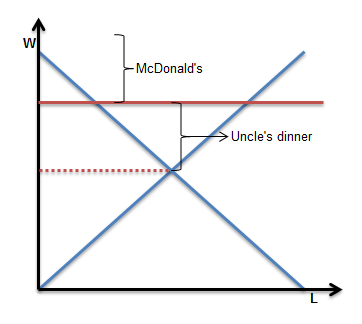
The first reaction is, so what? Why is that a problem? If the issue is to show that an increase of wages above their equilibrium level is going to produce unemployment, all that has to be shown is that this actually happens, not to show where it does not happen. This concern about the Seattle study is missing a key point of the economic analysis of minimum wages. The prediction is that jobs will be lost first among less efficient workers and less efficient employers, not equally across all workers and employers. More efficient employers may be able to absorb a larger share of the wage increase, to cut compensations, delay the lay-offs, etc. This is seen by the fact that demand is downward sloping and that a minimum wage above its equilibrium level “cuts” demand in two. Some employers are below the minimum wage (the less efficient ones) and others are above the minimum wage (the more efficient ones.) Let’s call the former “Uncle’s diner” and the latter “McDonald’s.” This how it is seen in a demand and supply graph:

minimum wage

Surely, there is some overlapping. But the point that this graph is making is that looking at the effects minimum wage above the red line is looking at the wrong place. A study that is looking for the effect on employment needs to be looking at what happens with below the red line. This sample, of course, has less information available than fast food chains such as McDonald’s; this is a reason why some studies focus on what can be seen even if the effect happens in what cannot be seen (and this is a value added of the Seattle study.)

This is why it is important to ask: “what do minimum wage advocates expect to find by increasing the sample size?” To question that minimum wages increase unemployment, then the critics also needs to focus on the “Uncle’s diner” part of the demand curve. If the objective is to inquire about something else, than that has no bearing on the fact that minimum wage increases do produce unemployment in the minimum wage market and at the less efficient (and harder to gather data) portion of it first.

PS: I have a previous post on minimum wages that can be found here.

More simple economic truths I wish more people understood

There are only four ways to spend money:

  1. You spend your money with yourself.
  2. You spend your money with others.
  3. You spend other’s money with yourself.
  4. You spend other’s money with others.

Just think about it for one second and you will agree: these are the only possible ways to spend money.

The best way to spend money is to spend your money with yourself. The worst is when you spend other’s money with others.

When you spend your money with yourself, you know how much money you have and what your needs are.

When you spend your money with others, you know how much money you have but you don’t know as well what other’s needs are.

When you spend other’s money with yourself you know your needs but you don’t know how much money you can actually spend. In a situation like this, some people will shy away from spending much money (when they actually could) and will end up not totally satisfied. Other people will have no problem like that and will spend as crazy, not noticing that they are spending too much. It doesn’t matter what kind of person you are: the fact is that this is not a good way to spend money.

When you spend other’s money with others you have the worst case scenario: you don’t know other’s needs as well as they know and you also don’t have a clear grasp of how much money you can actually spend.

In a true liberal capitalist society, the majority of the money is spent by individuals on their own needs. The more a society drifts away from this ideal, the more people spend money that is not actually theirs on other people. The more money is misused.

The government basically spend money is not theirs on other people. That’s why government spending is usually bad. Even the most well-meaning government official, more in line with your personal beliefs, will probably not spend your money as well as you could yourself.

Rent-Seeking Rebels of 1776

Since yesterday was Independence Day, I thought I should share a recent piece of research I made available. A few months ago, I completed a working paper which has now been accepted as a book chapter regarding public choice theory insights for American economic history (of which I talked about before).  That paper simply argued that the American Revolutionary War that led to independence partly resulted from strings of rent-seeking actions (disclaimer: the title of the blog post was chosen to attract attention).

The first element of that string is that the Americans were given a relatively high level of autonomy over their own affairs. However, that autonomy did not come with full financial responsibility.  In fact, the American colonists were still net beneficiaries of imperial finance. As the long period of peace that lasted from 1713 to 1740 ended, the British started to spend increasingly larger sums for the defense of the colonies. This meant that the British were technically inciting (by subsidizing the defense) the colonists to take aggressive measures that may benefit them (i.e. raid instead of trade). Indeed, the benefits of any land seizure by conflict would large fall in their lap while the British ended up with the bill.

The second element is the French colony of Acadia (in modern day Nova Scotia and New Brunswick). I say “French”, but it wasn’t really under French rule. Until 1713, it was nominally under French rule but the colony of a few thousands was in effect a “stateless” society since the reach of the French state was non-existent (most of the colonial administration that took place in French North America was in the colony of Quebec). In any case, the French government cared very little for that colony.   After 1713, it became a British colony but again the rule was nominal and the British tolerated a conditional oath of loyalty (which was basically an oath of neutrality speaking to the limited ability of the crown to enforce its desires in the colony). However, it was probably one of the most prosperous colonies of the French crown and one where – and this is admitted by historians – the colonists were on the friendliest of terms with the Native Indians. Complex trading networks emerged which allowed the Acadians to acquire land rights from the native tribes in exchange for agricultural goods which would be harvested thanks to sophisticated irrigation systems.  These lands were incredibly rich and they caught the attention of American colonists who wanted to expel the French colonists who, to top it off, were friendly with the natives. This led to a drive to actually deport them. When deportation occurred in 1755 (half the French population was deported), the lands were largely seized by American settlers and British settlers in Nova Scotia. They got all the benefits. However, the crown paid for the military expenses (they were considerable) and it was done against the wishes of the imperial government as an initiative of the local governments of Massachusetts and Nova Scotia. This was clearly a rent-seeking action.

The third link is that in England, the governing coalitions included government creditors who had a strong incentives to control government spending especially given the constraints imposed by debt-financing the intermittent war with the French.  These creditors saw the combination of local autonomy and the lack of financial responsibility for that autonomy as a call to centralize management of the empire and avoid such problems in the future. This drive towards centralization was a key factor, according to historians like J.P. Greene,  in the initiation of the revolution. It was also a result of rent-seeking on the part of actors in England to protect their own interest.

As such, the history of the American revolution must rely in part on a public choice contribution in the form of rent-seeking which paints the revolution in a different (and less glorious) light.

Algeria: a sparse memory

In 1962, France and the Algerian nationalists came to an agreement about Algerian independence. That was after 130 years of French colonization and eight years of brutal war including war against civilians. I participated in the evacuation of large number of French civilians from the country as a little sailor. The number who wanted to leave was much greater than anyone expected. It was too bad that they left in such large numbers. It was a pity for all concerned. The events were a double tragedy or a tragedy leading to a tragedy. The Algerian independence fighters who had prevailed by shedding quantities of their blood were not (not) Islamists. In most respects, intellectually and otherwise, they were a lot like me.

The true revolutionaries were soon replaced however by professional soldiers that I think of as classical but fairly moderate fascists. I went back to Algeria six years after independence. I was warmly received and I liked the people there. People invited me to lunch; I shared with them the fish I caught and a baby camel tried to browse my hair in a cafe.

I still think the nationalists were on the right side of the argument but I miss Algeria nevertheless. It’s like a divorce that should not have happened. And I am very sorry about where French incompetence and rigidity led everyone, especially the Algerians who keep migrating to France in huge numbers because they can’t find what they need at home.

The Deleted Clause of the Declaration of Independence

As a tribute to the great events that occurred 241 years ago, I wanted to recognize the importance of the unity of purpose behind supporting liberty in all of its forms. While an unequivocal statement of natural rights and the virtues of liberty, the Declaration of Independence also came close to bringing another vital aspect of liberty to the forefront of public attention. As has been addressed in multiple fascinating podcasts (Joe Janes, Robert Olwell), a censure of slavery and George III’s connection to the slave trade was in the first draft of the Declaration.

Thomas Jefferson, a man who has been criticized as a man of inherent contradiction between his high morals and his active participation in slavery, was a major contributor to the popularizing of classical liberal principles. Many have pointed to his hypocrisy in that he owned over 180 slaves, fathered children on them, and did not free them in his will (because of his debts). Even given his personal slaves, Jefferson made his moral stance on slavery quite clear through his famous efforts toward ending the transatlantic slave trade, which exemplify early steps in securing the abolition of the repugnant act of chattel slavery in America and applying classically liberal principles toward all humans. However, this very practice may have been enacted far sooner, avoiding decades of appalling misery and its long-reaching effects, if his (hypocritical but principled) position had been adopted from the day of the USA’s first taste of political freedom.

This is the text of the deleted Declaration of Independence clause:

“He has waged cruel war against human nature itself, violating its most sacred rights of life and liberty in the persons of a distant people who never offended him, captivating and carrying them into slavery in another hemisphere or to incur miserable death in their transportation thither.  This piratical warfare, the opprobrium of infidel powers, is the warfare of the Christian King of Great Britain.  Determined to keep open a market where Men should be bought and sold, he has prostituted his negative for suppressing every legislative attempt to prohibit or restrain this execrable commerce.  And that this assemblage of horrors might want no fact of distinguished die, he is now exciting those very people to rise in arms among us, and to purchase that liberty of which he has deprived them, by murdering the people on whom he has obtruded them: thus paying off former crimes committed against the Liberties of one people, with crimes which he urges them to commit against the lives of another..”

The second Continental Congress, based on hardline votes of South Carolina and the desire to avoid alienating potential sympathizers in England, slaveholding patriots, and the harbor cities of the North that were complicit in the slave trade, dropped this vital statement of principle

The removal of the anti-slavery clause of the declaration was not the only time Jefferson’s efforts might have led to the premature end of the “peculiar institution.” Economist and cultural historian Thomas Sowell notes that Jefferson’s 1784 anti-slavery bill, which had the votes to pass but did not because of a single ill legislator’s absence from the floor, would have ended the expansion of slavery to any newly admitted states to the Union years before the Constitution’s infamous three-fifths compromise. One wonders if America would have seen a secessionist movement or Civil War, and how the economies of states from Alabama and Florida to Texas would have developed without slave labor, which in some states and counties constituted the majority.

These ideas form a core moral principle for most Americans today, but they are not hypothetical or irrelevant to modern debates about liberty. Though America and the broader Western World have brought the slavery debate to an end, the larger world has not; though countries have officially made enslavement a crime (true only since 2007), many within the highest levels of government aid and abet the practice. 30 million individuals around the world suffer under the same types of chattel slavery seen millennia ago, including in nominal US allies in the Middle East. The debates between the pursuit of non-intervention as a form of freedom and the defense of the liberty of others as a form of freedom have been consistently important since the 1800’s (or arguably earlier), and I think it is vital that these discussions continue in the public forum. I hope that this 4th of July reminds us that liberty is not just a distant concept, but a set of values that requires constant support, intellectual nurturing, and pursuit.

For more underrecognized history surrounding the founding of America, see my Before the Fourth series!

Adam Smith on the character of the American rebels

They are very weak who flatter themselves that, in the state to which things have come, our colonies will be easily conquered by force alone. The persons who now govern the resolutions of what they call their continental congress, feel in themselves at this moment a degree of importance which, perhaps, the greatest subjects in Europe scarce feel. From shopkeepers, tradesmen, and attornies, they are become statesmen and legislators, and are employed in contriving a new form of government for an extensive empire, which, they flatter themselves, will become, and which, indeed, seems very likely to become, one of the greatest and most formidable that ever was in the world. Five hundred different people, perhaps, who in different ways act immediately under the continental congress; and five hundred thousand, perhaps, who act under those five hundred, all feel in the same manner a proportionable rise in their own importance. Almost every individual of the governing party in America fills, at present in his own fancy, a station superior, not only to what he had ever filled before, but to what he had ever expected to fill; and unless some new object of ambition is presented either to him or to his leaders, if he has the ordinary spirit of a man, he will die in defence of that station.

Found here. Today, many people, especially libertarians in the US, celebrate an act of secession from an overbearing empire, but this isn’t really the case of what happened. The colonies wanted more representation in parliament, not independence. London wouldn’t listen. Adam Smith wrote on this, too, in the same book.

Smith and, frankly, the Americans rebels were all federalists as opposed to nationalists. The American rebels wanted to remain part of the United Kingdom because they were British subjects and they were culturally British. Even the non-British subjects of the American colonies felt a loyalty towards London that they did not have for their former homelands in Europe. Smith, for his part, argued that losing the colonies would be expensive but also, I am guessing, because his Scottish background showed him that being an equal part of a larger whole was beneficial for everyone involved. But London wouldn’t listen. As a result, war happened, and London lost a huge, valuable chunk of its realm to hardheadedness.

I am currently reading a book on post-war France. It’s by an American historian at New York University. It’s very good. Paris had a large overseas empire in Africa, Asia, Oceania, and the Caribbean. France’s imperial subjects wanted to remain part of the empire, but they wanted equal representation in parliament. They wanted to send senators, representatives, and judges to Europe, and they wanted senators, representatives, and judges from Europe to govern in their territories. They wanted political equality – isonomia – to be the ideological underpinning of a new French republic. Alas, what the world got instead was “decolonization”: a nightmare of nationalism, ethnic cleansing, coups, autocracy, and poverty through protectionism. I’m still in the process of reading the book. It’s goal is to explain why this happened. I’ll keep you updated.

Small states, secession, and decentralization – three qualifications that layman libertarians (who are still much smarter than conservatives and “liberals”) argue are essential for peace and prosperity – are worthless without some major qualifications. Interconnectedness matters. Political representation matters. What’s more, interconnectedness and political representation in a larger body politic are often better for individual liberty than smallness, secession, and so-called decentralization. Equality matters, but not in the ways that we typically assume.

Here’s more on Adam Smith at NOL. Happy Fourth of July, from Texas.

The Behavioural Economics of the “Liberty & Responsibility” couple.

The marketing of Liberty is enclosed with the formula “Liberty + Responsibility.” It is some sort of “you have the right to do what you please, BUT you have to be responsible for your choices.” That is correct: the costs and profits enable rationality to our decisions. The lack of the former brings about the tragedy of the commons outcome. In a world where everyone is accountable for his choices, the ideal of liberty as absence of arbitrary coercion will be delivered by the resulting structure of rational individual decisions limiting our will.

The couple of Liberty and Responsibility is right BUT unattractive. First of all, the formula is not actually “Liberty + Responsibility,” but “Liberty as Absence of Coercion – What Responsibility Takes Away.” The latter is still right: Responsibility transforms negative liberty as “absence of coercion” into “absence of arbitrary coercion.” The problem remains a matter of marketing of ideas.

David Hume is a strong candidate for the title of “First Behavioural Economist,” since he had stated that it is more unpleasant for a man to have the unfulfilled promise of a good than not having neither the good nor the promise of it. The latter might be a desire, while the former is experienced as a dispossession. The couple “Liberty – Responsibility” dishes out the same kind of deception.

It is like someone who tells to you: “do what you want, enjoy 150% of Liberty”; and suddenly, he warns you: “but wait! You know there’s no such thing as a free lunch, if you are 150% free, someone will be 50% your slave. Give that illegitimate 50% of freedom back!” And he will be -again- right: being responsible makes everybody 100% free. Right – albeit disappointing.

Perhaps we should restate the formula the other way around: “Being 100% responsible for your choices gives you the right to claim 100% of your freedom.” Only a few will be interested in being more than 100% responsible for anything. But if it happens that someone is expected to deal alone with his own needs, at least he will be entitled to claim the right to his full autonomy.

The formula of “Responsibility + Liberty” is associated with the evolutionist notion of liberties, which means rights to be conquered, one by one. Being responsible and then free means that Liberty is not an unearned income to be neutrally taxed. It is not a “state of nature” to give in exchange for civilization, but a project to grow, a goal, a raison d’etre.

Putting first Responsibility and then Liberty determines a curious outcome: you are consciously free to choose the amount of freedom you are really willing to enjoy. Markets and hierarchies are, then, not antagonistic terms, but structures of cooperation freely consented. Moreover, what we trade are not goods, not even rights on goods, but parcels of our sphere of autonomy.

Mexicans in Mexico

I just spent another two weeks in Mexico, in Puerto Vallarta to be specific, a town pretty much invented by Liz Taylor and Richard Burton. (See the movie “Night of the Iguana.”) The more time I spend in Mexico, the more I like Mexicans. I may have to repeat myself here.

Mexican cities are clean because people sweep in front of the their doors every morning without being told. Everybody there works or is seeking hard to work. Everybody is polite and friendly. One exception: an older taxi driver showed some discrete ill humor with me. I had mistakenly given him 15 cents (American) for a tip. That’s it. Every other interaction I had was gracious or better. (It’s true that my Spanish is good and that I was accompanied most of the time by my adorable 8 year-old granddaughter modeling a broad-brim straw hat.)

Every time I am in Mexico, I notice something new. This time, I was there during the summer vacation period and Mexicans from the US were numerous and very visible. They come to Mexico to kiss old grandpa and grandma, in one case, to get married, and to a large extent, for a vacation, like everyone else. They tend to be loud and better dressed than the locals. They are brisk consumers who buy their children the best beach equipment and all the tours available, like new consumers often do. Many are garrulous and strike up a conversation with strangers easily. They know their place in the sun. I may be dreaming but I think there is something distinctively American about them.

I also bumped into a surprisingly large number of “returnees for good,” including several who got stuck on the southern side of the southern border. Many more lived in the US (legally or not, we don’t often talked about that), made their pile, and took their savings and deliberately started life anew in the old country. One bought two taxis, several built houses, another acquired a ranch where some of his less urbanized relatives live and make a living. He mentioned cows, of course, but also horses. There is a whole program of upward mobility in the simple word “horses.” Unless you have a dude ranch (unknown in Mexico, I think), horses are only for recreation. Manuel, back from short-order cooking in Los Angeles, can even afford to have his children ride. All those brief Mexican acquaintances speak well of the US; they are proud of their stay in this country but they are happy to be back in Mexico for good. In 2009, my co-author Sergey Nikiforov and I had already stated about Mexican immigrants that Mexicans, by and large, would rather live in Mexico. (“If Mexicans and Americans could cross the border freely.” [pdf])

Returnees play all kinds of bridge roles where their American experience is useful. The main “client relations specialist” in my hotel was a 23 year-old guy who had been brought up (illegally) in Colorado. Of course, his English is perfect. Soon, he will open his own business, I think.

I don’t want to give the impression that the returnees’ fate is merely to serve the needs of American tourists and visitors. It seems to me that, like many bilingual people who have lived in more than one country, they are naturally cosmopolitan types who are useful in many non-domestic business situations. (I have modest qualifications to pass judgment here because I taught international business at an elementary level for 25 years. I also worked as a consultant in that field for several years.)

The average literate Mexican is an avid student of Americana. With the help of returnee relatives, he may actually excel there. Everyone below 30 in Mexico is studying English. I have said it before: in a few years, we will be begging them to come back.

Surprisingly little talk about “the wall.” Mexicans have a sense of humor. Of course, I, myself, believe that Pres. Trump will succeed. He will build a solar electricity-producing wall, sell the electricity to Mexicans at low cost (thus making them pay for the wall) and they will thank him!