A quick rant on NY’s Excelsior Scholarship

Long Island Business News had a cover story last week: “Free for all?

And the answer is no.

NoL readers don’t need to be reminded that there ain’t no such thing as a free lunch. But I want to focus on the “for all” aspect. And the answer there is also no. This is a program that benefits the middle class and simply won’t be available for the poorest kids in the state.

There are a lot of different programs for paying for schooling costs, and I don’t want to get bogged down in specifics. So here’s (roughly) how this new program works: full time students whose family income is below (approximately) the 75th percentile get more money for school. That money goes away if they stop meeting those criteria.

This is not going to be helpful to poor students who don’t have to resources necessary to go to school full time. It sounds inclusive, but they might as well make the income requirement family income between the 60th and 75th percentile.

In the best case scenario, we might end up getting a positive return on this program (generating more tax revenues from more productive workers). But we still have to ask about what alternatives were possible.

Here are three problems with that outcome:

  1. If those kids were going to go to school anyways, then we’re just creating a common pool problem where costs and benefits aren’t compared by the relevant decision makers.
  2. If some of those kids weren’t going to go to school otherwise, then we’ve increased the pressure on poor kids to get a college degree without helping them out. And if we’re thinking of this like an investment, the returns would be higher on getting more poor kids to go through school.
  3. If this program doesn’t have a return on investment high enough to offset the costs, then that budget line has to compete with some other program (tax returns would be nice, or investment in infrastructure, or something else).

I don’t expect any legislation to solve the problem once and for all. But this program is more likely to make the underlying problems worse, at the expense of poor people, and with little net gain. Not only is this bad economics, it’s not even in line with the more honorable goals of progressives. It’s simply a way for politicians to buy votes with other people’s money.

On Nancy MacLean’s Thesis

Nancy MacLean’s Democracy in Chains continues to yield surprises. Just a few days ago, Phil Magness now shows a “typo” that plays a significant role in MacLean’s thesis.

Despite all these detailed scrutiny of her work, it is not clear that MacLean understand the type of error is being pointed out about her book. There are two types of errors regarding a thesis: (1) the thesis is correctly defined, but the proof is flawed, or (2) the thesis is incorrectly defined, in which case there is no need to test the thesis. What MacLean and her supporters don’t seem to realize is that Democracy in Chains is built on the second error, not on the first one. Instead of ignoring her critics, MacLean should be up to the academic game and engage accordingly. Her behavior is very telling. If her research is so solid, what’s the problem?

Consider he following example. Let’s say you find a book built on the thesis that Milton Friedman was a french communist who lived in the 18th century. You don’t need to read this book to know that the author is wrong on her argument. This book on Friedman is both factually (Friedman did not live in the 18th century and was not French) and theoretically (Friedman was not a communist) wrong. This is how wrong MacLean’s thesis on Buchanan is for anyone with some minimal exposure to his work and Public Choice.

There a few reasons why someone would still read Democracy in Chains. For instance, if the book is a preach to the choir To try to understand how such a misguided thesis can actually be supported by by an author with so little knowledge and expertise on Buchanan and Public Choice. Etc. But a reason why MacLean thinks that their critics are unwilling to consider her thesis is because she is unaware her error is the second one mentioned above. Her thesis is just wrong from the go.

White Supremacists

“White supremacy” has become a central part of the left’s narrative. In an hour and a half of casual news watching on television in early October 2017, for example, I heard three references to white supremacy. That’s more than I did in the decade 2005 to 2015, I believe.

One utterance came from the sports channel ESPN’s African-American commentator Jemele Hill who called president Trump a “white supremacist.” She added that he surrounded himself with white supremacists. Perhaps, by implication of the term “surround,” she meant several millions of his 63 million voters, or even all of them. This kind of verbal hysteria is not new and neither are intemperate television commentators but, in the recent past, such breathless declarations would have been laughed out of the park or negatively sanctioned, or both. Not anymore. Ms Hill’s statement was not exactly an isolated incident either.

In the first two weeks of October 2017, I hear the word “supremacist” on radio or television at least once a day. I am sure it has not happened before in my fifty years in this country (as an immigrant). This new tolerance makes some sense in political context.

For the inconsolable of Pres. Trump’s election, I suspect – but I don’t know for a fact – that the claim is by way of passing the baton at a time when the investigation on “Russian collusion” to elect him, now in its thirteenth month, is going nowhere. If he did not betray the country, what can we accuse him of that’s difficult for decent minded people to forgive, they ask? Digging into this country’s complex and troubled past is always a good bet if you are looking for dirt to throw at an American.

Mr Trump’s own intemperate comments – although never directed at the usual African-Americans targets of real supremacists – helped identify a valuable, superficially semi-plausible charge. The sudden emergence in the collective consciousness of unhappy young white Americans on the occasion of the 2016 election also contributed. (“…in the collective consciousness…;” they were around before that.) Unhappy young whites can but with little effort be turned into the racist rednecks of countless movies. Thus, the white supremacy narrative may be part of a half-blind collective endeavor to discredit for the long term the social forces thought to be associated with the sensational defeat in 2016 of a moderate liberal (and a feminist to boot; more on this below).

My first impression of the reality of a white supremacist movement, based on reading and listening to radio – including National Public Radio – about five days a week, besides watching television, is that there isn’t actually much going on nationwide in this respect. Yet, I am mindful of the fact that I live in “progressive” Santa Cruz, in liberal California. In neither place would one expect to bump casually into white supremacists. And if there were one, he would probably just clench his teeth and keep his mouth shut. In lily-white Santa Cruz, on the contrary, a black supremacist would probably be elected mayor on the first try without really campaigning. (OK, I may be exaggerating a little, here.)

I realize also that my reading habits as a conservative may not lead to chance encounters with supremacist tripe.* So, I wonder: What’s the actual situation? To try and explore this question more deeply, I use a two-step strategy. I look first for existing credible empirical reports on the topic. Second, I look for what should be the products of white supremacist groups, the tracks they should logically be expected to leave on the internet and elsewhere. But first, a brief historical detour. Continue reading

Markets for Secrets?

In a world without intellectual property, would it be possible to buy and sell secrets? I suggest the answer is yes. In this post, I provide both a theoretical framework for such markets, as well as pointing to real life examples of such markets already existing.

Introduction

In a previous post, we talked about why information is the only public good. But of course, it’s possible to keep information private. Such private information is called a secret. Currently, entrepreneurs and inventors have two choices when they have what they believe is a profitable secret: they can either keep recipe, industrial process, or so on, a secret, and be protected by “trade secret” laws; or they can “publicize” their secret in exchange for a patent (which they can use to either issue injunctions against competitors or to extract royalties).

But there has been a lot of economics literature in recent years that challenges the status of intellectual property (IP). Most famously, there is Michele Boldrin and David K. Levine’s book Against Intellectual Monopoly, where they detail both an empirical and theoretical case against the economics of intellectual property. Furthermore, patent lawyer Stephan Kinsella’s book Against Intellectual Property gives a principled legal and ethical case against IP.

Continue reading

How fast does populism destroy economic freedom in Latin America?

The turn of the twentieth century has seen an increase in populist government in Latin America. That populism is no friend of free markets is well known. And even if their movement against free markets if fairly quick, it is common for individuals to loose track of how fast they are loosing their economic freedoms.

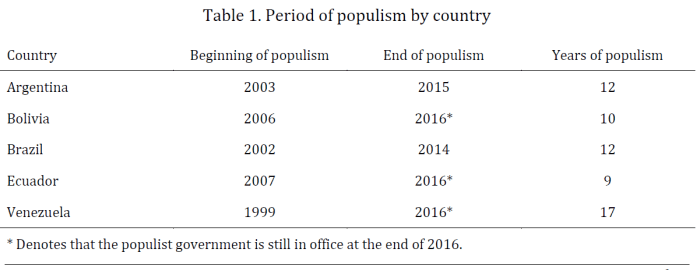
There are five cases of populist governments in Latin America that can work as benchmarks for the region. In particular, we can look at the behavior of governments in Argentina, Bolivia, Brazil, Ecuador, and Venezuela for the time frames depicted in the following table.

Table 1

During this time period, populist governments failed to increase GDP per capita consistently faster than the region. The only exception is Argentina. But its fast increase in GDP is largely explained as recovery after the 2001 crisis and by consuming capital stock, not as an expansion of potential output. It is no accident that Argentina met stagflation in 2007. In the last three issues of the Economic Freedom of the World (Fraser Institute) Argentina ranks among the bottom 10 free economies in the world.

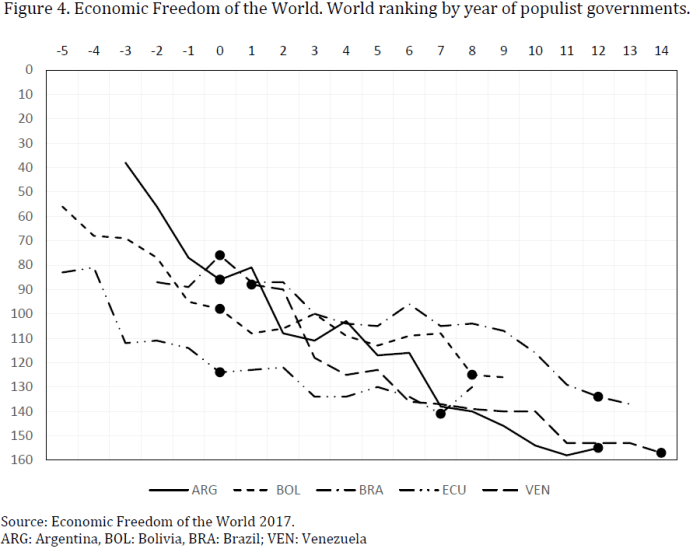
The following figure shows the fall in ranking of each country in the Economic Freedom of the World.

Figure 1

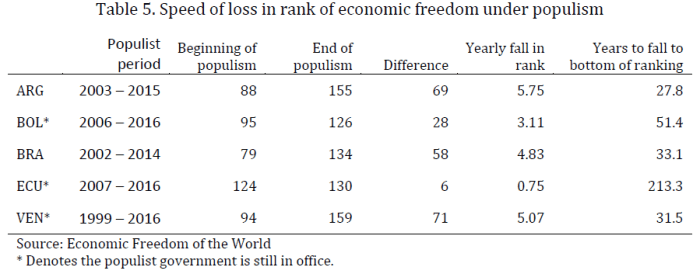
We can translate the information shown in the above into loss of ranking position per year of populist government. This is what is shown in the next table.

Table 2

This table offers a few readings:

  1. Argentina is the country that fall in the ranking of economic faster than its peers.
  2. Ecuador shows a very slow fall. This is due to two reasons: (1) Ecuador already starts from a low ranking position. (2) The last year of the index (2015) shows an improvement (without this improvement the fall is quite sharp as well.) Ecuador does not represent a case of “good populism.”

What this table is showing is that if an individual is born in any of these countries ranking 1st in economic freedom the same year a populist government takes office, then the same country will rank at the bottom of the world before he retires. In the case of Argentina, in 27.8 years the country will be at the bottom of the list, this means that by the time this individual starts to work, Argentina will already have a very repressed economy. By retiring time, this individual will have no experience of living and working in a free economy.

This numbers are not just descriptive of populism in Latin American countries. They also serve as a sort of warning for Europe and the United States, regions that have already seen some signs of populist behavior in their governments and political groups in the last few years. Populism can be emotionally attractive, but is very dangerous for our economic freedoms.

Physical Goods, Immaterial Goods, and Public Goods

Public goods in economics have been a contentious theoretical issue since Paul Samuelson introduced the concept in 1954. The main sources of contention are what real world things are public goods, and who should provide them. In this post I propose a new way of looking at goods that will shed light on why public goods have posed such a problem. In particular, I propose that there is an important distinction between physical goods and immaterial goods; that public goods can only be immaterial goods; and that this unique feature of public goods does not preclude the market to provide the “socially optimal level.

Introduction

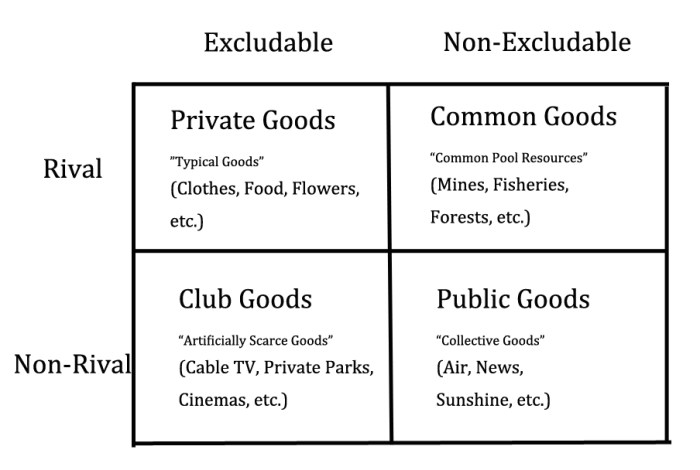
Economists define a public good as something that is “non-rival” (meaning that one person’s consumption does not affect another person’s), and “non-excludable” (meaning that one person cannot stop another person from consuming the good.) Public goods are often contrasted with private goods, which are rival and excludable.

The implications are that public goods cannot be provided by a free market, because no one would have to pay for such a good, and so there would be so incentive to produce it. Therefore, the argument goes, the government ought to provide public goods.

Features_of_goods

An example of a private good is an apple. Imagine a world with just you, me, and an apple. If I take a bite out of the apple, there is now less apple for you to consume. That means it’s rival. If I put the apple in a locker to which only I know the combination, then again you are prevented from consuming the apple. This makes it excludable.  Continue reading

Sunday reading: Bertrand Russell

We have a lot of fresh faces in my philosophy club this semester. On one hand, the new perspectives remind our old heads about some of the basic questions we studied when we first arrived at university, and it’s nice to introduce new students to philosophy; on the other, it makes us behave like a wolf pack, moving at the pace of the slowest member. Sometimes, I want to be an elitist and focus on more complex areas, utilizing the knowledge of our most experienced members. This would mean we lose all of our new members. Ultimately, semester after semester, keeping a high membership (and keeping students participating) always proves to be more important.

This fall I assigned Bertrand Russell’s Problems of Philosophy, as an easy intro text. As he introduces ideas, he injects his own interpretations and potential solutions, and I find I usually disagree with him. However, Russell is great at moving between analytic argument and simple, digestible prose, so I started seeking his other writing out, as one of the canonical popularizers. Here is an essay I thought I’d share, on his meeting with Lenin, Trotsky and Maksim Gorky, when, as a self-identified Communist seeking out the new post-capitalist order, he inadvertently ended up completely disillusioned with the “Bolshevik religion.” He would publish The Practice and Theory of Bolshevism shortly after in 1920, condemning the historical materialist philosophy and system he saw just three years after the October Revolution.

Russell remained somewhere between a social democrat and a democratic socialist throughout his life (e.g., his 1932 “In Praise of Idleness” on libcom.org), but a vocal critic of Soviet repression. He was also a devout pacifist, which explains his early infatuation with the Russian political party which advocated an end to WWI. He died of influenza in 1970 after appealing to the United Nations to investigate the Pentagon for war crimes in South Vietnam.

From his article on meeting Lenin:

Perhaps love of liberty is incompatible with wholehearted belief in a panacea for all human ills. If so, I cannot but rejoice in the skeptical temper of the Western world. I went to Russia believing myself a communist; but contact with those who have no doubts has intensified a thousandfold my own doubts, not only of communism, but of every creed so firmly held that for its sake men are willing to inflict widespread misery.

On the Difference between Hayek’s Road to Serfdom and Increasing Central Planning

Once, in another place, I had pointed out the misunderstandings of the common interpretation of Hayek’s road to serfdom thesis. This was not an unintended process by which government intervention on markets inevitably leads to further and increasing interventions. That might be Ludwig v. Mises’ thesis, but not Hayek’s.

What Hayek stated in The Road to Serfdom was that the checks- and-balances system of modern constitutionalism appears as an obstacle to the quick achievement of the concrete ends that an interventionist policy aims for. Thus, the road to serfdom is an unintended process by which legal constitutional processes are eroded by decisions based on expediency.

On that occasion it was left pending to solve the question of where the confusion on the central thesis of “The Road to Serfdom” came from.

The source of the answer to this question is yet Ludwig v. Mises. The Road to Serfdom was first published in 1944, but, previously, in essays published in 1935, we find Hayek, still heavily influenced by L. v. Mises, stating opinions that are very similar to the common confusion about the meaning of the road to serfdom: “In fact, however, if by planning is meant the actual direction of productive activity by authoritative prescription to be used, or the prices to be fixed, it can be easily shown, not that such a thing is impossible, but that any isolated measure of this sort will cause reactions which will defeat its own end, and that any attempt to act consistently will necessitate further and further measures of control until all economic activity is brought under one central authority” (“Socialist Calculation I: The Nature and History of the Problem”, first published in Collectivist Economic Planning, London,  1935, and reprinted in Individualism and Economic Order, Chicago, 1948).

F. A. Hayek did not change his opinions of 1935 in The Road to Serfdom (1944), he just shifted the realm of his inquiry from economics to political philosophy. Nevertheless, it would be a crass error to judge Hayek’s political and legal theory -for good or for bad- using his former opinions as an economist.

Lunchtime Links

  1. Interview with a secessionist
  2. Ducking questions about capitalism
  3. The perverse seductiveness of Fernando Pessoa
  4. Yet in this simple task, a doffer in the USA doffed 6 times as much per hour as an adult Indian doffer.”
  5. Conflicted thoughts on women in medicine
  6. The Devil You Know vs The Market For Lemons (car problems)

A short note on the Holy Roman Empire, “democracy,” and institutions

At the heart of Europe […] lay a hugely complex and fragmented political entity which resisted the ‘modernizing’ trend of national state formation, and preserved medieval arrangements conceived as rooted in antiquity: the Holy Roman Empire. After three decades of bloodshed retrospectively known as the Thirty Year War (1618-1648), the Empire had achieved a somewhat precarious equilibrium in which hundreds of semi-autonomous imperial estates co-existed under the loose authority of an emperor and a college of princes. Disparaged as a multi-headed monster by many […,] for Leibniz the Holy Roman Empire remained a preferable alternative to national and absolutist states. In his mind, the Empire offered an ideal of shared sovereignty in which limited territorial autonomy could be combined with a central imperial authority, and the main Christian confessions could cohabit peacefully in a balanced, representative Reichstag. Alongside his more famous works on logic, metaphysics, and mathematics, Leibniz wrote innumerable memos and proposals advising rulers on how to strengthen and re-order the Empire into a stable, supra-national political structure which could protect and promote common interests while maintaining local self-determination in territories and imperial free cities. In short, Leibniz regarded political unity in diversity under a supra-national authority as a better path to peace, prosperity, and stability in Europe than the ascendancy of competing national states.

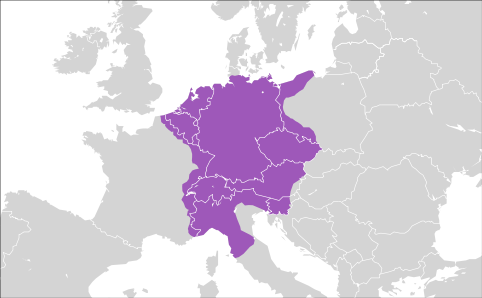
This is from Maria Rosa Antognazza, a philosopher at King’s College London, writing for Oxford University Press’s blog.  (h/t Barry) Check out this map of the outline of the Holy Roman Empire in 1600 AD (it is superimposed onto the outlines of today’s European states):

blog-holy-roman-empire-1600
(source)

It reminded me of this map I produced a couple of years ago showing the GDP (PPP) per capita of administrative units in Europe. What the map illustrates, generally, is a Europe where present-day Austria, western Germany, northern Italy, Switzerland, and Benelux are much wealthier than the rest of Europe (sans Scandinavia).

And here is a map, thanks to Vincent, of GDP per capita in European regions. What his map illustrates, generally, is a Europe where present-day Austria, western Germany, northern Italy, Switzerland, and Benelux are much wealthier than the rest of Europe (sans Scandinavia).

Wow, right? Eastern Germany, Poland, and Czech Republic are poor today, but the rest of what was once the Holy Roman Empire is very prosperous. So, two lines of thought here. One, socialism is really bad for people. It not only destroys economies and political and civil liberties, it also destroys institutions.

The second line of thought is to wonder aloud a bit more about institutions and their long-term viability. The first question that needs to addressed is “what are institutions?” Today, many scholars use “democracy” and “property rights” as generic answers when explaining to the general public what good institutions are, and they are not wrong, but they don’t do justice to the concept of democracy (or property rights, for that matter). I think a better term might be “representativeness,” or “constitutionalism,” or “republicanism.” Anything but “democracy.” Democracy implies rule of the people, but this doesn’t describe what has happened in the West, in regards to political equality and economic growth (both are uneven, but undeniably real).

“Democracy” sounds better than “political institutions favoring separation of powers and coalition-building in parliamentary settings, as well as the inclusion of people who don’t pull the levers of statecraft (through the voting mechanism),” but this shorthand has obvious negative unintended consequences: many a demagogue will use the term democracy to mean something quite different from what actual self-governance requires institutionally.

There is more to the Holy Roman Empire than just path dependency (albeit stretched to its limits). For instance, you’d have to explore why representative institutions in the HRE eventually failed. My quick guess would be that HRE’s neighbors (Russian Empire, French Empire, Ottoman Empire, Scandinavian kingdoms) were pretty ruthless and thus made it impossible for more formal constitutional institutions to take deep root and flourish in the heart of Europe. Instead, because of HRE’s unruly neighbors, the Empire was forever in flux between a loose alliance of petty states and a confederation.

What is a “left libertarian”?

I often hear a contrast drawn between “left-” and “right-libertarians.” In fact, I hear it so often, that I have no idea what it could possibly refer to. The history of the word makes it particularly confusing.

The word “libertarian,” prior to, perhaps, the later 20th century, referred to (definitely) left-wing, anarchist philosophies. The point is well-known and harmless. The modern day, American usage of the term refers to a different branch of philosophies, with a common root in classical liberalism. Comparing the left-wing anarchists of old to the Libertarian Party, for instance, would draw an obvious line between left-wing and right-wing politics. There’s nothing wrong or appropriative about this name change. The word “liberal” has also suffered a large definitional change in the United States that it hasn’t in most other countries. It could be argued that most political groups have shifted around under various names, at times co-opting even their ideological opponent’s.

So, “libertarian” to the average joe nowadays means something different than the libertarian socialism espoused by Proudhon or Bakunin. However, it could still be applied; it might just be an anachronism: two very different referents.

Then, for the modern libertarian movement, there again appears a “left” and “right” division. For instance, I hear Cato or the Institute for Humane Studies regarded as left-libertarian, and the Mises Institute as right-libertarian. Bleeding Heart Libertarians is called left-libertarian. These “left” groups are, however, all clearly in favor of mostly free market capitalism. Then there’s Center for a Stateless Society, which labels itself “pro-market anarchist,” and then, when people confuse it for just, I don’t know, anarcho-capitalism, Kevin Carson says he wants to use the word market instead. Maybe capitalism is too long to spell. In any case C4SS is considered left-libertarian. Michelangelo seems to use the term to refer to, again, capitalism-inclined folks. (I also hear Students for Liberty referred to as left- and Young Americans for Liberty more right-libertarian.)

“Left-libertarians” are not all anarchists intent on abolishing the state, but some are; meanwhile, libertarian socialists would hardly call market anarchism an “anarchism” at all, since they oppose private property rights. If you ask them, they generally seem pretty pissed off about the whole name co-opting. Noam Chomsky is, anyway.

So, it looks like there’s the left libertarians, who may be using an American anachronism, but maintain their philosophical etymology just as classical liberals try to. And then there’s the left-libertarians, who would still fall in the bottom-right of the modern political compass, directly to the left of the right-libertarians. Does that sound right? What is the sense in which a libertarian qua libertarian would use the term “left-libertarian”?

It doesn’t usually seem like libertarians use the term left-libertarian to refer to anarchic socialists, but it sometimes does. Hanging out with Marxists only makes it worse. I’m looking for someone who has been around the liberty movement longer than I have to make sense of it.

Worth a gander

  1. good piece of American sociology by Jeffrey Friedman (h/t Alberto Mingardi)
  2. Daniel Larison on the devastation in Puerto Rico
  3. Don Boudreaux has the best take I’ve read or heard on the Trump-pro athlete fiasco, and remember when conservatives blasted Obama for sticking his nose where it didn’t belong when cops killed a black kid in Baltimore?
  4. Chris Dillow explains Leftist confusion about Brexit
  5. smart Leftists talking about smart things (penguins, of course!)

North Korea at the North Sea?

Yesterday, both Houses of Dutch Parliament jointly opened the parliamentary year, which is always held on the third Tuesday in September, and is known as “Budget Day.” Normally, there is not much pomp and glory in the Low Lands, but on “Little Princes Day” (as the day is literally called), we go all-out: the King and Queen are driven in a horse-pulled carriage to the Hall of Knights, the oldest part of the parliamentary buildings (built around 1250), surrounded by military troops in full ceremonial dress. The King reads his speech (actually written by and under full political responsibility of the Prime Minister and cabinet) from a huge throne, announcing the government’s plans for the next year. Male ministers in morning coats, ladies in dresses and hats, with the powerful elites also assembled.

king and queen
King Willem-Alexander and Queen Maxima entering the Hall of Knights (source)

After the reading, the Royal couple make their way back to one of their palaces in the centre of The Hague, returning once to greet the masses from the balcony.

Meanwhile, the Minister of Finance officially presents the 2018 budget to the Lower House. The separate budgets of all departments are laws, which will have to pass both Houses before 31 December. This process is normally preceded by a two day debate on “the general state of the country,” but this year it is skipped because there is only a caretaker government in office. It awaits the finalization of negotiations for a new government, which started right after the elections on 15 March. Still no government is formed, although it is widely expected that a four-party coalition will be presented within a few weeks, consisting of small Christian left wingers, centre Christian Democrats, and two social liberal parties, D66, and Prime Minister Mark Rutte’s VVD.

Although much improved since the low point of the Great Recession, around 2011-2012, the public finances are still shocking from a classical liberal perspective. The income of the national government is 285 billion Euro (around 338.5 billion USD), which is 43% of GDP.

It consists mainly of several mandatory insurance premiums for collective arrangements (112.2 billion Euro), income tax (55.4 billion; the highest bracket of 51.5% tax applies to all personal income over 68.507 Euro), and VAT (52.8 billion). The rest are mainly specific taxes, related to companies, the environment, excises, dividends, et cetera. In 2011, the public share of GDP was still 47%, while in the 1980s it reached peaks of around 60%. Not exactly anywhere near an ideal liberal situation, no matter what liberal persuasion you are. Personally, I would argue that 25% should be the max for a decent set of state tasks, but I am sure that makes me some weird Northern European commie in some American libertarian eyes!

The situation is even more dire if we see where that money is spent. Health care (80.4 billion euro) and social security (79 billion) are always in competition as the largest spending departments. So that is 56% of the budget already and both increase annually, no matter the economic circumstances. The third post is public education (35.4 billion), followed by funds for provinces and municipalities (24.4 billion), foreign affairs and foreign aid (12), police and judiciary (10.3), defense (8.4), and infrastructure and environment (also 8.4), with the other departments taking parts of the rest. Despite a very rare expected budgetary surplus of 7.8 billion in 2018, the national debt is still 53.7% of GDP. Perhaps not bad in international comparison, still not good for any liberal.

These numbers are only part of the story, because there are also numerous local taxes, and the number of liberty-inhibiting regulations, from European, national, provincial and local origin are staggering. There is not one really free market, and there are hardly parts of individual life not regulated or influenced by the state. A comparison with North Korea is of course still far-fetched, yet socialism is alive and kicking on the North Sea shores.

In my view it is evidence of the remarkable power of capitalism that The Netherlands is still one of the richest countries on earth, a global top 15 economy (GDP per capita), with only 17 million inhabitants. No matter how hard you curb it, the capitalist system still delivers amazing results. Of course, the opportunity costs of the Dutch regulatory state are very high. In terms of personal liberty there are not many better places on the planet. Yet in other fields it is a different story. Economic freedom is a mess, which means that the material aspects of personal freedom are seriously restricted. Yet the worst is the mentality. Sadly, most Dutch have traveled the whole Hayekian Road to Serfdom, making a shift to classical liberalism highly unlikely.

On Financial Repression and ♀ Labor Supply after 1945

I just came back from the Economic History Association meeting in San Jose. There are so many papers that are worth mentioning (and many have got my brains going, see notably the work of Nuno Palma on monetary neutrality after the “discovery” of the New World). However, the thing that really had me thinking was the panel on which one could find Barry Eichengreen and Carmen Reinhart (who was an early echo of the keynote speech by Michael Bordo).

Here’s why : Barry Eichengreen seemed uncomfortable with the current state of affairs regarding financial regulation and pointed out that the after-war period was marked by rapid growth and strong financial regulation. Then, Reinhart and Bordo emphasized the role of financial repression in depressing growth – notably in the period praised by Eichengreen. I have priors that make more favorable to the Reinhart-Bordo position, but I can’t really deny the point made by Eichengreen.

This had me thinking for some time during and after the talks. Both positions are hard to contest but they are mutually exclusive. True, it is possible that growth was strong in spite of financial repression, but some can argue that by creating some stability, regulations actually improved growth in a way that surpassed the negative effects caused by repression. But, could there be another explanation?

Elsewhere on this blog, I have pointed out that I am not convinced that the Thirty Glorious were that “Glorious”.  In line with my Unified Growth Theory inclinations (don’t put me in that camp, but don’t exclude me either I am still cautious on this), I believe that we need to account for demographic factors that foil long-term comparisons. For example, in a paper on Canadian economic growth, I pointed out that growth from 1870 to today is much more modest once we divide output by household-size population rather than overall population (see blog post here that highlights my paper). Later, I pointed out the ideas behind another paper (which I am still writing and for which I need more data, notably to replicate something like this paper) regarding the role of the unmeasured household economy. There, I argued that the shift of women from the household to the market over-measures the actual increase in output. After all, to arrive at the net value of increased labor force participation, one must deduce the value of foregone outputs in the household – something we know little about in spite of the work of people like Valerie Ramey.

Both these factors suggest the need for corrections based on demographic changes to better reflect actual living standards. These demographic changes were most pronounced in the 1945-1975 era – that of the era of rapid growth highlighted by Eichengreen and of financial repression highlighted by Reinhart and Bordo. If these changes were most momentous in that period, it is fair to say that the measurement errors they induce are also largest in that era.

So, simply put, could it be that these were not years of rapid growth but of modest growth that were overestimated?  If so, that would put the clash of ideas between Bordo-Reinhart and Eichengreen in a different light – albeit one more favorable to the former than the latter.

But heh, this is me speculating about where research could be oriented to guide some deeply relevant policy questions.

A photo of Vincent and Michelangelo

Proof that NoL bloggers are living beings. Anyone else have photos of NoL meet ups?