It’s no longer the economy, but we are still stupid

Motivated Reasoning, Public Opinion, and Presidential Approval‘, an interesting new paper forthcoming in the journal Political Behavior (summarized here), by Kathleen M. Donovan, Paul M. Kellstedt, Ellen M. Key, Matthew J. Lebo finds that support for sitting presidents has become increasingly misaligned with national economic expectations. Rather than being a sign of voters realizing that presidents play little role determining economic performance, they attribute this to increased partisan polarization.

I think this is a compelling account. All I would add is a potential causal mechanism. My current favorite dimensions for analyzing democratic trends in the developed world is demography. Voters are ageing. When retired, they tend to have much less direct involvement with the productive economy than when they were working. On average, the elderly are quite rich and living off entitlements they have acquired during their working lives. So they are both less reliant on current economic opportunities and less knowledgeable of them. This means their personal costs of partisanship, relative to good policy, is lower than it used to be. And this is what lets all the culture-war nonsense creep into people’s decision functions.

Further thoughts on the carbon tax.

This post is in response to feedback from my previous post on this topic.


There are no panaceas.

But as abstract ideas go, pollution taxes are pretty appealing. Holding constant lots of things that we can’t really hold constant, it means replacing the inefficiency resulting from poorly defined/enforced property rights with a world where prices more accurately reflect the costs of one’s decisions.

Let me come back to the things we’re “holding” constant in a bit. Why do I want to throw my weight behind shifting public perceptions in favor of pollution taxes?

I think they’re underrated by the median voter. Climate change is just a subsidy paid in the form of worse conditions. But most people (including people who should know better) don’t have a good understanding of the problems caused by subsidies.

Which is not to say a carbon tax isn’t overrated by the median policy wonk. There are a ton of important caveats, but on balance, as a policy for use in the next 50 years, I think they’re a useful tool to enhance efficiency or replace worse tools.

Again, there are no panaceas. I’m also not a huge fan of the “Economists’ Statement on Carbon Dividends” as written (for reasons I’ve hopefully mostly addressed). I suspect the best case scenario for my preferred carbon tax policy would be a modest improvement. I think the bulk of the gain would be a cultural shift away from “let’s regulate our problems!” to “let’s leverage incentives to address our problems!” Not Earth shattering, but a step in the right direction.

So let me state my position, then we can dig into criticisms and caveats.

Let’s make marginal shifts away from taxing investment and towards taxing negative externalities. As we go, let’s spend a lot of effort trying to study the impacts and adjust accordingly. Let’s heavily agument that with abatement policies rather than trying to return to some pre-industrial climate target.

Okay, let’s dig into criticisms and caveats.

  1. Public choice considerations
  2. Geoengineering and other alternatives
  3. Cost
  4. Coordination
  5. Uncertainty

1-Public choice considerations

A Green New Deal will be a rent-seeking bonanza. Pollution taxes will face the same sorts of problems that plague the tax code in general. There will be intentional loop-holes and accidental screw ups.

We have to continue to push for reducing the complexity of tax codes in general. But I can’t deny that a carbon tax would be a step back on this margin.

Minus a hundred points for my position.

2-What about geoengineering?

Geoengineering sounds like a possible panacea. Maybe it is. But I’m not willing to flip a switch and find out the hard way all at once.

First off, geoengineering is scary. The climate is a complex system and complex systems are difficult-impossible to manage well. And that’s especially concerning if it means that anyone with a few million bucks can try to fiddle with Earth’s thermostat.

But it seems like a plausible tool that might be used to address climate change. Similar to my take on a carbon tax, I think the way to go is baby-steps plus research.

What about subsidizing “green _____”

Personally, I’m skeptical. Solar sounds appealing, and I (personally) think windmills are beautiful. But I don’t think the government will do a good job of picking winners and losers. Pollution taxes are appealing to me because they don’t require bureaucrats to choose. Again, I think the way to go is to use pollution taxes to offset other taxes–while continuing to advocate for reduced size/scope of government and a return to federalism.

Plus five points for my position.

3-Cost

We should also remember that GDP is an imperfect measure of well being. The current figures aren’t directly comparable to the figures we’d get in a post-carbon-tax world. A one-time fall in GDP doesn’t (necessarily) mean we’ve screwed things up.

A tax big enough to halt climate change would be incredibly costly. Too big a tax yields a negative net benefit.

Still, it’s worth remembering that a) we can go too far with a carbon tax, and b) we don’t have access to a silver-bullet solution. So let’s start small and gradually increase carbon taxes till we get close to (our best estimate of) the optimal level.

Plus epsilon points for my position.

4-Coordination

The basic idea of a carbon tax is that we’re dealing with a global-scale externality problem. But small scale taxes are unlikely to do much beyond shifting where pollution happens. A fully effective tax would require multi-lateral coordination. And, as a country, we aren’t very good at that.

Trying to create a tax on imported carbon-intensive goods that didn’t face a tax at home seems a) sensible at first blush, and b) a massive opportunity for public choice problems.

On the other hand, we could justify a tax commensurate with the local impacts (something like 10% of the global impact). This fits nicely with my idea of starting small and adjusting at the margin.

But even within the U.S. there are coordination issues. Long Island will likely face net costs from climate change, but other areas will benefit from a longer growing season.

Plus 10 points for my position, but also minus 10 points.

5-Uncertainty

Uncertainty cuts both ways: we’re currently accidentally manipulating the climate and that could turn out to be catastrophic. Trying to intentionally manipulate it in the other direction is also dangerous. Again, the appropriate focus is on marginal tinkering [much as it clashes with my non-interventionist priors] rather than ambitious global engineering [which grabs my priors by the lapels and knees them in the groin].

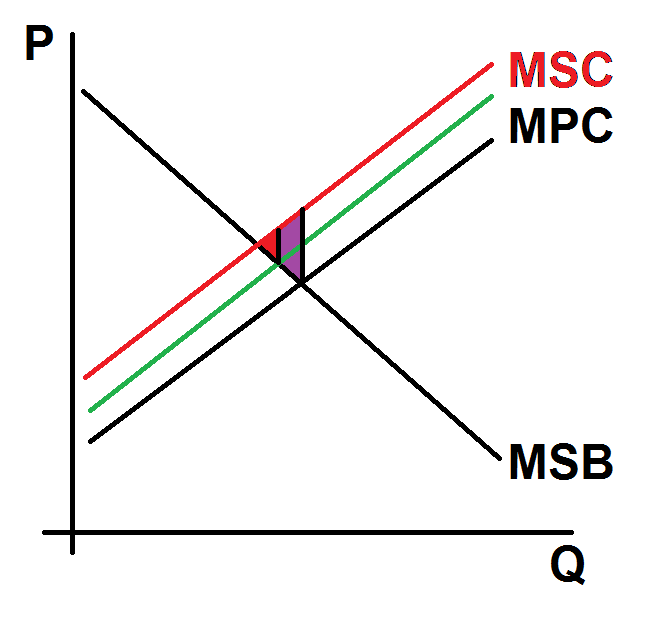
When I teach externalities, I draw a graph like this:

Negative externalities when we magically know their magnitude.

In this market, we end up with an equilibrium quantity defined by the point where Marginal Private Cost equals Marginal Social Benefit (MPC = MSB). But the Marginal Social Cost (MSC) is greater, so we get a deadweight loss equal to the triangle I’ve shaded in red and purple.

It’s important to note: we don’t actually know where the MSC curve is. It’s somewhere above MPC, but we’re basically in the position of trying to eliminate a subsidy we don’t know the size of.

The relevant models–climate models and economic models–are filled with uncertainty that we simply cannot resolve without real life experience.

What does the economic way of thinking tell us? Act on the margin. Setting a tax that pushes supply (MPC) up to the green line doesn’t fully address the problem (as I’ve assumed it to be in this graph), but it’s an improvement.

Even better, it’s an improvement where the biggest returns are experienced up front. This modest tax fails to get rid of the red deadweight loss (DWL) area, but it eliminated 3/4 of the total DWL.

Plus X points for my position where X is a random variable with an unknown distribution, positive first derivative, and negative second derivative.

tl;dr:

At my friend’s behest I’ve been looking at Bob Murphy’s critique of carbon taxes. I find it’s shifted the magnitude of my prior opinion, but not the direction. I still think carbon/pollution taxes are a good idea, but I no longer think they’re a great idea. My take away from Murphy’s work is that the optimal carbon tax is fairly modest. My response is to advocate for getting a very modest carbon tax on the books, then gradually shift tax policy in that direction.

For climate change (and any other problem) we ought to be pluralists. A mix of approaches is ideal. Part of the appeal of Pigouvian taxes is that they allow and encourage a wide range of responses. The best pollution abatement scheme isn’t something we can look up in a binder. We have to discover it, and crowdsourcing is the appropriate way to do that.

But carbon taxes are only one part. We should also advocate for changes that will ameliorate harm. I am more bullish on these policies than I am on a carbon tax:

  • Make it easier for the world’s poorest people to move to rich countries that will be better able to cope with climate change.
  • Quit subsidizing flood insurance.
  • Quit subsidizing polluting industries (and other industries).

Even though geoengineering scares me, we should try to learn more. Ditto for any other possible tools that come along.

The nature of the China-US-Vietnam economic triangle

While addressing a joint press conference in Hanoi, after his summit with North Korean Leader Kim Jong Un, US President Donald Trump spoke not just about the Summit, but also the current state of US-China relations. Trump criticised his predecessors for not doing enough to address the trade imbalance with China, while also making the point that he was all for China’s economic progress and growth, but not at the cost of the US.

If one were to look beyond the Summit in terms of the US-Vietnam economic relations, top US companies – Boeing and General Electric – sealed some important deals.

Given the focus of Trump’s visit (which was the Summit with Kim), perhaps these deals did not draw the attention they ought to have. The fact is that the US has begun to recognise Vietnam’s economic potential, as well as its geopolitical significance in Asia. This long note will give a backgrounder to Vietnam’s economic growth story in recent years, highlight some of it’s key strategic relationships, and then examine the nature of the China-US-Vietnam economic triangle.

Vietnam’s growth story: The key reasons Continue reading

An optimist turns pessimistic

I won an essay contest back in my undergraduate days for an essay on optimism. I understand that poverty worldwide is on the run. I understand that none of us have suffered through a devastating worldwide war like most of our ancestors did. In many ways, we have it good.

But Donald Trump is still President of the United States of America. I still remember waking up to the news that he had beat Hillary Clinton. It was surreal (it didn’t help that I was living Austin, where everything is a bit foggier, brain-wise).

Unlike Jacques, who seems to be so in love with Trump that he would get down on his knees and do whatever Trump wanted him to do, I don’t like Donald Trump. I don’t think he’s done a good job. I don’t even care that the left-leaning press is dishonest when it comes to reporting on his administration. I think this is the difference between libertarians like me, who lean more to the left, and libertarians like Jacques and Bruno, who lean more to the right.

Jacques and Bruno are not really defending the Trump and Bolsonaro administrations. And they’re not really speaking up for these two administrations because they hate leftists more than they like liberty. Guys like Jacques and Bruno care more about Truth than anything else, and the global mainstream media’s narrative skews left and is often dishonest.

Me? I’ve grown accustomed to dishonesty in media. I’ve also grown accustomed to ignorance. I pick and choose which dishonest or ignorant bits I want to challenge. When journalists write or say something about guys like Trump or Bolsonaro that are blatantly wrong, I make a mental note of the dishonest nature of the reporting, but that’s about it. Guys like Trump and Bolsonaro are bad for liberty, after all. I’d rather focus on the mainstream press’ dishonesty when it comes to people like Alexandra Ocasio-Cortez. The fawning over her is at least as concerning as the dishonest portrayals of Trump or Bolsonaro.

Left-wing populism is just as bad as right-wing populism, and everybody in the democratic world is going to be stuck with populism for quite awhile. Truth is on its way out the door, and I don’t know if it’ll be back in my lifetime.

Expression at the polls

Last election, Jillian Ostrewich drove to a polling place at a Houston rec center, expecting to vote. But she made the mistake of wearing a “Houston Fire Fighters” t-shirt. An election worker confronted Jillian, insisting that she couldn’t vote unless she turned the offending shirt inside out. The rationale: a measure on the ballot was related to firefighter pay, and the shirt was related to firefighters.

Tony Ortiz suffered a similar fate in Dallas. Tony’s crime was wearing a MAGA hat while he stood in the voting line outside his local library. An election worker said he couldn’t wear the hat to the polls because the MAGA slogan constituted “electioneering.” Tony responded that the hat had nothing to do with any issue or candidate on the ballot. The election worker threatened to call the police.

These election workers were relying on a Texas law that forbids electioneering or wearing “a badge, insignia, emblem, or other similar communicative device relating to a candidate, measure, or political party appearing on the ballot” in or near a polling place. The law even prohibits someone from wearing an ID if the name is the same as someone appearing on the ballot. A violation is a criminal misdemeanor. Today, my colleagues and I at Pacific Legal Foundation filed a lawsuit on behalf of Jillian and Tony challenging the Texas ban.

As it happens, the Supreme Court issued a decision just last year striking down a similar law in another case brought by Pacific Legal Foundation called Minnesota Voters Alliance v. Mansky. The Minnesota law in MVA prohibited wearing a “political badge, political button, or other political insignia” in the polling place. The Court said states can limit some electioneering at the polling place to prevent voter intimidation and excessive disruption. But the government has to have some clear and logical basis for sifting “what may come in from what must stay out.”

The word “political” was not a clear boundary. As the Court noted, almost anything could be considered political, and the fuzzy language offered too much wiggle room for abuse and discrimination. The attorney arguing for Minnesota drove this point home during an onslaught of blistering questions in oral argument: how about a rainbow flag shirt? Permitted, maybe. How about a “Parkland Strong” shirt? Permitted, probably. How about an NRA shirt? Definite no. How about a shirt with the text of the Second Amendment? Definite no. At about that point, most everyone knew the outcome of the case–the attorney had just proven the inherently arbitrary standard he was trying to defend.

The Texas case filed today is a bit different. For one, the ban extends to 100 feet outside the polling place, which clearly encompasses sidewalks and other public areas where speech rights enjoy their widest berth. But the ban is not quite as amorphous as the word “political.” Instead, the ban extends to messages that relate to a candidate, measure, or party on the ballot.

This slightly narrower language probably doesn’t save the Texas law. After all, almost anything can be considered related to a candidate if the candidate has taken any kind of position on it. If a candidate has criticized Trump (have any not?), then is Tony’s MAGA hat “related” to the candidate? If Ben & Jerry’s takes a position on a ballot measure, does a Ben & Jerry’s shirt relate to that ballot measure? Maybe, but it depends on the election worker–and therein lies the problem. As the Supreme Court said in MVA, “A rule whose fair enforcement requires an election judge to maintain a mental index of the platforms and positions over every candidate and party on the ballot is not reasonable.” Not only would such an index be impossible, but the contents and application of that index would be dictated by an election worker’s own biases and background.

The integrity of the electoral process is vital. But surely Jillian’s firefighter shirt or even the much-reviled MAGA emblem do not imperil the right to vote. Wed don’t shed the right to express ourselves in peaceable ways when we step into a polling line.

A short note on India’s air strikes in Pakistan

Indian Foreign Secretary Vijay Gokhale, while issuing a statement with regard to India’s air strikes on a training camp of the dreaded terror group Jaish-E-Muhammad (JeM) in Pakistan on February 26, 2019, dubbed these as pre-emptive ‘non-military strikes’. The Foreign Secretary stated that the Indian Air Force hit the largest training camp of the JeM, which is in Balakot, Pakistan, and a large number of JeM terrorists were killed in the strike.

The rising tensions between both countries have understandably caught the world’s attention.

JeM had claimed responsibility for the dastardly terror attack in Pulwama, Kashmir, on February 14, 2019 in which over 40 CRPF soldiers were killed. While efforts have been made to designate JeM chief a ‘global terrorist’ at the UN, China has blocked such moves.

The Indian side also made it clear that these air strikes were neither targeted at civilians nor at the Pakistani military. This served two purposes; one it would prevent further escalation and second, it could give some space to Imran Khan’s civilian government.

The international community was quick to react to the attacks by the Indian Air Force (IAF), and asked both sides to de-escalate. The US, while asking Pakistan to take action against terror groups on their soil, also stated that both sides should de-escalate. In a statement issued on February 26, 2019, US Secretary of State Mike Pompeo also asked Foreign Ministers of both countries to resume direct communication and avoid any ‘further military activity’.

A statement issued by the Chinese Foreign Ministry spokesperson also spoke in favour of India and Pakistan exercising ‘restraint’ and the need for peace and stability in South Asia. Even during Sushma Swaraj’s visit to Beijing, a day after the strikes, China, while condemning terrorism, emphasized on the need for reduction of tensions. It did not change.

Domestically, Prime Minister Narendra Modi received full support from the opposition, including the Congress Party. The President of the Congress Party was quick to tweet and congratulated the Indian Air Force. Even other prominent political leaders supported the IAF.

The Indian PM did not miss the opportunity to mention the IAF’s action at a political rally. While speaking at a rally in the Indian state of Rajasthan, Modi paid homage to the para-military troops who died in the February 14 terrorist attack, and also made a reference to the action of the Indian Air Force:

…I want to assure you that the country is in safe hands.

Foreign Minister Sushma Swaraj also met with opposition leaders from different political parties on February 26, 2019. This was in stark contrast to the surgical strikes in 2016 on terror camps in Uri (located in PoK).

Some BJP spokespersons also made unnecessary uncalled for statements. (The BJP did issue instructions to its spokespersons to not issue any uncalled for statements).

Risks of escalation and Indian media

Sections of the Indian electronic media went overboard as usual, something which has been witnessed post 26/11.

While media channels may believe they are raising patriotic fervour, pushing the PTI government led by Imran Khan and the Pakistani army into a wall may not be a very smart move. As mentioned earlier, the usage of the word ‘non-military’ strike was meant to give space to the Pakistan government.

Post the attack, Imran Khan was criticised by the opposition and will be under pressure. His immediate reaction was that Pakistan would respond at a time and place of its choice and also asked the Pakistani nation to be prepared for all eventualities.

Post the Pulwama attack, a well-known Indian strategic analyst had made an important point:

The Pakistani army might be more likely to start a war if its image takes too hard a beating in the eyes of the Pakistani people, than if it suffers physical damage outside the limelight.

It is not just the electronic media, but the narrative on social media which further raises tempers.

Bobby Ghosh, a prominent journalist, made an interesting comment on Twitter:

People keep saying the India-Pakistan conflict is more dangerous now because both have nukes. But other new weapons greatly increase the risk: Twitter, Facebook, WhatsApp… and hyper-nationalistic TV networks.

Conclusion

Not just the international community, but even sane minds in India and Pakistan realise the costs of conflict, and have been pitching for de-escalation. Apart from the role of the international community, a lot will also depend upon domestic narratives in both countries. While the Modi government received the support of the opposition post the Pulwama terror attack, it needs to focus now on not just taking all political players along but also ensuring that tensions do not rise further as things could go out of control. The media on its part needs to be more responsible, and as for the social media, a lot of it is driven by the views of the political leadership. The political leadership will thus need to change the direction of the narrative, so that tempers are calmed down.

Venezuela and the World

Nicolas Maduro’s regime seems to be on the ropes. Brazil, being one of Venezuela’s neighboring countries, feels this especially well. The border between the two countries is getting increasingly tense.

Nicolas Maduro came to power after the demise of Hugo Chavez. Chavez on his turn was the first leader connected to Foro de São Paulo to come to power as president in a Latin America country.

Foro de São Paulo is a coalition of leftist groups in Latin America created in the transition from the 1980s to the 1990s to answer to the collapse of the Soviet Union. Perceiving that they would no longer be able to depend on the USSR for help, Fidel Castro as his allies in Latin America decided to help themselves. Chavez’ rise to power was the first result of these efforts. He was followed by Lula da Silva in Brazil, Evo Morales in Bolivia, Nestor Kirchner in Argentina, and many others. At one point in the mid-2000s, it seemed that Latin America was already informally a “Union of the Latin American Socialist Republics”.

At closer inspection, it is possible to see that the relationship between members of the Foro de São Paulo was not always perfectly harmonious. There were inside fights for leadership. Besides that, some leaders were more pragmatic and others more idealist. Even more, the Brazilian Worker’s Party, one of the main players in the organization, was itself internally divided. But none of this stopped members of the Foro de São Paulo from giving significant support to one another.

In the 2010s Foro de São Paulo suffered from many obstacles. Oil prices went dramatically down, making Venezuela – one of the main oil producers in the world – a less dependable ally for Cuba and other partners. Dilma Rousseff, chosen by Lula da Silva to be his successors in Brazil, proved to be shamelessly incompetent as a president. In 2016 she was impeached from office under corruption charges and Lula himself was eventually sentenced to jail. Jair Bolsonaro’s election to the presidency last year marks a right-turn in Brazilian politics that further hurts the Foro de São Paulo’s ability to support Venezuela.

According to political scientist John Mearsheimer, it is simply impossible under current technological development for one country to be a global hegemon. Nevertheless, it is clear that countries try the next best thing: to be regional hegemons and to stop other countries from doing the same in other regions. The US, with its Monroe Doctrine and world diplomacy, is a very good example of this. At least since the beginning of the 20th century, the US was able to secure undisputed leadership in the American continent. However, one of the most important developments of the last decade is China’s economic advance in Latin America. Russia, a country economically very weak, is nevertheless constantly trying to oppose US diplomacy, and Latin America is not an exception.

During the Worker’s Party years, Brazil massively helped Venezuela. The ideological affinity between it and Chavez’s supporters was key in this process. Today leftist leaders in Brazil unashamedly show their hypocrisy by criticizing Bolsonaro’s remarks on intervening in Venezuela.

The fact is that countries, independently of the ideology of those in power, do try to intervene in one another’s internal affairs, no matter what international law might say about this. However, as Stephen M. Walt observes, the chances of such interventions to succeed are highly dependable on domestic factors, mostly the disposition of domestic groups to welcome an intervention.

Venezuela, one of the world’s potentially richest nations is under great humanitarian crises thanks to socialism. Socialists around the globe already have their answer to this: Venezuela was never socialist. Regardless, Venezuela is a real problem, and to buy into the left’s narrative will not help to solve it.

The American objective of isolating Iran continues to be a failure

Recent days have been witness to important events; The Middle East Conference at Warsaw, co-hosted by Poland and the US State Department on February 13 & 14, and the Munich Conference. Differences between the EU and the US over dealing with challenges in the Middle East, as well as Iran, were reiterated during both these events.

The Middle East Conference in Warsaw lacked legitimacy, as a number of important individuals were not present. Some of the notable absentees were the EU Foreign Policy Chief, Federica Mogherini, and the Foreign Ministers of Germany, France, and Italy. Significantly, on February 14, Iranian President Hassan Rouhani, Russian President Vladimir Putin, and Turkish President Recep Tayyip Erdogan met in Sochi, Russia to discuss the latest developments in Syria and how the three countries could work together.

Personalised aspect of Trump’s Diplomacy

In addition to the dissonance between EU and US over handling Iran, the dependence of Trump upon his coterie, as well as personalised diplomacy, was clearly evident. Trump’s son-in-law and Senior Aide, Jared Kushner, spoke about the Middle East peace plan at the Warsaw Conference, and which Trump will make public after elections are held in Israel in April 2019. The fact that Netanyahu may form a coalition with religious right wingers could of course be a major challenge to Trump’s peace plan. But given his style of functioning, and his excessive dependence upon a few members within his team who lack intellectual depth and political acumen, this was but expected.

EU and US differences over Iran

As mentioned earlier, the main highlight of both events was the differences over Iran between the EU and Israel, the US and the GCC (Gulf Cooperation Council) countries. While Israel, the US, and the Arabs seemed to have identified Iran as the main threat, the European Union (EU), while acknowledging the threat emanating from Iran, made it amply clear that it disagreed with the US method of dealing with Iran and was against any sort of sanctions. US Secretary of State Mike Pompeo went to the degree of stating that the goal of stability in the Middle East could only be attained if Iran was ‘confronted’.

The EU differed not just with the argument of Iran being the main threat in the Middle East, but also with regard to the methods to be used to deal with Iran. The EU, unlike the US, is opposed to the US decision to get out of the Joint Comprehensive Plan of Action (JCPOA) and is all for engaging with Iran.

At the Warsaw Conference Vice President Mike Pence criticised European Union member countries for trying to circumvent sanctions which were imposed by the US. Pence was referring to the SPV (Special Purpose Vehicle) launched by Germany, France, and Britain to circumvent US sanctions against Iran. The US Vice President went to the extent of stating that the SPV would not just embolden Iran, but could also have a detrimental impact on US-EU relations.

US National Security Adviser John Bolton has, on earlier occasions, also spoken against the European approach towards the sanctions imposed upon Iran.

Differences at Munich Conference

The differences between the US and the EU over Iran were then visible at the Munich Conference as well. While Angela Merkel disagreed with Washington’s approach to the Nuclear Deal, she agreed on the threat emanating from Iran but was unequivocal about her commitment to the JCPOA. While commenting on the importance of the Nuclear Agreement, the German Chancellor said:

do we help our common cause… of containing the damaging or difficult development of Iran, by withdrawing from the one remaining agreement? Or do we help it more by keeping the small anchor we have in order maybe to exert pressure in other areas?

At the Munich Conference too, the US Vice President clearly flagged Iran as the biggest security threat to the Middle East. Pence accused Iran of ‘fueling conflict’ in Syria and Yemen, and of backing Hezbollah and Hamas.

GCC Countries at the Warsaw Conference

It is not just the US and Israel, but even representatives of the GCC which took a firm stand against Iran. (A video leaked by Israeli Prime Minister Benjamin Netanyahu revealed this.)

Bahraini Foreign Minister Khaled bin Ahmed Khalifa went to the extent of stating that it is not the Israeli-Palestinian Conflict but the threat from Iran which poses the gravest threat in the Middle East. Like some of the other delegates present at the Warsaw Conference, the Bahraini Foreign Minister accused Iran of providing logistical and financial support to militant groups in the region.

Similarly, another clip showed the Saudi Minister of State for Foreign Affairs (Adel al-Jubeir) saying that Iran was assisting and abetting terrorist organisations by providing ballistic missiles.

Iran was quick to dismiss the Middle East Conference in Warsaw, and questioned not just its legitimacy but also the outcome. Iranian President Hassan Rouhani stated that the conference produced an ‘empty result’.

US allies and their close ties with Iran

First, the US cannot overlook the business interests of its partners not just in Europe, but also in Asia such as Japan, Korea, and India. India for instance is not just dependent upon Iran for oil, but has invested in the Chabahar Port, which shall be its gateway to Afghanistan and Central Asia. New Delhi in fact has taken over operations of the Chabahar Port as of December 2018. On December 24, 2018, a meeting – Chabahar Trilateral Agreement meeting — was held and representatives from Afghanistan, Iran, and India jointly inaugurated the office of India Ports Global Chabahar Free Zone (IPGCFZ) at Chabahar.

The recent terror attacks in Iran as well as India have paved the way for New Delhi and Tehran to find common ground against terror emanating from Pakistan. On February 14, 2019, 40 of India’s paramilitary personnel were killed in Kashmir (India) in a suicide bombing (the dastardly attack is one of the worst in recent years). Dreaded terror group Jaish-E-Muhammad claimed responsibility. On February 13, 2019, 27 members of Iran’s elite Revolutionary Guards were killed in a suicide attack in the Sistan-Baluchistan province which shares a border with Pakistan. Iran has stated that this attack was carried out by a Pakistani national with the support of the Pakistani deep state.

Indian Foreign Minister Sushma Swaraj met with Iranian Deputy Foreign Minister Seyed Abbas Aragchchi en route to Bulgaria. In a tweet, the Iranian Deputy Foreign Minister stated that both sides had decided to strengthen cooperation to counter terrorism, and also said that ‘enough is enough’. This partnership is likely to grow, in fact many strategic commentators are pitching for an India-Afghanistan-Iran security trilateral to deal with terrorism.

Conclusion

So far, Trump’s Middle Eastern Policy has been focused on Iran, and his approach suits both Saudi Arabia and Israel but it is being firmly opposed by a number of US allies. It is important that the sane voices are heard, and no extreme steps are taken. As a result of the recent terror attack in Pulwama, geopolitical developments within South Asia are extremely important. Thus, the US and GCC countries will also need to keep a close watch on developments in South Asia, and how India-Pakistan ties pan out over the next few weeks. New Delhi may have its task cut out, but will have no option but to enhance links with Tehran. Trump needs to be more pragmatic towards Iran and should think of an approach which is acceptable to all, especially allies. New Delhi-Tehran security ties are likely to grow, and with China and Russia firmly backing Iran, the latter’s isolation is highly unlikely.

The Gandalf Test

The two dominant American political parties have one defining trait in common, and it’s the trait that makes them both undeserving to hold the power they seek to wield. Both parties fail the Gandalf test.

I derive the Gandalf test from one of my favorite conversations in the Lord of the Rings. Gandalf pays a visit to Frodo Baggins after concluding that Bilbo’s old ring is in fact the One Ring–the single most dangerous and powerful object in Middle-earth. Once the full enormity of the ring dawns on Frodo, he tries to thrust it upon Gandalf. Gandalf flatly refuses. “With that power I should have power too great and terrible.” He recognized that he cannot embrace so much power even though he would want to do good with it. “Yet the way of the Ring to my heart is by pity, pity for weakness and the desire of strength to do good. Do not tempt me!”

The Gandalf test is simple: a righteous cause and a genuine desire to save the world do not qualify anyone for the exercise of extensive unilateral power. The Republican and Democratic Parties both have recently failed this test, and not for the first time. On one side, President Trump has turned to emergency powers to barge through constitutional barriers, so convinced he is that his cause is just. On the other side, the Green New Deal proposes to remake the United States economy. We tend to too often squabble over the merits of these policies instead of stepping back to apply the Gandalf test. Even if the policies themselves are good ones, even urgent ones, we must ask whether any person or cadre should wield the extraordinary power to put them into action. The “desire of strength to do good” is not enough.

A clear message of Gandalf’s and the Lord of the Rings generally is that progress toward the good and worthy comes through the everyday courage and goodness of ordinary people, not a few great souls on gilded thrones. Elsewhere, Gandalf points out: “Saruman believes it is only great power that can hold evil in check, but that is not what I have found. It is the small everyday deeds of ordinary folk that keeps the darkness at bay.” And in the Return of the King: “It is not our part to master all the tides of the world, but to do what is in us for the succour of those years wherein we are set, uprooting the evil in the fields that we know, so that those who live after may have clean earth to till. What weather they shall have is not ours to rule.” What a wonderfully apt response to the Green New Deal’s attempt to rule with an iron fist today in order to literally rule the weather that others might have tomorrow. That kind of hubris is poison to a republic.

We need to subject our leaders to the Gandalf test. We need to know if they are the type to vainly “master all the tides of the world,” or whether they will lead in humility by quietly empowering the everyday deeds of everyday people. If they can’t pass the test, I couldn’t care less whether they’re proposing a wall, a tax hike, or a clean energy revolution.

Bad guys and bad thinking

AOC made waves with her recent “lightning round” during a hearing on a new campaign finance behemoth lumbering through the House, HR 1. Her basic point was that under our current campaign finance regime, it’s “super legal” to be a “pretty bad guy.”

I wrote recently that much campaign finance rhetoric resembles a religious canon. If so, then AOC is vying for the position of high priestess. I can’t review all the many flaws in her five-minute fable, but I’ll briefly canvas her commitment to orthodoxy.

First, she asks the hearing panel whether there is anything stopping a “bad guy” from being entirely funded by corporate PACs. The panel answered that no law prevents that. But surely common sense does. Running on a campaign solely funded by corporate PACs would be a titanically stupid campaign strategy. First off, thanks to disclosure laws and the realities of a media-rich society, all constituents would know that the candidate was running solely off corporate PACs. Why any candidate would intentionally sell themselves as a corporate lackey is beyond me.

Not only would this look bad, but it would also come at a huge financial cost. Congressional campaigns are mostly funded by individual contributions, not corporate PAC money, so basically a candidate would be refusing a huge amount of loot in order to broadcast themselves as the Peter Pettigrew of electoral candidates. I’m not convinced this is a looming threat to our democracy. Why should we regulate a non-existent problem?

Of course, she also trotted out important theological terms such as “dark money.” She seems to think campaigns are directly funded by dark money. Not so–any contribution over $200 faces extensive disclosure requirements. Dark money usually refers to independent political expenditures, which still face a variety of disclosure requirements and make up a surprisingly small amount of total political expenditures. Again, she is swiping at phantasms.

A larger issue is that even if her claims are true, HR 1 and most other campaign finance laws are hugely overbroad. The overwhelming majority of political spending occurs with no eye toward extracting favors from a candidate. Yet HR 1 would impose huge burdens on all groups speaking in the political arena. The better route to catch “bad guys” is to enforce criminal laws that prohibit bribery. Will you catch every instance of quid pro quo corruption? Almost certainly not. But since when was this a controversial price to pay for a free society? We’ve long ago decided that it’s best to have less than perfect enforcement in order to preserve individual liberty.

The collateral damage that HR 1 would impose on legitimate, non-corrupt speech is tremendous. I’m not confident AOC is fretting over the real “bad guy.”

Blame it on Rio

I grew up in Rio de Janeiro in a very middle-class neighborhood. Not the fanciest one, but also not the poorest. Very much in the middle. This neighborhood also had the characteristic of being surrounded by hills. Many if not most hills in Rio de Janeiro have favelas. Favelas are poor neighborhoods that are formed by poor people who mostly want to live close to where the jobs are. Because I grew up in a middle-class neighborhood, studied in middle-class schools and had a middle-class family I was in danger of only knowing middle-class people. The thing that prevented me from that the most was going to church. In church, I lived with people from all kind of social backgrounds – including people who lived in favelas.

The history of Rio de Janeiro is mostly a history of expansion from the area we today call downtown. On several occasions, poor people (including my grandfather and his mother) were relocated (or frankly expelled) from their houses by the government that wanted to make some urban reform. People faced two options: to be relocated to far removed areas, far away from their jobs, or to occupy some undeveloped area in the vicinities of where they previously lived and form a favela.

Because Rio de Janeiro is the historic capital of Brazil, it received a lot of investment by governments over the decades. Many governments wanted to make it a vitrine of Brazil’s development. Also, Brazil has a strong history of developmentalism. Especially since Getúlio Vargas, who rule the country from 1930 to 1945 and again from 1951 to 1954, Brazilian presidents tend to believe that it is their job to bring economic development to the country. The higher the GDP growth, the best. I mean, who am I to say that GDP growth is a bad thing?! But we have a lot of stories worldwide of countries that grew too fast in too little time leading among other things to major population dislocations and new pockets of poverty around great cities. Lagos, in Nigeria, is a textbook example. So is Caracas, in Venezuela. So is Rio de Janeiro. This kind of development is pretty much like using steroids: the results are fast, but the side effects are terrible. Fernando Henrique Cardoso tried to “flip the page” from Vargas in the 1990s, but Lula da Silva and Dilma Rousseff returned to developmentalist policies in the 2000s. Even Jair Bolsonaro often talks as a developmentalist, apparently a tic from his military years. Anyways, developmentalism led to the fast growth of Rio de Janeiro over the decades – and the formation of new favelas.

One of the best stories of developmentalism in Rio de Janeiro is the neighborhood of Barra da Tijuca. Until the 1960s this part of the city, caught between the hills and the ocean, was basically desert. That’s when the government commissioned the architect and urbanist Lucio Costa to develop the area. Mr. Costa was also responsible for designing the city of Brasília, and it shows: Brasília and Barra da Tijuca are fairly similar. Not my kind of city or neighborhood. It’s very hard or even impossible to explore Barra da Tijuca on foot. Its area is roughly the size of Manhattan, but it has no subway lines. The bus lines are not very dependable. The city blocks are very large. Everything is very distant.

In my evaluation, Mr. Costa thought that he was God. Brasília and Barra and very interesting if looked from above, from the sky. But if you are on the ground level and don’t have a car, they are just not friendly. But that’s how modernists (including socialists) are: they swear they love humanity but hate human beings.

The news that the government was developing the Barra da Tijuca area spread fast. Many families came to the region looking for jobs in construction. Many of them settled in the vicinity of Rio das Pedras. Rio das Pedras became one of the main favelas of the region. In the absence of government, people started to organize themselves in neighborhood associations. Even with most of the construction projects done, the families never left. Barra da Tijuca became an affluent neighborhood with many jobs. Alongside came drug trafficking.

The “pre-history” of drug trafficking in Rio de Janeiro is almost idyllic. You just have to watch the movie City of God (2002). Of course, one could not sell drugs in fancy neighborhoods like Ipanema or Copacabana, where the government is strongly present.

So, most drug trafficking happened in the favelas, including Rio das Pedras. The first generation of drug dealers was mostly respectful towards residents of the favelas and other poor neighborhoods. Some even became legendary for pacifying the neighborhoods from other forms of crime: because they didn’t want to have trouble with the police, drug dealers would punish criminals themselves. However, this changed very fast. The dispute for territory led drug dealers to become more and more violent.

In response to drug dealers and the slackness of the government, people organized in militias. What once were neighborhood associations became paramilitary organizations. Just like happened with the drug dealers, the vigilantes were initially friendly towards the people living in the neighborhoods. However, this changed very fast. The dispute for territory led militias to become more and more violent. Eventually, drug dealers and militias became mostly indistinguishable. Some militia leaders entered politics.

Marcelo Freixo, a Rio de Janeiro politician of the PSOL (Socialism and Liberty Party – as I said before, a contradiction in terms) rose to fame in the 2000s for presiding over a parliamentary inquiry on the militias. Mr. Freixo had a character inspired on him in the movie Elite Squad 2 (2010). The first Elite Squad (2007) was a very good movie. The sequel, not so much. Elite Squad is somewhat based on real events and tells the story of (what else?) BOPE, an elite squad in the Rio de Janeiro military police (somewhat analogous to the SWAT), especially during the visit of Pope John Paul II to the city in the late 1990s. The movie has some similarities to Black Hawk Down (2001). If you haven’t watched it and want to be spoil free, you might want to skip to the next paragraph.

Pope John Paul II decided to stay in a dangerous neighborhood, surrounded by favelas. The BOPE was responsible for his security. Although disagreeing with the strategic intelligence of allowing the Pope to stay in a dangerous region of the city, the squad did its job. In very military fashion, “orders are orders”. The movie shows the police officers as very dubious figures: they are extremely violent and often disrespectful towards citizens. But they are also very honest and dutybound. Captain Nascimento, the main character, is a tragic figure. He became a police officer to protect innocent citizens. He discovers that by obeying orders he is often just putting his life in risk for very little or no results. Worse, he is misunderstood by all those around him, including his family.

Even his son ends up calling him a fascist. Elite Squad also portrays the drug dealers in a nuanced way. They are violent and vengeful, but Captain Nascimento himself understands that no one grows up dreaming about becoming a drug dealer. Drug dealers and BOPE members fight a private war and ironically might be the only ones to truly understand one another. The real villains of the movie are the upper-middle class youngsters who use drugs, financing the drug dealers who the BOPE fights. It is against them that the police officers direct most of their rage.

So, I believe that Elite Squad is a very good movie, that pictures quite well how life in Rio de Janeiro is for many people. Most of the time it is hard to precisely identify villains or heroes. However, no wonder, despite being very popular, the movie was trashed by leftist intellectuals who called it fascist. The sequel gains in quality in almost everything but the characters, and this makes it worse than the original. The villains are completely villainous and the heroes, heroic. It lacks the nuances of the original. The character inspired by Marcelo Freixo is morally perfect. The vigilantes whom he fights are cartoonish evil.

Brazilian and international media gave much attention last year to the assassination of Marielle Franco, a Rio de Janeiro politician who, just like Mr. Freixo, was a member of the PSOL. Ms. Franco’s assassination, like any other, is a tragedy. The police investigation is still ongoing, and no one really knows who killed her, but it seems very likely that she was murdered by members of a militia. Despite what international media might lead one to believe, Ms. Franco was far from being the first Rio de Janeiro politician to be murdered in the last few years. Mr. Freixo himself is under police protection for many years now. Other politicians from several political parties were not so lucky and didn’t receive the same attention from the media. The left’s last blow against president Jair Bolsonaro is to say that one of his sons, Flávio Bolsonaro, is somehow connected to Ms. Franco assassination. In their narrative, Flávio would be connected to militias who in turn killed Ms. Franco. All things are possible. Not all are plausible. Definitely, not all are proven. To be honest, there are people in the right saying that Jean Wyllys, also from the PSOL, is connected to Jair Bolsonaro’s assassination attempt last September. Maybe they should all go have a drink together. They have much in common.

Making a generalization (but I hope not an overgeneralization), politicians and intellectuals from the left tend to romanticize drug dealers. They are pictured as social victims or social bandits, almost Robin Hoods. On the other hand, they vilify the militias in a cartoonish way. Just like Elite Squad 2. I began this text mentioning that going to church prevented me from entirely growing in a middle-class bubble. Because of that, I heard people saying that old drug dealers had at least some sense of justice. Younger ones (sometimes as young as 16 years old) are almost animals, psychopaths without any sense of empathy. If you watched The Godfather trilogy you know what I mean. I also heard people frustrated with the government, that offered no protection against criminals. The same people were (at least initially) supportive of militias.

Politicians in the right, in turn, consider unimaginable to legalize any drug. But on the other hand, they were very slow to understand the danger of the militias, and citizens making justice with their own hands in general.

So, this is a story about Rio de Janeiro, one of Brazil’s most important cities. For decades politicians believed it was their job to bring economic development to the country – and to the city. This led to fast economic growth, which in turn led to the development of favelas. Favelas are areas where the official government is generally not present.

Therefore, its residents form neighborhood associations. Favelas are also places where, because of the lack of government, drug dealers can work in relative peace. However, over time drug dealers become more and more violent in their dispute for territory. The neighborhood associations, in turn, become militias. And the militias quite often become mafias. Some politicians rise to fame fighting these mafias, but the policies they defend are the same that begin this story in the first place. Politicians on the right are accused of dangerous liaisons. And no one seems to be willing to limit government to its primary function of protecting life and private property.
Time to emerge from the campaign finance mythology

Campaign finance laws long ago ascended to the Mount Olympus of political mythos. The mantra that we must exorcize money from politics has become an article of faith. But the basic premises undergirding this creed rest on a sandy foundation made up of unsound logic and unsupported claims. Not to mention a total disregard for First Amendment rights. The Supreme Court, however, will soon have a chance to reconsider campaign finance laws’ often dubious rationales and uncomfortable relationship with the First Amendment.

Campaign finance laws kicked off in the late nineteenth and early twentieth centuries with some early laws that banned corporation contributions, but they mostly gathered dust. Then, ironically, Republicans in 1947 used campaign finance laws to try and stifle union contributions, which led unions to create the much-hated PAC to dodge the restrictions. Then first serious attempt at comprehensive campaign finance regulation swept through in 1971 with the Federal Election Campaign Act. FECA laid down strict contribution and expenditures limits. Six years later, FECA led to the Supreme Court’s major canonical work in campaign finance lore, Buckley v. Valeo.

Buckley was a mixed bag. On the one hand, it struck down limits on independent expenditures by people who spend their own money on political communication during a campaign. On the other, it upheld limits on direct campaign contributions. Hence, both sides of the campaign-finance divide gripe about Buckley—First Amendment advocates want campaign contributions to be just as uninhibited as independent expenditures, and campaign-finance believers think government should be able to curtail independent expenditures to the same degree as campaign contributions.

As a speech advocate, I fall into the camp that feels Buckley did not do enough to protect First Amendment interests. Buckley relied on flawed notions about the nature of campaign contributions and the alleged need for limiting them. For example, the Buckley Court claimed that contributions don’t deserve as much First Amendment protection as expenditures because the speech facilitated by the contribution is someone beside the contributor. The trouble is that the same is true of expenditures—typically a political spender’s message is conveyed through a go-between, like an ad agency or a TV station. Courts have never held that reliance on someone else to convey your message robs you of the right to promote that message. Except for Buckley.

Another rationale for distinguishing contributions and expenditures is the “general” nature of a contribution. An expenditure allows the speaker to tailor his precise message. I.e.: I support Daenaerys Targaryen because she fries Lannisters with dragon fire. But if you just give a contribution to the Targaryen campaign, then no one knows why you support her. Anti-slavery? Dragons? Small Hands? You could be contributing for any reason, and the lack of specificity translates to a weaker First Amendment right. This is another lame excuse. After all, does the guy holding a “Warren 2020” deserve less First Amendment protection than someone holding a “Harris for better healthcare” sign? No case has ever said so or will ever say so. Except for Buckley.

The third rationale for contribution limits is that the quantity of the contribution does not strengthen or weaken the speech being regulated. That is, Buckley says if you give $5 or $500 to the Palpatine campaign, your message is the same. But surely the number is a clear metric for degree or intensity of support. If you gave $1 to Albus Dumbledore and $100 to Lord Voldemort, that says something about your viewpoint. If a cap is placed on contributions, the government is essentially saying that you can only support your candidate up to X amount—that’s more than a minor burden on someone’s right to political expression and participation. Plus, the contribution is not just about the symbolic act of giving—it’s also about the speech facilitated by that contribution, which is obviously affected by the quantity of the donation.

Buckley allowed contribution limits for the sake of combating corruption or the appearance of corruption. Here, too, Buckley falters. Study after study has failed to demonstrate that campaign contributions purchase special favors on anything approaching a widespread basis. Yet contribution limits take a widespread approach. Certainly, anecdotal evidence of quid pro quo exchange of contributions for favors exists. But that can hardly support a widespread cap where the overwhelming majority of contributions are motivated by ideological commitment, not a desire to obtain special political favors post-election.

Bereft of actual evidence, campaign finance zealots resort to bumper sticker slogans like “money buys elections.” Certainly, candidates who receive a lot of money tend to also receive a lot of votes. But this is just correlation. People will tend to donate to strong candidates, and people will also tend to vote for strong candidates. The likely variable here is a candidate’s popularity, not campaign contributions.

And what in the world is the “appearance” of corruption? No other First Amendment right that I know of lives or dies by the grace of the subjective feelings of the public. Rights are supposed to exist despite any prevailing hostility from the public. Yet that’s the Buckley standard. Indeed, courts have looked to public opinion polls and other tenuous evidence to uphold severe contribution limits in cities and states across the country.

While contribution limits likely don’t do any good, they do plenty of harm. Even beyond the injury done to the First Amendment interests of contributors, campaign finance laws tend to only help one group of people: incumbents. Campaign finance laws erect such arcane labyrinths that only the savvy, experienced politicians who can afford pinstriped election-law attorneys and have lots of name recognition will come out ahead. Contribution limits also do huge favors for wealthy, self-funded candidates.

Often, what political amateurs with no name recognition need is a concentrated boost of support from a small group of supporters to kickstart a competitive campaign. Contribution limits make this nigh impossible. But instead of loosening campaign finance laws that fortify incumbency, politicians peddle terrible ideas like term limits. If they truly wanted competitive politics (which they don’t), then they’d liberalize campaign finance.

Since we can hardly rely on the incumbents to break down incumbency protections, the time has come for the Supreme Court to return to Buckley. The Court will have the chance to do just that with a petition from a case called Illinois Liberty PAC v. Madigan. We could do for some fresh air in politics—the way to do that is to strip away an orthodoxy that only serves to protect the powerful.

Brazil’s sole openly gay congressman leaves the country after death threats?

According to The Guardian and other online sources in English, Jean Wyllys, “Brazil’s first and only openly gay congressman” left the country after death threats. But is that so? Running a great risk (or certainty) of being called homophobic, fascist, racist, taxidermist, guitarist, etc., I’m gonna give some information that The Guardian and other sources neglect.

First of all, Mr. Wyllys is not “Brazil’s first and only openly gay congressman.” He was preceded by at least one other “openly gay congressman,” Clodovil Hernandes (1937-2009). Mr. Hernandes was elected for Congress in 2006 and before that was for several decades a respected (although sometimes controversial) fashion designer and television presenter. Mr. Hernandes was always open about his sexuality and while in Congress had good relations with Jair Bolsonaro, frequently accused of homophobia by Brazilian and international media – including The Guardian.

But coming back to Mr. Wyllys, he rose to fame after winning the Brazilian version of the of the Big Brother reality franchised television show in 2005. Following that, he ran for Congress in 2010 representing the Socialism and Freedom Party (PSOL. Socialism and freedom – a contradiction in the very party’s name) but received only an average of 13,000 votes. His election was only possible, considering the number of votes he had, through the votes of another highly voted candidate of the same party. In 2014 he ran for reelection and this time, justice be done, received a great number of votes: almost 145,000 – more than enough to be elected by his own rights, although still way behind Jair Bolsonaro himself, who received 464,572 votes in the same election. However, in the last elections, Mr. Wyllys went back to electoral mediocrity, with meager 24,295 votes. Once again, as in 2010, he was benefited by his electoral law and party votes and got elected, despite being behind candidates who received way more.

After Bolsonaro was elected president in last October, many leftists in Brazil declared they were part of “The Resistance.” One of the mottos of this informal group was “nobody lets go of nobody’s hand.” There were many rumors on the internet saying that Mr. Wyllys would leave Brazil with Bolsonaro’s election. Answering these rumors he said, “the slogan of my campaign was resistance. For all those who spread fake news saying that I would leave Brazil, I am here and here I will stay.” However, Mr. Wyllys’ resistance didn’t last for a month. Just a few days before the swearing-in he released a note from overseas stating that he will not assume his position as a congressman in February and that he will also not return to Brazil due to alleged death threats. Mr. Wyllys didn’t present any proofs of the death threats he affirms is receiving.

Mr. Wyllys despicable 24,295 votes – and the downfall from his previous almost 145,000 – show that he is actually a minor figure in Brazilian politics. However, considering the cover given him by The Guardian and other media, one might think he is something else. One might think that his alleged death threats are a major threat to Brazilian democracy. But let’s consider some things that The Guardian and other media ignore:

Last September, during the presidential campaign, Jair Bolsonaro suffered a knife attack in Juiz de Fora, Minas Gerais. Bolsonaro’s stabber, Adélio Bispo de Oliveira, was affiliated to PSOL – Mr. Wyllys’ political party – between 2007 and 2014. According to official records of Brazil’s House of Representatives, on the same day of the attack, Mr. Oliveira was in the House, in Brasília. Brasília and Juiz de Fora are almost 700 miles apart. Did somebody register his presence to create an alibi? Immediately after the attack, Mr. Oliveira was assisted by extremely expensive lawyers. The identity of who pays these lawyers is secret. If all these things don’t raise eyebrows, I don’t know what to do.

In 2016, during the voting for the impeachment of Dilma Rousseff, Mr. Wyllys spit on Jair Bolsonaro. Mr. Wyllys spit was followed by a wave of leftists spitting on opponents as a sign of political resistance.

The case is still under investigation, but there is a lot of evidence that Fernando Holiday, a black and gay city councilor for São Paulo, suffered a murder attempt last December. Evidence also suggests that this was a political crime, for Holiday defends a controversial social security reform. But I don’t see The Guardian celebrating that São Paulo, Brazil’s greatest city, has a young, black, and gay councilor or that worried that his life might be under threat. Maybe because Holiday defends free-market and conservative policies?

Joice Hasselmann, elected for Congress in 2018 elections, also claims she received death threats. The difference between Ms. Hasselmann and Mr. Wyllys is that she presented proofs: in late November a pig’s head with a death note was left on her residence’s door. The case is under investigation. A woman, elected for Congress of one of the world’s largest democracies is apparently receiving death threats, but the coverage by international media is minimum. Maybe because Ms. Hasselmann is conservative?

In sum, Brazil’s democracy is fragile indeed. A presidential candidate was stabbed. A counselor in the country’s largest city was the victim of a murder attempt. A congresswoman by the country’s most populous state receives death threats on her home. If Mr. Wyllys is indeed receiving death threats, he shouldn’t leave the country. He should honor his voters, despite how few they are, and most of all, he should cooperate with the police.

Venezuela: a nightmare coming to an end?

Yesterday, January 23, Juan Guaidó, the head of Venezuela’s National Assembly, declared himself acting president of the country. Mr. Guaidó claims that the election that brought Nicolas Maduro to a second six-year term was not fair and that therefore Mr. Maduro is a “usurper” and the presidency is vacant. Donald Trump immediately recognized Guaidó as president and so did Brazil’s Jair Bolsonaro and the entire Lima Group (Argentina, Brazil, Canada, Chile, Colombia, Costa Rica, Guatemala, Honduras, Mexico, Panama, Paraguay, Peru, Guyana and Saint Lucia).

Venezuela does not have a very democratic history, but things began to deteriorate in 1999 when Hugo Chávez came to power as president. He ruled the country until his death in 2013 and was succeeded by his vice-president Nicolas Maduro. Initially, Chávez didn’t look so bad, but he became increasingly more dictatorial through his government.

Hugo Chávez was the first president linked to Foro de São Paulo to come to power. He was succeeded by Lula da Silva in Brazil, Evo Morales in Bolivia, and many others. Foro de São Paulo (or São Paulo Forum) is a conference of leftist political parties and other organizations from Latin America and the Caribbean launched by the Brazilian Workers’ Party (PT) in 1990 in the city of São Paulo. The aim of the Foro was to build mutual support between these organizations, especially considering the collapse of the Soviet Union.

It can be said that Foro de São was exceedingly successful for a while. At one point in the 2000s, a great part of Latin America was ruled by politicians connected to it. However, the problem with socialism, as Margaret Thatcher once said, is that “eventually you run out of other people’s money.” PT’s rule in Brazil began to fall in 2013 when a great number of Brazilians started protesting against Dilma Rousseff’s government. Dilma was impeached in 2016, and her predecessor and mentor Lula da Silva was jailed in 2018 by Operation Carwash. Jair Bolsonaro, Brazil’s new president, is a fierce anti-communist. His election also marks a turn of events not only in Brazil but in the whole in Latin America. Maduro can no longer count on the support he received from Brazil, the continent’s greatest economy.

With money running out and corruption escalating, the decline of socialism in Latin America is just a matter of time, just as it was in Europe. Wind of Change.

Jacques the Moron

The verbal assaults against Pres. Trump, both oral and printed, have become almost mechanical. The concerted attempt to make his presidency seem illegitimate has largely become successful for much of the America population thanks to this systematic demeaning of the man. The above-board conspiracy has mostly won. I am not referring to criticism of Mr Trump’s policies based on facts and analysis. That’s fine and necessary, of course. (I have done some of this myself, right on my FB and on this blog.) I refer to personal attacks. Individuals with zero achievements, many demonstrable morons themselves, routinely call the president a moron. (I am not making this up; I could name names; perhaps I will, right here.)

When opponents are not content with opposing President Trump but insult him too, they also insult me. I voted for Mr Trump for the same reasons million others did. First, his name was not Clinton; second, I thought it was important to seize the chance to appoint a conservative Supreme Court Justice (or two). Since he has taken office, Mr Trump has surprised me pleasantly. There is no doubt in my mind that the current general American prosperity has a great deal to do with his policies, beginning with the general tax cut. Incidentally, I am well aware of the fact that the drop in unemployment began with the Obama administration. Another administration might have stopped it, or slowed it down. So, I have had two years to recant my vote. I have not. If you call the man I voted for a moron; you are calling me a moron.

I am not inclined to be indulgent with respect to the insult because I believe I know where it comes from thanks the many hours I spent at the faculty club. It’s a social class reaction; it’s the offended retort of those who think they are superior because they have read three books. It’s the cry of anguish of the semi-washed against the great unwashed (the “deplorables” in Mrs Clinton precise and unforgettable formula). Those who insult Pres. Trump, and therefore, me, are elitists with little reason to consider themselves an elite of any kind. Obviously, those who merely oppose his policies don’t need to call him names; they just have to describe that which they object to.

The daily name calling is wearying. It will leave a mark on my soul. I am far from sure that I will find it in me to forgive, or if I will ever forget. I think a ditch has been dug that will not be filled.