Someone (I don’t remember who) said that International Relations is the academic discipline of disagreement. Internationalists disagree on mostly everything, beginning by how to view their object of study. With that said, the discipline of International Relations has been historically dominated mostly by two theoretical schools, Realism and Liberalism. Some other minor schools, such as Constructivism and the English School also have significant influence. With that in mind, I believe it might be useful to post something here about the theory of International Relations.
Although the chronology is highly disputed, it can be defended that Realism is the first theory of International Relations, going back to Thucydides in Ancient Greece or to Machiavelli in late medieval/early modern Europe. In any case, Realism is arguably the most influential theory of International Relations, partially for its influence in actual statecraft (in opposition to academic thinking). Realists come in many shapes and colors, but I believe that most of them present some core characteristics:
The first thing that most (or in this case, all) Realists believe in is that the international system is anarchic. Actually, this is something that virtually any student of International Relations believes in, because… it is! When we say that the international system is anarchic, we are not saying that it is a mess or a state of permanent war. In international relations, the definition of anarchy is more simple: it means that there is no formal hierarchy of power between countries. Of course, countries have a clear hierarchy of power, with some being much more powerful than others. However, all countries are formally sovereign and independent. Countries recognize themselves as their ultimate authority. Each one of them.
A second thing that Realists believe is that countries (or in the more technical vocabulary, states) are the main actors of the international relations. Although we can speak of international corporations and international institutions, in the end, the actors that really matter are countries, especially great powers. That is so mainly because they have military capabilities. Coca-Cola may have lots of money, but not an army.
Finally, Realists believe that countries have a relationship of competition. They tend to see each other as potential enemies. Maybe not actual enemies, but certainly potential ones. Because of that, countries have to defend themselves against one another.
There are many more characteristics that we could add to this list, but I believe that these are the essential points of realist thinking in International Relations. Realists call themselves realists because they believe they see reality as it is, not in an idealized manner. I tend to agree. I believe that history proves that unfortunately, International Relations work in a realistic way. And this is something that, I believe, is key for at least many realists, and that is too often misunderstood: realists are not saying that international relations should be this way. They are saying that [sadly] they are this way. If you analyze international relations objectively, you will find out that countries (even the ones you like) and politicians (even the ones you believe are so nice) act in very selfish ways.
Realists are accused of leaving little or no room for change. But is this a fair assessment? I wish! But most other schools of International Relations fail to present plausible ways in which the international system could be improved, leading to more peace and prosperity for all.
Venezuela crisis seems far from being solved, and the country now is entering into actual civil war. Some thoughts on that:
Contrary to leftist conspiracy theory and popular belief, the CIA does not interfere in other countries every other week. The last major US intervention to take down a government in a big country was in Iran in 1953. In the long run, considering the Iranian Revolution of 1979, it didn’t go too well. Therefore, it is understandable that today people in the White House are cautious.
Also contrary to popular belief and leftist conspiracy theory, the US hasn’t interfered much in Latin America in the past seventy years or so. Interventions in Central America and the Caribean were commonplace in the first decades of the 20th century (mostly during the progressivist government of Woodrow Wilson) but mostly cooled down in the 1930s.
Latin America in general and Venezuela, in particular, has little democratic experience, and this has nothing to do with outside forces. The counties in the region simply tented to make bad choices, rejecting classical liberalism in favor of mercantilism and political centralization.
Internationally, I believe that John Mearsheimer presented the most convincing theory to date: all countries desire to be superpowers. That’s the best way to feel safe in an anarchic world. However, given the dimensions of our planet and the current state of our technology, it is impossible for any country to be a global hegemon. Given that, they try the next best thing: to be regional hegemons and to stop other countries from being hegemons in their regions. The US is clearly the hegemon in the American continent. China and Russia are not happy with that and will try anything to change it. In the last few decades, both countries invested heavily in Venezuela, including its military capabilities.
On a regional level, Brazil could balance Venezuela to some extent. But it can’t, because the Worker’s Party trashed the country, while at the same time helped Venezuela. Brazil is too busy solving its own problems.
Sadly, Venezuela is by itself. While Nicolas Maduro has oil to buy his generals, and they don’t suffer from a conscience crisis, the humanitarian crisis will endure.
Danilo Gentili, one of Brazil’s most famous and popular comedians, was convicted and sentenced to seven months of prison time for defaming Maria do Rosário, a Brazilian federal congresswoman with a suggestion that she was a whore in a YouTube video. I wrote about Maria do Rosário before here.
Danilo has been literally on the Worker’s Party blacklist for many years because of his political remarks against it. His “crime” this time, according to the official sentence, was to offend a congressperson. The same kind of defamation against a “normal” citizen would not lead him to jail. Here is what happened: in his twitter account, Danilo criticized Maria do Rosário, saying that she was a hypocrite. The reason was because José de Abreu, a Brazilian actor famous for supporting the Worker’s Party, spit on the face of a woman in a restaurant after she criticized his political positions. Abreu did that shortly after Jean Wyllys, a former Brazil congressman, spit on Jair Bolsonaro. Maria do Rosário, who always presents herself as a feminist, defended José de Abreu. Danilo commented in the case in his twiter account saying that Maria do Rosário was a hypocrite. The congresswoman sent Danilo an official congress letter asking him to delete his twits. The comedian answered putting the letter inside his paints and then sending it back, an action he recorded on video and uploaded to YouTube.
In a similar case, not too long ago, Supreme Court judge Enrique Ricardo Lewandowski threatened with jail an airplane passenger who, turning to him, said he was ashamed of the Supreme Court. Lewandowski is often perceived as defending the Worker’s Party and its interests.
Why do I so frequently write in English about Brazil? In part because I want a broader audience who doesn’t know Portuguese to know what is going on there. As far as I know, for quite some time people outside Germany or the USSR thought that they were doing pretty well. Little did they know. Also because I want to offer a counterpoint to the (more often than not) leftist media that calls Bolsonaro a far-right racist, misogynist. Finally, because I hope that people from outside who read this might engage with the cause of freedom in Brazil. George Soros and others are engaging with the cause of slavery. They count on you not caring about it.
Another school funding case is knocking at the U.S. Supreme Court’s door. This case, Espinoza v. Walborn, hales from Montana, where the state’s fledgling school-choice program was killed moments after it left the crib. The Court now has a chance to revive it and land a major victory for educational choice across the country.
Montana’s first school-choice law, passed in 2015, took the form of a tax-credit scholarship program. If a taxpayer donated to an approved scholarship organization, she could claim up to $150 of the donation as a tax credit. The scholarship organizations then dished out scholarships to help parents afford to put their kids through private school.
Then the Montana Department of Revenue gutted it. The Department promulgated a rule that none of that scholarship money could go to religious private schools. This basically killed the program, since the vast majority of private schools in Montana–and in most states–are religious schools.
The Department claimed that the state constitution prohibited the scholarship dollars from going to religious schools because of the state ban on indirect public aid to religious schools. This is an absurd argument. The scholarship funds are privately donated dollars–they never touch a public coffer. The fact that someone can claim a tax credit hardly means that the donation becomes “public funds” because of diverted revenue. Such an argument, extended to its logical conclusion, would mean that all money is the government’s, and when it graciously declines to tax us, that extra money of ours is in fact part of the public fisc.
Nonetheless, the government prevailed at the Montana Supreme Court. In fact, the Court did the state one better–they just invalidated the whole tax-credit program, even for the few parents who might use a scholarship to send their kids to a secular school.
It’s a terrible blow to parents in Montana trying to find some genuine variety in education. But it also gives the Supreme Court a chance to right a wrong that has been festering in education policy for well over a century. The Supreme Court should hold that barring religious schools from accessing a neutral and generally available funding program violates the Free Exercise Clause and the Equal Protection Clause of the U.S. Constitution.
The portion of Montana’s state constitution that laid the tax-credit program in an early grave is known as a Blaine Amendment, named after 19th-century Congressman James Blaine. In 1875, Blaine proposed a federal constitutional amendment that would, among other things, prohibit states from funding “sectarian” schools with public money. Blaine’s federal amendment failed, but many states passed state-level amendments to the same effect, and Congress managed to make inclusion of such amendments a condition of statehood for new states entering the union.
The history is clear that these amendments are rooted in anti-Catholic bigotry. As the United States transitioned to a public school system, public schools had a distinctly Protestant flavor (often state-endorsed or even state-forced). Catholic migrants therefore began forming and attending private religious schools of their own. The backlash was fierce, and anti-Catholic sentiment often expressed itself in hostility to Catholic schools. James Blaine’s proposed amendment was a key manifestation of this bigotry.
And the bigotry lives on today. Ironically, however, now opponents of genuine choice in education have retrofitted Blaine Amendments as a partisan weapon to combat vouchers, tax credits, and education savings accounts. Montana’s law is only the most recent victim. If the Supreme Court doesn’t grant this case and strike down these state laws rooted in religious bigotry, it won’t be the last.
A few days ago, Brazil’s Foreign Affair’s Minister declared that Nazism “derives from the left”. Asked about his minister’s remark, president Jair Bolsonaro confirmed that he understands Nazism as a left-wing movement.
The understanding that Nazism is a left-wing movement is growing among Brazilian conservatives, especially those who support Bolsonaro’s government. On the other side of the debate, Bolsonaro’s adversaries ridiculed his remark or manifested concern with his “historical revisionism”.
Seems to me that classifying Nazim as a left-wing movement is not a Brazilian exclusivity. Political commentators from other countries (such as Dinesh D’Souza) are saying the same thing. It is probably more accurate to say that Brazilians are following a trend.
This trend, however, is not new. One of Friedrich Hayek’s main points in Road to Serfdom was to tell social democrats (who were indeed democrats in the classical liberal sense of the word) that they were closer to Nazis than they would like to admit. Hayek’s remark was as polemic then as it is now, but mainly because he is saying the truth: as Milton Friedman said, “The society that puts equality before freedom will end up with neither. The society that puts freedom before equality will end up with a great measure of both.” If I remember correctly, it was also Friedman who said that in order to obtain perfect equality more government would be necessary, which would completely undermine the desire for equality, for those in government would most certainly not be equal to everyone else.
The standard in Political Science is, of course, to call Nazim a right-wing movement. However, we see in moments like this how political and how little scientific Political Science can be. What many people observe is that Nazism shares a lot with communism: both are violent, both emphasize the collective (and not the individual), both rely on popular leaders, and so on. Of course, there are also differences: Nazism has nothing of the class-struggle so central to communism and certainly doesn’t appeal to the cosmopolitanism present in “workers of the World, unite!”.
With all that said, I have a growing feeling that there are only two political tendencies: “live and let live” and all others. Some people can’t stand the possibility of having others living a different lifestyle from them. Some people can’t stand people who disagree. Some people like to blame others. Some people truly believe that those who think and do like they do are superior to everyone else. These people come together and ask the government to force everyone else to comply.
What I’m going to say here is far from original, but I believe it is worth reminding from time to time. Yes, there is a lot of over-simplification here, but bear with me! This is the difference between conservatives, liberals, and libertarians (or at least this libertarian who writes):
Gun control:
Liberal: Guns are dangerous! People should not have guns!
Conservative: From my cold dead hands!
Libertarians: I personally don’t like guns and I wouldn’t like to have one. But I believe that people who so desire should have the right to own guns.
Drugs:
Liberal: Marijuana is less dangerous than alcohol and should be legalized!
Conservative: Marijuana is a gateway into heavier drugs and should be prohibited!
Libertarian: Although I personally never did drugs and have no desire to do so, nor have deep knowledge of how particular drugs are heavier than legalized substances or not, I believe that people who want to do drugs should not be prohibited from doing so.
Foreign Policy:
Liberal: We have to send more foreign aid. It is our moral responsibility! And who are we to judge which nations are democratic or not?
Conservative: The world is a dangerous place and it is our responsibility to police it!
Libertarian: Although I can see that the World is a dangerous place and I feel personally obligated to do something to help those in need, I don’t believe it is the role of the government to interfere in other nations.
Labor laws:
Liberal: We have to protect the poor!
Conservative: Capitalism is God’s way of deciding who is poor and who is smart!
Libertarian: I feel for the poor, and I believe we should do something to help. I believe that some governmental policies predictably hurt the poor and therefore should be changed. However, I believe that helping the poor should be mainly done by individuals and independent organizations, not by the government.
Crime in general:
Liberal: He is a victim of society!
Conservative: The chair!!!
Libertarian: External circumstances can explain and even attenuate certain crimes, but never justify it. On the other hand, if we are cruel towards criminals, we are becoming just like them. Also, throwing people in jail is very clearly an awful and simplistic way of dealing with crime and should think of other ways of punishment, always having reconciliation as an ideal.
Economics:
Liberal: We need more government oversight!
Conservative: The market will solve everything!
Libertarian:
Immigration:
Liberal: Open the border!
Conservative: Build a wall!
Libertarian: Completely opening the borders is abandoning any notion of nation-state. Nevertheless, we should be welcoming, though thoughtful, about immigration.
Education:
Liberal: Your kids are mine!
Conservative: We need to bring prayer back to public schools!
Libertarian: Education is fundamentally religious and reflects the values we aim to have. Maybe the state can have a very limited role in it, but the main responsibility belongs to the parents, who likely will instill their values on the children.
Politics in general:
Liberal: My party will solve everything!
Conservative: My party will solve everything!
Libertarian: There are no perfect solutions, especially not through politics. Do you want to change the World? Start by cleaning your room.
Fifty-five years ago, in 1964, Brazilian president João Goulart was overthrown and substituted by Castelo Branco, a military president. Until 1985 the country was governed by military presidents. To this day people are still debating the coup (some even denying that there was a coup), much because the victims and perpetrators are still commanding the debate. In light of that, I’d like to offer some thoughts about 1964 here.
In 1789, only thirteen years after the American Revolution, a small group of Brazilian discontents planned an independent attempt in the region of Minas Gerais. The movement failed miserably, leaving one infamous victim, Tiradentes, who would much later be considered the patron of Brazilian independence. In the following years Brazil saw many other revolts and independence attempts, but in 1808 a significant change of events took over the country: instead of fighting in Europe a war against Napoleon he believed he could not win, Dom João VI, the Portuguese prince-regent, decided to move his capital from Lisbon to Rio de Janeiro. However, some years later Dom João had to choose between staying in Brazil or losing his crown. He decided to go back to Portugal. His son, Dom Pedro I, remained in Brazil as a new prince-regent. Legend has it that, when embarking back to Europe, João turned to Pedro and said, “make the independence of this country before someone else does.”
And he did: on September 7, 1822, Dom Pedro I proclaimed Brazil’s independence and became the country’s first emperor. His son, Dom Pedro II, would succeed him in 1840 and rule until 1889 when the monarchy was overthrown, and the republic established. Now, just imagine if the king or prince of England or Spain proclaimed himself emperor of America. Well, that’s what happened in Brazil. It seems to me that people forget how absurd this scenario really was.
Fast-forward: Dom Pedro I followed his father’s steps in 1831. He had to choose between staying in Brazil or jeopardizing his family’s position in Europe. He went back to Portugal but left his son to become emperor in Brazil. Because Dom Pedro II was still only four years old, that wouldn’t happen until almost a decade later. And so, the 1830s were a very turmoiled time in Brazilian history. The country was ruled by several regents and was about to be torn apart. This favored speeding up Dom Pedro II’s coronation. Although he was only 14 years old, his rise to power helped to heal several wounds and bring a union to Brazil. The country’s subsequent history, at least until the proclamation of the republic in 1889, was lived under the shadow of the 1830s. To a high degree the Brazilian elites were afraid that without a strong central power, represented by the emperor, the country would fall apart, much like Hispanic America. On top of that, Brazilian economy was majorly dependent on African slaves, and the same elites were afraid that the Haitian Revolution of 1803 would be emulated in their country in the absence of a strong centralized government.
These are in my view the basics of Brazilian history in the 19th century. To prevent regional fragmentation (as in Hispanic America) or a slave revolution (as in Haiti) a very strong and centralized government was established. Liberal on the surface, but very far from that in reality. I don’t question that in the absence of this choice Brazilian history might have been quite different. However, I think that it is important to notice that Brazilian political history didn’t have a very democratic beginning.
As I already mentioned, the monarchy in Brazil ended in 1889. Dom Pedro II suffered a textbook coup d’état: some economic elites colluded with the military (mostly the army) and took over the power. The first forty years of Brazilian republic were notoriously oligarchic, ruled mostly by the coffee elites of the states of São Paulo and Minas Gerais. These elites, however, tasted their own medicine when, in 1930, Getúlio Vargas took over power by force. He would be the country’s dictator until 1945.
Vargas deserves special attention, both because of his long time in power and his enduring influence. On many occasions, he has been classified as a fascist, or something close to that. Populist is also a label that has been associated with him. I prefer to label him as “getulist”. To be sure, Vargas had some resemblance to fascists in Europe and populists in Latin America, but I understand that this is mainly so because all these governments share in their anti-liberalism, centralization of power and tendency to extreme violence.
Vargas peacefully stepped down from power in 1945, only to come back (democratically elected!) in 1951. He committed suicide in 1954. The whole period of 1945-1964 was lived under his shadow. Many tried to be his successor. Juscelino Kubitsheck, president from 1956 to 1961, began his political career as Vargas’ protégé and remained faithful to the mentor until Getúlio’s death. Leonel Brizola, governor of Rio Grande do Sul (1959-1963) – Vargas’ home state – also tried to continue Getúlio’s legacy. Even more so did Brizola’s brother in law, João Goulart, president from 1961 until the 1964 coup.
Even more than Juscelino Kubitsheck, João Goulart began his political career as a protégé of Getúlio Vargas, but never achieved the political brilliance of his mentor. Jango, as he was called, was not a communist by any means. Very much like Vargas, his ideology was a confused mix of positivism, laborism, populism and any other -isms. Very pragmatic. However, above all, Jango was a fool. He was unable to understand that the World had changed. What was successful for Vargas in the 1930s could not be reproduced in the 1960s. Because of that, amid the Cold War scenario he was mistaken for a communist by some. Others, more pointedly, realized that he was too oblivion to the communist threat Brazil was facing.
Communists had been trying to come to power in Brazil (rarely democratically) since the 1920s. The Cold War only intensified this threat. After the Cuban Revolution of 1959 many feared that Brazil would be the next domino to fall.
And this is in short, the scenario in which the military came to power in Brazil in 1964. As late Brazilian economist Roberto Campos very lucidly pointed, democracy was sadly not an option for Brazil in 1964. The country had to choose between a right-wing or a left-wing dictatorship. I believe they chose correctly. The communists took power in Cuba in 1959. They are still there. The military seized control in Brazil in 1964. They pacifically laid over power 21 years after and never tried to come back. I am not saying that a right-wing dictatorship is a good solution against leftism. Anyone who reads this here is reading his prejudices solely. What I am saying is that Brazil sadly has little democratic tradition and had even less 55 years ago. Therefore, we should not be surprised that the military took over power in 1964. Surprisingly would be if things happened in any other way. I don’t celebrate the military government of 1964-1985. Just the opposite: as with so many things in Brazilian history (or in life!) it is not something to celebrate. Just to accept and live with it.
Maybe Brazil is trying to set a record. With Luis Inacio Lula da Silva already sentenced, Michel Temer was sent to jail this Thursday. Temer was Dilma Rousseff’s vice-president and came to power with her impeachment in 2016. Temer is now also one of the prisoners made by Operation Car-Wash, formerly lead by judge Sergio Moro, currently president Jair Bolsonaro’s minister of justice.
Temer’s party, the MDB (until recently PMDB), is known for being a centrist party with little to none ideological leanings. In many ways, it is similar to Mexico’s Institutional Revolutionary Party. In his time in power, however, Temer made a fairly good job. Although not an enthusiast of free markets, he made some reforms that Brazil desperately needs, showing that only really radical people on the left deny that free markets are the way to prosperity. The problem is that Temer’s party is too deeply entangled in private interests (as his prison shows) to go deeper into the reforms the country needs.
The left’s standard narrative is that Temer made a coup in Dilma’s impeachment. Of course, nothing could be further from the truth. Brazil leftists are more and more like members of Flat Earth Society. Temer was Dilma’s vice-president, and this alone shows that he could not be too far from corruption.
Overall, Operation Car Wash is already one of the greatest blows against corruption in Brazilian history. To have two former presidents in jail might be bad for other countries. But in Brazil, it is a reason to celebrate. The law finally applies to everyone and anyone.
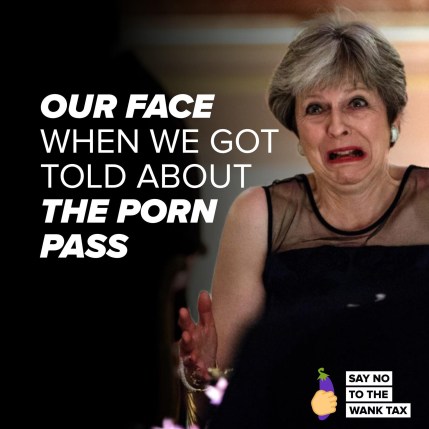
Brexit isn’t the only ridiculous thing happening in the United Kingdom. In April, the British government is rolling out statutory adult verification for pornography websites and content platforms. This requires all adult content providers to have proof of age or identity for all their users, whether a passport or a credit card (or more ludicrously a ‘porn pass’ that Brits wishing to browse anonymously will have to buy from local newsagents). The government plans to require internet service providers to block pornography websites that are not in compliance with adult verification once the system is in place. For those with university institutional access, Pandora Blake has written a timely explanation and critique published in Porn Studies: ‘Age verification for online porn: more harm than good?’.
Technical challenges with rolling out the system have led the dominant pornography search platform owner, MindGeek, to develop proprietary solution, AgeID, in cooperation with regulators. This cooperation between the dominant commercial pornography platform supplier and a Conservative government publicly intent on restricting access to pornography might appear surprising. However, it can be explained by a particular pattern of regulatory capture identified in public choice theory as a Bootlegger and Baptist coalition. Bruce Yandle observed that throughout the 20th century, evangelical Christians in the United States agitated for local restrictions on the sale of alcohol with the avowed aim of reducing consumption but with the secondary effect of increasing demand for alcohol for illegal bootleggers. Hence both interest groups, apparently opposed in moral principle came to benefit in practice. We now have a classic British case study. In this case, MindGeek is not acting as a literal bootlegger. It intends to be fully legally compliant with the filtering regime. However, the law will block all non-compliant competitors without a comparable verification system. They can gain a competitive advantage with a proprietary technical solution to the barrier introduced by the government.
Introducing identity verification systems has high fixed costs and low marginal costs. It is costly to develop or implement but easy to scale once integrated. The larger the pornography enterprise, the more easily these costs can be absorbed without the risk that it will not be worthwhile to serve the British market. For many smaller international pornography websites, without in-house legal advice or technical expertise, it might prove uneconomical to serve British users directly. So MindGeek’s platforms could become the least-cost legal gatekeeper between small enterprises producing pornographic content and the British public. The government is raising transaction costs to accessing pornography in a way that impacts larger and smaller platforms asymmetrically and favors one dominant platform in particular.
Both the premise of this policy and its likely impact on the market for pornography is unpromising. At its most benign, this could be a characterized as a ‘nudge’ against the consumption of pornography and reducing access of inappropriate content to minors. But these limited benefits have costs for both producers and consumers. On the consumption side, it increases risks to data security and privacy because it will plausibly tie records of pornographic access to verified identities, with a clear likelihood of being to infer an individual’s sexuality from private browsing. This could represent a particular vulnerability for LGBTQ identifying individuals who live in communities where there is still stigma attached to minority sexual orientations.
On the supplier side, it takes what already appears to be a market with strong tendencies towards a winner-takes-all model, and then augments it so that a dominant platform has a legally enforceable competitive advantage over potential rivals in the market. Ultimately, it threatens to further strengthen the bargaining position of a single corporate pornography platform against the sex workers who supply their content.
There has been a growing scepticism with regard to the Belt and Road Initiative (BRI) project in many quarters, due to the lack of transparency with regards to terms and conditions as well as the economic implications for countries which are part of the project. A report published in April 2018 by the Center for Global Development (CGD) in Washington flagged 8 countries (including Pakistan, Maldives, Laos, and Djibouti) where the level of debts are unsustainable.
Apart from the red flag raised by a number of researchers, the removal of Pro-China leadership in countries like Malaysia, Maldives, and Sri Lanka has also resulted in problems with the BRI project, and China’s economic dealings (which are clearly skewed in favour of Beijing) with other countries is drawing more attention.
The most vocal critic of China’s economic links has been Malaysian Prime Minister Mahathir Mohamad. During a visit to China in August 2018, Mahathir, alluded to China’s trade relations with poorer countries as ‘a new version of colonialism’. Mahathir later on denied that his statement was targeted at China or the BRI. The fact is that the Malaysian Prime Minister did scrap projects estimated at well over $20 billion (which includes a rail project, East Coast Link, as well as two gas pipelines).
Top officials in the Trump Administration, including US Vice President Mike Pence, have also been critical of the BRI project for a variety of reasons. The major criticism from US policy makers has been the economic ‘unsustainability’ of the project as well as the point that the project is skewed in favour of China.
‘Motivated Reasoning, Public Opinion, and Presidential Approval‘, an interesting new paper forthcoming in the journal Political Behavior (summarized here), by Kathleen M. Donovan, Paul M. Kellstedt, Ellen M. Key, Matthew J. Lebo finds that support for sitting presidents has become increasingly misaligned with national economic expectations. Rather than being a sign of voters realizing that presidents play little role determining economic performance, they attribute this to increased partisan polarization.
I think this is a compelling account. All I would add is a potential causal mechanism. My current favorite dimensions for analyzing democratic trends in the developed world is demography. Voters are ageing. When retired, they tend to have much less direct involvement with the productive economy than when they were working. On average, the elderly are quite rich and living off entitlements they have acquired during their working lives. So they are both less reliant on current economic opportunities and less knowledgeable of them. This means their personal costs of partisanship, relative to good policy, is lower than it used to be. And this is what lets all the culture-war nonsense creep into people’s decision functions.
But as abstract ideas go, pollution taxes are pretty appealing. Holding constant lots of things that we can’t really hold constant, it means replacing the inefficiency resulting from poorly defined/enforced property rights with a world where prices more accurately reflect the costs of one’s decisions.
Let me come back to the things we’re “holding” constant in a bit. Why do I want to throw my weight behind shifting public perceptions in favor of pollution taxes?
Which is not to say a carbon tax isn’t overrated by the median policy wonk. There are a ton of important caveats, but on balance, as a policy for use in the next 50 years, I think they’re a useful tool to enhance efficiency or replace worse tools.
Again, there are no panaceas. I’m also not a huge fan of the “Economists’ Statement on Carbon Dividends” as written (for reasons I’ve hopefully mostly addressed). I suspect the best case scenario for my preferred carbon tax policy would be a modest improvement. I think the bulk of the gain would be a cultural shift away from “let’s regulate our problems!” to “let’s leverage incentives to address our problems!” Not Earth shattering, but a step in the right direction.
So let me state my position, then we can dig into criticisms and caveats.
Let’s make marginal shifts away from taxing investment and towards taxing negative externalities. As we go, let’s spend a lot of effort trying to study the impacts and adjust accordingly. Let’s heavily agument that with abatement policies rather than trying to return to some pre-industrial climate target.
Okay, let’s dig into criticisms and caveats.
Public choice considerations
Geoengineering and other alternatives
Cost
Coordination
Uncertainty
1-Public choice considerations
A Green New Deal will be a rent-seeking bonanza. Pollution taxes will face the same sorts of problems that plague the tax code in general. There will be intentional loop-holes and accidental screw ups.
We have to continue to push for reducing the complexity of tax codes in general. But I can’t deny that a carbon tax would be a step back on this margin.
Minus a hundred points for my position.
2-What about geoengineering?
Geoengineering sounds like a possible panacea. Maybe it is. But I’m not willing to flip a switch and find out the hard way all at once.
First off, geoengineering is scary. The climate is a complex system and complex systems are difficult-impossible to manage well. And that’s especially concerning if it means that anyone with a few million bucks can try to fiddle with Earth’s thermostat.
But it seems like a plausible tool that might be used to address climate change. Similar to my take on a carbon tax, I think the way to go is baby-steps plus research.
What about subsidizing “green _____”
Personally, I’m skeptical. Solar sounds appealing, and I (personally) think windmills are beautiful. But I don’t think the government will do a good job of picking winners and losers. Pollution taxes are appealing to me because they don’t require bureaucrats to choose. Again, I think the way to go is to use pollution taxes to offset other taxes–while continuing to advocate for reduced size/scope of government and a return to federalism.
Plus five points for my position.
3-Cost
We should also remember that GDP is an imperfect measure of well being. The current figures aren’t directly comparable to the figures we’d get in a post-carbon-tax world. A one-time fall in GDP doesn’t (necessarily) mean we’ve screwed things up.
Still, it’s worth remembering that a) we can go too far with a carbon tax, and b) we don’t have access to a silver-bullet solution. So let’s start small and gradually increase carbon taxes till we get close to (our best estimate of) the optimal level.
Plus epsilon points for my position.
4-Coordination
The basic idea of a carbon tax is that we’re dealing with a global-scale externality problem. But small scale taxes are unlikely to do much beyond shifting where pollution happens. A fully effective tax would require multi-lateral coordination. And, as a country, we aren’t very good at that.
Trying to create a tax on imported carbon-intensive goods that didn’t face a tax at home seems a) sensible at first blush, and b) a massive opportunity for public choice problems.
On the other hand, we could justify a tax commensurate with the local impacts (something like 10% of the global impact). This fits nicely with my idea of starting small and adjusting at the margin.
But even within the U.S. there are coordination issues. Long Island will likely face net costs from climate change, but other areas will benefit from a longer growing season.
Plus 10 points for my position, but also minus 10 points.
5-Uncertainty
Uncertainty cuts both ways: we’re currently accidentally manipulating the climate and that could turn out to be catastrophic. Trying to intentionally manipulate it in the other direction is also dangerous. Again, the appropriate focus is on marginal tinkering [much as it clashes with my non-interventionist priors] rather than ambitious global engineering [which grabs my priors by the lapels and knees them in the groin].
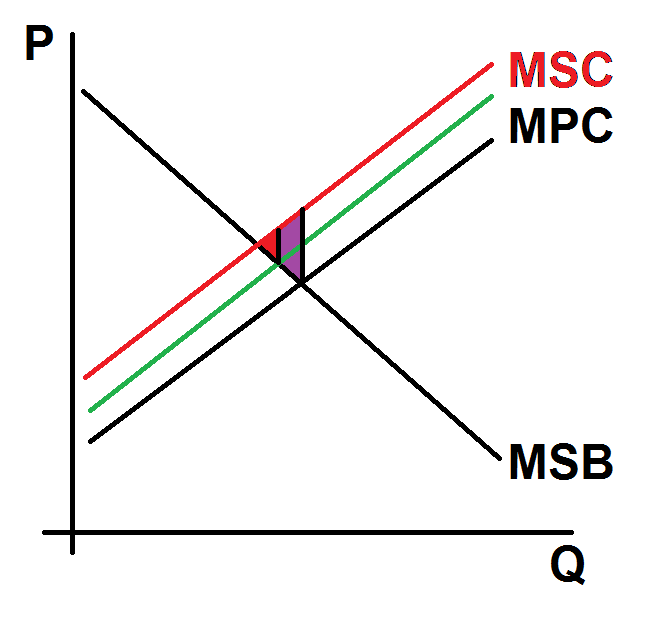
When I teach externalities, I draw a graph like this:
Negative externalities when we magically know their magnitude.
In this market, we end up with an equilibrium quantity defined by the point where Marginal Private Cost equals Marginal Social Benefit (MPC = MSB). But the Marginal Social Cost (MSC) is greater, so we get a deadweight loss equal to the triangle I’ve shaded in red and purple.
It’s important to note: we don’t actually know where the MSC curve is. It’s somewhere above MPC, but we’re basically in the position of trying to eliminate a subsidy we don’t know the size of.
The relevant models–climate models and economic models–are filled with uncertainty that we simply cannot resolve without real life experience.
What does the economic way of thinking tell us? Act on the margin. Setting a tax that pushes supply (MPC) up to the green line doesn’t fully address the problem (as I’ve assumed it to be in this graph), but it’s an improvement.
Even better, it’s an improvement where the biggest returns are experienced up front. This modest tax fails to get rid of the red deadweight loss (DWL) area, but it eliminated 3/4 of the total DWL.
Plus X points for my position where X is a random variable with an unknown distribution, positive first derivative, and negative second derivative.
tl;dr:
At my friend’s behest I’ve been looking at Bob Murphy’s critique of carbon taxes. I find it’s shifted the magnitude of my prior opinion, but not the direction. I still think carbon/pollution taxes are a good idea, but I no longer think they’re a great idea. My take away from Murphy’s work is that the optimal carbon tax is fairly modest. My response is to advocate for getting a very modest carbon tax on the books, then gradually shift tax policy in that direction.
For climate change (and any other problem) we ought to be pluralists. A mix of approaches is ideal. Part of the appeal of Pigouvian taxes is that they allow and encourage a wide range of responses. The best pollution abatement scheme isn’t something we can look up in a binder. We have to discover it, and crowdsourcing is the appropriate way to do that.
But carbon taxes are only one part. We should also advocate for changes that will ameliorate harm. I am more bullish on these policies than I am on a carbon tax:
Make it easier for the world’s poorest people to move to rich countries that will be better able to cope with climate change.
Quit subsidizing flood insurance.
Quit subsidizing polluting industries (and other industries).
Even though geoengineering scares me, we should try to learn more. Ditto for any other possible tools that come along.
While addressing a joint press conference in Hanoi, after his summit with North Korean Leader Kim Jong Un, US President Donald Trump spoke not just about the Summit, but also the current state of US-China relations. Trump criticised his predecessors for not doing enough to address the trade imbalance with China, while also making the point that he was all for China’s economic progress and growth, but not at the cost of the US.
If one were to look beyond the Summit in terms of the US-Vietnam economic relations, top US companies – Boeing and General Electric – sealed some important deals.
Given the focus of Trump’s visit (which was the Summit with Kim), perhaps these deals did not draw the attention they ought to have. The fact is that the US has begun to recognise Vietnam’s economic potential, as well as its geopolitical significance in Asia. This long note will give a backgrounder to Vietnam’s economic growth story in recent years, highlight some of it’s key strategic relationships, and then examine the nature of the China-US-Vietnam economic triangle.
I won an essay contest back in my undergraduate days for an essay on optimism. I understand that poverty worldwide is on the run. I understand that none of us have suffered through a devastating worldwide war like most of our ancestors did. In many ways, we have it good.
But Donald Trump is still President of the United States of America. I still remember waking up to the news that he had beat Hillary Clinton. It was surreal (it didn’t help that I was living Austin, where everything is a bit foggier, brain-wise).
Unlike Jacques, who seems to be so in love with Trump that he would get down on his knees and do whatever Trump wanted him to do, I don’t like Donald Trump. I don’t think he’s done a good job. I don’t even care that the left-leaning press is dishonest when it comes to reporting on his administration. I think this is the difference between libertarians like me, who lean more to the left, and libertarians like Jacques and Bruno, who lean more to the right.
Jacques and Bruno are not really defending the Trump and Bolsonaro administrations. And they’re not really speaking up for these two administrations because they hate leftists more than they like liberty. Guys like Jacques and Bruno care more about Truth than anything else, and the global mainstream media’s narrative skews left and is often dishonest.
Me? I’ve grown accustomed to dishonesty in media. I’ve also grown accustomed to ignorance. I pick and choose which dishonest or ignorant bits I want to challenge. When journalists write or say something about guys like Trump or Bolsonaro that are blatantly wrong, I make a mental note of the dishonest nature of the reporting, but that’s about it. Guys like Trump and Bolsonaro are bad for liberty, after all. I’d rather focus on the mainstream press’ dishonesty when it comes to people like Alexandra Ocasio-Cortez. The fawning over her is at least as concerning as the dishonest portrayals of Trump or Bolsonaro.
Left-wing populism is just as bad as right-wing populism, and everybody in the democratic world is going to be stuck with populism for quite awhile. Truth is on its way out the door, and I don’t know if it’ll be back in my lifetime.
Last election, Jillian Ostrewich drove to a polling place at a Houston rec center, expecting to vote. But she made the mistake of wearing a “Houston Fire Fighters” t-shirt. An election worker confronted Jillian, insisting that she couldn’t vote unless she turned the offending shirt inside out. The rationale: a measure on the ballot was related to firefighter pay, and the shirt was related to firefighters.
Tony Ortiz suffered a similar fate in Dallas. Tony’s crime was wearing a MAGA hat while he stood in the voting line outside his local library. An election worker said he couldn’t wear the hat to the polls because the MAGA slogan constituted “electioneering.” Tony responded that the hat had nothing to do with any issue or candidate on the ballot. The election worker threatened to call the police.
These election workers were relying on a Texas law that forbids electioneering or wearing “a badge, insignia, emblem, or other similar communicative device relating to a candidate, measure, or political party appearing on the ballot” in or near a polling place. The law even prohibits someone from wearing an ID if the name is the same as someone appearing on the ballot. A violation is a criminal misdemeanor. Today, my colleagues and I at Pacific Legal Foundation filed a lawsuit on behalf of Jillian and Tony challenging the Texas ban.
As it happens, the Supreme Court issued a decision just last year striking down a similar law in another case brought by Pacific Legal Foundation called Minnesota Voters Alliance v. Mansky. The Minnesota law in MVA prohibited wearing a “political badge, political button, or other political insignia” in the polling place. The Court said states can limit some electioneering at the polling place to prevent voter intimidation and excessive disruption. But the government has to have some clear and logical basis for sifting “what may come in from what must stay out.”
The word “political” was not a clear boundary. As the Court noted, almost anything could be considered political, and the fuzzy language offered too much wiggle room for abuse and discrimination. The attorney arguing for Minnesota drove this point home during an onslaught of blistering questions in oral argument: how about a rainbow flag shirt? Permitted, maybe. How about a “Parkland Strong” shirt? Permitted, probably. How about an NRA shirt? Definite no. How about a shirt with the text of the Second Amendment? Definite no. At about that point, most everyone knew the outcome of the case–the attorney had just proven the inherently arbitrary standard he was trying to defend.
The Texas case filed today is a bit different. For one, the ban extends to 100 feet outside the polling place, which clearly encompasses sidewalks and other public areas where speech rights enjoy their widest berth. But the ban is not quite as amorphous as the word “political.” Instead, the ban extends to messages that relate to a candidate, measure, or party on the ballot.
This slightly narrower language probably doesn’t save the Texas law. After all, almost anything can be considered related to a candidate if the candidate has taken any kind of position on it. If a candidate has criticized Trump (have any not?), then is Tony’s MAGA hat “related” to the candidate? If Ben & Jerry’s takes a position on a ballot measure, does a Ben & Jerry’s shirt relate to that ballot measure? Maybe, but it depends on the election worker–and therein lies the problem. As the Supreme Court said in MVA, “A rule whose fair enforcement requires an election judge to maintain a mental index of the platforms and positions over every candidate and party on the ballot is not reasonable.” Not only would such an index be impossible, but the contents and application of that index would be dictated by an election worker’s own biases and background.
The integrity of the electoral process is vital. But surely Jillian’s firefighter shirt or even the much-reviled MAGA emblem do not imperil the right to vote. Wed don’t shed the right to express ourselves in peaceable ways when we step into a polling line.