Another Liberty Canon: Foucault

Michel Foucault (1926-1984) was a French writer on various but related topics of power, knowledge, discourse, history of thought, ethics, politics, and so on. His name to some summons negative associations of French intellectual fashion, incomprehensibility, and refinements of Marxist anti-liberty positions.

However, his influence in various fields has become too lasting, and too much taken up by people who do not fit into the categories just mentioned, for such reactions to be considered adequate. Foucault himself resisted and mocked labels, which was a serious issue for him because in his work he tried to question the absolute authority of any one system of knowledge and the  authority of isolated great thinkers.

He said that once he had written something it was no longer what he thought, which is in part a playful attempt to resist labelling, but also a rather serious point deeply embedded in his thought, about the nature of subjectivity, how it is always more than what we say or more than the identity that power relations impose on us.

It seems to me that any ethics of subjectivity has pro-liberty implications, and despite the image some might have of Foucault as morally irresponsible or indifferent, he increasing developed the idea of  self-invented subjectivity, based on care of the self, the art of existence, and related terms.

The self-invention does not mean that Foucault thought we can arbitrarily will our self to be anything, it does mean that he thought we have possibilities to cultivate ourselves to live in a way that relates to, and challenges our existing strengths and goals.

Despite the image for some of intellectual fashion round Foucault, these ideas were partly developed through study of Ancient Greek and Roman ideas about ethics and style of living, which included interaction with scholars in the field.

Another theme he developed through his interests in antique knowledge and culture was that of ‘parrhesia’, Greek word that refers to free speaking, which in the context of ancient city states, particularly the Athenian democracy, had strong overtones of courage in truth telling before the city assembly, a prince of any other source of power.

The ethic of truth telling relates to Foucault’s own work on the language of knowledge and the history of science, as well his political ideas. He did not believe in absolute final systems of knowledge, autonomous of context, but he did believe that trying to find truths within whatever perspectives was an ethical enterprise connected with the kind of self cultivation he advocated.

Foucault’s own father had been a doctor and on at least one occasion Foucault suggested his own work was a continuation of the doctors work that evidently combines ethical and scientific aspects. It must also be said that Foucault was a great critic of the authority of experts, including doctors, so he might also be seen as struggling with the memory of his father.

The ambiguity and the personal involvement in ideas suggested there is very much at work throughout Foucault’s writing, in its tension and energy. It is part of his ‘difficulty’, which also comes from the philosophical and literary interests he had, which relate to the creative possibilities of linguistic disruption. We can see that in the most obvious way when he quotes literary texts of Borges, Beckett and so on.

The existential commitments in Foucault’s work is clear if we think about the book that made him famous, History of Madness (also known as Madness and Civilisation), and his personal experience of mental ill health and psychiatric treatment, particularly in his student years.

We can also think about his constant critique of power and his individual  willingness to physically confront power, as in the beatings he received from the police at demonstrations for rights in both France and in Tunisia (where he taught for a few years just after becoming a celebrity public intellectual in France).

Returning to the topic of experts and power, one of Foucault’s most pervasive ideas now is of ‘biopolitics’, that is the way that power expresses itself through prolongation of life. As the state has moved from a basis in the power of death over criminals and other supposed enemies, to a promotion of population, public health, and prolongation of life, it has demanded corresponding powers of intervention and control.

At the extreme this means the ‘racial hygiene’ ideas that German National Socialists used to justify the Holocaust, and in a more routine way means expanding state activity justified by public health goals. We can readily see the contemporary significance of Foucault’s ideas here in relation to ever expanding state and ‘expert’ attempts to limit smoking, drinking alcohol and supersized fizzy drinks, eating sugary and fatty foods, and so on.

The ideas about biopolitics builds on the discussion of modern power in maybe his most widely read book, Discipline and Punish, which deals with the way that the prison becomes the central means of punishment after the eighteenth century Enlightenment, and suggests the dangers of Enlightenment becoming a controlling form of rationalism.

The way the prison works, around observation, or surveillance, of prisoners to ensure adherence to prison routine was the model of modern power for Foucault including factories, schools, and armies, in a model of ‘disciplinarily’. Again Foucault’s intellectual interests correspond with life commitments, as he was a prominent campaigner for prisoner rights, under the inspiration of the man with whom he shared his life, the academic sociologist Daniel Defert.

Foucault’s analyses in Discipline and Punish, and related material, draw on the ‘classical sociology’ of Emile Durkheim and Max Weber with regard to norms and authority, as his views on the emergence of the modern state draw heavily on the ‘pre-sociology’ to be found in the historical and social work of the classical liberal thinkers Charles-Louis de Secondat, Baron of La Brède and Montesquieu and Alexis de Tocqueville.

There is some drawing on Marx, but one should be wary of those left socialist inclined advocates of Foucault who emphasise this strongly, since they don’t mention the other points of orientation so much. The same applies to remarks Foucault made about the importance of the twentieth century Marxist theory of the Frankfurt School, as those who emphasise such remarks ignore accompanying remarks about the importance of Max Weber and ‘Neoliberalism’ (i.e. classical liberal and libertarian thought since the Austrian Liberal school of Menger, Hayek, Mises etc).

Strange as it might seem, Foucault suggests we take Marx, Weber, the Frankfurt School, and Neoliberalism together as attempts to explore liberty and power. Maybe it shouldn’t seem so strange, however awful the consequences of Marxist ideas coming in power have been, that does not mean we should ignore Marx and Marxism, which starts by drawing heavily on classical liberalism and does have some noteworthy things to say about constraints on liberty in a capitalist society, even if offering bad solutions.

Certainly Foucault is not your man if you think a pro-liberty position means uncritical embrace of the links between private enterprise and state power, but since the liberty tradition has in a very significant way been concerned with criticism of rent seeking and crony capitalism, of the drives within capitalism to betray itself, then I don’t think we need to reject Foucault in this area. Indeed it is even a part of the liberty tradition to reject ‘capitalism’ as tied to the state and concentrations of power and argue for markets, property, and association rights liberated from state alliances with economic power.

This is the core of left-libertarianism, and even Foucault’s most Marxist leaning fans would find it hard to deny that left-libertarian is an appropriate label for Foucault. Clearly he was a natural maverick and critic of all power, including state socialist power. I suggest his life, his activism, and his writing, can be taken as an inspiration for all liberty-inclined people. Even on the more conservative side, Foucault’s thoughts about self-cultivation are a version of virtue theory, of an emphasis on cultivating virtue, so Foucault has a lot to offer to all streams of liberty thought.

Those Foucault texts most relevant to political thought about liberty

Monographs 

History of Madness (also published as Madness and Civilisation)

Discipline and Punish

History of Sexuality (3 volumes: Will to Knowledge, The Uses of PleasureThe Care of the Self)

Collected lectures

(Foucault’s rather early death means that much of his work was in lectures that would have been later revised into published material. The task of bringing those lectures into print is still underway).

Fearless Speech

The Government of Self and Others

The Birth of Biopolitics 

Security, Territory, Population 

Hermeneutics of the Subject 

Society Must be Defended 
Riding Coach Through Atlas Shrugged. Chapter 1: The Calendar Hung Itself.

50th Anniversary Edition pages 11-20*

*Note: The actual chapter ends on page 33 but I am splitting these up based on POV changes for easier digestibility.

Chapter Summary: White-collar worker Eddie Willars runs into a peculiar homeless man, reflects on a decaying city, and attempts to convince his boss of an urgent matter in Colorado.

My initial impressions are all pretty positive. The opening line: “Who is John Galt?” accomplishes everything an opening should and most importantly sets up a mystery to pique the reader’s interest.

Even with my limited knowledge of small parts of this book I was still immediately hooked by the questions presented on the first page: “Who is John Galt?”, “Why does it [the above question] bother you?”, and without missing a beat (or answering those questions) Rand describes the world that frames these questions quite beautifully with several potent, if a bit obvious, metaphors.

The bum as the faceless masses, intelligent but wearied and cynical without the energy to change their station but able to if inspired. “The face was wind-browned, cut by lines of weariness and cynical resignation; the eyes were intelligent.”

It also seems to be relevant that the bum is our introduction to the character of John Galt. The nameless, faceless masses knowing about the coming change almost instinctively and long before the more comfortable and well off middle class.

The city, in my estimation, represents society as a whole. Once beautiful but now decaying and, like the old tree on the Taggart estate, hollow and rotting from within. “…the shafts of skyscrapers against them were turning brown, like an old painting in oil, the color of a fading masterpiece.” The seed of beauty and triumph is there but it has rotted from within.

Eddie is who really intrigued me though; he reminded me a lot of Tolstoy’s Ivan Ilyich. A middle man in society who knows something is wrong but doesn’t have the skills to do anything about it. While he cannot identify the sinking feeling that permeates every fiber of his being he does have a stable foundation to latch onto.

“When he was asked what he wanted to do [in life], he answered at once, “whatever is right”…”twenty two years ago. He had kept that statement unchallenged ever since; the other questions had faded in his mind…[B]ut he still thought it self evident that one had to do what was right; he had never learned how people could want to do otherwise.”

As a natural-rights libertarian I believe that there are absolute moral and ethical truths and Eddie’s commitment to a similar personal philosophy deepened my ability to relate to the character. It also stands in stark contrast to more modern interpretations of ethics such as “rule utilitarianism” which will always decay to subjective act-utilitarianism.

“David Lyons argued that collapse occurs because for any given rule, in the case where breaking the rule produces more utility, the rule can be sophisticated by the addition of a sub-rule that handles cases like the exception. This process holds for all cases of exceptions, and so the ‘rules’ will have as many ‘sub-rules’ as there are exceptional cases, which, in the end, makes an agent seek out whatever outcome produces the maximum utility.”

In short, any attempt to prevent the “ends justify the means” outcome of utilitarian ethics, without some sort of higher moral authority, inevitably fails and the system is reduced to one of pure utilitarianism. I was actually under the impression that Rand was a bit of a utilitarian herself so I will be interested to see if this commitment to the universal “right” turns out to be a character flaw in Eddie or whether it remains an ideal to be upheld.

Eddie’s confrontation with James Taggart was also quite inspiring. A man who knows he is stepping out of line but is willing to do so for the sake of his personal convictions is an ideal that many of us could due to imitate. I will save my examination of James until the next installment but the important thing I took from this interaction between James and Eddie was how uncomfortable James grew when Eddie looked into his eyes.

“What Taggart disliked about Eddie Willars was this habit of looking straight into people’s eyes. Eddie’s eyes were blue, wide and questioning; he had blond hair and a square face, unremarkable except for that look of scrupulous attentiveness and open, puzzled wonder.”

If, as I suspect, Eddie is the everyman (or reader avatar) in this story and James is an (the?) antagonist then what I am supposed to take from this is that the villains in this world, and in ours, cannot stand up to scrutiny. They are filled with uneasiness when we examine their actions and question their motivations. If Eddie is an ideal, then his attentiveness is an ideal as well.

Eddie’s relationship with the Taggarts as a whole is something I hope is explored more. It is obvious he admires and respects Dagny since they grew up together and the fact that he still has some sort of respect for James leads me to believe that the latter wasn’t always so insufferable. What made Eddie so devoted to this family? Was it simply their entrepreneurial spirit or was there something more?

I had a few small criticisms but I am going to have to wait to see how they play out. As I mentioned briefly at the start of this entry Rand’s metaphors were really straight forward which isn’t bad in and of itself but simply something I am taking note of and will look for as the chapters go by.

I cringed a bit when Eddie admitted that he was simply a serf pledged to the Taggart lands. The whole feudalism angle is one that I am going to keep an eye on since one of the most common attacks on libertarianism is that it would descend into a neo-feudal corporatist society.

Of course I may be taking the line a bit too seriously since Eddie was simply trying to get James to agree to his requests to support the Rio Norte line. In fact it could very well turn out to be a rebuke of that attack once all is said and done.

Finally I have no idea what the giant calendar is supposed to represent or foreshadow. Perhaps it is simply a literal translation of the city’s days being numbered which would both be very clever and kind of groan-worthy at the same time. Hopefully Eddie shows up again soon to let us know but I have a sneaking suspicion that our protagonist isn’t Mr. Willars despite my initial preoccupation with his character.

Check in next time for first impressions of Dagny, a word of support for monopolies, and our first real look at James Taggart. I wish this was a George R.R. Martin novel so maybe he would be dead before the book was over. Hey, I never said I would be impartial.

Part 2

Into the ear of every anarchist that sleeps but doesn’t dream…

We must sing, We must sing,We must sing…


There is no libertarian art.

Well, that is a slight exaggeration, but not much of one. Art is a vital part to any social movement and it is one area where libertarians suffer immensely. Sure there are libertarian leaning authors such as Robert Heinlein and modern Austrian economic art like the guys over at www.econstories.tv but for the most part there are few non-academic ways to inspire potential libertarians.

This is a problem I lament when I am feeling negative about the prospects for a free society which, to be fair, is usually the case. Sometimes reading an article about Intellectual Property just isn’t enough to get the passion flowing.

“But Wait!” You say, “you failed to mention the author who brought tens of thousands of people into the libertarian fold. The late, the great, the Ayn Rand!”


….yea about that.


I don’t like Ayn Rand. There, I said it. Bring out the pitchforks and tie me to a Rearden Steel railroad track if you must but I stand by my statement. Now I know what you are all thinking: “But her works exemplify the individual freedoms that a libertarian society should strive for!” or “Dagny is a strong independent woman who don’t need no government!”

Yes, I am aware, but it isn’t Ayn Rand the author I dislike. Actually it isn’t even Ayn Rand the person that I dislike. I don’t like the idea of Ayn Rand. The metaphysical zeitgeist that surrounds and worships her throughout every circle of the libertarian movement from Walter Block to Milton Friedman to every other subscriber on www.reddit.com/r/libertarian.

All too often I have had to argue about libertarianism through the lens of someone whose only exposure to the philosophy is Ayn Rand and the objectivist selfishness that nearly everyone associates with capitalism. In short, I think she is bad for libertarianism and provides no end of ammunition that can be used against those of us with a more nuanced moral/ethical position.

Here is the kicker though. I have not read a single Ayn Rand novel. Not Anthem, not the Fountainhead, and especially not her magnum opus Atlas Shrugged. My knowledge of her works (outside of objectivist philosophy) comes mostly through a bit of osmosis during many diatribes in my conversion to libertarian thought and the first few chapters of Anthem I read in high school before being bored to tears.

I feel that my lack of personal experience with the work of Ayn Rand is a great injustice to someone so influential to many (but certainly not all) of the ideals that I hold so dear and maybe, just maybe, I can siphon off some of the passion that so many others feel when reading her novels.

So it is my objective to spend the next several weeks (months perhaps) reading Atlas Shrugged along with you, the faithful readers here at www.notesonliberty.com, and recording chapter based summaries of my thoughts, opinions, and analysis from a literary, ethical, and philosophical standpoint. These will be full of personal anecdotes and armchair analysis so be prepared for a tumultuous ride through one of the “great?” works of the 20th century.

Part one of many comes tomorrow morning.

Another Liberty Canon: Arendt

Hannah Arendt (1906-1975) was one of the more influential writers on political thought during the twentieth century. Born in Germany, her political views and Jewish origins (she was also Jewish in identity though not in religion) meant not only that she had to leave Germany after the Nazi takeover, but that she had to escape from Gestapo interrogation. A period in Paris was ended by the 1940 German invasion, which led to another escape from detention, and her final destination of the United States. She was able draw on this direct experience of totalitarianism and antisemitism to write The Origins of Totalitarianism, one of the classic works on this topic, which also considers the role of political anti-Semitism, as distinct from older religious prejudice, in the formation of the modern phenomenon of totalitarianism.

Arendt reached beyond an academic and scholarly audience in her most widely ready book, Eichmann in Jerusalem: A Report on the Banality of Evil, based on her journalistic reporting on the trial of one of the major administrators of the Holocaust, Adolf Eichmann. Though the book did much to draw attention to the extreme horror of  Holocaust, and and its history, which strange as it might seem now was not the object of a great deal of public or scholarly discussion in the immediate postwar period, also led Arendt into a morass of angry criticism and even hatred, in part for supposedly trivialising Eichmann’s criminality. However, the point of referring to the ‘banality of evil’ was not to say that the Holocaust was trivial, or to deny Eichmann’s criminality, but to suggest that as a person he was more of a small minded conformist than a grandiose anti-hero of apocalyptic evil.

From the point of view of Arendt’s work in political theory, her writing on the Holocaust and totalitarianism, contributed to her understanding of modern politics in its darkest possibilities, which were distinct from older forms of tyranny. That understanding itself drew on the breadth of her historical approach, including literary and cultural interest, which went back to the Ancient Greek beginnings of western political thought. Her understanding also included the ethical and religious thought of late antiquity, as can be seen in her doctoral dissertation, Love and Saint Augustine. She had a general appreciation of the whole of human life, with regard to consciousness and action, which is behind The Life of the Mind and can be found in some of her political theory, most obviously The Human Condition.

Arendt’s interest and appreciation of ancient politics, particularly the democracy of city state Athens,  sometimes leads to her being labelled a nostalgic and a believer in anti-individiualistic integrated communities. This can only be a parody though, Arendt thought that there might be some things to learn about modern politics through comparison with antiquity, but she did not advocate a return, and her interest in antiquity was in those communities like Athens and the Roman Republic, where we can see individualism growing and a decline in community based on adherence to tradition and to communal assumptions.

Arendt thought that the Athenians had achieved liberty of a significant kind for the aristocracy, and to some degree for the lower classes, on a real but limited basis in which some had the leisure to think and argue about the rules and laws of the city state. That form of library rested on ‘heroic’ and patriarchal values according to which the home and family are the place of economic production and therefore the place of necessity.

Liberty was understood with reference to the tradition of  heroes going to war or to a more recently evolved habit of widespread public free speech about public affairs. Arendt did not argue for this as the all time ideal, but as a moment with some ideal aspects, which was bound to fail. Partly it failed because law was understood as custom and communal obligation, rather than as concerned with contracts between free individuals.  In her historical analysis, the Romans made progress on the legal front, because they saw  that law can and should evolve with regard to the best ways of grounding freely chosen contracts,  while also failing to maintain political liberty as the republic gave way to Imperial autocracy

Arendt emphasised that the Roman model inspired modern movements for liberty, particularly the French and American Revolutions (the comparison is made in On Revolution). Though she wrote about the motives and early actions of French revolutionaries with great sympathy, she pointed out that it had all ended in revolutionary terror and then country-revolutionary autocracy, so that the American Revolution had created a better model, as shown in the long lasting nature of the Constitution. She both respected that achievement and pointed out that it rested on assumptions about the dominance of a land owning class, so that it could not in itself provide all the answers for modern liberty, even it established an enduring framework, which survived major shifts in the location of economic wealth and the sources of political power.

For Arendt, the modern capitalist world undermined the idea of a strict separation between a private realm of economic production, based on family ownership and use of land, as economic activity became what happened in factories and other enterprises, with regard to national and world markets. The social-cultural result was an undermining of the antique assumption that intellectual life is superior to, and dominant over, physical activity and economic life. It also  resulted in states that seemed more remote from traditional forms of allegiance and everyday customs, because the state became increasingly something concerned with legislative and administrative activity that aimed to enable production and trade, so for the first time establishing the state as something that aims to constantly elevate material wealth and ‘national welfare’. Arendt, in this way, argues that commercial society tends to create its own statist reaction.

Arendt equivocated to some degree about whether capitalism was to be preferred to socialism, but in political writing emphasised enhancing individuality and a spirit of competition and that can only be seen as directed against the expanding administrative state, particularly as she argued for more separation between political questions and social welfare questions. She looked for ways in which modern political participation could focus on the best parts of the antique legacy: public speech focused on the conditions of liberty rather than on expanding state activity, contests for esteem in the public sphere rather than levelling down egalitarianism.  Perhaps her equivocation about socialism can be seen as leaving the way open for ‘socialism’ as defined by left libertarians, markets without a state that promotes politically inspired concentrations of wealth and power. She was certainly a prominent critic of Soviet style state socialism.

Arendt had a grasp based in rather classically oriented political theory, of how capitalism tends to produce statist reactions to itself, which parallels the more political economy and economics oriented work of Austrian economics and Virginia Public Choice theory on  the rise of the administrative state and rent seeking.  Together with her interests in how to avoid antique tyranny and modern totalitarianism, this makes her a great twentieth century pro-liberty voice, particularly for those interested in the historical, psychological, moral, and literary aspects of political thinking.

All of Arendt’s major contributions to political thought are mentioned above. A good starting point for those new to Arendt might be the essays collected in Between Past and Future or The Promise of Politics

From the Comments: Has the deontological puzzle been solved?

Dr Fred Foldvary (yes, THE Fred Foldvary, the one who predicted the 2008 crash in 1998writes:

It is not clear what the policy consequences are regarding those who lose out due to competition. If we are free to choose our friends, there will be losers who lose someone’s friendship. Should we be forced to stay friends with those we no longer like? If not, then such a loss has no policy implication. Such incidental injuries have less damaging consequences than a law that prohibits ending a friendship. Thus the deontological and consequential effects are complements: Likewise, the consequences of prohibiting economic competition are worse than the losses due to competition. And entrepreneurs should know that the system is a profit and loss system, and anyone in business is vulnerable to losses. The losses due to competition are not torts and they are not coercive harms. They are injuries not deliberately inflicted but incidental to individuals and firms pursuing their happiness.

This is in response to my short post on the ethical divide within libertarianism between deontologists and consequentialists. I don’t think there is too much that we disagree on here; Indeed, it seems as if we are complimenting each other quite nicely (if I do say so myself!).

My one quibble is more of a question than a quibble: Although we cannot predict who will lose out to competition in markets, shouldn’t we be able to make some solid inferences? For example, if the US and Europe were to abolish subsidies to farmers and open up their markets to foreign competition, it stands safe to reason that Western farmers will lose out, at least in the short-run.

The logic behind Dr Foldvary’s comment is relatively clear: abolish protectionist subsidies (which are aggressive legislative acts perpetrated against Western consumers and foreign farmers) and this paves the way for non-aggression. Not only is this logic clear, it is irrefutable. It also shows how deontology and consequentialism are complimentary. However, logic and facts are not very useful when it comes to persuading the public. Philosophically this argument makes perfect sense, and politically and rhetorically Dr Foldvary makes it work, but in the general public sphere (especially the internet) the appeal to deontology has earmarked liberalization for disaster.

I suppose, if we follow Jacob Huebert’s line of reasoning, that the politics and the rhetoric of our ideas should not matter, but on the other hand we live in a world where even in the West libertarians have become a minority. The world will continue to liberalize as long as libertarians continue to be as lucid as Dr Foldvary, but I fear that men of his caliber are in very short supply today.

Deontology versus Consequentialism: The Great Libertarian Divide

I am not a philosopher. In fact, the two courses I took on philosophy in college (Honors courses on ancient Greek ethics and modern ethics) were the two courses where I received my lowest grades ever in college (B+’s). Nevertheless, I have been thinking about the great divide within libertarianism regarding the concept of ‘rights’.

I don’t want to delve into the concept of ‘rights’ here, largely because I have only a superficial understanding of the notion, but for the sake of non-libertarian readers I’d like to briefly explain that, within libertarianism, there is an argument about whether or not deontological ethics (wiki) or consequential ethics (wiki) is the proper framework with which to analyze the world.

Deontological libertarians argue that each and every individual has natural rights and that any sort of aggression upon these rights is inherently immoral. Consequentialist libertarians argue that the initiation of force is not as important as whether or not a policy makes everybody better off. In some ways, you can see these tensions being played out here on the blog.

Under these strict definitions I am a consequentialist, but I don’t think it’s quite right to label me as such. I think that the two ethical systems are complimentary more than they are antagonistic. For instance, I think the deontological framework is important because the urge of those in power to “do something”  for the greater good is often immense. Deontological ethics plays an important role in establishing boundaries that those in power have to respect. Mao Zedong’s Great Leap Forward provides a clear-cut example of what happens when power is unrestrained in the name of a greater good. Ethnic cleansing, famine, and poverty can all be attributed, in one form or another, to the lack of respect for deontological ethics.

On the other hand, deontological ethics is too dogmatic. It is impossible to have a society based completely upon the foundations of non-aggression. Free trade is a perfect example of this impossibility. Deontological libertarians support free trade because in the absence of coercion free trade would be the natural outcome. Yet this does not seem right to me. Free trade is good because it lifts up the overall standards of living for everybody in a society, but there are short-run losers when it comes to free trade. In fact, losers are a natural part of the marketplace as a whole. Without losers there could be no markets. We should all be thanking as many losers as we can, whenever we can (you can start with me; I recently set up a Tinder account).

Free trade, and the losers that it produces, has harmful short-run effects on some individuals and their property. Competition destroys fortunes and job skills alike. Free trade also creates verifiable prosperity for societies, and even the losers – eventually – become better off under free trade. Even the underlying structure of the capitalist order is based on aggressively protecting that “bundle” of individual rights that is so integral to freedom and prosperity (this does not mean that states are a necessity, but only that aggression is unavoidable in social relations).

I am off-base here? Am I knocking down a straw man? It seems to me that the consequentialist position – which is already very deontologically-friendly to begin with – is the better route to take, philosophically, politically, and rhetorically.

Another Liberty Canon: Kierkegaard

Søren Kierkegaard (1813-1855) is well known for his contributions to philosophical and religious thought, and for the literary qualities of his work in these areas. He has not been so well known as a contributor to political thought, though there is now a growing amount of scholarly commentary in this area.

Generally his politics has been seen as directed by an extreme kind of conservative reaction against changes, and particularity movements of  democratic and constitutional change in Denmark in his own time. The sense that he was conformable with the most absolute and conservative kind of monarchism possible has been accompanied by the sense that he was anti-political, that he just did not like politics, which connected with the supposed conservatism, because if there is no need for change in political structures, there is no need for political discussion and thought.

These positions might have some appeal to some libertarian-conservative fusionists, and do have some basis in some aspects of Kierkegaard’s thought. However, his thought cannot be properly characterised overall in this way, which would connect Kierkegaard at a relatively popular level with the political thinking of J.R.R. Tolkein, or at the more historical scholarly level with Robert Filmer, the English ultra-monarchist criticised at length by John Locke, or the Savoyard (French-Italian) ultra-monarchist critic of the French Revolution, Joseph de Maistre.

More justified connections can be made with David Hume, for example. Hume was cautious about both political change and claims that the authority of existing political institutions rests on either reverence for the past, or very deliberate conscious popular consent. Hume thought that though societies with political and legal institutions probably did originate with a contract of sorts between government and governed, such contracts cannot bind future generations, and the ‘contract’, or set of relations, between individuals and the state, are open to reform and renegotiation.

Kierkegaard’s comments on the politic currents of his time, suggest that he had a strong understanding both of the belief in the absolute authority of existing institutions, and of the wish to create a new absolute, in a spirit of revolution. His own view is that negotiation and renewal are desirable, and are certainly inevitable, which he saw as the need to revise historical contractual agreements.

Kierkegaard certainly did not wish for individuals to make politics the highest aspect of their lives, as this would detract from the individual relation with God, which was the central interest of this passionately religious man. However, that is not to say that Kierkegaard thought Christianity gives the answer to everything in worldly life, or that Kierkegaard had nothing else driving him. A passion for writing, which has a strong element of self-exploration even if though the medium of fiction and the pseudonyms, which are used in his books, or as fictional authors for many of his widely read books.

The writing and self-exploration converge, for Kierkegaard, in the understanding and communication of the deepest relation of the self with itself as necessarily a relation with God. The recognition of something more than momentary about the existence of the self, leads to a recognition of an absolute aspect of the self, and a struggle with any dissolution of the self into a series of moments. This was Kierkegaard’s way of exploring the value of the individual, and the word ‘individual’ is frequently and frequently orientates his writing. In this, he provided a great way of thinking about the value of the individual for any political thought concerned about the liberty of the individual, and why that should be at the centre of politics.

Kierkegaard saw in the more absolute kinds of political thought a desire for a version of God, and in doing so provided the basis for distinguishing between a politics that recognises limits to what it hopes for from the state and collective action, and a politics that tries to impose itself on society by turning the state into a substitute for God.

Kierkegaard was very critical of the state church, even though his brother had made a career in it, and suggest that dependent on the state weakened religion, as other forms of dependence create other forms of weakness. He did not argue for a pure nightwatchman state, or individualist-anarchism, but he did argue for caution about how much the state does, and for taking individual responsibility for assisting those who have met with misfortune.

In his emphasis on the individual in his understanding of Christianity, Kierkegaard also understood that Christianity places an enormous burden on the individual compared with earlier forms of thinking, in which the individual is primarily thought of as part of a family or state. Kierkegaard was particularly concerned with the ancient Greek and Roman city states in this context, including the literature they produced. He placed value on his own small city of Copenhagen for preserving some of the value of ancient city-state, where the individual can draw strength from connection with others in a very concrete community, without wanting to see the individual subsumed into any kind of communal or collective identity.

For Kierkegaard, the more worldly part of our lives rests on more than living under a state defined  by law or a society defined  by universal rights, necessary though these are. We need engagement with our social world, including its political debates. Though Kierkegaard was a great loner in some respects, he did walk regularly though crowded parts of the city, live near the centre, accept that he would be recognised,  contributed to magazines, and existed as a public figure, which was sometimes uncomfortable for him, but was never a role he excluded.  He was attacked as an eccentric in the press and condemned as a diabolical figure by some of the church establishment, but like his hero Socrates reacted with humour, intelligence and the assumption that the independent, even self-contained, individual deals with difficult public controversies. In his ways of bringing together an antique commitment to public life and a more modern sense of strong individuality, Kierkegaard made a remarkable contribution to themes which preoccupied the major classical liberal thinkers, like David, Hume, Benjamin Constant, John Stuart Mill, and many others.

It is not possible to recommend specific political theory texts by Kierkegaard, and just about everything he wrote can be read with great reward in association with the issues discussed above. A good starting point for a focus on the more political Kierkegaard though is the literary reflections in Two Agesfollowed up by the three masterpieces of 1843 that established his importance. The most immediately readable is RepetitionFear and Trembling is also relatively short. Either/Or is long and complex, but very rewarding and can itself be followed up by reading its sequel Stages on Life’s Way.

Liberalism Unrelinquished: Some Tactical Thoughts

Today is #LiberalismDay. My friend Dan Klein of George Mason University along with his colleague Kevin Frei have launched a project called “Liberalism Unrelinquished.” An impressive list of economists and others have signed their petition which declares that they “affirm the original arc of liberalism, and the intention not to relinquish the term liberal to the trends, semantic and institutional, toward the governmentalization of social affairs.”

Other bloggers will presumably rehearse the tale of how that storied term lost its original meaning, at least in the U.S., as it has been appropriated, since at least the 1930’s, by statists.  (Example: George Leef’s fine piece). I just offer a few thoughts on some tactics that may be appropriate to this battle.

  • We must stop using the word liberal to denote present-day statists. This should be easy since they themselves have largely abandoned the term in favor of “progressives.” (Note that modern progressives hate progress of the material sort more than anything. That’s an issue for another time.) I have nothing better than “progressives” to denote these folks except perhaps a qualified “so-called progressives.” I hope “governmentalists” doesn’t get started. That would be too big a mouthful.
  • Speaking of which, there must be a better term than “governmentalization,” another mouthful. Perhaps just “government takeover” which is more forceful and easier to say.
  • “Liberalism unrelinquished” doesn’t exactly roll off the tongue either. How about “liberalism restored?”
  • Our task will often be easier if we say “classical liberal” rather than just liberal.
  • The term libertarian has entered the mainstream of U.S. politics. We should take advantage of this progress. We can use phrases like “the libertarian position, or as I like to call it, the classical liberal position …”
  • We must understand the price we pay when we call ourselves or our positions “liberal” or “classical liberal.” The price consists in the time and energy required to make clear to our audience what we mean when we use the term. Whether the price is worth paying depends on circumstances.
  • In academic writing, speaking, or debating there is usually sufficient time to preface our arguments by explanations. Attention spans are long enough that the price paid for explaining why we say “liberal” will not be significant.
  • The last place to take this fight would be political campaigns or debates. Attention spans are minute, audiences are unsophisticated, and we will just confuse people by using the term in its classical meaning prematurely. We can, however, try to disavow the tired old “liberal-conservative” spectrum that is currently entrenched in the media. “I’m aTime permitting, we could say classical liberal, and that means I agree with conservatives on some issues and with progressives on others. All my positions are grounded in the notion of liberty.”
  • In letters to the editor where every word counts we can say “libertarian (or classical liberal)” or the other way around.

I congratulate Dan and Kevin on the response they’ve gotten so far and I hope the momentum continues.

Another Liberty Canon

For my first post, I’ll pick up on the bio under ‘About the Notewriters’ and start to address the issue of what kind of texts I find most valuable with regard to thinking about liberty, though there are other reasons for selecting those texts, in particular I favour the kind of texts which are deeply embedded in literature, culture, and history. It is not an either/or situation with regard to whether one prefers the alternative canon here or more standard canons in introductions to liberty, and the like, but I think there are good reasons for paying more attention to the suggested texts, which apply to individual toms of  engagement, and more institutional ways in which groups promote liberty.

My own personal ‘canon’, apart from my favourites among the more obvious liberty oriented thinkers,  includes Niccolò Machiavelli (1469-1527), Michel de Montaigne (1533-1592), Søren Kierkegaard (1813-1855), Friedrich Nietzsche (1844-1900),  Hannah Arendt (1906-1975), and Michel Foucault (1926-1984).  If anyone is disturbed by the inclusion of any of these figures, I hope they will be less so by the end of the series of posts I am now starting on these figures.

I suppose that Montaigne is the least controversial inclusion, but nevertheless I have not seen a great deal of liberty oriented writing devoted to him. The word ‘canon’ is itself necessary when talking about what texts and writers count the most, but let us beware of any idea that there is a self-evident canon, rather than a variable canon, or canons, constructed from the shifting aggregations and interactions of the preferences of many individuals concerned with liberty.

Let us start at the beginning of the list in this post with Machiavelli, traditionally condemned to the extent of being identified with  the devil, and often seen as the arch-apologist for the cynical use and abuse of power, so as to promote state authority without regard to individual rights. A more favourable variation on this is to see the exposure of cynicism in politics as a justification for an anti-political streak of liberty oriented political thought.

On this last point, the anti-political position is really the opposite of the truth about Machiavelli, since he was very rooted in an antique republicanism for which human flourishing includes politically active citizenship, or at least living in a community where many are pursuing their rights through politics. Machiavelli was very attached in particular to the ancient Roman Republic, which he discusses in some detail in The Discourse on the First Ten Books of Livy, usually just known as The Discourses. 

Livy was the Roman historian Titus Livius Patavinus,  living at the beginning of the period in which one man rule by Emperors had taken over from shared republican government. His massive History of Rome only survives in part, including those books discussed by Machiavelli, which cover the foundation of Rome, the rule of the early kings, the overthrow on monarchy, and the early republic, including its struggles between aristocratic and democratic political forces.

In his commentary, Machiavelli certainly has ‘Machiavellian’  moments in which he welcomes ruthless use of force or manipulation of religious symbols for state purposes. However, these moments are very much concerned with state foundation, changes in political regime particularly to a more liberty based regime, and wars. The reading of ‘auspices’ (pagan interpretation of avian  behaviour and the innards of sacrificed birds) is manipulated only when necessary to rouse soldiers in battle.

War is a deeply unpleasant and destructive business and we should all hope we  are moving to a world without it, but we do not live in a world free of bad governments, or proto-governments, willing to use force to extinguish liberty in other states as well as within their own. Machiavelli certainly did not and nether did Livy.  The use of some psychological manipulation to raise military morale in the heat of battle is not the last word in tyranny.  The foundation of states, including those most inclined to liberty, law and peace, and the overthrow of tyrannical regimes has largely happened by force.  This certainly applies to the foundation of the United States.

Machiavelli’s view of republics is that they are strongest, and most resistant to the return of tyranny, where the citizen body are motivated to defend their rights in the public political sphere, and that an unruly rambunctious democracy is the antidote to feudal oligarchy as well as one person tyranny.  This is surely a powerful argument against anti-politics, which risks leaving liberty advocates unable to participate in the political process in order to resist tyranny.  We can certainly find that argument in the conventional heroes of thought about liberty like Alexis de Tocqueville and John Locke. Despite his willingness to excuse extremes of force and deception in certain situations of  necessity for survival, Machiavelli is overall and overwhelmingly an advocate of the rule of law, and recommends republican government, partly on the basis that it is more favourable to the universal enforcement of law than the more personalised and arbitrary attitude to law arising from monarchy.

Sometime Machiavelli’s Discourses are divided from his most famous work, The Prince on the grounds that the latter text just is a cynical manifesto to obtain favour from the Medici rulers of Florence. However, careful reading will show many ways in which Machiavelli argues for the limitation of the power of a prince, and of the state in general. Again law is regarded with the utmost favour and respect, so that, for example, France is praised at least a couple of times for the many laws and legal institutions built up during the late Middle Ages and Renaissance, in implicit contrast with Italian princely states.

Again force and deception are advocated where necessary, but only where necessary and in strictly limited terms. It is said that the prince should use  force like a lion and deception like a fox, and that to be feared is better to be loved. However, the force, deception,  and ‘fear’ is oriented towards the stabilisation of institutions of law, followed by the  regular  enforcement of laws, and Machiavelli places limits on how far the force, deception, and fear can go . The unloved prince is unloved, because he does not attempt to bribe the people with money raised through taxes on them, and does not bankrupt the state with unfunded ‘generosity’.  We can surely all agree that liberty would be better preserved if contemporary governments followed such maxims.

Machiavelli recommends that a prince should avoid contempt through showing respect for the property of subjects and the honour of women, that is the prince should not use state power to seize property, or sexually abuse women. In general the prince should be mostly concerned with the art of war, which is really a way of trying to nudge princes into accepting the de facto republics that  will arise if monarchs if they limit their powers and activities to defence of national sovereignty.

In his views on the proper limits of state power and the consequences of over extension, Machiavelli is a forerunner of public choice theory, one of the major aspects of recent liberty oriented social science, and like James Buchanan he had a strong belief in democracy, where it is concerned with laws that apply equally to all, and is to opposed the extension of state activity beyond strictly defined public goods.

I would say that Machiavelli is a great lover of liberty and though there is an increasing amount of good scholarship and commentary on his thought, the lingering associations around his name still create problems in the proper appreciation of his thought. There is a streak in the liberty community of suspicion of politics and of suspicion of  any state action even in emergency situations, outside the strictest legal supervision. There are some good impulses behind those suspicions, which I welcome, but taken to the extreme they would have prevented the formation of the United States or the Swiss Confederation, the Glorious Revolution in Britain, or any of the historical republics which explored the possibilities of liberty. Leaving aside such purism, I don’t see anything disturbing in Machiavelli beyond a taste for presenting brutal realities for what they are.  Even the most pure and fastidious of min-archists, and individualist anarchists, should at least find some value in Machiavelli’s analyses and his impulses towards liberty under law.

Update from Austin, and a Warm Welcome too

I’m currently in the City of Austin, the capital of the great state of Texas. I’ll be here for the quite some time, so if you can visualize me in a cowboy hat instead of on a beach in California, that’d be great. Geographer Joel Kotkin has a good piece on Austin here. Among the gems:

Most of the strongest local economies combine the positive characteristics associated with blue states — educated people, tech-oriented industries, racial diversity — with largely red, pro-business administrations. This is epitomized by our top-ranked metro area, Austin, Texas, which has enjoyed double-digit growth in GDP, jobs, population and birthrate since 2007. The Texas capital has a very strong hipster reputation, attracting many of the same people who might otherwise end up in Silicon Valley or San Francisco, but it also boasts the low taxes, light regulation and reasonable housing prices that keep migrants there well past their 30s.

If that ain’t libertarian then I don’t know what is. I take advice on where to go for food and girls, too.

We’ve got a new blogger joining the team, too. I’m pleased to introduce you to Dr Barry Stocker. From his bio page:

Barry Stocker (personal website) is a British philosopher based in Istanbul, working at Istanbul Technical University. His academic interests cover political philosophy. Publications in this field include the monograph Kierkegaard on Politics (2014) and the co-edited volume Nietzsche as Political Philosopher (2014).  He is currently working on Michel Foucault and liberty. As these projects indicate, he likes to work on issue of liberty, ethics, individualism, and subjectivity, in authors a bit outside the conventional canon of liberty oriented thinkers, but does also work on more familiar names in this field, such as Adam Smith and Friedrich Hayek.

Please be sure to welcome Dr Stocker to the blog with you usual cunning wit and boorish criticisms in the ‘comments’ threads. I think Dr Stocker’s current location, his origins, and his specialized body of knowledge is going to make this project tremendously more interesting. Thanks for taking the plunge Dr Stocker!

Karl Marx versus Thomas Piketty

Both [Marx and Piketty] protest economic disparities, but move in opposite directions. Piketty advances into the domain of salaries, income and wealth; he wants to temper these extremes and give usto alter the slogan of the ill-fated Prague Spring of 1968capitalism with a human face. Marx advances into the domain of commodities, work, and alienation; he wants to undo these relations and give us a transformed society.

This is from UCLA historian Russell Jacoby in the New Republic. The rest of the article is not that great, to be honest (I’ll bet you ten bucks that Jacoby – whom I never took during my time in Westwood – is an old man; I can safely assume this because of the praise he lavishes upon Karl Marx at the expense of Piketty and other economists), but I thought this excerpt was a good opportunity to enhance my argument that Murray Rothbard was a great Cold War scholar and a terrible role model for the world we live in today.

Rothbard’s argument – exemplified by this excerpt that Adam provided in the ‘comments’ threads a while back – devastated the Marxist notions of the world held in the 1960s and 1970s, but Rothbard’s argument simply does not grapple with Piketty’s. It’s a whole new ball game, and one that newer scholars who have built upon Rothbard’s foundations are now grappling with. It does us no good to continue parroting a line of reasoning that has long since outlived its usefulness.

Neoliberalism: When French philosophy thinks about American economics

From an economic perspective, the vision of man becomes very, very poor. Man is a being who responds to stimuli from the environment, and we can modify his behavior with a choice of stimuli. And what government is, what power is, is the use of different kinds of stimuli. The economic theory gives a set of tools, a “good manner” to use stimuli to obtain the right comportment. In this respect, the result of the theory, perhaps, is to produce a vision of man that is very impoverished.

This is French philosopher François Ewald taking a moment away from his task of explaining Foucault’s thoughts on Gary Becker’s work to elaborate his own thoughts on the discipline of economics. Read the whole thing (pdf). It’s a short paper on Michel Foucault’s thoughts about American liberalism (or neoliberalism) and particularly Gary Becker’s work.

Abstract Ideas Don’t Deserve Patents [NY Times]

In preparation for something special that I will finally complete this week (Rothbard willing) lets talk about this editorial from the New York Times.


The article starts accurately enough explaining the US government’s monopoly power of ideas saying:

The Constitution gives Congress the power to grant inventors a temporary monopoly over their creations to “promote the progress of science and useful arts.”


I am actually shocked at the strong language used here, the four letter word “monopoly” is rarely used in reference to any government service.  At least in polite company.  I would also like to point out the subjective language quoted from the constitution.  “Useful arts”.  Useful to whom?  To the inventor?  To consumers?  To the government?  To humanity?  Like most state activities the ability to decide what is “useful” is left to bureaucrats in service to the government rather than in the free market where useful services will generate profits and those that generate disuse (or disutility) are met with losses.  Back to the article though:

“But in recent years, the government has too often given patent protection to inventions that do not represent real scientific advances.”


No argument there.  The “copyright troll” phenomenon is more than enough to make this libertarian squeamish.  Where is this editorial going I wonder?

  “The issue in this case, Alice Corporation Pty. v. CLS Bank International, is whether using a computer to implement a well-established economic concept can be patented. The court should rule that such ideas are not eligible for patent protection.


Alice Corporation obtained four American patents that cover a method of settling trades between investors in currency and other financial markets. The approach depends on a neutral middleman to make sure traders complete the transactions they have agreed to. The corporation, which is based in Australia, has accused CLS Bank, a London-based company that settles foreign exchange trades for investors around the world, of infringing its patents.”  

To make a long story short the US patent office granted the Alice Corporation a copyright on a form of interaction between a buyer, a middleman and a seller.  An absurd concept to be sure.  Now the question is what does the editorial suggest?

“The Supreme Court should make clear that nobody should be allowed to claim a monopoly over an abstract idea simply by tying it to a computer.”

I agree; but why stop there?  Why the artificial endpoint of “abstract ideas tied to a computer”?  If we shouldn’t allow patents on abstract ideas what would the author suggest if we proved that all ideas are necessarily abstract and therefore not able to be owned, sold, or monopolized?  Would he follow his logic to the conclusion that perhaps all patents are invalid?

More regions contemplating independence?

The historically great city-state of Venice is contemplating independence from Italy. “Over two million residents,” nearly half of the total population, “of the Veneto region took part in the week-long survey, with 89 percent voting in favour of independence from Italy.” The  Indipendenza Veneta party believes that the centralized Italian government is unable “to stamp out corruption, protect its citizens from a damaging recession and plug waste in the poorer south.” Venice joins Catalonia and, for better or worse, Crimea this year in considering breaking away from it’s central government. Catalonia’s request for an independence referendum denied by the Spanish prime minister while we all know how long Crimean independence lasted.  All is not lost however.

These types of referendum must be celebrated by libertarians throughout the world. The further decentralization of governments is a goal that can directly lead to a freer, more libertarian society and will serve as a siphon weakening governments worldwide. To quote, as I do so often, the great Murray Rothbard:

“Once one concedes that a single world government is not necessary, then where does one logically stop at the permissibility of separate states? If Canada and the United States can be separate nations without being denounced as in a state of impermissible ‘anarchy’, why may not the South secede from the United States? New York State from the Union? New York City from the state? Why may not Manhattan secede? Each neighbourhood? Each block? Each house? Each person?”

Why not indeed.

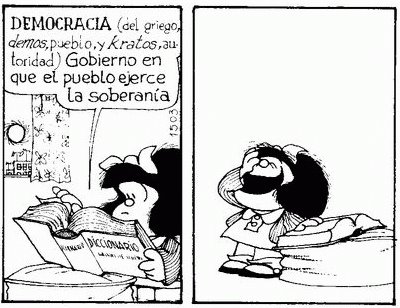
Demos sin cracia

democracia2

Las democracias modernas instituidas como “el gobierno de la mayoría” comenzaron a aparecer ya entrado el siglo XIX y se popularizaron velozmente.  Al lado de ella, la promoción de los ideales del sufragio universal, la igualdad de derechos y obligaciones entre hombre y mujer, la abolición de la esclavitud y del trabajo forzoso de curso legal, entre otros principios empezaron a dispersarse como un veloz germen en las sociedades occidentales y sus ex-colonias.  Han pasado ya 200 años desde que el germen democrático se dispersó por el mundo.  Sin embargo, los más recientes acontecimientos que han perturbado el flujo de las democracias de mayorías se ha visto afectado en Ucrania, Venezuela y desde hace dos días en El Salvador.

¿Por qué será que el ideal de la democracia ha “fallado” en estos países? 

Los argumentos a favor y en contra son muchos y muy complejos. Deben ser comprendidos desde distintas perspectivas y entender las posiciones tomadas por todos los actores que se han visto afectados de manera directa e indirecta por estos eventos.  Nosotros, el resto del mundo observador, podemos participar con ideas para ojalá descubrir más preguntas en nuestro camino. Hoy quiero compartirles una idea que cruzó por mi mente.

¿Acaso nuestro problema no ha sido que hemos tenído más “demos” que “cracia” en nuestro gobierno y en el desarrollo de nuestro rol ciudadano?

¿A qué me refiero con esto?

El término democracia es antiguo y complejo y se forma a partir de los vocablos “demos” traducido al castellano como -pueblo y/o poder- y “cracia” que indica un -gobierno o sistema-.  Así y actualizando el término desde la antigua Grecia a nuestros días, la democracia se refiere al gobierno del pueblo.

¿Pero acaso no ha sido el pueblo el que se ha volcado a la rebelión en Ucrania, Venezuela y El Salvador? Entonces, ¿la democracia reaccionó en estos países contra la democracia?

Quizás lo que ocurre en estos tres países (que son producto de la colonización y de la subyugación a los imperios durante la Guerra Fría) es que quizás no han pasado el suficiente tiempo en independencia institucional y maduración de sus gobiernos como para lanzarse desbocados a procesos democráticos que deben ir de la mano de una reforma educativa y cultural de la ciudadanía.  Pero, ¡alto! Que conste, que no me refiero a que estos países post-coloniales y post-guerra fría deban regresar bajo el control de un dictador o de una metrópoli.  Sino que, la participación del pueblo (demos) no debería avanzar cuando se ha descuidado o se ha impedido continuar el proceso de institucionalización de la democracia en la vida ciudadana.

Ucrania, Venezuela y El Salvador tienen como un común denominador la inmensa pobreza y la enorme desigualdad educativa y cultural entre la elite gobernante que heredó el poder de sus antiguos amos colonizadores y el grueso de la población. La mayoría de la población en estos países ha sido condicionada a servir como un “agente legitimador” al momento de ejercer su voto pero no se le ha permitido adquirir conciencia absoluta de su rol como “ciudadano legitimador empoderado”. Porque es su voto el que le permite exigir responsabilidad, honestidad y resultados en el equipo de gobierno que eligió en las urnas.

Titulo: 7 killed in post-election protests
Via: FoxNews

En Venezuela ha sido la población cansada y agotada de la corrupción la que ha tomado conciencia del poder de su voto al exigir la renuncia del gobierno revolucionario (aún a pesar de que recientemente había sido electo por el voto de las mayorías).  Es acá que el pueblo ha empezado a ilustrarse en su poder como votante y garante.

Titulo: Days of Protest in Ukraine
Via: The Atlantic

En Ucrania ha sido el pueblo el que también ha tomado conciencia del poder de su voto y de su derecho de autodeterminación pidiendo la anexión de Crimea y su mayoría étnica rusa a Rusia debido a sus distintos intereses económicos, políticos y culturales con el resto del país.

Titulo: El TSE pidió a los contendientes que respeten los resultados que el pueblo decida.
Via: http://www.lapagina.com.sv

Y en El Salvador desde el día lunes debido a que las elecciones presidenciales concluyeron con una cercana diferencia de votos entre los partidos ARENA y FMLN. ARENA rechazó el conteo de las elecciones luego del anuncio de su derrota. 6,000 votos marcaron la diferencia y el partido ARENA rechazó la legalidad del proceso democrático.

Espero que no sea aún tarde para extender una invitación a reflexionar a los ciudadanos salvadoreños sobre el funcionamiento del gobierno democrático y de la necesidad de estudiarlo a más profundidad y, quizás, comprender que el voto de la mayoría (aún si efectivamente ganará por 6mil votos de diferencia) no es garante suficiente de legitimidad.  Y que, es urgente que ambos partidos realicen un pacto serio, democrático y honesto antes de queso se derramé una sola gota de sangre.

En Venezuela, Ucrania y El Salvador es aún posible alcanzar acuerdo y pactos de concertación que partan del respeto al gobierno democrático y que busquen una inclusión de ideas, actores y modificaciones a los actuales procesos en los que el Pueblo (demos) colabore en la construcción y progreso del del Sistema de gobierno (cracia).

Esto evitará muertes y violaciones a los derechos individuales.  Pero más importante aún, permitirá la evolución y maduración de sistemas democráticos de gobierno en estos países que aún ahora se vieron afectados por la injerencia de los poderes imperiales en sus asuntos. Que envidia que en estos países quizás estén a las puertas de un desarrollo democrático del cual nuestros países vecinos podrían aprender mucho.