- Why is there no Rooseveltian school of foreign policy? Deudney & Ikenberry, Foreign Policy
- It’s time to drop the curtain on Japan’s colonial legacy Meindert Boersma, Lausan
- The ides of August (Afghanistan) Sarah Chayes (h/t Mark from Placerville)
- Rep. Barbara Lee on Afghanistan, 20 years later Abigail Tracy, Vanity Fair
Links
Nightcap
- Property rights imply social liability, not privilege Rosolino Candela, EconLog
- The lingering scars of World War I Cal Flyn, Atlas Obscura
- Is the Arctic turning blue? (hawkish) Sonoko Kuhara, Diplomat
- Myanmar (or is it Burma?) Zachary Abuza, War on the Rocks
Nightcap
- Placing the American secession in global perspective Steven Pincus, Age of Revolutions
- Trotsky after Kolakowski Branko Milanovic, globalinequality
- A guide to finding faith Ross Douthat, New York Times
- Cancel culture: A recantation Irfan Khawaja, Policy of Truth
Nightcap
- Art and exile in the Third Republic Hannah Stamler, the Nation
- Spending on infrastructure doesn’t always end well Richard White, Conversation
- Kabul and Chicago NEO, Nebraska Energy Observer
- The price of Tucker Carlson’s soul Andrew Sullivan, Weekly Dish
Nightcap
- A fourth globalization Marc Levinson, Aeon
- The Brazilianization of the world Alex Hochuli, American Affairs
- On American foreign policy Eric Schliesser, Digressions & Impressions
- Whither sovereignty Scott Sumner, EconLog
Some Monday links
I didn’t see a draft by Michalis this week, so I thought I’d jump in and substitute. I hope is well with everybody.
Some Monday Links
Symposium: Washington Consensus Revisited (Journal of Economic Perspectives)
Three Days at Camp David: The Fiftieth Anniversary (The International Economy)
Friends, Romans, Countrymen (Lapham’s Quarterly)
Some Monday Links
Japan’s Offbeat Olympics Opening Ceremony (Hyperallergic)
Stick a logo on it: the Olympics and the mediocrity of contemporary design (Prospect)
The Best-Selling Car in America, Every Year Since 1978 (Visual Capitalist)
Some Monday Links
Vaccine Mandates and Personal Liberty Can Coexist (Bloomberg)
Although the sentiment may seem paradoxical, libertarians should cheer this week’s decision by a federal judge upholding Indiana University’s vaccine mandate for students.
So argues professor Stephen L. Carter in this interesting piece. In short, a mandate checks the boxes if it is instated in a decentralized and narrow fashion.
Berlin in 1946 was a cultural battlefield unlike any before (Crime Reads)
Dismal Economics (Project Syndicate).
A review of four books challenging mainstream, neoclassical economics. In The Corruption of Economics, the author Mason Gaffney (btw, he passed away just over a year ago) proposes that the 19th century’s American universities perceived Georgist ideas as a threat to their vested interest in land-owning, and actively suppressed them. His work on the Stratagem against Henry George has been referenced in a NOL piece by – the also late – Fred Foldvary.
Some Monday Links – Of bloody summer stains, busted hopes and laundries
Also lingo. And beards.
Why Cuba is having an economic crisis (Noahpinion)
The Language of Totalitarian Dehumanization (Quillette)
On the Cuba events. Governments and protests, now that’s a strained relationship. Talking about the so-called “Second World” countries, Nikita Khrushchev did not even know what booing is, until he encountered it in his visit to London in 1956.
Few years later, during a massive strike in the Russian city of Novocherkassk, a crowd stormed the central police station. Whether it was a genuine assault, or a naive display of defiance from a people inexperienced in protesting, the government’s fearful puzzlement turned to cold, brutal aggression. Unarmed protesters at the center of the city, mistakenly thinking that those days were over, remained steadfast at the face of warnings to disperse. That is, until security forces opened direct fire against them. The ensuing massacre was covered-up for three decades. Since this was an à la Orwell un-event, no high-ranking officials’ records were stained.
Khrushchev’s aloof ignorance strikes a nerve, contrasted with the people’s heartbreaking one. Both glimpses are captured in the brilliant (though somewhat uneven) Red Plenty, by Francis Spufford.
All things said, Karl Marx Loved Freedom (Jacobin). More beards.
The Greek government, like its French counterpart, is escalating the push for vaccinations. As constitutional scholars argue the limits of state power regarding personal freedom and the public good, historical precedents are brought forth (for the US, c. early 1900s), involving mandatory vaccinations, quarantines and discrimination. The discussion draws from equal protection of the laws jurisprudence and smoothly led me to Yick Wo v. Hopkins (1886):
Yick Wo v. Hopkins established fair implementation of statutes (History Net)
The decision set a milestone and has been cited some 150 times.
The backdrop of the case is rich. As it turns out,
An 1880 ordinance of the city of San Francisco required all laundries in wooden buildings to hold a permit issued by the city’s Board of Supervisors. The board had total discretion over who would be issued a permit. Although workers of Chinese descent operated 89 percent of the city’s laundry businesses, not a single Chinese owner was granted a permit.
Oyez
The regulation was one in a series of many that reflected the anti-immigrant (especially anti-Chinese) sentiment, following the influx due to the Gold Rush (1849).
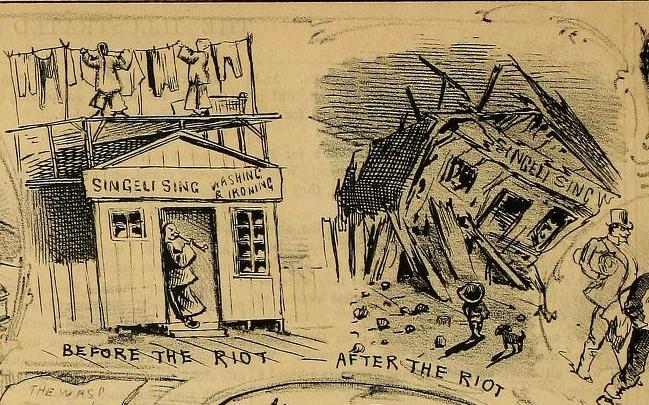
Yick Wo: How A Racist Laundry Law In Early San Francisco Helped Civil Rights (Hoodline)
A particularly badass line, from the unanimous opinion authored by Justice Stanley Matthews, shows that the Court did not hold back:
Though the law itself be fair on its face and impartial in appearance, yet, if it is applied and administered by public authority with an evil eye and an unequal hand, so as practically to make unjust and illegal discriminations between persons in similar circumstances, material to their rights, the denial of equal justice is still within the prohibition of the Constitution.
Monday Links, sticks and two (or maybe three) smoking sentences
Gangsters vs. Nazis (Tablet)
How the Jewish mob fought American admirers of the Third Reich. An excerpt:
Judd Teller, a reporter for a New York Jewish daily, relates how he met one day with “several men who said they were from ‘Murder, Incorporated’ and wanted a list of ‘Nazi bastards who should be rubbed out.’” Teller took the request to Jewish communal leaders. They told Teller that if the plan would be put in motion, “the police would be informed promptly.” Teller relayed this warning to his Murder, Inc. contact. Upon hearing this, the mobster angrily replied, “Tell them to keep their shirts on. OK, we won’t ice [murder] the bodies; only marinate them.” According to Teller, this is exactly what they did. He said the attacks by the Jewish mobsters was sufficient “marination” to drastically reduce attendance at Nazi Bund meetings, and discouraged Bundists “from appearing in uniform singly in the streets.”
The Inimitable Orwell (Commonweal)
On the Politics and the English Language essay. I try to stick to the six rules, but I fear I am not totally “outright barbarous”-proof. Another list with writing rules – a more light-hearted one – comes from Umberto Eco, the noted Italian scholar:
Umberto Eco’s 36 Rules for Writing Well (Openculture)
Speaking of proper phrasing, here is a passage from Lysander Spooner (Thomas L. Knapp posted it in the comments section of a NOL piece by Jacques Delacroix):
[W]hether the Constitution really be one thing, or another, this much is certain — that it has either authorized such a government as we have had, or has been powerless to prevent it. In either case it is unfit to exist.
Now, I may have found the second prospective opening for my public policy course, should I ever offer one (the absurd part is that I lack almost everything else to supply it, demand included). It is pithy, sharp and, importantly, timeless. The alternative one-liner I would possibly pen day one at the imaginary class:
Property imposes obligations. Its use by its owner shall at the same time serve the public good.
Weimar Constitution (1919), art. 153(c)
While not as punchy as Spooner’s aphorism, it has qualities and can raise eyebrows. Both phrases are metal. Independent of context, they have more or less exactly what it takes to pick and stick. Perhaps both of them should set the opening, leaving the audience free to choose the way forward.
Back to Spooner. Another prominent figure (of American individualist tradition this time) I had not heard of till this day.
Lysander Spooner (Online Library of Liberty). The particular passage comes from his No Treason. No. VI. The Constitution of No Authority (1870).

I took note that he challenged the government monopoly in mail services (a field with quasi-military structure, typically used as a matrix to consolidate state bureaucracy/ power, btw) with his American Letter Mail Company, on ethical and economic grounds. The state finally forced him out of business in 1851, though competition temporarily drove fees down.
(If you care about post stamps – I don’t – USPS to issue Ursula K. Le Guin stamp this month (Book Riot). I enjoyed Le Guin’s Earthsea and plan to read The Dispossessed, a veiled study of social systems I hear, before summer end)
If anything, Spooner seems to have shared the fiery convictions and language of his contemporaries at the First International. That was a time of memorable lines, obviously. This easily comes to mind:
The history of all hitherto existing society is the history of class struggles.
The Communist Manifesto (1848)
They also sported some serious beards. Those of Spooner and Marx are respectable, but I would award James Guillaume’s bonus points for the extra menacing vibe.
Some Monday Links
(US) inflation?
YES — Is the Fed Getting Burned Again? (Project Syndicate)
NO — In the Fed We Trust (Foreign Affairs)
TENTATIVE — Is the Phillips Curve Back? When Should We Start to Worry About Inflation? (Niskanen Center)
The dimming of the light (Aeon). Adds some color to this brief-but-thick (and somewhat pessimistic) exchange with Jacques Delacroix.
Fast Cars, Wide Roads, Blue Skies: Vintage Postcards From Across America (Flashbak)
Some Monday Links
Never-Before-Published Hannah Arendt on What Freedom and Revolution Really Mean (Literary Hub)
Boom and Gloom (Claremont Review of Books)
The Bitcoin Law: Counterfeit Free Choice in Currency (Alt-M)
Huge Diego Rivera mural about to go up at SFMOMA (The Mercury News)
NOL has revisited works of Diego Rivera here (this particular mural, aka Pan American Unity) and here (another mural, Frozen Assets – Fondos Congelados – from 1931).
Some Monday Links
Redefining Death (National Review)
Some medical devices don’t mean to be racist, but they are (Psyche)
Monetary Meld (IMF)
And, inspired by this NOL discussion here,
A History of My Economic Opinions (Deirdre McCloskey)
This is a long, but enrapturing piece (I am not familiar with McCloskey’s work, which was also referenced en passant in another fresh NOL post). An excerpt:
I happened in 1958 to devour in the Andrew-Carnegie financed public library of Wakefield, Massachusetts the Russian prince Pyotr Kropotkin’s Mutual Aid: A Factor of Evolution (1902) and the gullible American journalist John Reed’s Ten Days That Shook the World (1919). If I had instead come across Rose Wilder Lane’s The Discovery of Freedom (1943) or Ayn Rand’s Atlas Shrugged (1957) I suppose I would have gotten a better grasp of market pricing, earlier. Many market-loving classical liberals came to liberalism by that free-market path, and were never socialists. Yet the socialism-to-liberalism route is very common in 20th century political biographies, such as Leszek Kołakowski’s or Robert Nozick’s or, to descend a couple of notches, D. N. McCloskey’s. (The contrary route from market liberal to state socialist is vanishingly rare.)


_-_Local_Chips_(cropped).jpg)
