Greenland and the Spirit of 1776

On this sacred 250th anniversary of our Republic’s birth, to fully grok how the liberation of Greenland can fulfill our unextinguishable Spirit of 1776, we must discard the outdated notion that the Arctic is a frozen, peripheral wasteland. 

Throughout my career analyzing Arctic sovereignty, borderlands, and geopolitics, I have argued (since I was a young man in 1991) that the Far North is emerging as a central arena for global freedom, resource independence, and democratic sovereignty. Upon this July 4th’s sacred, quarter-millenium celebration of our liberty, this long-foreseen centrality has come to pass.

In my view, the Spirit of 1776 is not a static historical event: it is instead an ongoing, dynamic process of expanding self-determination, rolling back old-world colonial empires, and securing our continental perimeter against authoritarian overreach. 

To fulfill our Spirit of 1776 in the 21st century, the United States must extend its democratic umbrella northward! This is not an act of alliance-imploding imperial conquest as Denmark has sought to portray; rather, it is an inclusive act of collaborative liberation

By helping Greenland sever its last colonial ties to Europe and integrating it into North America’s hemispheric security and economic architecture, we can achieve three philosophical and strategic imperatives:

Continental Completeness: We complete the geopolitical vision of the Monroe Doctrine, ensuring North America is entirely governed by consent and free from European or Asian state interference.

Democratic Self-Determination: We empower the Kalaallit (Greenlandic Inuit) people with true economic and military independence, backed by American constitutional guarantees.

Frontier Ethos: We re-ignite the American pioneer spirit on the Arctic frontier, viewing the far north as a dynamic space for democratic civilization.

To help actualize this collabarative liberation, Greenland can craft a Constitution mirroring while customizing our own paradigmatic Constitution. Some key components could include the following.

A Proposed Constitution of the Republic of Kalaallit Nunaat

Preamble

We, the people of Kalaallit Nunaat, grateful to our ancestors who survived and thrived across the Arctic frontier, determined to preserve our culture, our language, and our environment, and committed to the universal principles of human liberty and democratic self-governance, do establish this Constitution for our sovereign Republic.

Article I: Sovereign Status and Geography

  1. The Republic of Kalaallit Nunaat is a sovereign, democratic, and independent nation encompassing the entire island mass of Greenland, its continental shelf, and its territorial waters.
  2. The sovereign power resides in the people, to be exercised through their elected representatives and direct democratic referendums.
  3. The official national languages are Greenlandic (Kalaallisut) and English.

Article II: Bill of Rights and Liberties

  1. Fundamental Rights: Every citizen is born free and equal in dignity. No law shall discriminate based on race, ancestry, language, or creed.
  2. Freedom of Expression: The right to free speech, a free press, and peaceful assembly shall not be abridged.
  3. Property and Private Enterprise: The right to private property is guaranteed. Free-market enterprise is the baseline economic system of the Republic, protected against arbitrary state nationalization.
  4. Indigenous Customs: The collective right of the Inuit people to hunt, fish, and manage local community lands in accordance with sustainable tradition is permanently protected.
  5. The Right to Bear Arms and Self-Defense: The right of the people to keep and bear arms for self-defense, protection against wildlife, hunting, and the security of the Republic shall not be infringed. No law shall prohibit the possession, carry, or responsible use of firearms by citizens. Licensing and registration shall be kept minimal and non-prohibitive to ensure remote families are never left defenseless against the elements or predators.
  6. Inherent Rights to Traditional Harvest and Lifeways: The right of citizens to engage in traditional hunting, fishing, gathering, and harvesting is an unalienable birthright. This includes the absolute right to harvest marine mammals, specifically whaling and sealing, as well as terrestrial fur trapping. The use, breeding, training, and deployment of sled dogs (Qimmit) for transportation and hunting is protected. No administrative regulation or international treaty shall penalize or restrict these practices. The local trade, consumption, or garment-making of legally harvested furs, skins, or traditional foods shall not be criminalized.
  7. Conversion of Ecological Zones to Subsistence Hunting Preserves: All lands previously designated as national parks, restrictive nature reserves, or ecological preserves under foreign administration are permanently converted into National Subsistence Hunting Preserves. The right of local populations to access these lands for subsistence hunting, traditional trapping, fishing, and temporary shelter is absolute and supreme over pure preservationist mandates.
  8. Family Sovereignty and Prevention of Child Removal: The family is the foundational and sacred unit of society. No agency of the state or external non-governmental organization shall have the authority to separate families or remove children from their parental home based on poverty, standard of housing, or adherence to traditional indigenous child-rearing practices. Separation shall be permitted only as an absolute last resort in instances of proven, severe physical harm, established by an independent jury of peers in a court of law. Preferential placement must be given to extended kinship networks and local community members.

Article III: Legislative Branch (Inatsisartut)

  1. Legislative power is vested in a unicameral parliament, the Inatsisartut, consisting of 31 members elected by proportional representation every four years.
  2. It has sole authority to pass domestic laws, levy taxes, approve national budgets, control and restrict immigration, and ratify commercial treaties.
  3. All laws concerning the extraction of critical mineral wealth require a three-fifths supermajority vote.

Article IV: Executive Branch (The Presidency)

  1. The executive power of the Republic is vested in the President, elected by direct popular vote for a term of five years, limited to two terms.
  2. The President serves as the Head of State, Head of Government, and Commander-in-Chief.
  3. Strategic Alliance Provision: The President has the constitutional power, with the consent of parliament, to delegate the external defense and aerospace protection of the Republic to the United States of America under a permanent Compact of Free Association.

Article V: Judiciary

  1. The judicial power is independent of the executive and legislative branches, vested in a Supreme Court and lower regional courts.
  2. The courts interpret the laws of the Republic, integrating western common law with traditional Inuit customary justice.

Article VI: Amendment and Ratification 

  1. Amendments to this Constitution may be proposed by a two-thirds vote of the Inatsisartut or by a petition signed by twenty percent of registered voters.
  2. An amendment becomes valid only when ratified by a majority vote of the citizens in a nationwide referendum.

Why This Fulfills the Spirit of 1776

Greenland’s current status under the Danish Realm represents a lingering anomaly of old-world European colonialism. While Nuuk has enjoyed increasing “Home Rule” and later “Self-Rule” governance, its security, defense, and monetary systems remain anchored in Copenhagen, with multiple levels of continuing dependency.

The Rejection of Imperial Feudalism: The Spirit of 1776 revolted against a small island nation in Europe governing a vast continent across the sea. Denmark’s management of Greenland inverse-mirrors this dynamic with a small continental nation governing a vast North American Arctic island. Facilitating Nuuk’s exit completes the decolonization of the Western Hemisphere.

Guarding the Empire of Liberty: Thomas Jefferson envisioned a continental space where democratic institutions could multiply safely. By more tightly integrating Greenland into America’s hemispheric perimeter, we can more ably protect critical minerals and contested seabeds from our rivals, while expandine the rule of law and the zone of liberty.

Self-Actualization of Indigenous Peoples: My scenario of liberation places the Kalaallit people at the center of their own destiny. By partnering with the United States, they trade a paternalistic European welfare state for a high-growth, constitutionally protected partnership, becoming absolute masters of their own nation.

It is time for their colonial dependency to end. It is time for the whole of North America to be free. It is time, on this sacred quarter millennium since America’s birth, for Greenland to declare its own independence, and to join us in the brotherhood of nations and free peoples. Let our 250th Independence Day become Greenland’s first!

Some Monday Links, in feary tales

Two sleeping beauties (the one has probably awaken), Pinocchio, and France.

Economic transitions aren’t transitory (The Hill)

Adam Posen is hardly an inflation alarmist. UK, 10 years ago. A nascent recovery and an inflation surge had Bank of England split on the way forward. He alone, as a member of the institution’s monetary policy committee, argued for more stimulus, deeming – correctly, with the benefit of hindsight – the inflation overshoot as temporary. That was in a world still relatively new in lowflation, central bank QE programs and suppressed interest rates, mind you. Today, he thinks quite different for the US.

Property is not (just) private (Verfassungsblog)

A ghost in the shell of German constitution haunts Berlin – the ghost of socialization. Article 15, which enables it, “has survived the decades, preserved and untouched and peculiarly history-less: no cases, no judgments, hardly any academic, economic and political interest”. Until now.

Why the French are revolting (UnHerd)

On pissed off French and their fighting chops (indeed, the Hellenic Military Academy, seemingly one of the world’s finest, was founded on French standards back in 1828). The author somehow missed that the French national anthem, La Marseillaise, is a literal call-to-arms.

Is the Original Pinocchio Actually About Lying and Very Long Noses? (Literary Hub)

About the famous work of a not-so-famous, disillusioned liberal in the freshly unified Italy of latter 19th century. Sheds some light at the sinister backdrop of the era (poverty, child labor and the like).

Monday Links, sticks and two (or maybe three) smoking sentences

Gangsters vs. Nazis (Tablet)

How the Jewish mob fought American admirers of the Third Reich. An excerpt:

Judd Teller, a reporter for a New York Jewish daily, relates how he met one day with “several men who said they were from ‘Murder, Incorporated’ and wanted a list of ‘Nazi bastards who should be rubbed out.’” Teller took the request to Jewish communal leaders. They told Teller that if the plan would be put in motion, “the police would be informed promptly.” Teller relayed this warning to his Murder, Inc. contact. Upon hearing this, the mobster angrily replied, “Tell them to keep their shirts on. OK, we won’t ice [murder] the bodies; only marinate them.” According to Teller, this is exactly what they did. He said the attacks by the Jewish mobsters was sufficient “marination” to drastically reduce attendance at Nazi Bund meetings, and discouraged Bundists “from appearing in uniform singly in the streets.”

The Inimitable Orwell (Commonweal)

On the Politics and the English Language essay. I try to stick to the six rules, but I fear I am not totally “outright barbarous”-proof. Another list with writing rules – a more light-hearted one – comes from Umberto Eco, the noted Italian scholar:

Umberto Eco’s 36 Rules for Writing Well (Openculture)

Speaking of proper phrasing, here is a passage from Lysander Spooner (Thomas L. Knapp posted it in the comments section of a NOL piece by Jacques Delacroix):

[W]hether the Constitution really be one thing, or another, this much is certain — that it has either authorized such a government as we have had, or has been powerless to prevent it. In either case it is unfit to exist.

Now, I may have found the second prospective opening for my public policy course, should I ever offer one (the absurd part is that I lack almost everything else to supply it, demand included). It is pithy, sharp and, importantly, timeless. The alternative one-liner I would possibly pen day one at the imaginary class:

Property imposes obligations. Its use by its owner shall at the same time serve the public good.

Weimar Constitution (1919), art. 153(c)

While not as punchy as Spooner’s aphorism, it has qualities and can raise eyebrows. Both phrases are metal. Independent of context, they have more or less exactly what it takes to pick and stick. Perhaps both of them should set the opening, leaving the audience free to choose the way forward.

Back to Spooner. Another prominent figure (of American individualist tradition this time) I had not heard of till this day.

Lysander Spooner (Online Library of Liberty). The particular passage comes from his No Treason. No. VI. The Constitution of No Authority (1870).

The Wings of Competition in Things Daily – Source

I took note that he challenged the government monopoly in mail services (a field with quasi-military structure, typically used as a matrix to consolidate state bureaucracy/ power, btw) with his American Letter Mail Company, on ethical and economic grounds. The state finally forced him out of business in 1851, though competition temporarily drove fees down.

(If you care about post stamps – I don’t – USPS to issue Ursula K. Le Guin stamp this month (Book Riot). I enjoyed Le Guin’s Earthsea and plan to read The Dispossessed, a veiled study of social systems I hear, before summer end)

If anything, Spooner seems to have shared the fiery convictions and language of his contemporaries at the First International. That was a time of memorable lines, obviously. This easily comes to mind:

The history of all hitherto existing society is the history of class struggles.

The Communist Manifesto (1848)

They also sported some serious beards. Those of Spooner and Marx are respectable, but I would award James Guillaume’s bonus points for the extra menacing vibe.

Small thought on the fundamental revolution of Blockchain

Mankind made a huge leap forward regarding human organization when it implemented the Constitution. Man was no longer to be ruled by kings and despots, but by a document that stipulated the rule of law. Still, we had the issue of who was going to interpret these laws and who was allowed to add new rules.

Now, we have made another revolutionary leap forward in human organization. We don’t need a third party – kings, governments, courts – to interpret the laws anymore if we have self-executing smart contracts that eliminate the need to trust these third parties. Trust is established through mass collaboration and clever code. On top of that, everyone is free to opt-in, to submit new rules, and to participate in a set of rules. No one is forced to participate. You can always secede. We have had many secessions in the blockchain space. Bitcoin Cash seceded from Bitcoin Core, Ethereum seceded from Ethereum Classic etc. It is therefore a peaceful means to organize human beings.

This is, in my opinion, the fundamental revolution of blockchain: a peaceful trust machine for social agreements and human organization.

Blockchain trust

The Tyranny of Darth Obama

Commentary by LA Repucci

 November 14th, Washington DC

President Obama spoke from the White House this morning regarding a proposed ‘fix’ to his failed health care policy in an effort to edify his fellow democrats through the next election cycle.

After publicly promising the American people that they could keep their insurance plans 30 times, the president has received flack due to the fact that millions are losing their insurance policies due to the Affordable Healthcare Act, commonly referred to as Obamacare.

In his address this morning, the president announced a ‘delay’ of the portions of the law to enable insurers to re-instate individual policies purchased on the “old individual market” to avoid losing their coverage…presumably, for another year.  Obama offered no details or legal explanation as to how this radical change in the law of the land would be implemented.

Okay — let’s suspend the fact that our Constitution very clearly states the government is prohibited from compelling the people to purchase a product or service.  Let’s pretend that the government, having betrayed this constitutional provision time and again (Social Security comes to mind), may simply call a compulsion to purchase a ‘tax’ as chief justice Roberts ruled regarding the health insurance mandate, circumvent one of the clearest directives of the US Constitution, and may compel the people to purchase a product or service. Even with this egregious transgression of the sovereignty of the people as a given, the State seems unable to obey its own new laws these days.  The federal government has been exposed time and again in the last few months (and decades) as the primary and frequent transgressor of our laws – the confirmed reports of illegal mass warrant-less surveillance are only the latest example of complete disregard for and perversion of the law to come from this administration.

There is a single mechanism by which our federal government transgresses the will of the people; one over-arching distortion of sanity by which the administration, law-makers and courts continue to exploit (at accelerating pace) and abridge the will of the people.  President Obama is merely the culmination of this singular corruption of constitutionality that transforms our nation from the rule of law toward the rule of tyrants.  As a student of constitutional law, Mr. Obama must know precisely what he is doing. Even if he didn’t, ignorance would not save his neck from the block that is the US constitution.

The truth is this:  all three branches of the federal government disregard the rule of law.  They are all traitors to the republic, and as such, should be tried, convicted, and sentenced for high treason.

How can a president (and constitutional scholar) mandate the people’s purchase of a product in clear violation of our supreme law, then claim the power to arbitrarily change his own law simply by decree?  The answer is two-fold.  First, a legitimate president cannot – a tyrant can and will do anything they please.  Second; as a tyrant by definition does not respect law in any case, once abridged, law may be changed without the legislative process or will of the governed, by decree.

Obamacare is unconstitutional – the state-appointed high-priests of the Supreme Court aren’t required to understand that simple point.  As an unconstitutional law issued by the fiat of a tyrant, supported by a false legislative process of ‘democracy’, it should be taken as given that law will now be dictated from the executive office out of hand, as the now impotent legislative and judicial bodies meekly question ‘can the president make law by decree? Law, by definition, is the littoral antipode of decree.

Dictation is the province of dictators – those who would destroy the rule of law and institute the rule of decree.  Ayn Rand prophesied this exact eventuality for American politics in her opus Atlas Shrugged, within the pages of characters decry ‘pragmatic, relative flexibility’ to be superior to principle.  When the state abandons duty to the law of the people, then it is the duty of the people to abandon the state.  A state that represents not the interest of the people, is anathema to the rule of law. According to Rand’s prophecy, this perversion of the very concept of law will accelerate dramatically as more ad-hoc tyrannical declarations are needed to patch the tower of babel created by the abomination that is the rule of man.  If Rand is right, this will all get much more absurd and destructive before it gets any better.

Obama’s decree this morning illustrates the now obvious point that the Affordable Health Care Act is HIS law, and not the law of the people.  The people change laws through the legislative process and the ballot — a tyrant changes his laws by decree.

Gravity is a law.  It needs no paper legislation, no judicial review, no vote of democratic tyranny to ‘be’ a law. It is a natural force acting upon reality whether people consent to it or not.  Markets are the same – they are a natural law.  They exist whether or not they are acknowledged by the state — and will continue to exist so long as there is a society within which to emerge and operate.  ‘Regulating’ an economy or market is akin to regulating gravity.  Paper law — Obama’s law, is not law at all. In fact, it is now specifically the opposite of law – it is the whim and decree of a despotic megalomaniac — it is Canute ordering the tides back.  Let’s all hope this tyrant drowns quickly so that our nation may once again be ruled by the laws of the natural universe, and the US government may return to performing its sole legitimate function – safeguarding the liberty of the people against tyrants like Obama.

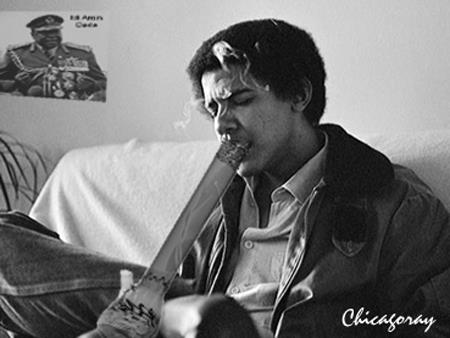
Image

Our President minored in bong rips, honoring his predecessors’ commitment to cocaine and drunk driving.

I am considering sending Mr. Obama a copy of Bastiat’s “The Law” – apparently, this foundational primer, along with Locke and Jefferson aren’t required reading in the Columbia University constitutional law curriculum.  Is it intellectually honest to assume that the nations’ chief executive is ignorant of the school of thought that is the genesis of our nations’ supreme law?  Likely not – either Mr. Obama is ignorant of the very nature and definition of law itself, or he is openly perverting its’ mechanisms in an effort to destroy the liberty of the people and supremacy of the Constitution.  Darth Sidious, evidently, trained another apprentice after the death of Vader.

Oh Jedi, where art thou?


Disgusted and Furious,

LA Repucci