Some Monday Links

Ulysses at 100: why Joyce was so obsessed with the perfect blue cover (The Conversation)

“Context is that which is scarce” (Marginal Revolution)

I had sensed this in training modules, but couldn’t quite put my finger on it. A good instructor, apart from presentation skills, should also provide just the right amount (sic) of context.

America’s Long War on Cancer: What Was It Good For? (Bloomberg)

Some tidbits of context for things Vishnu wrote about here.

The Price of Nails since 1695: A Window into Economic Change (Journal of Economic Perspectives)

Yes, Let’s Call ‘Beijing’ Peking (National Review)
Some Monday Links

How to Tell Africa’s History? (LA Review of Books)

Lost in Translation (Commonweal)

The Attack of Zombie Science (Nautilus)

Yogurt’s Long Journey (Tablet)

Diego Rivera by Francisco de la Mora and José Luis Pescador review – rumbustious hymn to a radical artist (The Guardian)

Rivera has been featured in NOL a few times.

Monday’s Link

The battle over the Tomb of the Unknown Soldier (eKathimerini)

About one of the many similar monuments around the world. If you ‘ve been in Athens, Greece, you have probably visited it. An excerpt:

Such controversies, however, underscore the importance of how public space is designed – in terms of both architecture and art – and not just with regard to how it helps form relationships and movements, or determine how a city is viewed, but also in how it contributes to the creation of collective memory and identity. To the manner, in short, that the central authority and society of any given era chooses to cast its relationship to the past and to address the future.

Some Monday Links: Mostly Econ, again

The worldly turn (Aeon)

The chocolate route (Aeon)

For the Woke warriors, culture and economics are two sides of the same coin – just ask Mollie-Mae (CapX)

Optional.: Knowing who Mollie-Mae actually is.

Measuring the Essence of the Good Life (Finance & Development)

Nightcap: Development with Dignity (NOL)

Great Stories and Weak Economics (Regulation)

Digital currencies and the soul of money (BIS)

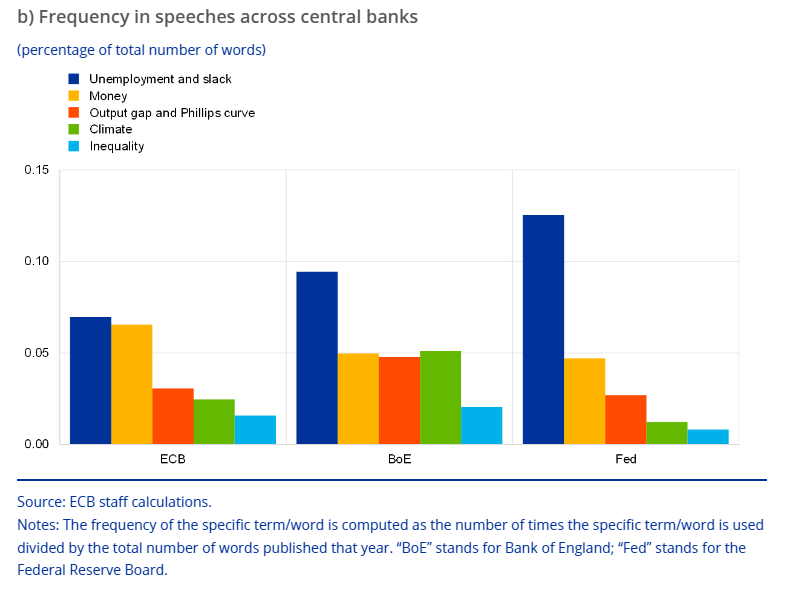
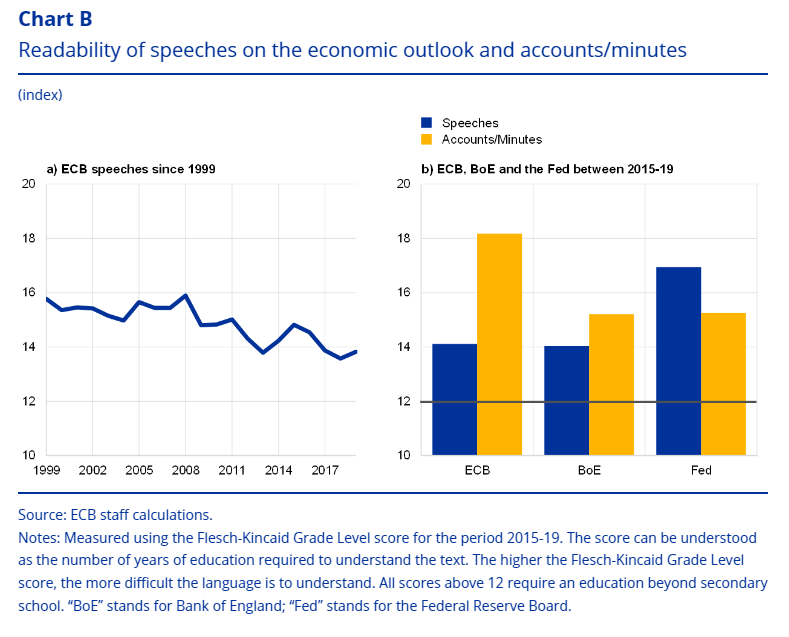
To close this, a couple of neat graphs from the European Central Bank. The first one shows a measure of central bank messages’ clarity , the lower the number, the better. The second graph demonstrates the frequency (a proxy for significance) of some buzzwords. As old Korean masters comment when comparing various strands of their art, the major central banks are “same, same, a little different“.

Source
Source

Some Monday Links

Burning the witch (New Humanist)

Not as funny as it may sound.

Will nudge theory survive the pandemic? (UnHerd)

From an ex-member of the UK Nudge Unit:

[I]t may be worth reflecting on where we need to draw the line between the choice-maximizing nudges of libertarian paternalism, and the creeping acceptance among policy makers that the state should use its heft to influence our lives without the accountability of legislative and parliamentary scrutiny.

Why Do We Return to the Greek Myths Again and Again? (LitHub)

Olympus, Texas?

French Socialism Embraced Neoliberalism and Signed Its Death Warrant (Jacobin)

The usual disclaimers on the use of term neoliberalism apply.

The Periodic Table of Commodity Returns (2012-2021) (Visual Capitalist)

Nightcap

  1. Remembering Christopher Hitchens John Rodden, Commonweal
  2. Is Vladimir Putin preparing for war? Bruno Maçães, New Statesman
  3. Russia does not want war in Ukraine Mary Dejevsky, spiked!
  4. What won the Cold War Daniel McCarthy, Modern Age

Nightcap

  1. The global recession of classical liberalism John McGinnis, Law & Liberty
  2. Where are we making progress? Scott Sumner, EconLog
  3. Anthropology has turned its back on its legacy Peter Wood, Spectator
  4. The spiritual space of Rus Vs. NATO Nathan Gardels, Noema

Nightcap

  1. One of history’s great transportation infrastructure projects (pdf) Dave Donaldson, AER
  2. Thomas Mann’s defense of the nonpolitical Adam Kirsch, City Journal
  3. Habsburg state-building in the Long Nineteenth Century (pdf) Robert Mevissen
  4. World order re-founded: The idea of a concert of democracies (pdf) Emiliano Alessandri, TIS

Nightcap

  1. State anarchy as order (pdf) Hendrick Spruyt, International Organization
  2. Classical liberalism, world peace, and international order (pdf) Richard Ebeling, IJWP
  3. Sovereignty in Mesoamerica (pdf) Davenport & Golden, PSP-CM
  4. The distributive state in the world system (pdf) Jacques Delacroix, SCID

Nightcap

  1. The colonization cost theory of anarchic emergence (pdf) Vladimir Maltsev, QJAE
  2. How Africa made the modern world Dele Olojede, Financial Times
  3. Gorbachev’s Christmas farewell to the Soviet Union Joseph Loconte, National Review
  4. How I did not celebrate Christmas (in Yugoslavia) Branko Milanovic, globalinequality

Some Monday Links

How Do We Define The Nightmare Before Christmas? (Tor)

How an iconic Canadian rock band lured angry teens to the dark arts of Ayn Rand. (LitHub)

Ill Liberal Arts (The Baffler)

Genghis Khan, Trade Warrior (FED Richmond)

Some Monday Links

The First World War battle that actually went to plan (Prospect)

The Eyes Have It (Quillette)

Kinship Is a Verb (Orion)

Vishnu used a similar play of words here.

How the University of Austin Can Change the History Profession (Law & Liberty)

New York, plus ça change: Chinatown under threat (Crimereads)

“Blood is Thicker Than Water: Elite Kinship Networks and State Building in Imperial China”

A long tradition in social sciences scholarship has established that kinship-based institutions undermine state building. I argue that kinship networks, when geographically dispersed, cross-cut local cleavages and align the incentives of self-interested elites in favor of building a strong state, which generates scale economies in providing protection and justice throughout a large territory. I evaluate this argument by examining elite preferences related to a state-building reform in 11th century China. I map politicians’ kinship networks using their tomb epitaphs and collect data on their political allegiances from archival materials. Statistical analysis demonstrates that a politician’s support for state building increases with the geographic size of his kinship network, controlling for a number of individual, family, and regional characteristics. My findings highlight the importance of elite social structure in facilitating state development and help understand state building in China – a useful, yet understudied, counterpoint to the Euro-centric literature.

Read the whole thing (pdf).

Some Monday Links (extend, not pretend version)

The Strange Career of Paul Krugman (Tablet)

If anything, it warrants at least some praise for finally giving a date to an oft-cited, curiously undated essay by Krugman, Ricardo’s difficult idea.

Learning Sixteenth-Century Business Jargon (Lapham’s Quarterly)

Brainwashing has a grim history that we shouldn’t dismiss (Psyche)

Made in Japan – source

Another Case Against Science’s Objectivity Myth: Nepotism in Publishing (The Wire Science)

Who Controls the Narrative?: On David M. Higgins’s “Reverse Colonization: Science Fiction, Imperial Fantasy, and Alt-Victimhood” (LA Review of Books)

Hasui Kawase’s Beautiful Prints of Japanese Landscapes (Flashbak)

“Federations, coalitions, and risk diversification”

[…] while we recognize that issues of participation in a coalition involve complex factors, there has been little discussion in the literature from a risk-sharing perspective. It is well-known in financial economics that the pooling of resources and the spreading of risk allows investors to realize a rate of return that approaches the expected rate. We take this to be a natural motive for federation formation among a group of regions. Indeed, the existence of an ancient state in China (the example given in the next section) supports our intuition. It appears that floods, droughts and the ability of a centralized authority to diversify risk paved the way for the unification of China as early as 2000 years ago. Thus, our approach is not empirically irrelevant.

Click the “pdf” tab on the right-hand side, not the “buy PDF” tab.