Trump’s Inauguration: Ageing Pains

fa87a4aa3343c8063a073e8f11be03b29c8f12e7e1973f5b4f6808bf4e0760fd

Vincent has discussed the relative age of US presidents. There is something to be said about the age of electorates.

I was living in the United Kingdom when we voted for Brexit (I was a soft remainer). I was living in the United States when Trump won the election. So I can’t help but feel that Trump’s inauguration is part of a generalised nationalist turn that, ironically, transcends national borders. Why is this nationalist turn happening? And why has it wrong-footed pollsters and political scientists more than once now?

We are repeatedly, and correctly, warned not to over-interpret individual events as somehow determined by given factors. Both the Brexit vote and the presidential election were close, with Trump taking the electoral college without the popular vote. One domino that didn’t fall last year was the Austrian presidency that, after a close call, went to a Green rather than a Nationalist. So whatever explanation we are looking for has to be a tendency that’s slightly shifted the odds in favour of nationalist politicians without the experts being able to anticipate it in advance.

Some suggest that this resurgent economic nationalism is an inevitable outcome of the overreach of trade liberalisation that has undermined national self-determination and humiliated local cultures. Others argue that the real cause is growing income and wealth inequality. I think a potentially more straightforward factor is demography. The electorate is simply older than it used to be.

There are a few reasons why this explanation may work better than the more popular ones. The ageing electorate is almost unprecedented in history. This could make it harder for political scientists to predict its impact on elections. Surveys might be able to tell us how older people vote as individuals without being able to work out how older people surrounded, in addition, by lots of older peers will behave.

Countries like Italy and Japan were somewhat ahead of us on this demographic transition. And perhaps not entirely coincidentally, Italy repeatedly elected a mini-Trump, Silvio Berlusconi as Prime Minister, while continuing to support the elderly at the expense of opportunities for the young. Meanwhile, Japan has always been more ethno-nationalist than other developed economies and in some ways has grown more politically reactionary in recent decades.

This explanation chimes with the fact that Trump voters were not typically economically disadvantaged. They were older and less educated but typically economically secure. Age was also a big factor explaining support for Brexit. At the same time, an ageing population presents real economic challenges that translate into politically salient problems. Demography is probably responsible for a great deal of the sustained drop in real interest rates, precisely the sort of thing that worries ageing savers with slowly growing pension pots.

Trump wants to boost infrastructure, construction and manufacturing. But these sectors do best with young and growing populations, where families want new and bigger houses and offices, roads to connect them and cars to drive to and from them. What happens when everyone already has a great deal of material goods and a country hasn’t got as many young adults to demand new stuff? Inevitably, an economy’s trend growth declines and may even contract, leaving investors with fewer places to get a good return.

What could this mean about the future? On the one hand, this could be quite a pessimistic explanation. There is very little that can be done in the short or medium term about the demographics of an electorate. So we might just be in for a more reactionary period. The vote is not about strength of belief, just the sheer numbers nudged in that direction, and that is what age can do.

On the other, this could be an optimistic hypothesis. The situation we find ourselves in is a side-effect of two generally attractive outcomes: people living much longer, and lower fertility thanks to women becoming more educated. The balance between the young and the elderly might eventually improve once the demographic bulge of the baby boomers has passed into history (this depends critically on whether institutions permit new family formation). In addition, tomorrow’s elderly are not the same as today’s elderly. They will probably be more educated, less nationalist and possibly less subject to cognitive decline than the current generation. They are less likely to be impressed by a bad sales pitch.

The Pox of Liberty – dixit the Political Economy of Public Health

9780226922171

A few weeks ago, I finished reading the Pox of Liberty authored by Werner Troesken. Although I know some of his co-authors personally (notably the always helpful Nicola Tynan whose work on water economics needs to be read by everyone serious in the field of economic history – see her work on London here), I never met Troesken. Nonetheless, I am what you could call a “big fan” in the sense that I get a tingling feeling in my brain when I start reading his stuff. This is because Troesken’s work is always original. For example, his work on the economic history of public utilities (gas and electricity) in the United States is probably one of the most straightforward application of industrial organization to historical questions and, in the process, it kills many historical myths regarding public utilitiesThe Pox of Liberty is no exception and it should be read (at the risk of become a fan of Troesken like I am) as a treatise on the political economy of public health.

Very often, it will be pointed out that public health measures are public goods that government should provide lest it be “underprovided” if left to private actors. After all, it is rare to hear of individuals who voluntarily quarantined themselves upon learning they were sick. As a result, the “public economics” argument is that the government should mandate certain measures (mandatory vaccination and quarantine) that will reduce infectious diseases. Normally, the story would end there. And to be sure, there is a lot of evidence that mild coercive measures do reduce some forms of mortality (mandatory vaccination and quarantine). The more intense the policies, the larger the positive effects on health outcomes. For example, taxes on cigarettes do reduce consumption of cigarettes and thus, secondhand smoke. In fact, even extreme coercive measures like smoking bans seem to yield improvements in terms of public health (another example is that of Cuba which I discussed on this blog).

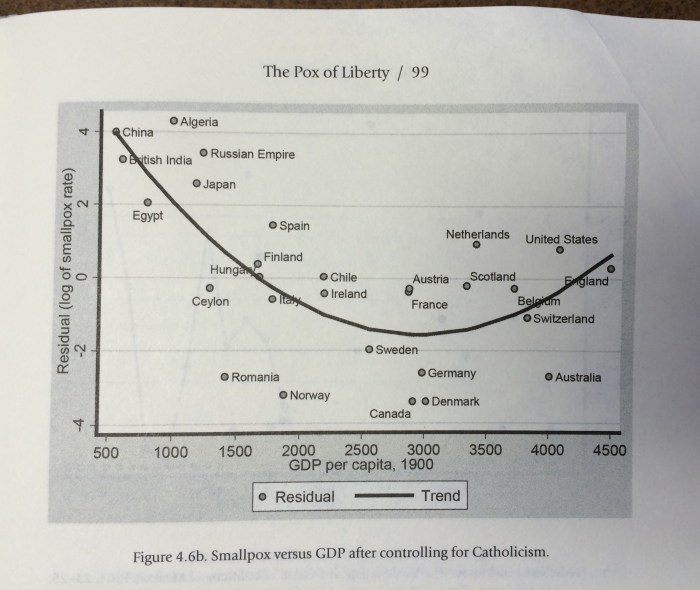
However, Troesken’s contribution is to tell us that the story does not end there. In a way, the “public economics” story is incomplete. The institutions that are best able to deploy such levels of coercion are generally also the institutions that are unable to restrain political meddling in economic affairs. Governments that are able to easily deploy coercive measures are governments that tend to be less constrained and they can fall prey to rent-seeking and regulatory capture. They will also tend to disregard property rights and economic freedom. This implies slower rates of economic growth. As a result, there is a trade-off that exists: either you get fast economic growth with higher rates of certain infectious diseases or you get slow economic growth with lower rates of certain infectious diseases (Troesken concentrates mostly on smallpox and yellow fever). The graphic below illustrates this point of Troesken. Countries like Germany – with its strong centralizing Prussian tradition – were able to generate very low levels of deaths from infectious diseases. But, they were poorer than the United States. The latter country had a constitutional framework that limited the ability of local and state governments to adopt even mild measures like mandatory vaccination. Thus, that meant higher mortality levels but the same constitutional constraints permitted economic growth and thus the higher level of living standards enjoyed by Americans relative to the Germans.

fullsizerender

But Troesken’s story does not end there.  Economic growth has some palliative health effects (in part the McKeown hypothesis*) whereby we have a better food supply and access to better housing or less demanding jobs. However, in the long-run economic growth means that new sectors of activity can emerge. For example, as we grow richer, we can probably expend more resources on drugs research to extend life expectancy. We can also have access to more medical care in general.  These fruits take some time to materialize as they grow more slowly. Nonetheless, they do form a palliative effect that contributes to health improvements.

However, there is an analogy that allows us to see why these palliative effects are important in any political economy of public health provision. This analogy relates to forestry. The health outcomes fruits from a “coercive institutional tree” can only be picked once. Once they are picked, the tree will yield no more fruits.  However, the yield from that single harvest is considerable. In comparison, the “economic growth tree” yields fewer and smaller fruits, but it keeps yielding fruits. It never stops yielding fruits. In the long-run, that tree outperforms the other tree. The problem is that you cannot have both trees. If you chose one, you can’t have the other.

In this light, public health issues become incredibly harder to decipher and understand. However, we can see a much richer wealth of information under this light. In writing the Pox of Liberty, Troesken is enlightening and anyone doing health economics should read (and absorb his work) as it is the first comprehensive treatise of the political economy of public health.


* I should note that I think that the McKeown hypothesis is often unfairly lambasted and although I have some reservations myself, it can be adapted to fit within a wider theoretical approach regarding institutions – like Troesken does. 

How Well Has Cuba Managed To Improve Health Outcomes? (part 3)

As part of my series of blog post reconsidering health outcomes in Cuba, I argued that other countries were able to generate substantial improvements in life expectancy even if Cuba is at the top. Then I pointed out that non-health related measures made Cubans so poor as to create a paradoxical outcome of depressing mortality (Cubans don’t have cars, they don’t get in car accidents, life expectancy is higher which is not an indicator of health care performance). Today, I move to the hardest topic to obtain information on: refugees.

I have spent the last few weeks trying to understand how the Cuban refugees are counted in the life tables. After scouring the website of the World Health Organization and the archives of Statistics Canada during my winter break, I could not find the answer.  And it matters. A lot.

To be clear, a life table shows the probability that an individual of age will die by age X+1 (known as Qx). With a life table, you will obtain age-specific death rates(known as Mx), life expectancy at different points and life expectancy at birth (Lx)(Where x is age). Basically, this is the most important tool a demographer can possess. Without something like that, its hard to say anything meaningful in terms of demographic comparison (although not impossible).The most common method of building such a table is known as a “static” method where we either compare the population structure by age at a single point in time or where we evaluate the age of deaths (which we can compare with the number of persons of each group alive – Ax). The problem with such methods is that static life tables need to be frequently updated because we are assuming stable age structure.

When there is important migration, Qx becomes is not “mortality” but merely the chance of exiting the population either by death of migration. When there are important waves of migration (in or out), one must account for age of the entering/departing population to arrive at a proper estimates of “exits” from the population at each age point that separate exits by deaths or exits (entries) by migration.

As a result, migration – especially if large – creates two problems in life tables. It changes the age structure of the population and so, the table must be frequently updated in order to get Ax right. It also changes the structure of mortality (exits). (However, this is only a problem if the age structure of migrants is different from the age structure of the overall population).

Since 2005, the annual number of migrants from Cuba to the United States has fluctuated between 10,000 and 60,000. This means that, on an annual basis, 0.1% to 0.5% of Cuba’s population is leaving the country. This is not a negligible flow (in the past, the flow was much larger – sometimes reaching north of 1% of the population). Thus, the issue would matter to the estimation of life tables. The problem is we do not know how Cuba has accounted for migration on both mortality and the reference populations! More importantly, we do not know how those who die during migration are measured.

Eventually, Ax will be adjusted through census-based updates (so there will only be a drift between censuses). However, if the Cuban government counts all the migrants as alive as they arrive in a foreign country as if none died along the way, it is underestimating the number of deaths. Basically, when the deaths of refugees and emigrants are not adequately factored into survival schedules, mortality schedules are be biased downward (especially between censuses as a result of poor denominator) and life expectancy would be accordingly biased upward.

Now, I am willing to reconsider my opinion on this particular point if someone indicates some study that has escaped my gaze (my Spanish is very, to put it euphemistically, poor). However, when I am able to find such information for other Latin American countries like Chile or Costa Rica and not for Cuba, I am skeptical of the value of the health statistics that people cite.

The other parts of How Well Has Cuba Managed To Improve Health Outcomes?

  1. Life Expectancy Changes, 1960 to 2014
  2. Car ownership trends playing in favor of Cuba, but not a praiseworthy outcome

What is Wrong with Income Inequality? Five Reasons to be Concerned

I sometimes part ways with many of my libertarian and classical liberal friends in that I do have some amount of tentative concern for income/wealth inequality (for the purposes of this article, the otherwise important economic distinction between the two is not particularly relevant since the two are strongly correlated with each other). Many libertarians argue that inequality ultimately doesn’t matter. There is good reason to think this drawing from the classic arguments of Nozick and Hayek about how free exchange in a market economy can often interrupt preferred distributions.

The argument goes like this: take whatever your preferred distribution of income is, be it purely egalitarian or some sort of Rawlsian distribution such that the distribution benefits only the worst off in society. Assume there is one individual in the economy who has some product or service everyone wants to buy (in Nozick’s example it was Wilt Chamberlain playing basketball), and let everyone pay a relatively small amount of income to that one individual. For example, assume you have a society with 10,000 people all who start off with an equal endowment of $5 and all of them decide to pay Wilt Chamberlain $1 to watch him play basketball. Very few people would object to those individual exchanges, yet at the end Wilt Chamberlain ends up with $10,005 dollars and everyone else has $4, and our preferred distribution of income has been grossly upset even though the individual actions that led to that distribution are not objectionable. In other words, allowing for free exchange precludes trying to construct an optimal result of that free exchange (a basic consequence of recognizing spontaneous order).

Further, these libertarians argue, it is more important to ensure that the poor are better off in absolute terms than to ensure they are better off relative to their wealthier peers. Therefore, if a given policy will increase the wealth of the wealthiest by 10% and the poorest by 5%, there is no reason to oppose this policy on the grounds that it increases inequality because the poor are still made richer. Therefore, it is claimed, we should focus on policies that improve economic growth and the incomes of the poor and be indifferent as to its impact on relative inequality, since those policies are strongly correlated with bettering the economic conditions of the poor. In fact, as Mises Argued in Liberalism and the Classical Tradition, a certain amount of inequality is necessary for markets to function: they create a market for luxury goods that can be experimented and developed into future mass-consumption goods everyone can consume. Not everyone could afford, for an example, an IPod when it first came out, however today MP3 players are cheap and plentiful because the very wealthy were able to demand it when it was very expensive.

I agree with my libertarians in thinking that this argument is largely correct, however I do not think it proves, as Hayek argued, that social justice (understood in this context as distributive justice) is a “mirage” or that we should be altogether unconcerned with wealth or income distributions. All this argument does is mean that there is no overall deontological theory for an ideal income distribution, but there still might be good consequentialist reasons to think that excessively unequal distributions can impact many of the things that classical liberals tell us to worry about, such as the earnings of the poor, more free political economic outcomes, or overall economic growth. Further, even on Nozick’s entitlement theory of justice, we might oppose income inequality if it arises through unjust means. Here are five reasons why libertarians and classical liberals should be concerned about income inequality (note that they are mostly empirical reasons, not claims about the nature of justice):

1) Income Inequality as a Result of Rent Seeking

Certain government policies result in uneven income distribution. For an example, a paper by Patrick MacLaughlin and Lauren Stanley at the Mercatus Center empirically analyze the regressive effects of regulatory policy. Specifically, Stanley and MacLaughlin find that high barriers to entry create barriers to entry which worsens income mobility. Poorer would-be entrepreneurs cannot enter the market if they must, for an example, pay thousands of dollars for a license, or spend a large amount of time getting costly education and certifications to please some regulatory bureaucracy. This was admitted even by the Obama Administration in a recent report advising reform of occupational licensing laws. As basic public choice theory teaches, regulators are subject to regulatory capture, in which established business interests lobby regulators to erect barriers to entry to harm would-be competitors. Insofar as inequality is a result of such rent-seeking, libertarians have an obvious reason to oppose it.

Many other policies can worsen inequality. When wealthy corporations receive artificial monopolies from policies such as excessive intellectual property laws, insulating them from competition or when they gain wealth at the expense of poorer taxpayers through improper subsidies. When the government uses violent policing tactics to unequally enforce drug laws against poorer communities, or when it uses civil asset forfeiture to take the property of the worst off. When the government uses eminent domain to take the property of disadvantaged individuals and communities in the name of public works projects, or when they implement minimum wage laws that displace low-skilled workers. Or, if the structure of welfare benefits discourages income mobility, which also worsens inequality. There are a myriad of bad government policies which benefit the rich and exploit the poor, some of which are a direct result of rent-seeking on behalf of the wealthy.

If the rich are getting richer, or if the poor are stopped from becoming wealthier, as a result of government coercion, even Nozick’s entitlement theory of justice calls for us to be skeptical of the resulting income distribution. As Matt Zwolinski argues, income distributions are not only a result of, pace Nozick, a result of the free exchanges of individuals, but they are also a result of the institutions in which those individuals exchange. Insofar as inequality is a result of unjust institutions, we have good reason to call that inequality unjust.

Of course, that principle is still very hard to empirically apply. It is hard to tell how much of an unequal distribution is a function of bad institutions and how much is a function of free exchange. However, this means we can provide very limited theories of distributive justice not as constructivist attempts to mold market outcomes to our moral desires, but as rough rules of thumb. If it is true that unequal distributions are a function of bad institutions, then unequal distributions should cause us to re-evaluate those institutions.

2) Income Inequality and Government Exploitation
Of course, many with more Marxist inclinations will argue that any amount of economic inequality will inherently result in class-based exploitation. There are very good, stand-by classical liberal (and neoclassical economic) reasons to reject this as Marxian class analysis as it depends on a highly flawed labor theory of value. However, that does not mean there is not some correlation between some notion of macro-level exploitation of the worst-off and high levels of inequality which libertarians have good reason to be concerned about, for reasons closely related to rent-seeking. Those with a high amount of economic power, particularly in western democracies, are very likely to also have a strong influence over the policies set by the government. There is reason to fear that this will create a class of wealthy people who, through political rent-seeking channels discuss earlier, will control state policies and institutions to protect their interests and wealth at the expense of the worst-off in society. Using state coercion to protect oneself at the expense of others is, under any understanding of the term, coercion. In this way, income inequality can beget rent-seeking and regressive policies which lead to more income inequality which leads to more rent-seeking, leading to a vicious political-economic cycle of exploitation and increasing inequality. In fact, even early radical classical liberal economists applied theories of class analysis to this type of problem.

3) Inequality’s Impacts on Economic Growth

There is a robust amount of empirical literature suggesting that excessive income inequality can harm economic growth. How? The Economist explains:

Inequality could impair growth if those with low incomes suffer poor health and low productivity as a result, or if, as evidence suggests, the poor struggle to finance investments in education. Inequality could also threaten public confidence in growth-boosting policies like free trade, says Dani Rodrik of the Institute for Advanced Study in Princeton.

Of course, this is of special concern to consequentialist classical liberals who claim we should worry mostly about the betterment of the poor in absolute terms, since economic growth is strongly correlated with bettering living standards. There is even some reason for these classical liberals, given their stated normative reasons, to (at least in the short-term given that we have unjust institutions) support some limited redistributive policies, but only those that are implemented well and don’t worsen inequality or growth (such as a Negative Income Tax), insofar as it boosts growth and helps limited the growth of rent-seeking culture described with reasons one and two.

4) Inequality and Political Stability

There is further some evidence that income inequality increases political instability. If the poor perceive that current distributions are unjust (however wrong they may or may not be), they might have social discontent. In moderate scenarios, (as the Alsenia paper I linked to argue) this can lead to reduced investment, which aggravates third problem discussed earlier. In some scenarios, this can lead to support for populist demagogues (such as Trump or Bernie Sanders) who will implement bad policies that not only might harm the poor but also limit individual liberty in other important ways. In the most extreme scenarios (however unlikely, but still plausible), it can lead to all-out violent revolutions and warfare. At any rate, libertarians and classical liberals concerned with ensuring tranquility and freedom should be concerned if inequality increases.

5) Inequality and Social Mobility

More meritocratic-leaning libertarians might say we should be concerned about equal opportunities rather than equal outcomes. There is some evidence that the two are greatly linked. In particular, the so-called “Great Gatsby Curve,” which shows a negative relationship between economic mobility and income inequality. In other words, unequal outcomes can undermine unequal opportunities. This can be because higher inequality means unequal access to certain services, eg. Education, that can enable social mobility, or that the poorer may have fewer connections to better-paying opportunities because of their socio-economic status. Of course, there is likely some reverse causality here; institutions that limit social mobility (such as those discussed in problem one and two) can be said to worsen income mobility intergenerationally, leading to higher inequality in the future. Though teasing out the direction of causality empirically can be challenging, there is reason for concern here if one is concerned about social mobility.

The main point I’m getting at is nothing new: one need not be a radical leftist social egalitarian who thinks equal economic outcomes are necessarily the only moral outcomes to be concerned on some level with inequality. How one responds to inequality is empirically dependent on the causes of the problems, and we have some good reasons to think that more limited government is a good solution to unequal outcomes.

This is not to say inequality poses no problem for libertarians’ ideal political order: if it is the case that markets inherently beget problematic levels of inequality, as for example Thomas Piketty claims, then we might need to re-evaluate how we integrate markets. However, there is good reason to be skeptical of such claims (Thomas Piketty’s in particular are suspect). Even if we grant that markets by themselves do lead to levels of inequality that cause problems 3-5, we must not commit the Nirvana fallacy. We need to compare government’s aptitude at managing income distribution, which for well-worn public choice reasons outlined in problems one and two as well as a mammoth epistemic problem inherent in figuring out how much inequality is likely to lead to those problems, and compare it to the extent to which markets do generate those problems. It is possible (very likely, even) that even if markets are not perfect in the sense of ensuring distribution that does not have problematic political economic outcomes, the state attempting to correct these outcomes would only make things worse.

But that is a complex empirical research project which obviously can’t be solved in this short blog post, suffice it to say now that though libertarians are right to be skeptical of overarching moralistic outrage about rising levels of inequality, there are other very good empirical reasons to be concerned.

From the Comments: Ottoman autocracy, Turkish liberty

Jacques, if you want to look at a libertarian/classical liberal case for the Ottoman Empire you should look at Islam without Extremes (Norton 2013) by Mustafa Akyol. I can’t claim to have got round to reading it myself, but I have seen Akyol’s summaries of his argumnents.

The power of Akyol’s argument in term of Turkey’s political scene has been somewhat undermined by his support for the AKP governemnt until after the Gezi Park protests. He is very critical of the AKP now, but as he was previously known as an AKP apologist (and enthusiast for Intelligent Design theory) it’s doubtful how much of an asset he is to Turkey’s rather small pro-liberty scene.

In any case I do not endorse myself straight on Ottomanist libertarianism and there are reasons it does not have much of a hold in Turkey’s pro-liberty scene though there are a few who think like this. The problems are endless and complex because the Ottoman system lasted from the 14th to 20th centuries and you can’t really talk about the same system, or at least few historians think you can. The millet system is a term applied late in Ottoman history, while the system was at its peak in terms of the size of the empire, along with it general prestige in the world, in the sixteenth century. Of course at that time, it could be said to have established some version of some liberty with order as good as many Christian states, and to me more power ful than any. I don’t think even at its height though you could say the Ottoman empire had more liberty than the most law governed and tolerant places in ‘Christendom’ and certainly while European thinkers respect the Ottoman system at its height it very much looked like an example of strong orderly monarchy, not decentralised liberty.

Even at its peak the Ottoman system obliged Balkan Christian families to send one son away at a very early age to be brought up as Muslim convert soldier-bureaucrat slave of the Sultan. The Janissary system, a very privileged kind of slavery and forced conversion, but that is what it was. The Sultan employed black eunuch slaves, transported from Africa, again a privileged position but not really an example of liberty.

Jumping forward, the Ottoman system started to imitate the west in some respects from the late eighteenth century, following military defeats to Russia. The biggest act of ‘reform’ was the violent repression/massacre of the Janissaries which formed a whole class of soldiers, bureaucrats and Istanbul firemen who were also market traders on the side, blocking the Sultan’s ideas of reform, including the formation of a more modern military.

Jumping forward again, the Ottoman sultan most revered by Turkey’s current Ottomanists on the whole, Abdulhamit II, suspended the national assembly, pursued a program of bureaucratic-military-technical centralisation, which included the early massacres of Armenians to which you refer. In the end he was overthrown as a ruker (not as holder of the title of Sultan) by westernising reformers (Committee of Union and Progress/Young Turks) who ended up continuing a centralising reform process which alienated people outside the Muslim Ottoman elite and the Anaotlian heartlands of the Empire. Jumping back to the period between the suppression of the Janissaries and Abdulhamit II’s rule, the Greek Independence movement was resisted with staggering levels of violence and cruelty (the Greek insurgents were not always fastidious in their methods either, it must be also be said). By the nineteenth century, the Ottoman system of relative tolerance towards non-Muslims on a communal rights basis was looking less impressive compared with a growing European tendency towards tolerance based on individual rights.

The ‘millet system’ at its peak provided a way Muslims, Christians and Jews could live together, but mostly as separate communities able to continue communal traditions, within a hierarchy in which Muslims had the real power. As with looking to models of liberty in ‘feudal’, medieval Europe, we may see some liberty benefits in the elements of localism and communal autonomy under a monarchy, but in both cases we are not talking about a system of individual rights or free interaction, we are talking about individuals constrained by communal traditions and hierarchies, along with the hierarchies between communities. If we value individual rights under common legal rights then this is not a model for us, even if we can see some lessons.

Even at its peak the Ottoman system blocked the spread of printing, one of the major elements of modern liberty. The reasons for the block combine the power of religious conservatism and the guild interests of manuscript copyists which seems to me to sum up the problems of even peak time Ottomanism for liberty. It was a system based on an assemblage of local, communal and guild privileges finding change difficult except through dramatic acts of autocratic rulers. The transition from Empire to French-modeled republic, but less liberal than the France of the time, in the 20s and 30s under Atatürk was itself the last great example of this and was a product of the difficulties the Ottoman system had with peaceful consensual change, even if it did have a few good moments on that score (e.g. the 1840 Tanzimat reforms).

Finally the Ottoman system was condemned by its own failure to defend itself, the last Sultan could only give into the victorious powers of World War One, while the republican-nationalists, who emerged from the most educated sections of the Ottoman elite, were able to mobilse a successful military struggle (the Independence War) even without control of the state apparatus. A system which can’t win a war is not a successful system, regardless of how sad the importance of war in human history is.

Arguments now about reviving the Ottoman Empire are surely self-evidently hypothetical only for anyone who does not take Erdoğan’s more bombastic statements seriously. In what way would the Middle East resolve anything by rule from Istanbul, particularly as part of a centralised state ruled by Erdoğan? If the question is should the Ottoman Empire have been prolonged at the end of World War One, the Ottoman government of the war undermined that possibility by massacres of Arabs, along with the leaders Faisal gave to Arab nationalists, aided by devious British and French policy.

The Ottoman Empire was in the Balkans before it was in the Middle East. Ottoman sultans used the title Kaiser-i rum (Emperor of Rome) after the Fall of Constantinople before they adopted the title of Caliph (leader of the faithful) after the later conquest of the Hezaz (i.e. the region containing Mecca and Medina). There is nothing natural or inevitable about a Turkey leaning predominantly towards the Middle East and nothing inherently desirable about Beirut, Amman, Riyadh, Damascus, etc coming under the dominance of Turks; there is nothing obviously healing for Arab Shiite Muslims in living under a Sunni Caliph in a palace on the Bosphorus, not now and not in 1919.

Ottomanist libertarianism makes most sense for those inclined to paleolibertarianism based on dispersal of power between homogenous traditionalist localised communities. I don’t see it has so much to offer to other kinds of libertarian. If we think about more modern liberal forms, there was some interest in Britsh style liberalism (already at that time in transition from classical liberalism to left liberalism) amongst the last Ottomans, most notably Prince Sabahattin, but this was a minority within a weakened elite, discredited by collaboration with British occupation at the end of World War One, which never had anything like a politics capable of mobilising the elite (very influenced by French republicanism politically and intellectually by the sociological expression of French republicanism in the work of Emile Durkheim), never mind the population as a whole.

(Yes Brandon I should be posting this kind of thing, in refined and revised form, but I really don’t have time to do this properly at present, believe me I really am in extreme crisis mode with writing/editing deadlines), after a particularly busy semester, believe me I will be posting when I can, and I should be able to manage within the next few months, sorry I can’t say any more than that, but it is the reality.)

This is from Barry Stocker, responding to Jacques’ musings on the Ottoman Empire and libertarian arguments that are sometimes in favor of it. The rest of the thread is pretty good too, though Dr Delacroix has yet to respond…

A Common Conservative Fallacy

I believe folly serves liberals better than it serves conservatives. Our way is the rational way while liberals tend to rely on their gut-feelings and on their sensitive hearts which make them comparatively indifferent to hard facts. That’s why they voted for  Pres. Obama. That’s why they voted for Mrs Bill Clinton against all strong evidence (known evidence, verifiable, not just suppositions) of her moral and intellectual unsuitability. That’s why many of them still can’t face emotionally the possibility of buyer’s remorse with respect to Mr Obama. That’s why they can’t collectively face the results of the 2016 election. So, conservatives have a special duty to wash out their brains of fallacy often.

It’s the task of every conservative to correct important errors that have found their way into fellow conservatives’ mind. Here is one I hear several times a week, especially from Rush Limbaugh (whom I otherwise like and admire). What’s below is a paraphrase, a distillation of many different but similar statements, from Limbaugh and from others I listen to and read, and from Internet comments, including many on my own Facebook:

“Government does not create jobs,”

and

“Government does not create wealth (it just seizes the wealth created by business and transfers it to others).”

Both statements are important and both statements are just false. It’s not difficult to show why.

First, some government actions make jobs possible that would not exist, absent those actions. Bear with me.

Suppose I have a large field of good bottom land. From this land I can easily grow a crop of corn sufficient to feed my family, and our poultry, and our pig, Gaspard. I grow a little more to make pretty good whiskey. I have no reason to grow more corn than this. I forgot to tell you: This is 1820 in eastern Ohio. Now, the government uses taxes (money taken from me and from others under threat of violence, to be sure) to dig and build  a canal that links me and others to the growing urban centers of New York and Pennsylvania. I decide to plant more corn, for sale back East. This growth in my total production works so well that I expand again. Soon, I have to hire a field hand to help me out. After a while, I have two employees.

In the  historically realistic situation I describe, would it not be absurd to declare that the government gets no credit, zero credit for the two new jobs? Sure, absent government tax-supported initiative, canals may have been built as private endeavors and with private funds. In the meantime, denying that the government contributed to the creation of two new jobs in the story above is not true to fact.

Second, it should be obvious that government provides many services, beginning with mail delivery. Also, some of the services private companies supply in this country are provided elsewhere by a branch of government. They are comparable. This fact allows for an estimation of the economic value of the relevant government services. Emergency services, ambulance service, is a case in point. Most ambulances are privately owned and operated in the US while most ambulances are government-owned and operated in France. If you have a serious car accident in the US, you or someone calls a certain number and an ambulance arrives to administer first aid and to carry you to a hospital if needed. Exactly the same thing happens in France under similar circumstances. (The only difference is that, in France, the EM guy immediately hands you a shot of good cognac. OK, it’s not true; I am kidding.)

In both countries, the value of the service so rendered is entered into the national accounting and it does in fact appear in the American Gross Domestic Product for the year (GDP) and in the French GDP, respectively. The GDP of each country thus increases by something like $500 each time an ambulance is used. Incidentally, the much decried GDP is important because it’s the most common measure of the value of our collective production. One version of GDP (“PPP”) is roughly comparable between countries. When the GDP is up by 3,5 % for a year, it makes every American who knows it, happy; also some who don’t know it. When the GDP shrinks by 1%, we all worry and we all feel poorer. If the GDP change shrinks below zero for two consecutive quarters, you have the conventional definition of a recession and all hell breaks lose, including usually a rise in unemployment.

Exactly the same is true in France. The government-provided French ambulance service has exactly the same effect on the French GDP.

Now think of this: Is there anyone who believes that the equivalent service supplied in France by a government agency does not have more or less the same value as the American service provided by a private company? Would anyone argue that the ambulance service supplied in France, in most ways identical to the service in America, should not be counted in the French GDP? Clearly, both propositions are absurd.

Same thing for job creation. When the French government agency in charge of ambulances hires an additional ambulance driver, it creates a new job, same as when an American company hires an ambulance driver.

By the way, don’t think my story trivial. “Services” is a poorly defined category. It’s even sometimes too heterogeneous to be useful (not “erogenous,” please pay attention). It includes such disparate things as waitressing, fortune-telling, university teaching, and doing whatever Social Security employees do. Yet it’s good enough for gross purposes. Depending on what you include, last year “services” accounted for something between 45% and 70% of US GDP. So, if you think services, such as ambulance service, should not be counted, you should know that it means that we are earning collectively about half to three quarters less than we think we do. If memory serves, that means that our standard of living today is about the same as it was in 1950 or even in 1930.

Does this all imply that we should rejoice every time the government expands? The answer is “No,” for three reasons. These three reasons however should only show up after we have resolved the issue described above, after we have convinced ourselves that government does provide service and that it and does create real jobs, directly and indirectly. Below are the three questions that correspond to the three reasons why conservatives should still not rejoice when government enlarges its scope. Conservatives should ask these three questions over and over again:

1 Is this service a real service to regular people or is it created only, or largely, to serve the needs of those who provide it, or for frivolous reasons? Some government services fall into this area, not many, I think. Look in the direction of government control, inspection, verification functions. Don’t forget your local government.

Often, the answer to this question is not clear or it is changing. Public primary and secondary education looks more and more like a service provided largely or even primarily to give careers to teachers and administrators protected by powerful unions. It does not mean that the real, or the expected service, “education,” is not delivered, just that it’s often done badly by people who are not the best they could be to provide that particular service; also people who are difficult or impossible to replace.

2   Is this particular service better provided by government or by the private sector? Is it better provided by government although the provision of the service requires collecting taxes and then paying out the proceeds to the actual civil servants through a government bureaucracy? That’s a very indirect way to go about anything, it would seem. That’s enough reason to be skeptical. The indirectness of the route between collecting the necessary funds and their being paid out to providers should often be enough to make government service more expensive than private, market-driven equivalent services. Note that the statement is credible even if every government employee involved is a model of efficiency.

The US Post Office remains the best example of a  situation where one would say  the private sector can do it better.

Only conservatives dare pose this question with respect to services one level of government or other has been supplying for a long time or forever. The Post Office is inefficient; if it were abolished, the paper mail would be delivered, faster or cheaper, or both. Some paper mail would not be delivered anymore. Many more of us would count it a blessing than the reverse. While there is a broad consensus across the political spectrum that children should be educated at collective expense, there is growing certitude that governments should not be in the business of education. In many parts of the country, the public schools are both expensive and bad. Last time I looked, Washington DC was spending over $20,000 per pupil per year. Give me half that amount and half the students or better will come out knowing how to read, I say. (It’s not the case now.)

3   This is the most serious question and the most difficult to answer concretely: Does the fact that this service is provided by government (any level) have any negative effect on our liberties? This is a separate question altogether. It may be that the government’s supply of a particular service is both inefficient and dangerous to freedom. It may be however that government supply is the most efficient solution possible and yet, I don’t want it because it threatens my freedom. As a conservative, I believe that my money is my money. I am free to use it to buy inefficiently, in order to preserve liberty, for example. I am not intellectually obligated to be “pragmatic” and short sighted.

To take an example at random, if someone showed me, demonstrated beyond a reasonable doubt, that Obamacare would reduce the cost of health care without impairing its quality, if that happened, I would still be against it because of the answer I would give to the third and last question above.

I don’t want a any government bureaucracy to make decisions that are ultimately decisions of life and death on my behalf. The possibility of blackmail is too real. Even thinking about it is likely to make some citizens more docile than they otherwise would be. So much power about such real issues must have a chilling effect on the many.

The rule of thumb is this: Every expansion of government reduces individual freedom. That’s true even if this expansion creates and efficient and effective government agency, say, a real good Post Office we don’t even know how to dream of. And this is not an abstract view. The well-intentioned and in other ways laudable recognition of homosexual marriage was followed in short order by threats and fines against a hapless baker who declined to bake a cake for a gay wedding. We must keep in mind at all times that, of course, the power to fine, like the power to tax, is the power to destroy.

An efficient but ethically objectionable government service is not something I worry much about, in the case of Obamacare specifically, by the way. It is inefficient, ineffective and dangerous to individual liberty all at once.

Conservatives don’t do enough to proclaim that their opposition to big government has an ethical basis, that it’s a moral position independent of the quality of big government. This silence makes if easy for liberals to caricature conservatives as just selfish grouches who don’t want to pay taxes.

Most of the time, I don’t want to pay taxes because I don’t want to be forced. I would gladly give away twice the amount of my taxes if there were a way to do it voluntarily instead of paying taxes.

I am so opposed to this kind of force that I think even the undeserving and obscenely rich should not be despoiled by the government. It’s an ethical position, not a pragmatic one. And, it sure cannot be called “selfish.” (WTF!)

Skills and creativity

Below is an excerpt from my book I Used to Be French: an Immature Autobiography. You can buy it on amazon here.


My mother was pretty much a part-time monster but she had big talents and one immense virtue.

She had been trained as a seamstress in a good technical high-school. Sometimes, when my father was working at night, she would hustle the five children through a hasty dinner of coffee with milk, bread, butter, jam and cheese and then, send everybody to his or her room. (She had to do that behind my father’s back because he belonged to the old French school that believes that if you don’t get two five-course, balanced meals a day, you will sicken in a short time.) She would lock herself in the dining room with fabric, her sewing machine, and her big scissors. By morning café au lait time, she would have a new outfit of extreme chic with appropriate gloves and detachable collars. Once, she produced in two nights matching tweed overcoats and golf pants for the three boys. Even little boys could see that the outfits were exquisitely elegant though the pants felt scratchy. No matter, we had to wear them to church and for a part of Sunday afternoon.

As long as she had defenseless offspring at home, my mother never saw a children’s costume event she did not like. She would enter as many of her children as would submit. The last time it happened to me, I was eleven and tall for my age. She dressed me up as a Roman legionnaire, with a cardboard armor ingenuously painted with stove silver coating. It almost killed me, not the armor, the embarrassment. I never wore a costume again until I was twenty-five though I must admit I have retained a certain flair. At least, I was never one of those social cowards who go to a Halloween party in jeans and keep a cowboy hat in their car just in case everyone else is costumed. (You know who you are, spineless scum!)

I was aware early that my mother used her talent to gain face and to pull rank on almost all other neighborhood women. Nevertheless, watching her cut and sew through the glass door exposed me early to the concept of creativity in general, and of visual creativity, in particular. I also picked up the broad notion that creativity not served by solid skills is meaningless. In my fifties, I began to paint, without hesitation although I am quite critical, because I had retained from observing her two forceful ideas: Skills will reveal talent, if any; with practice, skills can only improve.

My mother’s living example of inventiveness was at the antipodes of the narrow, sober petty-bourgeois values my whole environment projected. It belied what she was trying to teach her children every day. She contradicted with her hands what she  preached with her mouth.

A beautiful bit of small world mojo

The first time I went to Boston was to look for an apartment. On my last day I was hanging around Downtown crossing. Gmail confirms it was June 12th, 2010. I was having a polish sausage, and this guy approached me. I don’t remember what we talked about, but we chatted for a few minutes. Good town. That sort of thing is exactly what I’d expect in SLO (Central Coast California) or Santa Cruz… but this was in a place with a skyline! Anyways, he wasn’t in a cult and I didn’t get robbed.

Flash forward to some time that fall. I was in Inman Square and saw a chair left on the curb for anyone who needed a chair. I needed a chair. I lived in Union Square, but that was just the next neighborhood north (if I lived on Prospect Hill, there’s no way that chair would have made it, but I might have realized that before picking it up). So I pick up this chair and walk. Google Maps puts my route at 0.5 miles. I got a couple blocks short of that before I crap out. Fortunately I’ve got a place to sit down. So I’m sitting in an easy chair on the sidewalk, hauling it forward a few yards, and plopping down again.

Across the street, someone’s trying to get my attention. He comes over, and he’s the guy I’d randomly met months earlier. He lives across the street from me! And he helps me carry home my chair. We have a beer and chat.

Flash forward to Thanksgiving of that fall. I’m hanging out by myself. This is my first Thanksgiving alone. Neighbor guy knocks on my door and invites me over. Inside are a bunch of his musician friends, and this fantastic music is coming from one of the bedrooms. An impromptu jam session is playing the sort of dusty sounding blues I’m enamored with at the time. After they finish I mention that it sounds like this African blues guitarist, Ali Farka Toure. It turns out I pronounced his name right, because I’m immediately informed that his son was playing guitar just now!

Just now I was listening to Spotify, and a song reminds me of another song which led me to the song above from that album I’d bought when I lived in SLO and was trying to be worldly. Absolutely fantastic music, a mish-mash of cultural influences bouncing back and forth around the world, and I got to experience something of it first hand because of the grace and generosity of a fellow human.

But more than that, a mix of technology, globalization, and absolutely random chance created that beautiful memory and triggered it again just now. We live in a beautiful world.

On How Poor France Was in the 18th Century?

I have recently completed a working paper which has now been submitted (thank you a great many scholars who provided comments notably Judy Stephenson and Mark Koyama). That paper basically went back modestly on one datapoint in the work of Robert Allen which was published in 2001 in Explorations in Economic History. 

Probably one of the greatest ten papers in the field of economic history for the last twenty-five years, Allen’s article has had a tremendous influence. It introduced a new method of comparing real wages at a time when very few goods were traded internationally and most prices were determined at the local level. In using what we now call “welfare ratios” (which are akin to poverty lines), Allen managed to compare many countries before the industrial revolution.

My entire research agenda has been to improve on this stupendous work and to increase the constellation of observations as part of an “uncoordinated” (many scholars are working on this separately) effort to map living standards prior to the mid 19th century. The main part of my agenda is to add Canada and devote more attention to the important issue of relative prices in comparing old world (high labor to land ratios) and new world (high land to labor ratios) economies. In the process of comparing parts of the world, I had to re-examine some data for some established countries. One of my reconsiderations was for Strasbourg in France where I found that Allen might have misclassified wages of skilled workers which included in-kind payments as unskilled workers receiving full compensation in money wages.

When I enacted corrections to the money wage rate, I found that the Alsace region where Strasbourg is located had living standards more or less in line with those observed in Paris (rather than living standards at less than half the level of Paris). If you’re interested, the note is available here.

Note: For those who are interested, I really recommend reading this short article in Cliometrica by Sharp and Weisdorf who also discuss comparisons between France and England (and how it may relate to topics like the French Revolution).

The Ottoman Empire and Libertarianism

Every so often libertarians ask, in a speculative mode, whether the re-establishment of the Ottoman Empire would not be a formula for peace in the troubled Middle East. The question is interesting on several counts, one of which is that the regions affected by the Islamic State today, Arab and Kurdish alike, plus all of southern Iraq, plus Kuwait, plus Jordan and Palestine (including the current Israel), plus, more loosely, all of the Arabian Peninsula, were more or less under Ottoman/Turkish control until the end of World War One.

Libertarians allude to the “millet” system under which many different ethnic or national groups co-habitated peacefully for several centuries. Those are pretty much the same groups that have been eviscerating one another for several years and pretty much every time a strong and dictatorial leader does not clamp down on them. There is one large fault in this happy vision: the attempted genocide of the Armenians begun under full Ottoman power in 1895 and nearly completed as the empire was falling apart during World War One.

The millet system of governance should be of interest to libertarians who generally wish for less government, less expensive government, more responsive government and, especially, less intrusive government. Under the millet system, at least when it was fully functional, the Ottoman governor of say, the province of the empire that now encompasses Lebanon and Western Syria would summon yearly the Patriarch of the Greek Orthodox Church. He would address him as follows:

“Your Eminence is well I trust, and his family, and I hope that his sons are brave a wise. I am happy to hear that Almighty God has blessed Your Eminence with many grandchildren. And I am told your community is thriving. Now, based on the figures your office gave me and based on my own information, I think that the Greek Orthodox community must deliver to our master the Sultan, one hundred pounds of gold and three hundred fit young men of military age this year. Agreed? Thank you for your visit and may you and your community, Your Eminence, continue to prosper under the benign, enlightened and fair rule of our great sultan.”

Then, the governor would ask over the main Ayatollah of the Shiite Muslims and deliver himself of a similar oration. And so on.

But I must pause for a confession. The quote marks around the above monologue are metaphorical. I am not reproducing a real monologue. Something like the monologue above must have been delivered thousands of times but I must admit I was not present to hear any of them. (On the other hand, I spent time in Turkey on vacation ten years ago and I regularly drink coffee with Turks. And, I like Turks in general.)

Again, the millet system is a good historical example of extreme decentralization and of minimally intrusive government. It was also very inexpensive to administer. It had little permanent bureaucracy to speak of that could grow upon itself and reproduce itself endlessly thus forever shrinking the area of individual autonomy. At the same time as the comparable Hapsburg Empire was developing a large bureaucracy, at the time when territorially much smaller France was perfecting the art of centralized bureaucracy, at the time when the small Kingdom of Prussia was developing the very model of modern bureaucracy that was to become a model for the whole world, the millet system endured in the Ottoman Empire. In general, the Ottoman government was small and it seemed to be treading lightly on the land, you might say. It sounded a little like a sort of libertarian dream.

But, wait a minute, I need to complete significantly the imaginary monologue of the Ottoman governor above. On parting, the governor would have probably added: “Enjoy life and enrich yourselves. Everything will be fine unless I hear too much about you. If I do, bad things will happen to your community.” Or, he did not even need to utter the words. Everyone knew about the bad things that would happen if disorder arose. Some of these bad things were community leaders’ heads on a spike in village centers.

The Ottoman Empire that relied on the light, non-invasive, decentralized millet system was also famous for the fierceness of its repression. And this haven of diversity disintegrated swiftly throughout the 19th century with a speed that must give pause.

The unraveling of the Ottoman Empire began around 1805 when the large and important Egyptian subdivision gained all but nominal independence through an armed revolt and even waged successful war on the Empire. During the rest of the 19th century, the areas of the Empire now comprising Greece, Bulgaria and Romania decisively seceded. In the meantime, much of the rest of the officially defined Empire drifted away, such as Libya and Tunisia. Later, during World War One, the British (Lawrence) and the French did not have much trouble talking the remaining Arab areas of the empire into open rebellion. And yes, there was an attempted massive genocide of Armenians, in two phases. The first phase was under full Ottoman power in the 1890s; the second, much larger step occurred during the waning days of Ottoman rule starting in 1915.

Now, one can argue – and historians routinely do – that the spectacular disintegration of the Ottoman Empire was due to external pressures from the rising, fast industrializing European powers. Yet, the fact that national (ethnic) entities took up every opportunity to leave the Empire does not speak well of the effectiveness of Ottoman administration. The fact that they sometimes did it a a cost of great bloodshed, the Greeks in particular, does not strengthen the idea of contentment of the administered. The fact is that the subject people of the Ottoman Empire including the many governed through the millet system described above seem to have left as soon as the opportunity arose.

The disintegration of the Ottoman Empire poses a conceptual problem: Did it fall apart in spite of the admirable millet system of government or because of it? Was internal peace maintained in the Empire for a long time because of the virtues of the millet system or because of the ever-present threat of a large and fierce army facing a divided and unarmed populace?

Was the Ottoman Empire taken apart from within, and also from without, because the administrative principles behind the millet system impeded the supply of the means of self-preservation?

Beyond this lies an even graver question for anyone with libertarian aspirations: Do systems of administration that share the main features of the millet system, decentralization, low cost, and low-level invasiveness contain the seeds of their own destruction? Does administrative lightness actually nurture violent intervention from above and/or from outside?

I don’t know the answers to these serious questions. I think libertarians of all feathers don’t discuss these and related issues nearly enough. I suspect libertarian circles harbor their own form of political correctness that paralyzes such essential inquiries. I do what I can. I know it’s not much.

Free lunch: college edition

Andrew Cuomo recently proposed making college free taxpayer funded for middle class New Yorkers. He argues that college is a “mandatory step if you really want to be a success.” For the sake of argument, let’s assume that he’s making adequate adjustments for vocational training.

As a SUNY employee, I’m not sure how to feel about this. On the one hand, it means an increased demand for my services. On the other hand, it means increased pressure to keep costs down, which could mean a fall in my future earnings potential. Increased admissions pressure means I might have easier to teach students, but also probably means less chances for the low-income students coming from the worst public schools.

At best, we’re looking at a middle-class to middle-class transfer that will trade off the benefits of market pressure against the benefits (to families paying for school) of not having to think too hard about how to manage a large expense.

I won’t go into the issue of signaling (see Bryan Caplan), or the sheer wastefulness of having people get bachelor’s degrees for jobs that don’t need them (see Dick Vedder… esp. table 1). These are important points, because they get at the root problem Cuomo is misdiagnosing. College is mandatory because of subsidies and subsidies will only make it worse. But we don’t even need to be that sophisticated to understand why this plan is a problem.

Here’s my basic problem with “free” college tuition: it’s too good to be true. I get the desire to help out poor people, but the average household in NY makes just under $60K/year and this plan is for all households making less than $125K. That’s “free” tuition to a lot of households that would be sending their kids to school anyways. That money has to come from somewhere. The people paying for this program will largely overlap with the people benefiting from it.

If everyone thinks their kids should go to school, then what’s the point in taking away their money to send their kids to school?! We all like burritos, so give me your money and I’ll buy us all the burritos we want. Doesn’t make sense! Giving up control of your spending can only make you worse off, so this will ultimately be a bad thing for the middle class. And that lack of control from middle class helicopter parents will likely be a bad thing for the working poor people who could have been net beneficiaries (hopefully… I’m not certain this won’t back fire on net). Even if subsidizing higher-ed were a good idea, this is almost certainly a terrible way to go about it.

Libertarians on Climate Change

This post is part of the preliminary results of the NoL Foreign Policy Survey 2017 Pilot. I will be posting results throughout the week as I play around with the data. As always, I strongly emphasize that this is a pilot survey and these are just preliminary results

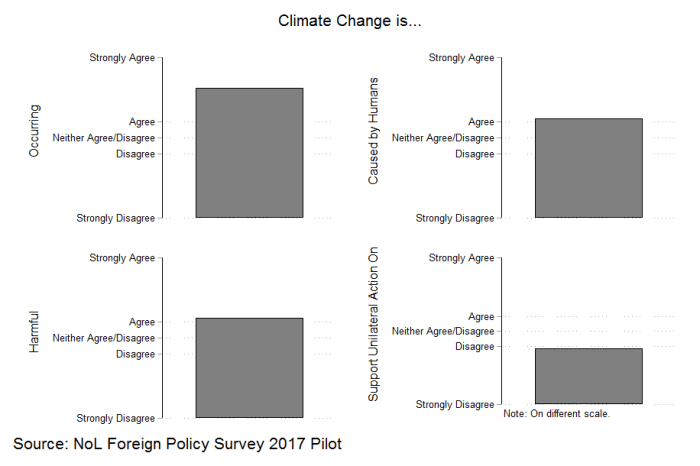
Are libertarians climate change deniers? No. The majority agree that it is occurring, caused by human activity, and that it is harmful. They do not however support unilateral action by the United States government. At least not the average libertarian respondent.

climatechange

Note that the last question, asking about supporting unilateral action, is on a different scale from the other three.


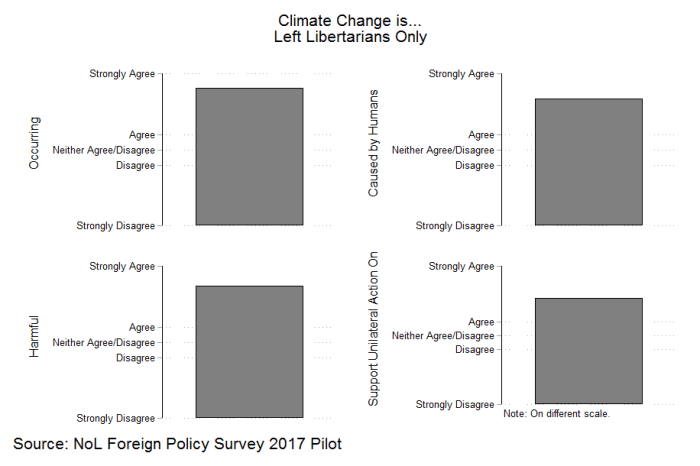
When you drill down by type of libertarian though you start to see stark differences. Left-libertarians agree much more strongly that climate change is occurring, caused by human activity, and harmful. They are also much more in support of unilateral action to prevent climate change.

climatechangell


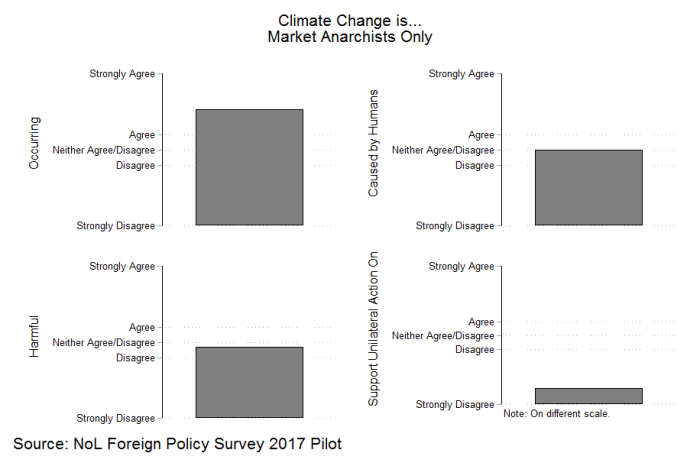
What is driving the differences between type of libertarian? Part of the story seems to be that those who think climate change is harmful are more willing to act to address it, but I suspect a large part of the story is also that some libertarians, particularly market anarchists, simply do not trust the government. Market anarchists are less likely to believe climate change is harmful or caused by humans compared to libertarians at large, but the big difference in opinion is whether the government should act on it.

Thoughts? Tomorrow I will be posting the demographics of those who took the survey.

climatechangema

Update: Updated graphs; minor coding error.

NoL Foreign Policy Results: Preliminary

tldr version; Libertarians are not isolationists in their foreign policy. Left-libertarians in particular are more supportive of things like NATO. Left-libertarians are also more supportive of acting on migration and climate change issues.


These are the preliminary results of the NoL Foreign Policy Survey 2017 Pilot. I will release the raw data and more results in the coming days. I am still in the process of cleaning things up.

The survey targeted self-identified libertarians through online libertarians communities (e.g. the Ron Paul Forums, reddit subreddits, facebook groups, etc.). The survey aimed to better understand the foreign policy views of self-identified libertarians based in the United States. The survey was conducted between December 23rd 2016 and January 1st 2017 and received over 600 replies.

Warning: This survey was a pilot and I discourage trying to generalize its results to the wider libertarian movement with any high degree of certainty.


Methodology:

The survey uses a survey experiment where respondents were placed into one of four alternative scenarios. Each scenario received similar questions, but had slight wording differences in two questions:

(1) whether the respondent supported providing military aid to a US ally and
(2) whether the respondent supported allowing in refugees from that country

The four scenarios were:

(1) A US ally being attacked by a neighbor – the base scenario
(2) The Baltic republics being attacked by Russia
(3) Afghanistan being attacked by Russia
(4) Taiwan ROC being attacked by China PRC

The survey can divided roughly into four parts:

(1) Military policy
(2) Migration policy
(3) Climate change policy and
(4) Trade policy


Results:
supportmilitaryaidbyattackedcountry

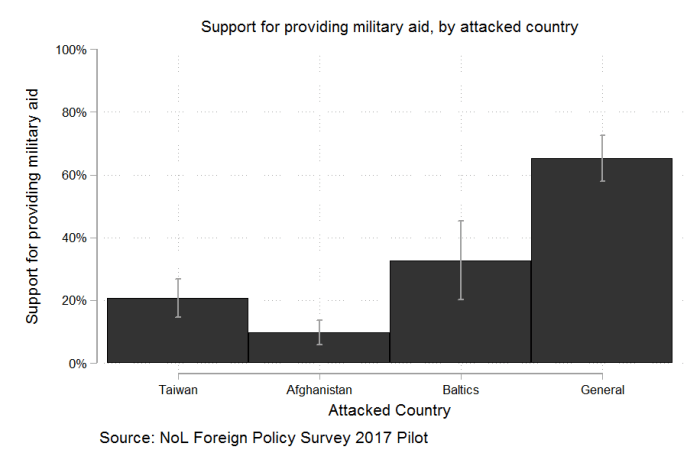
In the base scenario libertarians we find that the majority of libertarians favor providing military aid to a generic US ally. However that support goes down substantially when details are provided. If Afghanistan, a non-NATO major ally, were attacked it would receive support from less than 10 percent of respondents.

supportrefugee

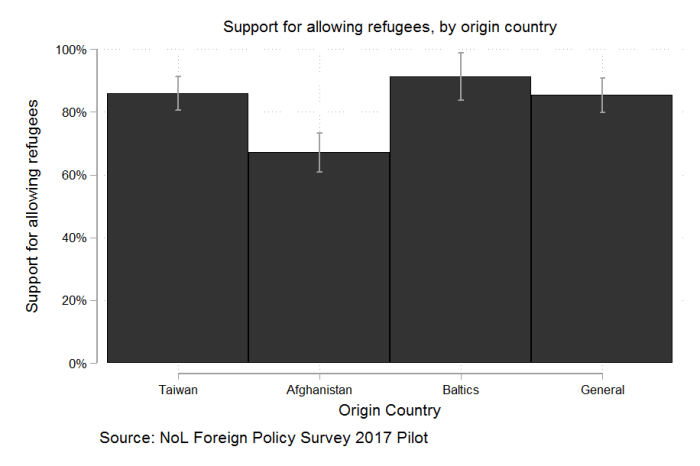
Likewise support for allowing refugees in from the attacked country is high in the base scenario, but drops for Afghanistan. Support for allowing refugees from Taiwan or the Baltic republics is not statistically different from the base scenario.

unilateral

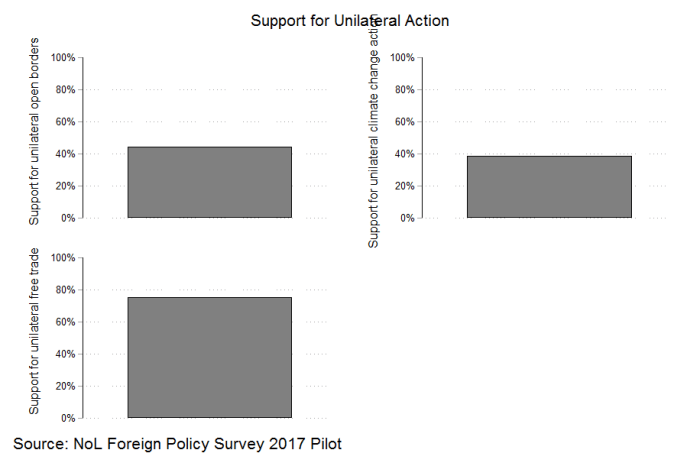
In the above graphs we see respondents’ support for unilateral action in free trade (“remove all trade barriers”), open borders, and addressing climate change. Support for unilateral action is almost twice as high for free trade than either support for open borders or climate change.

unilateral2

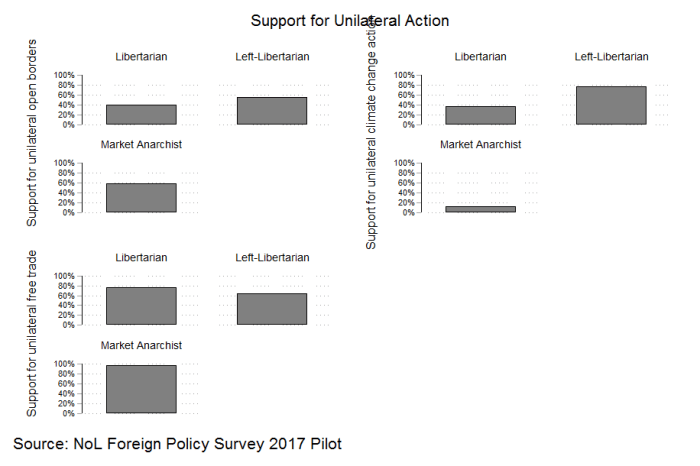
When I dig further into type of libertarian we see that left-libertarians are more willing to act on open borders and climate change than their counterparts. Almost 100 percent of market anarchists are in favor of abolishing all trade barriers.

int

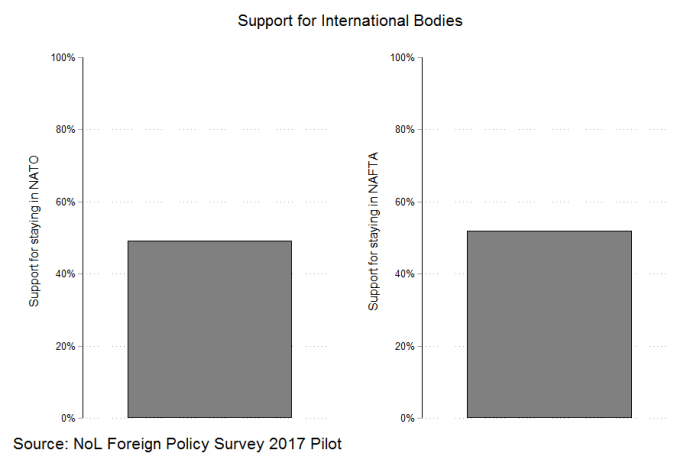
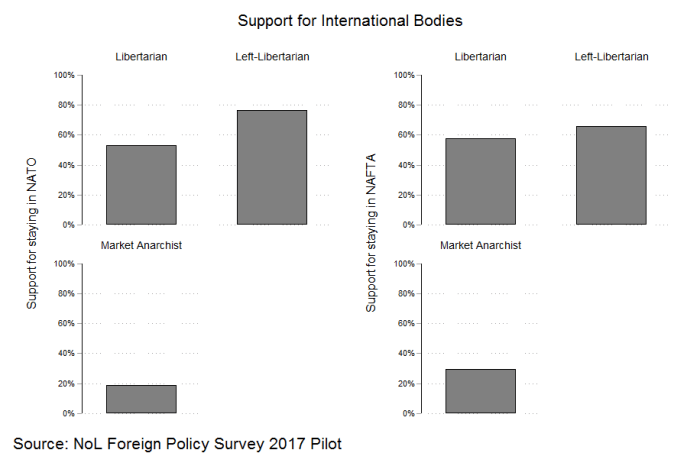
Respondents are split on support for international groups like NAFTA or NATO. If we look at sub-groups within the libertarian movement (i.e. libertarians, left-libertarians, and market anarchists) we see that left-libertarians are more supportive and market anarchists are less supportive of international action.

int2

The Asian Age

I love Asia. Ever since my student days I have had a keen interest in South East Asia and China, with my course on the Politics of the Asia Pacific at the London School of Economics in the run up to the handover of Hong Kong as a high point. This was followed almost a decade later with four years of living in Manila, with time spend as a freelance journalist covering Philippine politics and society, as well as teaching for three years at the European Studies Program at the elitist Ateneo de Manila University. I also had the opportunity to travel to almost all countries in the region (with the notable exceptions of Laos, Taiwan and the Koreas, but one should keep something to be desired). I admire the resilience of the Asians, their humour, great work ethics, the beauty of their countries, and of course their sumptuous food.

As a classical liberal I always have a keen interest in the economic developments of the region, which to me serve as the prime evidence for the great and positive impacts freeing up economies have. The rise of Asia in essence is the empirical proof that classical liberal ideas work, that capitalism has the capacity to improve the life of millions of people, in a very short term. This despite the imperfect implementation of capitalism throughout the region, so there is much room for further improvement. In this light it is also interesting to see how long economic freedom and political lack of freedom can co-exist. Classical liberal ideas predict, most clearly expressed by Milton Friedman in Capitalism and Freedom, that one follows the other. Economic and political freedom cannot be separated forever (nor forever suppressed together, as the experiences in the former Soviet bloc continue to make clear, even despite Putin’s increasing autocratic rule).

For an international relations observer from Europe, the developments in the Asia Pacific are of particular interest, because the rise of Asia seems to go together with the fall of Europe as a geopolitical player. Or more precisely: the fall of the middle rank European powers, as the European Union itself is a significant player in trade politics only, the only field where it represents all member states and policy is determined at the European level, with a leading role for the European Commission.

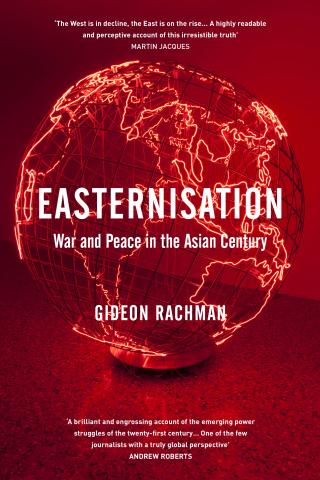
The recent book Easternisation: War and Peace in the Asian Century, by Financial Times journalist Gideon Rachman, deals precisely with this issue.

blog-easternisation

It is a great book, bringing together Rachman’s extensive experience in the US, Asia, and Brussels. Often, books written by journalists lack sound analysis for the mid to long term, and historical perspective. While Easternisation is not an academic tome either, it does provide sufficient deep analysis, especially by tackling developments in all important countries which play a role in the process. It is not just another volume of simply USA or EU bashing, as we have seen before with the huge literature on the alleged Japanese take-over of the US economy.

Rachman’s main argument is that the influence of the West, Europe in particular, has crumbled. This may lead to a major conflict in the Asia Pacific, most notably between China and the US, which also endangers the global economic order. Yet many other conflicts are also building up, in a region which heavily invests in armaments. In short, in the 21st century, ‘rivalries between the nations in the Asia Pacific will shape global politics, just as the struggles between European nations shaped world affairs for over 500 years from 1500 onwards’. I think this is an important message, which should be taken seriously by everybody. Certainly by the Europeans, who are in danger of just inhabiting the world’s largest open air museum within a few decades.  One thing is certain: the Asians will not wait for them to come to terms with the current shift of power.

A moral inquiry

Below is an excerpt from my book I Used to Be French: an Immature Autobiography. You can buy it on amazon here.


Note: I was born and reared mostly in Paris but I spent most summers in Brittany. Brittany summers left a deeper mark in me than the Paris school year.

In the Breton architectural fashion, my grandmother’s granite house shared a wall with the houses of two neighbors. On one side was the good looking old guy and his too virtuous old wife. On the other side of my grandmother’s house was a family of fishermen: old Pop, old Mom, grown daughter and grown son. They all lived in a single room that served as kitchen, dining room and bedroom. The parents shared a carved oak armoire-bed, accessible by climbing on a trunk and equipped with a sliding door to provide privacy. The adult children each had their small iron bed, placed at opposite corners of the room, I am pleased to report. There was no bathroom, of course, only an outhouse in the backyard. It was never scooped, never moved. It was surrounded by the most beautifully, healthy cabbage I have ever seen. The fisherman’s children never married. Perhaps they were too afraid of their parents; or, they liked each other too much. (But this is only hearsay.)

At the end of the dirt road, fifty yards away, lived the town ditch-digger and his large brood. The ditch digger’s boys were always hungry. They stole eggs, from wild birds’nests and from hen houses alike. They also picked wheat and toasted it in the fields, which was tolerated. In September, ripe hazelnuts were available for the picking. I don’t know what they did after September and I will never know because my family never stayed beyond that month. But school was back in session then, and there, they got at least one square a day.

Sometimes, we would climb over the priest’s orchard wall to steal his excellent pears. This happened less often than one might think because it presented moral problems: Everyone knew that the priest would not beat you hard if he caught you so, it was kind of unsporting to pick on him. And there was the issue of having to tell him in confession that you had stolen his pears. We discussed whether one would go to Hell for abstaining from confessing that single particular sin. There was no theological consensus.