Taxes, Free-riding, and Federation

Check out Adam Smith complaining about the rent-seeking that the UK’s North American colonies were practicing back in 1776:

The expence of the ordinary peace establishment of the colonies amounted, before the commencement of the present disturbances, to the pay of twenty regiments of foot; to the expence of the artillery, stores, and extraordinary provisions with which it was necessary to supply them; and to the expence of a very considerable naval force which was constantly kept up, in order to guard, from the smuggling vessels of other nations, the immense coast of North America, and that of our West Indian islands. The whole expence of this peace establishment was a charge upon the revenue of Great Britain, and was, at the same time, the smallest part of what the dominion of the colonies has cost the mother country. If we would know the amount of the whole, we must add to the annual expence of this peace establishment the interest of the sums which, in consequence of her considering her colonies as provinces subject to her dominion, Great Britain has upon different occasions laid out upon their defence. We must add to it, in particular, the whole expence of the late war, and a great part of that of the war which preceded it. The late war was altogether a colony quarrel, and the whole expence of it, in whatever part of the world it may have been laid out, whether in Germany or the East Indies, ought justly to be stated to the account of the colonies. It amounted to more than ninety millions sterling, including not only the new debt which was contracted, but the two shillings in the pound additional land tax, and the sums which were every year borrowed from the sinking fund.

This comes from Book 4, the third (and last) part (“Part Third”) of Chapter 7 in Smith’s famous book The Wealth of Nations (TWON). (Here is a great link to the whole chapter, courtesy of the Library of Economics and Liberty. I read the Bantam Classics version for my Honors seminar on Liberty in Western Political Thought, led by Andrew Sabl, who is currently a Visiting Professor at Yale, though I don’t have it with me so I can’t cite, let alone remember, the page numbers.)

Let me throw a little bit of historical context for this excerpt at you. Smith wrote TWON before the onset of the first Anglo-American war (TWON was published in 1776, which means it did not influence the American colonists in any way, shape, or form; think about the way information spread back in those days), and the war was largely the result of a quarrel between the UK and its North American colonies over taxation. The taxation, though, was needed in order to pay for a war (the Seven Years’ War) that the colonies had initially lobbied the British government to fight for them. The British colonies in North America had much more leeway than their French, Spanish, Portuguese, and Dutch counterparts, and a number of these colonies wanted to expand westward, into the Ohio Valley, where the French state had made claims that were recognized under international treaties.

To make a long story short: Several colonial factions picked a fight with the French and their Native American allies, and this little schoolyard brawl turned into a global war (with fighting in North America, India, Africa, South America, and East Asia) that saw the United Kingdom become the world’s preeminent imperial power and France lose almost all of its North American colonial possessions.* When the war was over, the British parliament wanted to tax the colonies to pay for their fair share of the war, and the colonists said “No taxation without representation!” Smith summed up the situation as thus:

In order to put Great Britain upon a footing of equality with her own colonies […] it seems necessary, upon the scheme of taxing them by parliamentary requisition, that parliament should have some means of rendering its requisitions immediately effectual, in case the colony assemblies should attempt to evade or reject them […] The parliament of Great Britain insists upon taxing the colonies; and they refuse to be taxed by a Parliament in which they are not represented.

This is quite the conundrum, and Smith put forth a proposal that I found quite novel when I first read it as an undergraduate. But before I get to his proposal, I want to make sure that everyone understands the situation here. The UK fought an expensive war at the behest of its colonies, and the colonies, once the war was over, refused to pay for it. Sound familiar? It should. Today the United States finds itself in this situation often (just replace the word “colonies” with “allies”).

Smith proposed the following deal instead of war or civil oppression (such as economic sanctions):

If to each colony […] Great Britain should allow such a number of representatives as suited the proportion of what is contributed to the public revenue of the empire, in consequence of its being subjected to the same taxes, and in compensation admitted to the same freedom of trade with its fellow-subjects at home. [Were British America] to send fifty or sixty new representatives to parliament, […] there is not the least probability that the British constitution would be hurt by the union of Great Britain with her colonies. That constitution, on the contrary, would be completed by it, and seems to be imperfect without it. The assembly which deliberates and decides concerning the affairs of every part of the empire, in order to be properly informed, ought certainly to have representatives from every part of it. That this union, however, could be easily effectuated, or that difficulties and great difficulties might not occur in the execution, I do not pretend. I have yet heard of none, however, which appear insurmountable. The principal perhaps arise, not from the nature of things, but from the prejudices and opinions of the people both on this and on the other side of the Atlantic. […]

Why didn’t the UK just federate with its North American colonies? Smith cited British fears of an unbalanced political constitution that the North American colonies might bring to such a union, and North American fears of being completely dominated by a faraway parliament were they to join such a federation. He countered both fears well, but check out what he predicted would happen if such a federation were to actually take place:

The distance of America from the seat of government […] would not be of very long continuance. Such has hitherto been the rapid progress of that country in wealth, population, and improvement, that in the course of little more than a century, perhaps, the produce of American [taxation] might exceed that of British taxation. The seat of the empire would then naturally remove itself to that part of the empire which contributed most to the general defence and support of the whole.

Interesting, right? Smith argued that the American colonies would become so rich and so populous that the capital of his proposed British federation would “naturally” move from London to somewhere in North America.

Smith was wrong in a general way, but correct in an even more general way. Let me explain.

Smith was wrong because the United States – once separated from the United Kingdom – evolved into the wealthiest, most innovative society the world has ever known. The reason for this is the aristocratic upper house of a legislative institution (“Senate”) that the 13 states had to create in order for all of them to join a federation. If Smith had had his way, the world would have never known the American Senate, and I doubt very much that the 13 colonies would have grown to become as innovative and wealthy as they are today without this vital institution of governance.

Smith was also wrong to make his argument for such a federation to be based on tax revenue rather than principled representation (though see Warren’s infamous post arguing for just such a proposal). The tax revenue argument might be more economically efficient, but it would not give polities seeking federal bonds the guarantee of some sort of equality (two representatives in the aristocratic chamber of the legislative assembly) that they would need to join such a federation. On these two points Smith’s argument was wrong, but what did he and other republicans and federalists get right?

To answer that I think it’s best to ask another question: What would happen if the UK and the US were to federate today?

The UK would be the poorest state in the union (as measured by GDP PPP per capita), if it were admitted as one state.

The stark difference in living standards doesn’t stop there, though. Suppose the SNP finally gets its way and Scotland leaves the UK. Even if England (intl$ 32,669), Wales (intl$ 25,947), and Northern Ireland (intl$ 27,573) were admitted into the US as three separate states, they would all be at the bottom of the living standards barrel. Were Scotland to go along with the other polities in the UK and federate with the US as a separate state, she would rank second-to-last (intl$ 33,791), just in front of Mississippi but behind Idaho. The rankings would look like this:

49. Idaho

50. Scotland

51. Mississippi

52. England

53. Northern Ireland

54. Wales

Smith’s argument suddenly looks a whole lot better, right? At least if you think living standards as they are measured by economists are a good way to gauge the overall health and wealth of a given society.

A federation is basically a huge, actual free trade zone (both capital and labor can move freely) coupled with a binding military pact and some institutions that allow factions to openly argue and contest for spoils that end up in a state’s treasury, but that’s not what the US has with any of its military allies or trading partners. What I find interesting is that the objections to federation between the UK and its North American colonies that Smith listed are essentially the same ones that crop up when such a federation is proposed between the US and its various allies and partners. The difference between now and then, though, is the Senate. Sending representatives based purely on population or tax revenue would most likely contribute to an unbalanced political constitution, but having two guaranteed representatives in a political body that’s heavily aristocratic and lightly democratic would surely guarantee an equality that all sides could eventually agree upon.

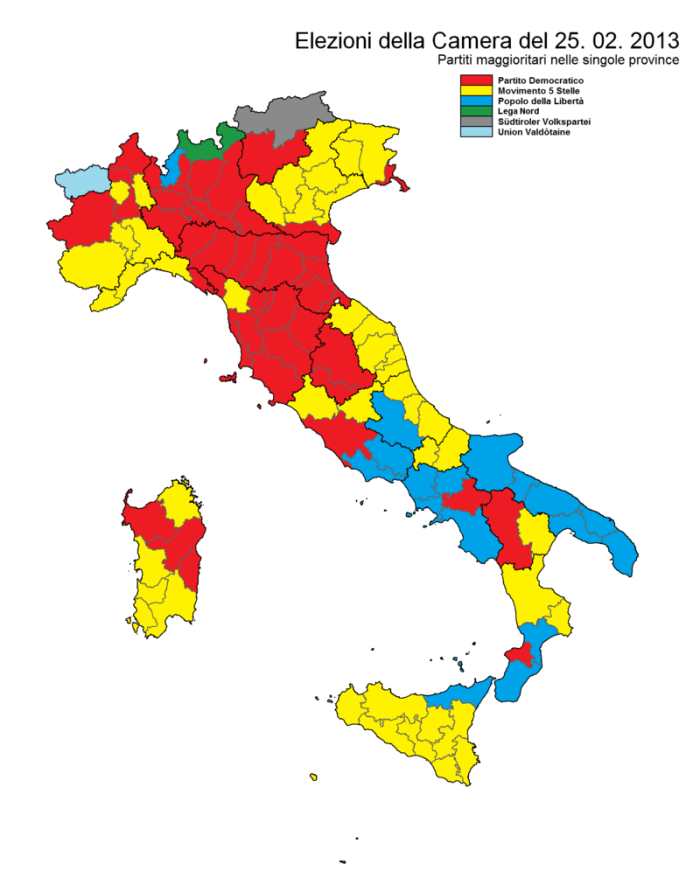
There is also an interesting cultural development to think about as well. The states in Western Europe and East Asia sans China have helped to develop a political culture that is more closely aligned with the one found in the US, Canada, and Australia/New Zealand, one where citizenship trumps ethnic identity. Identity based on citizenship is not as strong as the one found in the Anglo-Saxon world, and ethnic differences do pop up from time to time (largely due to linguistic differences), but the states of Western Europe and East Asia have taken many steps in the right direction to help eradicate the parochial tribalism that has long plagued European and Asian societies and replace it with citizenship. Take a look at the political constituencies of the following three countries:

blog-2013-elections-germany
Germany’s 2013 federal elections (source)
blog-2016-elections-south-korea
South Korea’s 2016 legislative election (source)
blog-2013-elections-italy
Italy’s 2013 legislative election (source)

They are largely based on a Left-Right divide rather than the ethnic ones we find in less economically-developed, less politically-integrated, post-colonial states. This Left-Right divide would fit in perfectly with the Madisonian constitution, as administrative units (i.e. Northern Ireland, Gangwon, Bavaria, or Trentino instead of the UK, South Korea, Germany, or Italy) could be added in a manner so as not to upset the balance between Left and Right currently found in the US. Political coalitions would wax and wane with time, of course, but if we want a world where the East Asians and Western Europeans pay their fair share, and where they are protected from Moscow and Beijing, then federation is as moderately radical as you can get.

Just ask Adam Smith.

Minorities and Economic Growth: Evidence from Jewish Communities in Premodern Europe

Urban theorist Richard Florida is celebrated for arguing that cities today succeed by attracting members of the “creative class.”  In a similar spirit I have a recent paper with Noel D. Johnson where we investigated whether or not cities in medieval and early modern Europe grew faster if they possessed a Jewish community.

Scholars have long noted the role of minority groups in economic development. This is particularly true for the the premodern period. The great scholar of long-run historical development in Europe, Fernand Braudel, observed that “successful merchants who controlled trade circuits and networks often belonged to foreign minorities.” These minorities could be other nationalities or religious minorities, for example, “the Jews, the Armenians, the Banyans, the Parsees, the Raskolniki (Old Believers) in Russia or the Christian Copts in Muslim Egypt” (Braudel, 1979, 1982, 165).

Hornung (2014) studies the impact of the Huguenot migration to Prussia. Since the nineteenth century, scholars like Friedrich List linked the presence of Huguenots with the transmission of human capital, skills, and innovation. Hornung (2014) is able to test this hypothesis using Prussian immigration lists from 1700 that document the location of Huguenot settlements and firm-level data on input and output for all 750 textile manufactories in Prussia in the year 1802. Approximately 16,000 to 20,000 Huguenots fled France to Prussia at the end of the seventeenth century.  Hornung finds that the presence of Huguenots significantly increased firm productivity. Specifically, a 1 percentage point increase in the share of Huguenots was associated with 1.5 percentage points higher productivity in 1802.

Jewish Communities and City Growth

In our paper we take a broad sweep of European history from 1400 to 1850.  We have a total of 1,792 cities in our panel data from the Bairoch (1988) dataset and 1,069 Jewish communities that appear in the Encyclopedia Judaica. The figure below shows both the cities in the Bairoch dataset and the Jewish communities mentioned in the Encyclopedia Judaica.


bairochandjewishcitiesgreyscale

To understand the relationship between the presence of a Jewish community and subsequent city growth we conduct a difference-in-differences style regression analysis.

The fact that we have data on city populations every century means we can hold constant the identity of a city using city fixed effects and see whether or not it grew faster in the centuries when it had a Jewish community in comparison to those centuries when it did not. We can also control for the possibility that overall city growth was faster in some centuries in comparison to others using century fixed effects.

We are also able to hold constant other factors that could plausibly have affected city growth. We control for local geography including cereal suitability, proximity to rivers, and proximity to coast, as these factors likely affected city growth in different ways over time. We also control for local infrastructure including presence of university and distance to a medieval trade route.

Our  analysis suggests that, indeed, cities with Jewish communities grew faster on average between 1400 and 1850. The effect we find suggests that cities with Jewish communities grew about one third faster than those that did not have Jewish communities. This analysis remains a correlation, however. We do not know if the presence of a Jewish community brought with it economic benefits or if Jews merely choose to settle in faster growing cities.

Instrumenting the Presence of a Jewish Community

We model the network of Jewish communities as one way to see whether the effect of Jews on city growth was indeed casual. By examining how Jewish communities expanded we hope to isolate a source of exogenous variation in the presence of a Jewish community.

We assume that a Jewish community is more likely to be established close to another Jewish community because of trade networks, financial relationships, or cultural linkages. We then calculate the closest travel path between Jewish communities using our information about the location of roads and river networks and estimates of premodern transport costs. The important assumption we make is that if cities with Jewish communities share certain “unobservable” characteristics that might make them more likely to grow rapidly, these characteristics become less correlated with distance.

We then divide Europe into 5km x 5km grids and assign the lowest travel cost to each grid. We apply Djikstra’s algorithm to determine the lowest cost of travel between all 3,211,264 city pairs (van Etten, 2012). This allows us to create a measure of ‘Jewish network access’ for each city.

Jewish network access itself is, of course, correlated with the unobservable characteristics of the city for which it is calculated. To overcome this we adopt two strategies to create valid instruments out of the network access measures. First, we calculate Jewish network access for cities that are only more than a certain distance away from each other. Second, we use information on expulsions to weight our measure of Jewish network access. The intuition behind this is that Jewish expulsions consist of an exogenous “push” factor leading to Jews settling in new cities close to the existing network of Jewish communities. Using these two strategies we obtain similar (though larger in magnitude) effects from the presence of a Jewish community on city growth. This provides further suggestive evidence that the correlation we found in our baseline analysis was indeed causal.

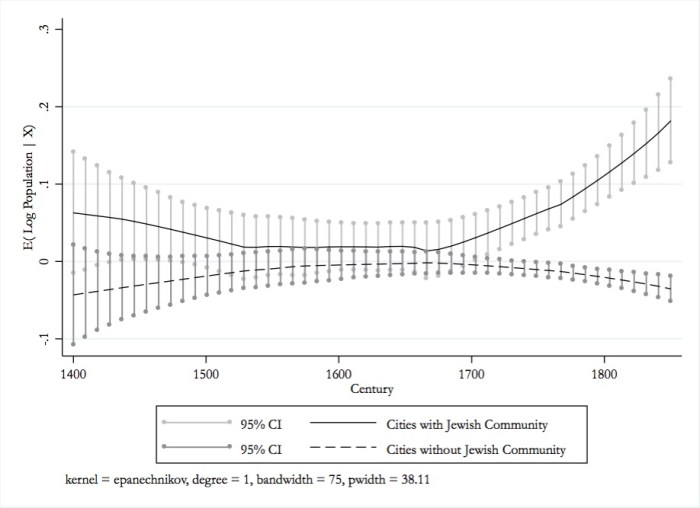
The Relationship Between Urban Growth and the Presence of a Jewish Community Over time

Across specifications, we find that cities with Jewish communities experienced no growth advantage in the 15th and 16th centuries. After 1600, however, they began to grow significantly faster.

motivationlpoly

The relationship we observe in the Figure does not appear to be inline with a pure human capital story. Jews had higher human capital than Christians throughout the medieval and early modern period. But the growth advantage of cities that had Jewish communities only became evident after 1600. This raises the possibility that something else changed around  17th century that made the human capital and skills of Jews more complementary to economic growth.

Two Mechanisms: Jewish Emancipation and Market Access

The two factors that stand out in explaining the emergence of a growth advantage for cities with Jewish communities after 1600 but not before are: (1) Jewish Emancipation after 1750; and (2) a complementarity between the presence of a Jewish community and market access.

The process of Jewish emancipation began in continental Europe after 1780. It was a major institutional break that signified a major change in the economic, social, and political status of the Jews in Europe. In work with Jean-Paul Carvalho, I’ve shown that Jewish emancipation lead to a religious schism and the emergence of both Reform and Ultra-Orthodox Judaism.

In the period before Jewish emancipation, legal barriers limited the ability of Jews to put their labor to its highest value use. Jewish businesses were prevented from hiring non-Jewish workers. Jews could not attend universities. Moreover, Jews and Christians were culturally isolated. This changed with emancipation, and we expect to see it reflected in the contribution of Jewish communities to city growth in the post-1750 period.

The second factor we study is the complementarity between the presence of a Jewish community and the development of markets. The historical literature points to the importance of Jewish trading and financial networks. But, while economic historians have conducted numerous studies of market integration during the early modern period, with a few exceptions these have focused on the grain trade with little systematic study of other markets due to data limitations. Jewish merchants in medieval and early modern Europe, however, did not play a prominent role in the grain trade but, rather, were involved in the transport of diamonds, sugar, silks, tobacco, and other luxury products in addition to playing a large role in banking and finance. Therefore, rather than looking at grain markets, we explore a more general measure of market integration based on market access.

Market access depends on the population size of nearby cities weighted by the cost associated with the least cost travel path. We show that market access was increasing for all cities after 1700. We find evidence that cities with Jewish communities were better able to take advantage of this increase in market access. As we detail in the paper, our findings are consistent with the argument made by numerous historians that Jewish trading and finance networks help to knit together the European economy, particularly in the period 1650 to 1800 (Israel, 1985).


Our analysis provides support for the accounts of historians who have emphasized the important role played by Jewish traders in 17th and 18th century Europe (such as Fortune, 1984; Israel, 1985; Trivellato, 2009). Furthermore, our story is in line with institutional arguments such as those developed by Douglass North, John Wallis and Barry Weingast, and Daron Acemoglu and James Robinson.  In the Middle Ages, the presence of Jewish communities was part of an institutional arrangement that extracted rents from society and distributed them among members of the ruling elite. The eradication of these rent-seeking arrangements and the liberalization of Jewish economic activity, first in the Netherlands and England and then in the rest of Europe following Jewish Emancipation, was of critical importance as it is in those cities that possessed emancipated Jewish communities that we observe the strongest relationship between the presence of Jews and economic growth.

Pornography, virtual reality and censorship [I]: presidents and feminism

Oculus Rift, recently purchased by Facebook and partnered with Samsung, and HTC Vive, manufactured by HTC with Valve technology, have lead the 2010 wave in developing virtual reality headsets. These technologies, innovative by today’s standards but primitive by science fiction’s, mark the beginning of a differently structured society. They also mark a starting point for a new debate about privacy, the social affects of videogames, and especially censorship in media.

Virtual reality (in its not-too-distant actuality) offers an opportunity to behave outside of social norms in an environment that is phenomenologically the real world. The only comparable experience for humankind thus far is lucid dreaming, for which the rewards are less intense and the journey less traversible than the quick promises of virtual reality machines. One inevitable development for these machines is violent, sexually explicit experiences, available for cheap and accessible 24/7. To see how VR might be received, the closest industries to analyze are the videogame and pornography industries.

Interestingly, pornography has a very liberal history, in comparison to other “societal ills,” like drugs. Erotica dates back to ancient cultures — notably, the Kama Sutra, hardcore by today’s standards, is still a staple of contemporary sexual experimentation — and today’s perversions were common themes: bestiality, pedophilia, etc., although pornography with an emphasis on violence might be a more modern trend. This isn’t to ignore, however, the roles typically played by women in ancient Western folklore and mythology, which are degrading by today’s feminist standards.

The case could be made that today’s censorial views on pornography come from a far more malevolent or oppressive stance toward women than two millennia ago. The free expression that pornographic media once enjoyed was severely deflated over the 20th century. Only two years ago, a plethora of activities were banned from pornography in the United Kingdom. Reacting to the legislation, commentators were quick to criticize what was seen as policy that was specifically anti-female pleasure. Female ejaculation, fisting, face-sitting, and many forms of spanking or role-play were among the restrictions. There are puritanical, “moral outrage” elements to the restriction, but many noticed the absurdity of banning face-sitting: said one producer, “Why ban face-sitting? What’s so dangerous about it? … Its power is symbolic: woman on top, unattainable.” (There has been well-intended censorship as well. Los Angeles county passed Measure B in 2012 to require condom use during any pornographic scene with anal or vaginal contact, to combat the spread of venereal disease.)

Nowadays, there are plenty of porn directors that have learned to focus on both male and female pleasure, and reintroduced artistic merit to their directions. With the equalizing force gaining momentum in porn, it’s curious what the vehement, persistent condemnation springs from, when not focused exclusively on abusive sex scenes. In addition, the negative effects of pornography’s presence in society are still being debated. Just the other day, a study which led to headlines like “Porn doubles the risk of divorce” and “porn signifies a death knell for marriage” was criticized by Reason magazine for failing to address important underlying factors that more plausibly contribute to both pornography consumption and an unhappy marriage leading to divorce. There seems to be an obsession on behalf of the great majority of the public in assigning pornography to some sort of social harm.

Research on photographic pornography’s effect on society began early and aggressively. The Meese Report (1986), commissioned by Reagan and still frequently cited by anti-pornography advocates, determined pornography to be detrimental to society and family relations, and especially for women and children. Arguments built on similar reports attempt to connect sexually explicit material with rapes and domestic violence, alleging that the desensitization to rough sex carries over from the depictional world into the real one. Henry E. Hudson, the Chairman of the Meese Commission, alleged that pornography “appears to impact adversely on the family concept and its value to society.” The Meese Report, however, has been challenged extensively for bias, and is not taken seriously as a body of research any longer. One criticism by writer Pat Califia, concluding a traditionalist narrative embedded in the research, states that the report “holds out the hope that by using draconian measures against pornography we can turn America into a rerun of Leave It to Beaver.

The United States’ Commission on Obscenity and Pornography, preceding the Meese Report and commissioned by Lyndon B. Johnson and Nixon, was unable to find evidence of any direct harm caused by pornography. (Although Nixon, despite the evidence under his administration, believed porn corrupted civilization.) It is curious that a new federal study was requested only sixteen years after the first extensive one, but maybe not too unusual given the growth of porn with technology (from adult stores and newsstands to unlimited free online access; the internet just celebrated its quarter-centennial birthday); also not too unusual given the absurd and expensive studies already undertaken by the federal government. It is also worth pointing out that pornography, though often connected to feminism, is a divisive issue within 20th century and contemporary feminism: some thinkers, like Andrea Dworkin, condemned it as intrinsically anti-women; others feminists like Ellen Willis argued for pornography as liberating and its suppression as moral authoritarianism. The debate along lines of sexuality, online or otherwise, culminated in the feminist “sex wars,” with groups like Feminists Against Censorship and Women Against Pornography popping up. Thus, the debate is open across every ideological camp, and support of pornography is neither necessarily liberal nor necessarily feminist.

[In the next post, I discuss violent pornography’s cross-media transformation into videogames, more sociological research and the general point, and insecurity, of prohibitory measures.]

The Coup in Turkey

I am based in Turkey and have been at the edge of some dramatic events. Before I was in Turkey, I was in the Turkish sector of Cyprus (officially designating itself the Turkish Republic of Northern Cyprus, but only recognised as such by Turkey), where I followed the Postmodern or Indirect Coup of 28th February 1997 when military representatives on the National Security Council were able to force the collapse of a coalition government under an Islamist Prime Minister. Later that year I relocated to Istanbul where I experienced sporadic terrorism from Kurdish separatists and Jihadists. In June of this year I landed at the Atatürk airport just after an ISIS suicide attack. In a more gradual way I saw the disappearance of a Turkish political system under the guardianship of Jacobin laicist army generals, known as Kemalists after the first President of the Republic of Turkey, Kemal Atatürk.

The changes in Turkey came about through a de facto alliance between a party with Islamist roots, the AKP (JDP, Justice and Development Party) and the followers of Fetullah Gülen. Gülen was himself a product of Nurcu Islam, which developed in the early years of the Republic before World War Two as a reaction against the state-led secularisation of Turkey. Gülen was a not very well educated preacher who operated in the context of a fragment of the Nurcu movement, which is not as a whole connected with him. Given the enormous tension between laic Kemalists and the religiously observant population, there was room for a movement devoted to developing conservative Muslim power in civil society and the state.

The Gülenists were preceded in this by the Nakşibendi community, which targeted the state bureaucracy and had followers in politics, notably Türgüt Özal, Prime Minister and then President in the 1980s. Secretive and manipulative politics has been a feature of Turkish and Ottoman politics for a long time. The power of the Janissary elite military and bureacratic corps during the Ottoman period was tied to a religious community, the Bektaşis, creating a parallel system to the legal power of the Sultan until they were violently crushed in the late eighteenth century.

The Committee of Union and Progress, which came to power with military support in the last phase of Ottoman history, developed into a conspiratorial organisation rather than a parliamentary political parry, and a secret arm of it was at the centre of the destruction of Anatolian Armenians in 1915. Secretive groups of Unionists provided a power base for Kemal Atatürk when he revolted against the restored power of the Sultanate and its subservience to the partition/occupation of what is now Turkey after World War One.

The idea of a secret part of the state was maybe not so strong during the early years of the Republic when a one-party system (though in principle the republic was under popular sovereignty) under the dominance of Kemal Atatürk and then İsmet İnönü maybe made it less necessary. Nevertheless, the conditions were established for a revived politics of manipulation behind the scenes. Unfortunately, İnönü’s decision to join the west after World War Two played a part in this. The reorientation resulted in free elections in 1950, with a change in government, and Turkish membership of NATO in 1952.

As in some other countries, the Gladio units played a role in dark political activities. These were the units established to engage in resistance in the event of a Soviet invasion. They had a secretive army within an army aspect and were inevitably a magnet for the most fiercely anti-communist officers, including Alparslan Türkeş, who played an important role in the 1960 Coup. Türkeş was expelled from the coup government, which found him too radical, but he founded the extreme right party in Turkey, Nationalist Action, which is comparatively moderate now, but was heavily involved in political destabilisation and terrorism along with the most anti-communist parts of the state.

What came later was infiltration of the state by Nakşibendis and then Gülenists. Their activity was rather overshadowed by the darker activities of the army and its extreme right allies, often also connected with the Mafia. This network is often known in Turkey as the Deep State. It tended to favour a secular democratic system in terms of formalities, but with concessions to religious conservatism along with an anything goes attitude to covert war against communists and then more importantly Marxist Kurdish autonomists, as well as very limited tolerance for the Left. The hard right element of the army with a base in Gladio was not the whole story. There were far left army officers, particularly up to 1971 and a general staff that tended to be in the middle, though the middle tended to move further right from 1960 to 1980, and then became unwilling to launch anymore violent coups after the 1980 military council stepped down in 198. The general staff itself became increasingly concerned about infiltration by Islamists, including Gülenists.

As it turns out the army’s fear was more than justified. The country liberalised, from a very illiberal base, in the late 1990s, and while the army to some degree went along with that, it launched a peaceful ‘post-modern’ coup in 1997 against the Islamists and was left with the image of the pillar of anti-democracy and anti-liberalism in Turkey. This is an important part of the background to the AKP ‘moderate’ Islamist/conservative democrat electoral victory of 2002 along with the economic crisis of 2001, which along with the 1997 coup left the secular parties very fragmented. The AKP gained a lot of liberal and libertarian support (a very small proportion of Turkey though) and more general reformist support from those who believed it would be a vehicle for reducing the military role in politics and for generally less nationalist-statist politics.

The AKP had very few supporters in place in the military, in the state bureaucracy, or in senior positions in education. The Fetullah Gülen campaign to turn his supporters into the dominant force in Turkey meant they had people in these positions, partly through infiltration of state institutions and partly through founding private educational institutions. This was just one part of the Gülen empire, which include major media groups, banks, and industrial companies in Turkey, and in many countries outside Turkey including the USA. Gülen himself moved to the USA to avoid prosecution by the Kemalist old guard before AKP came to power, claiming to have no links with the economic and educational empire of his supporters which is clearly less than honest of him.

The Gülenists expected a large role in the AKP government and served them most spectacularly in purging the armed forces after an attempted website coup in 2007. In that year the armed forces, unwilling to launch an outright coup, hoped to influence public opinion and the political process by placing a message on its website proclaiming the army’s guardian role in relation to secularism. This turned into the final political defeat of the army’s Kemalist guardian-tutelary role. The AKP won a general election and a referendum to change the method of electing the President. This triumph of civil electoral politics was, however, undermined by the trials of supposed armed coup plotters in the armed forces. Such trials gave the impression of completing the civilian dominance over the army, but were themselves rigged using weak and outright faked evidence. The judges and prosecutors were from the Gülen movement and were creating space for their own people to take the high offices in the armed forces.

The AKP began a campaign against the Gülenists after making its own illiberal core attitude very clear in 2013 in its highly intolerant and authoritarian reaction to the Gezi protest movement. It was increasingly clear to the (even then) most enthusiastic of liberal fellow travellers with the AKP that it was Islamo-nationalist and statist at its core, reducing democracy to the unlimited will of the party elected to government. The Gülenists and the AKP now found the state was not big enough for both of them and the Gülenists decided to use conspiratorial methods against the AKP. Audio files and video tapes of AKP figures and associates, which had evidently been kept in reserve and which suggested widespread corruption were released. Recep Tayyıp Erdoğan (then Prime Minister and now President) and the AKP government succeeded in sacking, retiring and transferring  enough Gülenist police officers, prosecutors and judges to stop this evidence coming to court. They then declared the Gülenists to be a parallel state and a terrorist group, entering into a process of purging the state of Gülenists and seizing their assets in the media, educational and other sectors. The coup conspiracy convictions against army officers, and others, were overturned and it became widely accepted that Gülenists had rigged the trials.

On 15th July this year, I was at a small party on a terrace in the Üsküdar district of Istanbul, overlooking one of the Bosphorus bridges, though by quite a large distance. We could see traffic interrupted on the bridge and news began filtering through of a confrontation between police and army units in what was described as an anti-terrorist operation gone wrong, but was beginning to sound like the beginning of a coup. It turned out that a coup had started and for a brief part of the night it appeared that the old Kemalist-Guardian army had come back to dispose of a government that was elected but increasingly authoritarian. Any welcome in the party where I was, of secular anti-AKP Turks and foreigners was strongly outweighed by a fear that a coup regime would be authoritarian, would create new problems, and the AKP or something like it, if not worse, would be in power for ten or twenty years by way of reaction. This turned out to be the mood of anti-AKP and anti-Erdoğan Turkey. It also became increasingly reported and accepted across the political spectrum that though the putschists had adopted Kemalist language, they were for the most part Gülenists rising up before a purge of the army in a last grasp at domination of the Turkish state.

Since then a purge has unfolded against the Gülenists in state and society, covering the universities (the sector where I work), which has already led to the sacking and arrests of about 60 ooo, including constitutional court judges, army generals and university rectors. The number will certainly at least double before the purge and the current state of emergency is over. Such sweeping action is understandable up to a point given the violent actions of 15th July, and the accumulating evidence over the years of Gülenist infiltration to create a Gülenist-controlled state and society, but clearly the potential exists for massive and systematic individual injustice with abuses of state power affecting over enemies of the state, real and imagined. Some of the language President Erdoğan has used since the coup has been highly polarising and vengeful, demanding submission to state power; some of his rhetoric has been more conciliatory, recognising that all political parties opposed the coup and that deputies across the spectrum sheltered together in the basement of the National Assembly fearing for their lives. I cannot say I am hopeful that the post-coup atmosphere will be beneficial to liberty, but we should hope for and work for the best in Turkey, while being vigilant in working against further declines of liberty.

One thing is for sure: republican politics will not come from the army now and Turkish republicanism must renew itself through engagement and re-engagement with the whole history of republican thought, which is at the origin of classical liberal and libertarian thought. In theoretical and philosophical terms, which is where I work, the discussions of republicanism and liberty going back to Hannah Arendt in the last century, along with the revived study of MachiavellianRenaissanceEarly Modern Republicanism and the way the classical liberals were dealing with the republican legacy of ancient Greece, ancient Rome and medieval city-states are particularly apposite given that Turkish politics, avowedly Kemalist or not, deals so much in a republican language of shared sovereignty and popular mastery.

McCloskey, Western equality, and Europe’s Jews

Warren shot me the following email a few days ago:

Brandon, do you know the name Deirdre McCloskey?

She is a first-rate economist with extensive expertise in history, literature and anthropology.  She recently finished a trilogy, the third volume of which is “Bourgeois Equality.” It’s a fat book but you would be well rewarded for time invested.  You don’t have to read the first two volumes to benefit from the third.

The purpose of the trilogy is to explain why we’re 30 times richer than our forebears of 250 years ago, as best that can be estimated.  Conventional answers like the industrial revolution and rule of law don’t go far enough.  The answer lies in attitudes toward commerce.

I haven’t read McCloskey’s book yet, but it’s been on my amazon wishlist for awhile and thanks to Warren’s prodding it’ll be my next purchase. (Here is all of NOL‘s stuff on McCloskey so far, by the way.)

My first instinct on this topic is to think about Europe’s Jews. Bear with me as I lay out my thoughts.

McCloskey’s book, which as far as I can tell takes readers to the Netherlands and the United Kingdom from the 17th to 19th centuries, is about how Europeans began to reconceptualize equality in a way that was very different from notions of equality in the past.

A very basic summary is that notions of equality in Europe prior to the modern era largely aligned with notions of equality elsewhere in the world. Basically, an established hierarchy based on either inherited land ownership or clerical ranking was justified in all cultures by a religious appeal: “we’re all Christians or Buddhists or Muslims or fill-in-the-blank, so don’t even worry about what we have and you don’t have.” This way of thinking was irrevocably altered in 17th century northwestern Europe. Once I actually read McCloskey’s book, I can give you more details (or, of course, you can just read it yourself).

This argument, that northwestern Europe became free and prosperous because of a change in ideas about equality, is of course very broad and qualitative, but I buy it. The big “however” in this line of reasoning is Europe’s treatment of its Jews.

I forget where I heard the argument before, but somebody or some school of thought has argued that because Europe’s Jews were forced by legislation to go into “dirty trades” like commerce, they became more broadly open-minded than other ethnic groups in Europe and therefore more prosperous. Dutch and British bourgeois culture no doubt had a Jewish influence, and because bourgeois culture is internationalist in scope this Jewish influence must have penetrated other European societies, but anti-Semitism in these other bourgeois centers was more rampant than than it was in the UK and the Netherlands. Why was this?

My main guesses would be “Protestantism” (because Protestants at the time were more open-minded due to being at odds with the Catholic Church), or “the seafaring character of British and Dutch societies.” These are just guesses though. Help me out!

Classical Liberalism and the Nation State

Barry’s response to my earlier post is another interesting read, yet it is also rather broad brush historical. I think he is erroneous if he claims that ‘it did not occur to classical liberals, on the whole, to question the state system as they knew it’. In fact the founding fathers of classical liberalism, David Hume and Adam Smith, were very much aware of other, often cosmopolitan ideals of world order. Yet they argued that the nation was attached to individual emotion, which could not be the case for entities beyond the nation state. This was also the position of later classical liberals such as Von Mises and Hayek, as I show in Classical Liberalism and International Relations Theory (Palgrave, 2009).  Let me elaborate a little, also in the wider context of international political theory.

Liberalism is the political expression of individualism, yet cooperation of individuals in groups is valued positively. For classical liberals the nation, or the country, is the largest group in society which is the object of human passion, both positive in the sense of national pride and negative in the sense of shame and humiliation. Hume noted that there are few men entirely indifferent to their country, and both he and Adam Smith underlined that humans sympathise more with people to whom they are close than with strangers or foreigners. Feelings for the nation are strong, natural motivational forces for individuals.[i]

This also applies in the age of modern states and nationalism. Despite the atrocities committed in the name of national glory throughout the twentieth century, Mises and Hayek never predicted nor called for the end of the nation state. Mises thought that language was the essence of nationality, and with the fragmentation of the polyglot Austro-Hungarian Empire in mind he argued that multi-language countries were doomed to failure. His solution was an increase in possibilities for individual self-determination and group secession, but not in the expectation that this would lead to a world without sovereign states.[ii] Hayek saw the nation as a prime source of human bonding and individual loyalty, but recognised the negative aspects of nationalism. He valued the nation, but nationalism was a poison,[iii] not least because he saw a strong relation between nationalism and imperialism. After all, it is a small step from thinking good about one’s country to trying to rule and civilise allegedly inferior others. Often, although certainly not in all cases, the nation as a group is politically organised as a sovereign state. In the classical liberal view, states are the most important actors in international relations.

To maximise individual freedom the state should only have a limited number of tasks. The state is an important protector of natural rights, but history has shown that it is also the biggest abuser of these rights. The principle of the rule of law intends to protect the negative liberty of individuals. Classical liberals think the state can best be bound by a combination of constitutions; separation of the legislative, executive and judicial powers; and the limitation of positive law.

In international affairs this means that states should be cautious about concluding and ratifying treaties and other forms of positive law. These are often binding commitments that are very hard to change or to get rid of, with a large possible negative impact on individual freedom. Some international agreements may be useful to smooth the working of the international society of states, or to settle practical matters. But the dangers of overregulation are just as real in world politics as they are in national politics. Besides some specific cross-border issues, the classical liberal rule of thumb is that there is no need for international state action if there is no domestic state task.

Consequently, attempts to build a better world by establishing international organisations and regimes are rejected. Mises and Hayek were strong critics of the League of Nations and its successor the United Nations, and Hayek was a fierce critic of the International Labour Organization. Their main concern was that these and other organisations were taking up tasks they should not perform, just like overactive states in national circumstances. Social constructivism is bad, no matter at what level it is performed.[iv]

In Degrees of Freedom (Transaction, 2015)  I have tried to illuiminate the differences between the different forms of liberalism (and conservatism, also see my earlier post on the differences between them entitled “Let’s clear up the liberal mess”), including their views in international relations. In summary it looks like this:

Liberalism, Conservatism and International Relations

Classical liberalism Social liberalism Libertarianism Conserva

tism.

Nation as limit of individual sympathy Yes No No Yes
State as prime actor in world politics Yes No No Yes
International governmental

institutions/regimes

No Yes No No
Can war be eliminated No Yes Yes No
Does trade foster peace? No Yes Yes No

Source: Edwin van de Haar, Degrees of Freedom. Liberal Political Philosophy and Ideology (Transaction Publishers, 2015).

That also explain partly why Barrry can rightly argue that the ideas of Kant, Mill and to a lesser extent Montesquieu differ from those of Hume, Smith, Mises and Hayek: they are not classical liberals but social liberals.

Notes:

[i] Hume, Treatise,79, 317; Adam Smith, The Theory of Moral Sentiments (Indianapolis: Liberty Fund, 1982), 299; also Edwin van de Haar, ‘David Hume and International Political Theory: A Reappraisal,’ Review of International Studies, 34:2 (April 2008), 225–242.

[ii] Ludwig von Mises, Nation, State, and Economy. Contributions to the Politics and History of Our Time (New York and London: Institute for Humane Studies & New York University Press, 1983), 39–40, 82.

[iii] Friedrich Hayek, Studies in Philosophy, Politics and Economics (New York: Simon and Schuster, 1967), 143.

[iv] Mises, Nation, State and Economy, 90–91; Ludwig von Mises, Omnipotent Government. The Rise of the Total State and Total War (Grove City: Libertarian Pres, 1985), 292–294; Friedrich Hayek, The Road to Serfdom (London: Routledge, 1997), 176.

Reply to ‘Classical Liberalism, Cosmopolitanism and Nationalism’

I write in reply to Edwin van de Haar’s post ‘Classical Liberalism, Cosmopolitanism and Nationalism’, which contains some generous remarks about my social media posts while putting forward a view different from my own about the role of the nation state. Edwin argues that the nation state is foundational to classical liberalism in that post. I have previously argued for the benefits of the United Kingdom staying in the European Union, just before the referendum which has put the UK on the path to leaving.

I will start with the doctrinal issues of how far classical liberalism might be considered as something that is embedded in the emergence of the nation state as we know it. It is true that classical liberalism arose as the nation state emerged and consolidated and it did not occur to classical liberals, on the whole, to question the state system as they knew it. That is a system defined in early modern natural law and contractual theory about law and state as one of a very unified system of sovereignty in a world of ‘a state of nature’, anarchy, or lawlessness between states.

We have to note at least one major deviation in the familiar list of classical liberal authors, which is Immanuel Kant, thinking of his essays ‘Idea for a Universal History with a Cosmopolitan Purpose’ (1784) and ‘Perpetual Peace: a philosophical sketch’ (1795), which do not question the internal  sovereignty of states, but does argue for a law governed set of relations between states with a global institution of some sort to prevent republics going to war with each other.

We should consider John Stuart Mill’s thoughts on federal states in Considerations on Representative Government (1861), particularly chapter XVII, ‘Or Federal Representative Governments’ which looks at the possibility of a state with decentralised decision making functions. A nation state can be federalised, at least in principle, but what are the components of the federation other then sub-nations, where the population may even regard them as nations within the state. Mill was building on the experience of the United States since the constitution of 1787, and Switzerland, particularly since the federal constitution of 1848.

The United States and Switzerland did not come out of nowhere. The US consolidated the links between thirteen colonies of Great Britain while federal Switzerland built on the Swiss Confederation and its links with places like Geneva which were associated with the confederation, but were not part of it until the restructuring of European states in the Napoleonic period. The point here is that modern states may be federal as well as unitary states and that includes continuity with pre-modern links between at last partly self-governing regions-nations. We could even say that kind of state of associated states was the Medieval norm.

The example, and even idealisation, of this Medieval structure enters classical liberalism via Montesquieu’s The Spirit of the Laws (1748), along with the work of Swiss jurists of the time, particularly in Berne. Montesquieu was building on the experience of the kind of medieval and early modern monarchy where he thought there was liberty, moderation in government, distinguishing it from tyranny. In such situations different laws and assemblies for towns and for historic regions was quite normal under the monarchy. In so far as such states, like France, were tending to evolve in states based on the absolute sovereignty of the centre, in the formation of what we call a nation state, Montesquieu saw the danger of despotism.

The historical experience that Montesquieu was drawing on was the way that Medieval monarchies were constructed through assembling  patch work of  the monarch’s personal domains, regions with their own lords and institutions, and church domains, along with increasingly self-governing towns. He also looked at the antique experiences of allying republics in a federation, which he thought was preserved in the Netherlands and Switzerland of his time. Germany, which at that time was a kind of federal/confederal empire of very varied forms of sub-imperial sovereign units including princes with lands outside the Empire, was also a form of federation for Montesquieu.

If we go back to the German history of the century before Montesquieu, the idea of the modern nation state is strongly associated with the Treaty of Westphalia (1648), which ended the Thirty Years war, focused on Germany, but drawing in most of Europe. ‘Westphalian state system’ has become a label for an internal system of states which are completely sovereign internally and face each other as equal legal personalities with no higher instance of sovereignty or collective instrument for enforcing the laws of nations, which do have some basis in the natural law doctrines of the time, and earlier.

The trouble with this understanding of Westphalia is that though it has some truth for Europe outside the German Empire (officially known as the Holy Roman Empire), it is very misleading for the Empire, and therefore for those European powers, including Sweden and Denmark, which had land within the Empire. The princes, cities and other territorial units within the Empire were under the legal authority of the Emperor, who largely served as a judge of interstate disputes though with far greater powers in the lands of the Habsburg family (consolidated as the Austrian Empire in the Napoleonic era) which always had the Emperor, though the Emperor was legally an elective office. The Habsburgs land extended outside the Empire into central Europe so the Westphalian system of Imperial authority brought in other European nations and extended outside the Empire strictly speaking.

Westphalia modified a system rooted in the Middle Ages of Germany as a middle European federation or confederation, drawing in other parts of Europe and therefore anchoring a European system of some kind. Periods of dominance by France or Spain complicate this story, but French claims always overlapped with Imperial claims and the peak of Spanish power was when the Spanish monarchy was from the same family as the German Emperors.

The Napoleonic era disrupted these arrangements severely, but we can see Napoleon as trying to revive the original Empire of the Romans under Charlemagne in the ninth century, which united France, Germany and neighbouring territories under a Frankish over-king. Charlemagne was know as ‘father of Europe’ in his time, perhaps more in connection with Europe as Christendom and his wars against Muslims in Spain, then with Europe as we might think of it now, but this is part of the story of what it is for there to be a Europe and a European system. Coronation by the Pope and recognition of the Frankish kingdom as heir to ancient Rome connects the medieval German Empire with the first great European political system, the Roman Empire.

The aftermath of the Napoleonic period in Germany was a confederation, which again included those European powers (the United Kingdom was one) which had lands in Germany. This evolved into the German Empire founded in 1871, which was itself an extraordinary mixture of Greater Prussia, federation, democracy, aristocracy, monarchy, and so on. It was more of a nation state than German predecessor systems in that it was a sovereign unified part of the international state system. The size and growing economic power of the Kaiserreich, incorporating Polish, French and Danish speaking areas, made it a destabilising force in Europe. Too big for the security of other European states, too small to anchor a European system.

The First World War and the Second World War were both consequences of this unstable system. The European Union is in large part an attempt to solve the problem by creating a European system which Germany anchors, though since unification the dominance of Germany has become an issue again. Whatever the problems, the EU provides a better framework for structuring a European system in which Germany is both contained and can exert influence in a consensual manner.

Returning to the issue of the nation state, Germany was never a nation state in the strictest sense of a very unitary state with a single language and ethnicity. France has usually been taken as the model of the nation state ‘strictly speaking’, but even so it has only been a country of speakers of standard French since the late nineteenth century. As it is now, it includes speakers of Breton, Basque, Occitan and Alsace German. Corsica has special status and Alsace-Lorraine also has some special arrangements in recognition of its specificities.

The European world before the First World War was more of a Europe of multi-national Empires than nations, with four Empires (German Hohenzollern, Austrian Habsburg, Turkish Ottoman, Russian Romanov) dominating the centre and east. Spain in practice has always been an extended Castille in which other regions-nations have played variable distinct roles. The United Kingdom never completely integrated as a nation state; even at the peak of integration in the nineteenth century, Scotland kept its own legal, state church and educational system and since then in a rather complicated way the UK has become more loosely integrated and may lose Scotland in a few years.

Even with the imminent departure of the UK from the EU, Europe continues to be a political system, not just an aggregate of nation states. The larger European states are not nation states in the strictest sense. Even without the EU, European states accept various kinds of obligation with regard to north Atlantic security and global trade which limit sovereignty. The UK will negotiate some kind of membership of the internal market of the EU and its passport union aspect, as well as participation in various EU schemes. It will therefore continue to be part of a European system anchored by Germany.

Ever since the Romans, Europe has needed a European system of some kind, and the German anchor schemes going back to 800 have recognised the Roman precedent. In reality there has never been a Europe of nation states and the periods closest to that model ended in catastrophic wars. Disaggregation of the European system as it is now may not result in war, but it has the potential to unleash trade wars, protectionism, competitive currency devaluation, erosion of chances to live, work, and study abroad, associated labour market sclerosis, destabilising struggles for political-diplomatic dominance, and an incapacity to ally in order to deal with global and strategic issues affecting Europe, including migration flows, Russian expansionism, and Middle Eastern conflict and terror.

(more on the consequences of the UK leave referendum soon)

Narratives, Impacts and the Actors: Bangladesh’s 1971 Liberation War

That’s the subject of my newest paper, which was just published by India Quarterly. Here is the abstract:

Both the Bangladesh state and society are yet to settle the questions over and narratives related to the Liberation War of 1971. Broadly, there are two groups with contradictory and conflicting interpretations of the events related to that war. This has also led to the mushrooming of militant groups in the country. The beginning of trial of perpetrators of Liberation War crimes since 2010 and the execution of a few of the leaders has further polarised the society and politics of Bangladesh. The existing debates over the Bangladesh Liberation War cannot be studied without looking into the roles of India and Pakistan. The two countries have their own interpretations and political fallout of the 1971 liberation war.

Here is the full paper (pdf).

A short note on two types of political structures

I just came across an excellent review by Herman Belz of a book on American history recently published by Nicolas Barreyre, a French history professor. The main thrust of the book Belz is reviewing has to do with American Reconstruction, but the theoretical thrust of the book is all about state-building and political economy. The whole article is worth your time, but I wanted to hone in on a particular paragraph that caught my attention:

In the 20th century, Progressive “living-Constitutionalism” dedicated to constructing a centralized administrative state […] undermined the Founders’ establishment of a territorial federal republic as the constitutional ground of American liberty. Americans were the territorial people of the United States. Sovereignty resided in the people of the state in which they lived as well as in the states united as a national whole. In the 21st century, the aspirations of Progressive statism reach beyond national borders to the conceit of transnational global authority.

In this paragraph Dr Belz draws a distinction between two political structures:

  1. a centralized administrative state
  2. and a territorial federal republic

The centralized administrative state is a much worse option than a territorial federal republic in Belz’ view (and my own), mostly because in the federal republic sovereignty resides in both “the people” and in the various “states” that have federated to form a republic (Belz suggests this made the United states “a national whole,” but I don’t think that’s true, largely because of Belz’ own description of what Barreyre calls “sectional” politics at the time, but I digress; see Michelangelo for conceptions about “the nation”).

The territorial federal republic is thus a bottom-up approach to a more inclusive, more open society, whereas the centralized administrative state relies on experts, many of whom are unelected and unknown, to govern public affairs.

Belz is largely correct in his summaries of these two political structures, but I think his conclusion (“the aspirations of Progressive statism reach beyond national borders to the conceit of transnational global authority”) misses the mark. This is not because he is right to suspect the Left of wanting to create and sustain a centralized administrative state with a global reach (i.e. the UN), but because he leaves out the possibility that a territorial federal republic can also have a global reach while still avoiding the pitfalls of morphing into a centralized administrative state. Belz is probably more conservative than I am, and hence more pessimistic about the chances of a “transnational global authority” being republican in nature rather than administrative, but I still think my argument is better…

Libertarians and Pragmatists on Democracy Part 3: Pragmatists on Democracy as a Way of Life

eNote: This is part of a series on democracy. It is assumed the reader is familiar with part one, defining democracy, and part two, summarizing classical liberal perspectives on democracy. In this section, we’ll analyze how pragmatists conceive of democracy as a broader philosophy. The final post will argue that a dialectical synthesis of libertarianism and pragmatism on democracy will yield an argument in favor of market anarchy.

As classical liberals have pointed out throughout history, particularly in since the mid-nineteenth century, democracy as a system of political decision-making can be extremely dangerous to individual liberty and social prosperity. It could lead to tyranny of the majority, it may be characterized in practice as the rule of the ignorant and irrational and yield awful policy, and it leads to a reification of the state as the just “voice of the people” which can cause further tyranny. For these reasons, there is a very strong argument from moving away from constitutions which rely primarily on democratic means for decision making for the protection of individual liberty. The natural question is: what is our current democratic regime to be replaced with?

To answer this question, perhaps it is worth examining what is admirable in democracy. Thus far, I have mostly been referring to democracy in the second sense mentioned in the introductory section (henceforth referred to, for want of a better term, political democracy), as a means of political decision making. However, there is also the fourth sense which, although related, is distinct from political democracy which may be called philosophical democracy. To further explore this meaning of democracy, and perhaps give an answer to the aforementioned question, it is worth engaging with the thought of some of the most strident defenders of democracy: the American pragmatists.

Pragmatists on Philosophical Democracy

The writings of John Dewey and Sidney Hook are exemplars of philosophical democracy (though certainly others in this tradition are as well). Dewey, in his 1888 essay “The Ethics of Democracy,” specifically argues against Henry Maine’s view that “democracy is only a form of government.” Dewey explicitly defines democracy as a much broader “way of life,” as he says in his 1937 work “Democracy and Education:”

Democracy is much broader than a special political form, a method of conducting government, of making laws, and carrying on government administration by means of popular suffrage and elected officials. It is that, of course. But it is something broader and deeper than that. The political and governmental phase of democracy is a means, the best means so far found, for realizing ends that lie in the wide domain of human relationships and the development of human personality. It is, as we often say, though perhaps without appreciating all that is involved in the saying, a way of life, social and individual. The keynote of democracy as a way of life may be expressed, it seems to me, as the necessity for the participation of every mature human being in the formation of the values that regulate the living of men together: which is necessary from the standpoint of both the general social welfare and the development of human beings as individuals.

Indeed, Dewey’s emphasis on how democracy allows for participation in the formation of social values is a common thread throughout his entire political philosophy. In his earlier days, he was deeply influenced by the Hegelian notion of society as a “social organism” (although, in his later work he became a bit more cautious about the collectivist and possible authoritarian implications of this doctrine; see his 1939 essay “I Believe”). In 1888, he argued that democracy, by allowing participation of all, “approaches most nearly the ideal of all social organization; that in which the individual and society are organic to each other.” He explains:

In every other form of government there are individuals who are not organs of the common will, who are outside of the political society in which they live and are, in effect, aliens to that which should be their own commonwealth. Not participating in the expression of the common will, they do not embody themselves. Having no share in society, society has none in them.

…The government is not made up of those who hold office, or who sit in the legislature. It consists of every member of political society. And this is true of democracy, not less, but more, than of other forms. The democratic formula that government derives its powers from the consent of the governed…means that in democracy, at all events, the governors and the governed are not two classes, but two aspects of the same fact—the fact of the possession of a unified and articulate will.

Thus, Dewey argues that “Democracy, in a word, is a social, that is to say, an ethical conception, and upon its ethical significance is based its significance as governmental.”

Dewey expands upon the sense in which Democracy is an “ethical conception” in his much later work “Creative Democracy: The Task Before Us,” in which he characterizes democracy as a “personal way of individual life” (his emphasis). In this sense, democracy is not only to be found in institutions but in “free gatherings of neighbors on the street corner to discuss back and forth what is read in uncensored news of the day, and in gathering of friends in living rooms of houses and apartments to converse freely with one another.”

The sense in which democracy is a personal way of life is characterized by what Dewey calls the “democratic faith.” There are two elements to this democratic faith, one is faith in “the possibilities of human nature.” That is, faith that “every human being, independent of the quality or range of his personal endowment, has the right to equal opportunity with every other person for the development of whatever gift he has.” Second, is a “faith in the capacity for human beings for intelligent judgment and action if proper conditions are fostered.” These two faiths combine to make democracy an overarching philosophy that characterized by “belief in the ability of human experience to generate the aims and methods by which further experience will grow in ordered richness.” It can be seen, then, how these faiths may be found in not so much the political institution of democracy but in every day deliberative discussion and face-to-face encounters like neighbors and friends discussing news.

Sidney Hook in his 1938 essay “The Democratic Way of Life” further expands on the ethical character of democracy as a personal way of life. He argues that there are “three related values which are central to democracy as a way of life.” Those are the “belief that every individual should be regarded as possessing intrinsic worth or dignity,” the “belief in the value of difference, variety and uniqueness,” and, to mediate between such values, a belief in “the method of intelligence, of critical scientific inquiry.”

In regards to that last value, it could be said that for Dewey and Hook participatory democracy is not only a “way of life” or an “ethic,” but also a social epistemology. He argues in “Democracy and Education” that, although intelligence is unevenly distributed among individuals, “it is the democratic faith that it is sufficiently general so that each individual has something to contribute and value of each contribution can be assessed only as it enters into the final pooled intelligence constituted by the contributions of all.” He says in Liberalism and Social Action that rapid changes in society “have to be directed” and “controlled that it will move in some end in accordance with the principles of life, since life itself is development.” For Dewey, taking advantage of the dispersed intelligence through the democratic process is essentially the application of the scientific method to political problems. Indeed, the idea of democratic experimentalism comes to the forefront in this philosophical conception of democracy precisely because of Dewey’s epistemological commitments to the scientific method.

Thus, democracy in this pragmatist sense is a personal philosophy and social epistemology that accepts scientific deliberation, humanism, and pluralism as necessary conditions for growth of individuals and society as a whole.

Dewey on Political Democracy

Of course, the pragmatists not only conceived of democracy as a way of life but defended democratic institutions. What is striking about this is how Dewey characterizes political democracy as a means to the aspirations of philosophical democracy rather than an end itself. Indeed, he writes in “Democracy and Administration” that the institutions of political democracy “are not a final end and a final value. They are to be judged on the basis of their contribution to end.” The end here, of course, is the extent to which it allows individuals to participate in the formation of social values and the defense of liberty necessary for such participation.

Recall that in The Constitution of Liberty Hayek also conceived of political democracy as an end, and there is a striking similarity between Dewey and Hayek on this point. One may be tempted to say that the ends they are seeking are entirely different as Hayek is seeking individual liberty. However, this is not necessarily the case, as Dewey argued in Liberalism and Social Action that the end of liberalism is “a social organization that will make possible the effective liberty and opportunity for personal growth in mind and spirit of all individuals.”

To be sure, Dewey’s and Hayek’s conceptions of what constitutes liberty are very different: Hayek specifically cites Dewey as conceptually confusing “power” with “liberty” for accepting a positive rather than negative conception of liberty. For Hayek, liberty simply means “the absence of coercion.” For Dewey, liberty means “the liberation of individuals so that realization of their capacities may be the law of their life.” However, what at first seems to be two contradictory beliefs in liberty are not necessarily contradictory. One may say, with Dewey, that positive liberties are necessary so that individuals may grow in mind and spirit and participate in the formation of social values, but agree with Hayek that a necessary prerequisite for such liberties is absence of coercion. Indeed, this defense of negative liberty for the sake of positive liberty is precisely the stance many modern neoclassical liberals take, most notably Jason Brennan and David Schmidt. Thus, Dewey’s and Hayek’s views on democracy as a means to the end of liberty are quite possibly complementary. (This is not to be confused with claiming they really said the same thing, which they clearly did not.)

Dewey defends democracy as the most effective means to this end on the basis that “no man or limited set of men is [sic] wise enough or good enough to rule others without their consent[.]” Political democracy is understood by the pragmatists, as Sidney Hook says, to be a society “where the government rests upon the freely given consent of the governed.” This consent (which Hook acknowledges is not in complete existence in reality) is given through voting.


Criticisms of the Pragmatist Incorporation of Political Democracy

The pragmatist conception of philosophical democracy is certainly admirable from a classical liberal standpoint. Its emphasis on dispersed knowledge, its call for liberal tolerance of diversity, its humanistic respect for the dignity of every individual, and its use of a broadly scientific (though not scientistic) approach to social issues are all well in line with classical liberalism’s goals. However, clearly the incorporation of political democracy as the political ideal by the pragmatists would irk many classical liberals and especially modern libertarians. In fact, I would argue that political democracy in practice is somewhat antithetical to the philosophical aspirations of the pragmatists.

There are four ways in which political democracy undermines the aspirations of philosophical democracy. First, in no meaningful sense could it be said that political democracy has the consent of the governed. Second, political democracy in practice is in no meaningful sense actually an application of intelligence and the scientific method to political issues in practice. Third, the centralization of political authority and planning in democracies undermines Dewey’s point that intelligence is distributed throughout society (particularly in his extremely interventionist views on economics). Finally, the democratic process undermines the mutual respect of individual human dignity philosophical democracy exalts.

Both Dewey and Hook argue that political democracy’s legitimacy and its epistemic superiority rest on its ability to take the freely given consent of the governed through the electoral process. Dewey is, at best, vague on what this means, but Hook is a bit more explicit in “The Democratic Way of Life:”

In saying that government rests upon the “consent” of the governed, it is meant that at certain fixed periods its policies are submitted to the governed for approval or disapproval. By “freely given” consent of the governed is meant that no coercion, direct or indirect, is brought to bear upon the governed to elicit their approval or disapproval. A government that “rests upon” the freely given consent of the governed is one that in fact abides by the expression of this approval or disapproval.

Hook gives three conditions of how this consent must be reached. First, the method of giving consent must not be obstructed (in this case, free elections without coerced voting). Second, there can be no economic threats to political dissenters, so the economic policy must be controlled through political means. Third, there can be no monopoly in education or the press. I argue, though the third may be reached in political democracy, the first two are nearly impossible to be achieved in political democracies.

On the first point, it is highly dubious that voting is truly a method of consent in the first place. Michael Huemer in The Problem of Political Authority identifies three arguments that are typically given to claim democracy has the consent of the governed. First, “naïve majoritarianism,” which believes that if all vote or have the opportunity to vote in an election the majority has just authority to govern as they please. Second, deliberative democracy, which holds that if participants can publicly reason about their proposals, have an equal voice, and a consensus can be aimed at, the resulting consensus or majority vote is just. Third, equality from authority which holds that treating others as equals means we must respect democratic decisions. Though neither Hook nor Dewey explicitly explain why they think a vote constitutes consent, it is safe to say that their beliefs fall somewhere between naïve majoritarianism and deliberative democracy, thus it is worth rehashing Huemer’s arguments against those views. (The equality argument is mostly irrelevant for present purposes.)

Against naïve majoritarianism, Huemer asks us what if such a principle were applied to everyday situations through a thought experiment of a number of friends trying to decide who pays for the tab in bar. Imagine that, against your wishes, everyone among your friends says they should take a vote on who should pay for the bar tab, and they happen to choose you. Are you morally obligated to pay the tab? Do your friends have the right to forcibly take your money away from you and pay the tab? Our intuition says no and that this isn’t really consensual, so why, Huemer asks us, is it any different with political institutions?

The more interesting argument Huemer takes up is Joshua Cohen’s conception of deliberative democracy, which certainly bears some similarity to the pragmatists. Huemer characterizes Cohen’s notion of deliberative democracy as bearing the following features:

  1. Participants take their deliberation to be capable of determining action and to be unconstrained by any prior norms
  2. Participants offer reasons for their proposals, with the (correct) expectation that those reasons alone will determine the fate of the proposals.
  3. Each participant has an equal voice.
  4. The deliberation aims at consensus, however if consensus is not achieved, it is decided by voting.

First of all, as Huemer notes, there is little reason why deliberation in democratic institutions should legitimize the claim that participants have consented to the results. If we return to the bar tab example, imagine if we just added the stipulation that before the vote was taken everyone gives you reasons and arguments about why you should pay the tab, fail to convince you, and still vote that you pay for it. Nothing changes in terms of your consent to their taking your money. Indeed, the fact that government coercion involves deliberation is irrelevant to whether that coercion was consented to.

However, there is a second reason why the argument for political authority from deliberative democracy fails, and this brings me to my second argument against the application of political democracy for the ends of pragmatist philosophical democracy. Dewey and Hook, as well as Cohen, act as if democratic discourse is actually deliberative as if reasons are actually given, as if everyone participates in the process. Dewey likens this process to the scientific method, holding that it is the “intelligence” that can control and direct changes in society.

This is decidedly not the case in any actual modern democracy. As public choice theorists note, the incentives facing voters is not to apply their intelligence and knowledge to voting, they instead vote as rationally ignorant. Further, contrary to Dewey’s democratic faith in the ability of people to make good decisions voting, they are systemically biased and irrational, as Bryan Caplan argued in The Myth of the Rational Voter. The result is not the controlled, experimental, scientific deliberation and discourse the pragmatists describe, but rule of an ignorant, irrational majority. How one can look at the cacophonic caterwauling in political discourse, the superficial pomp and circumstance of the electoral process, the irrational partisanship that low-information ideological voters possess, and the sensationalism of media coverage and call it “deliberative” or “intelligent” in any sense is quite beyond me. It seems that democracy is more like cheap pornography than science and deliberation, deliberative democracy and intelligence in the scientific method of actual democratic institutions is a myth.

Further, the idea that everyone has an equal say in any existing democracy is, at best, absurd. A fraction of the population votes and their votes are controlled by an even smaller fraction of the population in the press, policy research, and who controls campaign ads. The actual policies are not controlled by elections, but by backroom deals and bureaucracies in modern democracies. As public choice theory teaches us, this makes policy in democracy the whim of special interests who contribute to the politician’s campaigns, who engage in rent-seeking and regulatory capture, not the majority and this certainly undermines the idea that anyone has an equal say in political democracies.

Hook has another condition of consent for political democracies, that there is no indirect economic coercion. He elaborates on this point:

There are less obvious but no less effective ways of coercively influencing the expression of consent. A threat, for example, to deprived the governed of their jobs or means of livelihood, by a group which has the power to do so, would undermine a democracy even if its name were retained. In fact, every overt form of economic pressure, since it is experienced directly by the individual and since so many other phases of his life are dependent upon economic security, is an overt challenge to democracy…Where it cannot influence the expression of consent, it may subvert or prevent its execution. This is particularly true in modern social instruments of production, necessary for the livelihood of many, are privately own by the few…Genuine political democracy, therefore, entails the right of the governed, through their representatives, to control economic policy.

My strong disagreement with Hook here brings me to my third point, that political democracy’s tendencies towards centralization are antithetical to Hook and Dewey’s arguments that philosophical democracy acknowledges and takes advantage of the dispersed intelligence among individuals. Anyone schooled in public choice theory immediately sees the problem with Hook’s analysis that government policy controlling economics is necessary to reduce indirect economic coercion. As the concept of “concentrated benefits, dispersed cost” shows, the reality is that when policy is controlled by the government in democracies a select few special interests have the incentive to use government policy to their ends at the expense of the public good. In other words, what Hook calls “economic democracy” is undemocratic in every way due to the public choice problems embedded in the democratic process for selecting economic policy. Further, Hook’s point about unequal distribution of wealth needing to be subverted by state intervention is far off the mark; that exact state intervention is what causes such centralization of wealth in the first place.

But this brings me to my broader point about how political democracy is inconsistent with Dewey’s assertion that “it is the democratic faith that it is sufficiently general so that each individual has something to contribute and value of each contribution can be assessed only as it enters into the final pooled intelligence constituted by the contributions of all[.]” Political democracy has resulted in the centralization of decision making into ever larger governments by an increasingly elite group of bureaucrats, politicians, and special interests. This is not taking advantage of the intelligent contributions of each individual.

Further, Dewey’s general views on economic policy and favoring for big government that were bordering on socialism at times and were definitely in favor of progressive state intervention, are at odds with his broader epistemic commitments which are closely linked to philosophical democracy. This may be seen by directly comparing Dewey on these points with Hayek.

In a great paper entitled “Hayek’s Challenge to Dewey,” Alan Reynolds points out that both Hayek and Dewey have very similar epistemic views and both derive their political views from their respective epistemologies. However, Hayek’s and Dewey’s respective visions of liberalism are very different. Hayek counts himself in the old classical liberal tradition which seeks limited government to maximize individual negative liberty, while Dewey, despite acknowledging this older liberalism’s success at progress in the past, sees classical liberalism as an obstacle in Liberalism and Social Action and says it should be replaced with a “renascent liberalism” that embraces large government policies to guarantee positive liberties.

Yet, as Reynolds notes, both Hayek and Dewey have similar epistemologies, and his analysis is worth quoting at length on this point:

Dewey constantly argues that the philosophical tradition, starting with Plato but achieving its sharpest articulation with Descartes, portrayed humans as fundamentally rational beings, whose rationality has a single universal structure and is capable of detaching itself from experience to grasp universal truths.  Dewey instead puts forward a radically different view, in which knowledge is fallible, limited, social, embodied, and contextual.  He argues against the “old notion that intelligence is a ready-made possession of individuals.”   This view is a “purely individualistic notion of intelligence” that fails to recognize the social character of intelligence.   Knowledge, for Dewey, is not primarily acquired and developed in detachment from social interactions, but is embodied in them.  We live “in an environment in which the cumulative intelligence of a multitude of cooperating individuals is embodied.”   This means that knowledge is much broader than the articulation of it found in the philosophical tradition.  Dewey’s conception of knowledge, according to Posner, “includes tacit (‘how to’) knowledge as well as the articulate knowledge acquired by formal reasoning and systematic empirical methods, for both are useful.”   Knowledge is not confined to the articulate and explicit, but includes the knowledge weaved into the emotions, common sense, know-how, and intuition.   This broader sense of knowledge is not reducible to the articulate and explicit.

…Hayek’s vision of epistemology similarly deflates the pretensions of human rationality and broadens out our notion of knowledge to include those practical aspects of our know-how that remains unthematized (and possibly unthematizable).  Hayek offers a distinction between two opposing conceptions of “the place which reason plays in human affairs.”   There is the Enlightenment (and specifically Cartesian) view that “assumes that Reason, with a capital R, is always fully and equally available to all humans and that everything which man achieves is the direct result of, and therefore subject to, the control of individual reason.”   In contrast to this rationalist epistemology, he offers what he refers to as his evolutionist, “antirationalist approach,” which “regards man not as a highly rational and intelligent but as a very irrational and fallible being, whose individual errors are corrected only the course of a social process, and which aims at making the best of a very imperfect material.”   Human reason is able to provide the on-the-ground knowledge that helps to navigate particular contexts and situations – and this knowledge will be overwhelmingly what we might call “practical knowledge,” or know-how, which is not easy to formalize into know-that type information.  It is false (and potentially dangerous) to view humans as beings that are specially equipped to access universal truth via universal reason; contrarily, we are creatures that can navigate certain kinds of situations via practical problem-solving.  A great deal of this knowledge is “tacit, inarticulable, and therefore uncommunicable.”   In this view, “man has achieved what he has in spite of the fact that he is only partly guided by reason, and that his individual reason is very limited and imperfect.”   This rejection of Cartesian-inspired rationalism, and defense of an anti-rationalistic, fallibilist epistemology, is central to Hayek’s picture of the individual and the limits of knowledge.

Unlike Dewey, Hayek continually applies this critique of a hyper-inflated view of reason to government policy where Dewey stops short. Hayek’s point that our knowledge is inarticulate, incomplete, and fallible means that no man or group of men possess the knowledge to design an economy. Instead, we must rely on the decentralized decision making of the price system, on the spontaneous order of markets to allocate resources. Any attempts to design, plan, or control an economy are destined to fail due to this fundamental knowledge problem so closely linked to Hayek’s critique of Enlightenment rationalism that Dewey shares. Reynolds comments:

This assumption that socialist planning is possible and desirable relies, I argue, on the following moves on Dewey’s part: (1) Dewey throws out bad Enlightenment “Reason” and puts in its place the notion of “intelligence;” and (2) although “intelligence” does not harbor the pretenses of coming into contact with absolute truth like “Reason” does, it is still powerful enough to be capable of successfully planning and guiding the economy.  While Hayek joins Dewey in step (1) (deflating the pretensions of Reason), Hayek would rightly be concerned with step (2).  For Hayek, the shift from Enlightenment “Reason” to fallible “intelligence” should make us far more skeptical about the possibility and desirability of economic planning.  If Deweyans took Hayek seriously, they might find themselves in agreement with Richard Rorty when he asks the Left to “stop talking about the ‘anticapitalist struggle,’” and content itself with “sticking to small experimental ways of alleviating misery and overcoming injustice.”

It is a little strange, however, that Dewey failed to anticipate this Hayekian challenge. He does acknowledge in Liberalism and Social Action does acknowledge the very Hayekian point that “society in general is served by the unplanned coincidence of the consequences of a vast multitude of efforts put forth by individuals without reference to any social end” as a “new formulation” in classical liberalism. Further, his criticisms of aristocracy and the progressive tendency to over-rely on technocratic experts for government administration come close to Hayekian knowledge problem critiques of socialism at times. However, Dewey’s excessive focus on the historical abuses of early industrial state capitalism blinded him to the potential for markets to be a spectacular coordinating mechanism.

Getting off the topic of economics and back to democracy, it is clear that political democracy’s tendency to centralize everything and apply a one-size-fits-all approach to social problems based off of majority rule are at odds with the social epistemology of Deweyan philosophical democracy.

The final reason why political democracy fails to meet the end of philosophical democracy is it undermines the democratic faith in the dignity of humans, and deliberative discussion and hermeneutical openness to opposing opinions necessary for such a faith. Turn on cable news while covering a political issue or read the comments of the majority of internet political forums and you’ll be hard-pressed to find any examples of people respecting the dignity of “the other side.” Indeed, Jonathan Haidt notes in The Righteous Mind that political discussion tends to go ugly do to the way our minds process morality. Michael Huemer notes just how irrational political discourse in modern democracies can so often get. This bodes ill for any political project that seeks to use outright public debate (as opposed to dialogue) to be “deliberative,” especially pragmatist democracy.

Yet there’s another sense in which modern political democracy completely undermines the dignity of the human person. Modern democracies lead to a false identification of the state with “the will of the people,” a false identification Dewey himself bought in his earlier writings though repudiated after the rise of totalitarianism. Any individual who goes against the state, then, is going against “the people,” all of humanity. Often times, these people are written off with such labels as “unpatriotic,” “irrational,” “anti-democratic” (in the first sense as a meaningless insult) and the sort. That seems completely contrary to respecting the dignity of each individual, and to openness in dialogue and deliberation with other opinions that Dewey wants to embrace.

As we have seen, on almost every aspect political democracy fails to deliver the promises of philosophical democracy extolled by the pragmatists. Dewey himself did acknowledge in a later essay entitled “I Believe” that “democratic institutions are no guarantee for the existence no guarantee for the existence of democratic individuals.” Further, he insists that democratic institutions are a means to the philosophical ends and “are to be judged on the basis of their contribution to end[.]” It seems that it is not inconsistent, in light of recent evidence from public choice theory and experience, to oppose political democracy from a pragmatist perspective yet still embrace Dewey’s broadly “democratic” philosophical commitments.

Of course, Dewey would reject completely separating the means of democracy from the intended ends. As he wrote in an essay called “Democracy is Radical,” “The fundamental principle of democracy is that the ends of freedom and individuality for all can be attained only by the means that accord with those ends.” Further, he was immensely critical of Trotsky and revolutionary radicals for their attitude that the means justify the ends.

What is needed, then, is an alternative set of political institutions to democracy that can approximate the pragmatist philosophical aspirations of humanism, pluralism, open dialogue and serious scientific inquiry that are also consistent with individuality and liberty. In the next post, I will argue that this set of institutions can likely be found in market anarchism with a polycentric legal system.
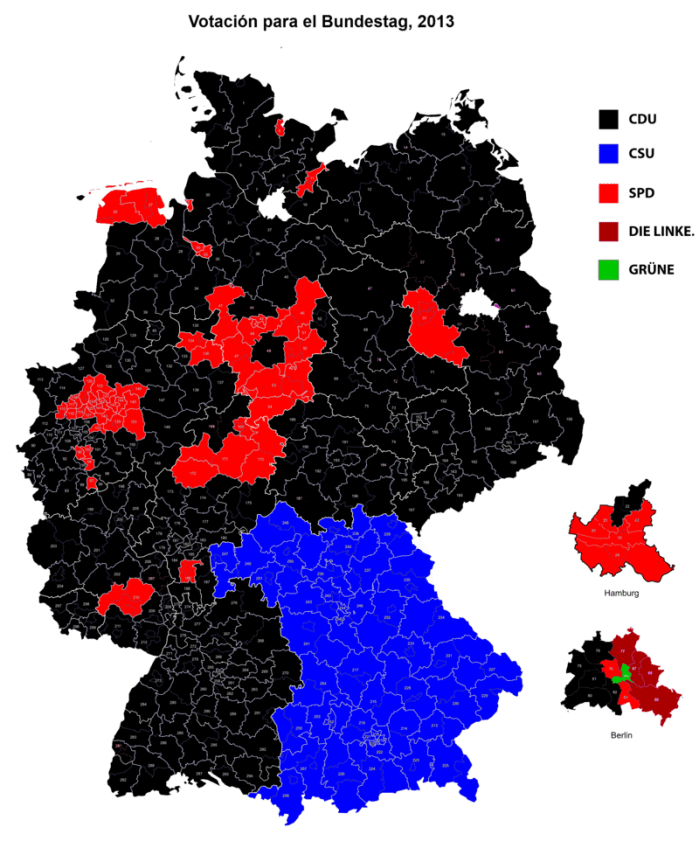

Libertarians and Pragmatists on Democracy Part 2: Classical Liberal and Libertarian Criticisms of Democratic Institutions

Note: This is part of a series on democracy. It is assumed the reader is familiar with part one prior to reading, in which the basic direction of this series is introduced and democracy is more concretely defined. This post is meant to do be a non-comprehensive, though fairly inclusive, look at a variety of views of democracy in classical liberal thought. The next post will survey progressive and pragmatist views of democracy, and the final post will argue that the truth in classical liberalism and pragmatism perspectives on democracy lead to a defense of market anarchy.

As alluded to in the introduction to this series, democracy has occupied a tricky place in the history of classical liberal thought. Despite the fact that the prevalence of democratic institutions in the West is at least partially a result of the influence of classical liberalism (in fact, I’d argue classical liberalisms’ role has been extremely significant in this regard), classical liberals have always been at best ambivalent to democracy. In recent years, libertarians have been critical and outright hostile towards democracy. For this reason, I’d argue that classical liberalism is, on net, critical of democracy, and there is a lot to learn from these criticisms. As a matter of housekeeping, it is important to note that I am using the term “democracy” in the second sense—as a system of political decision making—through most of this section unless otherwise noted.

Early Liberalism’s Cautious Enthusiasm for Democracy

At classical liberalism’s conception, democracy was in many ways the end-goal. No doubt, most classical liberals of the Enlightenment preferred democracy to the absolutist monarchism that had dominated Europe in their times. John Locke’s entire political project can be read as a criticism of absolutism, and he tended to more democratic views. In his Second Treatise on Government “democracy” is only mentioned twice by name in Chapter 10, mostly to define it in contrast to oligarchy and monarchy. However, throughout Locke there is a tendency to emphasize what we today would call “popular sovereignty”—a concept which strikes at the heart of the appeal of democracy. As Peter Laslett writes in his introduction to the Cambridge edition of Locke’s Two Treatises:

In his analysis of politics in terms of force as well as in rightful authority Locke is closer to the thought of our own day on the subject of sovereignty than the assumptions of his own time. Behind the superior power of the legislative in his system there is always to be seen the finally supreme, all-important power of the people themselves, again conceived of as a force, though justified once more by the concept of trust. It was a power which would only rarely display itself, and, as we have tried to show, there is considerable obscurity about the actual circumstances in which it could come to action and more about what it might achieve. Nevertheless, this residual power must be called Locke’s idea of what we now think of as popular sovereignty.

Drawing off of Locke, the American founders; inherited a skepticism towards absolutism and a little bit of faith in popular sovereignty. Of course, there is a slight difference in the founders’ conception of popular sovereignty and Locke’s in that it is far more individualist; in fact, it might be more accurate to say the founders did not so much believe in popular sovereignty as individual self-governance, but there is still an affinity between Locke and most of the founders’ on this point. Contra most west coast Straussians (ahem, Tom West and Harry Jaffa), it is important to note that the founders’ were influenced by much more than the classical liberal philosophy of John Locke. They, particularly John Madison, John Dickinson, and most of the early federalists, were just as influenced (if not more-so) by classical Greek and Roman political philosophy and the style of old whig conservatism of Burke and his contemporaries as classical liberalism. This can be illustrated in their perspective on democracy.

Though certainly wary of democracy’s dangers, most of the founders overall could still be described as democratic in some sense of the term. Of course, this point must be nuanced with the founders’ healthy criticisms of democracy influenced by classical liberal thought, whiggish conservatism, and Aristotelianism. Maddison is probably the most frequently cited example of an American founder who waxed pessimistic about democracy, given his writings on the “problem of factions” in Federalist No. 10. To be sure, most of the founders, as Ben Franklin famously said at the end of the constitutional convention, would have probably preferred the term “republic” to “democracy.”

Because of Madison’s Federalist No. 10 and a variety of quotes that were harshly critical democracy from the founders (many of which are false), a number of right-wingers today, particularly populist and nationalistic constitutional conservatives, argue that the founders were not democratic at all and are adverse to anything that refers to America as a “democracy.” To be sure, America is not a pure democracy, however there is little doubt that the founders still had at least some affinity for democracy, particularly in contrast to absolutist monarchy, with the possible exception of Hamilton sometimes (I would also argue that Hamilton was the least classically liberal of the founders and is largely my least favorite founder, but that’s another issue).

Further,  it is obvious the constitution incorporated democratic decision-making far more than any other of that time; in fact, the preamble beginning with “We the People” screams of the democratic, Lockean notion of popular sovereignty. Further, there is little doubt that even the America of the founders can be described as “democratic” at least in the third sense of the term (as a general term for modern Western governments).

Finally, some of the founders were pretty avidly pro-democratic, particularly Thomas Jefferson. As Jefferson wrote to John Taylor:

It must be acknowledged that the term “republic” is of very vague application in every language… Were I to assign to this term a precise and definite idea, I would say purely and simply it means a government by its citizens in mass, acting directly and personally according to rules established by the majority; and that every other government is more or less republican in proportion as it has in its composition more or less of this ingredient of direct action of the citizens.

Note how Jefferson’s definition of a “republic” is virtually indistinguishable from the way democracy is typically defined (in the second sense). Of course, Jefferson, especially in his later years in his later years was skeptical about the workability of this democratic/republican vision, writing “[s]uch a government is evidently restrained to very narrow limits of space and population. I doubt if it would be practicable beyond the extent of a New England township.” Nonetheless, it’s hard to consider Jefferson anti-democratic, especially in his younger years, when the notion of Jeffersonian democracy has been so influential in the history of American politics or if one considers Jefferson’s excuberance for the much more populist French Revolution prior to the Reign of Terror.

The Decline of Democracy in Classical Liberal Thought

After the founder’s era, however, experience with real-world democratic institutions began to contrast sharply with the theoretical hopes Enlightenment-era liberals had for democracy. The Jacobin reign of terror and aftermath of the French Revolution were sobering reminders of the dangers of the tyranny of the majority. As Edmund Burke wrote in Further Reflections of the French Revolution such a Democracy is a thing which cannot subsist by itself” and the specter of Robespierre led Burke to continually warn of mob-rule and the excesses of democracy. In America, the extremely low level of decorum in early elections (particularly in 1800 between Jefferson and Adams) must have made the more aristocratic and conservative of the founders (the likes of Washington, Hamilton, and John Dickinson) fearful of the direction in which their experiment was going.

By the Jacksonian era, it is safe to say that most classical liberal observers were waxing a bit more pessimistic on the prospects of democracy than their intellectual ancestors. The rise of a populist president in Andrew Jackson who had committed so many acts of tyranny against the Native Americans, the democratization of religious faith by the likes of Lorenzo Dow in the Second Great Awakening, and the growing of democracy into almost a political religion were signals of a disturbing trend to many of the surviving founders and European liberals like Mill and de Tocqueville. In fact, Jefferson even said of Jackson, in an interview with Daniel Webster:

I feel much alarmed at the prospect of seeing General Jackson President.  He is one of the most unfit men I know of for such a place.  He has had very little respect for laws and constitutions, and is, in fact, an able military chief.  His passions are terrible.  When I was President of the Senate, he was Senator; and he could never speak on account of the rashness of his feelings.  I have seen him attempt it repeatedly, and as often choke with rage.  His passions are, no doubt, cooler now; he has been much tried since I knew him, but he is a dangerous man.

No doubt, Jefferson’s critique of Jackson’s inability to control his passions mirror Plato’s critique of the “democratic soul” in the Republic.

However, it wasn’t until Alexis de Tocqueville’s famous Democracy in America that the classical liberal view of democracy truly turned critical. De Tocqueville saw democracy’s influence in America as resulting in the decline of an aristocratic class that “furnished the best leaders of the American revolution.” Socioeconomic egalitarianism was far from the worst of democracy’s problems in de Tocqueville’s eyes. He saw the concept of popular sovereignty as leading to “unlimited power of the majority” that was corroding the checks and balances of the American constitution in every branch of government. Indeed, there has perhaps never been as eloquent a critic of “tyranny of the majority” as de Tocqueville.

In England, JS Mill also was beginning to see the dangers of excessive democracy. Much of On Liberty can be read as building on and responding to de Tocqueville. For example, his warnings against the tyranny of majority opinion in the first chapter of On Liberty echo de Tocqueville’s concerns and are worth quoting at length (also, note how much of this anticipates much of the later insights of the Virginia School of Political Economy):

The notion, that the people have no need to limit their power over themselves, might seem axiomatic, when popular government was a thing only dreamed about, or read of as having existed at some distant period of the past. Neither was that notion necessarily disturbed by such temporary aberrations as those of the French Revolution….In time, however, a democratic republic came to occupy a large portion of the earth’s surface, and made itself felt as one of the most powerful members of the community of nations; and elective and responsible government became the subject of the observations and criticisms which wait upon a great existing fact. It was now perceived that such phrases as “self-government” and “the power of the people over themselves” do not express the true state of the case. The “people” who exercise the power are not always the same people with those over whom it is exercised; and the “self-government” spoken of is not the government of each by himself, but of each by all the rest. The will of the people, moreover, practically means, the will of the most numerous or the most active part of the people; the majority, or those who succeed in making themselves accepted as the majority: the people, consequently, may desire to oppress a part of their number; and precautions are as much needed against this as against any other abuse of power. The limitation, therefore, of the power of government over individuals, loses none of its importance when the holders of power are regularly accountable to the community, that is, to the strongest party therein.

…Like other tyrannies, the tyranny of the majority was at first, and is still vulgarly, held in dread, chiefly as operating through the acts of public authorities. But reflecting persons perceived that when society is itself the tyranny—society, collectively, over the separate individuals who compose it—its means of tyrannizing are not restricted to the acts which it may do by the hands of its political functionaries….Protection, therefore, against the tyranny of the magistrate is not enough: there needs to be protection also against the tyranny of the prevailing opinion and feeling[.]

By the generation of liberals after Mill, the insight that democracy itself can turn into tyranny became influential on the continent as well. French liberals such as Bastiat and Germans such as Mises became critical of democratic institutions. Both Bastiat and Mises noted how democracies are ultimately controlled by public opinion which can, often times, be irrational. Bastiat took note of this in regards to protectionist economics writing, “Protectionism is too popular for its adherents to be regarded as insincere. If the majority had faith in free trade, we should have free trade.” Mises elaborated on Bastiat’s insights more writing in Human Action:

Democracy guarantees a system of government in accordance with the wishes and plans of the majority. But it cannot prevent majorities from falling victim to erroneous ideas and from adopting inappropriate policies which not only fail to realize the ends aimed at but result in disaster.

(Note: Bryan Caplan has a great, more detailed analysis of Bastiat and Mises’ criticisms of democracy, it is highly recommended.)

Most of these problems of the tyranny of the majority highlighted by de Tocqueville and Mill, as well as the issue of a completely misinformed public, seemed confirmed in World War II after the rise of fascism via the democratic process in Germany and Italy.

Public Choice Theory and Democracy’s Continued Decline

In the middle of the twentieth century, classical liberals became influenced by a field of study that seemed to confirm and deepen their worst fears of democracy. I’m referring, of course, to the public choice theory of the Virginia School of Political Economy associated with the likes of James Buchanan, Richard Wagner, and Gordon Tulloch. It is important to note at this point, of course, that public choice theory itself is not a part of classical liberalism as it is a positive scientific research program that simply applies economic analysis to the political process that has been contributed to by libertarians, conservatives, and liberals like rather than any sort of political ideology; however, many of the founders of Public Choice Theory were themselves classical liberals and there is little doubt that this style of economic thinking has had more influence on libertarianism than any other political philosophy.

The new public choice theory found that democracy could result not only in the potential tyranny of the majority, but also in horrible policies thanks to the accumulation of special interests (akin to Madison’s analysis of the problem of factions). The idea that voters are rationally ignorant, the insight that elected representatives do not act in the public interest but out of their own rational self-interest and those of their lobbyist friends, and a number of concepts from the short-sightedness effect to the Arrow’s impossibility theorem seemed to cast poor prospects on democracy’s ability to protect individual liberty. The fact that so many democracies were adopting horrible Keynesian economic policies, and the explanation that this is due to the self-interest of politicians, caused further doubt on the compatibility of free markets and democratic institutions. Later insights from public choice theory revealed that voters were not only ignorant but also systemically biased and irrational, as Bryan Caplan’s Myth of the Rational Voter argued, only added to this anxiety.

This is not to say, of course, that classical liberals since the mid-nineteenth century have been wholly opposed to democracy. Indeed, Mill, Bastiat, Mises, and most of the public choice economists continued to prefer representative democracy strongly limited by a well-designed (well, at least for Buchanan) constitution to alternative systems of political organization. Even Mises in Liberalism: In the Classical Tradition defended democracy on the following grounds:

In the long run, no government can maintain itself in power if it does not have public opinion behind it, i.e., if those governed are not convinced that government is good….There is, therefore, in every form of polity a means for making the government at least ultimately dependent on the will of the governed, viz., civil war, revolution, insurrection. But it is just this expedient that liberalism wants to avoid. There can be no lasting economic improvement if the peaceful course of affairs is continually interrupted by internal struggles…Here is where the social function of democracy finds its point of application. Democracy is that form of political constitution which makes possible the adaptation of the government to the wishes of the governed without violent struggles.

The attitude of FA Hayek in The Constitution of Liberty towards democracy is perhaps the most typical attitude of most classical liberals and libertarians since the days of de Tocqueville, and the majority of libertarians in mainstream political discourse today. Hayek defends a heavily limited concept of democracy as a means to the end of individual liberty; as the most efficient of current possible political constitutions to ensure the freedom of the individual. He echoes Mises in the fifth chapter entitled “Majority Rule” where he writes:

If democracy is a means rather than an end, its limits must be determined in the light of the purpose we want it to serve. There are three chief arguments by which democracy can be justified, each of which may be regarded as conclusive. The first is that, whenever it is necessary that one of several conflicting opinions should prevail and when one would have to be made to prevail by force if need be, it is less wasteful to determine which has the stronger support by counting numbers than by fighting. Democracy is the only method of peaceful change that man has yet discovered.

Modern Libertarianism’s Hostile Opposition to Democracy

Since Hayek penned those words in 1960, before many of the most depressing insights of public choice had risen to prominence, classical liberals and libertarians—particularly more radical anarchists—have grown even more skeptical of democracy and are, at times, outright hostile to it. Hayek himself in his next major work on political theory, Law, Legislation, and Liberty, waxed a bit more pessimistic on constitutional representative democracy than he did in The Constitution of Liberty. Just thirteen years after he spent over five-hundred pages defending and articulating liberal constitutionalism, he opens the introduction to the first volume of his next major work by declaring “The first attempt to secure individual liberty by constitutions has evidently failed.” Though he still proclaims the destruction of liberty that was running rampant in the immediate aftermath of World War II was “not a necessary consequence of democracy,” he laments the role democracy had played in recent politics:

If I am right, it would indeed seem that the particular form of representative government which now prevails in the Western world, and which many feel they must defend because they mistakenly regard it as the only possible form of democracy, has an inherent tendency to lead away from the ideals it was intended serve. It can hardly be denied that, since this type of democracy has come to be accepted, we have been moving away from that ideal of individual liberty of which it had been regarded as the surest safeguard, and are now drifting towards a system which nobody wanted.

In other corners of classical liberal thought, the prospects for democracy were even grimmer. This hostile attitude is perhaps best exemplified by Hans Herman Hoppe’s book Democracy: The God that Failed. Hoppe argues that democracy suffers from a problem akin to the tragedy of the commons; whereas medieval monarchies, aristocracies, and feuds had some sense of ownership over the state, democracies have no clear sense of ownership and so democratic representatives have little incentive to make good policies that protect liberty and economic prosperity.

Though Hoppe spends far too much of the book on anti-intellectual, abrasive, and, at times, bigoted (in the literal meaning of the term) polemics, there is some truth to his central insight and it certainly has a resonance with the public choice research on the short-sightedness effect. I doubt that Hoppe’s insights have the radical implications he draws of by necessity (mainly that monarchy is preferable to democracy); there might be a case to be made that pre-democratic institutions had lower taxes and better protection of property rights, on virtually every non-tax matters it is fairly obvious that such governments were far more tyrannical. Freedom of movement, which was so important to Mises in Liberalism and is among our most important of liberties, was non-existent in feudal Europe; indeed, serfs in many European manors were little more than slaves, pieces of property tied to their land, rather than sovereign, free individuals. Further, social freedom and freedom of religion were virtually non-existent in such polities; homosexuals were executed, Muslims and Jews were persecuted, and there were a number of other violations of human rights I doubt even Hoppe (in his implicit and occasionally explicit homophobia) would defend. (Of course, Hoppe would throw a fit because his argument is purely deductive and a priori whereas mine actually uses empirical evidence, but his simpleton, idiosyncratic, and laughably unintelligent economic methodology and epistemology is another topic.) I highly doubt even the most dogmatic Rothbardian Hoppe-lover would rather live in a medieval Europe feudal manor or monarchy than a modern democracy, despite their flashy polemics.

More recently, Michael Huemer has had criticisms of democracy’s morality in his book (which I highly recommend) The Problem of Political Authority. Heumer’s argument throughout the book is that all attempts to justify the legitimacy of government authority or to argue that there is any real consent between real-world governments and citizens fail, and a better form of government may be found in market anarchism. He notes how democracy has created a false identification of voting with actual consent that can morally legitimize government, and argues against all attempts to claim that citizens of democracies—real world or hypothetical—are under legitimate authority by virtue of the fact that they are living in a democracy. In another chapter, Huemer analyzes the problematic psychology of authority and how democracy contributes to the idolization of government.

Even more recently, Jason Brennan has a forthcoming book out that is perhaps more critical of democracy than any other classical liberal—save perhaps Hoppe—aptly titled Against Democracy. Brennan argues, like Huemer, that our relationship to democracy is non-consensual. In line with most public choice theory, he argues that democracy is truly the “rule of the irrational and the ignorant” and that democratic deliberation, voting, and electoral participation actually makes people worse, more biased, more irrational citizens. Brennan, instead, defends what he dubs “epistocracy”—a sort of aristocratic rule of the knowledgeable. (I have yet to read through Brennan’s book as it hasn’t been released yet and I’m basing this entirely off of reviews and Brennan’s other writings, particularly BHL blog posts, so I may be butchering some of the details of his argument in this description.)

Clearly, the classical liberals—from de Tocqueville to Jason Brennan—have very good reason to be skeptical of democracy, and perhaps even to feverishly oppose democracy. I still do not take the conclusions to the extremes of Hoppe and (at least from my limited knowledge of his writing on this topic) Brennan. I would agree with Hayek and Mises that constitutional representative democracy is the nth best alternative to other systems such as feudalism, absolutist monarchy, and any form of authoritarianism. (Although my general opposition to nation-states for both anarchist and communitarian reasons makes me more critical of democracy than most moderate classical liberals.)

However, it is clear that democracy is far from the best of all possible governmental arrangements. At the very least, the truth that Aristotle emphasized in his Politics that it matters not so much the make-up of the government (rule of the many, few, or one) but the quality of government, whether it is tyrannical or not. There is very good reason to believe, due to most of the arguments by the great thinkers discussed above, that democracy is, unfortunately, more likely than not to lead to tyranny—even if it is less likely to do so than the existing alternatives.

Having said that, perhaps not all is lost for the spirit of democracy. In the next post, I will analyze the pragmatist conception of democracy perhaps most popular among American twentieth-century liberals and progressives. This conception of democracy is far more than a form of political decision making discussed by the classical liberals, but a broader social epistemology and philosophy as mentioned in the introduction. I hope it will be clear by the end of the next post in this series that it is possible to affirm some of the philosophical commitments of democracy extolled by thinkers such as John Dewey, Sidney Hook, and Richard Rorty without necessarily embracing democracy as a political decision-making progress or, as Hayek would argue, democracy as it presently exists.

Socialism(s) – Part One

Sanders and Me and not so Democratic Socialism

Sen. Sanders got a huge pass this primary season. Captivated by the deep dishonesty of one probable nominee and the crude ignorance of the other (not to mention his plain crudeness), the media, and informal commentators like myself, have not given the Democratic candidate and his program the attention they deserve. Also, in the current primary contest, it’s difficult not to like the guy. I have said several times that he inspires in me a kind of twisted affection. Plus, he has real pluck. But, let’s face it: He is probably done, or done for.

Sen. Sanders has gone very far into the primary while maintaining perfect dignity in his demeanor. He has seldom stooped to personal insults even when he was being severely tried by a Ms Clinton who seems to consider the man’s very candidacy a grave offense, an offense against the natural order of things, a crime of lèse-majesté, even a form of woman abuse. In the meantime Mr Sanders will have single-handedly rehabilitated the word “socialism.” This matters for the future of this nation. Time to look at it critically.

I, personally, especially like Sanders the man. I have reasons to. We are the same age; we went to college at about the same time, both in good universities. He took a fairly active part in the desegregation movement. I did not because it was too early in my American sojourn. (I wish I had taken part.) Nevertheless at age 25, Sanders and I were both leftists. The main difference between us is this: Fifty years later, he has remained impeccably faithful to the ideals of our youth while I walked away, faster and faster, really. I learned to understand the invisible hand of the market. I did some good readings. I was lucky enough to observe my leftists academic colleagues in action at close range early on. Cannily, I observed that the victorious Vietnamese Communist Party did not establish a workers’ paradise in its part of the world. I loathed authoritarianism in any guise. The Senator, meanwhile, spent his honeymoon in the Soviet Union.

When that latter country fell apart and its archives were open, the Senator had nothing to say about the eighty years of mass atrocities they revealed. I am guessing he did not think he had to because he believed in the democratic brand of socialism. It’s hard to tell how much history he knows. (I think that liberals in general are ignorant, including academic liberals. I could tell you stories about them that would raise the hair on the back of your neck.) It does not take much knowledge though to guess that Lenin and the 1916 Bolsheviks did not originally set out deliberately to create a tyranny. Too bad they had to come to power by overthrowing by force of arms a democratically elected government. (See “Kerensky.”) Still, they named the new country “The Union of Socialist Soviet Republics,” and the word “soviet” means “council,” and “republic” means what it means. But, building socialism wasn’t working out; too many people with bad attitudes. So Lenin had to nudge History a little bit with bayonets, with barbed wire, with organized famines and soon, with a bullet to the back of the head of those who stood in the way. The Bolsheviks were forced to choose between socialism and democracy. They chose the former and they got neither. There is no record of Sen. Sanders making any relevant comment. (As always, I am eager to correct my errors.)

It’s less clear whether the Communist Party of China ever had a democratic plan. The unauthorized biography of Mao by his personal doctor reads like a tissue of horrors right from the start. (Dr. Li Zhisui. The Private Life of Chairman Mao, 1994) The Communist Parties of Eastern Europe simply came to power in the wagon train of the Red Army occupying their countries. None of them ever got close to getting there through free elections. The most interesting is the case of East Germany, ruled by a fusion of a native communist party and of preexisting democratic socialist parties. Together, they achieved a fair degree of material success for the East German people yet, they never managed to make do without a police state. Today, Sanders’ backers may not remember or they may not know that the German Democratic Republic, as it was called with a straight face, disappeared overnight. Someone had left a back door open to this paragon of socialist success and the people immediately started voting with their feet by the tens of thousands.

This is all irrelevant, Senator Sanders’ supporters would claim. You are describing a grave perversion of socialism; again, we only want democratic socialism.

During much of my adult life, the ill-defined words “socialism” and “socialist” were used with all kinds of modifiers: “African socialism,” “Arab socialism.” In all cases, the regimes so named led their countries straight to poverty, usually accompanied by official kleptocracy. In India, a really democratic country, the mild Ghandian-Nehruan form of socialism produced deep poverty for two generations including in the large, educated Indian middle class . (Just compare and contrast with un-socialist South Korea which started in 1953, after a devastating war, much poorer than India had been in 1949 when it became independent.) Socialism – whatever that is – is normally the road sign that points toward generalized poverty. Perhaps, this is only the result of a fateful case of reverse magic naming: Call something good, reasonable “socialist” and it begins degrading and sinking! Go figure!

OK, this is all about ancient times, they say. So, let’s look at current examples.

In Venezuela, socialism started under unusually favorable conditions because the country had considerable oil income that minimized the need for high taxation, a major reason for discontent in most socialist experiments. Yet, the socialists in power there made such a mess of it that today, only a few years later, the country suffers about 400% inflation (in 2016). If you had a dollar’s worth of local money there 12 months ago, it now only buys about a quarter’s worth of milk or bread. The skilled middle-class is leaving or trying to. They may return later; or, they may not. If they don’t, it will take a couple of generations at best to rebuild the country’s human capital after the socialist experiment ends.

Note that the sharp drop in world oil prices has affected many countries. It’s only in “Bolivarian” socialist Venezuela that you will see mass exodus and severe shortages of necessities.

In Brazil, The Workers’ Party is in power. The sitting president is a woman whose bona fide, whose socialist credentials are not in question. When she was young, she was imprisoned and even tortured for her belief in socialism, or because she was a guerrilla. (That’s the name for a left-wing terrorist.) She would now be impeached for making up optimistic economic figures for her country, except for the fact that the man constitutionally designated to replace her is also under indictment for corruption. It was bound to happen. The federal government in Brazil eats up 40% of GDP. The huge national oil company, Petrobras is nationalized; it belongs to the government, a favorite socialist arrangement. So oil revenues belong to everyone which means they belong to no one. Why not help myself a little, generations of Brazilian politicians have figured? There are no shareholders to keep tabs and to complain, after all. Socialism and kleptocracy are like father and son.

But, but, you say, those are Third World countries that have not yet recovered from the corrupting influence of colonialism (200 years later). Point well taken. Here is another case I know well, of a socialist country that has not been colonized since about 50 (BC.) France has been under the guiding hand of the French Socialist Party for nearly five years this time around. By the way, France is a democratic country with fair elections and a free press. The Socialists won fair and square. They were in power for 23 of the 35 years since 1981. They largely implemented their program and there were few rollbacks – except by themselves, a few times when they understood the disastrous effects of the reforms they had implemented. I am thinking of a broad de-nationalization of banks in 1981-82. (This is directly relevant to Sen. Sanders’ thinking.)

The French Socialist Party in power never tried to restrict freedom of the press and it did not fill the prisons with its opponents. (Instead, it emptied them hastily of violent criminals, according to its security critics.) By and large, its rule has been quite civilized. There is just that pesky problem of chronic unemployment which never dips much below 10% (25% for the young; sky is the limit if you are young and your name is “Mohamed”). There is also the fact that economic stagnation is now seen as normal by the young. Has been for a couple of generations, now. And then, there is the unbelievable cultural sterility of French society (another story, obviously that I partially tell elsewhere on this blog. Ask me.)

True story: a few months ago, members of the socialist government celebrated loudly. That was because the government office of economic analysis had revised upward its estimate of annual economic growth from GDP: + 0.4% to +0.6% ! (Yes, that’s 6 tenth of one per cent. It’s true that today, in the spring of 2016, it’s at a respectable annual 2% plus.)

“No, no,” cries Sen. Sanders ( and I can almost hear him from here) “I don’t mean ‘socialist’ as in ‘Union of Socialist Soviet Republics,’ and I don’t mean Red China, and I don’t mean North Korea, certainly, and I don’t mean Cuba (although…), and I don’t mean Venezuela today, or Brazil. And, I don’t even mean France although I could not explain why exactly. (Bad call here, Senator. The French single-payer health care system works well; it’s cheaper than US health care, and French men live two years longer than American men.) I mean socialism as in Denmark and Sweden. Now, here we are at last. In part Two, we will look at what passes for Swedish “socialism.” (Denmark is too small to be an example, perhaps.)

Coase’s “Nature of the Firm”: An Anthropological Critique

But is it a good one? Is it even made in good faith? I need help.

From American anthropologist John D Kelly’s The American Game…:

Ronald Coase’s theory of the nature of the firm rescued, for neo-classical economics, the existence of firms or corporations as rational entities […] Markets always come first, and the problem of the existence of firms is depicted as the problem of why a rational manager would rely on employees rather than markets. State planning and private firms are taking over what already exists, integrated by the price mechanism of markets, and are successful to the extent that they lower costs, since there are a variety of costs involved in market transactions. Thus marginalist analysis implies that an equilibrium will always be found between planning structures and integration by price mechanism, especially since, as Coase says in “The Nature of the Firm,” “businessmen will be constantly experimenting, controlling more or less” and “firms arise voluntarily because they represent a more efficient method of organizing production.” The rise of the firm, as Coase imagines it, is always a movement from many pre-existing contracts to a controlling structure, “For this series of contracts is substituted one.” (94)

The emphasis is mine. Kelly continues:

This imaginary fits poorly the situations that were precisely the actual origins of firms, as when banks gave mortgages to planters, or stock markets funded companies of young agents, prepared to cut plantations into captured wilderness for tropical commodities […] usually employing labor moved long distances and disciplined by direct violence. There is more in the universe than Coase’s imagination, more motives for controlling powers of firms than their cost efficiencies. (94-95)

Kelly goes on to give a brief account of 1) how corporations created commodity production out of thin air, 2) how these corporations were tied to European imperialism, and 3) how they used slaves and indentured servants even when it would have been cheaper to hire the locals.

I want to address Kelly’s summary of Coase’s paper (here is a pdf, by the way, in case you want to follow along), mostly because I’ve never read it although I know it’s important, but first I want to make a couple of digressions. Libertarians would more or less answer Kelly’s three charges listed above as follows: 1) yes, and this is a good thing, 2) state-sponsored corporations and private firms are two distinct entities with two very different incentive structures, and 3) see #2. There is also an issue of accuracy in regards to Kelly’s brief summary of world history since 1600. I don’t want to get into the details here, but I do want you to recognize that I am reading Kelly critically. My last digression is simply to point out that libertarians and Weberian Leftists like Kelly have more in common than we think.

To get back to Coase’s paper, and Kelly’s critique of it, I want to highlight one sentence from Kelly’s book in particular and then turn it over to the peanut gallery in the hopes of gaining some insight:

Markets always come first, and the problem of the existence of firms is depicted as the problem of why a rational manager would rely on employees rather than markets.

Is this the puzzle Coase was trying to grapple with in his paper? I ctrl+f’d Coase’s paper (“employe” – not a typo) and couldn’t find anything that actually confirms Kelly’s summary, but it would be an interesting project (if I am right in stating that Kelly’s summary of Coase’s paper is not accurate) to follow this line of thought and delve into Kelly’s insight about the reliance that entrepreneurs/firms have on employees (rather than markets)…

Mohammad Iqbal’s writings on Islam and on the partition of India

That is the topic of a paper of mine that has just been published in the Journal of Punjab Studies. Here is the abstract:

Iqbal was a poet, religious philosopher, political activists, and supporter of autonomy to Muslim majority provinces in British India, but cannot be regarded as the ‘main’ architect of Pakistan. His basic concern was over the falling status of Muslims of India during British rule and ways to arrest the situation. His speech in 1930 at Allahabad session of the All India Muslim League is being always cited as his support to Pakistan, but later on he never made his position very clear over the issue of partition of British India. Yet his contribution to the formation of Pakistan cannot be entirely ruled out because he was speaking out the minds of the Muslim minorities who, by 1920s, not not only raised the demand, but started whispering about having a separate socio-political space. He was a towering figure of Islamic modernism, a great poet and also a religious philosopher, whose thinking still has considerable significance. His writings are still being read and researched in India and Pakistan.

The link to the whole paper can be found here [pdf].

The State versus Society, Part 12,908

Taken together, the evidence suggests that the Kuba state is associated with a deterioration of intrinsic motivations to follow the rules. This does not mean that the Kuba Kingdom was not a successful and well-functioning state. From the historical and anthropological literature, we know that it was. Although the state was prosperous and orderly, the evidence suggests that it eroded the intrinsic propensity of its subjects to follow rules even when enforcement is absent. (28)

Here (pdf)