Cronismo…você sabe o que é isto?

Não??? Então você não deve estar morando no Brasil. Ok, você mora, mas não sabe do que se trata. Um livro que divulgou este conceito no Brasil é o do Lazzarini. Mas você pode aprender também sobre isto neste video. Este blogueiro (junto com o Leo Monasterio) já falava de rent-seeking no Brasil desde o final do século passado. A galera, contudo, custou a nos acompanhar na literatura. Ao longo destes primeiros 13 anos do século, vimos vários autores e artigos sobre o tema. Claro, tudo começou com o Jorge Vianna Monteiro (embora muita gente não pareça saber fazer pesquisa científica direito e, portanto, não faça a revisão da literatura corretamente).

O termo rent-seeking nunca saiu muito das conversas de economistas e alguns poucos cientistas políticos esclarecidos. Claro, havia também a competição dos marxistas, sempre receosos de perderem sua platéia para teorias concorrentes. Mas, aos poucos, as coisas mudaram. Aí alguém, acho que foi o Gary Becker, popularizou o termo capitalismo de compadres (ou de compadrio). Paralelamente, a mudança de gerações nas redações de jornais e a tecnologia ajudaram a popularizar as idéias de Tullock, Olson, Buchanan e outros. Mesmo assim, convenhamos, “capitalismo de compadres” não é um termo muito retórico, no sentido da McCloskey.

Aí, agora, veio este novo termo, o tal “cronismo”. No fundo, no fundo, fala-se do mesmo fenômeno. Mas parece que este termo está se popularizando com certa facilidade. Ajuda, claro, a corrupção desenfreada que assistimos no Brasil desde a primeira administração da Silva (agora também conhecido como “Lula”, “Lula da Rose”, “o Barba”, dentre outros divertidos apelidos). O desencanto dos eleitores não deixa de ter um impacto positivo: o aumento do ceticismo e do grau de exigência quanto às suas demandas políticas. Claro que isto não necessariamente melhora a qualidade do setor público ou diminui a corrupção, mas o realismo trazido pelo ceticismo é sempre saudável.

Still on vacation but wanted to make sure everyone saw this…

Weigh in below on this meddling in India by their reserve bank.

Amo muito o bem público produzido pelo setor privado

20131227_101803

Pois é, leitor. Sempre que alguém vem a BH eu fico sem saber o que dizer. Aqui, convenhamos, não tem nada. Nada mesmo. Mas aí o setor privado, muito mais do que esta prefeitura ineficiente (vem assim desde a época do Célio de Castro e seus sucessores, mas não era muito melhor antes…enfim…), consegue me salvar.

Bem público produzido pelo setor privado com motivos “egoístas” (se ganhar dinheiro para pagar as contas é egoísmo, então Luis F. Verissimo e eu somos os mais egoístas do mundo…junto com você, leitor). Exemplo que poderia estar em qualquer livro-texto de Economia. Gostei tanto que fiz todo um malabarismo para comer na bandeja sem sujar o sanduíche e as fritas (e, sim, eu consegui fazer isto!) para guardar esta excelente peça de propaganda.

Aliás, gostei tanto que a empresa ganhou o direito a uma propaganda gratuita aqui.

E agora, para algo mais técnico…

O que é um bem público? Antes que você pense no senso comum, esta é uma definição técnica, um conceito teórico. Um bem público é um bem não-excludente e não-rival. O melhor exemplo disto está no livro-texto do Mankiw. Uma estrada com pedágio é excludente (sem pedágio, portanto, não-excludente). Uma estrada congestionada é rival (porque o espaço entre carros diminui. O consumo do mesmo pedaço de chão é rivalizado com outro motorista e seu pequeno SUV…). Sacou?

Bom, então fica meio óbvio – ou então você dá uma pesquisada na internet, ok? – que alguém que busque lucrar não tem muito motivo para produzir um bem público…em princípio. Por que? Porque não dá para lucrar tanto quanto se você produz um bem privado (rival e excludente). Claro que esta classificação do bem ou serviço em “privado” e “público” é uma questão de grau (além do fato de existirem bens rivais, não-excludentes e não-rivais, excludentes). Mais ainda, o grau pode ser alterado conforme a tecnologia mude. Pense no caso da TV. Há algumas décadas, era impossível vender um pacote de canais como um bem privado (o que se fazia era vender um bem público (o pacote de canais) com um financiamento via propaganda).

O que isto tudo tem a ver com o McDonald’s? Simples. A informação turística é um bem público. Supostamente, o governo poderia criar uma secretaria de turismo (esqueçam a ironia da coisa…ou melhor, dêem uma boa risada e prossigam) para prover os turistas de informações como esta. Bem, a coisa mais difícil do mundo é achar um guia turístico desta cidade de fácil acesso e na hora que você precisa. Aí entra a campanha da cadeia de fast-food, em busca de lucros com a praça específica de Belo Horizonte. De forma inteligente, percebe-se que homenagear a cidade torna o consumo do sanduíche mais agradável. A experiência de se comer dois pães e carne não se distingue, em princípio, por conta do lugar onde você o compra. Contudo, diferenciar o produto é uma prática mais antiga do que a prostituição (se é que não nasceu com a mesma…).

Portanto, ao vender um sanduíche (bem privado) com uma folha de papel destas, com uma propaganda da cidade, agrega-se à experiência de consumo um certo valor que, imaginam os donos do boteco, aumentará suas vendas. Bem, não estou eu aqui falando bem da propaganda?

Voltando ao hambúrguer…

Pois é. Eu pensei até em voltar hoje para comer um outro hambúrguer deles, mas não sou tão fã assim do consumo diário de McDonald’s. Mas fica aqui o exemplo, a evidência (talvez a milésima, neste blog) de que bens públicos podem ser produzidos de forma eficiente pelo setor privado. Eu diria, neste caso, até mais eficientemente do que o setor público municipal sequer poderiaimaginar alcançar um dia.

Antes de me despedir, eu me pergunto: burocratas, sempre tão invejosos dos sucesso alheio (dentro ou fora de seu mundinho, a repartição), adoram sabotar a concorrência com um papo furado muito bonito de “proteção às crianças, índios, animais domésticos, mulheres, etc”. Papinho bem ruim mesmo. Mas, às vezes, há até uma boa justificativa para tal, embora raramente me pareça ser a regra seguida por eles. Eu me pergunto quando vão proibir a cadeia de fast-food de produzir informações turísticas porque “apenas o fazem pelo lucro”.Como se os burocratas não maximizassem nem mesmo seu orçamento…

Vovô não quer BigMac. E agora, Ricardo?

Eis aí algo que é verdade aqui ou no Japão. O texto do casal de blogueiros é recheado de elementos que você pode usar para discutir com seus amigos, professores ou, claro, com seu avô. Eu ainda destacaria um ponto específico, além do demográfico: a questão ricardiana. Cito com negrito por minha conta:

If the central point of Abenomics is to boost prices and thus wages and consumption — the old “raise all boats” metaphor — then to a certain extent the plan has succeeded over the last year. Consumers don’t seem to be fixated on cheap goods and services any more, though, to be honest, it’s difficult to tell if this willingness to spend more is a function of anticipation for April’s consumption tax hike.

Pois é. A administração do Primeiro-Ministro Abe sabe que a política fiscal não é um saco sem fundo (até o do Papai Noel não tem buracos, vale lembrar…). Portanto, mesmo com o estímulo fiscal, a antiga promessa de aumentar o imposto sobre o consumo foi aprovada pelo parlamento.

E agora, para algo completamente diferente…ou pelo menos mais técnico.

A aprovação legal nos traz uma redução na incerteza jurídica, já que todos sabem que a lei, em um país desenvolvido (= civilizado) será cumprida sem maiores problemas. Mais ainda, o aumento tem data e foi anunciado. Então estamos diante de um clássico problema de Macroeconomia de se saber qual é o impacto de uma política anunciada em um mundo em que as expectativas racionais opera.

A proposição Barro-Ricardiana de livro-texto nos diz algo bem simples: se eu sei que vou ter que pagar impostos amanhã, eu poupo hoje. Já num mundo não-Ricardiano (ou não-Barro-Ricardiano), o reduzido imposto de hoje, sob a expectativa de aumento do mesmo amanhã, provavelmente me induzirá a consumir mais. Tudo isto, claro, ceteris paribus.

Mas quando se fala do Japão, é bom ter em mente um ponto muito importante que não tem nada a ver com aquela lenda de “cultura oriental”, mas sim com a demografia (o tal bônus demográfico que meus amigos Salvato, Ari e Bernardo explicam aqui, para o caso brasileiro). Os autores do post falam do desejo dos mais velhos em consumir produtos de qualidade maior (embora exagerem na ênfase). Não apenas isto, mas “mais velhos” no Japão significa que estamos falando de pessoas cujo padrão de consumo alimentar é bem distinto do moderno fast-food norte-americano que os jovens tanto parecem gostar.

Barro, na própria discussão de sua proposição, já havia discutido a questão demográfica ao falar do argumento do altruísmo (herança) que justificaria o efeito da equivalência no, digamos, longo prazo. No caso do post dos autores, a demografia não está tanto no longo prazo, mas no curto prazo (acho que se fala “coorte” lá em demografia). Estamos falando de um modelo de overlapping generations destes simples. Ou seja, no mesmo período de tempo convivem duas gerações distintas: a mais velha e a mais nova (estou supondo, por simplicidade, apenas duas gerações). Só que, ao contrário do modelo de livro-texto, estamos dizendo que o padrão de consumo das gerações é distinto: uma prefere consumir mais fast-food e outra prefere alimentos de maior tempo adicionado (é, eu pensei em algo comohousehold production models que o Tyler Cowen, implicitamente, usa aqui).

A pergunta, portanto, neste caso, é a seguinte: em um modelo simples, com dois períodos, o que acontece quando tornamos o bem “consumo” (que é, lembre-se, estudante de graduação, sempre sinônimo de consumo de bens não-duráveis) heterogêneo? Primeiro, à la ciclos reais, temos duas gerações e, adicionalmente, agora, colocamos a heterogeneidade do consumo. Suponha que o restante do modelo funciona tal como antes. Ah sim, é importante fazer o destaque didático-científico: mantenha as expectativas racionais. Afinal, pode ser que algo mude (ou não) no modelo, mesmo que não haja nenhuma mudança no tipo de racionalidade dos agentes (esta é uma observação para os eternos apressados que desejam, loucamente, jogar fora a racionalidade sem antes relaxar outras hipóteses do modelo. Interessados vejamisto).

Será que a equivalência barro-ricardiana se mantém? Poderia ser uma questão de prova, mas fica para o espaço de comentários. Preferencialmente, gostaria de ver citações de papers que trataram do assunto com hipóteses semelhantes.

Kalashnikov, hero and inventor, is dead, but how did he do it?

Mikhail Kalashnikov is dead. From the LA Times:

Weapons designer Mikhail Kalashnikov, […] The creator of the legendary AK-47, which became widely known as the Kalashnikov, […] died Monday […]

Over six decades, Kalashnikov’s cheap, simple and rugged creation became the weapon of choice for more than 50 standing armies as well as drug lords, street gangs, revolutionaries, terrorists, pirates and thugs the world over.

Here is a great piece by CJ Maloney celebrating the AK-47. What I really want to know is this: How was such an invention able to be created in the Soviet Union?

The only option I can think of is that the military-industrial complex of the USSR was so powerful and influential that incentives actually drove innovation in that sector of the economy.

But even this doesn’t fully explain how Kalashnikov was able to invent the gun, patent it, put his name on it, and reap the benefits from creating it in the first place. How could any of this be possible in a command-and-control economy?

Pesos, medidas e as instituições

Douglas Allen, em seu ótimo, The Institutional Revolution, defende a tese de que uma revolução institucional teria precedido a famosa revolução industrial. Texto importante, é que, para mim, já é candidato a livro-texto básico de qualquer bom curso de História Econômica.

Como sempre, senti falta de alguma coisa mais, digamos, tropical, no livro. Bom, mas como é que vou cobrar isto de um livro que não se propõe a contar a história das instituições em Portugal? Não posso. Isto é mais uma deixa para os pesquisadores brasileiros. Dica de amigo, quem sabe, para alguém que deseje fazer uma dissertação de mestrado sobre o tema.

Mas eu sou uma pessoa perigosamente curiosa. Fiquei intrigado com a questão dos pesos e medidas. No argumento do autor, a questão dos pesos e medidas, ou melhor, a questão da padronização de pesos e medidas, está diretamente relacionada com a mensuração de produtos, o que gera uma importante alteração nos custos de se trocar mercadorias (ou seja, nos custos de transação). Afinal, nada mais óbvio do que achar mais interessante comprar um quilo de abacate sem levar para casa meio quilo do mesmo.

No caso do Brasil colonial, então, pensei, deveria ser como em Portugal. Para checar isto, consultei este documento. Vejamos alguns trechos:

No que se refere às unidades de medidas adotadas ao longo do período colonial, o quadro não difere, como é natural, daquele oferecido por Portugal. A vara, a canada e o almude constituíam as medidas de uso mais comum, ainda que seu valor pudesse variar de região para região. Os produtos importados traziam consigo suas próprias medidas e, quanto mais geograficamente restrita uma atividade econômica, mais específico era o sistema de medidas utilizado. (…)

Vale dizer: nada muito diferente do restante da Europa.

Assim, a primeira menção expressa à atividade metrológica, em documentos coloniais, refere-se precisamente à fiscalização do funcionamento de mercados locais. Como em Portugal, o funcionário colonial mais diretamente envolvido com a fiscalização de pesos e medidas era o almotacé, mencionado pelas Ordenações Manuelinas e Filipinas e previsto pela organização do município de São Vicente, em 1532. Em número de dois, eleitos mensalmente pela Câmara Municipal, os almotacés tinham como atribuição básica manter o bom funcionamento dos mercados e do abastecimento de gêneros, além de fiscalizar obras e manter a limpeza da cidade. Como parte de suas responsabilidades, deveriam verificar mensalmente, com o escrivão da almotaçaria, os pesos e as medidas. Tal disposição estimulava, dada a dispersão e a diversidade dos municípios, a multiplicação dos padrões de medidas.

Veja só a importância do ofício. Alguém imaginaria que carregar uma régua ou uma fita métrica, hoje em dia, seria uma profissão digna de tanta importância? Bem, numa época em que o governo descobre que medir ajuda a maximizar sua receita, nada mais natural, não? Até eleição para o cargo havia.

No caso dos gêneros estancados ou submetidos a controles mais rígidos, a Coroa cuidava da melhor organização das atividades metrológicas. O estabelecimento do monopólio do tabaco, por exemplo, levou à criação, em 1702, do Juiz da Balança do Tabaco, nas alfândegas de Salvador e Recife. No caso das minas, o regimento do Intendente do Ouro, de 26 de setembro de 1735, mencionava expressamente sua obrigação de manter as balanças e marcos da Intendência aferidos, pesando o ouro corretamente, sem prejuízo das partes nem da Fazenda Real, atribuição expressamente mantida no regimento de 1751.

Como se percebe, a questão institucional é indissociável da questão econômica. Veja aí o depoimento do próprio autor: tem monopólio? Quem é o “dono” do monopólio? A Coroa. Reza o dito popular – e a teoria econômica – que “o olho do dono engorda o cavalo” – e não é diferente neste caso.

Pois bem, falta-nos – alô, colegas de História Econômica! – um estudo mais detalhado do papel dos almotacés (ou me falta mais pesquisa e leitura, vai saber…), não falta? Vou procurar meu exemplar de Fiscais e Meirinhos para rejuvenescer, digamos assim, meu interesse pelo tema.

Novamente, percebemos que a História Econômica não precisa nos dar sono.

The Pope, Capitalism, and los Yanqis

Below is a comment that seems to me to be missing about Pope Francis’ current grasping for the Nobel in Economics. It’s beyond the simple observation that what he said recently about capitalism re-affirms the simple fact that princes of the church want to do good but have not understood simple economics, ever. And, by the way, there is nothing new to what the Pope said. I heard the same when I was growing up in a progressive Catholic parish in Paris, a long, long time ago. (And no, I was not molested, except by that older girl-scout, another story obviously.)

The current pope is a member of the Jesuit order. In the Catholic world, the Jesuits enjoy a reputation for intellectualism. It’s true that almost all have advanced degrees. (This pope appears to be an exception.) It’s also probably true that the many schools the Jesuits run, including universities, are not allowed to fall below a certain minimum level of competence. Beyond this, 25 years of close observation tell me that their good reputation only holds in a relative sense. Only the widespread ignorance of the Catholic church and of its other religious orders makes the Jesuits look good. They are quite tightly wrapped in their prevailing ideology and largely blinded by it. That ideology happens to be left wing right now. (Jesuits used to be fierce right-wingers of the most ignorant, closed-minded kind.) I don’t expect any Jesuit to be an intellectual giant although a few are.

The Pope is also an Argentinean, a provincial Argentinean. He did not suddenly free himself from the associated intellectual burdens upon his election. Like many, nearly all (I have not done a count, I confess, Your Holiness) of his compatriots he has had to struggle all his life with the following question:

Why isn’t Argentina Canada, with a constant high level of prosperity and political institutions that guarantee stability and peaceful alternance in power?

A subsidiary question: Why does Argentina become rich every thirty years only to plunge back into poverty?

Confounded by the brutal reality of the fact that there is no response that does not point straight at themselves, Argentinean intellectuals have developed a short, undemanding answer and a long-winded complicated one, both of which hold them innocent of their plight.

The short answer is this: It’s because of los Yanqis.

Of course, there is a problem in the fact that Canada with many more and tighter economic and political links to the US performs splendidly on any measure of economic or social welfare.

I spent a good deal of my scintillating youth debunking the second, long answer to the query described above. They came out of Argentina in the late fifties as a narrative production called “Teoría de la dependencia.” It later morphed into something called “World System Theory” under the influence of an excellent book by an American.

To make a long story short the theories’ main allegations about Third World poverty were that the more economically tied poor countries were to major developed economies, (such as the American economy) the poorer they became. Those allegations finally did not hold up under the scrutiny permitted by computers handling large amounts of archival data. (See my own co-authored piece for example: Delacroix, Jacques and Charles Ragin. 1981. “Structural blockage: a cross-national study of economic dependence, state efficacy and under-development.” American Journal of Sociology. 86-6:1311-1347.) The modern empirical research performed in the US and other part of the English-speaking world utterly destroyed Latin fantasizing in that area.

Pope Francis did not get the news apparently. Few Latin Americans did. Proudly innocent of any understanding of statistics, they cling to their beloved narrative as tightly as they did in 1965. They may cling to it even more tightly than they did then since they tasted the dust of South Korea’s and even of India’s economic development. (I am deliberately not mentioning China’s real development and its fake relationship to “socialism” because I don’t want to have to write another ten pages.) It’s not my fault; the Pope is older than me. He never sat in my classroom or in any of my former students’ classrooms. We never got a chance to straighten him out.

You have to think of every one of Pope Francis’ economic pronouncement with the understanding that he would probably not receive a B in the Econ. 101 class of a good public university. (In a good private university, in a Jesuit university for example, there is a good chance he would be made to achieve a B by any means necessary, including legitimate means.)

I don’t blame the Pope or the Catholic Church much. The old Adam Smith’s The Wealth of Nations (1776) is still esoteric reading to many of our contemporaries, including college graduates, including most college professors, I would guess, including many who tango on in the media. (Just listen to National Public Radio.)

Pope Francis on Economics

by Fred E. Foldvary

Any statements which deplore “trickle down” economics reveal that the author has not quite yet grasped the heart of economics.

On November 26, 2013, The Vatican press published the apostolic exhortation, “The Joy of the Gospel.” The text was written in Spanish, and its full title in the English translation (converted here from upper case to initial capitals) is “Evangelii Gaudium of the Holy Father Francis to the Bishops, Clergy, Consecrated Persons and the Lay Faithful on the Proclamation of the Gospel in Today’s World.” Besides its religious calls, Pope Francis makes statements about today’s economic problems, and calls for greater economic justice.

One of the aims of this proclamation is to point out “new paths for the Church’s journey in years to come.” One of the questions the Pope seeks to discuss is “the inclusion of the poor in society.” Chapter Two is entitled, “Amid the Crisis of Communal Commitment.” In paragraph 52, Francis writes that “today we also have to say ‘thou shalt not’ to an economy of exclusion and inequality. Such an economy kills… Today everything comes under the laws of competition and the survival of the fittest, where the powerful feed upon the powerless.”

The Pope is wise and correct in seeing the harm done by inequality, but I urge him to see past the appearances to study the underlying reality. What provides the powerful with their might? The state has the ultimate power of force, and by its power to tax, to restrict, to mandate, and to subsidize, the state endows the powerful with the means to feed on the powerless. Market competition as such cannot impose force, and it does not create poverty. In a free society, each person has the power to be employed and pursue happiness. In a truly free market, all are fit to survive, because workers have access to natural opportunities. It is government intervention that stops this access.

Paragraph 54 is the key, widely cited, economic passage. We need to be sure that the English version is true to the original Spanish. In Spanish, Francis wrote, “algunos todavía defienden las teorías del « derrame », que suponen que todo crecimiento económico, favorecido por la libertad de mercado, logra provocar por sí mismo mayor equidad e inclusión social en el mundo.”

The Vatican’s English translation says, “some people continue to defend trickle-down theories which assume that economic growth, encouraged by a free market, will inevitably succeed in bringing about greater justice and inclusiveness in the world.”

The English-edition term “trickle-down theories” is translated from the Spanish, “teoria del derrame.” “Derrame” means a slow leak, hence a trickle, and so the English translation is accurate. The translated term “free market” is more literally “the liberty of the market” in the original Spanish, but the meaning is the same.

As noted by Harvard professor Greg Mankiw in his blog, critics of markets often use the term “trickle down” as a pejorative for the effects of a market economy. There is indeed a trickle down effect, for example, when a tourist resort is built in a location with many poor people, where a few get hired to work to clean rooms and wash dishes. A bit of the wealth of the resort trickles to the local population. But this situation does not confront the issue of why the poverty exists in the first place.

The theory of the free market is not one of “trickle down.” A truly free market is a fountain that gushes up wealth for all. Moreover, economic growth in market economies has indeed raised millions of persons up from poverty. However, the theory of market-driven growth does not claim that growth brings justice. The causation is the opposite: economic justice promotes growth. Moreover, justice and liberty are two faces of the same coin, so if a market has liberty, it must also provide justice.

The Pope continues: “This opinion, which has never been confirmed by the facts, expresses a crude and naïve trust in the goodness of those wielding economic power and in the sacralized workings of the prevailing economic system.”

But the proposition that free markets provide growth that benefits all is not a mere opinion. The proposition is a theory of growth that was first analyzed by the French economists of the 1700s, who concluded that the unhampered market, with free trade, would provide the greatest prosperity for all.

The prescription of the French economists was to abolish taxes on labor and trade, and instead use the surplus of the economy, which is land rent, for public revenue. Adam Smith in his Wealth of Nations brought this theory into classical economics. The American economist Henry George a century later explained in detail how land rent captures the gains from economic progress, and how growth generates inequality and poverty if that rent is not equally shared.

Markets have had various degrees of freedom, but there is no truly free market in the world today. Those who advocate a pure free market do not defend the “prevailing economic system,” but rather, they seek to stop the state’s subsidy of economic powers. The greatest subsidy and economic power is the land rent generated by the public goods provided by government.

The Pope is correct in decrying “the denial of the primacy of the human person” (paragraph 55) and that “Behind this attitude lurks a rejection of ethics” (57). Ethics and the primacy of the human person requires the equal right of each person to pursue happiness without harming others and to keep the earnings of his labor, as recognized by the commandment, “Thou shalt not steal.” Ethics must also respect the equal sharing of the benefits of nature and community, as stated in Ecclesiastes 5:9, “the profit of the earth is for all.”

The heart of economics is the understanding of the root cause of poverty: the forced redistribution of wealth from the working poor to the landed rich. This is caused not by markets but from state policy. It is good that Pope Francis seeks to remedy poverty. His “new path” should be to go more deeply into the economics and politics of maldistribution.

Uruguayan government: “monopoly” on pot

Last week, Uruguay’s government passed legislation to legalize marijuana. While the government will not be growing any cannabis plants (they are leaving that to private cultivators and farmers), the state will be playing a major role in the market… by fixing the price for marijuana at $1 per gram.

The rationale behind this production legalization and price fixing is to limit the amount of marijuana being trafficked into the country (mainly from Paraguay). As many of you may know, the narcotics trafficking business in Latin America is wrought with intense violence and organized crime. By fixing the price at $1 a gram, government officials believe this initiative will drive these traffickers out of business (at least in Uruguay). However, as all government interventions go, we need to ask ourselves, what are the possible unintended consequences lurking around the corner?

The issue I have is not with the legalization of marijuana, but with the price-fixing component of the legislation. Interventions into the market distort information (price) signals, forcing entrepreneurs to work off of incorrect information for their profit and loss calculations. Given that the drug market is already entrenched in these distortions, is this price-fixing component of the legislation a step in the right direction, or does it just complicate matters further?

The incentive structure, given the fixed price, is not the same as it would be in a free market. Any incentive that could have pushed these traffickers to move away from violence if it resulted in greater profits has been removed. Perhaps these violent traffickers will leave the marijuana business in Uruguay, but will they relocate efforts to other countries, or perhaps begin focusing on different illegal narcotics to traffic into Uruguay? If these new freedoms being granted to Uruguayans are coming at the cost of increased violence in other countries as a result of this price-fixing component, should we consider this a success?

Great (new?) resource for historical economic data

UC Davis’s Global Price and Income History Group has a new website up (at least I think it’s new) and it’s got a lot of really, really good data. (h/t again goes to contributing editor Claudio Shikida)

The Canons of Economics

by Fred E. Foldvary

A “canon” is a set of items which are regarded by the chiefs of a field to be the accepted elements of the domain. Every religion, for example, has a canon of accepted ideas and documents such as the established books of the Bible. Every scientific field has a canon of propositions and facts accepted as genuine by the experts and by those in authority such as editors of the major journals and most members of the departments of the prominent universities.

The canon of economics consists of the propositions, methods, and historical facts accepted as true and applicable by most scholarly economists. This canon appears in textbooks and in the articles of the prominent journals. The ideas and methods outside the canon are referred to as heterodox economics, in contrast to the mainstream or orthodox canon. There have been articles and organizations about the mainstream and alternative canons, but they have not laid out what the canons consist of. Here is my attempt.

The canon of orthodox neoclassical economics consists of 1) supply and demand; 2) graphical curves of equal utility, inputs, and output; 3) marginal analysis (additional amounts of utility, inputs, outputs); 4) the factors or input variables of capital goods and labor; 5) the price level; 6) equations of production and utility; 7) the government-influenced money supply and the market-based velocity of the circulation of money; 8) economic and accounting profit; 9) market failure and government corrections; 10) equilibrium; 11) maximizing and minimizing within constraints; 12) the premises of subjective values, self-interest, scarcity, unlimited desires, and the uncertainty of the future; 13) the “time preference” for present day good relative to future goods; 14) the trade-off between goods and leisure; 15) the trade-off between equity and efficiency; 16) diminishing marginal utility; 17) diminishing marginal products; 18) theory from mathematical models; 19) econometric testing of hypotheses; 20) the producer and consumer surplus.

Neoclassical economics is divided into several sub-schools for macroeconomic theory. The major schools and their canons are:
1) Keynesian or demand-side economics, with the canons of the consumption function, spending multiplier, and the determination of output from autonomous spending and the multiplier.
2) The Monetarist school, its canon being the equation of exchange: Money times velocity equals the price level times real output, hence monetary inflation generally causes price inflation.
3) The New Classical school with its canon of rational expectations, which makes inflationary policy ineffective.
4) The New Keynesian school with its canon of wages, prices, and interest rates stuck above equilibrium; it accepts New-Classical rational expectations but claims that contracts and other rigid conditions make expansionary policy effective in increasing output.

The heterodox Austrian economic school of thought accepts these elements of neoclassical economics:1, 3, 4, 7, 8, 12, 13, 14, 15, 16, 17, 20. Austrians reject the excessive emphasis on 6, 9, 10, 11, 18, 19. The canons of the Austrian school that have not been absorbed into the mainstream are: 1) the time and interest-based structure of capital goods; 2) market dynamics rather than equilibrium; 3) dispersed knowledge; 4) discrete marginal utility based on diminishing importance; 4) axiomatic-deductive theory (praxeology); 5) entrepreneurship as both discovery and creative reconstruction; 6) free-market money and banking; 7) roundabout production; 8) the market as spontaneous order; 9) the failure of government intervention; 10) the evenly rotating economy that illustrates the role of entrepreneurship in the real world of uncertainty and change.

The Marxist school canon includes 1) class struggle, 2) the labor theory of value; 3) the surplus from labor taken by the capitalists who dominate labor; 4) benefits from socializing wealth.

The Georgist or geo-classical school has these canons: 1) land and its rent as major elements of the economy; 2) the margin of production as the least productive land in use; 3) land speculation and the movement of the margin raising rent and reducing wages; 4) the creation of land rentals from public goods; 5) depressions resulting from land-value bubbles; 6) economic effects of replacing market-hampering market-hampering taxes and subsidies with land-value taxation; 7) the surplus as land rent; 8) the ethics of labor and land; 9) harmony between equity and efficiency, and 10) the social behavioral effects of economic justice.

There is also a school of thought called “public choice,” which has been accepted by neoclassical economics as well as by other schools, as a side branch. Its canon includes: 1) self-interest in politics; 2) the rational ignorance of voters; 3) transfer-seeking and getting due to concentrated interests and spread-out costs; 4) vote trading by representatives; 5) bureaucrats maximizing their power and comfort; 6) the primacy of the median voter; 7) constitutional versus operational choice; 8) clubs that provide collective goods to their members.

The classical economics canon, before it turned neoclassical, included these elements: 1) Say’s law, that production pays factors that enable effective demand; 2) the division of labor; 3) economic growth from unhampered production and free trade; 4) the margin of production as the least productive land in use; 5) population growth pushing the margin to less productive land; 6) the three factors of production as land, labor, and capital goods.

A problem in economics today is that each canon excludes the useful elements of other schools. Economics needs a universalist canon that integrates the best elements from all schools of thought. However, economists disagree on what the canon should be. In my judgment, the most glaring omission in the mainstream canon is the neglect of the Austrian-school time-structure of capital goods, its neglect of the creation of land rent by public goods, and its neglect of the benefits of a prosperity tax shift, the replacement of market-hampering taxes with market-enhancing payments of land rent and pollution charges.

Note: This article first appeared in the Progress Report.

A Drip of Local Flavor

The city of Little Falls, New York is missing nearly 400,000 gallons of water.

Located about twenty-five miles from me; the small central New York city is unable to locate over half of water that had been distributed in 2011. This amounts to about $300,000 dollars in wasted tax payer dollars and on top of that the city is expected to raise water rates.

Unsure whether the losses are caused by leaks, faulty meters or anything else the lead plant operator Daniel Benett says “”Some of it may be going in the ground. Some of it may be not captured by meters. We don’t really know. That’s why we’re out trying to fix as many leaks as we can.”

The cost of replacing the system is reported at a million dollars a mile which Benett assured citizens “The labor is the smallest cost ’cause the guys have to be here to work anyhow.”

Which  leads me to wonder what are those workers doing on a regular basis if it would cost no additional labor hours to do additional work.

Debunking the Wage Slavery Myth

By Adam Magoon

It is often stated by those who are ignorant of economics that work is not a voluntary endeavor even when a wage is agreed upon voluntarily by both parties.  The rationale behind this claim is that a human being must eat, drink, and have shelter and therefore the employer has this leverage to use in order to strangle wealth from the poor worker.  In order to examine this erroneous belief we must start as we do with all economic examination with the Robinson Crusoe scenario.

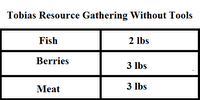
Assume a shipwrecked sailor (Tobias) on an island with no resources but his own two hands and his ingenuity.  To survive he has a number of options:  He can gather fruit/berries for a return of 3 pounds of berries per day, he can fish in the shallows(without tools) for a return of 2 pounds of fish per day, or he can hunt wildlife(without tools) for a return of 3 pounds of meat per day.
wageslavery1

Tobias requires 2 pounds of consumer goods per day to survive.  On this island consumer goods are either Berries, Meat, or Fish and given Tobias’ productive capacity of either 2 pounds of berries or 3 pounds of the other two consumer goods any intake of resources allows him to maintain his existence (subsistence).  It is at this point we must examine whether Tobias’ work is slave labor.

The definition [1] of a slave is:

1.

a person legally owned by another and having no freedom of action or right to property

2.

a person who is forced to work for another against his will

In our scenario is Tobias the property of anyone other than himself?  The answer is clearly “no” since Tobias is quite literally the only person on this island.  While he is “forced” to work due to his innate need for sustenance it would be counter-factual to claim he is somehow a slave to himself since the definitions of slave-master and slave are incompatible with another [2].  It is also absurd to say that because they provide his method of survival that Tobias is somehow slave to the ocean or the land [3].  So as we can see; when Tobias is alone on the island working to survive he is a slave to no one.

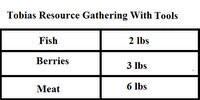
To this point we have been dealing with Tobias merely using his nature given resources to obtain and consume consumer goods.  However by collecting berries or hunting for two days (6pounds collected – 4 pounds consumed) he obtains 2 pounds of excess goods he can save.  Through this method of saving and then consuming the saved goods on the third day he can then use that time to create capital goods.  This means that on the third day, instead of hunting he can fashion himself a spear from collected wood.  The spear allows him to take on larger game and thus increases his collection of meat to 6 pounds per day.

 wageslavery2

At this point we need to examine two things.  First, at this point it would be foolish for Tobias to do anything other than hunt.  He has a decisive gain in resources due to his construction of the Spear and can use the vast amount of saved food to create even more goods (extra spears, traps, shelter, etc…).  As foolish as it may be objectively that diagnosis ignores his subjective valuations; perhaps he finds it distasteful to kill animals even in his situation, or simply prefers to pick berries due to the relative safety.  The reasons are irrelevant, just keep in mind that despite the obvious advantage of hunting in this scenario he can always choose not to.

The second thing we need to examine is whether Tobias is now a slave.  All of the evidence from the previous examination applies; he is still not a slave to himself.  The only thing that has changed is the creation of a spear from the saving of consumer goods.  It is clear that Tobias cannot be a slave to either the spear or his own saved consumer goods, again due to their nature as objects.  So we have seen that a worker working, both with and without capital goods, is a slave to no one.

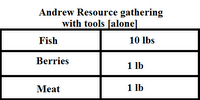
Now here is where the hypothesis comes into question.  Let us assume a second person becomes stranded on the island; except this person (let’s call him Andrew) has been able to scavenge from his wrecked ship a small life boat and netting that is suitable for fishing.  Using his tools while alone Andrew can Hunt for 1 pound of meat, gather 1 pound of berries, or gain 10 pounds of fish.

 wageslavery3

In this economy Tobias will gain the most by hunting and Andrew will gain the most by fishing and they both are likely to pursue those activities [4].  Now we must again identify if this change in circumstance has resulted in slavery.  Tobias’ situation has not changed at all, so he is not a slave to anyone.  Andrew is not interacting with Tobias in any way, he cannot be a slave to his boat, his net, the ocean, or himself so he is also obviously a slave to no one either.

However Andrew soon comes to believe that if he had someone to operate the net while he piloted the boat he could obtain 20 pounds of fish per day, this may be an erroneous prediction but that is the entrepreneurial risk Andrew must take to earn a profit.  For the sake of this examination we will assume that Andrew is an amazing entrepreneur and his prediction is exactly right; but to obtain the 20 pounds of fish Andrew needs an employee.

Here we reach the concept of wages.  In the economy where both Andrew and Tobias work alone they obtain 10 pounds and  6 pounds of consumer goods respectively for a total of 16 pounds.  Andrew, as an entrepreneur, sees that if he employed Tobias they would obtain 20 pounds of total consumer goods which is an increase in the size of their economy by 4 pounds of consumer goods.    At this point Andrew needs to hire Tobias.

If you remember; the subsistence level for Tobias is 2 pounds of consumer goods per day; so any attempt to hire Tobias for less than that will be ignored since he could not survive at that wage.  Currently though Tobias is producing 6 pounds of meat using just his own intelligence and skill so any attempt to hire Tobias below that rate will also be denied.

Andrew would obtain 10 pounds of goods without Tobias’ help so he would be amiss in paying Tobias more than that since then Andrew would then be taking a loss.  Using our final profit of 20 pounds if Tobias agrees to work for Andrew the wage rate must be between 6 and 10 pounds of goods per day.

In this scenario let’s assume Andrew offers to pay Tobias 7 pounds of goods in exchange for his work operating the net [5].   Tobias would then be gaining 1 pound of goods over his efforts if he worked alone.  Andrew would be gaining 3 pounds of goods compared to his work alone.  Tobias agrees to this arrangement and both parties are better off.  Here is where the proponent of wage slavery points to the fact that Tobias is seemingly generating 10 pounds of goods but only obtaining 7 pounds and thus he is being exploited by the capitalist-pig Andrew but let’s examine whether there is a master-slave arrangement here.

Andrew has freely chosen to hire Tobias at the cost of 7 pounds of consumer goods with the expectation of gaining 13 pounds for his own use.  He is free to terminate this agreement at any time.   Tobias is in a voluntary agreement to help Andrew obtain a total of 20 pounds of consumer goods in exchange for a payment of 7 pounds of goods.  He is free to leave at any time if the agreement becomes unsatisfactory and hunt for himself, though he would suffer a net loss of 1 pound of consumer goods to do so.

There is nothing here that fits the definition of slavery, Tobias is not forced to work against his will and Andrew is not forced to hire him.  Both parties own their own property and neither owns the other in part or in whole.  Even though Tobias would be taking a loss by leaving Andrew’s employment the loss to Andrew would be even greater!  Andrew would be losing 3 pounds of profit and Tobias would only be losing 1 pound.  Therefore despite Tobias’ innate need to work this does not cause a master-slave arrangement or “exploitation”.  It is true Tobias has to work to survive but he does not need to work for Andrew; but he voluntarily will continue to do so as long as it benefits him.

Finally, what of the “missing” 3 pounds of goods that Tobias is somehow losing?  The answer is obvious; it is the price put on Tobias’ use of Andrew’s capital goods which in this scenario are his boat and net.  Without these capital goods Tobias would not be able to generate 10 pounds of consumer goods and therefore there is a premium placed upon them by Andrew; after all they are his property and he must maintain them.  If Andrew’s boat was to spring a leak or his net tear Tobias would not have any responsibility to fix them and could happily take his 1 pound loss and go back to hunting while Andrew (if he had not achieved some profit) would suffer the far greater loss of both his 3 pounds of goods and the destruction of his capital goods.

It is worthwhile to note how this scenario compares to the classic opinion that people born into wealth have somehow acquired it illegitimately.  In our scenario Andrew did not need to save consumer goods like Tobias did in order to obtain capital goods, he simply has them due to luck, or fate, or what-have-you.  This does not change the fact that he does indeed own them and can utilize them how he wishes and that utilization is totally legitimate.  Would anyone scoff if Tobias handed down the hunting spear to a future son for his protection and livelihood?  To remain consistent we cannot then harry Andrew for passing down his fishing equipment for the sole reason that it would give his own heirs an “unfair competitive advantage”.

It is evident by now that the entire concept of wage slavery is simply a misunderstanding of economic principles.  Even the myth that somehow the wage earner does not get “his fair share” has been debunked.  The simple reason why so many find these concepts hard to extrapolate in the real world is due to the hundreds of years of savings, production of capital goods, and the highly specialized division of labor that has made worker productivity increase to such an extent that the fall to subsistence seems unfathomable.

The productivity of the workers in the industrialized world has become so great that any work outside of this world, such as gathering berries or fishing to feed an entire family, would require a massive drop in quality of life.  This is somehow turned around to be a slight on employers when they are the ones who have made this increase in the quality of life possible.

If we had replaced Andrew’s life boat in our scenario with a commercial fishing trawler that allowed Tobias to obtain 500 pounds of fish per day would we then say he is Andrew’s slave because he would be “forced” to return to hunting only 6 pounds of meat per day should he choose to leave?  Would Andrew be a villain for hiring Tobias and paying him such a vast increase over the wage he could obtain by working alone?  No! Of course not! It doesn’t logically follow!  Yet that is the accusation from the proponents of wage-slavery and it is clearly absurd.

[1] http://dictionary.reference.com/browse/slave?s=t

[2]  It is true that a slave could himself be the master of a third slave, but a slave master logically cannot be a slave to his own slave since either one slave or the other would end his own involuntary servitude.

[3] By their nature as objects they cannot own other objects.

[4] Whether they actually trade goods at this point is irrelevant because both parties are satisfying their base needs through their own effort.

[5] We are also assuming that the number of hours worked are the same and subjective preferences of hunting over fishing or vice versa are non-existent.

Keynes on Free Trade

I found this great quote from John Maynard Keynes earlier today:

In a regime of Free Trade and free economic intercourse it would be of little consequence that iron lay on one side of a political frontier, and labor, coal, and blast furnaces on the other. But as it is, men have devised ways to impoverish themselves and one another; and prefer collective animosities to individual happiness.

I found this in a journal article (pdf) on political decentralization and economic integration. The quote is from 1920 (the article is a couple of years old).

John Maynard Keynes’s system is collapsing in front of our eyes. It is doing so slowly, but it is collapsing nonetheless. What is interesting to note is that Keynesians share much of their ideology with libertarians. We are all liberals of one stripe or another, but the Keynesians won the public policy battles of the post-war period.

I’m not entirely certain I know what these policy battles were all about. Again, it seems like there is very little that we disagree with the technocratic Left about ideologically. Yet since the Keynesian system is collapsing it seems like now would be a good idea to go over how they got to technocratic planning from what is essentially the same starting point as the libertarian one. I think we would do well to exercise a great deal of our thoughts to thinking about this divergence.

Production bias in economic intervention

When an intervention is proposed, it’s usually offered that it will create jobs, or somehow otherwise create work. In Clash of Economic Ideas I’m reading about Indian economic planning and how in the early 5-year plans they proposed to subsidize low-scale labor-intensive cloth making. Otherwise power looms could take their jerbs! On the face of it, it looks like a policy where home weavers get more money (and maybe the price of cloth goes up… but people will be richer because of jobs, right?), but if we strip away the monetary veil, things look different.

What would this policy look like on Gilligan’s Island? The professor comes up with a way to harness the tide so that Gilligan doesn’t have to ride a stationary bike to generate power (bankrolled by Thurston Howell III). But the Skipper can’t let them take Gilligan’s job! So he forbids the professor from using his labor saving invention and there’s no costly transition from the status quo. Essentially the Skipper is consigning Gilligan to work harder than he otherwise would. For his own good!

Okay, that example is too easy, so let’s take it a step further. The Skipper decides they need a bridge (to where? Never mind, it’ll create jobs!) and sets Gilligan to work collecting materials while the professor draws up plans. This time the jobs created will actually result in something new, which is good. But is it good enough? If the discounted present value of the bridge is less than the present value of the costs they will have to incur, then a bridge building policy is like forcing or tricking Gilligan to work at a low wage when he would rather relax on the beach. Or if he pays Gilligan a good wage, then it’s like forcing the island’s tax payers to buy overpriced goods they don’t want; If I make you buy a Hyundai for $200,000, it hardly matters that you ended up with a reliable and efficient car because you got ripped off! The only alternative is that the person who decides to build the bridge eats the loss.

Entrepreneurs make mistakes, and that’s part of the learning process of the market. These sorts of mistakes are not just economically superior than poor policy, but they are ethically superior to state intervention or full-blown socialism. Let’s imagine that a government policy is passed with the expectation that it will be a net gain for the economy (tough, right?). This project is financed by either forcing/tricking someone to pay for it (taxes or inflation), or directly forcing someone’s hand (regulation or conscription). Even if the project turns a profit and the financiers are paid back, there’s something unsettling about the use of coercion. Contrast that with an honest mistake made by an entrepreneur. The financiers make a loss, but by their own volition. Nobody forced their hand, but they learned something and they can use what they learn to guide their actions in the future. Not so with a government failure.

tl;dr: Focusing on a policy’s effects on producers (“the seen“) overlooks what’s going on behind the veil of money: more work for producers without a commensurate gain is simply making them work harder than they need to, and it’s cruel. If (as is more often the case) it’s really a matter of making taxpayers buy something they don’t want for the price, it’s a ripoff and equally cruel. Even the ethical standing of “good” policies is questionable because it removes the element of choice from the individuals forced into backing the project.