The populist right in India, and the US

All eyes in India have understandably been on some important political developments over the past few days.

First, the by-election results of 3 parliamentary seats and 2 legislative seats were made more interesting by fact that BJP (Bharatiya Janata Party, a Hindu nationalist party, and India’s largest) had to face a surprising rout in the strongholds (Gorakhpur, Phulpur) of Uttar Pradesh’s Chief Minister (Yogi Adityanath) and Deputy Chief Minister (Keshav Prasad Maurya).

Second, there has been talk of other regional parties joining hands and forming an Anti-Congress Front. Two days after the election results, the exit of the Telugu Desam Party (TDP) from the BJP-led National Democratic Alliance (NDA) and its decision to pass a no confidence motion (which BJP is likely to win) has certainly made the fight for 2019 more interesting.

While it remains to be seen whether the opposition parties in 2019 can give the BJP a run for its money, those interested in US politics will have closely followed the result of a Congressional by-election (18th District) where Democrat candidate Connor Lamb (a 33 year old Marine) defeated Republican Candidate Rick Saccone in a close contest. This is a significant win after the triumph of Senator Douglas Jones in Alabama. Jones became the first Democrat to win a Senate Seat in Alabama (a Republican stronghold referred to as “Ruby Red”) since 1997.

The US President, who is quick to comment on virtually every issue, on Twitter, remained silent on the result of the 18th District.

The US President did state, at a private fundraiser for Missouri Senate candidate Josh Hawley, that the Democrat candidate’s stance on key economic issues was akin to that of Trump:

The young man last night that ran, he said, ‘Oh, I’m like Trump. Second Amendment, everything. I love the tax cuts, everything.’ He ran on that basis, Trump said. He ran on a campaign that said very nice things about me. I said, ‘Is he a Republican?’ He sounds like a Republican to me.

Lamb conservative on social and economic issues?

Trump’s views were echoed by a number of other Republicans. House Speaker Paul Ryan called Lamb a “pro-gun, anti-Nancy Pelosi conservative.”

While Republican Representative Chris Collins of New York said that he doesn’t “think you’ll see another candidate like Lamb,” another representative from the state of Pennsylvania, Mike Kelly, argued that Lamb was “more like a Republican.”

There is some truth in the President’s assertions, because Lamb did support the President’s imposition of tariffs on aluminium and steel imports. Said Lamb: “we have to take some action to level the playing field.” Even on issues like gun control and abortion, his views were to the right of conventional Democrats, though not absolutely in sync with the Republicans.

Why Trump can not ignore this defeat

Irrespective of what US President Donald Trump may say, the fact is that he had won the state by 20 points in the US Presidential election of 2016, and his economic agenda had found strong resonance. Trump, along with Vice President Mike Pence, had also campaigned for Saccone.

Significantly, in the last two Congressional elections, Democrats had not even bothered to field candidates in PA 18.

The announcement to impose tariffs on aluminium and steel had been made one week before the election, clearly with an eye on reaching out to large sections of ‘blue collar workers’. The US President calculated that he would be able to regain his popularity, but the results clearly show that Trump’s ‘ultra nationalism’ and economically inward looking policies by themselves will not suffice. He will also need to change his style of functioning and not continuously sack individuals.

Republican Speaker Paul Ryan himself had dubbed this verdict as a ‘wake up call’. Other Republicans have been forthright in their analysis of the defeat and blame Trump’s approval ratings for the same.

Doug Heye, a Republican strategist and former spokesman for the Republican National Committee, said:

There is a very real problem facing Republicans in the months ahead and that problem is Donald Trump’s approval rating.

What does Lamb’s win mean for the Democrats

Lamb’s victory may also result in some changes within the Democrats. Lamb has been pitching for a change in leadership and does not get along particularly well with Nancy Pelosi, Minority Leader of the US House of Representatives:

I have said, and I continue to say, that I think we need new leadership at the top of both parties in the House.

Pelosi however was quick to deny that Lamb’s criticism of her had anything to do with the outcome:

I don’t think that that really had that much impact on the race […] He won. If we hadn’t won, you might have a question, but we won — the ‘D’ next to his name was very significant.

The electoral verdicts in India and US have one common message: ‘economic insularity’,  and the whipping up of ultra-nationalist emotions can not make up for vacuous policies.

There are messages for the opposition in both the US and India; in spite of right wing nationalism having failed to address substantive issues, the voter is looking for new options — leaders with imaginative ideas outside of the cozy club .

If one were to specifically look at India, the fence sitters may not be particularly happy with the existing order, but does that imply that they will automatically tilt towards the opposition? The politics of doles and sops will not work. A progressive social agenda, which is in sync with the diverse ethos of this country, has to be complemented by a pro-reform economic agenda (which is of course inclusive, and sensitive to the concerns of the poorest).

Conclusion

What is clear however is that Trump’s re-election in 2020 and Modi’s in 2019, are not a done deal. One would have to say though, that in spite of the recent UP verdict, there is a higher probability of Modi being re-elected than Trump.

It remains to be seen whether the current populist right narrative, which is a lethal cocktail of inward looking economic thinking and conservative social policies, can be countered effectively, and defeated at the hustings, by a progressive, forward looking agenda. Will India and the US take the lead in challenging this narrative?

3 key problems with Trump’s style of functioning

The removal of Rex Tillerson as Secretary of State (who was replaced by Mike Pompeo, Director of the CIA) reiterates three key problems in US President Donald Trump’s style of functioning: First, his inability to get along with members of his team; second, impulsive decisions driven excessively by ‘optics’ and personal chemistry between leaders; and, finally, his inability to work in a system even where it is necessary.

Tillerson, who had differences with Trump on issues ranging from the Iran Nuclear Deal (which Trump has been wanting to scrap, though his stance was moderated by Tillerson) to the handling of North Korea, is not the first member (earlier senior individuals to be sacked are, amongst others, Michael Flynn, who was National Security Adviser, and Chief Strategist Steve Bannon) to exit hurriedly. Gary Cohn, Director of the National Economic Council, quit recently after opposing the US President’s tariffs on imports of steel and aluminium.

The US President tweeted this decision:

Mike Pompeo, Director of the CIA, will become our new Secretary of State. He will do a fantastic job! Thank you to Rex Tillerson for his service! Gina Haspel will become the new Director of the CIA, and the first woman so chosen. Congratulations to all!

The US President admitted that Tillerson’s style of functioning was very different from his own (alluding to the latter’s more nuanced approach on complex issues).

Interestingly, the US President did not even consult any of his staff members, including Tillerson, before agreeing to engage with North Korean Dictator Kim Jong Un. The South Korean National Security Advisor, Chung Eui Yong, had met with Trump and put forward the North Korean dictator’s proposal of a Summit.

The US President agreed to this proposal. Commenting on his decision to engage with Kim Jong Un, Trump tweeted:

Kim Jong Un talked about denuclearization with the South Korean Representatives, not just a freeze. Also, no missile testing by North Korea during this period of time. Great progress being made but sanctions will remain until an agreement is reached. Meeting being planned!

While Chung stated that the Summit would take place before May 2018, White House has not provided any specific dates.

There is absolutely no doubt that, at times, bold steps need to be taken to resolve complex issues like North Korea. Trump’s impulsive nature, however – refusing to go into the depth of things or seeking expert opinion – does not make for good diplomacy.

In fact, a number of politicians and journalist have expressed their skepticism with regard to where North Korean negotiations may ultimately lead. Ed Markey a Democratic Senator from Massachusetts, stated that Trump “must abandon his penchant for unscripted remarks and bombastic rhetoric to avoid derailing this significant opportunity for progress.”

In a column for the Washington Post, Jeffrey Lewis makes the point that there is a danger of Trump getting carried away by the attention he receives. Says Lewis in his column:

Some conservatives are worried that Trump will recognize North Korea as a nuclear-weapons state. They believe that an authoritarian North Korea will beguile Trump just as it did his erstwhile apprentice, American basketball player Dennis Rodman. They fear that Trump will be so overjoyed by the site of tens of thousands of North Koreans in a stadium holding placards that make up a picture of his face that he will, on the spot, simply recognize North Korea as a nuclear power with every right to its half of the Korean peninsula.

All Trump’s interlocutors have realized that while he is unpredictable, one thing which is consistent is the fact that he is prone to flattery. During his China visit, for instance, Trump was so taken aback by the welcome he received and the MOU’s signed with Chinese companies that he started criticizing his predecessors.

Finally, while Trump, like many global leaders, has risen as a consequence of being an outsider to the establishment, with people being disillusioned with the embedded establishment, the US President has still not realized that one of Washington’s biggest assets has been strategic alliances like NATO and multilateral trade agreements like NAFTA. The United States has also gained from globalization and strategic partnerships; it has not been one way traffic.

It remains to be seen how Tillerson’s removal will affect relations with key US allies. If Trump actually goes ahead with scrapping the Iran nuclear deal (2015), it will send a negative message not just to other members of the P5 grouping, but also India. In the last three years, India has sought to strengthen economic ties with Iran and has invested in the Chabahar Port Project. New Delhi is looking at Iran as a gateway to Afghanistan and Central Asia. If Tillerson’s successor just plays ball, and does not temper the US President’s style of conducting foreign policy, there is likely to be no stability and consistency and even allies would be skeptical.

Japan on its part would want its concerns regarding the abduction of Japanese citizens by Pyongyang’s agents, decades ago, to not get sidelined in negotiations with North Korea. (13 Japanese individuals were abducted in 2002, 5 have returned but the fate of the others remains unknown.) Prime Minister Shinzo Abe has made the return of the abductees a cornerstone of his foreign policy, and his low approval ratings due to a domestic scandal could use the boost that is usually associated with the plight of those abductees.

The removal of Tillerson underscores problems with Trump’s style of functioning as discussed earlier. The outside world has gotten used to the US President’s style of functioning and will closely be watching what Tillerson’s successor brings to the table.

Trump’s humor is not very funny to the world’s liberal democracies

The Chinese Communist Party, on February 25, 2018, made a significant announcement — that the two-term limit for Presidency will be abolished through an amendment to the constitution. This means that current President Xi Jinping will be President for life. This amendment was tabled on March 6, 2018 by the Communist Party during the two week National People’s Congress (which began on Monday, March 5, 2018).

According to a CNN recording, Donald Trump, while reacting to this development, stated:

He’s now president for life, president for life. And he’s great. And look, he was able to do that. I think it’s great. Maybe we’ll have to give that a shot someday.

The US President also called Xi a “gentleman,” and said that the latter had treated Trump very well during his China visit in November 2017. Trump’s reaction to Xi’s decision has been criticized by some politicians in the US, while other major Western democracies have not commented on the decision.

Trump’s inconsistency on China

Trump’s views with regard to China have not been consistent, as is the case on many other issues. Candidate Trump had used tough language for China; at one campaign rally, for example, candidate Trump stated:

We can’t continue to allow China to rape our country and that’s what they’re doing. It’s the greatest theft in the history of the world.

During his visit to China in November 2017, the US President had, interestingly enough, criticized his predecessors, and said that he does not hold China responsible for the skewed trade relationship:

[…] I don’t blame China. After all, who can blame a country for taking advantage of another country for the benefit of its own citizens? I give China great credit […] I do blame past [US] administrations for allowing this out of control trade deficit to take place and to grow. We have to fix this because it just doesn’t work […] it is just not sustainable.

While the US President is unpredictable, the criticism of his predecessors on foreign soil came as a shock to everyone.

Trump’s myopic approach towards complex economic and strategic issues has helped China

Trump’s recent praise of the constitutional change which will enable Xi to be President for life may have embarrassed many Americans and Liberals in other parts of the world. They would have perhaps expected the US President to raise a red flag.

The fact is, however, that many of Trump’s foreign policy decisions – withdrawing from the Trans Pacific Partnership (TPP) trade deal in January 2017, or repeatedly criticizing NATO (North Atlantic Treaty Organization) and stating that members are not meeting their ‘financial obligations’ or, more recently, the imposition of tariffs on imports of aluminium and steel – are embarrassing steadfast allies in Asia and Western Europe. All these decisions have sent a message globally that Trump’s view of the outside world is driven by domestic politics and transactionalism – and not realism as some would have us believe. This is in contrast to his predecessors, who valued relationships but also understood the relevance of common democratic values as a binding thread. Trump on the other hand is quite comfortable with authoritarian leaders.

Trump has often expressed admiration for authoritarian leaders like Vladimir Putin, and Phillipines President Rodrigo Duterte. Duterte, who is controversial for using extrajudicial methods to deal with a Filipino drug problem, has presided over a drug war that has cost the lives of more than 4,000 people. While praising Duterte, Trump said:

I just wanted to congratulate you because I am hearing of the unbelievable job on the drug problem. Many countries have the problem, we have a problem, but what a great job you are doing.

During their meeting on the sidelines of the ASEAN Summit in Manila (November 2017), Trump did not sufficiently raise US human rights concerns, and was criticized by many American politicians, including Republican Senator John McCain. The US-Philippines Joint Statement, while speaking about the challenge of the drug problem, did refer to a human rights issue (issued after the meeting between Trump and Duterte):

The two sides underscored that human rights and the dignity of human life are essential, and agreed to continue mainstreaming the human rights agenda in their national programs to promote the welfare of all sectors, including the
most vulnerable groups.

It would be pertinent to point out that the previous administration had criticized Duterte for adopting such measures. In return, Duterte used offensive language aimed at President Obama.

While the US has been in bed with authoritarian regimes in the past and turned a blind eye on many occasions to human rights violations, no one can deny the fact that even transactionalist Presidents like Ronald Reagan paid lip service to democracy and human rights. In a speech at Westminster, Reagan stated:

Democracy is not a fragile flower […] Still it needs cultivating. If the rest of this century is to witness the gradual growth of freedom and democratic ideals, we must take actions to assist the campaign for democracy.

Similarly, George W Bush, who was often thought of as being very simplistic, spoke about the importance of democratic values as a common binding factor with many of its allies.

Conclusion

In conclusion, while reasonable ties between Washington and Beijing are good news, Trump’s public appreciation of authoritarian leaders and their methods is worrying because at the global level there is a feeling that authoritarian leaders and systems deliver better results compared to chaotic democracies.

The US has always been the flagbearer of democracy, liberal values, and human rights. It is a matter of concern, then, when the leader of such a country pays little attention to these issues. In a way, Trump has played a pivotal role in wrecking the liberal order, and by doing so has created a situation where Beijing will not have to change its ways, but may well create a parallel order which many countries will be willing to join due to China’s economic prowess.

Pinker wrote a nice rejoinder

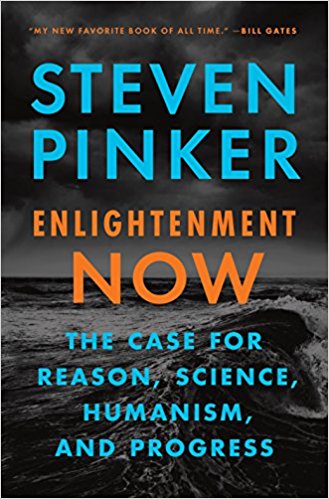
Steven Pinker, the Harvard professor, recently published Enlightenment Now. The Case for Reason, Science, Humanism, and Progress.

NOL Pinker Edwin
Buy it

It is a fine book that basically sets out to do what its subtitle promises. It does so covering a wide range of ideas and topics, and discusses and rejects most arguments often used against Enlightenment thought, which Pinker equates with classical liberalism.

Those who know the work of Johan Norberg of the Cato Institute, the late Julian Simon’s writings, Jagdish Bhagwati’s magisterial In Defense of Globalization, or last but not least, Deirdre McCloskey’s Bourgeois Trilogy will be updated on the latest figures, but will not learn much in terms of arguments.

Those new to the debate, or searching for material to defend classical liberal ideas and values, will find this a very helpful book.

Quad: The way ahead and the key challenges

The Quadrilateral Security Dialogue (QSD) consisting of India, Australia, Japan, and the US has been pitching in favor of a ‘Free and Fair Indo-Pacific’ ever since the first meeting between representatives of member states in November 2017.

Shinzo Abe, the current Prime Minister of Japan, actually proposed this arrangement about a decade ago. Diplomatic engagement began, and joint military exercises were even held, but a change in guard in Australia, as well as Chinese complaints to member states, resulted in the end of the arrangement. Given the increasing focus on the ‘Indo-Pacific’ region and the strengthening of strategic ties between all four countries, reticence was finally shed and representatives of the four countries met in November 2017, on the eve of the East Asia Summit in Manila. The main aim of the alliance, thus in other ways, has been to check China’s assertiveness, especially in the South China Sea, and democracy has been one of the key binding factors between the Quad. The U.S. State Department, after the meeting in November 2017, issued a statement that the United States is “committed to deepening cooperation, which rests on a foundation of shared democratic values and principles.”

More recently, the joint statement issued after the meeting between Trump and Australian Prime Minister Malcolm Turnbull in February 2018, reiterated the point about a Free and Open Indo-Pacific. Said the joint statement between both countries: Continue reading

Underrated & overrated libertarian thinkers

Here is my take on Tyler Cowen’s views on libertarian thinkers who are either overrated or underrated in shaping the libertarian tradition. Please be aware that I think libertarianism and classical liberalism are two different strands of liberal thought, as argued in more detail in an earlier post here at NOL and in my latest book. Please also note that my judgement will be particularly informed by their views on international relations.

Overrated:

  1. Hans-Hermann Hoppe – completely esoteric ideas about international relations, especially his erroneous and ill-thought idea about private defence through private insurance companies.
  2. Deepak Lal – no complaints about his general work, but his praise for empires was deeply disturbing, even though he meant well. Liberalism and globalization do not need empires, no matter how civilized – in the Oakeshottian meaning – they are meant to be.
  3. Ron Paul – I admire Ron Paul in many ways, but his ideas for ‘a foreign Policy of freedom’ are not much better than Hoppe’s. ‘peace, commerce, and honest friendship’: nice Jeffersonian goals, bad underlying analysis, not least about human nature.

Underrated:

  1. Friedrich Hayek – a far more sophisticated thinker on international relations than he is ever given credit for.
  2. Adam Smith – nowadays erroneously equated with ‘trade leads to peace’ fairly tales. Yet any reader of the complete two volumes of the Wealth of Nations recognizes that the book is also a lot about war and foreign policy, as are his Lectures on Jurisprudence and even a bit in The Theory of Moral Sentiments. Together these make for a full and sophisticated position on international affairs.
  3. David Hume – basically the same as Smith.
  4. Robert Jackson – ok, I am taking liberties here. I do not think Jackson would consider himself a classical liberal or libertarian. But his writings on international relations are important and often have a classical liberal leaning, especially The Global Covenant.

Tech’s Ethical Dark Side

An article at the NY Times opens:

The medical profession has an ethic: First, do no harm.

Silicon Valley has an ethos: Build it first and ask for forgiveness later.

Now, in the wake of fake news and other troubles at tech companies, universities that helped produce some of Silicon Valley’s top technologists are hustling to bring a more medicine-like morality to computer science.

Far be it from me to tell people to avoid spending time considering ethics. But something seems a bit silly to me about all this. The “experts” are trying to teach students the consequences of the complex interactions between the services they haven’t yet created and the world as it doesn’t yet exist.

My inner cynic sees this “ethics of tech” movement as a push to have software engineers become nanny-state-like social engineers. “First do no harm” is not the right standard for tech (which isn’t to say “do harm” is). Before 2016 Facebook and Twitter were praised for their positive contribution to the Arab Spring. After our dumb election the educated western elite threw up our hands and said, “it’s an ethical breach to reduce our power!” Freedom is messy, and “do no harm” privileges the status quo.

The root problem is that computer services interact with the public in complex ways. Recognizing this is important and an ethics class ought to grapple with that complexity and the resulting uncertainty in how our decisions (including design decisions) can affect the well being of others. My worry is that a sensible call to think about these issues will be co-opted by power-hungry bureaucrats. (There really ought to be ethics classes on the “Dark Side of Ethical Judgments of Others and Education Policy”.)

I don’t doubt that the motivations of the people involved are basically good, but I’m deeply skeptical of their ability to do much more than offer retrospective analysis as particular events become less relevant. History is important, but let’s not trick ourselves into thinking the lessons of 2016 Facebook will apply neatly to whatever network we’re on in 2026.

It hardly seems reasonable to insist that Facebook be put in charge of what we get to see. Some argue that’s already the world we live in, and they aren’t completely wrong. But that authority is still determined by the voluntary individual decision of users with access to plenty of alternatives. People aren’t always as thoughtful and deliberate as I’d like, but that doesn’t mean I should step in and be a thoughtful and deliberate Orwellian figure on their behalf.

If causality matters, should the media talk about mass shootings?

My answer to that question is “maybe not” or at the very least “not as much”. Given the sheer amount of fear that can be generated by a shooting, it is understandable to be shocked and the need to talk about it is equally understandable. However, I think this might be an unfortunate opportunity to consider the incentives at play.

I assume that criminals, even crazy ones, are relatively rational. They weigh the pros and cons of potential targets, they assess the most efficient tool or weapon to accomplish the objectives they set etc. That entails that, in their warped view of the world, there are benefits to committing atrocities. In some instances, the benefit is pure revenge as was the case in one of the famous shooting in my hometown of Montreal (i.e. a university professor decided to avenge himself of the slights caused by other professors). In other instances, the benefit is defined in part by the attention that the violent perpetrator attracts for himself. This was the case of another infamous shooting in Montreal where the killer showed up at an engineering school to kill 14 other students and staff. He committed suicide and also left a suicide statement that read like a garbled political manifesto. In other words, killers can be trying to “maximize” media hits.

This “rational approach” to mass shootings opens the door to a question about causality: is the incidence of mass shootings determining the number of media hits or is the number of media hits determining the incidence of mass shootings. In a recent article in the Journal of Public Economicsthe possibility of the latter causal link has been explored with regards to terrorism.  Using the New York Times‘ coverage of some 60,000 terrorist attacks in 201 countries over 43 years, Michael Jetter used the exogenous shock caused by natural disasters to study they reduced the reporting of terrorist attacks and how this, in turn, reduced attention to terrorism. That way, he could arrive at some idea (by the negative) of causality. He found that one New York Times article increased attacks by 1.4 in the following three weeks. Now, this applies to terrorism, but why would it not apply to mass shooters? After all, there are very similar in their objectives and methods – at the very least with regards to the shooters who seek attention.

If the causality runs in the direction suggested by Jetter, then the full-day coverage offered by CNN or NBC or FOX is making things worse by increasing the likelihood of an additional shooting. For some years now, I have been suggesting this possibility to journalist friends of mine and arguing that maybe the best way to talk about terrorism or mass shooters is to move them from the front page of a newspaper to a one-inch box on page 20 or to move the mention from the interview to the crawler at the bottom. In each discussion, my claim about causality is brushed aside with either incredulity at the logic and its empirical support or I get something like “yes, but we can’t really not talk about it”. And so, the thinking ends there. However, I am quite willing to state that its time for media outlets to deeply reflect upon their role and how to best accomplish the role they want. And that requires thinking about causality and accepting that “splashy” stories may be better left ignored.

A short note on Rand Paul’s shaming of the GOP

For those who don’t know what I’m talking about, Rand Paul delayed a new, 700-page congressional budget that purportedly adds $300 billion to the deficit. CNN has the money shot:

“When the Democrats are in power, Republicans appear to be the conservative party,” Paul said at one point. “But when Republicans are in power, it seems there is no conservative party. The hypocrisy hangs in the air and chokes anyone with a sense of decency or intellectual honesty.”

Read the rest. The delay lasted a couple of hours. What I found most interesting was the complaining, by Senators and House Representatives alike, about having to stay up until 4 or 5 in the morning to pass the budget.

Good. At first I was incensed that politicians could think of nothing other than getting a good night’s sleep after adding hundreds of billions of dollars to the deficit (these are the same people who have voted to give themselves six-figure salaries for their “public service”), but then I remembered, thanks in part to Rick’s constant reminders, to give my enemies all my faith. Washington’s politicians probably believe they are doing honest work, and that adding to the already massive deficit is okay as long as it achieves a bipartisan consensus.

One other thought: Rand Paul is playing politics when he uses the term “conservative” to describe budget discipline. He knows, like Jacques, that conservatives are unprincipled, middle-of-the-road opportunists, but in today’s public discourse, fiscal discipline is somehow associated with conservatism, so he uses the term “conservative” to describe his libertarian politics.

Does anybody know where the deficit actually stands?

2018 Hayek Essay Contest

The 2018 General Meeting of the Mont Pelerin Society will take place from September 30 – October 6, 2018 at ExpoMeloneras and Lopesan Hotels in Meloneras, Gran Canaria, Canary Islands. As with past general meetings, the Mont Pelerin Society is currently soliciting submissions for Friedrich A. Hayek Fellowships. The fellowships will be awarded through the Hayek Essay Contest.

The Hayek Essay Contest is open to all individuals 36 years old or younger. Entrants should write a 5,000 word (maximum) essay that addresses the quotation(s) and question(s) detailed on the contest announcement (available at the above link). The deadline for submissions is May 31, 2018. The winners will be announced on July 31, 2018. Essays must be submitted in English only. Electronic submissions should be sent in PDF format to this email address (mps.youngscholars@ttu.edu). Authors of winning essays must present their papers at the General Meeting to receive their award. The essays will be judged by an international panel of three members of the Society.

Please feel free to share this announcement with any individuals who may have an interest in submitting an essay for consideration of a fellowship award. All questions may be directed to the MPS Young Scholars Program Committee by email at mps.youngscholars@ttu.edu or phone at +1.806.742.7138.

MPS Young Scholars Program Committee

Déjà vu

A certain group claims to represent the middle class. It wants to nationalize one fifth of the economy. It refuses to accept the results of an election it lost, and claims its loss was the result of a conspiracy. Before losing, it uses the police unlawfully to try and smear its opponents. It’s obsessed with race. It interferes grossly with freedom of speech in universities, including with goons threatening speakers with a different viewpoint. Some of its main newspapers demand that a public document not become public. Its leaders publicly threaten the duly elected head of the executive branch. The group tries to combat moral decadence by destroying works of art. It is especially adamant against works of art that remind the nation of its historical past. Sounds familiar?

A free press, the Left, and the FBI

I taught for thirty years. That makes me an expert on verbal dishonesty. I can tell the difference between a student who let the dog eat his assignment and a student who made his dog eat his assignment.

And, I am saying this in connection to?

I am eager to read the Democrats’ and, perhaps, the FBI’s rejoinder to the memo they described as riddled with falsehoods and with omissions. I have some expectation that they will dig themselves in deeper when they try to make up for the omissions. You read it here first; please, give me credit.

The NYT and the Washington Post are on editorial record asking for prior censorship on the famous memo. It’s unheard of in times of peace. Two major leftist newspapers asked the government to violate the First Amendment, the very constitutional disposition that guarantees freedom of the press. The rank and file “liberals” I know and pay attention to in real life and on Facebook also fought transparency, in this case. Myself, and the conservatives I know, want the full sunlight on this and related matters.

I saw on CNN that House Representatives oppose releasing the Democrats’ rejoinder or version of the same memo. If that’s true (if), I am totally against this stance. I want to know everything; I don’t need babysitting of any kind.

Paul Romer, the World Bank and Angus Deaton’s critique of effective altruism

220px-Paul_Romer_in_2005

Last week Paul Romer crashed out of his position as Chief Economist at the World Bank. He had already been isolated from the rest of the World Bank’s researchers for criticizing the reliability of their data. It seems there were several bones of contention, including the accusation that Chile’s current social democratic government falsified data contributing to some of its development indicators. Romer’s allergic reaction to the World Bank’s internal research processes has wider implications for how we think about policy research in international NGOs.

Continue reading

Is Trump turning the US into the Biggest Loser?

US President Donald Trump has been quick to change his stance on complex issues like US relations with other countries, including China. Trump has also been unpredictable in his approach towards important multilateral organizations like the North Atlantic Treaty Organization (NATO) and US ties with important allies in the Indo-Pacific, especially Japan and South Korea.

The most recent instance of Trump yet again changing his views was his statement on the Trans Pacific Partnership (TPP) during the Davos Summit, saying that the US was open to a rethink, provided the provisions were fair. While the US pulled out of the TPP agreement much to the chagrin of other signatories, eleven countries (they are, in alphabetical order, Australia, Brunei, Canada, Chile, Japan, Malaysia, Mexico, New Zealand, Peru, Singapore and Vietnam) have agreed on signing the deal in March in Chile.

While speaking at Davos, Trump said that the US was not averse to negotiating trade deals with its TPP partners. In an interview with CNBC, on the eve of his address, the US President had said:

….we would do TPP if we were able to make a substantially better deal. The deal was terrible, the way it was structured was terrible. If we did a substantially better deal, I would be open to TPP.

The US President sensed the pitch at Davos, which was firmly in favor of globalization and a more open economic world order. During his address, while speaking of American interests, Trump made it a point to state that watching out for US interests did not imply that his administration would prefer America to become more insular. Said the US President:

America First does not mean America alone. When the United States grows, so does the world. American prosperity has created countless jobs all around the globe and the drive for excellence, creativity, and innovation in the US has led to important discoveries that help people everywhere live more prosperous and far healthier lives.

Mr Trump is not the only world leader to have won competitive elections by appealing to insularity, only to realize that economic interdependence between countries today is incredibly entrenched. For instance, Indian PM Narendra Modi, while arguing in favour of globalization, had said:

Instead of globalization, the power of protectionism is putting its head up.

Modi had gone to the extent of saying that inward looking tendencies were an important challenge, arguing that:

 …such tendencies can’t be considered lesser risk than terrorism or climate change.

Interestingly, Modi’s remarks on globalisation were welcomed by the Chinese, with the Chinese Foreign Ministry spokesman, Hua Chunying, arguing in favour of China and India working together to promote globalisation. Said Hua:

China would like to enhance coordination and cooperation with all countries including India to steer the economic globalisation towards benefiting world economic growth and well-being of all countries.

Last year in his address at the Davos Summit, Chinese President Xi Jinping had spoken in favour of globalization, saying:

Pursuing protectionism is like locking oneself in a dark room […] Wind and rain may be kept outside, but so is light and air.

While some flexibility is welcome, excessive unpredictability and Trump’s woolly approach on serious issues is confusing the outside world. A business-like approach is good to an extent, but to deal with complex geostrategic issues purely from the prism of US short-term financial interests as opposed to long term geopolitical interests is a disastrous idea.

Every country has to watch its own interests, and the US is no exception, and there is absolutely no doubt that domestic public opinion cannot be ignored. Yet if the US wants to be a leader, it cannot be as transactional as Trump. US dreams of a “Free and Open Indo-Pacific” – a key aim of the US Defense Strategy – will remain a mere dream if the US sends confusing signals to its allies in the region and is not willing to take a clear leadership role. While the Strategy identifies China as a threat, Trump’s continuous somersaults on relations with US allies are only emboldening Beijing.

While it is unfair to single out Trump for being insular he has been the mascot for inward looking protectionist economic policies and an anti-immigration sentiment. While the US President did tell the global audience at Davos that “America First does not mean America alone,” it will indeed end up alone if he does not start thinking like a US President.

Currently he is thinking purely like the head of a company, and running a business is different from running a country, which has long sought to be the flag bearer of democratic, liberal values and globalization. While Trump’s isolationism and short sightedness may cause some discomfort for other countries, and groupings like the TPP, the latter will find other alternatives as has been the case with the signatories of the TPP, and America will be the bigger loser.

The US Immigration Lottery

As I write, Democrats and Republicans are gearing up for a battle to transform an American immigration system that has changed little in fifty years. President Trump seems eager to alter both the number of immigrants and the nature of qualifications for immigration. His Democratic opponents call him “racist.” (Democratic extremists call anyone they don’t like “racist,” perhaps because they have exhausted all normal political insults.) The so-called “lottery” door to immigration is attracting special scorn from the president and from other high-ranking Republicans. Many in the general public, not well versed in matters of immigration, listen to the president’s attacks with perplexity or disbelief: a “lottery”? This short essay aims to throw light on the topic with a small number of figures.

In 2016 there were 1,200,000 admissions to permanent residency in the US. That’s the granting of the famous “green card” which gives one full rights to work, to go in and out of the country, but no political rights, no right to vote, and no right to be elected – until now. Permanent residency is not citizenship. This must be obtained later, separately after five or three years (the latter, for spouses of US citizens) in almost all cases. Nearly all legal residents who wish to eventually become American citizens.

“Admission” is a legal-bureaucratic term. Many of those so admitted have already been in the US, some for years, while their case was being processed. The number physically arriving in the US on that year is much larger because it includes tourists, students, and others who are supposed to be visitors staying only for a stated length of time. Immigrants are admitted on the basis of one of five broad categories:

Occupational/business qualification, family relationship to someone already legally in the US. (The latter actually includes two legal-bureaucratic categories. The distinction between the two need not concern us here.) This family-based category accounts for the bulk of legal immigration, 67% of the total in 2016. Refugees (and “asylees”) account for another large number that is variable from year to year. There is also a category “Others” which gathers a small number of odds and ends admissions otherwise not fitting into another category.

The most interesting basis for admission is the quaintly called “Diversity.” It’s an actual lottery. It’s a lottery without admission fee where one can play as often as one cares to. It contributed 50,000 admissions in 2016, or 4% of the total admitted. The number is so small that it hardly would seem to be worth the attention of policy makers, except perhaps when a lottery winner engages in spectacular criminal acts as happened in New York in the fall of 2017.

Once, in the late 80s, Senator Ted Kennedy discovered that immigration to the US included practically no Irish people. He got angry and, on the spot, devised a remedy that became – through his influence in Congress – the diversity lottery. I can’t guarantee this story is true but it’s plausible and its spirit explains well the existence of this strange anomaly.

The main reason some parts of the globe send few immigrants to the US is that most opportunities to do so are sucked up by the prevalence of immigration based on family status in other areas. It’s the result of a quasi-random starting point combined with chain immigration. Suppose a single young Mexican male manages to move to the US legally (worry not how). Within a couple of years he goes back to Mexico to get married. He brings his wife to the US. It turns out he already had a son in Mexico, from another woman. He brings the son over too. The couple has several children, all US born. Soon, they would like to have built-in babysitters. They bring in both of the wife’s parents and the husband’s surviving mother. So, in this unremarkable story, we go – in the space of less than ten years – from one immigrant from Mexico, to six. After a few more years, any of the foreign born adults may bring one or two more immigrants, including brothers and sisters. The US-born children can also bring in their Mexican uncles, aunts, and cousins, though it would take a long time. There is a natural snowball effect built into the system.

To the extent that Congress wishes to cap the total number of immigrants brought in (excluding refugees), national contingents that happened to be numerous early may monopolize a very large number of available immigration opportunities. This leaves the door almost closed to other nationalities that were not present in large numbers early. The purpose of the lottery is to improve the US immigration chances to people living in areas of the world that have been under-served for a little while. Accordingly, lottery slots are allocated among regions observed to be contributing a small number of immigrants by other means. The drawing occurs individual under-served region to under-served region. Each region corresponds more or less to a continent (distinguishing between South America and North America).

The lottery products are interesting. First, the lottery results in a frequency distribution of admissions by country of origin that would be difficult to predict in general. Second, it would be hard to forecast which countries would end up still undeserved. In 2016, lottery admissions included people from 152 countries. Only six countries passed the (arbitrary) bar of “diversity” lottery of 2,000 immigrants into the US. They were, by order of the magnitude of their immigrant contingent:

  • Egypt, Nepal, Iran, Congo (formerly Zaire), Uzbekistan, and Ethiopia.
  • Ukraine, with 1,915, almost made the cut.
  • In 2016 also, four Uruguayans qualified under the lottery (that’s 4, four units.)

Together, the core western European countries of Belgium, Denmark, France, Germany, Italy, Ireland, the Netherlands, Portugal, Spain, the United Kingdom, Sweden, and Norway, sent a grand total of 1,390 to the US under this qualification. That’s between 2 and 3% of the total diversity lottery winners. Although European countries do send immigrants to the US under other programs, Europe is classified as one of the under-served regions. It also turns out to be under-served by the lottery. In 2016, about one per thousand of the immigrants admitted to the US came from the conventionally defined core western European areas under an admission program intended to correct for under-representation. The Republic of Ireland produced 51 winners. Sen. Kennedy hardly got his way.

Anybody who calls the current American immigration system racist is out of his mind, probably dishonest as well as ignorant and, more likely, dishonestly ignorant. Inevitably, any forthcoming reform of American immigration laws is going to give results that will seem racist in comparison. Brace yourselves with facts!

All data from Homeland Security: Immigration Statistics and Data


I am an American sociologist by training, with a doctorate from a good university. I am also an immigrant and married to another immigrant, from another country. Together, we have two adopted children, both born abroad. I have lived in the US for fifty years. During that time, I have rarely been out of touch with immigration issues although they are not one of my subjects of systematic scholarly inquiry. Many other essays are here in Notes On Liberty and also on my blog: factsmatter.wordpress.com.