Some thoughts on the ivory tower; part 1: discrimination

I entered academia in 2009 when I started my bachelor’s degree and began graduate studies in 2014 when I entered a master’s program. I have been in the ivory tower in some form for almost a decade. Others have spent much more time in the tower than I, but I am hardly a newcomer. I hope then that I can offer thoughts on discrimination and mental health in the ivory tower.

In the past few years I have noted an increased self-aware discussion on the lack of diversity, both in terms of phenotype and ideology, in the ivory tower. The tower is full of center-left white men. I have seen various formal (e.g. #womenalsoknowstuff ) and informal groups groups advocate for greater inclusion in the tower. For the record there are non-leftist groups involved in this as well. CU Boulder has a program to increase conservative intellectuals. The Institute of Humane Studies (IHS) essentially serves to advocate for classical liberals in the tower. 

There is nothing wrong with these goals. Women also knows stuff tries do this by advertising the work of female scholars. IHS does it by inviting classical liberals to book discussions – and providing beer. Both approaches sound sensible to me. My concern is that ultimately the pipeline isn’t being fixed. Not really. Both approaches help those who managed to enter, at minimum, graduate school but do little to help solve more structural reasons for why there respective groups are rare in the tower.

Why are there so few women and classical liberals (and especially so few classical liberal women!) in academia? It’s partly cultural and partly institutional.

Minorities get made fun of in academia. Academics like to think of themselves as cosmopolitan, but it’s a big lie. A recent undergrad thesis by a Berkeley student looked at misogynistic discussions on an online forum frequented by economists. I disagree with the research design of the paper, but I believe the general argument that the tower is filled with misogyny. I also believe it’s filled with dislike for conservatives, Christians, atheists, whites, blacks, Arabs, Chinese, etc.

I don’t think the tower is unique in this. Human beings divide themselves by groups and I don’t see why that will ever change. I think the academy is just a bit whiter and a bit more lefty because of sorting effects. You can see this happening even within the tower. Classical liberals sort into economics – how many classical liberal anthropologists do you know? Not counting NoL’s chief editor? Some minorities sort into ethnic studies. How many black game theorists do you know? Native American psychometricians?

What can we do? I’m not sure. We can improve the pipeline so that grad students, and eventually faculty, get more diverse. However I suspect the sorting problem will remain. Superficially we will have more diversity, but is it really diversity if we’re sorted by discipline and subfields? Should we force new classical liberals to enroll in sociology grad programs? I don’t know. Maybe we should give up on diversity all together and focus on abolishing the state. Maybe? Who knows? What do you  all think?

By the way if you want to know what true cosmopolitanism is, visit an inner city. True cosmopolitanism is seeing blacks, Mexicans and Koreans eating pupusas made by a Honduran. Everything else is a GAP commercial concoted by HR people.

When to list working papers?

I have been updating my CV the past weekend and as a process have spent more time than I should have looking at other’s CV for reference. The experience has reminded me of two things, (1) I do not share other’s infatuation with latex and (2) I despise how working papers are listed.

My primary concern with many CVs is that some people list working papers along with peer reviewed published papers. I cannot help but feel this is weaseling. This is not aided when people list “revise and resubmits” along with actual publications. An R&R is not a publication. By all means it is a good sign that a paper will get published, but it is not a publication.

My second concern is that people list working papers, but offer no link to a draft copy. In the absence of a readily accessible draft, how am I to know if someone has a ‘real’ working paper or simply some regression results on a power point? I am especially irked when I contact an author asking for a draft of their working paper and am told that no such draft exists.

I’m still a graduate student, but if I am to be humored I think academia would benefit if it became the norm to list working papers (and R&Rs) in a separate section and if it were required to upload a draft on SSRN (or whatever your preferred depository is).

Likewise I think it best to list book reviews and other non-peer reviewed materials separately. I was surprised the other day to find people who listed op-eds in local newspapers or blog posts under publications. Don’t get me wrong – I think some blog posts (especially those on a certain site) are great reads! But peer reviewed publications they are not.

Does this sound reasonable?

Against Guilt by Historical Association: A Note on MacLean’s “Democracy in Chains”

It’s this summer’s hottest pastime for libertarian-leaning academics: finding examples of bad scholarship in Nancy MacLean’s new book Democracy in Chains. For those out of the loop, MacLean, a history professor at Duke University, argues in her book that Nobel-prize winning public choice economist James Buchanan is part of some Koch-funded vast right-libertarian conspiracy to destroy democracy as inspired by southern racist agrarians and confederates like John Calhoun. This glowing review from NPR should give you a taste of her argument, which often has the air of a bizarre conspiracy theory. Unfortunately, to make these arguments she’s had to cut some huge corners in her federally-funded research. Here’s a round-up of her dishonesty:

  • David Bernstein points out how MacLean’s own sources contradict her claims that libertarian Frank Chodorov disagreed with the ruling in Brown v. Board.
  • Russ Roberts reveals how out-of-context Tyler Cowen was taken by MacLean, misquoting him to attribute to Cowen a view which he was arguing against.
  • David Henderson finds that she did the same thing to Buchanan.
  • Steve Horwitz points out how wildly out-of-context MacLean took a quote from Buchanan on public education.
  • Phil Magness reveals how much MacLean needed to wildly reach to tie Buchanan to southern agrarians with his use of the word “Leviathan.”
  • Phil Magness, again, reveals MacLean needed to do the same thing to tie Buchanan to Calhoun.
  • David Bernstein finds several factual errors about MacLean’s telling of the history of George Mason’s University.

I’m sure there is more to come. But, poor scholarship and complete dishonesty in source citation aside, an important question needs to be asked about all this: even if MacLean didn’t need to reach so far to paint Buchanan in such a negative light, why should we care?

I admittedly haven’t read her book yet (so could be wrong), but from the way even positive reviewers paint it and the way she talks about it herself in interviews (see around 15:30 of that episode), one can infer that she is in no way interested in a nuanced analytical critique of Buchanan’s public choice models or his arguments in favor of constitutional restrictions on democratic majorities. Her argument, if you can call it that, seems to be something like this:

  1. Democracy and majority rule are inherently good.
  2. James Buchanan wants stricter restrictions on democratic majority rule, and so did some Southern racists.
  3. Therefore, James Buchanan is a racist, evil corporate shill.

Even if she didn’t need to establish premise 2, why should we care? Every ideology has elements of it that can be tied to some seedy elements of the past, it doesn’t make the arguments that justify those ideologies wrong. For example, the pro-choice and women’s health movement has its roots in attempts to market birth control to race-based eugenicists (though these links, like MacLean’s attempts, aren’t as insidious as some on the modern right make them out to be), that does not mean modern women’s health advocates are racial eugenicists. Early advocates of the minimum wage argued for wage floors for racist and sexist reasons, yet nobody really thinks (or, at least, should think) modern progressives have dubious racist motives for wanting to raise the minimum wage. The American Economic Association was founded by racist eugenicists in the American Institutionalist school, yet nobody thinks modern economists are racist or that anyone influenced by the institutionalists today is a eugenicist. The Democratic Party used to be the party of the KKK, yet nobody (except the most obnoxious of Republican partisans) thinks that’s at all relevant to the DNC’s modern platform. Heidegger was heavily linked to Nazism and anti-Semitism, but it’s impossible to write off and ignore his philosophical contributions and remain intellectually honest.

Similarly, even if Buchanan did read Calhoun and it got him thinking about constitutional reform, that does not at all mean he agreed with Calhoun on slavery or that modern libertarian-leaning public choice theorists are neo-confederates, and it has even less to do with the merits of Buchanan’s analytical critiques of how real-world democracies function. In fact, as Vincent Geloso has pointed out here at NOL, Buchanan has given modern scholars the analytical tools to critique racism.

Intellectual history is messy and complicated, and can often lead to links we might—with the benefit of historical hindsight—view as situated in an unsavory context. However, as long as those historical lineages have little to no bearing on people’s motivations for making similar arguments or being intellectual inheritors of similar ideological traditions today (which isn’t always the case), there is no relevance to modern discourse other than perhaps idle historical curiosity. These types of attempts to cast guilt upon one’s intellectual opponents through historical association are, at best, another intellectually lazy version of the genetic fallacy (which MacLean also loves to commit when she starts conspiratorially complaining about Koch Brothers funding).

Just tell me if this sounds like a good argument to you:

  1. Historical figure X makes a similar argument Y to what you’re making.
  2. X was a racist and was influenced by some racists.
  3. Therefore, Y is wrong.

If it doesn’t, you’re right, 3 doesn’t follow from 2 (and in MacLean’s case 1 is a stretch).

Please, if you want to criticize someone’s arguments, actually criticize their arguments; don’t rely on a tabloid version of intellectual history to dismiss them, especially when that intellectual history is a bunch of dishonest misquotations and hand-waving associations.

From the Comments: Naval Power and Trade

This is an extremely interesting point, the worth of fighting pirates and guerre de course seems difficult but is completely worth the effort. Strangely, just before reading this post, I finished the book To Rule The Waves by Arthur Herman, which asserts that the rise of large-scale trade went hand in hand with the growth of British naval strength, and points very specifically to the 18th and 19th centuries. On page 402, he asserts that it was only naval protection that enabled British trade to grow considerably during the Napoleonic wars (over 11,000 British merchants were captured by the French from 1793-1815 and far more would have been but for the British blockades and convoy protection). How much can one measure the cost-to-yield of maintaining peaceful trade against such depredation?

Herman also argues that Naval research and technology drove the development of far better seagoing technologies without which large-scale merchant ventures would have had far lower yield (perhaps the most famous example is the Longitude Prize) and the demand for iron and ship production was a major driver of the early Industrial Revolution. While I think that both of these arguments are very vulnerable to crowding out arguments, it seems to me that there were nuanced interconnections between technology, trade, and naval power that each had positive feedback into the others. It seems to me that by examining the very large investment made by the British East India Company in their merchant marine in this very period gives a parallel in which private interests made similar investments in protection of sea trade routes, showing its probable positive return on investment.

I am glad to see that you have recognized that naval production was almost always based on relative strengths of navies. The huge decomissioning trends of the mid-19th century in Britain was exceeded by that of their enemies/rivals (the Dutch had been weak since the late 1600s, the French were exhausted completely, and the Spanish and Portuguese were on a long decline worsened by French occupation). However, there is one major aspect to consider in examining naval strength longitudinally: complete revolution in ship technology. Steam, iron plating, and amazing advances in artillery picked up hugely after 1815, and the British navy in the Crimean War would have been unrecognizable to Nelson. I am not sure how this would affect your analysis, because navies became simultaneously more expensive and more effective, and GDP was exploding fast enough to support such high-tech advances without bankrupting the Brits. I am sure this is not an original problem, but I am interested in seeing how historical economists can control for such changes.

Good luck on this paper, it seems like an extremely useful examination with a lot of interesting complications and a fundamentally important commentary on the balance between maintaining law and allowing market determination of resource distribution.

This is from my fellow Notewriter Kevin on another fellow Notewriter’s (Vincentrecent post about shipping and imperial navies.

From the Comments: Weber, Geloso on inequality

How did I not see these before? Rick chimed in on Zak’s post about inequality and libertarianism awhile back. As usual, he tries to give the opposition the benefit of the doubt:

Taking public choice logic seriously means considering the political distortions/impediments to proposed policy. Taking inequality seriously is the flip side of that. Perceptions of (and attitudes towards) inequality matter and libertarians (and conservatives) would do well to acknowledge it.

I suspect that the problem is that 1) (like any ideology) we’ve got a blind spot, and inequality is in that spot. 2) Our liberal friends can see into that blind spot. 3) They’ve got a blind spot that leads them to make silly policy prescriptions (e.g. ignoring public choice roots of inequality and instead calling for policies that would reduce growth). And as a result, 4) we’re turned off by discussion of inequality before considering it.

Vincent, in the usual French manner, has a different take:

Okay massive disagreement here:

A: Inequality is not something “measurable” in the sense of utility. I chose to be an economist. My income is X% below that of my wife who went to school fewer years than I did and her income grows faster than mine and she will live longer than me (in probabilistic terms given life expectancy differences M/F). According to that definition, my couple is an unequal one and growing more unequal. Yet, I would not trade her job for mine even if her job was twice as remunerative (she is an attorney). I chose a path of lesser income because it made me happy. Income maximization was, in that case, not synonymous with utility maximization. By definition, rich societies will have more cases like that since gains in marginal utility may not be associated with marginal gains in monetary income. See the issue of the backward-bending labor supply curve.

B: The literature on linking growth to inequality is VERY weak. Look at the empirical papers, the results often depend on the choice of variables and the time window. It NEVER accounts for what I mentioned in point A. More importantly, there is NO THEORETICAL LINK with neoclassical theory on this (with the notable exception of Herb Gintis and Sam Bowles and I am working on a paper tackling their logic) that is axiomatically consistent. An empirical observation without a theory that is logically sound (the most repeated is the general Keynesian argument about consumption, but that is very weak and that rebuttal is powerful in the theoretical papers) is basically rubbish.

C: The Great Gatsby Curve is also rubbish since most of the past observations are based on the weird assumptions that mobility based on father-sons is a proper estimate to compare with modern estimates. You can consult the very convincing rebuttals made by Scott Winship. Moreover, the Great Gatsby curve is again a case of empirical observations without theory. I don’t need any of this story to see that mobility is down (modestly) at the same time that labor market restrictions are up.

There is more discussion, too.

From the Comments: Ottoman autocracy, Turkish liberty

Jacques, if you want to look at a libertarian/classical liberal case for the Ottoman Empire you should look at Islam without Extremes (Norton 2013) by Mustafa Akyol. I can’t claim to have got round to reading it myself, but I have seen Akyol’s summaries of his argumnents.

The power of Akyol’s argument in term of Turkey’s political scene has been somewhat undermined by his support for the AKP governemnt until after the Gezi Park protests. He is very critical of the AKP now, but as he was previously known as an AKP apologist (and enthusiast for Intelligent Design theory) it’s doubtful how much of an asset he is to Turkey’s rather small pro-liberty scene.

In any case I do not endorse myself straight on Ottomanist libertarianism and there are reasons it does not have much of a hold in Turkey’s pro-liberty scene though there are a few who think like this. The problems are endless and complex because the Ottoman system lasted from the 14th to 20th centuries and you can’t really talk about the same system, or at least few historians think you can. The millet system is a term applied late in Ottoman history, while the system was at its peak in terms of the size of the empire, along with it general prestige in the world, in the sixteenth century. Of course at that time, it could be said to have established some version of some liberty with order as good as many Christian states, and to me more power ful than any. I don’t think even at its height though you could say the Ottoman empire had more liberty than the most law governed and tolerant places in ‘Christendom’ and certainly while European thinkers respect the Ottoman system at its height it very much looked like an example of strong orderly monarchy, not decentralised liberty.

Even at its peak the Ottoman system obliged Balkan Christian families to send one son away at a very early age to be brought up as Muslim convert soldier-bureaucrat slave of the Sultan. The Janissary system, a very privileged kind of slavery and forced conversion, but that is what it was. The Sultan employed black eunuch slaves, transported from Africa, again a privileged position but not really an example of liberty.

Jumping forward, the Ottoman system started to imitate the west in some respects from the late eighteenth century, following military defeats to Russia. The biggest act of ‘reform’ was the violent repression/massacre of the Janissaries which formed a whole class of soldiers, bureaucrats and Istanbul firemen who were also market traders on the side, blocking the Sultan’s ideas of reform, including the formation of a more modern military.

Jumping forward again, the Ottoman sultan most revered by Turkey’s current Ottomanists on the whole, Abdulhamit II, suspended the national assembly, pursued a program of bureaucratic-military-technical centralisation, which included the early massacres of Armenians to which you refer. In the end he was overthrown as a ruker (not as holder of the title of Sultan) by westernising reformers (Committee of Union and Progress/Young Turks) who ended up continuing a centralising reform process which alienated people outside the Muslim Ottoman elite and the Anaotlian heartlands of the Empire. Jumping back to the period between the suppression of the Janissaries and Abdulhamit II’s rule, the Greek Independence movement was resisted with staggering levels of violence and cruelty (the Greek insurgents were not always fastidious in their methods either, it must be also be said). By the nineteenth century, the Ottoman system of relative tolerance towards non-Muslims on a communal rights basis was looking less impressive compared with a growing European tendency towards tolerance based on individual rights.

The ‘millet system’ at its peak provided a way Muslims, Christians and Jews could live together, but mostly as separate communities able to continue communal traditions, within a hierarchy in which Muslims had the real power. As with looking to models of liberty in ‘feudal’, medieval Europe, we may see some liberty benefits in the elements of localism and communal autonomy under a monarchy, but in both cases we are not talking about a system of individual rights or free interaction, we are talking about individuals constrained by communal traditions and hierarchies, along with the hierarchies between communities. If we value individual rights under common legal rights then this is not a model for us, even if we can see some lessons.

Even at its peak the Ottoman system blocked the spread of printing, one of the major elements of modern liberty. The reasons for the block combine the power of religious conservatism and the guild interests of manuscript copyists which seems to me to sum up the problems of even peak time Ottomanism for liberty. It was a system based on an assemblage of local, communal and guild privileges finding change difficult except through dramatic acts of autocratic rulers. The transition from Empire to French-modeled republic, but less liberal than the France of the time, in the 20s and 30s under Atatürk was itself the last great example of this and was a product of the difficulties the Ottoman system had with peaceful consensual change, even if it did have a few good moments on that score (e.g. the 1840 Tanzimat reforms).

Finally the Ottoman system was condemned by its own failure to defend itself, the last Sultan could only give into the victorious powers of World War One, while the republican-nationalists, who emerged from the most educated sections of the Ottoman elite, were able to mobilse a successful military struggle (the Independence War) even without control of the state apparatus. A system which can’t win a war is not a successful system, regardless of how sad the importance of war in human history is.

Arguments now about reviving the Ottoman Empire are surely self-evidently hypothetical only for anyone who does not take Erdoğan’s more bombastic statements seriously. In what way would the Middle East resolve anything by rule from Istanbul, particularly as part of a centralised state ruled by Erdoğan? If the question is should the Ottoman Empire have been prolonged at the end of World War One, the Ottoman government of the war undermined that possibility by massacres of Arabs, along with the leaders Faisal gave to Arab nationalists, aided by devious British and French policy.

The Ottoman Empire was in the Balkans before it was in the Middle East. Ottoman sultans used the title Kaiser-i rum (Emperor of Rome) after the Fall of Constantinople before they adopted the title of Caliph (leader of the faithful) after the later conquest of the Hezaz (i.e. the region containing Mecca and Medina). There is nothing natural or inevitable about a Turkey leaning predominantly towards the Middle East and nothing inherently desirable about Beirut, Amman, Riyadh, Damascus, etc coming under the dominance of Turks; there is nothing obviously healing for Arab Shiite Muslims in living under a Sunni Caliph in a palace on the Bosphorus, not now and not in 1919.

Ottomanist libertarianism makes most sense for those inclined to paleolibertarianism based on dispersal of power between homogenous traditionalist localised communities. I don’t see it has so much to offer to other kinds of libertarian. If we think about more modern liberal forms, there was some interest in Britsh style liberalism (already at that time in transition from classical liberalism to left liberalism) amongst the last Ottomans, most notably Prince Sabahattin, but this was a minority within a weakened elite, discredited by collaboration with British occupation at the end of World War One, which never had anything like a politics capable of mobilising the elite (very influenced by French republicanism politically and intellectually by the sociological expression of French republicanism in the work of Emile Durkheim), never mind the population as a whole.

(Yes Brandon I should be posting this kind of thing, in refined and revised form, but I really don’t have time to do this properly at present, believe me I really am in extreme crisis mode with writing/editing deadlines), after a particularly busy semester, believe me I will be posting when I can, and I should be able to manage within the next few months, sorry I can’t say any more than that, but it is the reality.)
This is from Barry Stocker, responding to Jacques’ musings on the Ottoman Empire and libertarian arguments that are sometimes in favor of it. The rest of the thread is pretty good too, though Dr Delacroix has yet to respond…

From the Comments: New Republics, Westphalia, and Russian Strategy

Thomas L. Knapp (check out his two contributions to the most recent Cato Unbound symposium on voting) has a great comment about Ukraine (Russia) that deserves further scrutiny:

In order for Putin to “pull out of” Ukraine, he’d first need to be in Ukraine.

The new republics which seceded from Ukraine are not in Ukraine.

Knapp brings up an interesting point that most geopolitical outlets and experts rarely consider (the Washington Post‘s Worldviews is a notable exception, as is Ilya Somin over at Volokh Conspiracy), and because of that these outlets fail to provide any depth or light to the world around us. There are three aspects of Knapp’s excellent comment that I’d like to hone in on.

The new republics

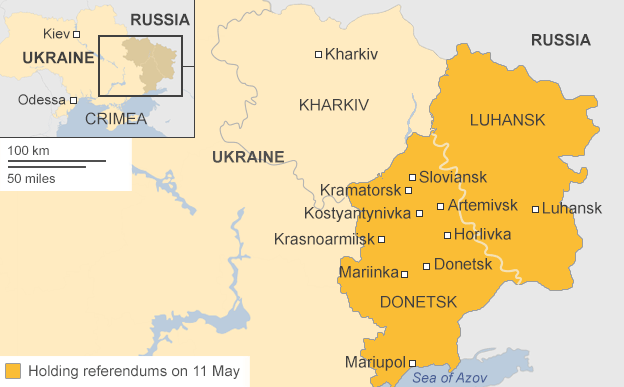
First, what are these “new republics” Knapp mentions? If you don’t count Crimea (wiki), which Moscow formally recognized in 2014, then the new republics that declared their independence from Ukraine are Luhansk (wiki) and Donetsk (wiki). Both polities are roughly 3300 square miles in area and house roughly 1.5 million people (you can get the exact numbers from the wiki links I provided above). Here is a map:

74717073_ukraine_donetsk_luhansk_referendum_624
(source)

Alarmingly, both republics style themselves “people’s republics” and (less alarmingly) have aligned publicly with Moscow. Russia, by the way, has not recognized these “new republics,” for geopolitical reasons I hope to make clear below.

Westphalian sovereignty

Russia does not like to recognize new polities (“republics”) because of its adherence to the ideal of Westphalia, which is state sovereignty (elsewhere at NOL Barry Stocker argues that the Westphalian ideal can be better understood as an early modern cosmopolitanism rather than state sovereignty). All throughout the Cold War Russia and China were staunch supporters of the Westphalian ideal (as were states in Africa and Asia that broke away from colonial empires), and they became even more so after the collapse of socialism in 1993. State sovereignty is the idea that states (“countries”) have sole control over what goes on in their own borders, and that any interventions of any kind, by any type of organization, needs to be approved by the state. It is called “Westphalian” because of the Treaty of Westphalia that was signed by a number of major and minor European states in the 17th century. The major states were able to maintain a balance of power and the minor states were able to assert more sovereignty over their territories than ever before because they were signatories of an international treaty. (Edwin van de Haar’s article in the Independent Review [pdf] on the balance of power as the most libertarian option available is worth reading, and is made stronger, I believe, by Giovanni Arrighi’s argument [pdf] that the balance of power led directly to the “capitalist oligarchies” that eventually pushed feudalistic institutions out of Europe beginning in the late 15th century.)

Russia, China, and other autocratic regimes prefer an international system that is respectful of state sovereignty because of the fact that this idea helps their governments to administer an amount of coercion on populaces that Western states consider immoral or rights-violating.

Russian strategy

Why did Russia hint at recognizing Donetsk and Luhansk, but ultimately decide not to recognize them? Because the West has been recognizing separatist republics since the USSR fell apart, and it has done so in the traditionally Russian sphere of influence (noticeably carving up Yugoslavia at Serbia’s geographic expense). The West has not carved up post-Soviet space by simply recognizing the sovereignty of self-proclaimed republics, but also by incorporating these polities into the international system that it dominates. Russia wants to show elites (but not necessarily the public) that it is tired of policymakers ignoring Westphalian notions of sovereignty (which are enshrined in the UN charter that almost all recognized states have signed; when they sign it they get rent-seeking privileges, but that’s a story for another day…).

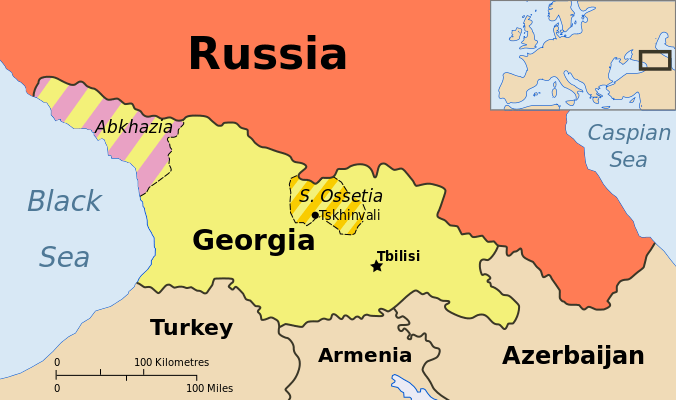
This is fairly straightforward logic on Moscow’s part. When the West supported Kosovo’s secession from Serbia (in defiance of Article 2(4) of the UN charter), Russia responded by supporting South Ossetia and Abkhazia breaking away from Georgia before annexing them. The interesting thing here is that Russia even mimicked Western use of force to back up its play. When the West supported Montenegro’s secession from Serbia (in defiance of Article 2(4) of the UN charter), Russia responded by supporting Donetsk, Crimea, and Luhansk breaking away from Ukraine before annexing Crimea. The interesting thing here is that Russia even mimicked Western use of force to back up its play. Both Russia and the West used minimal military resources to achieve their objectives, and both played the sovereignty card to back up their actions.

blog-map-of-caucasus
(source)

Western policymakers will never be able to bring liberty to Russia, and liberty will never be known by Russians if the rule of law is trumped by geopolitics. The West dominates the world’s international governing organizations. It has made the rules. It has drawn up the contracts. It has invited the non-West to participate. It has given concessions in order to gain the non-West’s support. So when the West breaks the rules it first outlined and drew up, the non-Western polities it convinced to join IGOs in the first place cannot be expected to take such rules seriously. The fact that Russia does play by the West’s rules, by taking seriously the claims of breakaway regions, suggests that the West has been in the wrong post-1993.

American media pundits and critical thinking

All of this leads me back to sensationalist headlines about nefarious Russian meddling in the American presidential election. Don’t believe any of that garbage. Firstly, look at how often American foreign policy pundits have been wrong. Just look! Amid the cries of Russian meddling in the Clinton-Trump contest you can surely hear the faint echoes about weapons of mass destruction in Iraq. Secondly, all good analyses of geopolitical affairs provide at least some bit of historical context to them. Does your foreign policy pundit use history as a guide? Thirdly (and lastly), when thinking about a country remember that most accounts will have a point of view that shadows the consensus found in the world’s political and financial centers, which are useful but will sacrifice important details in the name of efficiency (and efficacy).

American libertarians, of all the factions out there, realize this best. Unfortunately, until they can shake the isolationist dogma that has paralyzed the movement since the Rothbard era of the 70s and 80s, they will continue to be marginalized in contemporary discussions about foreign policy, either as token libertarians in a Republican administration or as token libertarians in the “anti-war” movement (I put “anti-war” in scare quotes because by now it should be obvious that this movement represents the Democratic Party [pdf], not an ideal; see, though, Michael Kazin’s excellent, if ultimately unconvincing, argument for a different take on the disappearance of the anti-war movement once Obama and the Democrats came to power). New republics, secessionist movements, and other endeavors of exit are often embraced by American libertarians because of their autonomist appeal, but if they don’t pay attention to how state actors view such movements, especially regional and global hegemons, they may end supporting some very nasty regimes in the name of liberty.

The ugliness of international politics

What has been widely feared is about the happen, it seems. President Assad’s troops, supported by the Russians, are winning the battle over Aleppo. That is not great from a lot of perspectives. To name just a few: first of all for the civilians, who are killed and bombed continuously. Secondly, the crushing of the rebel forces there means the further weakening of what are ‘natural’ allies of the West, as they are against Assad and against ISIS. Thirdly, this victory (if it all continues this way, of course) strengthens Assad’s position, making it even more unlikely that he will disappear from the scene anytime soon. The only good thing seems to be the further weakening of ISIS.

Like many others, I do not like this development at all. I think Assad is a ruthless murderer of his own people and should therefore be taken to justice, preferably in its most definitive form. I wish the Syrian people all the best and would like them to decide over their own fate in liberty. I also deeply hate ISIS and all that it stands for. And the interference of foreign powers (either Russian, Turkish, Iranian, Western) certainly does not do much good either, although I also think it has been inevitable. Public opinion, perceived and real interests, and the defence of allies all foster these kind of interventions. These are of course just a few of the important variables in an enormously complex war.

So what to do, or aim for, as Western countries? Obviously, most Syrians are better off in a stable situation without war, than with any currently viable alternative. This means that negotiations about cease fires should commence, or at least be fostered, which will then hopefully lead to a permanent settlement. I do not dare to predict how long it will take for this approach to be successful. Yet any alternative is worse. These negotiations, whenever feasible, should have all parties at the table, Assad included. No vetoes against him being part of future talks, as has previously been the case. The man will stay around for a while, and we better get used to the idea. This is surely deplorable, yet inevitable. The situation in Syria shows once again the ugliness of international politics, with very limited roles for international law and justice.

Let it be a lesson for those within the liberal tradition who still think differently.

Safe Places, Continued

This is in response to Will’s response to my initial post on safe places. I’d add it to the comments section, but that area has already been bloated.

If I understand Will correctly he is pointing out that in order to be harmed by words one must to an extent cooperate. If we were, for example, to mail the site’s founder with USC memorabilia the act in itself would be meaningless unless he decided to interpret the act to be an attack on his UCLA background. There are exceptions to this rule, such as those with certain mental conditions (e.g. PTSD).

If this is the point Will is making, I agree with him. I do however feel compelled to add that there is another group of individuals, besides those with mental disorders, who cannot willingly change how they react to certain words or cues – children. Why do I bring children into this discussion? Isn’t the safe place discussion mostly about their inclusion in universities? Let me make the case that a large portion of a university’s student body is composed of children; and to be clear I do not say this with malice towards said students.

The concept of childhood is relatively new in human society. It used to be that once a toddler was old enough to move around they were given work to do, be it helping around the farm or the factory. Delaying entrance into the job market required having parents able to ‘buy’ children’s time and so childhood was only possible following the industrial revolution. I’m sure everyone has heard of a version of this story before. If not I recommend the Cunningham book on the subject.

What if these calls for safe spaces are a response to the development of new period between childhood and adulthood? By all means the students on university campuses are physically adults, just look at their facial hair and sexual activity. They aren’t meeting the traditional landmarks of becoming adults mentally though. They are pushing back having children. Many of them are returning to live back home or never left to begin with. I know of several 20-30 somethings who are still trying to get on a career path.

Many, myself included, have seen safe places as infantilizing students. What if it’s the reverse though? It could be that students were already infantilized to begin with and that safe places are a symptom of universities having to respond to that.

If that is the case it is tempting to want to find out who is behind this. As with the development of childhood though the source of this post-childhood stage is our wealth. Our wealth has increased life expectancy. Our wealth has allowed parents to ‘buy’ more and more of their children’s time. Our wealth has allowed us to subsidize institutions (e.g. universities) that give these post-children a place to go and further delay their entrance into the labor force.

Should we really be angry then? We will have to adapt certainly. We will have to stop thinking of universities, most universities at least, as places populated by adults. We need to update our institutions. Should non-adults have the vote? Etc. Etc.

What is our alternative? Destroy our wealth so that this post-childhood pre-adulthood stage can’t exist?

Thoughts and comments are always appreciated.

From the Comments: Lenin knew what he was doing when he picked Stalin

Barry and William had an interesting discussion in the ‘comments’ threads of Dr Rosi‘s post about Lenin. At the heart of the dialogue is whether or not Lenin thought Stalin was an incompetent fool. Here is Dr Stocker’s final response:

This all depends on accepting that a text written by Krupskaya was Lenin’s own view. Leaving that aside, Kotkin is very against the idea that Stalin was stupid and I don’t think we should equate Stalin’s crassness with stupidity. Even leaving aside Kotkin, it is clear that Stalin did intellectually demanding things over many years, with regard to political organisation, political journalism and writing on Marxist doctrine (particularly the national question and this was before the Revolution long before issues of Stalin getting people to write things for him).

General Secretary of the Party was a very influential job, which meant selecting the people to run the party and therefore the country along with a complex range of other tasks which require some intellectual capacity. If Lenin appointed Stalin believing that Stalin was not very bright and could therefore be given an unimportant job, he was bizarrely mistaken about the demands and influence of the party secretary, the head of the Party in a party-state. Lenin did not need this title as he was the undoubted leader and instigator of the October Revolution. After he was off the scene, the party secretary would inevitably be the most powerful person in Russia. Stalin was at all times crude, brutal, cunning, calculating and dishonest in his behaviour, but this is not same as intellectual lack.

As Robert Service, amongst others, have pointed out Trotsky portrayed himself as the great intellectual with the right to inherit Lenin’s mantle and needed to portray Stalin as stupid and maybe needed to believe that someone lacking in his formal education, knowledge of foreign languages and manners associated with intelligentsia culture really was stupid. Well Stalin won the power struggle and I think it had something to do with intelligence behind the crassness.

Lenin and Trotsky themselves have been exaggerated as Great Thinkers by their followers. Clearly they had some scholarship and intellectual capacity, but what did they write which anyone would care about if they hadn’t come to power in 1917? Interest in Lenin’s writings has dropped off in a quite extreme way since Leninism stopped being the official ideology of what used to be the USSR, allied regimes and some large allied political parties outside the socialist bloc. Sort of equalises the intellectual legacy of Lenin, Trotsky and Stalin.

Read the whole thing.

Can money have a negative effect on happiness?

About a year ago I was part of a liberty fund colloquium at PERC. At one point the discussion turned to the issue of how important money was in achieving happiness. I don’t recall the exact context, but I believe we had been discussing limitations of using the market system to solve environmental problems. The concern was that the market system failed to capture the full value of certain goods.

The consensus among the discussants was that happiness was one such example of when the market failed.

I had to bite my tongue when this was said. Never mind the empirical research showing the relationship between income and happiness.  I was biting my tongue because most of the discussants were wealthy individuals. The marginal dollar might have mattered little to my fellow discussants, but that was because they had not lived through poverty. Getting ten dollars can change your mood immensely when it is the difference between paying the rent or having to sleep on skid row.

I had forgotten about the incident until I read Grigorev’s story and I started to ask myself if I was happy. On second thought, happy might not be the best term. Satisfied? Comfortable? Content? Safe?

It isn’t a question I’ve had the chance to ponder on much. As a rule of thumb I spend most of my day worrying about money. When I was young I worried about whether my parents had enough money to pay the bills till the next paycheck came in. I often damned myself for not being able to work – the United States’ child labor laws are plain stupid. Even when I grew up, and my family’s finances improved slightly, thinking about money became my obsession as I took more and more economics classes. In my mind money and happiness are so strongly linked that if asked how my day is going I think about how much money I’ve made (or lost) since waking up.

After thinking about it for a week I’ve come to the conclusion that I was wrong about money’s effect on happiness. My summer job pays well enough and my bank account has never been so full. I am not happier for it though. To the contrary, I have fallen into a bout of depression. It is hard to explain, but it is what it is. After paying for the essentials (rent and food), a few luxuries, and stashing away some rainy day savings I just don’t know what to do with extra money and it makes me uncomfortable. I think I could live a comfortable life on a budget of $12,000~15,000 annually, a bit above world average income.

I knew that the effect of money on happiness was diminishing, hence my fellow discussants waving away the importance of money on happiness. I however never thought that money might have a negative effect on happiness.

For the time being I have quit my summer job and given away my extra cash to family members whose returns are still positive. Hopefully once the school year starts, and I return to being near the poverty line, my depression will be replaced by happiness.

Has anyone else had a similar experience? Or am I an outlier? Alternatively, what are you all spending your money on?

From the Comments: Foucault’s purported nationalism, and neoliberalism

Dr Stocker‘s response to my recent musings on Foucault’s Biopolitics is worth highlighting:

Good to see you’re studying Foucault Brandon.

I agree that nationalism is an issue in Foucault and that his work is very Gallocentric. However, it is Gallocentric in ways that tend to be critical of various forms of nationalist and pre-nationalist thought, for example he takes a very critical line of the origins of the French left in ethnic-racial-national thought. Foucault does suggest in his work on Neoliberalism that Neoliberalism is German and American in origin (which rather undermines claims that Thatcherism should be seen as the major wave). He also refers to the way that Giscard d’Estaing (a centre-right President) incorporated something like the version of neoliberalism pursued by the German Federal Chancellor, Helmut Schmidt, from the right of the social democratic party.

Thoughts about the relations between France and Germany going back to the early Middle Ages are often present in Foucault, if never put forward explicitly as a major theme. I don’t see this as a version of French nationalism, but as interest in the interplay and overlaps between the state system in two key European countries.

His work on the evolution of centralised state judicial-penal power in the Middle Ages and the early modern period, concentrates on France, but takes some elements back to Charlemagne, the Frankish king of the 8th century (that is chief of the German Franks who conquered Roman Gaul), whose state policies and institutional changes are at the origin of the French, German and broader European developments in this are, stemming from Charlemagne’s power in both France and Germany, as well as other areas, leading to the title of Emperor of the Romans.

Getting back to his attitude to neoliberalism, this is of course immensely contentious, but as far as I can see he takes the claims of German ordoliberals to be constructing an alternative to National Socialism very seriously and sympathetically and also regards the criticisms of state power and moralised forms of power with American neoliberalism in that spirit. I think he would prefer an approach more thoroughly committed to eroding state power and associated hierarchies, but I don’t think there is a total rejection at all and I don’t think the discussion of ordoliberalism is negative about the phenomenon of Germany’s role in putting that approach into practice in the formative years of the Federal Republic.

Here is more Foucault at NOL, including many new insights from Barry.

From the Comments: Pushback in favor of Brexit

Dr Stocker‘s recent post arguing against Brexit elicited the following response from Chhay Lin in the ‘comments’ threads, and I think it’s worth highlighting in a post of its own:

Very well explained, Barry Stocker. Although it can be good for Britain to leave the EU, it entirely depends on how they go on from there. I am worried that Britain will move unto the path of less free trade which would be an erosion of the 4 freedoms – free movement of goods, capital, services, and people. On the other hand, it seems to me that the EU was steadily moving toward greater centralization and harmonization of regulations that would decrease the competition between its member states and thereby becoming quite harmful. I think that the EU should have never had greater ambitions than the 4 freedoms with a European Court of Justice that would protect these freedoms. Now they can impose EU-wide tariffs and quotas against products from countries outside of the EU or they can impose EU-wide sanctions. Some harmful examples of the EU: the quotas on cheap Chinese solar panels and EU-wide sanctions against Russia. A wise independent Britain would have free trade agreements with countries within and outside the EU, but I’m afraid that too large a portion of the Leave supporters are hostile to immigration and open markets.

Chhay Lin has written more about Brexit, in Dutch, on his homepage and I do recommend you check it out.

From the Comments: Why care about Syrians?

Dr Gibson notes:

I’d say the “big question” makes no sense. Surely some Syrians would be better off under ISIS and some under Assad.

And there’s a bigger question: who the hell cares? Few if any of us Americans have enough information to judge this issue nor should we. We have our own fish to fry. The Washington politicians have done incalculable damage with their ceaseless meddling in the affairs of the Middle East and elsewhere. Let the Syrians and their immediate neighbors sort this out.

I wanted to draw this excellent comment out for two reasons. Reason number one has to do with Dr Gibson’s first paragraph. Questions rarely make sense (which is why you ask people for help), but suppose you asked whether Syrians would be better off under capitalism or socialism. Some Syrians would be better off under socialism than capitalism, but that doesn’t mean it’s just as good as capitalism. Right? One of those systems is better for far more people than the other, and as an individual don’t you have a moral duty to support the more just system in some form or other? These are questions that libertarians, especially libertarians in the United States, should be asking themselves more often than not. There is a disturbing tendency among this faction of libertarians to lean in the direction of nationalist parochialism when it comes to matters outside of our borders. This brings me to reason number two for highlighting Dr Gibson’s (quite excellent) comment: Reminding libertarians and classical liberals that our creed is an international (and a humble) one.

War refugees represent the humblest of our species. The UN estimates that the war has affected nearly 12 million Syrians so far and, of course, that doesn’t include all of the people outside of Syria’s borders who have been affected. Russians, Europeans, North Americans, Syria’s immediate neighbors, and East Africans have all been affected by the ongoing war. How could you not be interested, especially from an individualist point of view?

I think the problem of the American libertarian’s parochialist nationalism stems from Murray Rothbard’s Cold War-era writings. Unlike F.A. Hayek and Ludwig von Mises, who were both big supporters of more international cooperation (but who both saw the glaring flaws in organizations like the UN and what is now the EU), Rothbard’s writings on foreign affairs were heavily influenced by the fact that the world was dominated by two superpowers and that the government he lived under used lies and deceit to counter Moscow’s power plays. Rothbard’s world of bi-polar geopolitics is long gone. It doesn’t exist. It will not exist again in my lifetime. Ours is a world of multipolarity. Yet somehow Rothbard’s writings on foreign affairs (which descended into outright incoherence near the end of his life) still have a profound impact on the American libertarian movement.

Much of my work here at NOL is dedicated to eviscerating this long-expired mindset from the American libertarian movement. Isolationism is nationalist, plain and simple (just pay attention to the rhetoric of libertarians like Justin Raimondo or Doug Bandow if you need more convincing), but Warren’s point about Washington’s meddling in the affairs of other states remains pertinent. So perhaps a different question to ask (even if it doesn’t make sense) is what a more internationalist-minded, in the vein of Hayek and Mises and Adam Smith, US foreign policy would look like. (I’ve been asking this question for a while now.)

Rick comments on the latest news

While googling a phrase to see if I’m creative (I don’t know if “Hayekian leisure class” is uniquely mine, but the first page of Google’s 78,000 results indicates yes), I found this interesting tidbit: Thorstein Veblen’s house sold (way back in 2004) for $1 million.

The developer is going to (already has? Already started to then went bust?) tear it down and build some sort of luxurious suburban palace. Ironic, but not as ironic as it could have been. Far more Veblenesque would have been leaving it standing as a conspicuously authentic status item.

I can’t find the specific house, but narrowing down to its area on Zillow (based on Internet commentary) leads me to believe that the property has been folded together into a larger lot, but would hypothetically be worth about $2 million today.