- Heritage in an age of identity Kenan Malik, Pandaemonium
- Race is not real, it’s a power relationship Gregory Smithsimon, Aeon
- The Only Woman in the Writers’ Room Ellin Stein, Slate
- The Revolutionary Roots of America’s Religious Nationalism Benjamin E. Park, Religion & Politics
Author: Brandon Christensen
“10 things you didn’t know about World War I”
That’s the title of my weekend piece over at RealClearHistory. The structure of the pieces, if you’ll remember, is Top 10 style, but I try to throw some more in-depth stuff into the mix, too. An excerpt:
3. World War I showed the world what a united Germany could do. Germany was formed in 1871, making it almost 100 years younger than the United States and much younger than France and the United Kingdom. Prior to the formation of Germany, which came about due to Prussian diplomat Otto von Bismarck’s genius machinations, observers and thinkers throughout the world penned works speculating on what a unified German-speaking world would do, politically, economically, culturally, and militarily. Rome’s decentralized barbarian enemies were from Germania, the Holy Roman Empire (which was neither Holy nor Roman nor an Empire), the Hanseatic League, and the German Confederation which all tried, in vain, to do what Bismarck did. Many of the attempts to unite Germany were foiled by French, British, Austro-Hungarian, and Russian statesmen because of fears that a united Germany would come to dominate Europe and upset the balance of power that European elites had come to rely on as their foreign affairs blueprint. They weren’t wrong.
Please, read the whole thing.
Nightcap
- Another short history of The Partition Zareer Masani, History Today
- The surprising history of the wolf whistle Alex Marshall, BBC
- Pinker is wrong on religion and Enlightenment Francis X. Clooney, Commonweal
- Populists are too democratic, not autocratic Shadi Hamid, American Interest
Nightcap
- Was he a literary genius or simply Stalin’s stooge? Stefan Dege, Deutsche Welle
- The world’s longest wine list is in…Florida Patrick Edward Cole, 1843
- Identity and Assimilation Luma Simms, National Affairs
- Immigrants Give America a Foreign-Policy Advantage Kori Schake, the Atlantic
From the Comments: More trade, more states?
Nguyen Ha left this thoughtful comment about my post on protectionism in Africa that I am embarrassed I missed:
Would you care to explain how “stronger economic ties will hasten the demise of current African states’ superficial institutions”?
What a tough question! First, though, I stated that it was my hope that deeper trading ties would lead to more states, not my prediction. My hope is based on current trends around the world: stronger economic ties have led to more states (and more aspirations for statehood within existing states).
The best academic treatment on this topic comes from Giacomo Ponzetto, an economist currently at CREI in Barcelona (he’s been mentioned at NOL on more than one occasion, too), and especially the Introduction and Section 5 of his working paper titled “Globalization and Political Structure.” Here:
As globalization proceeds, localities remove borders by increasing the size of countries. The number of countries declines and the mismatch between each locality is ideal and actual provision of public services grows. Eventually, this mismatch is large enough to justify a move to a two-level governance structure. The world political structure shifts from a few large countries to many small countries within a world economic union. The two-level structure is more expensive, but it is nonetheless desirable because it facilitates trade and improves preference-matching in the provision of public services.
By “two-level governance structure” Ponzetto means one level, a locality, that’s focused on delivering public goods to that specific locality, and another level, a world economic union, that’s focused on protecting property rights and eliminating border costs.
You can see this concept play out in a few different federative structures, especially the EU, the US, India, and China. In the European Union, multiple localities have tried to separate from countries (Catalonia from Spain, Scotland from UK) while still remaining part of the international economic union in place. Deeper trade ties, more states.
Three new states were created in India in 2000, and China is currently grappling with federalism as a way to keep up with its predictable economic success. The US hasn’t seen any new states added since 1959, but that’s because its system does a good enough job overall to keep all its member states content (happy, even).
The free trade zone in Africa will be interesting to watch because there are so many different variables at play than in China, the EU, India, or the US. India was governed by one overseas empire; the EU has been able to maintain stability because of American military power and the security umbrella it provides; China has been unified on and off again for centuries; and the US is, for all intents and purposes, a polity underscored by British cultural, economic, and political mores. Africa has none of these traits, yet its various leaders recognize that free trade leads to prosperity and often (not always) to better diplomatic ties.
If all goes well, and current trends elsewhere are any indication, Africa would see more states come into being to go along with its deeper economic ties. (This might be a major factor why Nigeria refused to join; Abuja fought a vicious civil war in the 1970s against separatists in Biafra and its leaders are probably tacitly aware of current global trends.) If all doesn’t go well, then violence and poverty will be just around the corner.
Nightcap
- The global reaction to “America First” Brands & Feaver, War on the Rocks
- Putin’s new Cold War Lawrence Freedman, New Statesman
- The “borders” of Gaza Irfan Khawaja, Policy of Truth
- A difficult question on Trump’s tariffs Arnold Kling, askblog
Nightcap
- France hails a martyr, but Catholicism is dying there Bruce Clark, Erasmus
- The misunderstood art of the Qajar dynasty Joobin Bekhrad, BBC
- Let’s restore judicial impeachment Greg Weiner, Law and Liberty
- John Paul Stevens is wrong on Second Amendment, again Damon Root, Reason
Lunchtime Links
- David Reich’s essay in the New York Times on genetics, race, and IQ
- Henry Farrell’s essay at Crooked Timber on genetics, race, and IQ
- Ezra Klein’s essay at Vox on genetics, race, and IQ
- Chris Dillow’s essay at Stumbling and Mumbling on genetics, race, and IQ
- Andrew Sullivan’s essay at Daily Intelligencer on genetics, race, and IQ
Andrew’s essay is a must read. It’s careful, well thought out, and bolder than the other ones. All are well-worth reading, though.
Reich’s essay has sparked an important dialogue in the Anglo-American world (props to the NY Times). Globally, I think conceptions of race, genetics, and IQ in the non-Anglo world are based on pseudoscience (at best), so it’s nice to see this debate unfold the way it has (so far).
I don’t think any of them have done a good job grappling with Charles Murray’s argument. (More on that later.)
Thanks to Uncle Terry for bringing this to light in the first place.
Nightcap
- The Geopolitical Risks of Trump’s Protectionism Shikha Dalmia, Reason
- A New Classic in Administrative Skepticism Jeffrey Pojanowski, Law and Liberty
- A short history of black people and their banks Towns & Hardin, LA Review of Books
- The popular connoisseur: Kenneth Clark, art historian Richard Dorment, NY Review of Books
Eye Candy: The Age of Borders
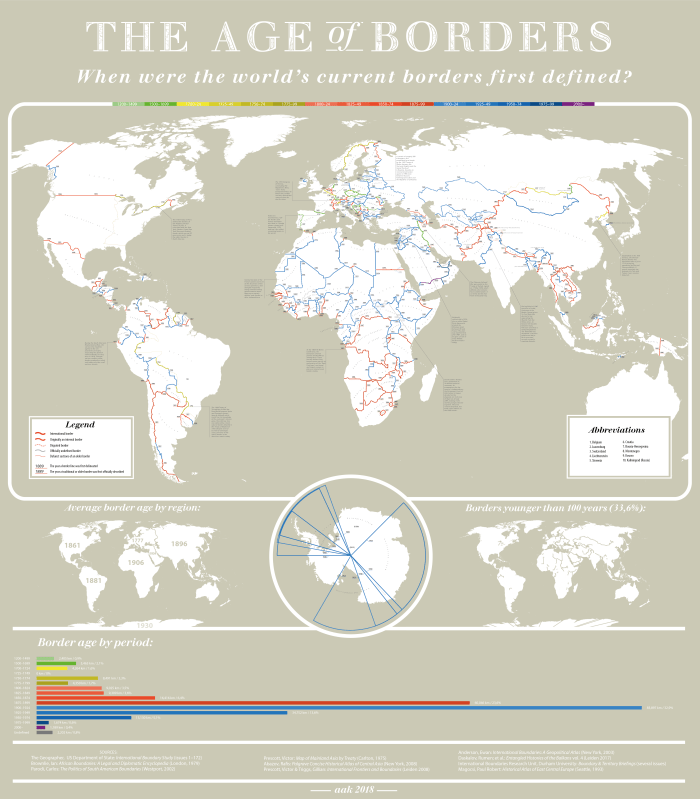
I think the border dates for Europe are a disingenuous in places, such as the Czech Republic’s 1459 border with Germany (neither of these two countries existed then) and the borders of the Balkan states (Yugoslavia?). Other than a few discrepancies here and there, it’s a pretty cool map. (h/t Bill Easterly)
Nightcap
- Kenneth Clark, John Berger, and art as seeing Kenan Malik, Guardian
- 10 forgotten wonders of the world Simon Schama, Financial Times
- Why writing Jewish history is so hard Adam Kirsch, New Yorker
- Ottoman erotica İrvin Cemil Schick, Aeon
Nightcap
- The socialism of moralizing fools Chris Dillow, Stumbling and Mumbling
- Friedrich Hayek’s devotion to the free market Linda Yueh, Times Literary Supplement
- The art of the Big Lie Phil Tinline, New Statesman
- Revolutionary Terrorism and Russian Literary Culture Chelsea Gibson, LA Review of Books
English and Math
These thoughts by David Henderson over at EconLog have stuck with me since the day I read them (in 2012):
At the end, one of two hosts [of a radio program he was being interviewed at] asked me, “If you were giving a 12-year-old American kid advice on what languages to learn, what advice would you give?” I think he was expecting me to say “English and Chinese.” I answered, “Two languages: English and math.”
I think of this insight often when I read, mostly because they confirm my own anecdotal experiences travelling abroad. Everybody in Ghana spoke English, and only rural Iberians and Slovenians had trouble with English in Europe. Non-Native French speakers seem only to be in parts of France’s old empire, where old customs – learning the language of the conqueror to get ahead in the rat race – still prevail. English is learned because it’s necessary to communicate these days.
Check out this excerpt from a piece on Swiss language borders in the BBC:
There are four official Swiss languages: German, French, Italian and Romansh, an indigenous language with limited status that’s similar to Latin and spoken today by only a handful of Swiss. A fifth language, English, is increasingly used to bridge the linguistic divide. In a recent survey by Pro Linguis, three quarters of those queried said they use English at least three times per week.
Read the rest. That’s a lot of English used in a country that’s sandwiched between Germany, France, and Italy. I think the power of English, at least in Europe, has to do with the fact that it’s a mish-mash of Germanic and Latin; it’s a “bastard tongue,” in the words of John McWhorter, a linguist at Columbia. Let’s hear it for the bastards of the world!
Nightcap
- John Bolton is back, and so are his bad ideas Emma Ashford, the Skeptics
- Some more thoughts on libertarian foreign policy Matt Fay, Niskanen
- Congress should reclaim its war powers Ilya Somin, Volokh Conspiracy
- John Bolton isn’t crazy. The world is. David French, National Review
The Abraham Lincoln Brigade
My latest over at RealClearHistory went up on Tuesday. The schedule for my work over there goes as follows: I’ve got a regular Friday column and a Tuesday blog post, so be on the lookout! Here’s an excerpt:
The volunteers were to be used as cannon fodder for the Republicans, which explains the high casualty rate, but it was the disorganized front put on by the democratically-elected Republican government that is to blame for the high casualty rates, rather than some sort of prejudice or malice on the part of the Spanish Left. The volunteers almost all came from non-military backgrounds, too, as most were starry-eyed urban idealists who believed they were fighting injustice. After a meager 30 days of training, the Lincoln Battalion was marched to the front lines to fight a bunch of battle-hardened troops that mostly hailed from Spain’s colonies, where military governance was practiced and honed to near perfection.
Read the rest. This was a fun one to write. I initially wanted to do something about the Spanish Civil War and international meddling (Madrid fell to Franco on March 29), before tying it in to the events in Syria.
My editor gently reminded me that the blog posts should be about American history, so I threw in the Abraham Lincoln Brigade. And check out my RCH colleague’s post on the birth and rise of the Republican Party.
 Notes On Liberty