RCH: 10 libertarian thoughts on the (American) Civil War

I went there. I did it. I dropped a doo-doo right in the middle of August, for all the world to see. An excerpt:

5. Shout-outs to Alexis de Tocqueville and Joseph Smith. Alexis de Tocqueville wrote the best book on America, ever. Joseph Smith founded the “American religion” (to quote Leo Tolstoy). Both men also saw that the north-south divide in the United States was bound to lead to future calamity. It wouldn’t be accurate to call their thoughts on the American divide “predictions,” but both men were outsiders in one form or another, and both men have etched their names into history. The French, who had lost Tocqueville just two years prior to the beginning of the Civil War, approach to the American bloodbath was to remain neutral (after consulting with the United Kingdom), and instead invade Mexico. Napoleon III invaded Mexico, in the name of free trade, late in 1861 and established a puppet monarchy, which angered the United States as it violated the Monroe Doctrine. However, there was not much the U.S. could do and Napoleon III did not abandon his puppet until early 1866, when it became apparent which side was victorious in the American Civil War. The French preferred normalized relations with the American republic to a puppet monarch in the Mexican one. The Mormons, for their part, largely sat out the Civil War. Volunteers from Utah helped guard the mail routes from Indian attacks, but other than that, the Mormons, who had not yet been assimilated into American society (indeed, they had only fled from violence in Missouri to Utah a few decades prior to the Civil War), were content to let both sides bleed.

Please, read the rest.
Nightcap

  1. The other side of broken windows Eric Klinenberg, New Yorker
  2. “Peace through strength” is weakening Putin at home Krishnadev Calamur, the Atlantic
  3. How to cleanse the Catholic Church Andrew Sullivan, Daily Intelligencer
  4. The garment of terrorism Azadeh Moaveni, London Review of Books

Nightcap

  1. Why Czechs don’t speak German Jacklyn Janeksela, BBC
  2. The Kurds, Sykes-Picot and the quest for redrawing borders Nick Danforth, BPC
  3. The language of the economy: prices Rick Weber, NOL
  4. A Balkan border change the West should welcome Marko Prelec, Politico EU

Nightcap

  1. Yoram Hazony and the New Nationalism Samuel Goldman, Modern Age
  2. The archive of comics sponsored by South Africa’s Apartheid government William Worger (interview), Africa is a Country
  3. Photo essay on the Soviet squelching of the Prague Spring Alan Taylor, the Atlantic
  4. Failed states and failed civilizations Nick Nielsen, The View from Oregon

Nightcap

  1. Confucianism and meritocracy James Hankins, American Affairs
  2. Lots of ideological axes to grind Scott Sumner, EconLog
  3. Did the notorious Zinoviev Letter ever exist? Alan Judd, Spectator
  4. That time when Chile conquered Peru and Bolivia Stefan Aguirre Quiroga, History Today

Nightcap

  1. Soccer, communists, fascists, and Yugoslavia Richard Mills (interview), Jacobin
  2. Over- and under-reactions in politics Chris Dillow, Stumbling & Mumbling
  3. How a controversial non-violent movement has transformed the Israeli-Palestinian debate Nathan Thrall, Guardian
  4. Sovereignty, confusion, and the international order Nick Danforth, War on the Rocks

Nightcap

  1. Reclaiming Full-Throttle Luxury Space Communism Aaron Winslow, Los Angeles Review of Books
  2. Elves and Aliens Nick Richardson, London Review of Books
  3. Imperialism, American-style Michael Auslin, Claremont Review of Books
  4. The Congo reform project: Too dark altogether Angus Mitchell, Dublin Review of Books

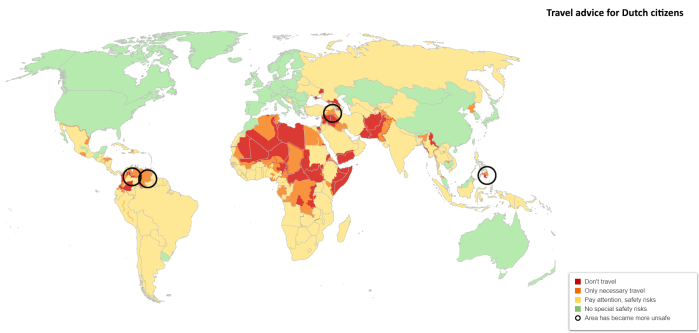
Eye Candy: travel advice for Dutch citizens

NOL Dutch travel advice
Click here to zoom

Interesting map, for a few reasons. The United States is in green, which means there are “no special safety risks” to worry about. What I take this to mean is that as long as you stay out of, say, North Sacramento, or East Austin, when the sun goes down you’ll be safe.

The “pay attention, safety risks” label makes quite a big jump in my conceptual understanding of this map. What this warning means is that if you are particularly stupid, you won’t end up getting mugged and losing your wallet (like you would in green areas), you will instead end up losing your life or being kidnapped for ransom (or slavery).

This is quite a big jump, but it makes perfect sense, especially if you think about the jump in terms of inequality and, more abstractly, freedom.

Nightcap

  1. The return of Henry George Pierre Lemieux, EconLog
  2. The politics of purity and indigenous rights Grant Havers, Law & Liberty
  3. The Ottoman Empire’s first map of the United States Nick Danforth, the Vault
  4. The age that women have babies: how a gap divides America Bui & Miller, the Upshot

Nightcap

  1. Death of a Marxist Vijay Prashad, The Hindu
  2. We’re on the threshold of a third wave of globalization. What should we expect? Branko Milanovic, globalinequality
  3. Turkey kills PKK’s leader in Iraq Amberin Zaman, Al-Monitor
  4. France’s second-class citizens Haythem Guesmi, Africa is a Country

Naipaul (RIP) and the Left

The most interesting reflection on V.S. Naipaul, the Nobel Prize winner who died earlier this week, comes from Slate, a low-brow leftist publication that I sometimes peruse for book reviews. Naipaul, a Trinidadian, became loathed on the left for daring to say “what the whites want to say but dare not.”

The fact that Slate‘s author tries his hardest to piss on Naipaul’s grave is not what’s interesting about the piece, though. What’s interesting is what Naipaul’s wife, a Pakistani national and former journalist, has to say about Pakistan:

[…] she smiled and asked if I knew what Pakistan needed. I informed her that I did not. “A dictator,” she replied. At this her husband laughed.

“I think they have tried that,” I said, doing my best to stay stoic.

“No, no, a very brutal dictator,” she answered. I told her they had tried that, too. “No, no,” she answered again. Only when a real dictator came in and killed the religious people in the country, and enough of them that the streets would “run with blood,” could Pakistan be reborn. It was as if she was parodying a gross caricature of Naipaul’s worst views—and also misunderstanding his pessimism about the ability of colonial societies to reinvent themselves, even through violence—but he smiled with delight as she spoke.

“That’s so American of you,” she then blurted out, before I had said anything. My face, while she had been talking, must have taken on a look of shock or disgust. “You tell a nice young American boy like yourself that a country needs a brutal dictator and they get a moralistic or concerned look on their face, as if every country is ready for a democracy. They aren’t.”

Damn. This testy exchange highlights well what the developing world is facing, intellectually. Religious conservatives heavily populate developing countries. Liberals, on the left and on the right, in developing countries are miniscule in number, and most of them prefer, or were forced, to live in exile. Liberty is their highest priority, but the highest priority of Western elites, whose support developing world liberals’ desperately need, is democracy, which empowers a populace that cares not for freedom.

So what you get in the developing world is two kinds of autocracies: geopolitically important autocracies (like Pakistan), and geopolitically unimportant autocracies (think of sub-Saharan Africa).

That Naipaul and his wife had the balls to say this, for years, is a testament to the magnificence of human freedom; that Leftists have loathed Naipaul for years because he had pointed this out is a bitter reminder of why I left the Left in the first place.

By the way, here is Naipaul writing about the GOP for the New Yorker in 1984. And here is my actual favorite piece about Naipaul.

10 horrific ways to die (RCH)

Yes, that’s the subject of my weekend column over at RealClearHistory. An excerpt:

4. Cutting off limbs/flaying. The English version of being hanged, drawn, and quartered involved removing genitals, but did any other society in history stoop so low? Um, yes. Not only have penises and/or testicles been removed and vaginas flayed, but they have sometimes been displayed as trophies, eaten, or converted into jewelry. Genitals aren’t the only limbs to have been removed over the years. Fingers and toes, tongues, breasts, eyes, ears, lips, nipples, noses, kneecaps, fingernails, eyelids, skin, and bones have all been forcibly removed over years by governments exacting punishment. Aside from the removal of genitals, flaying is probably the worst of the bunch. That’s when you beat somebody so hard that their skin comes off.

I had a lot of fun writing this, and I suspect my ever-so-patient editor had a lot of fun reading (and editing) it. I hope you enjoy it too! Here’s the rest of it.

Nightcap

  1. World War II and the point of Surrealism Sophie Haigney, 1843
  2. Is religion a universal in human culture? Brett Colasacco, Aeon
  3. Sikh pilgrimages: Hope for a religious corridor Tridivesh Singh Maini, The News
  4. For centuries, people thought lambs grew on trees Abbey Perreault, Atlas Obscura

Nightcap

  1. End the double standards in reporting political violence David French, National Review
  2. Campaign politics and the origins of the Vietnam War Rick Brownell, Historiat
  3. Hussein Ibish on Muslim identity Irfan Khawaja, Policy of Truth
  4. Friends of freedom and Atlantic democratization Micah Alpaugh, Age of Revolutions

RCH: Imperialism and the Panama Canal

Folks, my latest over at RealClearHistory is up. An excerpt:

The political ramifications for Washington essentially stealing a province from Colombia were huge. The United States had just seized a number of overseas territories from Spain in 1898, and the imperial project was frowned upon by numerous factions for various reasons. The U.S. foray into imperialism led to governance issues in the Caribbean, where Washington found itself supporting anti-democratic autocrats, and confronting outright ethical problems in the Philippines, where the United States Army was ruthlessly putting down a revolt against its rule. So acquiring a “canal zone” in a country that was baited into leaving another country was scandalous, especially since Colombia’s reluctance to cooperate with France and the U.S. was viewed as democratic (the Colombian Senate refused to ratify several canal-related treaties with France and the U.S.), and the two Western powers were supposedly the torchbearers of democracy. To make matters worse, many elites in Panama, after agreeing to secede in exchange for protection from Colombia, felt betrayed by the terms of the Panama Canal Zone, which granted the United States sole control over the zone in perpetuity.

Please, read the rest.