- Who is Joe Epstein? Jonathan Leaf, Modern Age
- “Company-style” paintings from 19th century Burma Jonathan Saha, Colonizing Animals
- Nazis: A Modern Field Guide Jonathan Kay, Quillette
- The Dangers of Letting Someone Else Decide Jonathan Klick, Cato Unbound
Author: Brandon Christensen
Nightcap
- Conservatives, sex, and the aspirations of women Rachel Lu, Law & Liberty
- Hello Mars, farewell Mars Caleb Scharf, Life, Unbounded
- Terrorism justified: a response to Vicente Medina (Machiavelli) Irfan Khawaja, Policy of Truth
- The third gender of southern Mexico Ola Synowiec, BBC
Afternoon Tea: “Magna Carta for the World? The Merchants’ Chapter and Foreign Capital in the Early American Republic”
This Article examines the early modern revival and subtle transformation in what is here called the merchants’ chapter of Magna Carta and then analyzes how lawyers, judges, and government officeholders invoked it in the new American federal courts and in debates over congressional power. In the U.S. Supreme Court in the early 1790s, a British creditor and an American State debated the meaning and applicability of the merchants’ chapter, which guaranteed two rights to foreign merchants: free entry and exit during peacetime, without being subjected to arbitrary taxes; and, in wartime, the promise that their persons and goods would not be harmed or confiscated, unless their own king attacked and confiscated English merchants. In other words, no harm to enemy aliens, except as retaliation. Tit for tat.
The idea that reciprocity was a fundamental mechanism of international (and interpersonal) relations became something like a social science axiom in the early modern Enlightenment. Edward Coke claimed to find that mechanism in the merchants’ chapter and publicized it to lawyers throughout the emerging British Empire and beyond. Montesquieu lauded the English for protecting foreign commerce in their fundamental law, and Blackstone basked in that praise. American lawyers derived their understanding of the merchants’ chapter from these sources and then, in the early Republic, stretched the principle behind it to protect foreign capital, not just resident merchants. The vindication of old imperial debt contracts would signal to all international creditors that, in the United States, credit was safe. Federalists then invoked the chapter outside of the courts to resist Republican attempts to embargo commerce and sequester foreign credit. For Republicans, doux commerce had become the Achilles heel of the great Atlantic empires: their reliance on American trade could be used to gain diplomatic leverage without risking war. For Federalists, economic sanctions threatened not just their fiscal policy but their entire vision of an Atlantic world that increasingly insulated international capital from national politics. They all agreed, however, that the role of foreign capital in the American constitutional system was a central issue for the new and developing nation.
This is from Daniel J. Hulsebosch, a historian at NYU’s law school. Here is the link.
Nightcap
- The passion for a kind of justice born of righteous rage Waller Newell, Claremont Review of Books
- Zbigniew Brzezinski’s Cold War: Less Than Grand Strategy Andrew Bacevich, the Nation
- No, Sex Wasn’t Better for Women Under Socialism Cathy Young, Reason
- I am Ashurbanipal, king of the world, king of Assyria Samuel Reilly, 1843
Eye Candy: Kalmar Union, circa 1400
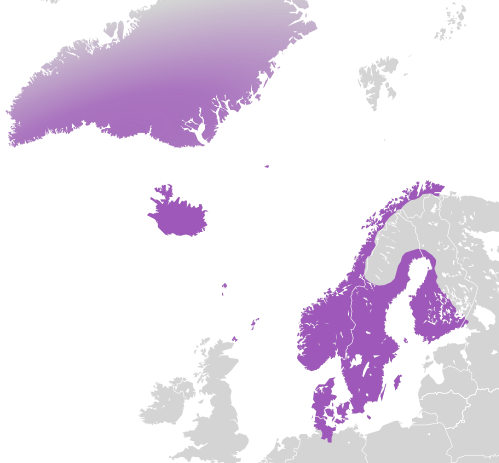
The Kalmar Union lasted from 1397 to 1523. Here is a wiki on it. Imagine Denmark, Norway, and Sweden united as a single country when it came to foreign affairs, but each of them having plenty of room to govern themselves domestically. The main rivalry here was the “monarchy” of Kalmar and the aristocracies of both Sweden and Denmark. This domestic rivalry, coupled with fact that its neighborhood included the Holy Roman Empire and the Hanseatic League, means that the Kalmar Union is probably one of the more interesting polities in European history. Yet I know next to nothing about it…
Used in classrooms, abused in chatrooms
My God, it’s the end of November. This blog was founded at the beginning of January in 2012. When I started this consortium I just wanted to band together libertarians who already blogged but who didn’t have a large following. I thought that maybe if I could band them together something would come about. I also thought that the San Francisco Bay Area had plenty of smaller voices in the libertarian movement, so I tried to invite people from that part of the world, in the hopes that NOL could be some kind of counterweight to Mises down south and Mercatus back east.
Both efforts obviously failed spectacularly, which is not necessarily a bad thing.
Today, NOL is used in classrooms and abused in chatrooms.
I have been reading much more than writing lately. I have one child running around the flat and another on the way (due date is Jan 14th!). I have been making a rather rough sociocultural transition from city life to suburban/rural life. My wife is working towards her CPA license. I’m working a shitty job, writing for RealClearHistory, blogging here, and shoring up future articles for future academic publication. Some people are ready to write me off as a scholar, but that is foolish of them.
I’ve got something up my sleeve for NOL in 2019, too, but I’m keeping it close to my chest for now. It’s nothing crazy, so don’t go anywhere. Just know that NOL is committed to experimentation and evolution as much as it is to human freedom.
Nightcap
- Israel’s political balagan Michael Koplow, Ottomans & Zionists
- A summary of the rights of British America Thomas Jefferson, Avalon Project
- Studying Singapore before it was famous Frank Beyer, Asian Review of Books
- The mystic life of Hermann Hesse Philip Hensher, Spectator
Nightcap
- No easy road: easements and occupation in the West Bank Irfan Khawaja, Policy of Truth
- Clouds over the Pacific: War, Stagnation, and the end of the Asian Century James Holmes, National Review
- Was philosophy founded by non-Western women? Dag Herbjørnsrud, Aeon
- Natural History of a Cherry Tree Nick Nielsen, Grand Strategy Annex
Afternoon Tea: “Shareholder Activism at the Dutch East India Company 1622-1625”
This paper explores the reason for the absence of control rights of shareholders in the Dutch East India Company (VOC) and the background of the conflict between shareholders and directors that arose in 1622/1623 when the VOC Charter of 1602 was extended.
The VOC was the result of a merger between several companies that had been trading in the East Indies between 1594 and 1602. The legal structure of most of these “pre-companies” which were incorporated for a single voyage to the East Indies, prevented shareholders from having actual influence. In most of these companies, the shareholders invested their money, not in the company itself, but via one of the individual directors. The relationship between a shareholder and most of the precompanies was therefore indirect, which impeded the exercise of control rights. Furthermore, shareholders may not really have been interested in their control rights given the high returns and the expectations of the newly opened trade route.
When these pre-companies were merged into the VOC in 1602, nothing changed with respect to the absence of shareholder control rights. The VOC, however, was established for a longer period and had to meet other more long-term challenges than those faced by the pre- companies. The failure to adapt the control structure to suit the different circumstances may have been a source of the conflicts that arose between the directors and shareholders between 1602 and 1623.
In 1622, upon extension of the 1602 Charter, a significant conflict erupted between the shareholders and directors. The so called dissenting participants complained about the numerous conflicts of interests that had been arising between the various directors and the VOC. They accused the directors of abuse of power, short-selling and self-enrichment. They argued that shareholder approval was required for the VOC to turn to the capital market to borrow funds. They also demanded that large investors be entitled to vote on the appointment of new directors. As the dissenting participants supported their arguments by referring to the English East India Company, the corporate governance of the EIC is briefly described.
Publishing their complaints in pamphlets, the shareholders mobilized public opinion and attempted to convince merchants not to invest in the Dutch West India Company, which was being incorporated at the same time. They exerted pressure on the government to ensure that more rights were granted to the shareholders when the VOC Charter was extended. To a limited extent, the activism of the “dissenting participants” was successful. The 1623 Charter granted certain rights to large investors, including the right to nominate new candidates for appointment as director. The 1623 Charter further regulated insider trading by the directors and encouraged the directors to pay a yearly dividend to the shareholders. In addition, a committee of nine shareholders was entrusted with the supervision of the VOC directors. This corporate body was known as the “Lords Nine” (Heren IX).
This is from Matthijs de Jongh, a judge in the Netherlands. Here is the link.
Nightcap
- As economic freedom goes global, American conservatives turn inward John Tamny, RealClearMarkets
- Machiavelli was no Machiavellian Catherine Zuckert, Aeon
- Florentine liberty and Machiavelli’s The Prince Barry Stocker, NOL
- Scaling Up: a history of dragons! Tom Shippey, Literary Review
Nightcap
- A reassessment of socialism Branko Milanovic, globalinequality
- Mexico’s Postmodern Populism Angel Jaramillo Torres, American Affairs
- America’s zeal for intervention, challenged Jacob Heilbrunn, New York Times
- The Souls of Yellow Folk—A Review Daniel Oppenheimer, Quillette
More Longform essays
Barry’s essays on republican libertarianism (not what you think, American readers!) and British sovereignty and isolationism are up in the new ‘Longform Essays‘ section of the blog. You’ll see that there are more in the works, too, including essays by Zak, Rick, and at least one more from Barry.
These essays join Jacques’ work on legal immigration into the United States and protectionism/free trade, as well as Mary’s essay on education and its relationship with The State.
Editing these essays makes me the luckiest dude in all of libertarian-dom! I hope there are many more in the years to come.
I still pay attention to the news cycle, but it’s so outrageous these days that it’s hard to write about, let alone analyse or interpret. What a mess. I will say that corporate media is definitely skewed to the left.
Libertarians – and economists – haven’t done a good job of explaining the benefits of free trade. Telling the man on the street that free trade is a fundamental truth has not worked. “Democracy” is another major issue; people throw the word around like a baseball, but its fundamentals are rarely discussed. Given that we’ve gone to war over democracy, on numerous occasions, I think it needs to be discussed far more often.
At any rate, enjoy the essays!
Afternoon Tea: “Disjuncture and Difference in the Global Cultural Economy”
The central problem of today’s global interactions is the tension between cultural homogenization and cultural heterogenization. A vast array of empirical facts could be brought to bear on the side of the ‘homogenization’ argument, and much of it has come from the left end of the spectrum of media studies, and some from other, less appealing, perspectives. Most often, the homogenization argument subspeciates in to either an argument about Americanization, or an argument about ‘commoditization’, and very often the two arguments are closely linked. What these arguments fail to consider is that at least as rapidly as forces from various metropolises are brought into new societies they tend to become indigenized in one or other way: this is true of music and housing styles as much as it is true of science and terrorism, spectacles and constitutions. The dynamics of such indigenization have just begun to be explored in a sophisticated manner, and much more needs to be done. But it is worth noticing that for the people of Irian Jaya, Indonesianization may be more worrisome than Americanization, as Japanization may be for Koreans, Indianization for Sri Lankans […] Such a list of alternative fears to Americanization could be greatly expanded, but it is not a shapeless inventory: for polities of smaller scale, there is always a fear of cultural absorption by polities of larger scale, especially those that are nearby. One man’s imagined community is another man’s political prison.
This is from Arjun Appedurai, an anthropologist at NYU. Here is the link.
Nightcap
- The two afflictions that enhance the challenge for returning vets David French, National Review
- The varieties of Muslim faith become a vital form of diplomacy Bruce Clark, Erasmus
- How the Inkas governed, thrived and fell without alphabetic writing Christopher Given-Wilson, Aeon
- Qatar’s progress on its improbable World Cup David Conn, Guardian
New Books: Philosophy of the Novel, French conquests
Just wanted to call your attention to Barry‘s newest book, Philosophy of the Novel. Here’s a description:
This book explores the aesthetics of the novel from the perspective of Continental European philosophy, presenting a theory on the philosophical definition and importance of the novel as a literary genre. It analyses a variety of individuals whose work is reflected in both theoretical literary criticism and Continental European aesthetics, including Mikhail Bakhtin, Georg Lukács, Theodor Adorno, and Walter Benjamin. Moving through material from eighteenth century and ancient Greek philosophy and aesthetics, the book provides comprehensive coverage of the major positions on the philosophy of the novel. Distinctive features include the importance of Vico’s view of the epic to understanding the novel, the importance of Kierkegaard’s view of the novel and irony along with his other aesthetic views, the different possibilities associated with seeing the novel as ‘mimetic’ and the importance of Proust in understanding the genre in all its philosophical aspects, relating the issue of the philosophical aesthetics of the novel with the issue of philosophy written as a novel and the interaction between these two alternative positions.
Barry has more on liberty and the novel here and here.
Jacques has a new book out, too, titled Indecent Stories by Decent Women. It’s under a pen name, John René Adolph, for obvious reasons. Here is a 2014 essay by Jacques titled “Why Young Women Are Stupid (If They Are): A Scientific Inquiry.”
 Notes On Liberty