- Cultural Marxism and the New Right Neuffer & Paul, Eurozine
- Black soldiers in European wars, 18th century edition Elena Schneider, Age of Revolutions
- A forgotten Indian hero TR Vivek, Pragati
- The treason prosecution of Jefferson Davis Will Baude, Volokh Conspiracy
Author: Brandon Christensen
Nightcap
- Parmesan cheese and Sunbucks Coffee Scott Sumner, EconLog
- In search of the true Dao Ian Johnson, ChinaFile
- The ‘flower men’ of Saudi Arabia Molly Oringer, BBC
- French anti-tax revolts are nothing new Murray Rothbard, Free Market
Nightcap
- Reflections on totalitarianism’s greatest critic Daniel Mahoney, City Journal
- Ralph Nader’s weird novel predicted the future Jeff Greenfield, Politico
- Hack gaps and noble lies John Holbo, Crooked Timber
- Social noble lies Bill Rein, NOL
Eye Candy: The HDI of BRICS
Phew, that’s a lot of acronyms. But this is a great map:
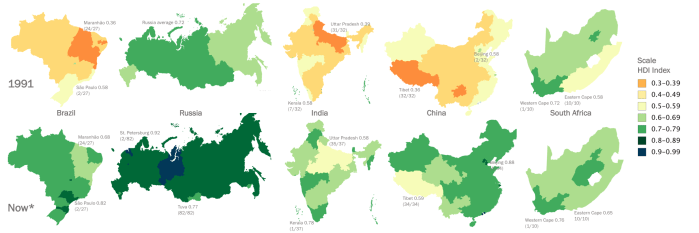
Orange and yellow is bad, green and blue is good. HDI stands for “Human Development Index,” which is a measurement that’s not nearly as good, in my opinion, for understanding how wealthy and happy a population is. Nevertheless, HDI is still one of the better measurements (Top 5, again in my opinion) out there. Here’s the wiki on HDI.
The maps are colored according to “subunits,” or provinces (which are like American states, such as Nebraska).
Brazil, India, and South Africa are multi-party democracies, while the other two are not. So what do all five have in common?
Nightcap
- African soldiers (excellent film review) Jeremy Harding, London Review of Books
- Not born in the USA Irfan Khawaja, Policy of Truth
- Iraq’s Kurds versus Turkey’s Kurds Mahmut Bozarslan, Al-Monitor
- Branko Milanovic’s confusion on inequality David Henderson, EconLog
Nightcap
- Hannah Arendt On Why It’s Urgent To Break Your Bubble Siobhan Kattago, IAI
- Does the right to self-defense apply against agents of the state? Jason Brennan, Reason
- Amazon (the company) and the Department of Defense Melanie Sisson, War on the Rocks
- ‘I have noticed a difference between older EDM stars and younger ones’ Cory Arcangel, Are.na
Nightcap
- Chinese and Soviets backed South African liberation movements…and apartheid ones, too Martin Plaut, QZ
- The dilemmas of competing with Xi Jinping’s China Peter Mattis, War on the Rocks
- Frankopan’s New Silk Road: A review Francis Sempa, Asian Review of Books
- How the sneaker conquered the world Luke Leitch, 1843
Nightcap
- A short romp through medieval London Philip Parker, Literary Review
- The new globalisation Richard Baldwin, VOX
- Why we miss the WASPs Ross Douthat, NY Times
- The fragility of badness Irfan Khawaja, Policy of Truth
Nightcap
- At home with the homeless Johannes Lenhard, Aeon
- Naguib Mahfouz’s Cairo Ursula Lindsey, the Nation
- Tyler Cowen on geopolitics marginalrevolution
- Collected. Bought. Looted? Friedel & von Gliszczynski, Africa is a Country
Joakim Book: Winner of the 2018 Money Metals Exchange & Sound Money Defense League essay contest
Just to keep readers up to date, Joakim just won a scholarship for an essay on sound money and banking. Here is the link to the essay. Here is the link to the announcement. It reads as follows:
For the third straight year, Money Metals Exchange, a national precious metals dealer recently ranked “Best in the USA,” has teamed up with the Sound Money Defense League to offer the first gold-backed scholarship of the modern era. These groups have set aside 100 ounces of physical gold to reward outstanding students who display a thorough understanding of the economics, monetary policy, and sound money.
A gold-backed scholarship?! Freakin’ awesome. Here is Joakim’s latest post at NOL, which was highlighted at the Financial Times‘ “Alphaville” blog (the FT is like the Wall Street Journal for countries that were once part of the British Empire).
One of the things I liked most about Joakim’s latest blog was the fact that he incorporated a post by another Notewriter into his thoughts (in this case Rick’s musings on Mariana Mazzucato and counterfactuals). The folks at “Alphaville” have been good to us over the years, too. They’ve linked, since 2017, to thoughts from Shree, Federico, Vincent (twice!), Mark, and Tridivesh as well as Joakim.
Joakim’s well-deserved award stacks up quite nicely with Lucas’ 2018 Novak Award from the Acton Institute and Nick’s winning entry for the Mont Pelerin Society’s 2018 Hayek essay competition. All in all, it’s been a good year for the Notewriters.
Nightcap
- Hayek and liberal dictatorship Matthew McManus, Areo
- Rule of Law: the case of open texture of language and complexity Federico Sosa Valle, NOL
- How the Germans finally caught up with the West Wolfgang Streeck, London Review of Books
- Rebuilding Europe after World War II Barry Stocker, NOL
Afternoon Tea: “Confucian Constitutionalism in Imperial Vietnam”
The phantasm of “Oriental despotism” dominating our conventional views of East Asian imperial government has been recently challenged by the scholarship of “Confucian constitutionalism.” To contribute to our full discovery of the manifestations of Confucian constitutionalism in diverse Confucian areas, this paper considers the case of imperial Vietnam with a focus on the early Nguyễn dynasty. The investigation reveals numerous constitutional norms as the embodiment of the Confucian li used to restrain the royal authority, namely the models of ancient kings, the political norms in the Confucian classics, the ancestral precedents, and the institutions of the precedent dynasties. In addition, the paper discovers structuralized forums enabling the scholar-officials to use the norms to limit the royal power, including the royal examination system, the deliberative institutions, the educative institution, the remonstrative institution, and the historical institution. In practical dimension, the paper demonstrates the limitations of these norms and institutions in controlling the ruler due to the lack of necessary institutional independence. At the same time, it also suggests that the relative effectiveness of these norms and institutions could be achieved thanks to the power of tradition. The study finally points out several implications. First, the availability of the constitutional norms and institutions in the tradition is the cultural foundation for the promotion of modern constitutionalism in the present-day Vietnam. Second, the factual material concerning the Vietnamese experiences can hopefully be used for further study of the practice of Confucian constitutionalism in East Asia and further revision of the “Oriental despotism” - based understanding of imperial polity in the region. Third, the findings may also be useful for a more general reflection on pre-modern constitutionalism.
That is from Son Ngoc Bui, a legal scholar at the Chinese University of Hong Kong’s law school. Here is a link.
Nightcap
- After Federalist No. 10 Greg Weiner, National Affairs
- Photos of the Paris “Yellow Vest” Riots Alan Taylor, the Atlantic
- A century of HIV Thomas McDow, Origins
- The long, entwined history of America First and the American dream Kevin Kruse, the Nation
Nightcap
- Will Mexico get the populist “full package”? Alberto Mingardi, EconLog
- What is populism? Christopher Caldwell, Claremont Review of Books
- The poverty of the Brexit debate Oliver Wiseman, CapX
- Jews revolutionized the university. Will Asians do the same? Barbara Kay, Quillette
Nightcap
- Between populism and internationalism: conservative foreign policy after Trump Colin Dueck, War on the Rocks
- Recovering the profound divisions that led to the Civil War Gordon S. Wood, New Republic
- The private intellectual Tobi Haslett, New Yorker
- Christian humanism: A path not taken Paul Seaton, Law & Liberty

