Three papers from this year’s American Economic Journal: Economic Policy deal with shocks that change people’s willingness to migrate to another location. As usual with these, I’m reporting on recent research results that readers might find interesting, but I’m not otherwise commenting.
In a study of crony capitalism in China: when a Chinese local leader is transferred from one prefecture to another, large firms in the old prefecture buy up 3x more land than average in the new prefecture at half the normal price. These land parcels show lower use efficiency afterwards. For the last 30 years, land sales make up 60% of local government revenue. There is no effect going the opposite direction (firms in the new prefecture buying land in the old one) and there is no effect when that politician subsequently moves to the next prefecture.
Following the Forbes 400 richest Americans from 1981-2017, it is clear that they are very likely to move away from states with estate taxes, particularly as they get older. They “find a sharp and economically large increase in estate tax revenues in the three years after a Forbes billionaire’s death.” Putting the two effects together, they find that it is still profitable for most states to adopt estate taxes despite some departures with a cost/benefit ratio of 0.69.
A panel fixed-effect model looking at how the climate changed decade by decade shows that fewer Indian workers move from rural to urban or ag to non-ag firms within a district, but no effect on movement between districts. They also show this comes from changes in demand patterns: higher temperatures lower rural yields and incomes, so they buy less from non-ag sectors, which reduces the demand for non-ag labor. These effects are larger in districts with fewer roads and/or less access to the formal banking sector.
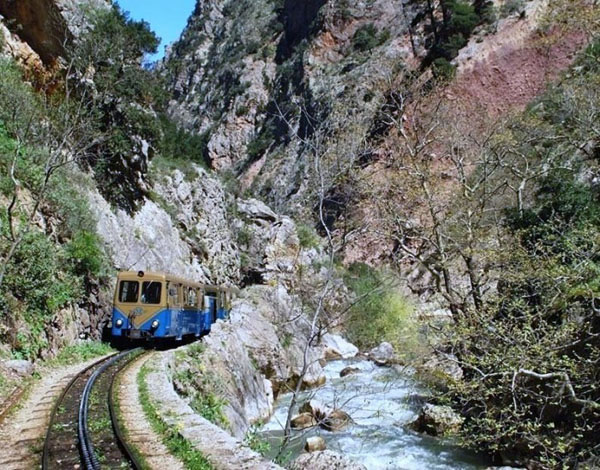
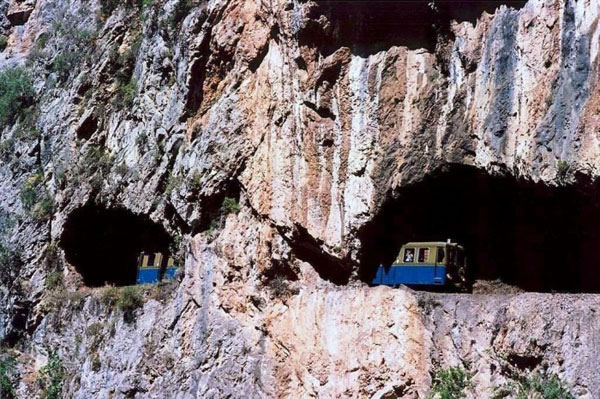
Peloponnese in Southern Greece features one of the most spectacular rack trains in the world, “Odontotos”. The short route connects a seashore town (Diakofto) with the mountainous Kalavryta plateau (700m altitude), up and through the impressive Vouraikos Gorge. Visited it for the first time recently. I kind of knew that railways were built in 1880s/90s? Something like that. The relatively young Greece acquired the large Thessalia flatland in the north at the time, putting integration via transport into perspective. Government was frantically trying to develop inter/ intra-national trade routes and at the same time bring forth a late to the party industrial mojo. Railway became a smoking symbol of this endeavor.
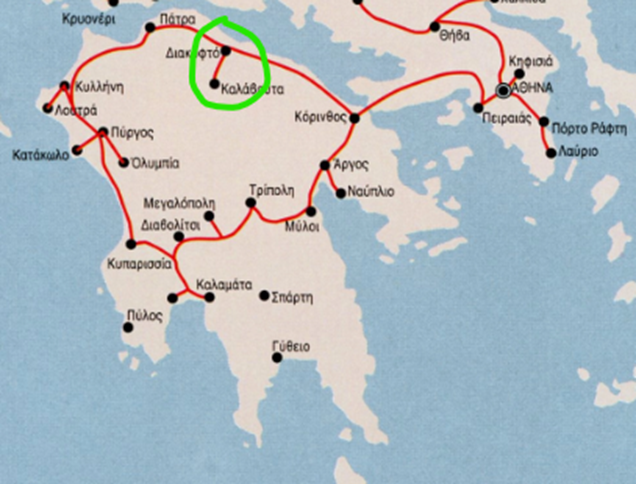
The initial expansion from Athens to the Peloponnese makes sense: Apart from the obvious pros (accessibility, speed, safety, mass character, for natives and visitors alike) of the railway, there were some major ports and established trade houses there, while agricultural production was also of note. The rails formed a curve around the northern/ western coastal line of Peloponnese and cut through its mainland in the southern/ eastern sides, in order to form a ring of sorts:
This is the 1882 plan, which mostly went through. The network was constructed in a “regular” manner, albeit with rails less wide than the international standard ‘cause cost, including cities, towns, ports and a couple of special sites (i.e., Olympia). And then we have the green-circled outcrop, the rack rail. The recent trip there left me perplexed. Why decide to undertake such a difficult task in rugged terrain, that needed expertise and special rails (different from those of the rest)?
Surely, Kalavryta was (and still is) a place of national significance. The Greek Revolution of 1821 is said to have started at a monastery (Agia Lavra) there, where the local Metropolitan blessed the gathered leaders of the upcoming war. A celebratory 1896 edition, on the occasion of the first modern Olympic Games (hosted in Athens that year), even chronicles the Peloponnese railway saga. Regarding the rack train, it references the exquisite natural environment, Agia Lavra and another historical monastery as good reasons to give it a ride. Fair enough, but still somewhat vague. What else was there that made that region stand out from the others? Here the rationale gets a step up.
Kalavryta was home to a wealthy, powerful family. It happened that a member of the family served as Member of Parliament when the railway project was on fire. This man persuaded the PM of the vital role a railway connection was to play in the development of the surrounding areas. Provided that a scion of the same family serves in the current Greek Parliament, too, this “local interest cuddling” reasoning gets some traction, in my view.
Even if the decision was just that, local patronizing, it still held some more rational economic – political water: Back then, the cost of sending wheat from the (fertile) plateau down to sea level was twice as high the cost of shipping said wheat from fucking Russia to Greece (compare 22km to, dunno, 2200km). And why not just import the dang thing then? Well, Greece had had the “honor” to be at the receiving end of a naval pacific blockade by the era’s great forces in 1886, so it perhaps had reached the conclusion that food security was something to be pursued.
The rack train project was initiated by law in 1889 and (after absorbing 3x the envisaged cost plus 5x the scheduled time of completion, effectively cutting short any ideas of expanding it further towards Tripoli) began its inaugural journey in, well, 1896.
It turns out that the whole railway affair was overhyped and demand for train services did not to really stretch that far to meet supply, not to mention the appearance of competitive means of transport (steamboats and roads). The rack train, however, remained the sole anchor of reliable transport till the 1970s, when roads proper were built. In the meantime, it also became a traveler’s sensation, too, confirming the positive light that celebratory book shone on it 120+ years before.
The death of a black man in Minneapolis, the largest city in the U.S. state of Minnesota, after a white police officer put pressure on his neck led to large-scale protests not only in the United States but also in cities around the world, including Osaka and Tokyo. […] In Japan, discrimination based on differences in appearance and attributes occurs on various levels, including discrimination against black people, but what are the circumstances involved in this? Rather than treating this incident as something that happened in a faraway country and distancing ourselves from it, I would like people to think about it in relation to things that are familiar to them.
That’s the title of this excellent piece by Toby Green, a historian at King’s College London. Green does a wonderful job of highlighting all of the problems that African societies face today: corruption, poverty, and my personal favorite, “neoliberalism.” Neoliberalism is just shorthand for loans that Western financial institutions give to African states. These loans are usually only given if African states promise to follow certain guidelines that Western financial institutions have drawn up. The end result is corruption and poverty.
I can agree that it’s a terrible system, even if I think the name Green has given it is dumb.
Throughout the piece, Green makes a good case for fundamental change in Africa. The problem is that he mistakenly thinks that this change can occur via the states that are currently in place in Africa. He mistakenly thinks that Ghana, Nigeria, Uganda, or Angola, to name some of the more prominent examples, have what it takes to enact the changes necessary for a fundamental shift.
Green argues that “unipolar American and Western European hegemony” (which by definition cannot be unipolar if there’s two poles, unless…) is responsible for Africa’s problems, and that the continent’s early independence leaders should be looked to for guidance. The problem with this, as Hendrik Spruyt has pointed out, is that the continent’s early independence leaders didn’t listen to anybody but themselves. They simply sought to graft their visions of what Africa should be onto the existing colonial governance system of the various European powers.
These early independence leaders sought to forge nations out of the colonies that the Europeans had haphazardly patched together. There were other elites on the African continent who wanted something different from what Africa’s early independence leaders wanted. Some of these elites were nationalists who wanted their states to be fully recognized equals on the world stage, just like the early independence leaders. The difference between these nationalists, and the early independence leaders, was that they wanted to abolish colonial boundaries and restore pre-colonial boundaries which would then be recognized as states within the Westphalian states-system. Like so:
Early Independence Leaders
Other, actual Nationalists
Wanted African states to inherit colonial boundaries
Wanted African states to abolish colonial boundaries and restore old ones to prominence
Wanted to create and forge national identities out of these colonial boundaries
Wanted to harness the power of already-existing national identities by tying them to internationally-recognized states
The early independence leaders obviously won out. The borders of European colonialism were maintained and enshrined within the Westphalian states-system that soon encompassed the globe.
Green and other Leftists think that the above column on the left is a perfectly acceptable way to continue, and that the problem is not the states-system that Africa’s early independence leaders established, but rather the “unipolar hegemony of America and Europe.” Without a rethink of the fundamentals, Green and other Leftists are going to continue inadvertently contributing to the immiseration of Africa.
Don’t get me wrong! The current loan system is awful. It’s terrible. But it’s exactly what you’d expect to get from an order like the one outlined above.
If people are serious about unleashing Africa then they need to look to the above column on the right. The map of the nations that were ignored by Africa’s early independence leaders (ignored, and eventually slaughtered, oppressed, persecuted, and imprisoned) is still there. You can find good maps of nations in Africa — often condescendingly referred to as “ethnic groups” rather than nations – that are superimposed on the map of African postcolonial states. Here’s the best one in the world at the moment.
Green implicitly recognizes that there’s something wrong with the postcolonial African state of Africa’s early independence leaders. He can tell that the column on the left is somehow off:
[…] in many African countries, traditional chiefs [are] more respected than elected officials […] A more damning indictment of the failings of the democratic model promoted across Africa […] is hard to find.
What he can’t seem to do is see that the column on the right lines up almost perfectly with the views that Africans have of their chiefs. Now, the chiefs are by no means revered by everybody in Africa, and there is a strong, if minute, anti-chief current throughout the continent because not everybody wants an Africa based on the tenets of nationalism. The columns above only highlight two strains of thought on how Africa should be governed. There are others, most notably Islamist proposals, but the one that libertarians (and, indeed, most Leftists) should find most attractive is that of the African federalists.
African federalists competed with the two nationalist camps when it became apparent that things were about to change vis-à-vis Africa’s relationship with Europe. While the nationalists embraced decolonization, which meant independence from European colonial rule, the federalists embraced integration with their colonizers. They argued that African colonies could, and should, federate with European countries. This federation would mean that African provinces would stand on equal footing with older provinces of European states. African provinces would be able to practice self-government without resorting to autarky. Like so:
Early Independence Leaders
Other, actual Nationalists
Federalists
Wanted African states to inherit colonial boundaries
Wanted African states to abolish colonial boundaries and restore old ones to prominence
Wanted African colonies to become represented provinces in federated European polities
Wanted to create and forge national identities out of these colonial boundaries
Wanted to harness the power of already-existing national identities by tying them to internationally-recognized states
Wanted full citizenship rights within the federated polities that would replace the old European empires
In hindsight, the federalists were right to deplore the idea of independence from Europe. The Westphalian nation-state, at least as it was envisioned by Africa’s early independence leaders, has been a disaster for Africa. It’s also clear that the federalists had an uphill climb, not only because decolonization-nationalism were all the rage but also because several of the Europeans who ran the colonies did not themselves have federated orders. The French and Portuguese had no experience with federalism, and the Spanish and British had weird federalisms based on monarchical principles. The Dutch and the Americans both had good models to emulate, but they didn’t have any African colonies and the idea of African colonies federating with Dutch or American states was out of the question in the 1960s and 1970s. That doesn’t have to be the case for today.
There’s nothing in this world that says the ideas of Africa’s federalists can’t be put in to practice today. There’s nothing to prevent the world’s most powerful polity, the compound republic of the United States, from entertaining the ideas put forth by Africa’s federalists. Nothing, that is, except the conservatism of Western and Western-educated elites, who believe that Africa’s early independence leaders were somehow right, because even though the results of their actions have gone horribly wrong, their ideals were pure in motive.
 Notes On Liberty