Why Persecute?

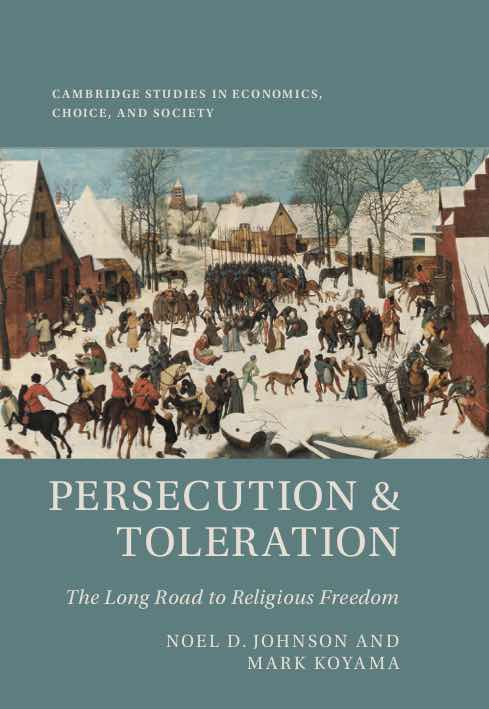
Why was religious persecution common in the premodern world? This is the question Noel Johnson and I address in Persecution and Toleration.
Answers that rely on the alleged barbarism of the times or the brutality or narrowed-mindedness of individual churchmen or rulers are unsatisfying. We need to understand why religious dissent was so alarming that political and religious authorities resorted to violent repression.

In Persecution and Toleration, we outline why states often had an incentive to enforce religious conformity.

Suppose the ruler wants to pass a law. The religious authority can choose to legitimate this law or to oppose it. If the religious authority opposes it, the law will be seen as illegitimate, and the ruler will face unrest or opposition in attempting to enforce it. If the religious authority legitimates the law, then compliance with the law will be greater and the law will be enforced at a much lower cost for the ruler. Rulers therefore have a good reason to want legitimacy. Because religious authorities were the most powerful source of legitimacy in the premodern period, it was natural for rulers to rely on religious legitimacy.

Rulers can bargain with religious authorities to obtain legitimacy. One way to do this is to enforce religious conformity. This provides a natural framework for studying religious persecutions.

One insight is that persecutions are necessarily political. The justification for persecution can vary. Secular authorities will persecution in terms of secular arguments. Religious authorities may persecute on religious or doctrinal grounds. But structurally these persecutions will resemble one another.

A second key argument is that some form of religious repression was the default in the premodern world but outright persecution was, in fact, quite rare. The default level of religious repression we characterize as a state of conditional toleration. Religious differences were usually tolerated, but only conditionally. Outright persecution was quite rare. But the threat of persecution played an important role in enforcing religious conformity, restricting dissent and providing states with legitimacy.

How general is our account? Is this story only applicable to Western Europe? Or to monotheistic societies? Can it explain the persecution of Christians in pagan Rome or the persecution of Christians in 17th century Japan? And what distinguishes religious persecutions from other persecutions?


To address these concerns, consider the persecution of Christians in the Roman Empire. Historians such as Candida Moss downplay these persecutions (here). Catherine Nixey’s The Darkening Age — reviewed positively in the New York Times —for example, writes:

“The idea, therefore, of a line of satanically inspired emperors, panting for the blood of the faithful is another Christian myth. As the modern historian Keith Hopkins wrote, ‘the traditional question: “Why were the Christians persecuted?” with all its implications of unjust repression and eventual triumph, should be re-phrased: “Why were the Christians persecuted so little and so late?”

Nixey correctly cautions the reader not to view Christian accounts of the death of martyrs as historical accounts. But her argument is a larger one. To her mind, the persecution of Christians was not a religious persecution. Commenting on the Roman governor Pliny’s decision to persecute some Christians, she writes:

“Pliny’s problem with all of this is not religious. He is not upset because Jupiter has been neglected, or Hera has been slighted: he is upset because the citizens of his province are becoming disgruntled by the Christians’ behaviour . . .”

“. . . Even the locals who were forcing Pliny’s hand might not have been complaining about Christians for religious reasons either: it has been speculated that what was really upsetting them was not theology but butchery. Local tradesmen were angry because this surge of Christian sentiment had led to a drop in the sales of sacrificial meat and their profits were suffering: anti-Christian sentiment caused less by Satan than by a slow trade in sausage-meat.”

Because Christians were punished as pests and social deviants, rather than for reasons conventionally identified as religious, Dixey suggests this was a simple matter of“law and order”. If anything her sympathies appear to be with the Roman governor responsible for prosecuting Christians:

“What should Pliny do with these odd people? Trajan’s reply is brief and to the point. He doesn’t get into theological or legal debates about the legal status of Christianity (to the disappointment of later scholars); nor does he (thus confounding the martyrdom tropes) fulminate against the Christians. He does agree with Pliny that those who are proved to be Christian ‘must be punished’ — though for precisely what charge is unclear. He also adds that ‘in the case of anyone who denies that he is a Christian, and makes it clear that he is not by offering prayers to our gods, he is to be pardoned as a result of his repentance however suspect his past conduct may be’. Roman emperors wanted obedience, not martyrs. They had absolutely no wish to open windows into men’s souls or to control what went on there. That would be a Christian innovation.”

This hardly not exculpates the Romans or implies the persecution of Christians was a myth. Nixey is correct that the Roman authorities were unconcerned with what Christians believed. But she is wrong to suppose that this is the defining characteristic of religious persecution. And the urge to downplay the persecution of Christians suggests other anachronistic instincts are at work. After all, no-one denies that Christians were killed, often horrifically, in the Roman persecutions (for a critical review of Moss’s book, on which Nixey relies, see here).

Theologians were, of course, concerned with wrong beliefs. But the reason why religious dissent became a major concern to both secular and religious authorities in medieval Europe was precisely due to the threat heresy posed to the established social and political order.


Consider another example from medieval Europe. Norman Cohn’s Pursuit of the Millennium explains the threat heretical movements posed to political order. Focusing on the most revolutionary millennium sects — movements that envisioned the last days as at hand, and took action to herald their coming — Cohn’s text vividly captures both the appeal as well as the radicalism and violence of these movements. Describing the manifesto of the “Revolutionary of the Upper Rhine”, Cohn writes:

“the route to the Millennium leads through massacre and terror. God’s aim is a world free from sin. If sin continues to flourish, divine punishment will surely be visited upon the world; whereas if sin is once abolished, then the world will be ready for the Kingdom of the Saints. The most urgent task of the Brethren of the Yellow Cross is therefore to eliminate sin, which in effect means to eliminate sinners . . . To achieve that end assassination is wholly legitimate: ‘Whoever strikes a wicked man for his evildoing, for instance for blasphemy — if he beats him to death he shall be called a servant of God; for everyone is in duty bound to punish wickedness.’ In particular the Revolutionary calls for the assassination of the reigning Emperor, Maximilian, for whom he had an overwhelming hatred.”

Such beliefs were a threat to all established authority. Church authorities were naturally concerned with monitoring belief and practice. But heresy also posed a potent threat to secular authority.

Of course, many people in medieval society had incorrect and unorthodox religious beliefs. What principally concerned the Church was not ignorance but heresy: obstinately holding beliefs that directly contradicted Church teachings.

Heresy was feared because it was a source of disorder. Religious dissent had the potential to unleash revolutionary violence and social chaos. This was one reason why Martin Luther recanted his earlier support for religious liberty during the Peasant Revolt.

Arguments for enforcing religious conformity went deeper than the fear of revolutionary violence. Such was the importance of the Church to the social and political order that all challenges to Church authority were perceived as threats to society.


Consider the doctrine of apostolic poverty — which emerged in the 11th and 12th centuries as the Commercial Revolution was transforming the European economy increasing urbanization, trade, wealth, inequality and also poverty. Shocked by the growing gap between the rich and the poor, adherents to this doctrine aspired to the simple poverty of Christ’s followers. They lived without property or money and they were critical of the wealth accumulated by the Church.

The fact that the Church was wealthy did not, of course, imply that Churchmen were not devout or dedicated. The problem was, however, that the Church was also a political institution. Many bishoprics were the preserve of the nobility who would jostle to ensure that their younger sons became influential churchmen. These prelates were expected to be the equal of the secular nobles, to entertain lavishly, and to dress splendidly. Taken too far, therefore, apostolic poverty threatened the legitimacy of the Church and its relationship with secular authority.

Through mendicant orders such as the Franciscans, the Church could accommodate these demands and concerns. But groups who directly attacked the legitimacy of the Papacy itself, such as the Waldensians and the Spiritual Franciscans could not be tolerated. The leader of the Spiritual Franciscans, Angelo da Clareno denied that Pope John XXII was pope, a direct challenge to the legitimacy of the Church. Precisely because of the threat they posed to the church and state alliance — and not because of their theological beliefs, which were unremarkable — the Spiritual Franciscans had to be repressed.

Were the concerns of the Roman Emperors so different from those of medieval rulers and churchmen? Religion was not a private affair in antiquity. It had political consequences; it mattered for the fate of the Empire. The first Empire-wide persecution of Christians occurred under Decius (r. 249–251). Decius’s response to the political crisis facing the Empire — invasions from both Persia and the Goths — was a revival of the state religion and the imperial cult.

Claiming that Roman persecutions of Christianity were not religious but political, as Moss and Nixey do, is misleading; all persecutions are political. Because it began as a persecuted cult, Christianity as a religion contained many potent arguments against religious persecution. For these reasons, it was probably less predisposed to persecution than many other religions. Nevertheless, the fact that the medieval Church eventually came to persecute dissent points to deep, structural, political economy factors that made religious freedom impossible. It this these factors that are the subject matter of Persecution & Toleration.

Blockchain Distributed Governance

Blockchain-Funds

This is a cross-post from the blog of the Centre for the Study of Governance & Society at King’s College London.

Over the last two decades online services have transformed from a product of a multitude of enterprises to being dominated by a handful of corporate-owned platforms such as Apple, Microsoft, Facebook, Google and Amazon. They specialize in connecting media producers to users. These are often mutual interactions with users both producing and consuming content. These platforms play an increasing role governing commercial exchange, as well as civil discussion, with plausibly pernicious implications for liberal democracy. As I propose in a recent paper ‘Markets for Rules’, blockchains offer a promising solution to this danger by helping to displace corporate ownership in favor of common platforms sustained by users themselves.

Corporate concentration has produced enormous efficiencies and innovations, improving user experiences and boosting investment in hardware and infrastructure. But it has also had several bad consequences. These enterprises face extremely low marginal costs and network effects whereby additional users add value to an existing user-base. Some of these effects are explained by these platforms’ business models of collecting personal data to target advertising more effectively at customers. The more interactions on a single platform users have with each other, the more useful the data for advertisers. The result is overwhelming returns to scale and a winner-takes-all competition for profits.

This has troubling implications for economic inequality, especially if we end up with a handful of corporations taking a bite out of every conceivable transaction. Of greater concern is the way owners exert control over who can join and what people are allowed to do on their platforms. Content producers can be demonetized or banned, effectively denying them access to a user-base or revenue. Online sellers can find themselves frozen out of a platform payment system without legal remedies. Controversial or unpopular producers survive at the whim of executives or, at best, a patchily enforced official policy.

This reliance on private governance is a problem for consumers, producers and ultimately citizens. But it is also a challenge for executives who find themselves mediating acrimonious personal disputes and political debate. With all the data in the world, they struggle to judge consistently what belongs on their platforms. The fact that these corporations have ended up functioning as unofficial censors and wielders of sanctions has led some commentators to propose regulating these platforms as public utilities or, more radically, nationalizing them so that access to them is decided democratically. These solutions have their own perils because any centralized system of monopoly control, whatever the underlying democratic credentials, can produce authoritarian outcomes. Liberal democracies up until now have been sustained by an independent civil society constituted by overlapping and competing spheres of governance, not the monopoly of either democratic or corporate government.

The prosecution of the CEO and founders of Backpage, who failed to exclude sex workers from their platform, illustrates the reliance of these private enterprises on government support on controversial policy issues even in relatively free societies. The combination of privately-developed data-collecting networks with over-arching state control is arguably reaching a nadir in China which is rolling out an unaccountable surveillance system of ‘social credit’ that can identify political dissidents and automatically exclude them from significant spheres of civil society.

Is there a way that blockchains can help navigate around the centralising and authoritarian impetus of technology-facilitated governance? Blockchains emerged from two pre-existing technologies – public ledgers and asymmetric cryptography – to produce a way of sharing data across a network that is resistant to manipulation by unauthorized actors. Initially conceived as offering alternatives to state-backed currencies, blockchains are now used to build decentralized autonomous organizations (DAOs) and dapps (decentralized apps). They can supply similar functions as corporate platforms but without an overall owner.

These systems are sustained by rewarding network participants with tokens (through completing intensive computing processes called mining). Tokens are convertible into ordinary currency, albeit currently at volatile rates. The entrepreneurs that build these platforms typically reward themselves and investors a large stake in those tokens but once the network is launched, they do not have control over how it is utilized. The rules of each network are self-enforcing. These rules can be changed, either through the original (or new) developers launching a rule-set that others may choose to switch over to (a fork). Alternatively, the rule-sets might contain provision for amendment. Such amendment schemes are, of course, open to manipulation as is the case for all political processes. Nevertheless, what these schemes offer is a way of interacting and exchanging at large distances without an overarching ruler. Instead, conduct is permitted on the basis of fixed rules enforced mechanically by people’s decisions to participate in the system. One way of looking at these schemes is that they have decentralized properties of communal norms, combined with the possibility of more deliberate design and experimentation of more formal rules and institutions. I call this common government.

The implications of this new technology and kind of governance might turn out to be very far-reaching, approaching that of the development of the Internet itself or even the printing press. But what could it mean for familiar Internet platforms in the medium-term? First, participating in mutual platforms might better align the incentives of users and platform designers. Right now, platform owners rely on squeezing as much data out of users as possible in order to sell it on to advertisers and to sell additional services. Mutual platforms, without responsibilities to shareholders, can experiment with different funding models. Individual users might elect to sell access to their profile to advertisers but the data itself can be made more secure as it will be a property of an encrypted network rather than a profile stored in a central private database. Privacy can be better assured than private management with public regulation.

Second, the networks can be more robust both to natural and political perturbations. Under decentralized protocols, ordinary users help store and serve content to each other. With the addition of blockchains, these users can be compensated for making their idle computer resources available for network use. This means that data doesn’t have to travel so far as is currently the case from host to user and the network as a whole can better cope with outages from particular nodes without data loss. Without a central controller, there is no particular agent that a government can coerce or punish for allowing specific interactions over a platform. Governments would then face the more difficult choice of permitting or prohibiting Internet communications altogether. It is thus more robust against arbitrary government censorship and manipulation of trade.

The relationship between users on a platform is mutual. The relationship between users and platform owners, however, is presently hierarchical – a private dynamic that government agencies can exploit. What blockchains may eventually permit is the provision of relatively efficient networks reliant neither on a single public agency nor private owner.

Learn more about Nick’s work here.

Nightcap

  1. A certain idea of France Peter Hitchens, First Things
  2. Political tribalism is overstated Matt Grossman, Defending the Open Society
  3. Do books make us more cosmopolitan? Tim Parks, New York Review of Books
  4. Culture matters Virginia Postrel, Econlib

Thank you anonymous reviewers

I recently had a paper rejected in Political Analysis. I fully expected a rejection given the journal’s high ranking and had submitted it for the sake of feedback. As I’m sure academic readers know, getting someone to read our papers can be hard. Unsurprisingly I got a rejection notice earlier today.

Surprisingly, all reviews were actually constructive feedback and, while critical, kind. To add strangeness to the whole ordeal, the process took less than a month from submission.

Since I have no way to contact the anonymous reviewers, I post my thanks here. Thank you anonymous reviewers. I wish reviewer #2, and here too I’m sure academics know the type I am referring to, should be more like you.

Nightcap

  1. To love is no easy task (America is just fine) Rachel Vorona Cote, New Republic
  2. Chronic vomiting (medical marijuana) Christopher Andrews, OUPblog
  3. The Neanderthal renaissance Rebecca Wragg Sykes, Aeon
  4. A mild defense of Andrew Johnson (the American president) RealClearHistory

Nightcap

  1. India’s constitution is way too long Bhatia & Modi, Pragati
  2. Pakistan’s proxies Adnan Naseemullah, Duck of Minerva
  3. Is Bernie Sanders the Ronald Reagan of socialism? Ross Douthat, New York Times
  4. How the Gupta brothers hoodwinked South Africa Karan Mahajan, Vanity Fair

Britain’s Pornographer and Puritan Coalition

D1dm1BuWkAAYreQ

Brexit isn’t the only ridiculous thing happening in the United Kingdom. In April, the British government is rolling out statutory adult verification for pornography websites and content platforms. This requires all adult content providers to have proof of age or identity for all their users, whether a passport or a credit card (or more ludicrously a ‘porn pass’ that Brits wishing to browse anonymously will have to buy from local newsagents). The government plans to require internet service providers to block pornography websites that are not in compliance with adult verification once the system is in place. For those with university institutional access, Pandora Blake has written a timely explanation and critique published in Porn Studies: ‘Age verification for online porn: more harm than good?’.

Technical challenges with rolling out the system have led the dominant pornography search platform owner, MindGeek, to develop proprietary solution, AgeID, in cooperation with regulators. This cooperation between the dominant commercial pornography platform supplier and a Conservative government publicly intent on restricting access to pornography might appear surprising. However, it can be explained by a particular pattern of regulatory capture identified in public choice theory as a Bootlegger and Baptist coalition. Bruce Yandle observed that throughout the 20th century, evangelical Christians in the United States agitated for local restrictions on the sale of alcohol with the avowed aim of reducing consumption but with the secondary effect of increasing demand for alcohol for illegal bootleggers. Hence both interest groups, apparently opposed in moral principle came to benefit in practice. We now have a classic British case study. In this case, MindGeek is not acting as a literal bootlegger. It intends to be fully legally compliant with the filtering regime. However, the law will block all non-compliant competitors without a comparable verification system. They can gain a competitive advantage with a proprietary technical solution to the barrier introduced by the government.

Introducing identity verification systems has high fixed costs and low marginal costs. It is costly to develop or implement but easy to scale once integrated. The larger the pornography enterprise, the more easily these costs can be absorbed without the risk that it will not be worthwhile to serve the British market. For many smaller international pornography websites, without in-house legal advice or technical expertise, it might prove uneconomical to serve British users directly. So MindGeek’s platforms could become the least-cost legal gatekeeper between small enterprises producing pornographic content and the British public. The government is raising transaction costs to accessing pornography in a way that impacts larger and smaller platforms asymmetrically and favors one dominant platform in particular.

Both the premise of this policy and its likely impact on the market for pornography is unpromising. At its most benign, this could be a characterized as a ‘nudge’ against the consumption of pornography and reducing access of inappropriate content to minors. But these limited benefits have costs for both producers and consumers. On the consumption side, it increases risks to data security and privacy because it will plausibly tie records of pornographic access to verified identities, with a clear likelihood of being to infer an individual’s sexuality from private browsing. This could represent a particular vulnerability for LGBTQ identifying individuals who live in communities where there is still stigma attached to minority sexual orientations.

On the supplier side, it takes what already appears to be a market with strong tendencies towards a winner-takes-all model, and then augments it so that a dominant platform has a legally enforceable competitive advantage over potential rivals in the market. Ultimately, it threatens to further strengthen the bargaining position of a single corporate pornography platform against the sex workers who supply their content.

Nightcap

  1. A global history of the Communist Party Tony Wood, the Nation
  2. The issue is the issue Scott Sumner, MoneyIllusion
  3. The case of Ilhan Omar Irfan Khawaja, Policy of Truth
  4. Early US diplomatic culture and the Native Americans Zachary Conn, Age of Revolutions 

Italy and the Belt and Road Initiative

There has been a growing scepticism with regard to the Belt and Road Initiative (BRI) project in many quarters, due to the lack of transparency with regards to terms and conditions as well as the economic implications for countries which are part of the project. A report published in April 2018 by the Center for Global Development (CGD) in Washington flagged 8 countries (including Pakistan, Maldives, Laos, and Djibouti) where the level of debts are unsustainable.

Apart from the red flag raised by a number of researchers, the removal of Pro-China leadership in countries like Malaysia, Maldives, and Sri Lanka has also resulted in problems with the BRI project, and China’s economic dealings (which are clearly skewed in favour of Beijing) with other countries is drawing more attention.

The most vocal critic of China’s economic links has been Malaysian Prime Minister Mahathir Mohamad. During a visit to China in August 2018, Mahathir, alluded to China’s trade relations with poorer countries as ‘a new version of colonialism’. Mahathir later on denied that his statement was targeted at China or the BRI. The fact is that the Malaysian Prime Minister did scrap projects estimated at well over $20 billion (which includes a rail project, East Coast Link, as well as two gas pipelines).

Top officials in the Trump Administration, including US Vice President Mike Pence, have also been critical of the BRI project for a variety of reasons. The major criticism from US policy makers has been the economic ‘unsustainability’ of the project as well as the point that the project is skewed in favour of China.

Italy to join BRI Continue reading

Nightcap

  1. Tianxia: a philosophy for world governance Salvatore Babones, Asian Review of Books
  2. Imperialism or federalism? Round Two Notes On Liberty
  3. A new history of the United States Julio Ortega, New York Times
  4. Postmodern politics Chris Dillow, Stumbling & Mumbling

Interwar US inequality data are deeply flawed

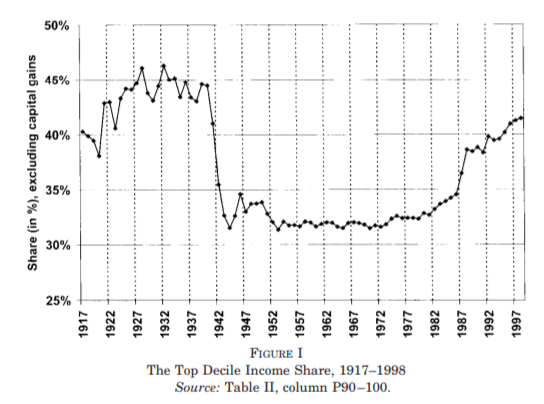
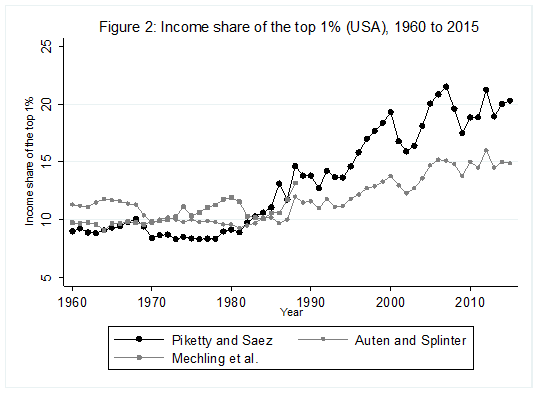
For some years now, Phil Magness and myself have been working on improving the existing income inequality for the United States prior to World War II. One of the most important point we make concerns why we, as economists, ought to take data assumptions seriously. One of the most tenacious stylized facts (that we do not exactly dispute) is that income inequality in the United States has followed a U-curve trajectory over the 20th century. Income inequality was high in the early 1920s and descended gradually until the 1960s and then started to pick up again. That stylized fact comes from the work of Thomas Piketty and Emmanuel Saez with their data work (first image illustrated below). However, from the work of Auten and Splinter and Mechling et al. , we know that the increase post-1960 as measured by Piketty is somewhat overstated (see second image illustrated below).  While the criticism suggest a milder post-1960 increase, me and Phil Magness believe that the real action is on the left side of the U-curve (pre-1960).

Inequality

NOL1

Why? Here is our case made simple: the IRS data used to measure inequality up to at least 1943 are deeply flawed. In another paper recently submitted, I made the argument that some of the assumptions made by Piketty and Saez had flaws. This did not question the validity of the data itself. We decided to use state-level income tax data from the IRS to compute the state-level inequality and compare them with state-income tax data (e.g. the IRS in Wisconsin versus Wisconsin’s own personal income tax data). What we found is that the IRS data overstates the level of inequality by appreciable proportions.

Why is that? There are two reasons. The first is that the federal tax system had wide fluctuations in tax rates between 1917 and 1943 which means wide fluctuations in tax compliance. Previous scholars such as Gene Smiley pointed out that when tax rates fell, compliance went up so that measured inequality went up. But measured inequality is not true inequality because “off-the-books” income (which was unmeasured) divorced true inequality from measured inequality.  This is bound to generate false fluctuations in measurement as long as tax compliance was voluntary (which is true until 1943). State income taxes do not face that problem as their tax systems tended to be more stable throughout the period. The same is true with personal exemptions.

The second reason speaks to the manner the federal data is presented. The IRS created wide categories with the numbers of taxpayers according to net taxable income (rather than gross income) in each categories. For example, the categories go from 0$ to 1,000$ per filler and then increase by slice of 1,000$ until 10,000$ and then by slices of 5,000$ etc. This makes it hard to pinpoint where to start each the calculations for each of the fractiles of top earners. This is not true of all state income tax systems. For example, Delaware sliced the data by categories of 100$ and 500$ instead. Thus, we can more easily pinpoint the two. More importantly, most state-income tax systems reported the breakdown both for net taxable and gross income. This is crucial because Piketty and Saez need to adjust the pre-1943 IRS data – which are in net income – to that they can tie properly with the post-1943 IRS data – which are in adjusted gross income. Absent this correction, they would get an artificial increase in inequality in 1943. The problem is that the data for this adjustment is scant and their proposed solution has not been subjected to validation.

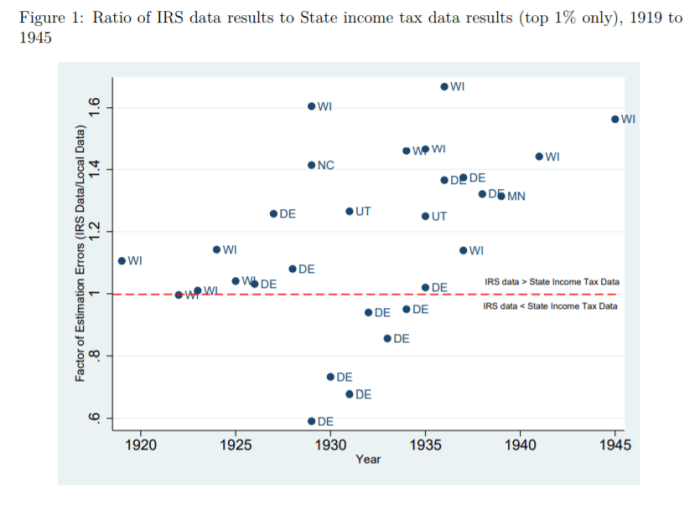
What do our data say? We compared them to the work of Mark Frank et al. who used the same methodology and Piketty Saez but at the state-level using the same sources. The image below pretty much sums it up! If the points are above the red line, the IRS data overestimates inequality. If below, the IRS underestimates. Overall, the bias tends towards overestimation. In fact, when we investigated all of the points separately, we found that those below the red line result merely from the way that Delaware’s (DE) was adjusted to convert net income into gross income. When we compared only net income-based measures of inequality, none are below the red line except Delaware from 1929 to 1931 (and by much smaller margins than shown in the figure below).

IRS.png

In our paper, we highlight how the state-level data is conceptually superior to the federal-level data. The problem that we face is that we cannot convert those measures into adjustments for the national level of inequality. All that our data do is suggest which way the bias cuts. While we find this unfortunate, we highlight that this would unavoidably alter the left side of the curve in the first graph of this blog post. The initial level of inequality would be less than it is now. Thus, combining this with the criticisms made for the post-1960 era, we may be in presence of a U-curve that looks more like a shallow tea saucer than the pronounced U-curve generally highlighted.  The U-curve form is not invalidated (i.e. is it a quadratic-looking function of time or not), but the shape of the curve’s tails is dramatically changed.

Nightcap

  1. The intellectual distrust of democracy Jacob Levy, Niskanen
  2. Leave John Locke in the dustbin of history John Quiggin, Jacobin
  3. In defense of neoliberalism William Easterly, Boston Review
  4. The predated mind (our animal origins) Nick Nielsen, Grand Strategy Annex

It’s no longer the economy, but we are still stupid

Motivated Reasoning, Public Opinion, and Presidential Approval‘, an interesting new paper forthcoming in the journal Political Behavior (summarized here), by Kathleen M. Donovan, Paul M. Kellstedt, Ellen M. Key, Matthew J. Lebo finds that support for sitting presidents has become increasingly misaligned with national economic expectations. Rather than being a sign of voters realizing that presidents play little role determining economic performance, they attribute this to increased partisan polarization.

I think this is a compelling account. All I would add is a potential causal mechanism. My current favorite dimensions for analyzing democratic trends in the developed world is demography. Voters are ageing. When retired, they tend to have much less direct involvement with the productive economy than when they were working. On average, the elderly are quite rich and living off entitlements they have acquired during their working lives. So they are both less reliant on current economic opportunities and less knowledgeable of them. This means their personal costs of partisanship, relative to good policy, is lower than it used to be. And this is what lets all the culture-war nonsense creep into people’s decision functions.

Nightcap

  1. Austin City Limits Kevin Williamson, Claremont Review of Books
  2. Boredom and the British Empire Erik Linstrum, History Today
  3. The little-known war crime in Tokyo Hiroaki Sato, Japan Times
  4. China’s “Hundred Schools of Thought” Ian Johnson, ChinaFile

RCH: “10 Worst Space Disasters in History”

My latest at RealClearHistory:

When I think about space disasters, I am reminded of the space battle between Earth and Trisolaris in Liu Cixin’s fantastic sci-fi novel. Stay with me here. Liu Cixin’s Dark Forest novel needs to be read. In the novel, humans make contact with a nearby alien civilization, who proceed to make plans to invade earth, wipe out its human population, and re-populate it with themselves. The first battle between Earth’s space forces and the would-be invaders ends badly for Earth, as thousands of space warships are destroyed in a matter minutes by a Trisolaran probe. The novel brings up an uncomfortable theory that humans have been all-too-willing to neglect: what if the universe is a hostile, deadly place instead of a curious one?

Please, read the rest.