2017: Year in Review

Well folks, another year has come and gone. 2017 was Notes On Liberty‘s busiest year yet. Traffic came from all over the place, with the most visits coming from the US, the UK, Canada, Australia, and India. (In the past, India and Germany have vied for that coveted 5th place spot, but this year India blew Germany out of the water.)

NOL is a voluntary cooperative, and as such this year saw the introduction of 6 new Notewriters: Kevin Kallmes, Nicolás Cachanosky, Ash Navabi, Tridivesh Maini, Matthew Bonick and Trent MacDonald.

Michelangelo invited Kevin to join, Nicolás is an old grad school buddy of Rick‘s, I reached out to Tridivesh, and Ash and Matthew were invited on Vincent‘s initiative.

Speaking of Vincent, 2017 was his year. He had Tyler Cowen (MarginalRevolution), Mark Thoma (Economist’s View), Anthony Mills (RealClearPolicy), Barry Ritholtz (Bloomberg), Don Boudreaux (Cafe Hayek), John Tamny (RealClearMarkets) and Pseudoerasmus (a well-regarded economic historian) all link to his thoughts multiple times over the course of the year. His Top 10 list for best papers/books in recent economic history (Part 1 and Part 2) were legitimate viral sensations, dominating the top 2 spots on NOL‘s most-read list. Other huge posts included “Did the 30 Glorious Years Actually Exist? (#5),” “The Pox of Liberty – dixit the Political Economy of Public Health (#9),” “James Buchanan on racism,” “The GDP, real wages and working hours of France since the 13th century,” “Did 89% of American Millionaires Disappear During the Great Depression?,” and “A hidden cost of the war on drugs.” My personal favorite was his “Star Trek Did More For the Cultural Advancement of Women Than Government Policies.” Dr Geloso’s thoughts made up 40% of NOL‘s 10 most-read 2017 posts.

My favorite posts from Edwin this year were his analyses of Dutch politics – “Dutch politics, after the elections” and “North Korea at the North Sea?” – but the reading public seemed to enjoy his posts on Ayn Rand, especially her thought on international relations, and his summary of Mont Pelerin Europe more than anything else. Van de Haar’s day job is in the private sector, so his blogging is understandably light (especially given his incredible publishing output in academic journals). I look forward to what looms ahead in 2018.

Federico’s most recent post on artificial intelligence and the law got love from some major outlets, including FT‘s Alphaville blog and 3 Quarks Daily. His question “Does business success make a good statesmen?” and his report on a Latin American Liberty summit are worth reading again, but my personal favorites were his comments on other Notewriters’ thoughts: first jumping in to add some historical clarity to Bruno’s post on Latin American conservatism and then to add layers onto the debate between Mark and Bruno on the Protestant Reformation. Federico has been invaluable to NOL‘s welcoming, skeptical culture and I cannot wait to see what he comes up with in 2018.

Barry was generous enough recount the situation in Turkey after the coup earlier in the year, and fruits of this endeavor – Coup and Counter Coup in Turkey – can be found in six parts:

  1. First of a series of posts on Turkey since 15th July 2016 and background topics
  2. Immediately after the coup and party politics
  3. Gülenists and Kemalists
  4. The Kurdish issue in Turkey
  5. Jacobins and Grey Wolves in Turkey
  6. Presidential Authoritarianism in Turkey

Dr Stocker also began writing an appendix to his six-part series, which resulted in a first post on authoritarianism and electoral fixes. Barry is hard at work on a new book, and of course the situation in Turkey is less than ideal, so I can only hope he has a bit more time in 2018 for NOL.

Michelangelo had a banner year at NOL. His #microblogging has been fun, as were his post analyzing relevant data from his surveys: What libertarians think of climate change, for example, or urban planning in Oregon. Michelangelo also utilized NOL to play around with concepts like race, marriage markets, data, Spanish language services, affirmative action, and freeware, to name a few. My absolute favorite Michelangelo post this year was his excellent “Should we tax churches? A Georgist proposal.” Michelangelo is a PhD candidate right now, too, so if he ever gets some time to himself, watch out world!

Rick also had a banner year at NOL. His post arguing against Net Neutrality was one of the most-read articles of the year here (#4), and many of his wonkier thoughts have been picked up by the sharp eye of Anthony Mills (RealClearPolicy) and the excellent Chris Dillow (Stumbling and Mumbling). Rick is my favorite blogger. Posts on cycling in Amsterdam, subsidies, management and measurement, linguisticsmore subsidies, and my personal favorite of his for the year, “Why do we teach girls that it’s cute to be scared,” always make me think and, more importantly, smile.

Bruno’s blogging was also amply rewarded this year. His thoughts on some of the problems with postmodernism brought in the most eyeballs, but thankfully he didn’t stop there: Articles introducing postmodernism and highlighting the origins of postmodernism also generated much interest. RealClearWorld picked up his post analyzing Brazil post-Rousseff (he had more analysis of Brazilian politics here and here), and his post delving into whether Nazism is of the left or the right provoked quite the dialogue. Dr Rosi was at his best, though, when prompted by Mark to further advance his argument that the Protestant Revolution played an integral role in the rise of the freedom of conscience. Times are tough in Brazil right now, so I can only hope that Bruno continues to play a vital role as a Notewriter in 2018.

Chhay Lin, now in the private sector, had his post about Bruce Lee’s application of Taoist philosophy head to the top of reddit’s philosophy sub, and his post on Catalonia and secession got love from RealClearWorld and Lew Rockwell (Political Theater). I hate to be *that* guy distracting a man from making his money, but I hope to see Chhay Lin pop in at NOL much more often in 2018!

Zak has been busy with a number of different projects, as well as attending Michigan-Ann Arbor full-time. He still managed to have one of his posts, on “libertarian” activist hypocrisy (#10), highlighted in the Guardian, the UK’s premier left-wing mouthpiece. His post on The Nancy MacLean Disgrace earned him plaudits from the online libertarian community and Don Boudreaux (Cafe Hayek), and his posts on open borders and income inequality show just how much of a bad ass he has become. I had a tough time trying to pick out my favorite Zak article of 2017, so I’m just gonna highlight all three of them:

  1. Immigration, Cultural Change, and Diversity as a Cultural Discovery Process
  2. Why I’m No Longer A Christian…
  3. Against Libertarian Populism

They’ve all got great self-explanatory titles, so do yourself a favor and read ’em again! Hopefully Zak can continue to work NOL in to his many successful ventures in 2018.

Jacques continues to amaze me. He’s been retired from academia for – as far as I can tell – at least a decade and he’s still producing great material that’s able to reach all sorts of people and places. His post on the Ottoman Empire and libertarianism (#6), which was featured at RealClearWorld and much-shared in Ottomanist corners of Twitter – took aim at popular American libertarian understandings of decentralization and seems to have landed pretty squarely on target. My favorite post of Dr Delacroix’ this year was about French Africa (also featured at RealClearWorld), but his late-year book review on Christopher De Bellaigue’s 2017 book about Islam might end up being a classic.

Bill’s 2017 here at NOL was productive and he continues to impress. His “Speech in academic philosophy: Rebecca Tuvel on Rachel Dolezal” brought in thousands of readers, but it was not his ability to draw crowds that I found impressive. His ability to tackle tough concepts and tough issues came to the forefront this year: drug use, “vulvæ,” more drug use, party culture (my personal fave), schooling (another personal fave), more schooling, and music (personal fave). Bill’s ability to weave these trends together through the lens of individual freedom is so much fun to read and important for fostering a culture of tolerance and respect in today’s world. I can’t wait to see what 2018 has in store for him!

Nicolás came out firing on all cylinders this year. With excellent dialogues between himself and Vincent, as well as between himself and guest blogger Derrill Watson (who I hope will be back for more in 2018), Dr Cachanosky’s passion for teaching has shown through clearly and brightly. I hope 2018 – his first full year with NOL – is filled with much more hard-hitting but insightful blogging from Nicolás.

Ash brought the heat, too. Check out the subject matter of his first few posts here at NOL: “A Right is Not an Obligation,” “Physical Goods, Immaterial Goods, and Public Goods,” “The Economics of Hard Choices,” “Markets for Secrets?,” “A Tax is Not a Price,” and “A Radical Take on Science and Religion.” Like Nicolás, Ash’s first full year at NOL is coming up, and if 2017 is any indication, readers can look forward to an interesting and engaging 2018.

Mark’s first full year here at NOL was a definite barnburner. His debate with Bruno on the Protestant Reformation (#8) brought in a bunch of eyeballs, including from RealClearHistory, while his “The Return of Cyclical Theories of History” also brought in thousands of readers, thanks in large part to Robert Cottrell’s excellent website, the Browser. Dr Koyama’s review of Aldo Schiavone’s The End of the Past also caught Mr Cottrell’s eye and the attention of his readers. Mark’s post on geopolitics and Asia’s “little divergence” is well worth reading again, too. Like Zak and Bill’s posts, I couldn’t choose just one favorite, so I give you two:

  1. Political Decentralization and Innovation in early modern Europe
  2. Some Thoughts on State Capacity” (an especially good criticism of American libertarian understandings of the “state capacity” literature)

We’re lucky to have Mark here at NOL.

Kevin, like Ash and Nicolás, brought the ruckus for his first few posts here at NOL. Kevin’s very first post at Notes On Liberty – “Rules of Warfare in Pre-Modern Societies” (#3) – ended up on the front page of RealClearHistory while his “Paradoxical geniuses…” earned a spot on the Browser‘s prestigious reading list. Not a bad start. Kevin will be finishing up the second half of his first year of law school (at Duke), so I doubt we’ll see much of him until June or July of 2018. My personal favorite, by the way, was Kevin’s “Auftragstaktik: Decentralization in military command.” His posts on taking over Syria – Roman style, the median voter theorem, and inventions that didn’t change the world also got lots of love from around the web.

Nick’s post on public choice and Nancy MacLean (#7) earned a nod from Arnold Kling (askblog), Don Boudreaux (Cafe Hayek), Chris Dillow (Stumbling and Mumbling), Mark Thoma (Economist’s View), and pretty much the entire online libertarian community, while his post analyzing the UK’s snap election earned a spot at RealClearWorld. Dr Cowen’s thoughts on school choice and robust political economy, as well as a sociological analysis of Trump/Brexit prompted by Vincent, all garnered love from libertarians and scholars around the world. My favorite Cowen post was his question “Is persecution the purpose?

Overall, it was a hell of a year here at Notes On Liberty. I’m really looking forward to 2018. Here’s to a happy, healthy you. Oh, and my proudest piece this year was “North Korea, the status quo, and a more liberal world.” HAPPY NEW YEAR!

In memory of Christie Davies: defender of the right to joke

ChristieDavies

As we approach the end of 2017, I remember this year’s sad passing of Christie Davies. Davies was a rare academic beast: a classical liberal sociologist. Despite representing a minority perspective in his discipline, he was able to thrive and leave a mark that will continue to influence scholars for generations.

Continue reading

Ayn Rand and International Politics

In a previous post I promised to write about Ayn Rand and her views on international politics, based on a recently published article.

I find Ayn Rand a fascinating figure in libertarian history, for a number of reasons. Her life style and ways she went about it in her life are so far distanced from me, that made me curious. Some of her philosophical ideas are great, others do not appeal to me at all. I plainly admire her for making the moral case for capitalism and individualism, which stands out in the economist-dominated libertarian tradition.

I am on the one hand annoyed by the way she fostered such cult-like circle of followers, in her own day and after her death in 1982, that led to dogmatism and intellectual isolationism, which goes against all basic academic standards I think are crucial.

On the other hand, I think the people at the Ayn Rand Institute do a great job preserving her legacy and attempting to widen her appeal. Overall, I am convinced that no matter what your take on this fascinating figure or her work is, Rand deserves to be studied in academia, because she remains influential to this day, especially in the US, and left a serious collection of writings that warrant intellectual analysis, even by people who do not consider themselves Randian.

Against this background I made a comparison between mainstream liberal theories of International Relations (IR) and the ideas on world affairs of Ayn Rand. The brief summary of the first is as follows:

  • World peace is attainable, in the belief that humans are rational enough to overcome war and conflict.
  • The nation is seen as a problematic actor in world affairs. Its room for maneuvering needs to be curtailed, including the importance of the balance of power between states, and the alleged influence of ‘war mongering’ diplomats and the so-called military-industrial complex.
  • Peace oriented foreign policies can be fostered by domestic institutional arrangements, most notably democracy (democratic peace theory).
  • In the international realm, there is an important role for intergovernmental and non-governmental organizations, regimes and international law (liberal institutionalism), which aim to overcome or neutralize the effects of the logic of power politics.
  • International trade is also expected to foster peace, often in combination with the alleged pacifying influence of interest groups and public opinion of foreign policy decision-making.
  • A recent addition is the broad support for humanitarian intervention.

To keep this blog at readable length I will not go into the details of Rand’s writings, but limit myself to her main views on these ideas, which should be seen in the context of her fierce opposition to the Soviet Union and its allies in the Cold War, and her concern for America losing its super power position through internal causes, not least the loss of the individual liberty-enhancing spirit among the American people.

  • In contrast to classical liberals from Smith to Hayek, Rand did indeed think that world peace would be attainable, but only in an Objectivist world. Among rational men living according the Objectivist principles there would be a harmony of rational interests. Yet in the current world there was also abundant irrational behaviour, bad morality, and other grounds for dispute.
  • The main causes of war were not material issues, domestic interests, institutional arrangements, or the structure of the international system. Rather, war was rooted in human nature. It went back to the tribal era, when brute force was the prime rule of conduct. The (socialist) dictatorships were contemporary examples in her mind, with their lack of respect for the rights of their own citizens, and those of foreigners alike. ‘Statism needs war, a free country does not’.
  • Rand was inconsistent in her valuation of the power of public opinion. She noted that most people often do not want war. Yet the origins of war still lay with those civilians, also in non-democratic regimes, because they failed to reject the doctrine that it was right and justified to achieve goals by physical force. If people put up with a dictatorship like the Soviet Union, or decided not to flee, they were co-responsible for the deeds, and deserved the same fate as their government.
  • Rand recognized that individuals live in groups or communities, but she regarded respect for tribal roots, ethnicity, and regional languages as uncivil and, above all, irrational and a limit on individual liberty. Ethnicity was also an important cause of war. Nationalism was perhaps less abstract than Marxism, but it was at least as vicious in stirring emotions such as hatred, fear, and suspicion. Therefore rational people would altogether disregard their roots as guides in (political) life.
  • Rand had two positions on the issues of sovereignty and intervention, depending on the moral character of the nation in question. Sovereignty was a right that had to be earned, but could also be forfeited. If a nation fully respected the principle of individual rights, it’s right to sovereignty was morally secured and should be respected by other nations. However, if a state violated the rights of its citizens it would lose its sovereign rights. ‘A nation ruled by brute force is not a nation, but a horde, whether led by Atilla, Genghis Khan, Hitler, Khrushchev, or Castro.’
  • Dictatorships were outlaws and could therefore be invaded as a matter of choice for the free nations, although there was no duty to do so. The right to self-determination and sovereignty only existed for free nations, and for societies seeking to establish freedom.
  • Yet this way, anarchy loomed. Rand divided the world into three groups of countries. First, countries complying to the Objectivist principles, with full sovereign rights. Second, countries on their way to freedom, often referred to as ‘mixed economies’, or half-way houses between freedom and dictatorship. Third, countries not worth existing, such as dictatorships and tyrannies. Unfortunately, the world lacked fully free countries. The mixed economies did not have unlimited right of intervention, they could only interfere when another country seriously breached Objectivist principles, for example by establishing one party rule, enacting censorship laws, executing people for political offences without trial, or nationalizing or expropriating private property.
  • Rand acknowledged the perpetual influence of power in world politics. The character of international politics was, and always had been among states, a balance of power game.
  • The US army was under domestic, non-patriotic attack for its virtues, for being a competent and strong force. It was unwise to cut the defence budget, while -in another contrast to liberal IR thought- ‘the military-industrial complex’ was ‘a myth or worse’.
  • Statism at the international level, in the form of ‘a planetary community’ and other cosmopolitan ideas had to be rejected. The collaboration of semi-free countries with communist dictatorships in the UN was evil and stood in contrast to reason, ethics, and civilization. The UN provided the Russian camp with prestige and moral sanction, suggesting that ‘the difference between human rights and mass slaughter is just a matter of opinion’.
  • Another point of contention with the social liberals was development cooperation. Foreign aid was nothing but ‘altruism extended to the international realm’.
  • While, in contrast to social liberals, she lacked faith in international law as such, Rand did regard international treaties as firm obligations.
  • Also, Rand saw peaceful effects of laissez-faire capitalism, because it was based on the recognition of self-interest by free individuals and the non-initiation of force. Capitalism fostered a society of traders. Therefore the essence of Objectivist foreign policy had to be free trade.

To briefly sum up: Rand’s writing show that not all liberals are peace-seeking cosmopolitans, attempting to minimise the role of the nation, the balance of power, the military, and warfare in international relations. She rejected most forms of international governmental organization and other expressions of liberal institutionalism. Often her ideas lack sufficient (legal) detail, while they are also centred on America, and hence limited to the perspective of an influential super power with large military capacity. Yet her writings show that fostering liberty in international relations can be done in several ways, and that different liberals have different ideas about the route towards that goal.

SMP: On the Delusions of Price Level Stability

One of the lessons that should have been learned after the 2008 crisis is that price level stability does not guarantee economic and financial stability. Rather, central bankers and policy makers understand that the lesson is there should be even more regulation.

In a recent column, William White explains how “major central banks’ vigilant pursuit of positive but low inflation has become a dangerous delusion.” The idea that price level stability is both, necessary and sufficient to achieve macroeconomic stability and growth should have been put to rest by the 2008 financial crisis. But conflicting narratives have enabled it to live on.

Since the crisis, the focus of many central bankers has turned to macroprudential policy. The objective is to manage financial risk. Regulatory efforts have increased as a result. On the monetary policy front, price level stability still reigns supreme. New tools have been developed to execute monetary policy, to be sure. But the overall objective has been more-or-less left intact.

Keep reading at Sound Money Project.

Let’s talk about Star Wars

Unless you’re living in a compound somewhere in Colorado, you have no doubt realized that the latest installment in the Star Wars series has come out. You’ve no doubt read countless commentaries on the series by now too. I suspect that at this rate Disney will be pumping out SW films every Christmas until my death and beyond. So get used to it.

I’ve decided to just share my rankings of the films and quick commentary.

  • Revenge of the Sith
  • Empire Strikes Back
  • A New Hope
  • The Last Jedi
  • Return of the Jedi
  • The Force Awakens
  • The Clone Wars
  • The Phantom Menace

My rankings are based on rewatch value. Revenge of the Sith dominates in this dimension. The cheesy dialogue is just fun in a way the other films can’t match it. And you know what? I like the space politics, even just as a concept.

Return of the Jedi spends too much time with the teddy bears and if I want to see the Death Star blown up I’ll just rewatch A New Hope. I only list the main series here, but Rogue One would fit somewhere near the top. It’s self contained and made me care about its characters in a way few others in the series did.

Do you disagree with my rankings? What is your ranking of the SW films?

#microblogging #IJustLikeHashTags

*The Islamic Enlightenment* | A critical review

De Bellaigue, Christopher. (2017) The Islamic Enlightenment: The Struggle Between Faith and Reason 1798 to Modern Times. Liveright Publishing Corporation (Norton & Company) New York, London.

In 1798, in view of the Pyramids, a French expeditionary force defeated the strange caste of slave-soldiers, the Mamlukes, who had been ruling Egypt for several centuries. The Mamlukes charged the French infantry squares on horseback, ending their charge with the throwing of javelins. The Mamlukes were thus eliminated from history. The French lost 29 soldiers. In the conventional narrative, the battle woke up the whole Muslim world from its long and haughty slumber. The defeat, the pro-active reforms of Napoleon’s short-lived occupancy, and the direct influence of the French scholars he had brought with him lit the wick of the candle of reform or, possibly, of enlightenment throughout the Islamic world.

De Bellaigue picks up this conventional narrative and follows it to the beginning of the 20th century with a dazzling richness of details. This is an imperfect yet welcome thick book on a subject seldom well covered.

This book has, first, the merit of existing. Many people of culture, well-read people with an interest in Islam – Islam the sociological phenomenon, rather than the religion – know little of the travails of its attempted modernization. Moreover, under current conditions of political correctness the very subject smells a little of sulfur: What if we looked at Muslim societies more closely and we found in them some sort of intrinsic inferiority? I mean by this, an inferiority that could not easily be blamed on the interference of Western, Christian or formerly Christian, capitalist societies. Of course, such a finding could only be subjective but still, many would not like it, and not only Muslims.

Second, and mostly unintentionally, possibly inadvertently, the book casts a light, an indirect light to be sure, on Islamist (fundamentalist) terrorism. It’s simple: Enlightened individuals of any religious background are not likely to be also fanatics willing to massacre perfect strangers. Incidentally, I examine this issue myself in a fairly parochial vein, in an essay in the libertarian publication Liberty Unbound: “Religious Bric-à-Brac and Tolerance of Violent Jihad” (January 2015). With his broader perspective, with his depth of knowledge, De Bellaigue could have done a much better job of this than I could ever do. Unfortunately he ignored the subject almost entirely. It wasn’t his topic, some will say. It was not his period of history. Maybe.

Continue reading

BC’s weekend reads

  1. Holy shit! (great news)
  2. Hayek’s rapid rise to stardom | misunderstanding Hayek
  3. great write-up on Catalonia | a philosophical case for secession
  4. if colonialism was the apocalypse, what comes next? | should UNM replace its seal?
  5. do trees fall in cyberspace? | how to use Facebook better
  6. a pretty shallow deep throat | vulvæ in pornography and culture

(Unofficial) IHS Graduate Student Facebook Group

I’ve created an (unofficial) facebook group for graduate students who are part of the IHS crowd so that we can organize appropriate conference meet ups, look for potential hotel sharing buddies, and other hijinks. Several NoL writers and readers have gone through IHS so I figured I’d share the link.

I may or may not be using the group as a way to find future NoL writers.

https://www.facebook.com/groups/1958211444500599/

#mini-microblog

Can you manage what you can’t measure?

Disclaimer: I’m not a macroeconomist, but I play one in Principles classes. Feel free to point out my errors in the comments.

Economics is filled with imperfect measures of important concepts. GDP, unemployment rates, and price indices all have significant flaws. Measures of entrepreneurship are even worse.

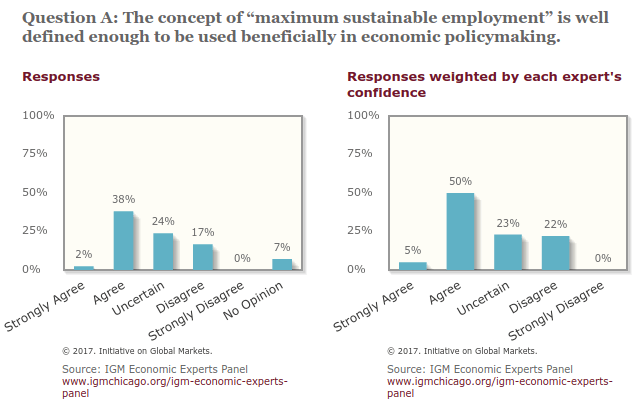
The Chicago Booth IGM Experts’ Panel recently posted an interesting result about the problems with unemployment:

IGMChicago_EmploymentandtheUSEconomy

The question is: “The concept of “maximum sustainable employment” is well defined enough to be used beneficially in economic policymaking.”

That’s 42 economists asked, 34 with an opinion (including “uncertain”), and about half of the sentiment is positive. And that sounds about right to me. I read this question as “can we engage in macroeconomic policy that doesn’t do long-run harm?” And if I were to describe my opinion probabilistic, it would look like these results. We could probably do “good policy” with a low degree of precision (i.e. useful enough for severe situations) if 1) we magically didn’t have to deal with political squabbling and 2) explicitly limited our goals to the short run.

Respondents agreeing emphasize that it’s “good enough.” But what does that mean? What level of precision and control are we looking at here?

Here’s the basic situation: given the underlying economic reality (everyone’s individual preferences, capabilities, knowledge, etc.) it makes sense to have some limited number of unemployed people at any given time. Unemployment rate is a measure of “how far are we from 0,” not, “how far are we from the ideal level?” That raises the following questions:

  • How accurately can we know what’s going on in the world?
  • How accurately can we know what’s supposed to be going on in the world?
  • How precisely can we affect the world?

The aggregate macroeconomic theory and empirics of the 1960’s were seriously imprecise. Trying to target macroeconomic policy would be like doing eye surgery with a hand grenade. In that sort of world, your best medicine is probably chicken soup and bed rest.

Here in the present we have much better data and computation. And it’s going to get better. Facebook already has data precise enough to track the exact effects of policy down to the individual level.

But think about a precise outcome and imagine what sort of policy would be required to get there. Let’s say our outcome is “get Rick to buy a new car.” Some mix of low interest rates, the right set of subsidies, and ideal circumstances might move things in that direction. But that sort of surgical outcome is just never going to be possible through legitimate macroeconomic policy (and definitely not monetary policy*). The size of the problem just means that Butterfly Effect problems will prevent macroeconomic policy from having household-level precision, even if the data could (in principle) measure the effect.

Less precise outcomes seem plausible (e.g. “get middle class households in the north east to buy 30-60,000 new cars”), but not without making a lot of second order problems. It’s not so much a “middle of the road leads to socialism” situation as a multiplier effect from a convergent series. Push a billion over there, create big distortions, follow those up with medium distortions, and finally let small remaining problems fizzle out on their own. Throw in public choice issues and it seems obvious that the efficiency cost of precise interventions won’t scale up nicely.

We’re now in a world where our theoretical and empirical tools are more precise than our implementation tools. We’re no longer trying to do surgery with a hand grenade. But that doesn’t mean we’ve got a laser scalpel either. It’s more like we’ve got we’ve got laser-like measuring tools but our implementation tools are blunt objects. If we aren’t careful, we’ll spend our time swatting flies with sledge hammers.

All told, it seems possible that we could engage in fairly targeted macroeconomic policy. But as the scale increases, the marginal cost will rise rapidly (maybe less so with the right institutions). Better timing might increase the effectiveness of each dollar spent*, but overall, it seems like things have to be really bad before the government should consider anything too ambitious.

Manage an economy’s economic health using imperfect measures like unemployment rate is about like trying to manage your physical health using heart rate and body mass index figures. Can we do “good enough”? Only to a limited extent. We could stop eating garbage and get some exercise. But there isn’t some magic combination of vitamins and crystals that will stop cancer. Anyone who tells you otherwise is a) trying to sell you something and b) trying to convince themselves they’re in control of the uncontrollable.

In terms of macroeconomic policy, we should start by caring about fundamentals (i.e. long run economic development) and be skeptical of people promising to control the business cycle.


*And let’s face it, we aren’t likely to get decent macroeconomic policy (in terms of efficiency, timing, and appropriateness of policy to circumstances) out of Congress until there’s a serious cultural shift.

Towards a genuinely Inclusive, Liberal, and Open Global Agenda

The recent past has been witness to the increasing rise of ‘economic-nationalism’, anti-immigration policies, and increasing xenophobia. Countries which in the past have welcomed immigrants, and have been protagonists of Free Trade and open borders, while immensely benefiting from the same, are becoming more and more insular. While this point got strongly reiterated by the election of Donald Trump. Apart from the US and UK, many of the EU member states and Australia are also becoming more and more inward looking.

Germany and Canada have tried to develop an alternative narrative while being open to immigrants, and opening their doors to refugees. Justin Trudeau in Canada, like Angela Merkel, deserves immense credit for exhibiting courage and conviction and not capitulating before populist and ultra nationalist sentiments.

Both Trudeau and Merkel have opened their doors to refugees, with Trudeau opening his country’s doors to nearly 40,000 Syrian refugees. After the US imposed a ban on immigrants from certain Muslim countries, he tweeted:

“To those fleeing persecution, terror & war, Canadians will welcome you, regardless of your faith. Diversity is our strength #WelcomeToCanada.”

Angela Merkel, Chancellor of Germany, in spite of scathing criticism for her decision to admit over 1 Million refugees, since 2015, from Syria, Iran, and Afghanistan, has stuck to her guns. In an interview, the German Chancellor stated:

“It was an extraordinary situation and I made my decision based on what I thought was right from a political and humanitarian standpoint.”

The rise of the extreme right AfD, which emerged as the third largest political outfit, and which Merkel managed to beat by a lesser margin than usual, has been attributed to Merkel’s open door policy.

Along with Macron and Trudeau, one more leader who is trying to offer an alternative narrative is the Mayor of London, Sadiq Khan, who has started a campaign, ‘London is Open’. Said Khan in his message:

…Many people from all over the globe live and work here, contributing to every aspect of life in our city. We now need to make sure that people across London, and the globe, hear that #LondonIsOpen… 

Not restricted to any ideology or country

It would be pertinent to point out that while the rise of right-wing leaders like Trump and AFD in Germany is cited as one of the reasons for this growing insularity, even left leaning leaders have been equally inward looking, when it comes to economic and trade policies. One thing which was common between Trump and Bernie Sanders was their economic policies, which found resonance with the working class.

Not just Trump

While Trump has emerged as the mascot of ‘insularity’ and economic nationalism, it must be pointed out that not just the US, but other countries which have benefited from immigration, to have tended to look inwards on important issues.

Australia, which has opposed Trump’s withdrawal from the Trans Pacific Partnership TPP and has repeatedly spoken in favour of an ‘open’ Indo-Pacific, has brought in some tough laws to oppose immigration. This includes the abolition of the 457 Visa (for skilled migrants), replacing it with a new visa program which is far more stringent, and will make it tougher for workers from other countries.

Commenting on the abolition of the Visa, Australian Prime Minister Malcolm Turnbull stated:

“The migration program should only operate in our national interest. This is all about Australia’s interest.”

The second point to bear in mind is that some countries have spoken vociferously in favour of trade agreements, and open borders, but have played it safe on important human rights issues and immigration. This includes not just Syrian refugees, but more recently the Rohingya Issue. If one were to take the case of ASEAN for instance, a number of member states including the Chair for 2018, Singapore, have argued in favour of economic openness, and were critical of the US approach towards TPP. Yet, they have been cautious on the Rohingya Issue, not wanting to rub Aung San Suu Kyi the wrong way.

Conclusion

In conclusion, there can  not be a selective approach, countries which seek to benefit from globalization, need to be open to immigrants and at times shoulder onerous responsibilities. After all, it is not just immigrants who benefit economically, but countries which they have migrated too also benefit from their skills and productivity.

Secondly, an enlightened, liberal agenda cannot just be restricted to economic issues, important human rights issues, can not be obliterated and must get the attention they deserve.

Third, it is pointless, to blame any one country or ideology for insularity, everyone shares collective responsibility for the same.

The Dictator’s Handbook

I recently pointed you towards a book that has turned out to be a compelling and interesting read.

At the end of the day, it’s a straightforward application of public choice theory and evolutionary thinking to questions of power. Easy to understand theory is bundled with data and anecdotes* to elucidate the incentives facing dictators, democrats, executives, and public administrators. The differences between them are not discrete: they all face the same basic problem of compelling others’ behavior while facing some threat of replacement.

Nobody rules alone, so staying in power means keeping the right people happy and/or afraid. All leaders are constrained by their underlings. These underlings are necessary to get anything done, but they’re also potential rivals. For Bueno de Mesquita and Smith the crucial facts of a political order are a) how big a coalition (how many underlings) the ruler is beholden too and b) how replaceable the members of that coalition are.

The difference between liberal and illiberal orders boil down to differences in those two parameters. In democracies with a larger coalition and less replaceable coalition members, rulers behave better.


I got a Calculus of Consent flavor from Dictator’s Handbook. At the end of the day, collective decision making will reflect some version of “the will of the people… who matter.” But when we ask about the number of people who matter, we run into C of C thinking. Calling for bigger coalitions is another way of calling for an approach to an effective unanimity rule (at least at the constitutional stage).

In C of C the question of the optimal voting rule (majority vs. super majority vs. unanimity) boils down to a tradeoff between the costs of organizing and the costs of externalities imposed by the ruling coalition. On the graph below (from C of C) we’re comparing organization costs (J) against externality costs (I) (the net costs of the winning coalition’s inefficient policies). The idea is that a unanimity rule would prevent tyranny of the majority (i.e. I is downward sloping), but that doesn’t mean unanimity is the optimal voting rule.

Figure 18.  Click to open in new window.

But instead of asking “what’s efficient” let’s think think about what we can afford out of society’s production, then ask who makes what decisions. In a loose sense, we can think of a horizontal line on the graph above representing our level of wealth. If we** aren’t wealthy enough to organize, then the elites rule and maximize rent extraction. We can’t get far up J, so whichever coalition is able to rule imposes external costs at a high level on I.

But I‘s height is a function of rent extraction. Rulers face the classic conundrum of whether to take a smaller piece of a larger pie.

The book confirms what we already know: when one group can make decisions about what other groups can or must do, expect a negative sum game. But by throwing in evolutionary thinking it shed light on why we see neither an inexorable march of progress nor universal tyranny and misery.

As you travel back in time, people (on average) tend to look more ignorant, cruel, and superstitious. The “default state” of humanity is poverty and ignorance. The key to understanding economics is realizing that we’ve bootstrapped ourselves out of that position and we aren’t done yet.

The Dictator’s Handbook helped me realize that I’d been forgetting that the “default state” of political power is rule by force. The liberalization we’ve seen over the last 500 years has been just the first part of a bootstrapping process.

Understanding the starting point makes it clear that more inclusive systems use ideas, institutions, capital, and technology to abstract upward to more complex levels. Something like martial honor scales up the exercise of power from the tribe (who can The Chief beat up) to the fiefdom (now the Chief has sub-chiefs). Ideology and identity can tie fiefdoms into nation-states (now we’ve got a king and nobility). Wealth plus new ideologies create more inclusive and democratic political orders (now we’ve got a president and political parties). But each stage is built on the foundation set before. We stand on the shoulders of giants, but those giants were propped up by the non-giants around them.

Our world was built by backwards savages. The good news is that we can use the flimsier parts of the social structure we inherited as scaffolding for something better (while maintaining the really good stuff). What exactly this means is the tricky question. Which rules, traditions, organizations, and processes are worth keeping? How do we maintain those? How/when do we replace the rest? And what does “we” even mean?

Changing the world involves uncertainty. There are complex interrelations between every part of reality. And the knowledge society needs is scattered through many different minds. To make society better, we need buy-in from our neighbors (nobody rules alone). And we need to realize that the force we exert will be countered by an equal and opposite force some plural, imperfectly identifiable, maybe-but-probably-not equal, and only-mostly-opposite forces. There are complex and constantly shifting balances between different coalitions vying for power and the non-coalitions that might suddenly spring into action if conditions are right. Understanding the forces at play helps us see the constraints to political change.

And there’s good news: it is possible to create a ruling coalition that is more inclusive. The conditions have to be right. But at least some of those conditions are malleable. If we can sell people on the right ideas, we can push the world in the right direction. But we have to work at it, because there are plenty of people pitching ideas that will concentrate power and create illiberal outcomes.


*I read the audiobook, so I’m basically unable to vouch for the data analysis. Everything they said matched the arguments they were making, but without seeing it laid out on the page I couldn’t tell you whether what they left out was reasonable.

**Whatever that means…

What classes are worth subsidizing?

A friend of mine has a great phrase that captures what’s wrong with about 1/3 of the population. They’re “people who would make good Nazis.” These are the obedient people who are ready to follow orders without thinking without having sufficiently high standards for whose orders they’ll follow.

My question is “what can I do to help my students not fall into this category?” The trouble is that these folks aren’t drawn to intellectual arguments. I need to get them in a more visceral way. I think the answer is art. These kids need to be watching TV shows and movies/shows like Donnie Darko and The Handmaid’s Tale (tell me your favorites in the comments!). They need something that will grab them by the lapels, shake them, and shout “question authority!”

Pragmatic folks (the sort of people who are normally excited to hear what a libertarian economist has to say) would usually think that schools should focus on pragmatic things. It’s certainly a good idea for kids to leave school with some ideas about how to manage their personal finances and research important issues. But the economic justification for subsidies rarely favors such pragmatic topics. Petroleum engineers don’t need their schooling subsidized because they’ll end up getting paid enough to pay off their student loans.

I like to think of myself as a pragmatic person*, but I’m increasingly coming around to the idea that art is worth subsidizing. Even (perhaps) if that means giving money to ridiculous people who argue incoherently against freedom.

Bildergebnis für ned flanders parents

As subsidies go, art is cheap. You don’t need to build anything as complicated as a particle accelerator. You just need to grab some kid out of the nearest Starbucks and give them a few bucks to make something.

You’ll end up paying for a lot of garbage, but life is full of waste (I’d bet good money that any good project involves a good amount of unrealized potential savings that are only obvious after the fact). For that matter, you’ll almost certainly do some degree of harm. If we threw money at art departments (the way we did with STEM departments during the cold war) the money spent on Che shirts could easily fuel the western hemisphere by attaching a generator to Guevara’s spinning corpse.

And the benefits will be vague and arguable. I’m not in the business of selling bonafide snake oil; this idea isn’t a magical cure-all.

In fact, the more you try to measure the benefits, the less benefit you might get. If we could measure important but intangible things like decency and thoughtfulness, we’d already have those things. But when we try to come up with proxies for important things, those proxies quickly become bad proxies. All the more so if we try to reward people for measurable achieving our goals. Funding should be unconditional (and focused on production rather than selection) if we want to avoid funding propaganda. We almost certainly will be funding propaganda, but if humanity is really worth saving, it’s a baby/bathwater tradeoff.

I’ve just spent three paragraphs convincing you that this might be a terrible idea. But I still think the net benefits could justify the cost. Imagine some imperfect estimate of the impact and an even more imperfect measure of the value created. What will we get out of this (on average)? In a word: more. More novels, web comics, paintings, podcasts, and films.

And with more art, there’s more cream to rise to the top. The best art typically encourages thoughtfulness and empathy. This is a “let a thousand flowers bloom” approach that would (at relatively low cost) saturate the public sphere with enough semi-thoughtful stuff to force usually-thoughtless people to think more clearly about the world around them.

If** we can subsidize free thought, this is how we’ll do it. And if it’s possible, it’s worth doing in a world where we clearly have too many people who would make good Nazis.


*If that was really true I’d work in a bank.

**Do I really think this would work? I’m not remotely sure. But I think it’s an idea worth discussing. I teach economics because I hope the marginal return (in terms of improving the “civic quality” of my students) is high. But it feels Sisyphusian at times, and some students are clearly not ready to get it. I worry that they’ll go out into the world ready to follow any maniac’s orders. In terms of the stability of a free and peaceful society, doing something about those people seems important.

What if we have already been ruled by an Intelligent Machine – and we are better off being so?

Common people and even reputed scientists, such as Stephen Hawking, have been worrying about the very menace of machines provided with Artificial Intelligence that could rule the whole human genre in detriment of our liberty and welfare. This fear has two inner components: the first one, that the Artificial Intelligence will outshine human intellectual capabilities; and the second one, that the Intelligent Machines will be endowed with their own volition.

Obviously, it would be an evil volition or, at least, a very egotistic one. Or maybe the Intelligent Machines will not necessarily be evil or egotistic, but only as fearful of humans as they are of machines – although more powerful. Moreover, depending on their morality on a multiplicity of reasonings we cannot grasp, we could not ascertain whether their superior intelligence (as we suppose the feared machines would be enabled with) is good or evil, or just more complex than ours.

Nevertheless, there is still a additional third assumption which accompanies all the warnings about the perils of thinking machines: that they are a physical shell inhabited by an Artificial Intelligence. Inspired by Gilbert Ryle’s critique of Cartesian Dualism, we can state that the belief of Intelligent Machines provided with an autonomous volition rests upon the said assumption of an intelligence independent from its physical body: a self-conscious being whose thoughts are fully independent from the sensory apparatus of its body and whose sensations are fully independent from the abstract classification which its mind operates by.

The word “machine” evokes a physical device. However, a machine might as well be an abstract one. Abstract Machines are thought experiments compounded by algorithms which delivers an output from an input of information which, in turn, could be used as an input for another circuit. Theses algorithms can emulate a decision making process, providing a set of consequences for a given set of antecedents.

In fact, all recent cybernetic innovations are the result of the merging of abstract machines with physical ones: machines that play chess, drive cars, recognize faces, etc.. Since they do not have an autonomous will and the sensory data they produce are determined by their algorithms, whose output, in turn, depends on the limitation of their hardware, people are reluctant to call their capabilities “real intelligence.” Perhaps the reason of that reluctance is that people are expecting automata which accomplish the Cartesian Dualism paradigm of a thinking being.

But what if an automaton enabled with an intelligence superior to ours has already existed and is ruling at least part of our lives? We do not know of any being of that kind, if for a ruling intelligent machine we regard a self-conscious and will-driven one. But the ones who are acquainted with the notion of law as a spontaneous and abstract order will not find any major difficulty to grasp the analogy between the algorithms that form an abstract machine and general and abstract laws that compound a legal system.

The first volume of Law, Legislation, and Liberty by Friedrich A. Hayek, subtitled “Norms [Rules] and Order” (1973), is until today the most complete account of the law seen as an autonomous system, which adapts itself to the changes in its environment through a process of negative feedback that brings about marginal changes in its structure. Abstract and general notions of rights and duties are well-known by the agents of the system and that allows to everyone to form expectations about the behaviour of each other. When a conflict between two agents arises, a judge establishes the correct content of the law to be applied to the given case.

Notwithstanding our human intelligence -using its knowledge about the law- is capable of determining the right decision to each concrete controversy between two given agents, the system of the law as whole achieves a higher degree of complexity than any human mind might reach. Whereas our knowledge of a given case depends on acquiring more and more concrete data, our knowledge of the law as a whole is related to more and more abstract degrees of classifications. Thus, we cannot fully predict the complete chain of consequences of a singular decision upon the legal system as a whole. This last characteristic of the law does not mean its power of coercion is arbitrary. As individuals, we are enabled with enough information about the legal system to design our own plans and to form correct expectations about other people’s behaviour. Thus, legal constraints do not interfere with individual liberty.

On the other hand, the absolute boundary to the knowledge of the legal system as a whole works as a limitation to the political power over the law and, thence, over individuals. But, after all, that is what the concept of rule of law is about: we are much better off being ruled by an abstract and impersonal entity, more complex than the human mind, than by the self-conscious -but discretional- rule of man. Perhaps, law is not at all an automaton which rules our lives, but we can ascertain that law -as a spontaneous order- prevents other men from doing so.

Words on the Move

I just listened to a recent(ish) episode of Econ Talk: John McWhorter on the Evolution of Language and Words on the Move.

I particularly enjoyed this episode because:

  1. Emergent order (duh!).
  2. It shed new light (for me) on a category of words that serve a function but don’t really mean anything. “Well” doesn’t really mean anything. Well, sometimes it means a hole filled with water, but in this sentence I’m using it as a “pragmatic.” Other pragmatics like eh, and huh feel like filler, but they’re really a part of oral communication where the speaker can casually and non-disruptively check in with the listener. Pretty cool, huh?
  3. And the discussion of accents was interesting in light of an experience I had just the other day. I’ll get to that at the bottom, but let me set the stage…

I’ve been particularly aware of my own accent since a young age because kids have always been quick to point out how different I’ve always sounded. At around age 7 I moved from the prairies to southern Ontario and I remember some kid asking me if I was British. They might have been picking up on regional variation in the Canadian accent, or it might be that my accent was affected by the movies and TV shows I had watched to that point (I suspect watching Monty Python at a young age deeply affected me).

Later (aged 17) I moved from Canada to Texas where I worked very hard to ditch my Canadian accent and gain some Southern drawl. When I moved to California I kept trying to lose the Canadian parts of my accent but gave up on trying to gain the drawl. When I moved to Boston I picked up some affectations that now makes me stand out on Long Island. I drink kahfee instead of quofee, but since I never did like the mwahll, my pronunciation of “mall” is probably the slightly-off version I would have picked up in my youth.

The other day I was talking to a student and noticed something especially bizarre–as our conversation moved from seafood (note to self: soak calamari in buttermilk for 3 days) to boar hunting I found myself involuntarily moving back into my Texas voice! (You’ve probably already guessed that this was an econometrics student.) I have zero experience with hunting, but I had to suppress this reflexive change in my accent. Somehow, all the automatic processes in my brain have lined up in such a way that made it clear that not only do I have a lot of tacit knowledge, but I even have unseen triggers for how I communicate.

India-US relations and engaging with Trump

Ivanka Trump jointly inaugurated the GES Summit in Hyderabad (November 28-29) along with Prime Minister Narendra Modi, and she lauded the latter for his phenomenal rise. Modi had invited Ivanka during his US visit in June 2017. The US President’s daughter and Adviser was quick to accept the invite, and tweeted:

Thank you, Prime Minister Modi, for inviting me to lead the U.S. delegation to the Global Entrepreneurship Summit in India this fall.

During her address, Ivanka also highlighted India’s economic achievements in recent years, while also praising the country’s democratic credentials.

Said Trump:

‘You are celebrating it as the world’s largest democracy, and one of the fastest growing economies on earth…Through your own enterprise, entrepreneurship, and hard work, the people of India have lifted more than 130 million citizens out of poverty – a remarkable improvement, and one I know will continue to grow under the leadership of Prime Minister Modi.’

Why India reached out to Ivanka

By reaching out to Ivanka Trump, India has done the right thing, given the fact that all countries – including China, Saudi Arabia, Japan, and South Korea – have realized the importance of business interests, as well as personalized diplomacy with Trump.

Every country has to recognize its own interests, and the Trump Administration has been quite vocal on a number of issues including its tough stance on terrorism emanating from Pakistan, as well as a larger role for India in the Indo-Pacific. The US President, during his recent visit to Asia used the expression Indo-Pacific on more than one occasion (as opposed to the earlier expression Asia Pacific), while US Secretary of State Rex Tillerson has also spoken for a greater role for India in Asia Pacific. China took strong exception to the usage of ‘Indo-Pacific’ as opposed to Asia Pacific.

It is important however to bear a few points

First of all, while those who support Trump praise him for being a realist, at times what is dubbed as his transactionalism is a bit too simplistic. The US President is also not just unpredictable, but fickle. While some unpredictability is good, there are limits to this. Trump’s approach towards China, as well as other serious issues is a strong reiteration of his fickleness. While during his election campaign he used harsh language for Beijing, said Trump during an election rally in 2016:

‘We can’t continue to allow China to rape our country, and that’s what we’re doing.’

The warm reception he received in China was enough for Trump, to not only praise the Chinese, but even criticize previous US governments. While he lambasted Pakistan in a speech in August, a few weeks later he was all praise for the Pakistan army, after it helped in rescuing an American-Canadian couple who had been kidnapped by the Haqqani terrorist network. While rigidity is not good in diplomacy, and election campaigns do not translate into policy actions, it is important to understand the broad thrust of the US foreign policy.

It is not just policy issues, but even his relations with key members of his cabinet which are important to watch. The latest instance being of Rex Tillerson, the aforementioned Secretary of State who has tried to adopt a more realistic stance on issues like Iran. If Tillerson is changed as is being speculated, other countries who have built a strong rapport with him and sought to understand his orientation will need to now start from scratch.

Second, Trump is more inward looking than earlier Presidents, and that is advantageous for China in the strategic sphere, especially in the context of Asia.

While the Chinese will humor him through sweeteners such as FDI commitment, and this will help in influencing not just Trump, but even some of his key advisers like Jared Kushner, ultimately Beijing will have the last laugh in the strategic sphere, especially in the Indo-Pacific region. A number of countries in ASEAN have already subtly expressed their reservations with regard to Trump’s isolationist approach towards not only Asia but the rest of the world.

Third, unlike his predecessors, including Obama, Trump has no strong convictions with regard to democracy. While it is true that every country should see its own interests, a lot of countries have been more comfortable with the US because of the emphasis it places on democracy and civil liberties. During his recent visit to Myanmar for instance, Tillerson did refer to the Rohingya Issue, and the need for the NLD government to ensure the well being of the Rohingya committee.

Democracy and plural values drive the bilateral relationship between many countries , and in the context of India and the US, these should not be kept out. If Trump is totally indifferent to the nature of regimes, there is not much to distinguish the US from China, and American indifference towards issues such as democracy and civil liberties will only reduce an important component of its Soft Power.

What India needs to do

It is thus important for India to use innovative ways for reaching out to Trump, but also have a clear stand on key foreign policy issues. The Quad alliance (US, Japan, Australia and India), for instance, is important with Japan and Australia taking a clear stance against Chinese expansionist tendencies. While the US is part of this alliance, it is tough to predict whether the Trump Administration will really play a pro-active role, especially if Beijing objects to the alliance.

Similarly, India is doing the correct thing by maintaining an independent stance on Iran given its own strategic and economic interests. The Chabahar Port Project, which India is funding, is India’s gateway to Central Asia and Afghanistan, and by going ahead with the project even with the souring of ties between Washington and Tehran it has sent a clear message that it will not blindly tow Washington’s line.

In conclusion, while New Delhi has to see to its own interests, and explore synergies with the Trump Administration, there are likely to be some significant challenges given Trump’s simplistic approach towards complex issues, and the lack of any sort of consistency.