…we’ll take ISIS. ISIS has flatbed trucks and machine guns. Assad represents the strategic arch from Tehran to Beirut, 130,000 rockets in the hands of Hezbollah, and the Iranian nuclear program.
That’s from Michael Oren, a prominent Israeli lawmaker and a former ambassador to the United States. I got the quote from an excellent bit of reporting in the Wall Street Journal by Yaroslav Trofimov on the Syrian war as viewed by the Israelis. (Read the whole thing.)
Today is F.A. Hayek’s birthday, and if he would have been alive he would have been 117 years old now. Hayek is one of the most seminal economists and social philosophers of the 20th century. His works have left a deep impression on me when I first encountered them at the age of 20. The first three works of Hayek that I read were: 1. The Constitution of Liberty; 2. The Road to Serfdom; and 3. an essay entitled The Use Of Knowledge In Society. They have greatly influenced my views on political philosophy and the social sciences.
However, it was not so long ago that another illustrious philosopher, Ludwig Wittgenstein who was a second cousin and 10 years senior to Hayek, was born 127 years ago. In the same year that I became acquainted with Hayek, I also read Wittgenstein’s Tractatus Logico-Philosophicus or to put it more precisely: I attempted to read it. The work is incredibly dense and until today I still don’t feel confident that I have a sensible understanding of the book. Nonetheless, as a small tribute to both of them, I thought it would be nice to post a memoir that Hayek wrote of Wittgenstein.
Wittgenstein
F.A. Hayek – Remembering My Cousin, Ludwig Wittgenstein
BETWEEN THE RAILS and the building of the railway station of Bad Ischl there used to be ample space where, sixty years ago, in the season, a regular promenade used to develop before the departure of the night train to Vienna.
I believe it was on the last day of August 1918 that here, among a boisterous crowd of young officers returning to the front after visiting their families on furlough in the Salzkammergut district, two artillery ensigns became vaguely aware that they ought to know one another. I am not sure whether it was a resemblance to other members of our families or because we had actually met before that led us to ask the other, “Aren’t you a Wittgenstein?” (or, perhaps, “Aren’t you a Hayek?”). At any rate it led to our travelling together through the night to Vienna, and even though most of the time we naturally tried to sleep we did manage to converse a little.
Some parts of this conversation made a strong impression on me. He was not only much irritated by the high spirits of the noisy and probably half-drunk party of fellow-officers with which we shared the carriage without in the least concealing his contempt for mankind in general, but he also took it for granted that any relation of his no matter how distantly connected must have the same standards as himself. He was not so very wrong! I was then very young and inexperienced, barely nineteen and the product of what would now be called a puritanical education: the kind in which the ice-cold bath my father took every morning was the much admired (though rarely imitated) standard of discipline for body and mind. And Ludwig Wittgenstein was just ten years my senior.
What struck me most in this conversation was a radical passion for truthfulness in everything (which I came to know as a characteristic vogue among the young Viennese intellectuals of the generation immediately preceding mine only in the following university years). This truthfulness became almost a fashion in that border group between the purely Jewish and the purely Gentile parts of the intelligentsia in which I came so much to move. It meant much more than truth in speech. One had to “live” truth and not tolerate any pretence in oneself or others. It sometimes produced outright rudeness and, certainly, unpleasantness. Every convention was dissected and every conventional form exposed as fraud. Wittgenstein merely carried this further in applying it to himself. I sometimes felt that he took a perverse pleasure in discovering falsehood in his own feelings and that he was constantly trying to purge himself of all fraud.
THAT HE WAS VERY highly strung even at that time cannot be doubted. Among the remoter relatives he was thought of (though hardly known by them) as the maddest member of a rather extraordinary family, all of whom were exceptionally gifted and both ready and in a position to live for what they most cared for. Before 1914 I had heard much of (though being too young to attend) their famous musical soirees at the “Palais Wittgenstein”, which ceased to be a social centre after 1914. For many years the name meant to me chiefly the kind old lady who, when I was six years old, had taken me for my first car-ride—in an open electromobile round the Ringstrasse.
Apart from an even earlier memory of being taken to the luxurious apartment of an extremely old lady and being made to understand that she was the sister of my maternal great-grandfather— and, as I now know, Ludwig Wittgenstein’s maternal grandmother—I have no direct knowledge of the Wittgenstein family at the height of their social position at Vienna. The tragedy of the three elder sons apparently all ending their lives by suicide had attenuated it even more than the death of the great industrialist at its head would otherwise have done. I am afraid that my earliest recollection of the name of Wittgenstein is connected with the shocked account of one of my Styrian maiden great-aunts, surely inspired by envy rather than malice, that their grandfather “sold his daughter to a rich Jewish banker. . . .” This was the kind old lady I still remember—just.
I DID NOT MEET Ludwig Wittgenstein again for ten years; but I heard from him from time to time through his eldest sister who was a second cousin, an exact contemporary and a close friend of my mother. The regular visiting had made “Aunt Minning” a familiar figure to me (actually, she spelt her name, which is an abbreviation of Hermine, with a single “n”, but this would sound odd to English ears), and she remained a frequent visitor. Her youngest brother’s problems evidently occupied her much, and though she deprecated all talk about the “Sonderling”, the crank, and strongly defended him when occasional and undoubtedly often much-distorted accounts of his doings circulated, we did soon learn of them. The public eye did not take notice of him while his brother Paul Wittgenstein, a one-armed pianist, became a well-known figure.
But I did, through these connections, become probably one of the first readers of Tractatus when it appeared in 1922. Since, like most philosophically interested people of our generation I was, like Wittgenstein, much influenced by Ernst Mach, it made a great impression on me.
The next time I met Ludwig Wittgenstein was in the spring of 1928 when the economist Dennis Robertson, who was taking me for a walk through the Fellows’ Gardens of Trinity College, Cambridge, suddenly decided to change course because on the top of a little rise he perceived the form of the philosopher draped over a deckchair. He evidently stood rather in awe of him, and he did not wish to disturb him. Naturally, I walked up to him, was greeted with surprising friendliness, and we engaged in a pleasant but uninteresting conversation (in German) about home and family to which Robertson soon left us. Before long Wittgenstein’s interest flagged, and evident signs of his not knowing what to do with me made me leave him after a while.
IT MUST HAVE BEEN almost twelve years later that the first of the only real series of meetings I had with him took place. When I went to Cambridge in 1939 with the London School of Economics I soon learned that he was away working at some war hospital. But a year or two later I encountered him most unexpectedly. John Maynard Keynes had arranged for me to have rooms in the Gibbs building of King’s College, and after a while I was asked by Richard Braithwaite to take part in the meetings of the Moral Science Club (I think that was the name) which took place in his rooms just below those I occupied.
It was at the end of one of these meetings that Wittgenstein quite suddenly and rather dramatically emerged. It concerned a paper which had not particularly interested me and of the subject of which I have no recollection. Suddenly Wittgenstein leapt to his feet, poker in hand, indignant in the highest degree, and he proceeded to demonstrate with the implement how simple and obvious Matter really was. Seeing this rampant man in the middle of the room swinging a poker was certainly rather alarming, and one felt inclined to escape into a safe corner. Frankly, my impression at that time was that he had gone mad!
It was some time later, probably a year or two, that I took courage to go and see him, after having learnt that he was again in Cambridge. He then lived (as always, I think) in rooms several flights up in a building outside the College. The bare room with the iron stove, to which he had to bring a chair for me from his bedroom, has often been described. We talked pleasantly on a variety of topics outside philosophy and politics (we knew that we disagreed politically), and he seemed to like the very fact that I strictly avoided “talking shop”, not unlike one or two other curious figures I have met in Cambridge. But, though these visits were quite pleasant and he seemed to encourage their repetition, they were also rather uninteresting and I went along only two or three times more.
After the end of the War, when I had already returned to London, a new kind of contact by letter began when the possibility arose, first to send food parcels, and later to visit our relatives in Vienna. This involved all kinds of complicated contacts with bureaucratic organisations about which, he rightly assumed, I had found out details before he did. In this he showed a curious combination of impracticability and meticulous attention to detail which must have made all contacts with the ordinary business of life highly unsettling for him. However, he did manage to get to Vienna fairly soon after me (I had succeeded for the first time in 1946), and I believe he went there once or twice again.
I THINK IT WAS in the course of his return from his last visit to Vienna that we met for the last time. He had gone to see his dying sister Minning once more, and he was (though I did not know it) himself already mortally ill. I had interrupted the usual railway journey from Vienna via Switzerland and France at Basel and had boarded there the sleeping-car at midnight the next day. Since my fellow occupant of the compartment seemed to be already asleep I undressed in semi-darkness. As I prepared to mount to the upper berth a tousled head shot out from the lower one and almost shouted at me, “You are Professor Hayek!” Before I had recovered sufficiently to realise that it was Wittgenstein and to register my assent, he had turned to the wall again.
When I woke up next morning he had disappeared, presumably to the restaurant car. When I returned I found him deeply engrossed in a detective story and apparently unwilling to talk. This lasted only until he had finished his paperback. He then engaged me in the most lively conversation, beginning with his impressions of the Russians at Vienna, an experience which evidently had shaken him to his depth and destroyed certain long-cherished illusions. Gradually we were led to more general questions of moral philosophy, but just as it was getting really exciting we arrived at the port (in Boulogne, I believe). Wittgenstein seemed very anxious to continue our discussion, and indeed he said that we must do so on board ship.
But I simply could not find him. Whether he regretted having become so deeply engaged, or had discovered that, after all, I was just another Philistine, I do not know. At any rate, I never saw him again.
Part One of this essay was posted a couple of days ago. In it, I reviewed some of the avatars and zombies of the vague words “socialist” and “socialism.” I arrived at the inescapable conclusion that Sen. Sanders “democratic socialism” means only Scandinavian and, specifically, Swedish “socialism.” I look at that social and fiscal arrangement below.
First, let me say that Sweden is a good place to live; it’s a very civilized country. I just don’t know in what sense it’s “socialist.” Center-left parties took part in governing the country for most of the 20th century, true. Yet, little of Swedish commerce or industry is nationalized, or in any way public property. The Swedish government tends not to be invasive with regulations or direct intervention. Sweden even ranks a little higher than the US in “business freedom” on the 2016 (international) Index of Economic Freedom. Swedish companies are thriving, at home and abroad. Swedish capitalism is obviously alive and well.
I suspect that what confused Sen. Sanders and those of his supporters who have even thought about it is that the Swedish government offers extensive and high quality services to its citizens, many of which services that would belong to the private sector in other advanced societies. Let me say it again because this is an important point: The Swedish government is a quality service provider. But Swedes pay for these services with very high taxes. Swedish workers, on the average receive less than 50 of the income they earn. Careful: micro aggression coming. This is to me an unbearable negation of personal freedom, no matter how high the quality of services Swedish citizens receive “in return.”
Thus, even in moderate, impeccably democratic Sweden, “socialism” proves to be liberticide, it blocks on a massive scale and routinely the realization of individual wishes, the pursuit of happiness, in other words. To take an example: Those Swedes who would rather earn less money and spend more time reading philosophy, for example, practically are prevented by high taxes from even trying lest they starve. Incidentally, the share of GDP taken by Swedish taxes has been declining since the 90s. It would make sense for socialist Sen. Sanders to ask why. Hint: This decline was accompanied by a strong rise in GDP growth.
Sweden is a well managed capitalist welfare state. It would have been more ingenuous for Sen. Sanders to say this clearly rather than drag out the soiled word “socialism.” This assumes that he knows the difference, of course. His followers evidently do not.
I want to make a detour here about Swedish income inequality because inequality is a topic dear to Sen. Sanders’ supporters. As you would expect, and as is intended, Sweden has one of the lowest income inequality on Earth (Gini Index: 0.25 vs the US about 0.44). However, its wealth inequality is very high (Gini Index: 0.85). This curious divergence is compatible with several scenarios including this alluring possibility: Socialist-inspired schemes designed to procure income equality had the effect – probably unintended – of freezing wealth disparities to where they were before “socialism.” It’s almost impossible to get ahead from near the bottom of the economic ladder when your income is seized before you even see it. For one thing, high taxes make it difficult or impossible to accumulate capital to create a new small business and therefore, new jobs. In other words, in many years of Swedish socialism, the restaurant waiter remained a restaurant waiter, the local Rockefeller remained Rockefeller, while the former was earning $12/hour and the latter only $24 (figures made up). As I said, other scenarios can account for divergence between income inequality and wealth inequality. Play at imagining them. Good luck.
Whether or not one considers the objectives of Swedish-style “democratic socialism” desirable, there are considerable obstacles in the path of realizing it in America. Sen. Sanders and his followers semi-consciously assume that given the right legislation – not to forget far-reaching executive orders since the path has been open by President Obama – the United States could be turned into a kind of Sweden. There are three-plus things about American society that make this dream unrealistic.
First, until right now, Sweden was a thoroughly middle-class society. I mean by this that nearly everyone, except for a few skinheads, shared an understanding of the good life, and the same ethical system. We, in the USA, by contrast have a whole Third World inside our boundaries. I refer, of course, to all of Louisiana, to Chicago and its suburbs, to some parts of Texas and New Mexico, and to nearly all black inner-city ghettos. (Read carefully: I did not say “predominantly black areas.”) Third World conditions breed predatory behavior. That makes the job of civil servants difficult. It also sucks up public resources for policing.
Second, and at the risk of breaching the etiquette of political correctness, Swedish society if fairly restrained as compared to most others, certainly as compared to American society. It’s a collective trait. It does not mean that most Swedes are restrained but that many Swedes are. I mean by this, for example, that on the average Swedish drunks are more polite, less noisy and less dangerous than American drunks. Collective restraint makes all government functions easier to perform obviously.
Third, Sen. Sanders assumes implicitly that given a victory, his administration would easily generate the first-class federal civil service that makes the Swedish welfare state function effectively and smoothly. That is an unrealistic assumption. Think the IRS, of course, and TSA (that’s never caught a terrorist ever, or ever stopped a terrorist action). Think of the Bureau of Alcohol, Tobacco, Firearms, and Explosives that generously donated hundred of firearms to Mexican drug cartels. Think of the Environmental Protection Agency that declared CO2 – the main plant food – a noxious gas subject to its regulation. I could go on.
Good civil services are rooted in a broad social tradition whereas smart, well-educated people chose careers in government in preference to a business career. There is no such American tradition. It would take many years of bad private employment before preferences of such individuals would shift away from business. Here is the question: can so-called “socialist” policies be implemented so quickly in America that private employment will worsen soon enough to serve the requirements of a quality civil service necessary to the implementation of the same-self “socialism”?
I must add a fourth obstacle to the success of Swedish style welfare state in the US, one that I don’t necessarily believe in myself. Swedes and also Danes keep telling me the following: Their form of welfare “socialism” involves a high degree of forced sharing. The acceptance of such taking from Peter to give to Paul is well served by the fact that Paul is a lot like Peter and even looks a lot like him. According to this view, the high population homogeneity of Sweden until now is a necessary condition to the confiscatory taxes imposed on ordinary wage earners that is at the heart of its “socialism.” Needless to say, the US population is low on homogeneity (a fact I celebrate myself).
So, a gifted, honest, competent civil service is central to the welfare capitalist supposedly “socialist” Swedish model (which the Swedes themselves explicitly do not propose as a model). My unavoidably subjective judgment is that a United States Sanderista civil service would, with some effort, with much reform, place somewhere between the French and the Brazilian. To think otherwise is the height of ignorant wishful thinking bordering on hubris.
I am not hugely alarmed at the prospect of a new American capitalist welfarism though, for the simple reason that we are already half-way there. Sen. Sanders’ more-of-the-same would not be Armageddon. It only promises an accelerated decline of this vibrant, inventive, culturally brilliant society accompanied by more short-term equality, less equity, and more poverty- and therefore less freedom – for all.
PS Incidentally, I am not much opposed to Sen. Sanders’ proposal to make state universities and college tuition-free. I think the proposal has the same justification as publicly supported elementary and secondary schooling. I would be willing to bet such a measure would have the same overall beneficial economic results as the GI Bill did right after WWII. Finally, there is just a chance that government management would put a brake on the unconscionable rise in the cost of tertiary schooling, of what universities charge without restraints. It’s not as if the current system that largely separates the decision makers from the payers, from the beneficiaries, has worked really well!
Sen. Sanders got a huge pass this primary season. Captivated by the deep dishonesty of one probable nominee and the crude ignorance of the other (not to mention his plain crudeness), the media, and informal commentators like myself, have not given the Democratic candidate and his program the attention they deserve. Also, in the current primary contest, it’s difficult not to like the guy. I have said several times that he inspires in me a kind of twisted affection. Plus, he has real pluck. But, let’s face it: He is probably done, or done for.
Sen. Sanders has gone very far into the primary while maintaining perfect dignity in his demeanor. He has seldom stooped to personal insults even when he was being severely tried by a Ms Clinton who seems to consider the man’s very candidacy a grave offense, an offense against the natural order of things, a crime of lèse-majesté, even a form of woman abuse. In the meantime Mr Sanders will have single-handedly rehabilitated the word “socialism.” This matters for the future of this nation. Time to look at it critically.
I, personally, especially like Sanders the man. I have reasons to. We are the same age; we went to college at about the same time, both in good universities. He took a fairly active part in the desegregation movement. I did not because it was too early in my American sojourn. (I wish I had taken part.) Nevertheless at age 25, Sanders and I were both leftists. The main difference between us is this: Fifty years later, he has remained impeccably faithful to the ideals of our youth while I walked away, faster and faster, really. I learned to understand the invisible hand of the market. I did some good readings. I was lucky enough to observe my leftists academic colleagues in action at close range early on. Cannily, I observed that the victorious Vietnamese Communist Party did not establish a workers’ paradise in its part of the world. I loathed authoritarianism in any guise. The Senator, meanwhile, spent his honeymoon in the Soviet Union.
When that latter country fell apart and its archives were open, the Senator had nothing to say about the eighty years of mass atrocities they revealed. I am guessing he did not think he had to because he believed in the democratic brand of socialism. It’s hard to tell how much history he knows. (I think that liberals in general are ignorant, including academic liberals. I could tell you stories about them that would raise the hair on the back of your neck.) It does not take much knowledge though to guess that Lenin and the 1916 Bolsheviks did not originally set out deliberately to create a tyranny. Too bad they had to come to power by overthrowing by force of arms a democratically elected government. (See “Kerensky.”) Still, they named the new country “The Union of Socialist Soviet Republics,” and the word “soviet” means “council,” and “republic” means what it means. But, building socialism wasn’t working out; too many people with bad attitudes. So Lenin had to nudge History a little bit with bayonets, with barbed wire, with organized famines and soon, with a bullet to the back of the head of those who stood in the way. The Bolsheviks were forced to choose between socialism and democracy. They chose the former and they got neither. There is no record of Sen. Sanders making any relevant comment. (As always, I am eager to correct my errors.)
It’s less clear whether the Communist Party of China ever had a democratic plan. The unauthorized biography of Mao by his personal doctor reads like a tissue of horrors right from the start. (Dr. Li Zhisui. The Private Life of Chairman Mao, 1994) The Communist Parties of Eastern Europe simply came to power in the wagon train of the Red Army occupying their countries. None of them ever got close to getting there through free elections. The most interesting is the case of East Germany, ruled by a fusion of a native communist party and of preexisting democratic socialist parties. Together, they achieved a fair degree of material success for the East German people yet, they never managed to make do without a police state. Today, Sanders’ backers may not remember or they may not know that the German Democratic Republic, as it was called with a straight face, disappeared overnight. Someone had left a back door open to this paragon of socialist success and the people immediately started voting with their feet by the tens of thousands.
This is all irrelevant, Senator Sanders’ supporters would claim. You are describing a grave perversion of socialism; again, we only want democratic socialism.
During much of my adult life, the ill-defined words “socialism” and “socialist” were used with all kinds of modifiers: “African socialism,” “Arab socialism.” In all cases, the regimes so named led their countries straight to poverty, usually accompanied by official kleptocracy. In India, a really democratic country, the mild Ghandian-Nehruan form of socialism produced deep poverty for two generations including in the large, educated Indian middle class . (Just compare and contrast with un-socialist South Korea which started in 1953, after a devastating war, much poorer than India had been in 1949 when it became independent.) Socialism – whatever that is – is normally the road sign that points toward generalized poverty. Perhaps, this is only the result of a fateful case of reverse magic naming: Call something good, reasonable “socialist” and it begins degrading and sinking! Go figure!
OK, this is all about ancient times, they say. So, let’s look at current examples.
In Venezuela, socialism started under unusually favorable conditions because the country had considerable oil income that minimized the need for high taxation, a major reason for discontent in most socialist experiments. Yet, the socialists in power there made such a mess of it that today, only a few years later, the country suffers about 400% inflation (in 2016). If you had a dollar’s worth of local money there 12 months ago, it now only buys about a quarter’s worth of milk or bread. The skilled middle-class is leaving or trying to. They may return later; or, they may not. If they don’t, it will take a couple of generations at best to rebuild the country’s human capital after the socialist experiment ends.
Note that the sharp drop in world oil prices has affected many countries. It’s only in “Bolivarian” socialist Venezuela that you will see mass exodus and severe shortages of necessities.
In Brazil, The Workers’ Party is in power. The sitting president is a woman whose bona fide, whose socialist credentials are not in question. When she was young, she was imprisoned and even tortured for her belief in socialism, or because she was a guerrilla. (That’s the name for a left-wing terrorist.) She would now be impeached for making up optimistic economic figures for her country, except for the fact that the man constitutionally designated to replace her is also under indictment for corruption. It was bound to happen. The federal government in Brazil eats up 40% of GDP. The huge national oil company, Petrobras is nationalized; it belongs to the government, a favorite socialist arrangement. So oil revenues belong to everyone which means they belong to no one. Why not help myself a little, generations of Brazilian politicians have figured? There are no shareholders to keep tabs and to complain, after all. Socialism and kleptocracy are like father and son.
But, but, you say, those are Third World countries that have not yet recovered from the corrupting influence of colonialism (200 years later). Point well taken. Here is another case I know well, of a socialist country that has not been colonized since about 50 (BC.) France has been under the guiding hand of the French Socialist Party for nearly five years this time around. By the way, France is a democratic country with fair elections and a free press. The Socialists won fair and square. They were in power for 23 of the 35 years since 1981. They largely implemented their program and there were few rollbacks – except by themselves, a few times when they understood the disastrous effects of the reforms they had implemented. I am thinking of a broad de-nationalization of banks in 1981-82. (This is directly relevant to Sen. Sanders’ thinking.)
The French Socialist Party in power never tried to restrict freedom of the press and it did not fill the prisons with its opponents. (Instead, it emptied them hastily of violent criminals, according to its security critics.) By and large, its rule has been quite civilized. There is just that pesky problem of chronic unemployment which never dips much below 10% (25% for the young; sky is the limit if you are young and your name is “Mohamed”). There is also the fact that economic stagnation is now seen as normal by the young. Has been for a couple of generations, now. And then, there is the unbelievable cultural sterility of French society (another story, obviously that I partially tell elsewhere on this blog. Ask me.)
True story: a few months ago, members of the socialist government celebrated loudly. That was because the government office of economic analysis had revised upward its estimate of annual economic growth from GDP: + 0.4% to +0.6% ! (Yes, that’s 6 tenth of one per cent. It’s true that today, in the spring of 2016, it’s at a respectable annual 2% plus.)
“No, no,” cries Sen. Sanders ( and I can almost hear him from here) “I don’t mean ‘socialist’ as in ‘Union of Socialist Soviet Republics,’ and I don’t mean Red China, and I don’t mean North Korea, certainly, and I don’t mean Cuba (although…), and I don’t mean Venezuela today, or Brazil. And, I don’t even mean France although I could not explain why exactly. (Bad call here, Senator. The French single-payer health care system works well; it’s cheaper than US health care, and French men live two years longer than American men.) I mean socialism as in Denmark and Sweden. Now, here we are at last. In part Two, we will look at what passes for Swedish “socialism.” (Denmark is too small to be an example, perhaps.)
Note: This is part of a series of posts critiquing democracy. I plan on writing this series in four parts. First, in this post, I plan on introducing the various nuances to the term “Democracy.” Second, I will give a brief summary of classical liberalism’s skeptical attitude towards democracy. Third, I’ll summarize the insights into the benefits of democracy from the perspective of the American pragmatists. Finally, I’ll argue that the dialectical synthesis of these perspectives on democracy leads to a plausible defense of market anarchism.
Democracy has tended to occupy a bizarre position in the history of classical liberal and libertarian thought. Particularly in recent decades, here’s a sense of ambivalence amongst libertarians towards democracy the last couple decades even though the prevalence of democratic institutions in the west is almost a direct result of our intellectual ancestors. There are also a diversity of perspectives on democracy amongst libertarians, from fanatically opposed, such as Hoppe, to ambivalently supportive, such as Hayek, to fairly supportive, such as the younger Jefferson. Fellow note writers here at NOL have recently been showing a far more negative view on democracy typical of more modern libertarians.
My personal attitude is further complicated by other intellectual influences. Whereas there’s a tendency in my thought to be very skeptical of democracy, for many of the reasons anti-democratic libertarians are apt to emphasize, the other main intellectual tradition that influences my thinking—that of American pragmatism—is extremely pro-democratic. Democracy is arguably the very center of the philosophy of John Dewey, who has had a profound influence on my philosophical and political views (despite my extreme disagreements with his statist policy agenda). As a result, if someone were to ask me “What do you think of democracy?” I’d probably give a very wishy-washy response. In this series, I’ll attempt to reach a sort of dialectical synthesis between the variety of classical liberal opinions of democracy and the radically pro-democratic ideas of the Deweyan pragmatists.
Before critiquing it, perhaps understanding what the term “democracy” even means is in order. There are four main ways I see the term used in modern discourse. The first, trivially, is thrown around as an empty term of political praise; in popular political discourse, the term “democratic” is uttered as an almost meaningless praise when a politician does something the speaker likes that happens to agree with the majority consensus and the term “anti-democratic” is thrown around as an insult if a politician does something that the speaker disagrees with and happens to be against the majority consensus. The fact that democracy is now a term of empty praise is especially ironic as it is a pretty recent development; prior to the nineteenth century, democracy was a term with strongly negative connotations since Aristotle used it to describe tyrannical rule of the majority in his Politics and Plato critiqued the “democratic soul” in the Republic. This use of the term in America has been particularly abused since the age of Andrew Jackson, who committed a jihad (see what I did there?) on the concept of America as a republic by turning the idea of democracy into a national religion. Clearly, this use of the term is mostly (although not altogether) unrelated to the issues I’ll be addressing in this series.
The second way the term “democracy is used, most obviously, is as a simple description of a mode of political decision making or constitutional design. In this most literal sense, democracy is defined as the election of political leaders or policies by majority vote. Third, democracy is used as kind of a generic term for the system of government that has dominated the west since World War II—even though terms such as “parliamentarian” or “republican” are probably more accurate.
Finally, and perhaps most interestingly, democracy is used in some circles (particularly by the pragmatists) to describe a social epistemology, an overarching philosophical orientation, or—to quote Sidney Hook and John Dewey—a “way of life.” As Dewey writes in the Democracy and Educational Administration “Democracy is much broader than a special political form, a method of conducting government…it is something broader and deeper than that.” Dewey describes this deeper meaning of democracy “as the necessity for the participation of every mature human being in the formation of the values that regulate the living of men together[.]” This notion of democracy is characterized by a thoroughgoing experimentalism and Dewey himself essentially sees democracy as the application of the spirit of the scientific method to social relations. I will have much more to say about this conception of democracy later, but for now note that it is possible to affirm many of the epistemic and philosophical commitments to the democracy of the pragmatists without necessarily affirming democracy as a political constitution.
In the next post, I’ll analyze what political democracy means in the tradition of classical liberalism; in particular, I’ll focus on some of the unease about democracy’s potential for tyranny occupied by earlier classical liberals such as Mill and De Tocqueville, and some of the criticism of democracy in more recent libertarian thought inspired by the insights of public choice theory. By the end of the series, I argue the criticisms that classical liberals and libertarians have had may be devastating to the argument that a predominately democratically (in the second sense) oriented government is the best possible political system; however, those criticisms do not necessarily apply to the fourth understanding of democracy extolled by the pragmatists. In fact, if we take into account the flaws of democracy pointed out by libertarians, some form of market anarchy may perhaps be the best way to fulfill the democratic goals of the pragmatists.
Sometimes, I feel that some authors simply evolve separately from all those who might be critical of their opinions. I feel that this hurts the discipline of economics since it is better to confront potentially discomforting opinions. And discomforting opinions are never found in intellectually homogeneous groups. However, a recent paper in the American Economic Review by Alan Blinder and Mark Watson suffers exactly from this issue.
Now, don’t get me wrong, the article is highly interesting and provides numerous factoids worth considering when debating economic policy and politics. Basically, the article considers the differences in economic performance under different presidents (and their party affiliation). Overall, it seems that Democrats have a slight edge – but in large part because of “luck” (roughly speaking).
However, no where in the list of references do we find an article to the public choice theory literature. And its not as if that field had nothing to say. There are tons of papers on policy decisions and the form of government. In the AER paper, this can be best seen when Blinder and Watson ask if it was Congress, instead of the president, that caused the differences in performance. That is a correct robustness check, but it is still a mis-specification. There is a strong literature on “divided government” in the field of public choice.
In the case of the United States, this would be presidents and congresses (or even different chambers of congress) of different party affiliation. Generally, government spending is found to grow much more slowly (even relative to GDP) when congress and the White House are held by different parties. Why not extend that conclusion to economic growth? I would not be surprised that lagged values of divided government (mixed partisanships in t minus one) would have a positive on non-lagged growth rates (growth in t-zero).
Now, this criticism is not sufficient to render uninteresting the Blinder-Watson paper. However, it shows that some points fall flat when two fields fail to link together. Public choice theory, in spite of the wide fame of James Buchanan (Nobel 1986), Gordon Tullock and affiliates (or off-spawns) like Elinor Ostrom (Nobel 2009), is still clearly unknown to some in the mainstream.
The concept of a “safe space” has dominated the discourse in identity politics for the last several years. Proponents of safe space, mostly left-leaning millennials are now demanding that colleges, schools, corporations, and various other institutions remove potentially offensive or triggering ideas or images that might harm minorities. Much of the time, this leads to hilariously captious nitpicking over things like Halloween costumes and ethnic food. Other times, it leads to what critics (mostly conservatives and libertarians) see as threats to free speech. It has led to violent reactions to opposing candidates, the ridiculous firing of college presidents, and censoring of speakers at universities.
Largely, the conservatives and libertarians are right. College and society as a whole are not and should not be “safe spaces.” Especially in education, one should be exposed to offensive, radically different ideas and world views. The reason free speech and academic freedom exists, as JS Mill argued in On Liberty, is because stifling freedom of expression robs humanity of potentially true ideas in the future. There is a similarity the merits of freedom of speech and entrepreneurship in the market; dissenters with public opinion are essentially ideological entrepreneurs who are discovering better vocabularies and better ways of thinking. If we stifle the free market, we are stuck with the same suboptimal products, services, technologies and methods of production; if we stifle free speech we risk being stuck with the same false ideas.
There is little I can say in defense of free speech on college campuses that hasn’t been said before. How coddling the youth leads to intellectual stagnation, or how tolerance is a two-way street and if we are to tolerate liberal point of views, we should tolerate bigotry. However, there are two points that are too often overlooked in the debate over safe spaces by the right wing critics.
First, the idea that the drive for safe spaces and censorship of ideas is solely a left-wing phenomenon is a complete and total myth. Conservatives like to fashion themselves as the “strong” defenders of free speech and inquiry, and the wimpy leftists as fascists seeking to protect their fragile little feelings. Beyond the fact that these are over-generalizations, it is a fact that conservatism is occasionally as much an enemy to free speech in trying to create “safe spaces” for people who agree with conservative, Christian values as the leftists are in trying to create safe spaces for minorities. I might have selection bias in that I recently left the ultra-conservative Hillsdale College, but there were many comical attempts there to censor ideas of those who disagreed with the college’s overwhelming conservatism; whether it was the administration’s banning of an LGBT group, students protesting a theatrical performance that included gay characters, or the students throwing a fit over the college using Starbucks because their CEO is a liberal. Look no further than some of the policies at colleges like Bob Jones, Patrick Henry, or Liberty University (my mother’s alma mater, for the record) where free speech is regularly suppressed to support conservative propaganda. Or the events which bear an uncanny resemblance to the recent incident at Claremont at William and Mary last decade.
As a further anecdote, I was a co-founder of the Gadfly Group at Hillsdale which sought to intellectually provoke Hillsdale students by promoting non-conservative political and philosophical viewpoints. One day, the president of the college (Dr. Larry Arnn) flat out told me and the group’s main founder that he didn’t think the group should or needed to exist on campus. While we were forming, at least according to Arnn, one of the deans had attempted to stop our approval by the administration (though, thankfully, the provost disagreed). After the group’s formation, though we had a number of popular events and many of the students were supportive of us, many students ridiculed us as “pseudo-intellectuals” engaging in “intellectual masturbation” (actual words said to me), calling us “angry libertarians” (even though I was the only libertarian in the group and we did events on people like Rawls), and some students were extremely offended by our presence and said the group should be banned. If that’s not evidence of right-wing censorship on college campuses, I don’t know what is. It’s enough that I’d consider writing a book in the spirit of Buckley entitled Ubermensch and Man at Hillsdale College.
Second, despite the problems with safe spaces when applied to macro level social institutions, freedom of association is consistent with a limited concept of safe spaces when applied to micro level social organizations. Though I detest their means, I do sympathize with many of the ends of these so-called “social justice warriors.” I am a liberal in the Rortian sense that I think cruelty is the worst thing you can do, and much of this attempt to create “safe spaces” is an attempt to what they perceive reduce cruelty to minority groups. Of course, they take it way too far in complaints about cultural appropriation which are not cruel to anyone, but it doesn’t diminish the fact that safe spaces are a potentially useful construct if done correctly.
The biggest problem that the Social Justice Warriors commit is a problem that Hayek pointed out so eloquently in The Fatal Conceit. As Hayek points out, modern man exists in “two worlds at once.” One, we live in the micro-level war world of intimate social relations such as families, immediate communities, and friends. (The type of people who are included in Dunbar’s number.) But we also exist in the “extended order,” the macro-level relationships that include humans we interact with and know, but only distantly; like trading partners in a large market, other citizens of a nation, or other members of our larger culture. Hayek’s writings on this are worth quoting at length:
Moreover the structures of the extended order are made up not only of individuals but also of many, often overlapping, sub-orders within which old instinctual responses, such as solidarity and altruism, continue to retain some importance by assisting voluntary collaboration, even though they are incapable, by themselves, of creating a basis for the more extended order. Part of our present difficulty is that we must constantly adjust our lives, our thoughts and our emotions, in order to liver simultaneously within different kinds of orders according to different rules. If we were to apply the unmodified, uncurbed rules of the micro-cosmos (ie., of the small band or troop, or of, say, our families) to the macro-cosmos (our wider civilization), as our instincts and sentimental yearnings often make us wish to do, we would destroy it. Yet if we were to apply the rules of the extended order to our more intimate groupings, we would crush them. So we must learn to live in two sorts of worlds at once. (Bold mine, Italics his)
Those who would seek to create a safe space out of the entire university or society at large are applying the rules of our macro-cosmos to our micro-cosmos. The idea that we should not bring up certain topics or ideas in certain social situations out of considerations for our fellow human beings is the truth behind the safe space. But to apply that principle to every social situation within a university or nation is a huge mistake. Safe spaces make sense for some of those overlapping sub-orders and micro-level organizations, but not for the extended order of society. So while it is a huge mistake and assault to make a safe space out of an entire college campus, perhaps it is reasonable to make safe spaces out of a dorm room, or a professor’s office, or a meeting for a student group. While it is obviously a huge act of the most heinous form of censorship to ban people from questioning the morality of homosexuality, perhaps it makes sense to not bring up that topic at a college GSA meeting where many of the LGBT students are just seeking a place to belong, or when talking to a group of LGBT students who are facing severe psychological issues while being discriminated against.
If you think applying the concept of safe spaces everywhere and anywhere is always wrong, you’re probably apt to attack me for being “politically correct” for defending the concept in some situations. I agree, we shouldn’t be “politically correct” in the way that term is typically used, but perhaps we should be decent human beings and allow people to freely associate.
The University of New Mexico is under fire to change its seal. The current seal depicts two Spanish conquistadors. This is part of a wider movement asking for universities to remove controversial symbols. This includes calls to rename Calhoun College at Yale, remove Wilson imagery at Princeton, or change the Harvard Law School Crest. This movement is not exclusive to the US. Similar calls are being made to remove perceived symbols of colonialism in South Africa and elsewhere. Nor are these calls exclusive to the political left. Conservatives at my alma mater want to get rid of a Che Guevara mural.
I for one am against these calls.
I am against these calls on the basis that I do not feel college campuses should be safe spaces. Students should be exposed to ideas they may found troubling in college. Students need not embrace these ideas. I am not making the case that we should re-institute slavery or attack the nearest Indian reservation. Students are free to, and I hope, reject these ideas but they should be exposed to them if only so they know their weaknesses.
More importantly though I feel that it whitewashes history. I am against these calls for the same reason I dislike seeing whites celebrate Native American Day. Removing symbols of colonialism or observing an indigenous people’s day are good symbols that efforts are underway to correct historical injustices. However in practice they are a way for people to pat themselves on the back for being socially progressive and little else.
There are many things that could be done to improve the welfare of Indians, but few have the drive to carry them out. Why should they? Instead of changing bad public policy they can get rid of a seal or statue and think they’ve done their part. If they’re particularly lazy they can change their facebook display image to include a rainbow or French flag. Symbols of colonialism should be kept and used to remind people that historical injustices continue to be propagated.
In the specific case of the UNM seal I am concerned that it is too easy for attacks against Spanish conquistadors to be turned into general attacks against the Columbian exchange. The enslavement and massacre of Indians was awful. However it is difficult, especially since I am a mestizo, to believe that the interaction between the two worlds was ultimately for the worse. To the contrary the exchange made the world richer.
Pizza is a prime example of this. Pizza could not exist prior to the Columbian exchange. Europeans lacked tomatoes and native Americans lacked wheat. The first pizza was made in Italy, but even then what most of us think of pizza has its roots in New York City. Pizza is a mestizo, half European half American. If UNM does change its seal it should consider having a native and conquistador sharing a slice.
Coming out of their book, I could not help feel depressed and simultaneously vindicated in my classical liberal outlook of the world. While they avoid the Pikettyesque tendency to create “general laws” of inequality, their results suggest that inequality has risen in spite of massive government intervention since the 1920s.
To be clear, Unequal Gains is probably the best book you can get on understanding the dynamic of inequality. Although I am biased in their favor since both authors have given me great help in my academic career, the book should overthrow Capital in the 21st century as the reference work on inequality. Throughout the book, they use normal economic theory to explain why inequality increased or decreased (discrimination, capital flows, immigration, changes in labor force participation, urbanization, relative factor scarcities, uneven supply shocks, changes in returns to human capital, regional income differences). They constantly eschew general laws. From the book, we should understand that inequality is context-specific. Like a recipe, difference mixes of the ingredients of inequality will yield different courses. This is the main strength of the book (plus the tons of data).
And this is also why it is depressing. The vast majority of inequality before 1910 in the United States would have been the result of market forces (immigration, urbanization, capital flows, relative factor scarcities, regional income differences) and not of governmental decisions. I believe that the pre-1910 level of inequality is sensibly overestimated and that, while not gigantic, government policies did have a non-negligible role in raising inequality. Nonetheless, most of these inequalities are hard to judge negatively. More immigrants from poor Italy may depress (I do not agree with that claim, but people like G.Borjas of Harvard could make this claim) wages in the United States in 1900 and increase inequality, but the migration of the Italian to America leaves no one worse off while improving the living standard of the Italian migrant. Urbanization, as part of the industrialization, is a hard process to fault and criticize. So, inequalities before 1910 are simply an issue of explaining their levels and trends.
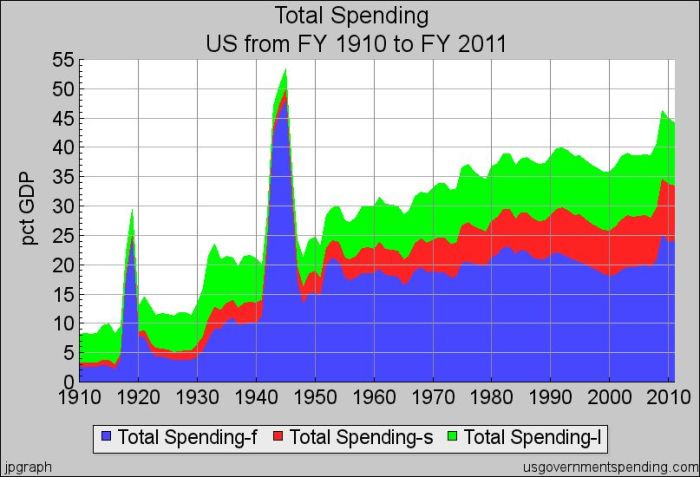
After 1910 however, there is what Lindert and Williamson call the “great leveling” where there is an important decrease in inequality which ends in 1970. This is where I become depressed. In my paper, I highlighted that most of the fall in inequality between 1910 and 1970 occurs because or regional convergence, gender wage convergence and racial wage convergence. Between the 1910s and 1970s, differences in per capita state-level incomes narrowed dramatically (and they have since slightly widened). Between 1910 and 1970, thanks to the migration of blacks to the north, wages between whites and blacks grew closer together. Between 1910 and 1970, thanks to the arrival of household amenities like running water, appliances and electricity, women joined the labor force and the gender wage gap narrowed. None of these factors have anything to do with redistributive policy. Now, I am not claiming that redistributive policy had no impact on inequality measures (that would be empirically false). What I am claiming is that numerous forces were at play – some of which were related to non-governmental factors. Between 1910 and 1970, if one looks at ratios of government spending to GDP, there is a massive increase in the size of government. And yet, many factors of convergence had little to do with government.
Since the 1970s, inequality has surged again – and this is in spite of the fact that governments are growing larger in many respects. While spending is at all levels seems to be either stable or growing, regulatory barriers like licensing regulations and rent-seeking arrangements in the form of corporate bailouts have multiplied. Thus, the rise of inequality occurs in spite of a very active state. Not only that, but I am working on papers with John Moore of Northwood University to study inequality from 1890 to 1940 because we believe that the level is overestimated and misunderstood and (by definition) that this affects the trendline of inequality in the 20th century. If inequality in the 1920s falls slightly, the U-shaped curve of inequality (very high before 1910 falling to 1970 and increasing thereafter) described by Piketty and others becomes a flatter upward slopping curve (maybe more like a J-shaped curve). If me and John are correct (we are still crunching numbers and collecting data) inequality increased with state intervention.
And that is highly depressing. Now, I am a classical liberal who believes that state intervention should be limited. But it is not beyond to recognize that when the state throws tons of money of something, it might get a few things the way it wants (a broken clock is still right twice a day). Thus, I expected some social programs to have an impact (and I still believe that on a case-by-case basis, some social programs do reduce inequality) but I did not expect such a disappointing performance. One could even say “depressing” performance.
Nonetheless, I would suggest to everyone to read Unequal Gains and throw out Capital in the 21st century.
Note: To be clear, Lindert and Williamson are not making the claim I am making here. While their book is predominantly a “positive economics” work, they do propose some policy courses to reduce inequality and argue favorably for redistributive policy. This is merely my “positive take” on their book.
I have recently returned home from 4 days of Prague, Czech Republic, where I attended two conferences: Austrian Economics Meeting Europe and the Prague Conference on Political Economy. After having been secluded from Austrian economists and Libertarians for almost 2 years, it felt like a homecoming to be surrounded again by people who share similar thoughts. This was after all the only place in the last two years where I was able to fully express my (´controversial´) ideas about society. Being surrounded by tremendously smart people – you have to be rather smart and geeky to give up part of your free time or professional work in order to visit conferences and discuss philosophy, politics and economics – within the beautiful city of Prague made it a wonderful experience.
The AEME came about after the summer of 2014 when those from Europe who visited Mises University that year decided to come together again to discuss classical liberal ideas in the spirit of Carl Menger, Ludwig von Mises, Friedrich von Hayek and Murray Rothbard. The first AEME event took place in 2015 in Vienna, Austria, the city where the Austrian School of economic thought emerged from the works of Carl Menger, Eugen von Böhm-Bawerk, Friedrich von Wieser, and others. The Austrian School is famous for its methodological struggle against the Prussian Historical School and their idea that economics is culture- and time-specific and therefore does not contain universal validity. The Austrian School is also famous for such theoretical contributions as the subjective theory of value (as opposed to Marx’ labour theory of value), theory of marginal utility, opportunity cost doctrine, Austrian business cycle theory, the time structure of production and consumption, methodological individualism and the economic calculation problem that was first formulated by Ludwig von Mises in 1920 and later expanded upon by Friedrich von Hayek to show that pricing systems in socialist economies were necessarily deficient. From a socio-political perspective, the School argues for limited government and some even for libertarian anarchism.
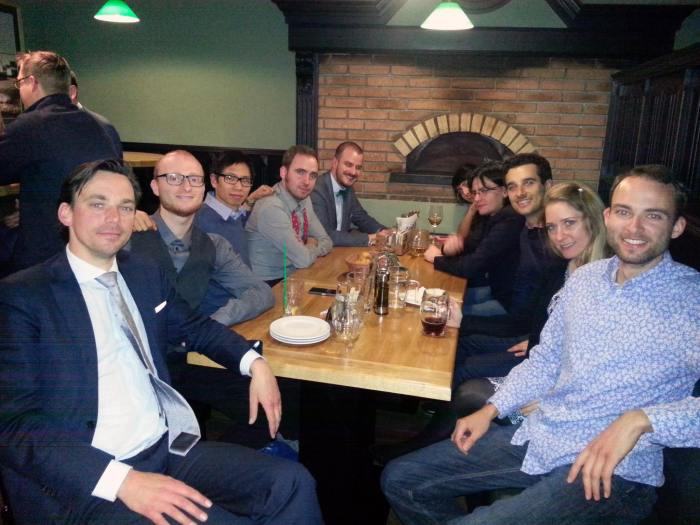
AEME participants sharing their last evening in Prague in a local pub
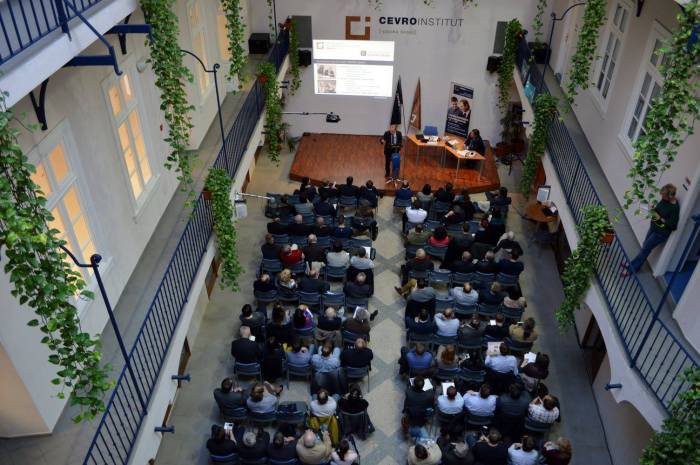
What was great about the second AEME is that it took place right before the PCPE conference at the CEVRO Institute. Most of us who attended AEME have stayed two extra days to attend the PCPE conference as well. The CEVRO Institute is a private university founded in 2005 that is located in the very centre of the city of Prague. The university prides itself in its emphasis on freedom, markets, and its innovative character that is for example manifested in its PPE (Philosophy, Politics, Economics) programme taught by such international illustrious professors as Michael Munger who is also director of Duke University’s PPE programme, Peter Boettke who is the director of the F.A. Hayek Program at George Mason University, David Schmidt who is director of the Center for the Philosophy of Freedom at the University of Arizona, Boudewijn Bouckaert who was the former dean of the Faculty of Law at the University of Ghent, and Josef Sima who is the president of the CEVRO Institute. The institute has invited several prominent speakers for its conference. Prof. Mark Pennington (London School of Economics) was for example invited to present “Why most things should probably be for sale”. Prof. Benjamin Powell who is the director of the Free Market Institute at Texas Tech University, the University to which I almost applied to to pursue my PhD in the academic year of 2015 but eventually decided to work as a software engineer, was there as well to speak about “Migration, Economic Calculation, and the European Situation.” Prof. Mario Rizzo (New York University) had the honour to be the keynote speaker and spoke about “The four pillars of new paternalism” which was followed by commentaries from Prof. Pascal Salin, former president of the Mont Pelerin Society.
Mario Rizzo’s welcome speech to PCPE
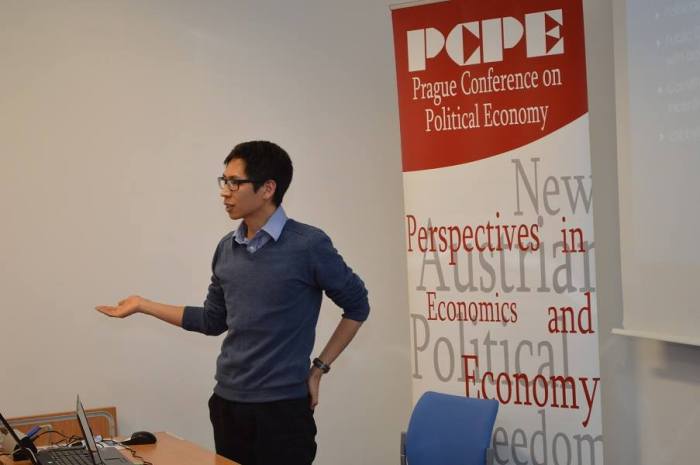
The second day of the PCPE conference, there were 27 speakers spread over 9 sessions on such topics as economic theory, anarcho-capitalism, the Austrian School, entrepreneurship, cryptocurrencies, the role of family and more. I was one of the speakers and spoke on the “Philosophical investigation of seasteading as the means to discover better forms of social organization”. The thesis of my talk was that one core focus of political philosophy is to deal with the realities of value pluralism and political disagreements. I contended that the most common form of social organization, representative democracy, does not satisfactorily deal with these realities. Therefore, we should look for political possibilities beyond representative democracies and that in order to discover these possibilities, we should experiment with new forms of social organizations. By approaching the issue from a meta-system level perspective and realizing that governments are resistant to structural societal changes we should then introduce competition into the industry of governments. Seasteading, the creation of habitable dwellings on the oceans, could serve as a means to introduce more competition in the industry and lessen political tensions between citizens who hold different comprehensive doctrines.
Me speaking at PCPE about Seasteading as the means to deal with such political realities as value pluralism and political disagreements
If I could mention one thing that has made the most remarkable impression on me, it would be the warning issued by Prof. Stephen Baskerville (Patrick Henry College, USA) that the most immediate threat to our liberties is feminism and the social justice movement. He maintained in his talk that there is an ensuing crisis of the family which is perpetuated by the state. According to Prof. Baskerville, family courts can enter homes uninvited, take away people’s children, confiscate their property, and incarcerate them without trial, charge or counsel. With over 50% of all first marriages ending in divorce and more than half of all these divorces involving children, the greatest threat to our liberties is the colluding social work state bureaucracies with radical feminism. These groups have colluded to suppress information on such injustices. Listening to Baskerville’s talk, I felt the great urgency to engage in an intellectual battle against feminism and the social justice movement.
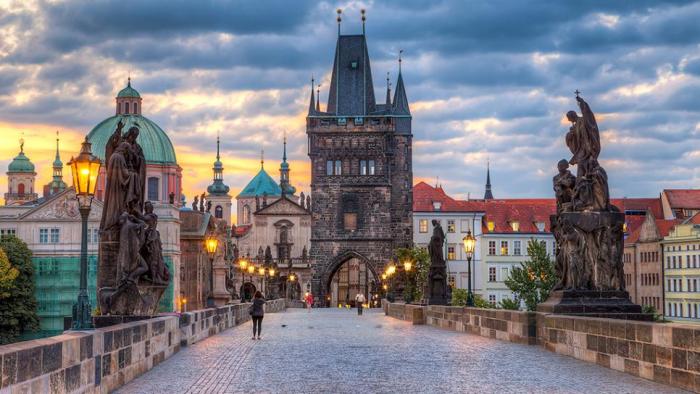
Other than the many intellectually invigorating moments, the city itself provided many magnificent sites. To mention several sights: we visited a beer garden, experienced a classical music concert at the Mirror Chapel, walked over the Charles Bridge, and visited the Prague Castle.
The beautiful Charles Bridge crossing the river Vltava
All in all, the city of Prague, AEME and PCPE were an unforgettable experience! It has already been decided that next year’s AEME conference will take place in Krakow, Poland. The conference will be open for anyone who is interested in Austrian economics and libertarianism. For more information on AEME and the papers that were presented in the previous editions, you can find our website here. In case you are interested in studying at the CEVRO Institute and its MA PPE programme with specializations in “Austrian Economics”, “Studies of Transition”, and “International Politics”, you can visit their website here.
John McAfee’s latest political campaign ad is inspiring as it asks voters to vote libertarian. It is an homage to Apple’s “Think Different” ad as well as to individual freedoms, creativity and intellect.
The video shows ‘rebels’ and game-changers who have moved the world forward. You do find Steve Jobs, Elon Musk, Edward Snowden, Julian Assange, Peter Thiel, Bradley Manning, Ross Ulbricht, Martin Luther King, Ayn Rand and many more. You even see Bitcoin and crypto-capitalism which is simply another form of libertarian anarchism. Ending with the lift-off of a spaceshuttle, the ad presents a message of hope for libertarians and a message of progress as long as we “let life live”.
The same celebration of human individualism and message of hope was also apparent in McAfee’s earlier campaign ad that was released two weeks ago.
Ronald Coase’s theory of the nature of the firm rescued, for neo-classical economics, the existence of firms or corporations as rational entities […] Markets always come first, and the problem of the existence of firms is depicted as the problem of why a rational manager would rely on employees rather than markets. State planning and private firms are taking over what already exists, integrated by the price mechanism of markets, and are successful to the extent that they lower costs, since there are a variety of costs involved in market transactions. Thus marginalist analysis implies that an equilibrium will always be found between planning structures and integration by price mechanism, especially since, as Coase says in “The Nature of the Firm,” “businessmen will be constantly experimenting, controlling more or less” and “firms arise voluntarily because they represent a more efficient method of organizing production.” The rise of the firm, as Coase imagines it, is always a movement from many pre-existing contracts to a controlling structure, “For this series of contracts is substituted one.” (94)
The emphasis is mine. Kelly continues:
This imaginary fits poorly the situations that were precisely the actual origins of firms, as when banks gave mortgages to planters, or stock markets funded companies of young agents, prepared to cut plantations into captured wilderness for tropical commodities […] usually employing labor moved long distances and disciplined by direct violence. There is more in the universe than Coase’s imagination, more motives for controlling powers of firms than their cost efficiencies. (94-95)
Kelly goes on to give a brief account of 1) how corporations created commodity production out of thin air, 2) how these corporations were tied to European imperialism, and 3) how they used slaves and indentured servants even when it would have been cheaper to hire the locals.
I want to address Kelly’s summary of Coase’s paper (here is a pdf, by the way, in case you want to follow along), mostly because I’ve never read it although I know it’s important, but first I want to make a couple of digressions. Libertarians would more or less answer Kelly’s three charges listed above as follows: 1) yes, and this is a good thing, 2) state-sponsored corporations and private firms are two distinct entities with two very different incentive structures, and 3) see #2. There is also an issue of accuracy in regards to Kelly’s brief summary of world history since 1600. I don’t want to get into the details here, but I do want you to recognize that I am reading Kelly critically. My last digression is simply to point out that libertarians and Weberian Leftists like Kelly have more in common than we think.
To get back to Coase’s paper, and Kelly’s critique of it, I want to highlight one sentence from Kelly’s book in particular and then turn it over to the peanut gallery in the hopes of gaining some insight:
Markets always come first, and the problem of the existence of firms is depicted as the problem of why a rational manager would rely on employees rather than markets.
Is this the puzzle Coase was trying to grapple with in his paper? I ctrl+f’d Coase’s paper (“employe” – not a typo) and couldn’t find anything that actually confirms Kelly’s summary, but it would be an interesting project (if I am right in stating that Kelly’s summary of Coase’s paper is not accurate) to follow this line of thought and delve into Kelly’s insight about the reliance that entrepreneurs/firms have on employees (rather than markets)…
Samuel Hammond, a friend of a friend, has recently written a blog post musing about whether trade between Mars and Earth should be discouraged. The basic premise is that the case for colonizing Mars is to decrease the likelihood of a catastrophe leading to the extinction of humanity due to a black crow event.
Inter-planetary trade would allow both planets to minimize the harms of minor to moderate events, Samuel seems to acknowledge this. This is how international trade today helps nations minimize the harms of localized events. The harm of the ongoing drought in California has been lessened due to ability of consumers to tap into markets elsewhere to meet their demands. What Samuel is concerned about is those events whose danger increases in proportion to the inter-connectivity of markets. Samuel gives the example of financial markets, but allow me to introduce another similar danger: the Mule.
The Mule, primary antagonist in I. Asimov’s Foundation & Empire
In Isaac Asimov’s sci-fi universe much of the known galaxy in the distant future comes under the rule of the Foundation Federation. The Foundation is a liberal galactic government that promotes intra-galactic trade, but grants each planet wide freedom to settle its internal matters. It has waged wars of defense, but is notable in that it has never waged a war of conquest and its members have all joined voluntarily. I would go as far to say it is an ideal form of galactic government. However the Foundation’s promotion of galactic inter-connectivity backfires when the Mule, a mutant human with the ability to influence minds, takes control of the government elite. The Mule is a single man but, due to the hyper-connectivity of the Foundation, can assume control with a few well placed followers. Almost overnight the Mule transform the liberal Foundation into his personal dictatorship. The last bastions of freedom are those regions of space controlled by pirates free traders.
Eventually the Mule is defeated and liberal government restored, but only because of the efforts of those polities outside the Foundation’s control. If the Foundation had been a monopolis, a government that controlled all of humanity, then it is doubtful the Mule would have been defeated. Inter-connectivity can yield significant benefits, but as outlined above it can also maximize the damage of black crow events.
Does this mean that Samuel is correct and that any further space colonies must be separated from Earth in terms of trade and governance? Not quite. Although I think Samuel’s concerns serve as an argument against extreme inter-connectivity between worlds, I do not think it is sufficient to justify actively building barriers between worlds. Rather I interpret black crow events as arguments in favor of tolerating the existence of rogue nations, such as North Korea, Somalia, and other contemporary nations that exist outside the primary world system.
As space exploration becomes a reality I think all efforts should be made to promote inter-connectivity between the various worlds. We should promote Earth-Mars relations. We should not however oppose those who wish to live in the asteroid belt and minimize their contact with the rest of us. This break away colonies will arise naturally and need not be actively created, only tolerated. These break away colonies will be founded by an assortment of pirates, religious zealots, political dissidents, and other outcasts. By tolerating their existence we will reap the benefit of space exploration while minimizing the likelihood of black crow events to destroy all of humanity.


 Notes On Liberty