India needs to work harder, both in its own backyard and in its near-abroad

While there is absolutely no doubt that Donald Trump has on more than one occasion sent harsh warnings to Islamabad – calling upon Pakistan to give up its support for terrorist groups or face the consequences – Trump’s predecessors had begun to reduce aid to Pakistan. During the Obama years, for example, American aid to Pakistan dropped from over 2 Billion USD in 2014, to a little over 1.1 Billion USD in 2016.

In his latest tweet, Trump minced no words, saying that Pakistan had fooled the US all these years, and that US will not take this lying down:

The United States has foolishly given Pakistan more than 33 billion dollars in aid over the last 15 years, and they have given us nothing but lies & deceit, thinking of our leaders as fools. They give safe haven to the terrorists we hunt in Afghanistan, with little help. No more!

Trump tweeted early morning on New Year’s Day.

Earlier in the year, during his August speech pertaining to Afghanistan, Trump had categorically stated that it no longer could be business as usual, and that Pakistan needed to stop extending support to the Haqqani network and other groups. Said the US President:

We have been paying Pakistan billions and billions of dollars, at the same time they are housing the same terrorists that we are fighting. But that will have to change. And that will change immediately.

A number of senior officials in the Trump Administration, such as the Secretary of State Rex Tillerson, Defence Secretary Mattis, and Vice President Mike Pence have hinted that harsh steps for Islamabad are a real possibility, some of which include not just withdrawal of aid to Pakistan, but also the removal of Pakistan’s non-NATO ally status.

During his recent visit to Afghanistan, Pence stated that President had put Pakistan on notice. Said Pence: “President Trump has put Pakistan on notice. As the President said, so I say now: Pakistan has much to gain from partnering with the United States, and Pakistan has much to lose by continuing to harbor criminals and terrorists.”

In an oped written for the New York TimesTillerson stated:

Pakistan must contribute by combating terrorist groups on its own soil. We are prepared to partner with Pakistan to defeat terror organisations seeking safe havens, but Pakistan must demonstrate its desire to partner with us.

China – which has strategic and economic interests in Pakistan, with the primary one being the China-Pakistan Economic Corridor (CPEC) – has stood by Pakistan. While reacting to Trump’s August 2017 address, State Councillor Yang Jiechi said:

“We should attach importance to Pakistan’s important role in Afghanistan and respect Pakistan’s sovereignty and legitimate security concerns.”

India’s reactions

New Delhi has understandably been closely observing these events. Trump’s warnings to Pakistan are viewed as positive news for India, and the Trump Administration has also pleased New Delhi by speaking against violent groups that are targeting India. The US, for example, has lent support to India’s demand for declaring Jaish-E-Muhammed (JEM) Chief, Masood Azhar, a designated terrorist by the UN (this move has of course been stalled by China).

Realists in New Delhi will however be keeping an eye on the following issues.

First, sections of the political class in Pakistan, as well as old hands in the American administration will not allow things between Islamabad and Washington to go downhill. A number of Pakistani politicians, such as Sherry Rehman, have already stated that while Pakistan should have its own independent policy, and it should not be submissive, it need not be excessively aggressive. While such politicians may not publicly say so, the fact is that there is a large swath of the Pakistani population which may not be very comfortable with the US, but is even more uncomfortable with the increasing Chinese presence in Pakistan as a consequence of CPEC.

In the US too, there are sections in the State Department which follow the approach of engaging with moderate forces in Pakistan given the country’s strategic importance. There is a section of the US establishment which does not want Pakistan to totally drift away from Washington’s orbit, mostly because China is beginning to take a larger role in the whole of South Asia, including Afghanistan. One of the declarations of the first Foreign Minister-level trilateral dialogue between China, Pakistan, and Afghanistan was the extension of (CPEC) into Afghanistan.

Said the Chinese Foreign Minister:

So China and Pakistan are willing to look at with Afghanistan, on the basis of win-win, mutually beneficial principles, using an appropriate means to extend CPEC to Afghanistan.

Both New Delhi and Washington will closely watch this development.

Apart from Beijing, Pakistan will rely on Saudi Arabia to soften Washington’s approach vis-à-vis Pakistan. The Sharif brothers, both Nawaz and Shahbaz, have strong connections in Saudi Arabia and while there were speculations that the Saudis were trying to broker a deal between the Pakistani military and the Sharifs, there is also a view that there’s an understanding between the Pakistani army and the Sharifs, and that the latter would use their links in the Saudi establishment to soften the Trump Administration, which has strong ties with Riyadh.

In conclusion, there is an increasing awareness with regard to the nexus between the Pakistani army and terror groups targeting India. Yet New Delhi should be more realistic in its calculations, and it needs to not just bank on Washington. Instead, India should also leverage its economic ties with Riyadh and Beijing to put more pressure on Pakistan. While there is no doubt that strategic convergence with Washington has increased phenomenally, Trump’s harsh words against Pakistan are not just driven by any conviction, but also by simple transactionalism. This very transactionalism has also created space for China to become more pro-active in South East Asia and South Asia. New Delhi thus needs to be pragmatic, deft, and leverage its economic rise more effectively.
2017: Year in Review

Well folks, another year has come and gone. 2017 was Notes On Liberty‘s busiest year yet. Traffic came from all over the place, with the most visits coming from the US, the UK, Canada, Australia, and India. (In the past, India and Germany have vied for that coveted 5th place spot, but this year India blew Germany out of the water.)

NOL is a voluntary cooperative, and as such this year saw the introduction of 6 new Notewriters: Kevin Kallmes, Nicolás Cachanosky, Ash Navabi, Tridivesh Maini, Matthew Bonick and Trent MacDonald.

Michelangelo invited Kevin to join, Nicolás is an old grad school buddy of Rick‘s, I reached out to Tridivesh, and Ash and Matthew were invited on Vincent‘s initiative.

Speaking of Vincent, 2017 was his year. He had Tyler Cowen (MarginalRevolution), Mark Thoma (Economist’s View), Anthony Mills (RealClearPolicy), Barry Ritholtz (Bloomberg), Don Boudreaux (Cafe Hayek), John Tamny (RealClearMarkets) and Pseudoerasmus (a well-regarded economic historian) all link to his thoughts multiple times over the course of the year. His Top 10 list for best papers/books in recent economic history (Part 1 and Part 2) were legitimate viral sensations, dominating the top 2 spots on NOL‘s most-read list. Other huge posts included “Did the 30 Glorious Years Actually Exist? (#5),” “The Pox of Liberty – dixit the Political Economy of Public Health (#9),” “James Buchanan on racism,” “The GDP, real wages and working hours of France since the 13th century,” “Did 89% of American Millionaires Disappear During the Great Depression?,” and “A hidden cost of the war on drugs.” My personal favorite was his “Star Trek Did More For the Cultural Advancement of Women Than Government Policies.” Dr Geloso’s thoughts made up 40% of NOL‘s 10 most-read 2017 posts.

My favorite posts from Edwin this year were his analyses of Dutch politics – “Dutch politics, after the elections” and “North Korea at the North Sea?” – but the reading public seemed to enjoy his posts on Ayn Rand, especially her thought on international relations, and his summary of Mont Pelerin Europe more than anything else. Van de Haar’s day job is in the private sector, so his blogging is understandably light (especially given his incredible publishing output in academic journals). I look forward to what looms ahead in 2018.

Federico’s most recent post on artificial intelligence and the law got love from some major outlets, including FT‘s Alphaville blog and 3 Quarks Daily. His question “Does business success make a good statesmen?” and his report on a Latin American Liberty summit are worth reading again, but my personal favorites were his comments on other Notewriters’ thoughts: first jumping in to add some historical clarity to Bruno’s post on Latin American conservatism and then to add layers onto the debate between Mark and Bruno on the Protestant Reformation. Federico has been invaluable to NOL‘s welcoming, skeptical culture and I cannot wait to see what he comes up with in 2018.

Barry was generous enough recount the situation in Turkey after the coup earlier in the year, and fruits of this endeavor – Coup and Counter Coup in Turkey – can be found in six parts:

  1. First of a series of posts on Turkey since 15th July 2016 and background topics
  2. Immediately after the coup and party politics
  3. Gülenists and Kemalists
  4. The Kurdish issue in Turkey
  5. Jacobins and Grey Wolves in Turkey
  6. Presidential Authoritarianism in Turkey

Dr Stocker also began writing an appendix to his six-part series, which resulted in a first post on authoritarianism and electoral fixes. Barry is hard at work on a new book, and of course the situation in Turkey is less than ideal, so I can only hope he has a bit more time in 2018 for NOL.

Michelangelo had a banner year at NOL. His #microblogging has been fun, as were his post analyzing relevant data from his surveys: What libertarians think of climate change, for example, or urban planning in Oregon. Michelangelo also utilized NOL to play around with concepts like race, marriage markets, data, Spanish language services, affirmative action, and freeware, to name a few. My absolute favorite Michelangelo post this year was his excellent “Should we tax churches? A Georgist proposal.” Michelangelo is a PhD candidate right now, too, so if he ever gets some time to himself, watch out world!

Rick also had a banner year at NOL. His post arguing against Net Neutrality was one of the most-read articles of the year here (#4), and many of his wonkier thoughts have been picked up by the sharp eye of Anthony Mills (RealClearPolicy) and the excellent Chris Dillow (Stumbling and Mumbling). Rick is my favorite blogger. Posts on cycling in Amsterdam, subsidies, management and measurement, linguisticsmore subsidies, and my personal favorite of his for the year, “Why do we teach girls that it’s cute to be scared,” always make me think and, more importantly, smile.

Bruno’s blogging was also amply rewarded this year. His thoughts on some of the problems with postmodernism brought in the most eyeballs, but thankfully he didn’t stop there: Articles introducing postmodernism and highlighting the origins of postmodernism also generated much interest. RealClearWorld picked up his post analyzing Brazil post-Rousseff (he had more analysis of Brazilian politics here and here), and his post delving into whether Nazism is of the left or the right provoked quite the dialogue. Dr Rosi was at his best, though, when prompted by Mark to further advance his argument that the Protestant Revolution played an integral role in the rise of the freedom of conscience. Times are tough in Brazil right now, so I can only hope that Bruno continues to play a vital role as a Notewriter in 2018.

Chhay Lin, now in the private sector, had his post about Bruce Lee’s application of Taoist philosophy head to the top of reddit’s philosophy sub, and his post on Catalonia and secession got love from RealClearWorld and Lew Rockwell (Political Theater). I hate to be *that* guy distracting a man from making his money, but I hope to see Chhay Lin pop in at NOL much more often in 2018!

Zak has been busy with a number of different projects, as well as attending Michigan-Ann Arbor full-time. He still managed to have one of his posts, on “libertarian” activist hypocrisy (#10), highlighted in the Guardian, the UK’s premier left-wing mouthpiece. His post on The Nancy MacLean Disgrace earned him plaudits from the online libertarian community and Don Boudreaux (Cafe Hayek), and his posts on open borders and income inequality show just how much of a bad ass he has become. I had a tough time trying to pick out my favorite Zak article of 2017, so I’m just gonna highlight all three of them:

  1. Immigration, Cultural Change, and Diversity as a Cultural Discovery Process
  2. Why I’m No Longer A Christian…
  3. Against Libertarian Populism

They’ve all got great self-explanatory titles, so do yourself a favor and read ’em again! Hopefully Zak can continue to work NOL in to his many successful ventures in 2018.

Jacques continues to amaze me. He’s been retired from academia for – as far as I can tell – at least a decade and he’s still producing great material that’s able to reach all sorts of people and places. His post on the Ottoman Empire and libertarianism (#6), which was featured at RealClearWorld and much-shared in Ottomanist corners of Twitter – took aim at popular American libertarian understandings of decentralization and seems to have landed pretty squarely on target. My favorite post of Dr Delacroix’ this year was about French Africa (also featured at RealClearWorld), but his late-year book review on Christopher De Bellaigue’s 2017 book about Islam might end up being a classic.

Bill’s 2017 here at NOL was productive and he continues to impress. His “Speech in academic philosophy: Rebecca Tuvel on Rachel Dolezal” brought in thousands of readers, but it was not his ability to draw crowds that I found impressive. His ability to tackle tough concepts and tough issues came to the forefront this year: drug use, “vulvæ,” more drug use, party culture (my personal fave), schooling (another personal fave), more schooling, and music (personal fave). Bill’s ability to weave these trends together through the lens of individual freedom is so much fun to read and important for fostering a culture of tolerance and respect in today’s world. I can’t wait to see what 2018 has in store for him!

Nicolás came out firing on all cylinders this year. With excellent dialogues between himself and Vincent, as well as between himself and guest blogger Derrill Watson (who I hope will be back for more in 2018), Dr Cachanosky’s passion for teaching has shown through clearly and brightly. I hope 2018 – his first full year with NOL – is filled with much more hard-hitting but insightful blogging from Nicolás.

Ash brought the heat, too. Check out the subject matter of his first few posts here at NOL: “A Right is Not an Obligation,” “Physical Goods, Immaterial Goods, and Public Goods,” “The Economics of Hard Choices,” “Markets for Secrets?,” “A Tax is Not a Price,” and “A Radical Take on Science and Religion.” Like Nicolás, Ash’s first full year at NOL is coming up, and if 2017 is any indication, readers can look forward to an interesting and engaging 2018.

Mark’s first full year here at NOL was a definite barnburner. His debate with Bruno on the Protestant Reformation (#8) brought in a bunch of eyeballs, including from RealClearHistory, while his “The Return of Cyclical Theories of History” also brought in thousands of readers, thanks in large part to Robert Cottrell’s excellent website, the Browser. Dr Koyama’s review of Aldo Schiavone’s The End of the Past also caught Mr Cottrell’s eye and the attention of his readers. Mark’s post on geopolitics and Asia’s “little divergence” is well worth reading again, too. Like Zak and Bill’s posts, I couldn’t choose just one favorite, so I give you two:

  1. Political Decentralization and Innovation in early modern Europe
  2. Some Thoughts on State Capacity” (an especially good criticism of American libertarian understandings of the “state capacity” literature)

We’re lucky to have Mark here at NOL.

Kevin, like Ash and Nicolás, brought the ruckus for his first few posts here at NOL. Kevin’s very first post at Notes On Liberty – “Rules of Warfare in Pre-Modern Societies” (#3) – ended up on the front page of RealClearHistory while his “Paradoxical geniuses…” earned a spot on the Browser‘s prestigious reading list. Not a bad start. Kevin will be finishing up the second half of his first year of law school (at Duke), so I doubt we’ll see much of him until June or July of 2018. My personal favorite, by the way, was Kevin’s “Auftragstaktik: Decentralization in military command.” His posts on taking over Syria – Roman style, the median voter theorem, and inventions that didn’t change the world also got lots of love from around the web.

Nick’s post on public choice and Nancy MacLean (#7) earned a nod from Arnold Kling (askblog), Don Boudreaux (Cafe Hayek), Chris Dillow (Stumbling and Mumbling), Mark Thoma (Economist’s View), and pretty much the entire online libertarian community, while his post analyzing the UK’s snap election earned a spot at RealClearWorld. Dr Cowen’s thoughts on school choice and robust political economy, as well as a sociological analysis of Trump/Brexit prompted by Vincent, all garnered love from libertarians and scholars around the world. My favorite Cowen post was his question “Is persecution the purpose?

Overall, it was a hell of a year here at Notes On Liberty. I’m really looking forward to 2018. Here’s to a happy, healthy you. Oh, and my proudest piece this year was “North Korea, the status quo, and a more liberal world.” HAPPY NEW YEAR!

Lunchtime Links

  1. Trophy-taking and dismemberment as warfare strategies [pdf]
  2. optimally vague contracts and the law [pdf]
  3. Germanic and Carthaginian republicanism
  4. traditional resurgence in tropical Africa [pdf]
  5. crisis bureaucracy: homeland security and the political design of legal mandates [pdf]

From the Comments: New Republics, Westphalia, and Russian Strategy

Thomas L. Knapp (check out his two contributions to the most recent Cato Unbound symposium on voting) has a great comment about Ukraine (Russia) that deserves further scrutiny:

In order for Putin to “pull out of” Ukraine, he’d first need to be in Ukraine.

The new republics which seceded from Ukraine are not in Ukraine.

Knapp brings up an interesting point that most geopolitical outlets and experts rarely consider (the Washington Post‘s Worldviews is a notable exception, as is Ilya Somin over at Volokh Conspiracy), and because of that these outlets fail to provide any depth or light to the world around us. There are three aspects of Knapp’s excellent comment that I’d like to hone in on.

The new republics

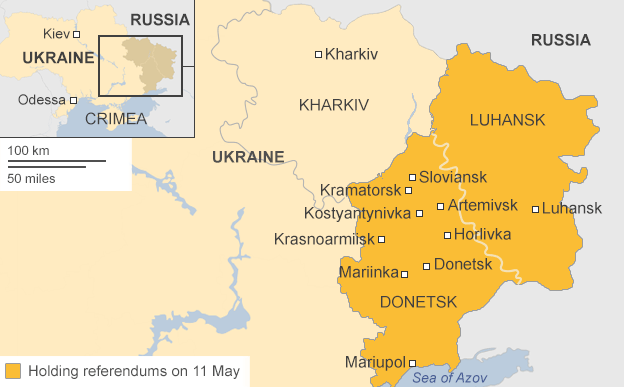
First, what are these “new republics” Knapp mentions? If you don’t count Crimea (wiki), which Moscow formally recognized in 2014, then the new republics that declared their independence from Ukraine are Luhansk (wiki) and Donetsk (wiki). Both polities are roughly 3300 square miles in area and house roughly 1.5 million people (you can get the exact numbers from the wiki links I provided above). Here is a map:

74717073_ukraine_donetsk_luhansk_referendum_624
(source)

Alarmingly, both republics style themselves “people’s republics” and (less alarmingly) have aligned publicly with Moscow. Russia, by the way, has not recognized these “new republics,” for geopolitical reasons I hope to make clear below.

Westphalian sovereignty

Russia does not like to recognize new polities (“republics”) because of its adherence to the ideal of Westphalia, which is state sovereignty (elsewhere at NOL Barry Stocker argues that the Westphalian ideal can be better understood as an early modern cosmopolitanism rather than state sovereignty). All throughout the Cold War Russia and China were staunch supporters of the Westphalian ideal (as were states in Africa and Asia that broke away from colonial empires), and they became even more so after the collapse of socialism in 1993. State sovereignty is the idea that states (“countries”) have sole control over what goes on in their own borders, and that any interventions of any kind, by any type of organization, needs to be approved by the state. It is called “Westphalian” because of the Treaty of Westphalia that was signed by a number of major and minor European states in the 17th century. The major states were able to maintain a balance of power and the minor states were able to assert more sovereignty over their territories than ever before because they were signatories of an international treaty. (Edwin van de Haar’s article in the Independent Review [pdf] on the balance of power as the most libertarian option available is worth reading, and is made stronger, I believe, by Giovanni Arrighi’s argument [pdf] that the balance of power led directly to the “capitalist oligarchies” that eventually pushed feudalistic institutions out of Europe beginning in the late 15th century.)

Russia, China, and other autocratic regimes prefer an international system that is respectful of state sovereignty because of the fact that this idea helps their governments to administer an amount of coercion on populaces that Western states consider immoral or rights-violating.

Russian strategy

Why did Russia hint at recognizing Donetsk and Luhansk, but ultimately decide not to recognize them? Because the West has been recognizing separatist republics since the USSR fell apart, and it has done so in the traditionally Russian sphere of influence (noticeably carving up Yugoslavia at Serbia’s geographic expense). The West has not carved up post-Soviet space by simply recognizing the sovereignty of self-proclaimed republics, but also by incorporating these polities into the international system that it dominates. Russia wants to show elites (but not necessarily the public) that it is tired of policymakers ignoring Westphalian notions of sovereignty (which are enshrined in the UN charter that almost all recognized states have signed; when they sign it they get rent-seeking privileges, but that’s a story for another day…).

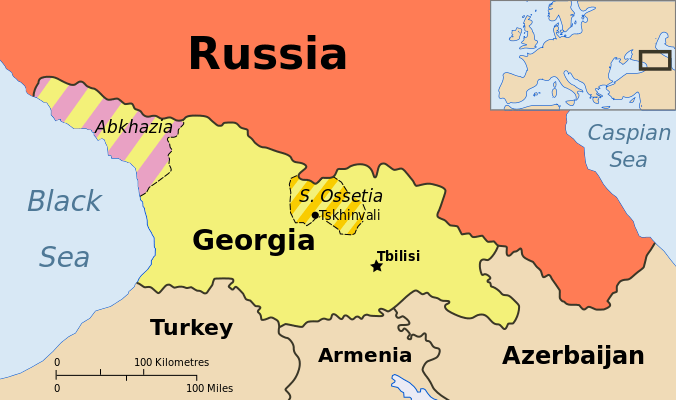
This is fairly straightforward logic on Moscow’s part. When the West supported Kosovo’s secession from Serbia (in defiance of Article 2(4) of the UN charter), Russia responded by supporting South Ossetia and Abkhazia breaking away from Georgia before annexing them. The interesting thing here is that Russia even mimicked Western use of force to back up its play. When the West supported Montenegro’s secession from Serbia (in defiance of Article 2(4) of the UN charter), Russia responded by supporting Donetsk, Crimea, and Luhansk breaking away from Ukraine before annexing Crimea. The interesting thing here is that Russia even mimicked Western use of force to back up its play. Both Russia and the West used minimal military resources to achieve their objectives, and both played the sovereignty card to back up their actions.

blog-map-of-caucasus
(source)

Western policymakers will never be able to bring liberty to Russia, and liberty will never be known by Russians if the rule of law is trumped by geopolitics. The West dominates the world’s international governing organizations. It has made the rules. It has drawn up the contracts. It has invited the non-West to participate. It has given concessions in order to gain the non-West’s support. So when the West breaks the rules it first outlined and drew up, the non-Western polities it convinced to join IGOs in the first place cannot be expected to take such rules seriously. The fact that Russia does play by the West’s rules, by taking seriously the claims of breakaway regions, suggests that the West has been in the wrong post-1993.

American media pundits and critical thinking

All of this leads me back to sensationalist headlines about nefarious Russian meddling in the American presidential election. Don’t believe any of that garbage. Firstly, look at how often American foreign policy pundits have been wrong. Just look! Amid the cries of Russian meddling in the Clinton-Trump contest you can surely hear the faint echoes about weapons of mass destruction in Iraq. Secondly, all good analyses of geopolitical affairs provide at least some bit of historical context to them. Does your foreign policy pundit use history as a guide? Thirdly (and lastly), when thinking about a country remember that most accounts will have a point of view that shadows the consensus found in the world’s political and financial centers, which are useful but will sacrifice important details in the name of efficiency (and efficacy).

American libertarians, of all the factions out there, realize this best. Unfortunately, until they can shake the isolationist dogma that has paralyzed the movement since the Rothbard era of the 70s and 80s, they will continue to be marginalized in contemporary discussions about foreign policy, either as token libertarians in a Republican administration or as token libertarians in the “anti-war” movement (I put “anti-war” in scare quotes because by now it should be obvious that this movement represents the Democratic Party [pdf], not an ideal; see, though, Michael Kazin’s excellent, if ultimately unconvincing, argument for a different take on the disappearance of the anti-war movement once Obama and the Democrats came to power). New republics, secessionist movements, and other endeavors of exit are often embraced by American libertarians because of their autonomist appeal, but if they don’t pay attention to how state actors view such movements, especially regional and global hegemons, they may end supporting some very nasty regimes in the name of liberty.

BC’s weekend reads

  1. Smuggling Nikita Khrushchev’s memoirs out of the USSR
  2. Are memes disrupting American politics? So asks a Leftist
  3. The 4th Amendment, policing, and pedagogy
  4. At least the end of the War on Drugs is nigh
  5. A new (old) strategy for a polycentric world (but why not federation?)
  6. A simple map of Brazil and its states

BC’s weekend reads

  1. Generals and Political Interventions in American History
  2. they neglect to take account of the experiences of postcolonial states that form the vast majority of members of the international system. “
  3. The U.S. Hasn’t ‘Pulled Back’ from the Middle East At All
  4. No special sharia rules in American courts for Muslims’ wrongful-death recovery
  5. Is Gary Johnson a True Libertarian? American libertarianism has a purge problem
  6. Identity politics and the perils of zero-sum thinking

BC’s weekend reads

  1. China’s Legalist Revival
  2. Does Europe need a new Warsaw Pact?
  3. Daniel Larison (PhD in Russian History) on Trump’s foreign policy speech
  4. The Anti-Trumplodytes
  5. Why Popular Sovereignty requires the due process of law

BC’s weekend reads

  1. Libya Epitomizes Hillary Clinton’s Not-So-Smart Power
  2. Paradoxes of the Gray Zone
  3. The Kurdish Conundrum
  4. The Future of the Arab
  5. Just Following Orders: Leadership Lessons from Argentina’s “Dirty War”

BC’s weekend reads

  1. Dank Federalism
  2. What About Capitalism? Jürgen Habermas’s Project of a European Democracy
  3. The IDF gets leaner as its enemies evolve (the US should do the same, by the way)
  4. A moderate defense of extremism in defense of liberty
  5. Why I lean libertarian
  6. Backlash grows to Schengen backlash

Go Broncos

BC’s weekend reads

  1. Bohumil Hrabal: the life, times, letters and politics of a Czech novelist
  2. What Davos Missed by Excluding North Korea
  3. The Rise and Fall of the Soviet ‘Death Star’
  4. Searching for Vadim Kozin, the Soviet tango king
  5. Are we likely to see new nation-states emerge this century?
  6. Historical Methodology and the Believer (of Islam)

Russia in Syria: A Gift to the West (but not to Syrians)

I don’t see why so many Western commentators and analysts are up in arms over Russia’s move into Syria. (Actually, I do: From Ukraine to Iran to Syria, Moscow has been more active in geopolitics than it has been for nearly 25 years.) Moscow’s move into Syria can only be seen as a gift to the West, in terms of strategy and geopolitics. Think of it this way:

Russia has no military experience whatsoever outside of its borders. The Russian military did a ruthlessly good job of stamping out secessionist movements in the Caucasus, and its internal security bureaucracy has done a great job of stifling dissent and shaping the narrative that Moscow wants to be highlighted. Yet Russia’s success outside of its borders has been paltry, at best.

Intervention in Ukraine has brought widespread, global condemnation upon Russia, and economic sanctions to boot.

The Russians in Syria are going to be ruthlessly slaughtered and exploited by the myriad of factions in the region. Not only is Russia backing the wrong horse (Assad), it is backing it up with hardware and personnel that have no experience with the region. Russia has produced an insular intellectual class over the past 15 or 20 years, and this is going to play out badly for its Syrian intervention.

The West, which has an awful lot of experience playing factions off on each other in the Near East, will most likely take advantage of Russian ignorance (to the detriment of Syrian society as whole) and as a result the world will see a Russian military outsmarted, outgunned, and outmanned by an insurgency with no official support from the outside world. The Russians are going to get bloodied in Syria. I don’t see why Western hawks are so keen on making Russia “pay” for its excursion on the global diplomatic stage.

Around the Web

  1. Why Women Hunt: Risk and Contemporary Foraging in a Western Desert Aboriginal Community (pdf)
  2. Competing to Be Leaderless: Food Sharing and Magnanimity Among Martu Aborigines (pdf)
  3. In Pursuit of Mobile Prey: Martu Hunting Strategies and Archaeofaunal Interpretation (pdf)
  4. Signaling Theory, Strategic Interaction, and Symbolic Capital (pdf)
  5. Rethinking Rights (and Freedom): A Series (be sure to scroll through the ‘comments’)
  6. Deconstructing Colonial Historiography: A Case Study of Afanasy Nikitin

Odysseus and Individuality

The Iliad is the story of Achilles moving from rage with an ally to sympathy with an enemy. Many other characters appear and the extremism of Achilles’ character, which leads him to remove himself from battle and therefore the narrative, lends itself to allowing other characters to present other possibilities of human personality.

The Trojan characters, particularly Hector, provide on obvious source of alternatives, but so do the other Greek hero warriors, and one of those who emerges most distinctly is Odysseus. Though Odysseus is a fierce remorseless warrior, inclined towards killing the enemy, particularly when the enemy can be seen as socially inferior, he is also characterised by his intellectual resources. It is highly indicative that one of the major appearances of Odysseus in The Iliad is on a spying trip into the Trojan camp. This early appreciation of the role of intelligence of in warfare is part of what makes the Homeric epics a classic of the theory of war, as well as a class of many other kinds.

Odysseus we see in The Iliad is the best adapted of the Greek kings to moderating disagreements, speaking with a constructive purpose in assemblies and councils, and thinking about the conduct of the war. This does not always make him sympathetic, but it does show that the human individual can exist in a very vivid and alive way through speech and thought as well as through anger and violence.

It is fitting then that Odysseus get his own epic, The Odyssey, which contrasts the very communal, even hyper communal, world of men at war, with the growing isolation of a man separated both from the brothers in arms community of Troy and from his family community back in Ithaca. The journey from Troy to Ithaca takes him right across the Greek world of the time, conveniently for symbolising other kinds of distance between the world of war and the world of human community. That is in part the distance between a world of plunder and slave girls on one side, and a world of productive labour and marriage on the other side. The Homeric poems does not make the contrast as favourable to the home community, as that might suggest.

Clearly the Heroes at Troy in some way feel most alive at war, straining their human faculties most in that endeavour. The Iliad also suggests other ways in which individuals can heighten the sense of life, the athletic competition at the funeral of the Patroclus and the desire to be remembered in poetry are the most obvious. These are not separate activities from war in Homer. Odysseus participates in games and weeps at poetic performance about himself in the land of the Phaeacians. In both cases war is very close. The games nearly turn in to violence between Odysseus and a Phaeacian who ‘accuses’ him of being a merchant and the poetry refers to the Trojan War.

With all due qualifications, we can still say that The Odyssey shows the value for an individual of getting back to the peaceful world of productive labours and familial affections. It also shows an individual losing all of the normal social bonds that define the self and finding other aspects of the self, which are not obviously present in the community of war and plunder or the community of family and labour. These are the aspects of the self which are part of ‘individualism’, of the idea as an individual as having an existence behind and, to some extent, separable from the most deeply entrenched social roles and connections. The appreciation of such aspects of the individual is the ethical foundation of political ideas of liberty, and Homeric poetry, though apparently the product of very communal communities, does much to establish that ethic (in some ways more than later philosophers in the antique world).

Odysseus confronts the possibility of a lonely death at sea after losing all his men in the long journey from Troy. The fault is partly his and partly his men. The vital passage for many of these issues is the adventure in the land of the Cyclops. Odysseus is thoughtless of danger when he takes some of his men to a cave whose occupant is absent, where they feast on the available food. Odysseus is taking assumptions about the applicability of laws of hospitality to an imprudent extreme here, and even tips over in plunder when it seems he plans to return to the ships with much of what is in the cave before the occupant returns.

The occupant, Polyphemus, returns too soon for that and is inherently more inclined to consume his guests than give them presents. Odysseus evades death through cunning, partly by telling Polyphemus that his name is ‘No man’. This idea of Odysseus that he might be taken as anyone and therefore no one, is itself a comment on how being some thing depends on being recognised as someone. It is also a resourceful individual thinking of how to use these abstractions to evade danger. Odysseus, however, guarantees ten more years of danger by boasting of his name and demanding it be known when he is sailing away from the island, incurring the enmity of Polyphemus’ father the god Poseidon.

The danger of the name and the desire for a name is emphasised later in the Sirens episode where malevolent demigoddesses try to lure Odysseus to his death with songs of the glory of Odysseus. To only want to live by your name as warrior heroics is dangerous. Odysseus has to resist this to live and again be thrown back on a very individualised kind of individuality.

The Homeric role in the origins of liberty is then partly bound up with the sense that even an individual very tied to the basic forms of community in his society can only fully thrive and live, if wiling to experience and play with, or suffer, separation from social bonds, and that the strength of those bonds itself rests most strongly on characters who can confront and live from encounters with extreme and even traumatic loss of communal bonds, and without becoming addicted to such situations and there dangers either.

Some more thoughts on what to do with conspiracy theorists and other libertarian sympathizers

Just a quick note on a perennial topic…

Years ago I met my (now) ex-girlfriends crazy uncle. For whatever reason we ended up talking about how some policy or other was a bad idea. “Oh cool,” I thought, a fellow traveler. And then he started talking about how 9-11 was an inside job. “Okay, sure, whatever, but there’s so much else. We could actually convince people that, for example, a better regulatory system could improve the world.” To which he replied that yes indeed 9-11 sure was extra inside-job-y.

Now, this guy was a legitimately crazy uncle, so whatever. But this exchange wasn’t about his being a crazy uncle, because I’ve met plenty of non-crazy, non-uncles who have been similarly zombie-like. Whether they’re of the “Obama is a secret gay Muslim” variety, or any other variety of conspiracy theorist, they are just completely uninterested in attacking the Democratic party for any sensible reason. And this is true of anti-Republicans too. There the conversation is something like “war sure is bad, huh?” “Yeah, and Bush’s puppet masters set the whole thing up.” “Okay, let’s just assume that’s true, how do we reduce the amount of war?” “By getting hung up on evidence that only convinces people who don’t need any more convincing!” “I’m going to go get another drink.”

Here’s the thing: there are plenty of good arguments for opposing whoever it is you want to oppose. Yes, it feels good to talk about how the bums in charge are pawns for the cartoon-mustache-twirlingly-evil powers that be. But if you want to be taken seriously, keep it to yourself.

I see two things going on here. First, these conspiracy zombies are simply bad at thinking like economists. The first rule of being a good economist is that you have to recognize opportunity cost. By perseverating on the big, exciting, good-vs-evil struggle amongst competing factions of the Illuminati (I guess?) you attach all your attention to something you’re unlikely to have any real influence on at the expense of minor but achievable goals like marginal improvement of the immigration system, or school choice, or any number of other things the other side is willing to discuss with you (yeah, yeah, they aren’t willing to discuss that stuff because they’re convinced that your side is in a deal with the devil too…).

Second, and this is more troubling, people have a natural predilection to these sorts of things. People would rather get excited about conspiracies than actually make the world a better place. Is there anything we can do about that? I don’t know. Maybe we need to convince rank-and-file Republicans and Democrats that aliens are conspiring to pit humans against one another by making us argue unproductively rather than simply reform immigration policy. Maybe Krugerz was right?

From the Comments: Russia Resurgent and a Libertarian Strategy

I am working on a speculative piece about the recent assassination of liberal (i.e. libertarian, a.k.a. internationalist) politician Boris Nemtsov in front of the Kremlin. In the mean time, here is an old comment of mine on Russia’s new grand strategy:

Thanks Dr A,

I still think this is all a part of Russia’s symbolic strategy against the West. As you mention, the referendum is not legally binding and nobody aside from Moscow has recognized it.

What I think the best option available to the West would be to go ahead and recognize the independence of regions within Russia’s “official” borders (the territories you mentioned, for example).

To back this up, simply make a mockery of the whole process going on in Crimea. Have a couple of silly press conferences. Then, to add teeth to the recognitions, publicly announce some weapons deals with Georgia and Ukraine. Publicly announce that all Western arms-related bans in the Caucasus are to be repealed.

Then point out, in a rueful manner, that Canada and Mexico are under threat from domestic fascists and must be invaded in order to protect the American citizens and lovers of American citizens in those two countries.

Mocking Russia’s current moves in Crimea will have a much greater impact on policy decisions and public opinion than economic sanctions (which will only make things much, much worse).

Sanctions are a prelude to war.

There is also the issue of secession and political oppression to think about. As it stands, the Crimeans should be able to vote their way out of a political union with Kiev. So, too, should Dagestanis, Chechens, Karelians, etc., be able to vote their way out of a political union with Moscow. The fact that only guns have so far been able to secure a vote in favor of public opinion (Crimean secession from Ukraine) suggests that liberalism has yet to reach enough minds and institutions to have the positive impact that I think it could have on the world.

I also don’t buy the argument, made by some, about the fact that at least one of these oppressed post-socialist, post-Soviet regions was able to secede from a political center it deemed oppressive and should therefore be viewed in a positive light, even if it was Moscow’s guns which brought about the change. To me this line of reasoning is akin to arguing that the US invasion of Iraq was a cautious positive for the world, even though half a million people died due to the invasion, because there is now one less dictator in the world.

Secession needs to be viewed as a legitimate political option for peoples and this recognition needs to be incorporated into the legal systems of liberal societies if we want to avoid more conflicts like the one between Russia and Ukraine. The world is devolving politically, which means secessionist tendencies will increase, and if there is no political or legal mechanism (much less intellectual recognition) for dealing with these aspirations then be prepared for more problems in the post-colonial world (see this and this), but not so much in the West (see this and this). Liberals, of course, have been at the forefront of the secession debate since John Locke first brought it up in his 1689 classic Second Treatise of Government.