The Helsinki Follies

Myself, my wife, Rush Limbaugh, and a couple of others on FB, alone of those who express themselves publicly, have taken leave of their senses. The obvious has stopped waiving at the American intelligentsia (Russian word, on purpose).

Mr Mueller, in charge of demonstrating that Russia gave Mr Trump the election, announces three days before a president’s meeting with Mr Putin that he has charged 12 Russian military intelligence officers with crimes (presumably, violations of American law).

Several things are wrong with this picture.

First, is it a surprise that Russian military intelligence is trying to mess with us? Is this new? Did they used not to? Why make a major announcement of it? It’s routine stuff. Catch them; slap them! Is it the case that US intelligence agencies never tried to mess with Mr Putin’s endless re-elections? What’s their excuse if they did not? Is it the case that our intelligence agencies are not interfering with, say, Venezuela’s political processes today? Really? I liked better the days when our CIA had balls and was the scourge of everything and everyone progressive and socialist.

Second, ignoring the futility of the charges, what’s the chance any of the twelve is going to show up to be tried in America? Not great? Reminder, tentative reminder: Kidnapping them on foreign soil to bring them to American justice would probably violate someone’s law. So, why bother; why indict them? What was the purpose? What was the purpose, a couple of days before President Trump was to meet Mr Putin publicly? Was the purpose other than satisfying justice? Was the purpose to cover up and distract from something more important? Did it have to do with Mrs William Clinton?

Mr Putin offered – short of extraditing the twelve – several compromise solutions so that Mr Mueller could interrogate the Russian intelligence officers named. Will Mr Mueller accept any of those offers? Why not? Give a good reason why he should not.

Reminder: Extradition treaties between countries are always reciprocal: I send you the people you charge; you send me the people I charge. There are really good reasons the US should not want to have such a treaty with Russia.

Does Mueller really want to interrogate the Russian intelligence officers he charged, really? Does he want the truth? (Isn’t it already known?)

How was Mr Trump supposed to respond to such a brutal and vicious attack on his honesty, proffered by Mr Mueller while he was going to be on foreign soil? Was he supposed to lower his eyes, smile sweetly and keep mute? I would not have! He should not have! Should he not have allowed doubt about our intelligence agencies pass his lips, after what the FBI, for example, did? Is he crazy; is he stupid?

Putin is a brutal dictator, a meddler, and probably a murderer. With its nuclear arsenal, his country is the only one really capable of hurting us irreversibly. Good reason to talk to him. We don’t have to be friends but some formal courtesy is required.

The collective reactions of the American political class to the Helsinki meeting tells me that it has lost touch with elementary reality. It’s folly; it’s in a state of collective hysteria. I remember being there before. That was in the eighties.

Warning: If you are sensitive, please, don’t read the next sentences.

In the 80s, the media were awash with denunciations of brutal sex abuse of small children by Satanic cults. People were charged, convicted and sentenced on the testimony of four-year-old coached by eager, man-hating social workers. I remember well, especially, a story in The Atlantic. A father of two confessed to nailing his small daughters to the floor of his living room so his buddies could rape them. The next day, the girls would go to school as usual. No problem! I believe no apologies were ever issued. The justice system was very reluctant to let go of the imprisoned.

A senior Wall Street Journal journalist, Dorothy Rabinowitz, had a solitary struggle of several years to get the wrongs righted.

Wake up, America; get a grip! Those are wooden nickels you are taking!
Nightcap

  1. Cambodia and the academic Left Matthew Blackwell, Quillette
  2. Lewis Carroll’s adventures in Russia Mark Davies, Times Literary Supplement
  3. Does ‘Melanesia’ exist? Rhys Griffiths, History Today
  4. KFC: Kentucky Fried Camel Sarah Osman, Coldnoon

Nightcap

  1. Did Cicero Devise Modern Constitutional Thought on His Own? David Potter, Law & Liberty
  2. Russia’s Pacific history is little known, perhaps even in Russia Peter Gordon, Asian Review of Books
  3. The Opium War and the Humiliation of China Ian Morris, New York Times
  4. The Puzzle of Russian Behavior in Deir al-Zour Kimberly Marten, War on the Rocks

Nightcap

  1. Lake Wobegon’s Ghost Churches Rod Dreher, The American Conservative
  2. The Russian affinity for American stuff continues unabated Guy Archer, Moscow Times
  3. Avoiding World War III in Asia Parag Khanna, National Interest
  4. Did government decentralization cause China’s economic miracle? Hongbin Cai, World Politics

Nightcap

  1. Privilege Versus Paranoia Steve Salerno, Quillette
  2. Russia, sport, absurdity, and reality Arkady Ostrovsky, Times Literary Supplement
  3. Christian Zionism in America Steven Grosby, Law & Liberty
  4. Welcome to North Macedonia Michael Goodyear, Le Monde Diplomatique

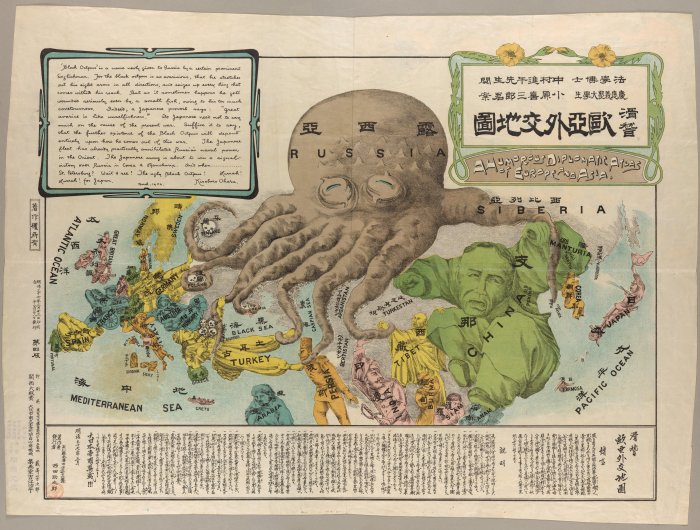
Eye Candy: Japanese anti-Russian propaganda

NOL map Japanese anti-Russia
Click here to zoom.

This dates from the late 19th or early 20th century. The Japanese won the Russo-Japanese War, but a quick glance at the casualties suggests it was more a pyrrhic victory for the Japanese.

Nightcap

  1. The Russian view of Syria and Israel Michael Koplow, Ottomans and Zionists
  2. It’s time to end one-size-fits-all approach to aid Seth D. Kaplan, American Interest
  3. How the Syrian protests spiraled into savagery Ian Birrell, Spectator
  4. Historians can’t seem to catch up to urbanization Michael Goebel, Aeon

Can you spot the most important information in this title?

The Diplomat has a piece up with the following title: “Russia’s Sole Aircraft Carrier to Be Fitted With Advanced New Air Defense System.”

The author of the piece goes on to wax poetic about the advanced new air defense system, but that’s not the most important information being conveyed. It’s the fact that Russia – Russia – has a single aircraft carrier.

Here is Popular Mechanics on countries and their aircraft carriers.

Nightcap

  1. Why the West is Suicidal Daniel McCarthy, Modern Age
  2. US Constitution requires congressional authorization for war Ilya Somin, Volokh Conspiracy
  3. When autarky becomes the only solution Branko Milanovic, globalinequality
  4. Revolution, Lightning, and the People’s Will Kevin Duong, Public Domain Review

Nightcap

  1. Religion and human rights Bruce Clark, Erasmus
  2. Voltaire and the Buddha Donald Lopez, Public Domain Review
  3. The politics of the past in Europe and Russia Douglas Smith, LA Review of Books
  4. Lessons unlearned, empire falls Niall Ferguson, Vanity Fair

Bolton’s Iran policy: could it strengthen the China-Russia-Iran-Pakistan axis?

John Bolton, who took over as Donald Trump’s National Security Adviser on April 8, has had significant differences with India on a number of issues in the past. As US Ambassador to the UN, he opposed India’s elevation to the United National Security Council (UNSC), even at a time when relations were at a high during the Manmohan Singh-Bush era. Bolton had initially opposed the Indo-US nuclear deal, though later he lent his support. While the Trump administration has sought to elevate India’s role in the Indo-Pacific region, Bolton has expressed the view that there are some fundamental differences between India and the US. In the short term, though, there is no serious divergence.

Bolton and Iran

What would really be of concern to India however is Bolton’s hawkish approach towards Iran. Bolton’s views are not very different from those of US President Donald Trump and recently appointed Secretary of State John Pompeo. Bolton is opposed to the Iran Nuclear Agreement signed between Iran and P5+1 countries in 2015. In 2015, the NSA designate called for bombing Iran, last year he had criticized the deal, and last year he had called for scrapping the deal.

The Iranian response to Bolton’s appointment was understandably skeptical. Commenting on Bolton’s appointment, Hossein Naghavi Hosseini, the spokesman for the Iranian parliament’s National Security and Foreign Policy Commission, said: Continue reading

Nightcap

  1. The socialism of moralizing fools Chris Dillow, Stumbling and Mumbling
  2. Friedrich Hayek’s devotion to the free market Linda Yueh, Times Literary Supplement
  3. The art of the Big Lie Phil Tinline, New Statesman
  4. Revolutionary Terrorism and Russian Literary Culture Chelsea Gibson, LA Review of Books

Eye Candy: the Russian Civil War

Click here to zoom

(h/t Adrián)

Nightcap

  1. A question about Israel for a Bleeding Heart Libertarian Irfan Khawaja, Policy of Truth
  2. How Putin has changed, and subjugated, Russia Christian Esch, der Spiegel
  3. Russia’s bite is not nearly as powerful as its bark Daniel DePetris, the Skeptics
  4. Who cares about Washington anymore? Parag Khanna, Politico

“Does Russia own a piece of the US?”

That’s the title of my latest piece over at RealClearHistory. An excerpt:

The Russian-American Company was run through Saint Petersburg and thus had a strict racial hierarchical code in place, in conformity with the latest beliefs about race at the time. The neighborhoods of Fort Ross were segregated, but an archaeologist at the University of California, Berkeley, Kent Lightfoot, has produced excellent research at Fort Ross, showing how the Company’s racist charter was unofficially ignored, with miscegenation widespread (“creoles” was even created as an official race for documentation purposes) and interethnic activities commonplace. The people inhabiting Fort Ross preferred to follow instead something the anthropologist Jean-Loup Amselle calls “mestizo logics.”

Please, show me some love.

Kent Lightfoot can be found at NOL here. Jean-Loup Amselle can be found at NOL here. I also give a shoutout to Andrei Znamenski‘s work in the piece, so be on the lookout for that.

I didn’t get to delve as much into this piece as I’d have liked to. I wanted to get more into the inner workings of the Russian-American Company and compare it to the Dutch East India Company, but that sounds like a tall task even for a PhD dissertation.

I don’t think I did a good enough job of highlighting just how rich Pacific Rim trade was in the early 19th century. I tried in vain to sneak a reference to Hawaiian laborers that could be found throughout the Pacific world at the time of Fort Ross’ founding, but I’ve got a 600 word limit.

Also, I wanted to highlight the fact that Native Americans weren’t losers in the opening up of the Pacific to the world. They were active participants in the globalization of the Pacific Rim trade. They were powerful. I don’t know if I’d focus on California Indians to highlight Native American actors. I’d probably focus on an area a little further north, in the Puget Sound-Vancouver area.

At any rate, hope you enjoy the piece!