Famine and Finance: Credit and the Great Famine of Ireland

41YjUSWp3JL._SX351_BO1,204,203,200_I have recently finished reading Famine and Finance by Tyler Beck Goodspeed. While short, it should have a prominent place on the shelves of economic historians interested (obviously) in Irish history and (less obviously) in Malthusian theory.

Famine and Finance is a study of the response of Irish farmers to the potato blight. As it is known to many, many individuals simply left Ireland. However, where micro-credit was available, Goodspeed finds that farmers adapted by shifting to different types of activities – notably livestock. These areas experienced a smaller decline in population. Basically, where the institution of micro-credit was present, the demographic shock was much less severe. If only for this nuance, the book makes a sizeable contribution to the historiography of Ireland. The methods used are also elegantly simple and provide an interesting road map for anyone interested in studying the responses of local population to environmental shocks.

However, the deeper point comes from it tells us about institutions. In Goodspeed’s story, the amplitude of the collapse of the Irish population in the 19th century depends on the presence of the institution of micro-credit. Basically, the institution determined the amplitude of the shock. Since Ireland’s potato blight is often presented as the textbook case of Malthusian pressures, Goodspeed’s results are particularly interesting. In his chatper titled”Was Malthus Right?”, he shows that when controls for the institution of micro-credit is present, the typical Malthusian variables fail to explain population changes. In other words (i.e.  my words) , Malthusian pressures (the change in population) are in fact institutional failures.

This is a point I have often made elsewhere (see here, here and here and a blog post here). And because Goodspeed backs this point of mine, he has earned himself a place on my shelf of “go-to” books.

Illegal Immigration: Pres. Trump’s New Measures

I can’t wait for the raging assaults by the pseudo-cultural elite and by the media against Pres. Trump to stop to begin criticizing some of his decisions, as I would with any other president.

I have heard and read reports that the president intends to launch a policy of accelerated repatriation of illegal aliens. It will single out criminals for priority deportation (as was the case under Mr Obama). At this point, almost everybody agrees about getting rid of illegal aliens who are real criminals, especially the violent ones. Again, the new policy sounds a lot like Mr Obama’s, with a few details different. The details often matter when it comes to human lives, also when it comes to traditions of government. Here are two such details.

First, I have heard that even traffic tickets qualify an illegal alien for quick deportation. Make a wrong u-turn and your life gets broken up.

Second, I have heard and read that even being merely charged with a crime places you at the head of the line for deportation. Someone who looks like you steals a car. You get charged by mistake. You are gone.

The first detail seems awfully rough to me. I would feel better if the word “recidivist” were included. A person who breaks driving rules repeatedly is a trouble-maker we can do without. A guy who is too distracted to interpret the U-turn sign (could be me – once) is not exactly a criminal in the real sense of the word.

It’s true that such extreme severity would improve the driving of all illegal aliens. The claim is probably also correct however that it would interfere with aliens’ (legal and not) willingness to cooperate with the local police. Aside from this, I would bet it would involve significant law enforcement costs just to process traffic tickets through to the Immigration Service. I am a conservative, I am against big government, even against big government at the local level. I don’t want tax money, federal, state, or local, to be wasted processing a U-turn violator. It seems irrational to me.

The second, detail concerns the treatment of people only charged with a crime. It’s simple. I just don’t want any of them to be included in the priority list. Having any branch of government treating the accused as guilty simply goes too strongly against everything I believe. It’s un-American.

Yes, I have not forgotten that the subjects have no right to be in the country in the first place. I don’t care. It’s not about illegal aliens’ rights. Immigrants, legal or not, have no rights as a category as far as I am concerned. They only possess the ordinary human rights of anyone under American jurisdiction.

It’s about a slippery slope for all. If we begin officially thinning out the traditional wall between “charged” and “guilty,” where are we going to stop?

I understand that a lawyer would argue that the person is technically not being deported for the imaginary crime of being charged but because he has no right to be in the country, period. Do you know the one about the lawyer….

Dear Muslim Fellow Citizens:

President Trump’s executive order temporarily barring entry into the US to those coming from seven countries was a rude act.* To make things worse, it was badly implemented, causing inconvenience and even distress to a number of innocent travelers. What’s more, it’s unlikely to be very effective in its stated goal of keeping Americans safe. The reason the administration gave for the order was to give the appropriate agencies some time to improve their techniques for vetting ordinary travelers from those countries.

As I write, the bar is in circuit court where it will be decided whether a previous federal judge’s order suspending application of the bar holds or not. There is a mano-a-mano between a largely liberal circuit court and a fairly conservative and decisive new executive. Whether the executive prevails or not, the order was given and it will be remembered as one of the first acts of the Trump administration. It’s worth discussing.

Much of what has been said about the order is false, ridiculous, or dishonest. I urge you to preserve your collective credibility by not falling for the falsehoods, and worse, for partially true but misleading statements you have heard. Some, you have heard repeatedly.

Beyond this, I suspect you have not done enough collective self-examination. I suspect this because no one reasonable talks to you frankly about matters concerning you. There are plenty of ill-informed hysterical, obscene anti-Muslim shouts which you probably (rightly) shut out. The rest of America is too paralyzed by political correctness to say anything to you that may seem critical. I am reasonable and I am not paralyzed by political correctness. In addition, there is a good chance I am pretty well informed. (Go ahead, Google me.) Where I am not, I listen to advice and corrections with an open mind. I wish to talk to you about mistrust of Muslims and about what you may not have done to represent yourselves in a light inducing others to be fair. Lastly, I wish to address you about what you have done that has not been helpful.

The persecution of Muslims

Fact: The seven countries the executive temporary banning order targeted are all predominantly Muslim countries.

That does not make the order an anti-Muslim measure. If President Trump had wanted to persecute Muslims, Indonesia, Pakistan, Egypt and even India (yes, India) would be heading the list. There are something like forty predominantly Muslim countries in the world. How do you think the seven were chosen?

The seven were originally selected by the Obama administration as dangerous countries from which it was difficult to obtain enough information to vet travelers. This explains why most Muslim countries – by a long shot – did not make the list. In the case of five Arab Muslim countries on the list, they are there because they are failed states unable to provide credible information if they want to. Iran is a special case. President Trump, and some of us, think that the information should not be trusted that comes from a country where the political class has been smiling benevolently for the past thirty years on demonstrators whose main demand is “Death to America!” Taking people at their word is not a dirty trick, right? The sixth country on the list, Sudan, is there for both reasons. It’s an ineffective state and its leadership is openly hostile to America. It’s unable to cooperate in vetting and it will not.

Why should President Trump want to go to extraordinary lengths to vet travelers from those particular countries, you wonder suspiciously? It’s because – you are right – the Muslim world is widely thought to be a privileged source of terrorism. That’s in the 21st century. In the 20th century, it would have been (largely Catholic) Ireland, the (Catholic) Basque area of Spain and, especially, the (Hindu) Tamil area of Sri Lanka. The fact that no IRA terrorist, no ETA terrorist and no Tamil Tiger terrorist ever claimed to be acting in the name of God or of his religion may make a difference though. What do you think?

Personally I don’t see how anyone can disagree with the proposition that Muslim countries (not all, some, of course) generate large numbers of terrorists when those same terrorists massacre many more Muslims than they do anyone else? I can’t believe you are not aware of the many car bombs detonated near mosques during prayer from Pakistan and Afghanistan to Iraq. And have you ever thought of what the proportion of Muslims must have been at the massacres in the French night club or during the Bastille Day festivities, in Nice, France? Let me tell you: Many French Muslims are immigrants from rural areas in Africa. It’s been true for a long time. They have more children than people born in France. Whenever you find children and young people, in France, you are looking at many young Muslims. And, go back to the “Underwear Bomber” trying to blow up a plane over largely Muslim Detroit, during Christmas Eve, of all times. Who do you think would have died, primarily? How many Christians are on a plane on that night? (Reminder: He is a young man from a good Nigerian family. He is having a bad time in federal prison, right now.) It’s your duty to be informed about the people who are massacring both your people and your neighbors, I think.

Incidentally, the fact that Muslims die much more than other people under the knife of neo-jihadists does not give your passivity a pass.

This all is sufficient to explain well why there are only Muslim countries on the ban list. It would have been more polite of the Trump administration to add, say Iceland, Paraguay, and Laos, or Timor. Perhaps, they did not think of it. No one is perfect. Perhaps they did think of this trick and decided to not implement it to signal that political correctness has to go, at last.

Before I move on, note what the paragraphs above do not (NOT) say, lest your memory tricks you later: They do not say that “most Muslims are terrorists,” as stupid liberals allege such statements mean. I don’t think most Muslims are terrorists. I do not think that many Muslims are terrorists. I am not even sure the terrorists who claim to be Muslims are Muslims, or good Muslims. I don’t really know. However much I regret it, I can see how it is easy to find justification for religious acts of violence in the Islamic sacred Scriptures. (Ask me or tell me plainly that I am wrong, that there are no such justifications in the Scriptures.)

Trump’s order was intended to keep terrorists where they are for the time being, until we learn better to spot them. It was intended to protect me and my children, and you and your children. I have my doubts about its efficacy, as I have said elsewhere. You should feel free to criticize it on that ground without going to motives you have little way of knowing. “Stupid” is not the same as “prejudiced.”

The Muslim contribution to the mistrust of Muslims: Inaction

Next, I need to ask you if Muslims collectively have done anything to contribute to widespread mistrust of Muslims in America. First I need to ask what American Muslims did not do that they should have done – and can still do. This can be brief.

Large American Muslim organizations have put themselves repeatedly on the public record denouncing terrorism perpetrated by those who claim to be inspired by Islam. They are quick to assert that religious violence is incompatible with Islam, that the neo-jihadists are simply bad Muslims, or even, not Muslims at all. This is all for the good although – I am sorry – most of the protestations sound hollow. One of the things missing, incidentally – is condemnations by obvious religious authorities.

What bothers me personally, and probably others who don’t have the time to think about it, is the lack of individual faces to accompany condemnations of neo-jihadist barbarism. There are two exceptions I know of, two Arab-American men who sometimes come on TV to reject barbarism or any links to American Muslims vigorously. I don’t have either name in mind right now and I would not name them anyway because I don’t have a clear idea of the risks they are taking.

What I am missing is reactions from individual, private persons of Muslim faith, people with a face. I ask how many of you said anything – outside the family – when ISIS was beheading an American journalist and then, an American social worker, all on video. I wonder if you said anything, at work, even if only at the water fountain, when ISIS was burning people alive in cages. How many of you expressed horror aloud or when it was turning thousands of young women and girls into sex slaves. How many dismiss Boko Haram which is burning its way through North Western Nigeria as a (black) African monstrosity?

Some of you, most of you, or all of you, think these questions are superfluous and even, that my expectations are outrageous. I have a friend, a young Muslim woman who tells me straight up that terrorism is no more her problem than mine. It’s unrealistic and it’s false. The abstract category “American Muslims” (I am not using “community” deliberately) turns out enough terrorists and would-be terrorists to destroy this presumption of distance between you and the prevalent kind of barbarism. Note also that, irrespective of provocations, since the masterful, well-planned, very successful aggression of 9/11, there has not been a single act of private terrorism against Muslims or Muslim institutions in America. (Hectoring of women wearing the hijab in public places does not quite count as terrorism.) Mind what I am really saying: It’s not your job to stop terrorism committed in your names but you would be wise to reject it forcefully and loudly, and also in person when you have a chance.

The Muslim contribution to mistrust of Muslims: Actions

There are also the things American Muslims did that contributed to the process leading to the Trump administration temporary ban on travel from seven Muslim countries.

Let me help you remember. In 2008, you voted for Barack Obama in large numbers although he was a leftist of zero demonstrable achievement but one. (He did pass the bar exam.) I don’t know if you did it because the father he never knew was a Muslim (a drunken Muslim), or because his middle name is “Hussein,” or because you were caught up in the great Democratic emotional sweep. Later, in 2016, you largely supported the candidacy of an obvious liar and cheat who had already sold some of the country to foreign powers before even being elected. What’s more, she presented herself squarely as President Obama’s successor. Many of you just bet on the wrong horse without much of an excuse for doing so. (I think I have read somewhere that American Muslims are better educated than the average American. Correct me if I am wrong.)

Had more of you voted Republican, they just might have influenced the result of the primary, perhaps, Marco Rubio (my candidate) would have won it, or the honorable Mayor Giuliani. The presidential election could have played out differently. If it hadn’t, there is a chance you would have still earned a voice within Republican politics. You chose instead to trust in liberal cliches to go with the easy flow of falsely generous liberalism.

Even with Donald Trump as president, you would have avoided getting trapped in the Democratic identity mishmash. You would have saved yourselves the embarrassment of ending up squeezed in their book between illegal aliens from China and transgender activists. At this point, your main public, visible representation in American politics – by default, I realize – is the pathetic, corrupt loser’s personal assistant. She is very elegant but she is married to a gross pervert. The fact that her parents are members of the Muslim Brotherhood does not help. It’s not a terrorist organization exactly but it’s very unfriendly to America and to its main values. By the way, you appear to still not be paying enough attention. The fact is that, right now, thousands of Americans are talking (and screaming) in the streets in defense of, and often in the names of, Muslims in general. Yet, the voices of American Muslims themselves are hard to perceive in the din. It makes no difference; when the fog clears up, some Americans are going to blame you for the riots. You are innocent, of course but, to a large extent, you put yourselves there.

There is danger in letting others speak in your place on the public square. It’s the same others who recently used the armed power of government to force others to violate their conscience. (By forcing a Catholic nuns’ order, for example, to provide contraceptive services to their employees.) How is this going to play out tomorrow when your own religious practice needs protection, I wonder.

The executive order and our constitutional order

There is much misunderstanding everywhere about the legal nature of the order. It’s all over the media and elsewhere. One Iranian woman, a distinguished MD, I am told, is suing the federal government because she suffered some travel inconvenience as a result of the executive order. (I don’t know if she is a Muslim; it does not matter.) I hope the suit only shows confusion about the American Constitution rather than some sinister plot. Whatever some little liberal judge in the boondocks may say, the Constitution does not apply to those who are not under the power of the US government. This includes citizens, legal permanent residents, illegal permanent residents, prisoners of war, to some extent, and those who are already on US soil by whatever means, or otherwise under exclusive US control. It does not apply to Mr Yokama in Osaka, to Mrs Dupont in Marseille, or to Ms Reza in Iran, or on a layover in Dubai.

The media have also shown growing confusion about the nature of a visa. It’s not a contract between a government and a private foreign party. It’s not enforceable in any court. It’s a promise to admit and evidence that someone is considered acceptable at a particular time. Either of these assessments can change in minutes. Incidentally, American immigration officers at all levels have always had discretion to do what they think is best: You can arrive at LA International from Finland, with a perfect visa, and have a fat federal employee in short sleeves get suspicious of you and deny you admission on the spot. There is no legal recourse, never has been.

Nation-states avoid canceling visas in ways that would look arbitrary, for two reasons. First it makes the relevant government lose international credibility. That’s a subtle phenomenon. No one knows how much denials and cancellation push the relevant country over the brink. Thus, any government, including, the Trump administration assumes it has a good deal of discretion in this matter. The second possible consequence of many negative visa events is that other governments may take retaliatory measures: You do it to us, we do it to you or even, we deny your citizens any visa. It’s not surprising that some governments of small, poor countries just don’t care much about serving up reciprocation to a large, desirable country such as the US. If you are an alien and you have a visa for the US, it means that you have a good chance to get in. It’s not a guarantee.

The president and his conservative supporters are not responsible for the confusion about the Constitution whipped up and smartly supported by liberal opinion.

Islamophobia

By now, I suspect, you are thinking “Islamophobia.” I don’t quite know how to defend myself against accusations sitting in your mind about what’s going on in my own mind. It’s like suspecting me of watching porn inside my head. How can it convince you that I don’t? Nevertheless, for what it’s worth, nothing predisposes me to a blind, irrational hatred of Islam or of Muslims. I have known Muslims all my life. I have had nothing but harmonious personal relationships with them. I think there is much to love in Islamic culture. For example I am fond of calligraphy in Arabic, the language of the Koran, so fond that the Profession of Faith (the Sha’hada) hangs over my bed. (I wouldn’t be surprised if this usage by a non-believer is considered blasphemy, somewhere or other.) The few times I have lived among Muslims, I have liked it. There is even a Muslim country where I would like to live permanently now that I am old. (My wife won’t hear of it; what do you know!)

“Islamophobia” is not a real concept anyway. It was invented by liberal intellectuals to shut up debate up. If it were not so, there would be other similarly formed words such as “Protestanphobia” and “Bhuddistphobia.” The impression that Muslims in America take refuge behind that rotten old hyena hide is deplorable. It feeds many unfair stereotypes.

And, by the way, what would be wrong with being an Islamophobe? I mean in the American tradition of freedom of conscience and freedom of speech? Being a Muslim is not a race, an unalterable fact about a person. It’s a choice. If I understand a little about Islam, it’s even the supreme choice. There is widespread confusion there also.

Why should anyone not be morally, intellectually allowed to detest a choice you can reverse any time you wish? Take me, for example. I used to be a Catholic. I am not anymore. I am an ex-Catholic. Anyone could have blamed me for being a Catholic, a believer in fairy tales and a supporter of an organization massively complicit with child rape. “Catholicophobe” would not become an insult; it did not. Why would you deserve special treatment, in this regard?

No one at all blames me either for being an ex-Catholic, by the way. There is (well-founded) Catholicophobia in this country. There is no such thing as “ex-Catholicophobia.” I am also aware as I write that changing religion is called “apostasy.” I am further aware that apostasy is punishable by death in a number of countries. They are all Muslim countries, as far as I know. (Please, correct me if I am wrong on this.) One of the advantages of living in the US, as you and I do, is that there is no penalty here for transgressions of conscience. There is no punishment for walking away from a set of beliefs. This is never discussed in narratives that use the word “Islamophobia.” We don’t speak enough about such matters. Muslims, in particular, don’t speak enough. (And, I don’t believe the media suppress such conversations. The liberal media will print anything said by anyone identified as “Muslim,” especially if the speaker wears a hijab.) I realize that one can find many statements by American Muslims on the Internet. That’s not good enough; I shouldn’t have to do research.

There is also much confusion – often spread by the liberal media – about the First Amendment to the US Constitution. That main amendment to the Constitution is widely misunderstood, by native-born citizens and by many others as well. It states categorically that government cannot have a favorite religion; it says that government cannot interfere with religious practice or belief. Moreover, the Constitution forbids government to administer religious tests as a precondition to holding any government office. That’s it!

There is no part of the US Constitution that protects anyone from criticism by private parties. There are countries where such criticism is illegal; the US is not one of them. Personally, I hate Communism and Devil worship, and I also detest obsessive talk about baseball statistics, for example. Do I have a right to my dislikes? May I express them openly? Should I count on the protection of my government – whose first assignment is to protect me – when I express these dislikes? May I say safely, “Devil worship is an abomination”? How about, “Christianity is a false religion”? Should you, personally, have to forbid yourselves from detesting Devil worship aloud? How does the Constitution answer these questions?

Since I began talking calmly about things some Muslims don’t enjoy hearing, let me continue a little way. Let me affirm as a preamble that you have as much right to be here as anyone. If you are an immigrant like me, you might have even a little bit more right than most. (Immigrants contribute somewhat more than the native-born.) Irrespective of your rights, if you are a person who dislikes the separation of Church and State, if the gap between religion and government is anathema to you, I hope you will leave. I won’t do anything about you but you must know that I don’t want you as a fellow-citizen. And, if you take my suggestion, please, take with you as many Baptists, Lutherans and Catholics of the same belief you can find. I hope our government will do its best to limit or prevent the entry of people who hold such beliefs.

To end: It’s likely that most of you are people with whom I would like to have a cup of coffee or a meal. I suspect that we have more in common than not. You would yourselves be astonished at what a pleasant person of culture I am in real life. (Go ahead, Google me.) We would talk about our children and our grandchildren. We would share our experiences in the country I chose. This probable commonality creates no obligation for me to tolerate nonsense. The Trump temporary executive order of mention may well be regrettable. If it’s unlawful – I don’t see how – it will not be implemented. Our institutions are working. In the meantime, it’s not the end of the world. We, Americans, you and I, have bigger fish to fry.

About Syria: There are tens of thousands of Syrian refugees we could take in without endangering ourselves. We should do it, for two reasons. First, it the right thing to do and it’s good for our souls. Second, we are partly responsible for the unending disaster in Syria. I have not forgotten the red line in the sand the dictator Assad was not supposed to cross or else…. That was before the Russians were heavily involved. At the time, the US Air Force and the US Navy could have destroyed 95% of Assad’s planes and helicopters in one morning if there had been political will. It would have made it extremely more difficult for him to continue fighting and to massacre civilians. We did not intervene. Now, we have to give a hand, a big hand. I don’t see why this help should include a path to citizenship.


*The executive order has been suspended by a judge (a single judge) as I write. The Administration fast track appeal has been rejected. Afterwards, the administration appealed to the 9th Circuit Court. Our institutions are doing their work even if it’s at the cost of some judges believing it’s their job to make laws. To my mind, the fact that the order was issued at all is important whether it’s ultimately put to work or not.

A non-argument against immigration

I often encounter the argument that immigrants, especially Muslims, are so different from the populations of their host countries that they threaten the institutional foundations of these societies. As a result, the logic goes, we must restrict immigration.

I do not accept that argument as valid nor do I accept it as sufficient (in the case I am wrong) to make the case in favor of further restrictions on immigration.

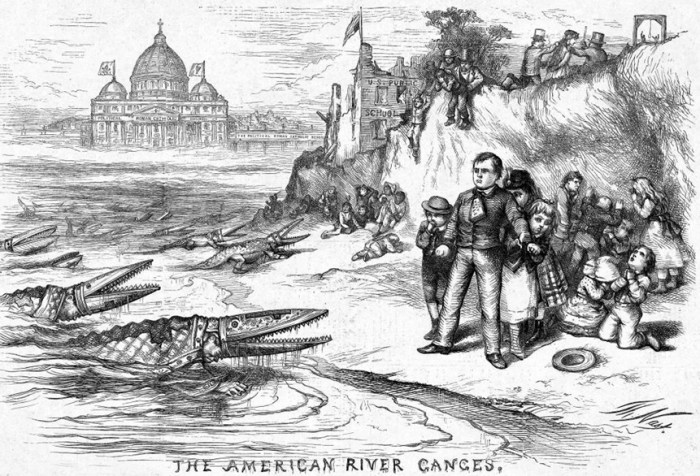
First of all, the “social distance” between immigrants and the hosts society is very subjective. The caricature below offers a glimpse into how “unsuited” were Catholic immigrants to the US in the eyes of 19th century American natives. Back then, Catholics were the papist hordes invading America and threatening the very foundations of US civilization. Somehow, that threat did not materialize (if it ever existed).  This means that many misconceptions will tend to circulate which are very far from the truth. One good example of these misconceptions is illustrated by William Easterly and Sanford Ikeda on the odds of a terrorist being a muslim and the odds of a muslim being a terrorist. Similar tales (especially given the propensity of Italian immigrants to be radical anarchists) were told about Catholics back then. So let’s just minimize the value of this argument regarding going to hell in a hand basket.

nast1

But let us ignore the point made above – just for the sake of argument. Is this a sufficient argument against more immigration? Not really. If the claim is that they hinder “our” institutions, then let them come but don’t let them participate in our institutions. For example, the right to vote could be restricted to individuals who are born in the host country or who have been in the country for more than X-number of years. In fact, restrictions on citizenship are frequent. In Switzerland, there are such restrictions related to “blood” or “length of stay”. I am not a fan of this compromise measure (elsewhere I have advocated the Gary Becker self-selection mechanism through pricing immigration as a compromise position).*

The point is that if you make the argument that immigrants are different than their host societies, you have not made the case against immigration, you have made the case for restrictions against civic participation.

* Another “solution” on this front is to impose user fees on the use of public services. For example, in my native country of Canada, provincial governments could modify the public healthcare insurance card to indicate that the person is an immigrant and must pay a X $ user fee for visiting the hospital. Same thing would apply for vehicle licencing or other policies. Now, I am not a fan of such measures as I believe that restrictions on citizenship (but offering legal status as residents) and curtailements of the welfare state are sufficient to deal with 99% of the “problem”. 

Trump Is Right!

It is easy to emphasize all that is bad about the new American President. For sure, I think he is a clown who will do a few bad things to the US and the world at large. His protectionist agenda is of course a libertarian nightmare, which will also make the people who elected him worse off. Still, the US President is not a dictator, so some trust in the institutions and the actors that fill them still seems appropriate.

Trump is also plainly right on a number of issues. Foremost, his plea (also in yesterday’s inaugural address) for the partners of the USA, especially in NATO, to contribute in equal measure. This is not new, all recent American Presidents have pointed this out to their European allies. It is simply outrageous to let Mrs Jones from North Dakota pay for the defense of other rich countries, such as my home country of The Netherlands. The Europeans got away with major free riding. Only recently did they start to get their act a little bit together, as the Russian threat is looming again. The defense budgets in almost all European NATO members have decreased drastically since the early nineties, which is plainly immoral if you are in the world’s most important security organization together. So hopefully Trump will pressure them to the max.

He is also right in pointing out that many US foreign interventions have been a disaster. And it is good that he wants some closer scrutiny from now onwards. I am not a great fan of military intervention, although I also do not want to rule them out them perennially (as opposed to many others in the liberal tradition). Many of the interventions over the past few decades have lead to nothing though, and created their own follow-up problems. So it’s pretty good if that same Mrs Jones is not likely to lose her son or daughter at the battlefield in some faraway country.

And of course Trump is right in asserting that the government is not ruling the citizens, but is just a service provider on behalf of the people, and fully accountable to them. Sure this is bit more complicated in practise, but it is the only proper principle.

So in these three respects: hail to the new chief! Hopefully he sticks to them and does not screw up too dramatically at all other policy fields.

From the Comments: New Republics, Westphalia, and Russian Strategy

Thomas L. Knapp (check out his two contributions to the most recent Cato Unbound symposium on voting) has a great comment about Ukraine (Russia) that deserves further scrutiny:

In order for Putin to “pull out of” Ukraine, he’d first need to be in Ukraine.

The new republics which seceded from Ukraine are not in Ukraine.

Knapp brings up an interesting point that most geopolitical outlets and experts rarely consider (the Washington Post‘s Worldviews is a notable exception, as is Ilya Somin over at Volokh Conspiracy), and because of that these outlets fail to provide any depth or light to the world around us. There are three aspects of Knapp’s excellent comment that I’d like to hone in on.

The new republics

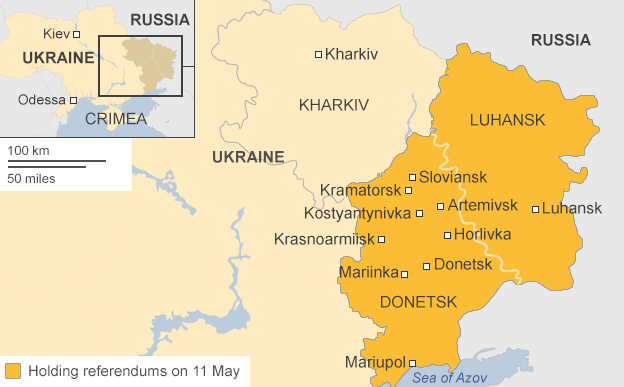
First, what are these “new republics” Knapp mentions? If you don’t count Crimea (wiki), which Moscow formally recognized in 2014, then the new republics that declared their independence from Ukraine are Luhansk (wiki) and Donetsk (wiki). Both polities are roughly 3300 square miles in area and house roughly 1.5 million people (you can get the exact numbers from the wiki links I provided above). Here is a map:

74717073_ukraine_donetsk_luhansk_referendum_624
(source)

Alarmingly, both republics style themselves “people’s republics” and (less alarmingly) have aligned publicly with Moscow. Russia, by the way, has not recognized these “new republics,” for geopolitical reasons I hope to make clear below.

Westphalian sovereignty

Russia does not like to recognize new polities (“republics”) because of its adherence to the ideal of Westphalia, which is state sovereignty (elsewhere at NOL Barry Stocker argues that the Westphalian ideal can be better understood as an early modern cosmopolitanism rather than state sovereignty). All throughout the Cold War Russia and China were staunch supporters of the Westphalian ideal (as were states in Africa and Asia that broke away from colonial empires), and they became even more so after the collapse of socialism in 1993. State sovereignty is the idea that states (“countries”) have sole control over what goes on in their own borders, and that any interventions of any kind, by any type of organization, needs to be approved by the state. It is called “Westphalian” because of the Treaty of Westphalia that was signed by a number of major and minor European states in the 17th century. The major states were able to maintain a balance of power and the minor states were able to assert more sovereignty over their territories than ever before because they were signatories of an international treaty. (Edwin van de Haar’s article in the Independent Review [pdf] on the balance of power as the most libertarian option available is worth reading, and is made stronger, I believe, by Giovanni Arrighi’s argument [pdf] that the balance of power led directly to the “capitalist oligarchies” that eventually pushed feudalistic institutions out of Europe beginning in the late 15th century.)

Russia, China, and other autocratic regimes prefer an international system that is respectful of state sovereignty because of the fact that this idea helps their governments to administer an amount of coercion on populaces that Western states consider immoral or rights-violating.

Russian strategy

Why did Russia hint at recognizing Donetsk and Luhansk, but ultimately decide not to recognize them? Because the West has been recognizing separatist republics since the USSR fell apart, and it has done so in the traditionally Russian sphere of influence (noticeably carving up Yugoslavia at Serbia’s geographic expense). The West has not carved up post-Soviet space by simply recognizing the sovereignty of self-proclaimed republics, but also by incorporating these polities into the international system that it dominates. Russia wants to show elites (but not necessarily the public) that it is tired of policymakers ignoring Westphalian notions of sovereignty (which are enshrined in the UN charter that almost all recognized states have signed; when they sign it they get rent-seeking privileges, but that’s a story for another day…).

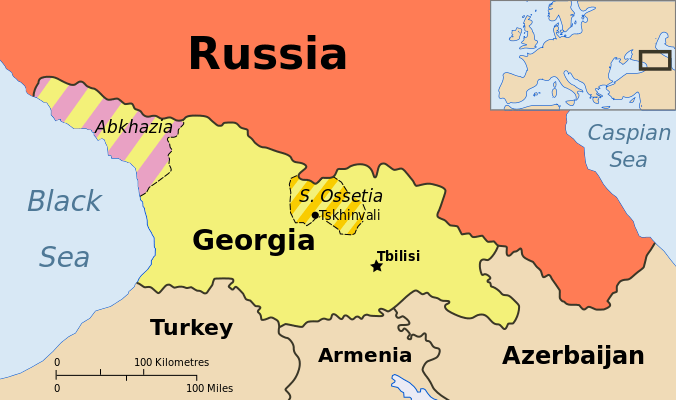
This is fairly straightforward logic on Moscow’s part. When the West supported Kosovo’s secession from Serbia (in defiance of Article 2(4) of the UN charter), Russia responded by supporting South Ossetia and Abkhazia breaking away from Georgia before annexing them. The interesting thing here is that Russia even mimicked Western use of force to back up its play. When the West supported Montenegro’s secession from Serbia (in defiance of Article 2(4) of the UN charter), Russia responded by supporting Donetsk, Crimea, and Luhansk breaking away from Ukraine before annexing Crimea. The interesting thing here is that Russia even mimicked Western use of force to back up its play. Both Russia and the West used minimal military resources to achieve their objectives, and both played the sovereignty card to back up their actions.

blog-map-of-caucasus
(source)

Western policymakers will never be able to bring liberty to Russia, and liberty will never be known by Russians if the rule of law is trumped by geopolitics. The West dominates the world’s international governing organizations. It has made the rules. It has drawn up the contracts. It has invited the non-West to participate. It has given concessions in order to gain the non-West’s support. So when the West breaks the rules it first outlined and drew up, the non-Western polities it convinced to join IGOs in the first place cannot be expected to take such rules seriously. The fact that Russia does play by the West’s rules, by taking seriously the claims of breakaway regions, suggests that the West has been in the wrong post-1993.

American media pundits and critical thinking

All of this leads me back to sensationalist headlines about nefarious Russian meddling in the American presidential election. Don’t believe any of that garbage. Firstly, look at how often American foreign policy pundits have been wrong. Just look! Amid the cries of Russian meddling in the Clinton-Trump contest you can surely hear the faint echoes about weapons of mass destruction in Iraq. Secondly, all good analyses of geopolitical affairs provide at least some bit of historical context to them. Does your foreign policy pundit use history as a guide? Thirdly (and lastly), when thinking about a country remember that most accounts will have a point of view that shadows the consensus found in the world’s political and financial centers, which are useful but will sacrifice important details in the name of efficiency (and efficacy).

American libertarians, of all the factions out there, realize this best. Unfortunately, until they can shake the isolationist dogma that has paralyzed the movement since the Rothbard era of the 70s and 80s, they will continue to be marginalized in contemporary discussions about foreign policy, either as token libertarians in a Republican administration or as token libertarians in the “anti-war” movement (I put “anti-war” in scare quotes because by now it should be obvious that this movement represents the Democratic Party [pdf], not an ideal; see, though, Michael Kazin’s excellent, if ultimately unconvincing, argument for a different take on the disappearance of the anti-war movement once Obama and the Democrats came to power). New republics, secessionist movements, and other endeavors of exit are often embraced by American libertarians because of their autonomist appeal, but if they don’t pay attention to how state actors view such movements, especially regional and global hegemons, they may end supporting some very nasty regimes in the name of liberty.

A libertarian case for Hillary Clinton

I have abstained from commenting on the American presidential race between Donald Trump and Hillary Clinton (sorry Rick) for so long because I just wasn’t very interested in it. I’m still not that interested in it, but the topic has come up quite a bit lately here at NOL so I thought I’d throw in my two cents.

First, though, I thought I’d use up a couple of paragraphs to explain why I don’t really follow American presidential elections, even though most intelligent people, in most parts of the world, do. American presidents simply don’t have a lot of power in domestic American politics. Congress controls the purse strings, makes the laws, and, in the case of the House of Representatives at least, is closer to the People than is the President. The Supreme Court is in charge of deciding which laws are good and which are not, and in some cases even has the power to create laws where Congress or the People simply aren’t getting the job done (Proposition 8 in California comes to mind). To me, that makes the executive branch the most boring branch of government.

The one area in American politics where the head of the executive branch does have a lot of leeway, foreign policy, is one area where I’m not particularly worried about either candidate. I’m not worried because both, despite holding views of the world I strongly disagree with, are not advocating anything radical or unpredictable. I’d rather have a presidential candidate advocate the same old garbage of getting in Russia’s face and keeping troops in South Korea because that way I know they’re ignorant and, more importantly, I know they know they’re ignorant on such matters because they defer to the Washington Consensus.

Libertarians don’t like statists and we don’t like statist policies. Some of us don’t even think voting is worth the effort (or even a good idea). I think there is a case to be made, though, for Libertarians and libertarians to get out and vote this fall for Hillary Clinton over Donald Trump. My case rests on 3 hugely important facts (at least to libertarians and Libertarians).

Fact #1: Thanks to the recent wikileaks revelations, we know for sure that Hillary Clinton is in favor of free trade. This is THE most important reason to vote for Hillary Clinton in the fall. Imagine if the United States, led by Trump’s isolationism, were to begin breaking its trade agreements with the rest of the world. Yikes. Free trade has lifted hundreds of millions of people out of poverty over the last 30 years, but because the majority of beneficiaries to trade liberalization have happened to not be American citizens, demagoguery ensues. I understand that Clinton has expressed skepticism in US free trade agreements on the campaign trail, but when you’re in a party that is vying for potential voters who feel they have been hurt by free trade, you’ve gotta do what you’ve gotta do.

Regardless of what Clinton says to the masses, her record on free trade while holding political offices is impressive (a ‘No’ vote on CAFTA notwithstanding). Free trade, or trade liberalization, is one of the fundamental tenets of libertarianism. Individual liberty cannot be realized or even partly realized without markets that are free from the constraints of governments and the factions that manipulate them. Donald Trump, like Bernie Sanders, wants to reverse decades of trade liberalization and the benefits that such a policy has bestowed upon humanity.

(Digression: Libertarians and libertarians are so adamant about free trade not only because it loosens the grip of the state over peoples’ lives, but also because it makes everybody – not just fellow countrymen – better off. When libertarians and Libertarians hear protectionist sentiments from the political class, you will often see or hear us point out that the Great Depression of the 1930s was hastened not only because of central banking policies but also because of the isolationist tariffs that Congress threw up as a response to the economic downturn caused by the new central bank’s policies. Free trade is a BFD.)

Fact #2: Hillary Clinton is much more individualist than Donald Trump. Women’s rights is an individualist issue, and always has been, even though Clinton has made a mockery of the historical movement by playing the “gender card” and defending (and pledging to expand) subsidies in the name of women’s rights. Trump wants to “make America great again,” but Hillary just wants your vote, any way she can get it. If that ain’t individualist, I don’t know what is.

Hillary Clinton is not a racist, either. She marched against The State’s oppression of black Americans in the South and against The State’s discrimination against black Americans in the rest of the country throughout the 1960s. (For what it’s worth, I don’t think The Donald is a racist. Businessmen rarely are, for reasons that should be obvious to any fair-minded person, but his rhetoric on race is absolutely toxic, and he knows it. His deplorable actions bring to mind a certain F-word I won’t mention here.)

Trump may or not be a racist – I’ll give him the benefit of the doubt – but I don’t know for sure. Clinton is definitely not a racist.

Fact #3: Hillary Clinton is a lawyer and she knows how our government is supposed to work (even if she doesn’t like it). One could make the case that Trump knows how our federal system of government works, too, given his braggadocio about buying off politicians, but his is a vulgar understanding of what is, after all, a magnificent example of compromise and diplomacy over our more primal urges. Lawyers make better politicians than businessmen. As Alexis de Tocqueville remarked way back in his 1831 ethnography of the United States:

“the authority [Americans] have entrusted to members of the legal profession, and the influence which these individuals exercise in the Government, is the most powerful existing security against the excesses of democracy […] When the American people is intoxicated by passion, or carried away by the impetuosity of its ideas, it is checked and stopped by the almost invisible influence of its legal counsellors, who secretly oppose their aristocratic propensities to its democratic instincts, their superstitious attachment to what is antique to its love of novelty, their narrow views to its immense designs, and their habitual procrastination to its ardent impatience.”

Lawyers, Tocqueville observed, make up a sort of informal aristocracy in America because their training in the field of law requires them to have a deep respect for precedent and “a taste and a reverence for what is old.” Businessmen are not used to the clumsy, inefficient coalition-building necessary for good governance. That’s why businessman George W Bush was such a failure and attorney Bill Clinton was such a success. Any good libertarian needs to acknowledge the benefits that come from specialization and the division of labor. Any really good libertarian, the kind that has actually read a little bit of FA Hayek’s work, knows that change in the political and institutional arena needs to be done slowly, and preferably through the legal system (no matter how imperfect it may be).

I know all about the bad stuff that Hillary has supported and voted for in the past (especially on foreign policy, and even more especially on foreign policy in Africa). I get it. I really do. But Donald Trump represents a very nasty strain of thought that has swept into power of the country’s Right-leaning political party. His nationalism is antithetical to libertarianism in a way that Clinton’s typical corruption and condescension is not: libertarianism has a long history in this country of dealing with Clinton-esque figures. The American polity was forged by consensus and thus has recourse, perhaps more so than any other presidential system, to constrain exactly this type of persona. This persona is egotistical and out for personal glory and prestige, but libertarians, progressives, conservatives, and others here in the United States have institutions and networks that were created specifically for presidencies run by people like Clinton.

We’re small in number, too small to have a significant impact if we all voted for Clinton, but we have an outsized impact in the realm of ideas and policy. Get behind Clinton in any way that you can, because more of the same ain’t all that bad.

The trade offs of Hillary vs Donald

An interesting thing to talk about is whether one ought to support the Donald or the Hillary. And it’s my impression that those who are marginally in favor of Donald and vice versa do that with a completely different view on the risks associated with either of them.

People who favor Hillary have something like this in mind:

Hillary will continue with the status quo that started with George W. Bush (especially foreign policy) and continued under Obama (who added domestic trends such as Obamacare). Trump, on the other hand, is a complete wild card who will transform the (fragile) political institutions we have into something of an even more authoritarian system. And having an authoritarian figure with his fingers on the red button just seems like a very bad idea.

People who favor the Donald are seemingly thinking something like this:

Hillary will continue with the status quo that started with George W. Bush (especially foreign policy) and continued under Obama (who added domestic trends such as Obamacare). Trump, on the other hand, will be such a weak politician that he will get almost nothing done. Even in his own party, he is so unpopular that he won’t get executive discretion even if he asked for it. He won’t be able to achieve anything and he might even get impeached. But regardless, he will be an overall failure of a politician, and that’s a good thing relative to the trend that Hillary started.

I could be wrong, of course, but this seems like the trade off that people are making. We know, with a reasonably high certainty margin, what kind of policies Hillary will favor. Trump, however, is a complete wild card. Some people think the wild card will accomplish very little (and thereby show a high confidence in the current workings of the American governmental system), so therefore he is preferable to Hillary. Other people think he will accomplish a lot (and thereby showing very little confidence in the current workings of the American governmental system.)

I think this trade off is basically right: where you stand on Hillary versus Trump depends on your view in the likelihood they’ll achieve what you think their plans are. Which of these have the correct view, I do not know. But it’s an interesting question nonetheless.

Minorities and Economic Growth: Evidence from Jewish Communities in Premodern Europe

Urban theorist Richard Florida is celebrated for arguing that cities today succeed by attracting members of the “creative class.”  In a similar spirit I have a recent paper with Noel D. Johnson where we investigated whether or not cities in medieval and early modern Europe grew faster if they possessed a Jewish community.

Scholars have long noted the role of minority groups in economic development. This is particularly true for the the premodern period. The great scholar of long-run historical development in Europe, Fernand Braudel, observed that “successful merchants who controlled trade circuits and networks often belonged to foreign minorities.” These minorities could be other nationalities or religious minorities, for example, “the Jews, the Armenians, the Banyans, the Parsees, the Raskolniki (Old Believers) in Russia or the Christian Copts in Muslim Egypt” (Braudel, 1979, 1982, 165).

Hornung (2014) studies the impact of the Huguenot migration to Prussia. Since the nineteenth century, scholars like Friedrich List linked the presence of Huguenots with the transmission of human capital, skills, and innovation. Hornung (2014) is able to test this hypothesis using Prussian immigration lists from 1700 that document the location of Huguenot settlements and firm-level data on input and output for all 750 textile manufactories in Prussia in the year 1802. Approximately 16,000 to 20,000 Huguenots fled France to Prussia at the end of the seventeenth century.  Hornung finds that the presence of Huguenots significantly increased firm productivity. Specifically, a 1 percentage point increase in the share of Huguenots was associated with 1.5 percentage points higher productivity in 1802.

Jewish Communities and City Growth

In our paper we take a broad sweep of European history from 1400 to 1850.  We have a total of 1,792 cities in our panel data from the Bairoch (1988) dataset and 1,069 Jewish communities that appear in the Encyclopedia Judaica. The figure below shows both the cities in the Bairoch dataset and the Jewish communities mentioned in the Encyclopedia Judaica.


bairochandjewishcitiesgreyscale

To understand the relationship between the presence of a Jewish community and subsequent city growth we conduct a difference-in-differences style regression analysis.

The fact that we have data on city populations every century means we can hold constant the identity of a city using city fixed effects and see whether or not it grew faster in the centuries when it had a Jewish community in comparison to those centuries when it did not. We can also control for the possibility that overall city growth was faster in some centuries in comparison to others using century fixed effects.

We are also able to hold constant other factors that could plausibly have affected city growth. We control for local geography including cereal suitability, proximity to rivers, and proximity to coast, as these factors likely affected city growth in different ways over time. We also control for local infrastructure including presence of university and distance to a medieval trade route.

Our  analysis suggests that, indeed, cities with Jewish communities grew faster on average between 1400 and 1850. The effect we find suggests that cities with Jewish communities grew about one third faster than those that did not have Jewish communities. This analysis remains a correlation, however. We do not know if the presence of a Jewish community brought with it economic benefits or if Jews merely choose to settle in faster growing cities.

Instrumenting the Presence of a Jewish Community

We model the network of Jewish communities as one way to see whether the effect of Jews on city growth was indeed casual. By examining how Jewish communities expanded we hope to isolate a source of exogenous variation in the presence of a Jewish community.

We assume that a Jewish community is more likely to be established close to another Jewish community because of trade networks, financial relationships, or cultural linkages. We then calculate the closest travel path between Jewish communities using our information about the location of roads and river networks and estimates of premodern transport costs. The important assumption we make is that if cities with Jewish communities share certain “unobservable” characteristics that might make them more likely to grow rapidly, these characteristics become less correlated with distance.

We then divide Europe into 5km x 5km grids and assign the lowest travel cost to each grid. We apply Djikstra’s algorithm to determine the lowest cost of travel between all 3,211,264 city pairs (van Etten, 2012). This allows us to create a measure of ‘Jewish network access’ for each city.

Jewish network access itself is, of course, correlated with the unobservable characteristics of the city for which it is calculated. To overcome this we adopt two strategies to create valid instruments out of the network access measures. First, we calculate Jewish network access for cities that are only more than a certain distance away from each other. Second, we use information on expulsions to weight our measure of Jewish network access. The intuition behind this is that Jewish expulsions consist of an exogenous “push” factor leading to Jews settling in new cities close to the existing network of Jewish communities. Using these two strategies we obtain similar (though larger in magnitude) effects from the presence of a Jewish community on city growth. This provides further suggestive evidence that the correlation we found in our baseline analysis was indeed causal.

The Relationship Between Urban Growth and the Presence of a Jewish Community Over time

Across specifications, we find that cities with Jewish communities experienced no growth advantage in the 15th and 16th centuries. After 1600, however, they began to grow significantly faster.

motivationlpoly

The relationship we observe in the Figure does not appear to be inline with a pure human capital story. Jews had higher human capital than Christians throughout the medieval and early modern period. But the growth advantage of cities that had Jewish communities only became evident after 1600. This raises the possibility that something else changed around  17th century that made the human capital and skills of Jews more complementary to economic growth.

Two Mechanisms: Jewish Emancipation and Market Access

The two factors that stand out in explaining the emergence of a growth advantage for cities with Jewish communities after 1600 but not before are: (1) Jewish Emancipation after 1750; and (2) a complementarity between the presence of a Jewish community and market access.

The process of Jewish emancipation began in continental Europe after 1780. It was a major institutional break that signified a major change in the economic, social, and political status of the Jews in Europe. In work with Jean-Paul Carvalho, I’ve shown that Jewish emancipation lead to a religious schism and the emergence of both Reform and Ultra-Orthodox Judaism.

In the period before Jewish emancipation, legal barriers limited the ability of Jews to put their labor to its highest value use. Jewish businesses were prevented from hiring non-Jewish workers. Jews could not attend universities. Moreover, Jews and Christians were culturally isolated. This changed with emancipation, and we expect to see it reflected in the contribution of Jewish communities to city growth in the post-1750 period.

The second factor we study is the complementarity between the presence of a Jewish community and the development of markets. The historical literature points to the importance of Jewish trading and financial networks. But, while economic historians have conducted numerous studies of market integration during the early modern period, with a few exceptions these have focused on the grain trade with little systematic study of other markets due to data limitations. Jewish merchants in medieval and early modern Europe, however, did not play a prominent role in the grain trade but, rather, were involved in the transport of diamonds, sugar, silks, tobacco, and other luxury products in addition to playing a large role in banking and finance. Therefore, rather than looking at grain markets, we explore a more general measure of market integration based on market access.

Market access depends on the population size of nearby cities weighted by the cost associated with the least cost travel path. We show that market access was increasing for all cities after 1700. We find evidence that cities with Jewish communities were better able to take advantage of this increase in market access. As we detail in the paper, our findings are consistent with the argument made by numerous historians that Jewish trading and finance networks help to knit together the European economy, particularly in the period 1650 to 1800 (Israel, 1985).


Our analysis provides support for the accounts of historians who have emphasized the important role played by Jewish traders in 17th and 18th century Europe (such as Fortune, 1984; Israel, 1985; Trivellato, 2009). Furthermore, our story is in line with institutional arguments such as those developed by Douglass North, John Wallis and Barry Weingast, and Daron Acemoglu and James Robinson.  In the Middle Ages, the presence of Jewish communities was part of an institutional arrangement that extracted rents from society and distributed them among members of the ruling elite. The eradication of these rent-seeking arrangements and the liberalization of Jewish economic activity, first in the Netherlands and England and then in the rest of Europe following Jewish Emancipation, was of critical importance as it is in those cities that possessed emancipated Jewish communities that we observe the strongest relationship between the presence of Jews and economic growth.

What sort of “Meritocracy” would a libertarian endorse, if he had to?

The first attempt to answer this question should say: “none.” Notwithstanding that this is the correct approach, we can’t help but feel uneasy about it. Libertarians have had to deal with this uncomfortable truth for so long. In respect to my own personal experience, I remember where I was when I read, for the first time, “Equality, Value, and Merit,” the title of Chapter 6 in Friedrich A Hayek’s The Constitution of Liberty. I was attending a weekly reading group about that book, and we were gathered in a cafê in Buenos Aires. The number of attendees was enough to find every kind of reader you could expect (and not expect) to meet in such a group:

  • There was the one who had already studied and condensed each chapter and then was re-reading and re-assessing the whole book; the one who did his “homework” without any effort;
  • the one who the embarrassment of failing to accomplish the reading requirements for the meeting overcame the pleasure of any type of procrastination (i.e. me, mostly because I was one of the promoters);
  • and the one who gave to the group the enthusiasm to last for six months in a row and finish the whole book. The latter, in this case, was a truly “natural Libertarian,” the one who had the pure Libertarian position for each subject by not showing an excessive regard for what Hayek was actually saying.

I remember that I arrived to the “Equality, Value, and Merit” meeting with a feeling of uncertainty. Hayek argued that there is no merit to acknowledging in a market process, none of any sort, a just compensation for the value of one’s apportation – a value whose magnitude depends on the relative scarcity of the marginal product. The reader who always accomplished his reading duties without any effort shared my sentiment of awe. Almost the whole meeting was conducted by our companion who was reading the book for a second – or perhaps third – time. In effect, Hayek left no place to meritocracy, since it is impossible to decide democratically among any scale of merit (remember Kenneth Arrow’s theorem on the impossibility of democracy, cited later on the third volume of Law, Legislation and Liberty), so retributions based on value enable the system to adapt spontaneously to the changes in the environment with more efficiency. The explanation was a bit of an unpopular one, but accurate. Not without reluctance, almost all of us accepted it. All of us but one: our true spontaneous Libertarian. She would under no condition surrender her convictions on the merit of the retributions that the market process assesses spontaneously to each one in accordance to the marginal value of their activity. While we acknowledged no merit to the results of the market process, she was prone to endorsing a moral value to the blinded results of the allocation of goods adjusted to the changes in their relative scarcities.

Many years after our debate took place, I am now starting to acknowledge that there might be a particle of truth in the statements of our natural Libertarian and, what is most outstanding, that these statements could be deducted from other chapters of the same book (The Constitution of Liberty), particularly the one which concerns on the definition of liberty (“Liberty and Liberties”). I said a particle of truth, not the whole truth, but at least that particle which is needed to start an intellectual quest.

In The Constitution of Liberty, written in 1960, Hayek made a quick outline of the different notions of liberty that were popular at that moment in time. Positive liberty, negative liberty, inner liberty, individual liberty, freedom from, freedom to, and freedom of were some of the categories mentioned. He made it clear that an in-depth discussion of each notion was not his main aim, but instead that was trying to make a quick account of them in order to give a conceptual frame to the one of his choice: a variant of the individual negative liberty defined as “the absence of arbitrary coercion.”

Slavery is the subjection to the will of another person, without boundaries of any kind. A slave could be subject to a good master who allows him to keep a normal life, but he could lose all of his freedom on a whim of his master at any time. On the other hand, the boundaries to the freedom of a free man are imposed by abstract and general laws and by contracts and the judicial decisions based on those contracts. The ordinary experience of a man enables him to discover principles and patterns of what would be regarded by others as just conduct, and to form in such way expectatives on how a given conflict could be solved. This concept of individual liberty as an absence of arbitrary coercion stated by Hayek in 1960 finds a strong resemblance today in the notion of liberty as an “absence of domination” by contemporary republican authors such as Quentin Skinner, Philip Pettit and, here in Argentina, Andrés Rosler.

The outcome of such a system is that every individual is enabled with a set of possible actions to be taken at his sole will, which we call an “individual sphere of autonomy.” In principle, these spheres are delimited by general and abstract laws and any controversy on the limits between two of them will be solved by an impartial court whose decision will be based on principles expressed by these norms. These judicial decisions would be in accordance to the patterns of just conduct that everyone had previously formed by ordinary experience, so they will prove correct the expectatives of most people and then will be regarded as non-arbitrary.

Of course, we could find that some judicial decisions would be taken by equity or that some administrative decisions would be based on expediency. But such a system could stand some exceptions, most of them aimed to solve an unexpected situation. Some of these new “precedents” are compatible with the principles which inform the existing laws and then their formulation will be a sort of “discovery” of new norms that until that moment were “implicit” in such a normative system. A criterion to distinguish the discovery of new norms from a decision based on expediency might be that the universalisation of the former brings about stability to the system; it makes the law work as a negative feedback system while the universalisation of the latter would only cause an increasing process of disorder.

Friedrich Hayek developed his theory of law – savagely summarised in the previous paragraphs – in Law, Legislation and Liberty and it provides us with an accurate modelization of how it would work a legal system that could not be experienced as “arbitrary” by the individual. In Hayek’s legal model, the fulfillment of the law would imply the respect of individual freedom as the absence of arbitrary coercion, since all boundaries to one’s will are previously known or reasonably expected and, then, our individual plans are conceived and accomplished regarding such limits.

After such a long digression we may come back to our initial enquiry: if a Libertarian had to “do meritocracy,” what sort of meritocracy would it be? The usual answer is, as we noted above, “none.” But I suspect that the wrong statements of some intuitive Libertarians carry within them a kernel of truth: the assignment of functions and subsequent retributions are expected not to be arbitrary, because even the changing value of the marginal products implies (1) some sort of predictability, (2) an impersonal process, and (3) a learning feedback system that fosters increasingly correct pattern predictions.

If we state that liberty is one, be it political, economic or social, we cannot use a definition of liberty in the political realm and another notion of it in the economic one. The “none answer” implies just plain individual negative liberty (absence of coercion) in political economy issues, while our definition of individual liberty is “absence of arbitrary coercion,” and this should be applied to the definition of economic liberty as well.

Therefore, I dare to state that a non-arbitrary distribution of functions and its subsequent remunerations should be a central problem to economic liberty, if we define it as “absence of arbitrary coercion.” Since our spheres of individual autonomy are delimited by a system of norms of just conduct, general and abstract, which distinguish arbitrary from just coercion, the economic liberty is expected to be found in such a framework.

Usually, the legal framework of a free market is regarded to be a neutral one: general and abstract rules, whose source could be the legislation sanctioned by an assembly of deputies of the people and notable citizens or the customs acknowledged as mandatory by the judiciary courts. In any case, general and abstract rules that are not conceived by a single will but have the impartiality of a plurality of legislators or juries. In this sense, “absence of arbitrary coercion” is identified with “absence of coercion by discretionary powers of the state.” Nevertheless, we consider that this is not enough: we should be conceptually endowed to do an evaluative judgement about the outcome of such economic system. We need to determine if the result of a neutral legal framework produces a non-arbitrary distribution of functions and retributions.

A neutral legal framework works like a peaceful, predictable, and secure Lockean Civil Society – i.e. the opposite of a Lockean Civil Society. Since we accept that legal norms express rules of just conduct whose obedience brings about a rightful delimitation of each individual sphere of autonomy, the remaining normative conflicts will be related to moral and social norms. But these normative conflicts will not occur among competitive orders, such as legal order against moral order or against social order, since we acknowledge the preeminence of the rule of law over any other source of obligations. Modernity relegates moral and social norms to the inner of each individual sphere of autonomy or, at most, to conflicts among different individuals which will never escalate and balloon into physical violence. That means that morals and social customs will not bring about an alternative order to society, but that they will enable the individual with an order to rule the inner aspects of his personality and a limited scope of his interactions with other individuals. These sets of moral and social rules will not integrate the formal institutions – to use the categories coined by Douglass North – but will be embodied in “packs of precepts of life” that we usually name “virtues” (a term cherished by the republicans mentioned above and by libertarian authors such as Deirdre McCloskey.)

These “virtues” are expected to contribute to the fulfilment of most individual plans in a system of inner stability. What we regard as good and wrong are a set of received values accrued after generations of trial and error processes. “Being honest,” for example, might be considered as a pack of precepts of life which successfully spread all over the members of the society structured by a neutral legal framework. The unit of evolution is neither the society nor even the individuals, but the “virtues” that are spread among the individuals that compounds that society.

At this stage, we must admit that what we regard as “neutral” is just an analytical category that means a set of fixed elements that work as a framework for other elements which change their respective relative positions. This framework is what Hayek named “order” (we can find in his Sensory Order the most accurate definitions of this concept: more than one). These notions allow us to do a clear distinction between the concepts of “evolution” and “change.” Change occurs among the relative positions of different elements given a stable framework – a Hayekian “order” – while “evolution” – in our terms – is related to a modification in the framework where the ordinary events occur. In the words of Douglass North, “evolution” is an incremental change in opposition to a disruptive change – or revolution. Notwithstanding this use of the terminology at hand, only Hayekian orders “evolve,” while their elements (or events) simply “change” their relative positions.

Nevertheless, to use an Arthur Schopenhauer image, events are the eyes of the blind machine which is the spontaneous order. Given a certain abstract order, the population with some types of virtues extended among the individuals will prevail over other ones. For example, Max Weber, in his Protestant Ethic, showed how the habits of frugality, self-confidence, hard work, and so on, were once considered by most people as eccentric but eventually took over whole communities and changed the meaning of good and evil in a process that ended up in an “iron cage of liberty”: the dissolution of the transcendent values that had previously given a religious sense to those habits into a neutral framework of standard moral duties immanent to the social system.

Another classical book that illustrate a process of “natural selection” of virtues might be The Prince by Nicoló Machiavelli: from the very beginning, the author warns us that a different set of virtues would be needed to be develop in a Republic and that he treated that matter in another book, The Discourses on the First Decades of Titus Livius. The Prince, instead, is focused on determining which virtues is a Prince to be enabled with in order to survive in a realm where no one has the sense to be bound by any moral or legal obligation, i.e.: in a set of non-cooperative games. The whole book can be read as a succession of mental experiments about which virtue could make the Prince survive over his competitors. In Richard Dawkins terms, the ones which are competing are the virtues, and the politicians who struggle with each other are the “vehicles” of those virtues. A very well-known example shows how the population of the ones who seek to be feared at the risk of being hated will displace the population of the ones who seek to be loved at the risk of being scorned. To put this another way: in the “ethical pool” the trait “seek to be feared” will outshine the trait “seek to be loved.” Finally, at the last paragraph of the book, the very virtue of the Prince rules supreme among the other ones: the initiative.

Besides the fact that The Prince – as Quentin Skinner pointed out – should be regarded as a satire (but see Barry here and here for a contrary account) , the emergence of the virtue of the initiative as the inner quality of a political leader of a non-republican system scraps any moral sense of the term “virtue.” Virtues are a compound of personality traits that conditions the agent’s decisions from the inner. But certain virtues depend on the legal framework to spread over the “ethical pool.” As we have said, the virtues that will prevail in an authoritarian regime will be different from those which flourish in a republic. The “republican virtues” described by Machiavelli in his Discourse on the Decades can only proliferate among people within a given set of procedural rules. A similar distinction was made later by David Hume: “natural virtues,” such as empathy, can emerge at any given circumstances, as they are embodied in human nature, but artificial virtues such as “justice” will depend upon a determinate legal framework.

Virtues will erode or shore up a formal institutional framework by incremental change (D. North), yet this will occur only as a response to the change in the environment (virtues as the eyes of the blind machine of the spontaneous order). For example, Gutenberg’s press discovery allowed the evangelical movement to gain force since anyone could then start to count with a Bible. Within the Evangelical movement took place a Puritan one, which at its turn changed the sense of morality in the people for whom it took place. This resulted, for example, in the anti-slavery political movement in certain states of the US or cities of the UK such as Bristol, even at a price of high economic cost.

Nevertheless, while spontaneous changes in virtues lead to incremental political and legal change, a disruptive change of the latter could bring about a dramatic shift in uses and customs of the people involved. This need not to be a violent revolution, since democratic institutions are enabled to issue the required laws to make a significant change for the good – or for the bad – in the said virtues to spread among the society. Sound money is a condition for the virtue of frugality to appear, for example. On the other hand, the Adam Ferguson’s book When Money Dies shows how the people change their main traits due to the phenomenon of hyperinflation.

Since virtues are – in the definition stated here – a mere pack of ethical traits that condition the individuals who are their vehicles from the inner, allowing them to survive and pass their virtues to the next generation of individuals, on what basis should we endorse some virtues over other ones? Our theory cannot provide us with a normative answer by itself, since it leads us to the conclusion that what we regard as good and evil comes from a process of blind evolution. As we have said, a learned libertarian would not endorse a meritocracy of any kind.

However, the complex order compounded by the legal framework and the moral and social virtues extended in society might be “neutral” for each individual involved in such society, but the legal framework will not be neutral to the moral and social virtues that are spread in that society. Different types of frameworks will deliver different sets of virtues to be spread. An authoritarian regime will deliver the set or virtues described by Machiavelli in The Prince, while a republic will spread the virtues of The Discourse on the Decades of Titus Livius. Moreover, the difference between the former and the latter is found in the proportion of decisions taken on the basis of expediency and the ones taken on the basis of principles. The whole message of Hayek’s Road to Serfdom might be exemplified in the transition from a system of public decisions based on principles (i.e.: a republic), to a system of public decisions based on expediency. Each system will deliver a different set of “virtues.”

Thus, we are now in a better position to answer the question “what sort of meritocracy would a libertarian would endorse, if he had to?” A natural libertarian will expect that the distribution of functions and retributions will correlate with the virtues most expected to be found in a legal and political system in which most decisions are taken on the basis of general and abstract principles. Such a system of norms and values will be experienced by the individual as “non arbitrary” and then the ideal of negative individual liberty as “absence of arbitrary coercion” will be achieved, not only in the political realm, but also in the economic and social ones.

In a “Keynesian turn,” we could point out that a system whose decisions are taken purely on the basis of principles is an “especial case” and that we usually find mostly the opposite. In most constitutional systems the “macroeconomic policy” is not a matter subject to the courts and we have to acknowledge that the spreading of some virtues over other ones are more conditioned by monetary or tariff policies than by a neutral legal framework. Nevertheless, this reality is not a reason to disregard the value of the virtues that would arise should those policies be neutral (i.e. not being policies at all, but legal norms). Moreover, these objections just pointed out are good reasons to claim for a republican system of liberties as a fairer system.

To summarize: natural libertarians are not so wrong when they aim to achieve a special kind of meritocracy – the one in which the functions and retributions would correlate with the virtues spread in a society where liberty as absence of arbitrary coercion is respected. In such a system, most political decisions will be taken on the basis of general and abstract principles. After all, the dissatisfaction manifested by a natural libertarian when most of the wealth of a society goes to the rent seekers is rooted in a well founded claim for a “free and virtuous society.”

What is a nation?

I know Michelangelo has already asked and answered this question, and NOL has dealt extensively with “the nation” before, but:

Nations are now defined not as races or peoples but by their possession of a state, and states are legitimate only if they express political will of a nation. The strange new idea of nation-building was born, the other side of the coin of state-building in the decolonizing world. It is a game played by given rules, above all that no other forms of political will and action were legitimate, especially wars of conquest.In outcome, the poor, the small, and the marginal gain the freedom of self-determination, the telos of independence, but their democratic rights extinguish utterly at the border. They have right of influence anywhere else.(137-138)

I have just two thoughts about this nugget of insight from American anthropologist John D Kelly, writing on the Wilsonian ideal in his book The American Game: Capitalism, Decolonization, World Domination, and Baseball. 1) The “given rules” Kelly writes of are still a factor in today’s world. You can most clearly see them via international governing organizations (IGOs) like the UN, World Bank, IMF, WLO, etc. Given rules are handed down to former colonies by IGOs not as a way to control these colonies but to guide them gently into the modern era. This may seem quaint, but this is how Wilson and his ilk viewed their rules and their fellow man in the colonies of Africa and Asia. If you think about institutions, even weak ones like IGOs, you know that the rules and ideals that such institutions were created to embody are hard to break; often a critical juncture is needed to do so. So the given rules of the international system are, I would argue, still based on condescending early 20th century notions about non-European peoples. This is partly why Scots and Catalonians are allowed to vote on their secessionist arguments while Kurds and Balochs and Biafrans are labelled terrorists or rebels, and states like Montenegro and Kosovo are allowed to enter the international system with virtually no hiccups while Kurdistan, Balochistan, and South Ossetia are ignored by IGOs and only informally recognized when an official state like the US requires an ally to fight an enemy.

2) This is hard for me to admit as a libertarian, but the Wilsonian ideal has helped to almost entirely eliminate old-school imperialism (violent conquest followed by oppressive government and extractive economic policies) from the earth.

The State versus Society, Part 12,908

Taken together, the evidence suggests that the Kuba state is associated with a deterioration of intrinsic motivations to follow the rules. This does not mean that the Kuba Kingdom was not a successful and well-functioning state. From the historical and anthropological literature, we know that it was. Although the state was prosperous and orderly, the evidence suggests that it eroded the intrinsic propensity of its subjects to follow rules even when enforcement is absent. (28)

Here (pdf)

Does the EU promote liberalization?

This is in response to Brandon’s earlier post asking for literature on the EU’s effect on promoting liberalization. The short reply is the EU promotes liberalization – sometimes. Below are two pieces of the literature on the issue.

On a quick aside, I have mixed feelings towards the recent Dutch referendum on the Ukraine-EU Association Agreement. I don’t think that the EU should extend a hand to Ukraine. Namely because I think the Russians are much more willing to use force over the issue than West Europeans. Secondly, because I think it gives peripheral countries the idea that they don’t need to join/remain in the EU to receive its protection. Moral hazard if you will.

However I disagree with co-blogger Evgeniy Grigorjev that Ukraine, and other peripheral nations, should be denied EU affiliation until they reach certain benchmarks. I’m sure that Ukrainian politicians would consider EU association a victory and feel less compelled to act. However the long term effect of EU membership would be greater trade in goods, people, and ideas. With any luck liberal ideas. I would welcome the EU expanding into North Africa and parts of the Near East if it meant the expansion of liberal ideas to those regions.


The Effect of Labor Migration on the Diffusion of Democracy: Evidence from a Former Soviet Republic {LINK}

This empirical paper looks at the effect of return migration on political attitudes in Moldova. The basic idea is that return migrants bring with them new political ideas from abroad.

In the late 1990s Moldova experienced financial trouble that encouraged many of its laborers to migrate temporarily to Russia and the west (largely Italy) in search of work. Regions with more return migrants from Italy were found to have the least support for the Communist Party in future Parliamentary elections. Regions where migrants went to Russia had increased (albeit sometimes small and/or statistically insignificant) support for the Communist Party.

There are two take aways here:

(1) Trade in ideas matter.
(2) The type of ideas you trade matter.

The EU, and the Schengen area, can promote idea trading but what makes the EU important is that it is a liberal institution. An institution that needs reform, but one worth keeping.

Anchoring Democracy from Above? The European Union and Democratic Backsliding in Hungary and Romania after Accession {LINK}

This paper looks at the different responses the EU took towards Hungary and Romania when the national governments of both respectively introduced illiberal measures. Discusses some of the weak points in the EU and how it can be reformed to improve its ability to react to similar future events. As Evgeniy points out, the EU has a weakened ability to punish illiberal policies once EU membership has been granted. Intra-EU coordination is also difficult to achieve to use those tools it does have. The EU is not however impotent and reforms could be introduced to rectify this.

Good Health Will End Civilization

Good health and decisive minds. With maybe about 5% probability. We’re far more likely to destroy ourselves with war or stupidity, but knowledge could do us in too.

The basic problem is that as our knowledge of health and aging increases, we’re going to end with a lot of old people around. We’re going to be those old people, which is great for us, but it could be deadly in the long run.

Institutions are made up of formal rules, and informal interpretations of those rules by members of society. We learn how to interpret our environment by observing how our predecessors did so, copying them, ideally refining their approach, occasionally rebelling against the old ways and finally pushing our ways on the next generation.

This sets up an evolutionary process where variation and generational turnover occur together. The basic problem is that few people change their minds once they’re about 25. You might be able to teach an old dog new tricks, but odds are good you can’t teach him a new way of looking at the world.

Yeah, some people can change with the times, but on the whole Bill Burr’s pretty much spot on: [as far as other people are concerned] you can live too long. The older the median voter, the further removed their view of the world is from the actual reality of the time.

Now, there’s certainly some optimal degree of conservatism. We don’t want to upend society every five years in the name of progress. But if generational turnover grinds down to a glacial pace, so may institutional adaptation.

But of course we don’t know what the future holds. Perhaps an older, wiser median voter is a good thing. Perhaps the key to longer lifespans includes therapy to stimulate neural plasticity.

In any case, I hope that coming generations will hear a message that mirrors advice given to my generation. We were told “don’t expect to have the same job forever.” Now we need to be told “don’t expect to have the same opinion forever.”

From the Comments: Money, Currency, and Bitcoins

Dr Gibson chimes in on Chhay Lin‘s most recent post about bitcoins (I hope there will be more):

“Unspent dollars means reduced sales, and as sales decline, profits drop, layoffs increase, and the total social income decreases, making less money available for consumption. Hoarding induces more hoarding as the economy sinks into a downward spiral.” (Smith, 2009)

That’s a lot of nonsense in just two sentences. (Note this is Smith’s paraphrase of the anti-hoarding argument, which he ably disputes.)

First, there is no distinction between “spent” and “unspent” dollars. Money jumps instantly from one pocket to another whenever it is used in a transaction. All money is “idle” between jumps. This could refer to the demand to hold money which is the inverse of the velocity of money. We hold money for convenience, safety, and occasionally as a hedge against deflation.

Second, decreased velocity means price deflation, other things being equal, and if a fall in velocity happens suddenly and unexpectedly, it can be a temporary boon to buyers and a detriment to sellers. But the idea of a deflationary spiral feeding on itself is silly, if only because we all have to eat. Low prices are the cure for low prices, as bargain-hunters move in and prices stabilize.

Then there’s this “social income” phrase. Real social income is not enhanced by faster spending. It is enhanced by greater productivity which depends on private saving, which in turn depends largely on property-friendly institutions. We cannot spend our way to prosperity.

I’ll also comment on Kaminska’s claim that bitcoins “do not benefit the economy” because they do not bear interest. Along with currency and (in their time) gold and silver coins, bitcoins are what economists call “outside money” meaning they are an asset that is no one’s liability. Checking account balances are a form of “inside money” because they are at once an asset of the account holder and a liability of the bank. When outside money is deposited in a fractional-reserve bank where it becomes inside money, some is kept in reserve and some is loaned out. This apparently what is meant by “benefit to the economy” but in fact it’s a benefit to the bank which can earn profits on the new loans and to the borrower, if all goes well. It’s a detriment to the rest of us because there is an increase in the money supply which causes price inflation.

There is nothing anti-social about holding outside money. Some of us see marginal benefits in holding outside money (security, convenience) that exceed the cost in foregone interest. So what?

My own two cents on this (get it?) is merely that Dr Gibson needs to spend more time at NOL fixing the mistakes of financial journalists and keeping his fellow economists honest. (Notereaders and Notewriters, holla at me and Warren in the ‘comments’ threads if you agree!)