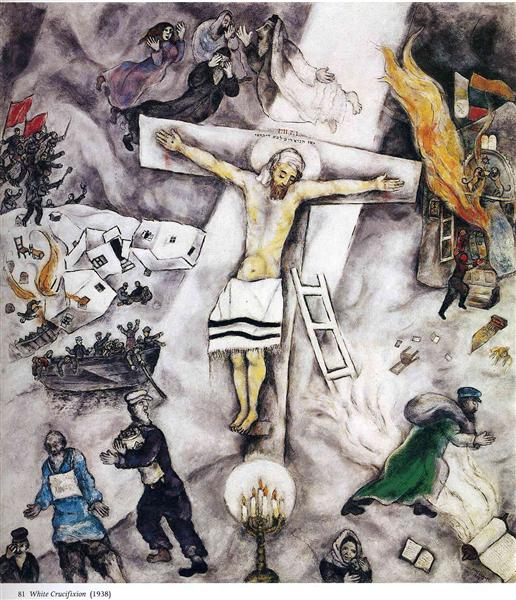
Afternoon Tea: White Crucifixion (1938)

From the esteemed Jewish French-Belarusian artist (and one of my personal favorites), Marc Chagall:

nol art chagall white crucifixion 1938
Click here to zoom

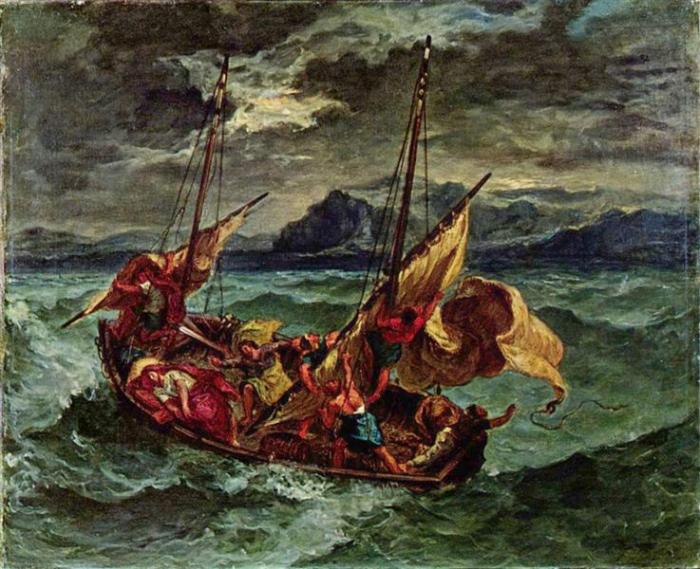
Afternoon Tea: Christ on the Sea of Galilee (1854)

From Eugene Delacroix, as requested by Jacques Delacroix:

nol art delacroix christ on the sea of galilee 1854
Click here to zoom

I could stare at this for hours…

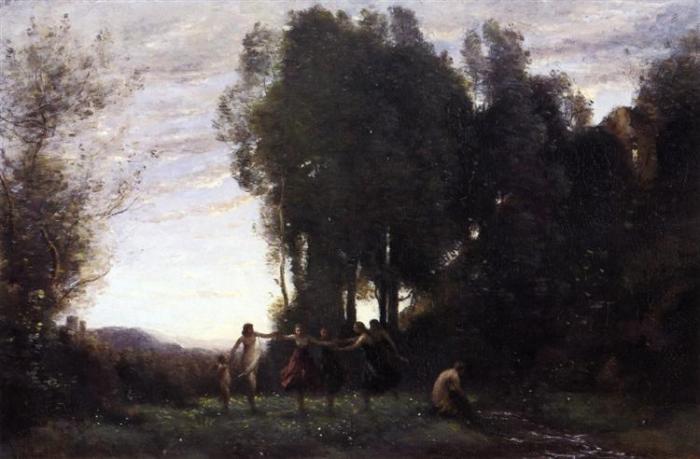
Afternoon Tea: Circle of Nymphs, Morning (1857)

From Camille Corot, a French painter from the 19th century:

nol art corot circle of nymphs morning 1857
Click here to zoom

I love mornings.

The Yellow Vests: Update

In the ninth weekend of demonstrations, the politics of envy seem to dominate. (Soak the rich again!) The Government must give us more money. Lower some taxes but impose or re-impose others especially the former tax on wealth.

Far behind: Introduce a degree of popular initiative in the political process: allow groups of citizens to initiate legislation, to implement it, and to abrogate it.

I can’t tell if those who want more money are the same as those who demand popular initiative in legislation. It’s a problem with grass root movements. They make attribution difficult.

Pres. Macron’s response is all over the place. It sounds like the work of an old man although the pres. is only 41. I think I know why this is: Nearly all the past thirty presidents and prime ministers are graduates from the one same school. Maybe they just crib the class notes of their predecessors.

Notably, Mr Macron’s response – contained in an open letter – to the nation includes more “save the Planet” proposals as if he had forgotten that an environmentalist tax set the barrels of powder on fire to begin with. Little chance he will be heard by the Yellow Vests although his open letter may serve to rally the main part of the population around him as the lesser of several evils.

Notably, the president, on his own, mentioned the possibility of limiting immigration although that’s not high in any of the Yellow Vests demands. Curious.

The president’s proposed themes are supposed to be debated widely and on a national scale. They are expected to give rise to suggestions on how to govern France. The suggestions will be collected at the municipal level (a good idea; the French like their mayors) in complaint books called “cahiers de doléances.” The latter sounds to me like a very bad idea. The last time those words were used on a large scale, was around 1788-89. The ruling circles lost their heads soon afterwards. (I mean literally.)

Keep things in perspective: If you add all the demonstrators nationally in every town any Saturday, you arrive at a very small number although it’s made up of persistent people . They are persistent because they represent a large minority facing serious, possibly unsolvable problems. Many ordinary French people have grown weary of the disruptions the Yellow Vests have caused. There is also huge revulsion against the acts of violence that accompany Yellow Vests demonstrations (not necessarily their own acts).

Cool heads counsel the president to dissolve the National Assembly and to call for new elections. Supposedly, this would bring up elected representatives more in tune with the people’s mood. My own guess is that new elections would result in the isolation of the Yellow Vests and bring an end to their movements. Just guessing.

Did I forget anything?

Muslim Welcome

Here is a nice little story, I think.

I was once a pretend hippie. It was only “pretend” because my drug consumption was moderate and limited and I never dropped acid. Also, I never dropped out as recommended. I attended graduate school and I even worked quite a bit.

At the end of a work interlude in France from graduate school in the US, I thought I deserved a reward. (I often think I deserve a reward; it does not take much.) I was a big-time free-diver (no SCUBA) for most of my life, not so much for the beauty of it but always in search of something good to eat. I decided to leave gray Paris for a diving vacation in sunny Algeria.

It was only nine years after the end of the bloody war by which Algerians won their independence from France. Practically, the whole French population was gone. There were tensions between the French and the Algerian governments although hundreds of thousands of Algerians were working and living in France. I thought my good manners and my smiling face would get me through any difficulty. Also, I thought that with the French gone, there must have been precious little spear fishing in Algerian waters. I half-believed that big groupers would practically jump at me

I packed my VW bus I had outfitted for camping and I put a small borrowed plastic boat on its roof. My then-future ex-wife (“TFEW”) and I drove to Marseilles where we checked in bus and boat. We spent the night-long crossing of the Med on deck. There was a moving moment in the middle of the crossing when all the portable radios on board suddenly tuned them selves to Arab music from Radio Algiers. The dolphins accompanied our ship into the light blue waters of Algiers Bay.

One thing the Algerians had learned from the French and had not yet forgotten was running a non-corrupt bureaucracy. (I believe corrupt is good, that it expedites bureaucratic processes.) It took hours to clear us because the TFEW had an American passport, something unusual then and there. Clearing the bus and the boat through customs took even more time. By the time we were out of the harbor building, the sun was setting. We did not want to spend the night in some shabby overpriced hotel in the big city so, we drove on out of town in a general eastward direction.

After a couple of hours in deep-darkness, we were on a dirt road climbing some hills which made me admit that it was probably not the main coastal highway. I couldn’t see much with the weak VW headlights and there was a little mist. The torchlight I had packed was not much more useful. I ended up stopping the bus more or less at random. We stepped outside for a leak. There were not house lights, not street lights, and no sound except the song of the cicadas. We figured we might just bed down in the van till morning.

The sun was fairly high in the sky when we woke up. I saw some blue through a window of the bus. I opened the door to take out the equipment necessary for a cup of Nescafé. I discovered we were parked right in the middle of a low farmhouse courtyard. And old man in a djellaba was quietly sitting on a rock outside our door with an earthenware jar of cool water at his side and a basket of figs on his lap. “Bonjour, Salaam” he said pleasantly.

French Africa

This is a meandering essay; although it’s about history, it’s a bit personalized, for effect. In other words, it’s far from straightforwardly scholarly history but I think it’s all or mostly true. Be patient, at one point it will become about the former French African colonial empire and socio-cultural strata it deposited in France, and there to this day.

Acting Uncool

Often, in my dotage, I sneak a look at TV5, the French language cable channel. Often too, I fall asleep on the couch while watching its usually – but not always – insipid programs. One day, a short documentary catches my attention. It’s about sexual harassment of French women on the public way. It catches my attention because it’s not obvious to me what would pass for sexual harassment in France, I mean, this side of grabbing and such. So, it turns out that the makers of the documentary had placed a man with a hidden camera near a cafe on a street with a bad reputation. The street is near to one of the main railroad stations in Paris, guaranteeing a two-way flow of commuters, including women, of course.

In the course of twenty minutes, the documentary displays about thirty episodes of “sexual harassment.” I am only a man, of course, and thus limited, and a skeptic, but the worst harassment I witness takes the form of annoying mouth noises that I am not talented enough to reproduce with words. Mostly, there are gauche invitations to have a cup of coffee. The documentary ends with the expected boring, trite lamentations, blah, blah. There is zero mention of a striking fact: All the harassers without exception sport a thick North African accent.

I say a “thick” accent to signify recent arrival in France. The accent normally erodes in a few years or months. I imagine the harassers were young immigrants from small villages in Algeria and Morocco trying artlessly to deal with the knowledge that they were now in a society where sex could theoretically be had outside of marriage and outside of prostitution. Some may have been merely lonely and naively hoping to make a French friend. Political correctness clashes with political correctness: Harassing women, even if only verbally, is terrible but mentioning that the harassers all proceed from Muslim countries is terrible too. So, make the documentary and shut up about the obvious!

This is not a very interesting story, of course; I know this. Would anyone expect probably poorly educated rural young men from sex-segregated societies to learn to be cool with women as they are stepping off the boat? It will take quite a while, at best. For some, it will never happen; they will remain uncool forever. Then, they will marry an immigrant woman from their area of origin. Again, it would be absurd to expect anything else. In the same vein, would it be reasonable to imagine that all those immigrants would quickly come to appreciate the importance of the separation of religion from governance (of “church and state”) when it’s anathema in Islam?

Is it possible that a few will never appreciate at all the beauty of such separation? Is it possible that their ignorance, or their hostility, will be passively transmitted to their offspring, together with pork avoidance, for example? Will (would) that transmission have a cumulative effect on French society? France contributed more than its share of apprentice terrorists to ISIS, even would-be war brides, even young women ready for the sexual jihad. The one thing may have little to do with the other. And, it’s true that a startling number of the above are converts from Christianity or, more likely, from atheism.

French people who are not racist, or even “Islamophobic” in any mechanistic sense, carry this sort of question on their minds all the time. Some French people who have been in France for a long time but have Muslim names become themselves attached to secularism (la laïcité). They also discreetly worry about the very same issue. Those who will actually talk about it appear more worried than their fellow citizens with names like mine, or like “Pierre Dupont.” This is all impressionistic, of course. There is no survey. For one thing, it’s illegal in France to gather data about ethnicity.

How did it come to this, you might wonder. Why are these guys in France at all, the ones acting uncool in every conceivable meaning of the word?

Quitting Algeria

In 1962, the French Republic and the Algerian nationalists of the Front de Libération Nationale (“FLN”) came to an agreement about Algerian independence. That was after 130 years of French colonization and eight years of brutal war, including war against civilians, from both sides. The colonization had been in depth, with hundreds of thousands of French settlers convincing themselves that Algeria was a kind of second France, resembling the original in every way. Except, that is, for the inconvenient prior presence of numerous exotically dressed people who were neither Christians nor free-thinkers. Except for the fact that many of the French settlers were newly minted poor immigrants from Spain and Italy.

At Independence, I participated in the evacuation of large number of French civilians from the country as a little sailor. I mean “French French.” By that time and belatedly, the presumably Muslim population had been granted citizenship. Too little, too late. Probably in an an effort to divide to conquer, the numerous (Arabic speaking) Algerian Jews had all been granted citizenship in the 1880s. In the days of evacuation, the number of (old) French who wanted to leave was much greater than French authorities had planned for. An aircraft carrier – emptied of its planes – had to be used. It was a pathetic show, complete with broken, uncomprehending old grandmothers who had probably never set foot in France. There were no deluxe suitcases in sight but there were used mattresses. Some factions within the FLN were threatening the French with death if they did not go immediately; others would have liked to keep them, or some of them. The death threats prevailed.

It was too bad that the French left in such large numbers. It made the transition to independence technically more difficult than it could have been. It gave the upper hand in Algeria to those who had the best guns rather than to those who could govern, or to the people. It was a pity for all concerned. The French refugees faced an uncertain and harsh future in France, for the most part. For the Algerians, many positions were left for a while without competent personnel, including a budding oil industry in the Sahara. There was a shortage of medical doctors for many years.

Make a mental note of this fact: The French French were not the only ones fleeing. They were accompanied by tens of thousands of families with Muslim names and whose native language was other than French. They were Algerians who had chosen the wrong side in the war of independence and who feared to be massacred in the new Algeria (correctly so, it turned out). Those joined the other hundreds of thousands who had been living in France for economic reasons beginning with WWI.

I think of those events as a double tragedy or a tragedy leading to a tragedy. The Algerian independence fighters who had prevailed by shedding quantities of their blood were definitely not (not) Islamists. In most respects, intellectually and otherwise, they were a lot like me at the time, moderate, democratic leftists. In fact, I once spent a moving three hours drinking coffee with a convalescing FLN soldier my age, in a third country. He and I had most things in common, including the French language. (More needs to be said about communities of language.)

The true Algerian revolutionaries were soon replaced in power in Algiers however by the professional soldiers of an army that had never really fought because it had been formed outside Algeria while partisan-style forces battled the French army. The military is still in power, fifty-five years later. I think of their regime as a classical but fairly moderate kind of fascism. It has bloodily fought Islamism to a standstill on Algerian soil so, everyone pretends to like them.

The Poor Politics of Colonialism

I went back to Algeria – as a tourist, a spear fisherman, believe it or not- six years after independence. I was warmly received and I liked the people there. They felt like cousins, the sort of cousins you played with in childhood but have not seen in adulthood. I think now, as I thought in 1962, that the nationalists were on the right side of the argument but I miss Algeria nevertheless. It’s like a divorce that should not have happened if someone had been more reasonable. Even such a short time after the events, events I had lived through as an adult, it was difficult to comprehend what had gone wrong. It was difficult to find any trace of hatred for the French. A young man I wanted to thank for a favor done asked me to take him to a restaurant where he could eat Brie, made expensive by a tariff. (Do I have the talent to make up this anecdote?)

I blame the astonishing incompetence of a French political class that failed in the course of 130 years to invent a form of citizenship that would have accommodated a large and fast growing Muslim population. At the time, it was widely argued that the Muslims insisted on being ruled by a mild form of Sharia insofar as their personal affairs, such as marriage and divorce, were concerned. Such an arrangement was incompatible with the strictly secular laws of the French Republic, of course, they were told. The Muslim numerical majority thus had to remain subjects, with only individual access to citizenship, more or less like any Finn or any Bulgarian. I don’t know if this was a genuine obstacle or an excuse for a simple case of yielding to the local French population who did not wish to live under Muslim rule, even if only for local affairs. In spite of their well publicized humanitarian and liberal values, French parties of the left played a prominent part in colonization and in the attendant repression of native populations. The late Socialist Pres. Mitterand, for example, was vigorously policing Algeria when he was a young politician (who had had one foot in the Resistance and one foot in Vichy, earlier, another story, of course).

A brief history of imperialism

After completing the military conquest of Algeria in 1847, which had been arduous, France soon developed a vague appetite for easy territorial gains overseas. The age-old British rival’s imperialism probably inspired the French. By WWI, France had placed under its control, Algeria’s neighbors Tunisia and Morocco (the latter, split with Spain), and the present countries of Mali, Niger, Mauritania, Senegal, Guinea, Cote d’Ivoire, Burkina Faso, Chad, Benin, the Central African Republic, Gabon, and the Congo (the small one, next to the Belgian Congo). During World War I, France also took Togo, and the southern half of Cameroon from Germany. We must add Djibouti on the Red Sea and the large island of Madagascar in the Indian Ocean.

Most – but not all – of the population in the colonies was Muslim. Possibly close to half were native speakers of Arabic dialects. However in North Africa, large minorities knew no Arabic but were speakers of several varieties of Tamazigh (“Berber”). French colonial power did not fail to utilize this linguistic dichotomy, as you might expect. Be it as it may, at the close of WWII, you could travel straight south from Algiers on the Mediterranean to Pointe Noire, (across the river Congo from Kinshasa in the larger and better known Belgian Congo) without ever leaving French control.

The possession of a colonial empire seems to have generated monopolistic profits for a few French people, the extraction of which were accompanied by routine atrocities in some parts. The horrors of French rule in the equatorial colonies where hevea -rubber trees – grew, was documented by the great writer André Gide in his travel narrative Un Voyage au Congo. National possession of the empire gave the average French person much psychic income, I think. At least, it facilitated fantasizing – under the gray French skies – about palm trees and warm seas. And adventurous but skill-less young Frenchmen could always find jobs easily in the southern colonies, overseeing native (black) labor just for being white, French, and knowing the common language (French) well.

All the sub-Saharan African countries achieved independence peacefully in the late fifties or early sixties. Morocco and Tunisia had preceded them in 1956. Before that, in Sétif, Algeria, a peaceful demonstration against the French government was put down in 1945 in a massacre where thousands perished. In 1947, an attempted insurrection against French colonial power in faraway Madagascar was ended with another bloodbath. One concrete objection to colonialism is that it regularly places mediocre men in charge of the destinies of many others, some of whom are not mediocre. Those who gave the order to shoot in both Sétif and Madagascar where low level public servants.

Compare

There is an intuitive tendency to view colonialism largely or completely in terms of the culture of the colonial power. This is probably wrong. What matters is the circumstances of the colonial acquisition and the use to which it was put. The contrasting cases of Algeria and Senegal are instructive in this respect.

Algeria was conquered militarily between 1830 and 1847 in a thoroughly ravaging war. Note that 1830 was only 18 years after the Waterloo defeat. The Napoleonic era’s stupendous French military victories (excepting Waterloo) were fresh in the collective consciousness. Plus, the political entity centered in Algiers had been far from a bucolic and peaceful place before the French conquest. Its economy relied heavily on piracy and various forms of slaving. It made a likely prey. No one or almost no one was going to miss it. (It’s a mystery why Thomas Jefferson ran out of breath before he got to that Barbary state.) Algeria always mattered because it seemed a likely colony of settlement. It became one, a good one, in spite of the existence of a large native population.

The balance of France’s African colonies – with the exception of Tunisia that was wrested from nominal Ottoman rule by a brief military invasion – was acquired without much purposefulness and with little fighting. A large swath of land near the Equator was taken without a fight by an Italian adventurer, a naturalized Navy officer, a contemporary of Stanley. Brazza was usually accompanied only by a handful of native troops. Wherever he went, he cheekily raised the French flag and abolished slavery. The capital of the Congo bears his name to this day (indicating that he left a pretty good memory).

The smallish country of Senegal in western Africa is a special case of French colonization. French political presence there dates back to the 17th century, first in the form of slave trading posts. Later, the four main cities of Senegal were re-formed as French political municipalities. This, in the absence of a significant local French population. The inhabitants of those cities obtained French citizenship in 1792, that is, earlier than many inhabitants of France. They were eligible to vote and to be elected. French power over the countryside extended slowly from those four towns meeting little resistance.

This special case matters because the assimilationist current in Senegal was strong before independence in 1960 and it continued after independence. Today, it’s difficult to find a Senegalese who does not speak good to excellent French. The unknown percentage who can write do it in French. Interestingly, the casual racism guiding the interaction with the natives of the few French administrators and military personnel, plus a handful of businessmen, was largely suspended when they dealt with the Senegalese. (Personally, I think labels matter, “citizen,” for example. Obviously, that’s another story.)

The narrative of the colonization of Senegal is fairly important because it shows one case where a Muslim country (95%) is explicitly friendly toward the West and well informed about it (via the French language). It is also politically stable and democratic although it is poor (GDP/capita of only about $2,600 around 2015). It’s a case of successful intellectual colonization. I have even personally heard English-speaking Africans accuse Senegalese intellectuals of the same sins of arrogance and obstinacy that usually stick to Paris Left Bank intellectuals. Something went right in Senegal.

By the time of WWII, much of public opinion – including the still-large officer class – was enamored with the notion of France as a great Muslim power.

Colonial strata within France

Every new acquisition of territory in Africa generated a new wave of emigrants to France: students, low-level civil servants climbing the bureaucratic ladder, and some laborers. Public school teachers of native extraction – a large number – would go to France for training through what was intended as a revolving door. There, some would find true love, marry and stay. Every loss of a colony did the same as every acquisition because – as I have mentioned – not everyone knows how to choose the right side in a conflict. Every war also brought Africans to France, as soldiers and as laborers both. Many won French citizenship and remained too. Over the twentieth century that African-originated population grew inside France because immigrants, mostly from rural areas, usually multiply faster than the more urban host population. All immigrants and all their children and all their grandchildren attended the Republic’s schools, or, more rarely, the few Catholic schools.

There was comparatively little true racism, racism by color. (Read the subtle observations of the black American writer Richard Wright, for example.) The existence on the soil of Metropolitan France of a long assimilated black West Indian population may have contributed to deny conventional racism much traction. Despised cultural traits and a condition of economic inferiority on the one hand, and skin color on the other, just did not coincide well enough.

The relative rarity of color sentiment and its shallowness, does not mean that the French were or are free of prejudice, of course. For more than one century, the worst jobs in the country were occupied by immigrants from North Africa, mostly Algeria. Those were people from deeply rural, primitive regions, literate in no language. For most of that period, they lived in ghettos, while their wives and children remained behind in a Maghreb that was always fairly near.

Those people were subject to systematically poor treatment. It was made much worse by the Algerian war of independence that was fought partly in France, with numerous acts of terrorism. French French people never knew enough about Islam until recently and they were too religiously indifferent to call that prejudice “Islamophobic,” I think. What is now the largest political party in France, the Front National, used to be overtly anti-Muslim. Under new leadership, it has cleaned up its act in this respect, avowedly because that stance was doing it more electoral harm than good. It’s now against all immigration. In the current (2017) presidential campaign, some people with Muslims names have said publicly that they would vote for the Front. (They remain a curiosity, I am guessing.)

I am trying to be fair and descriptive here. Two relevant stories. When I was a teenager, I worked part time in an expensive hotel in Paris. Luxury hotels are like theaters; they have a public stage and a backstage. There was a middle aged guy who was the fix-everything man. He was knowledgeable and he had all the tools of most trades. His name was “Ahmed” backstage but it became magically “Jean” when he was in the public area. The great and luminous French movie star Isabelle Adjani (b. 1955) kept her half Algerian origins in the closet for half of her career. To be fair, when she disclosed that she was the daughter of an Algerian Amazigh (a Muslim) a consensus quickly formed that her secrecy had been silly. It’s also possible that she feared the nude scenes in her movies would meet with dangerous disapproval from her father’s group of origin.

In the end, there is a large sub-population in France today that traces its ancestry to various parts of Africa, north, west, and central. By American standards, some are black, some are white. Many or most are citizens. Many are not but have a legal right to live in France by virtue of some international post-colonial agreement or other. Some almost have that right. Many – and still coming – don’t have any such right at all but their cousin lives there. Their children all attend school. They all arrive knowing some French from the schooling in their countries of origin. Given the comparatively effective (comparatively) French school system, and given the unsmiling, generalized French contempt for multilingualism, they all end up “French” in some sense, knowing the French language well, familiar with the fundamentals of civics, well versed in basic French history.

Muslim identity

The only trait that consistently differentiates some, or probably most people of African origin from the rest of the French population, is their presumed Muslim identity. (Notably, you almost never hear of people of African descent who are Christian, or even nothing at all.) Islam matters as a cultural fact, even irrespective of genuine religious sentiment, because it prevents mixing to a large extent, and especially, intermarriage. Previous immigrants, from Poland, Germany, Italy, Spain, and more recently, Portugal all tended to marry French. Even more so did their daughters. Muslims from Africa mostly don’t except that a few men marry non-Muslim women.

I say “presumed” Muslim identity because there is no rigorous way to estimate the current Muslim population in France. That too, is forbidden. Going by names – which is often done – is sure to give bad results. It’s likely that most French people with a Muslim name are like the bulk of other French people, religiously indifferent.  Hence name counting inflates the number of Muslims in any meaningful sense. Still, there are many mosques in France and many recriminations about their being in insufficient number. There is a large, monumental, highly visible mosque near central Paris. It shelters the headquarters of the official national organization that represents the interests of French Muslims with the government. I don’t know how representative that representative organization currently is, of course.

People with Muslim first names and last names are everywhere in France, over the latitude and longitude of the territory but also from the bottom – sweeping the streets of Paris – to the top of the socioeconomic pyramid. (A while ago, I was half in love with a French woman named Rachida Dati. She was a minister in Pres. Sarkozy’s cabinet. It did not work out!) The first French soldier to die in the NATO expedition in Bosnia was named El Hadji. The Paris cop terrorists killed outside of Charlie Hebdo also had a Muslim name.

There are many other markers of long-term African presence in France. Here are some, pell-mell: Best couscous in the world. The North African Arabic word for “fast” is commonly used in French, including by people with 32 ancestors born in France. One of the many vocables for the male appendage in French, also one of the most commonly used, is straight from Arabic. (Don’t count on me to satisfy you salacious curiosity; do your own research.) Paris is the world center for the promotion and recording of rich West African music. Same for most fiction and poetry in French, including a significant production from Africa. The strange, often baffling intellectual movement “la négritude“(“negroeness,” I think) developed in France. The largest or second largest collection (after that of the British Museum, maybe) of black African art in the world is in a Paris museum, etc.

Cultures

Those who know me, in person or through Notes On Liberty, or Liberty Unbound, those who spend even a little time on my blog (factsmatter.worldpress.com), or on my FB page will have heard me lamenting loudly the sterility of contemporary French culture. I cry torrents, especially over the impoverishment and the muddiness of the current French public French language, I mean, as spoken in France, specifically.* For the past fifty years, the French have had precious little to show by way of visual arts, or music and much of their contemporary literature projects the very cold of the grave. Aided by endless government subsidies, the French make many mediocre movies whose slowness and technical imperfection passes for intellectual depth, especially among a certain category of Americans.  (On this topic of government help to the French movie industry, you might read Delacroix and Bornon: Can Protectionism Ever Be Respectable? A Skeptic’s Case for the Cultural Exception, with Special Reference to French Movies.” [pdf])

French public figures talk like teenagers and they generally don’t know how to finish a sentence. If a member of the French intelligentsia speaks to you about Iraq, for example, say a journalist at prestigious Le Monde, you know no more about Iraq when he is finished than you did when he begun; you may know less. It was not always like this. (And, I will not insist that the decline of French culture and language are due to my emigration to the US at age 21 but the dates coincide pretty well.) Incidentally, the museums are still good; actually, the whole country of France is like an attractive museum that would have a superlative cafeteria attached. But I digress. This is all to let you know of a certain critical pessimistic state of mind of mine.

Still, there are French cultural phenomena that continue to interest me. One is a “culture” TV show with a strong political component that’s tougher on politicians than anything we do in the US. (It’s called, “On nest pas couchés.“) Another is a pure political show, also hard on the politicians interviewed there. (It’s called simply, “L’ Emission politique.“)

So, another time, I am watching French TV intently because there is a retrospective show on the anarchizing singer/composer George Brassens who died in 1981. Brassens is the closest thing France has – except for Edith Piaf –  to a secular modern saint. He wrote elegant poems addressed to ordinary people that the intellectual elite also admired. He also put to music Victor Hugo and even the medieval poet François Villon. He sang all with a distinctive stage presence.

That night several current stars of French popular song have been gathered in one setting to each sing one or more of Brassens’s songs. A man named “Slimane” takes one of the three or four most popular, most familiar of Brassens’ pieces and sings it in a deliberately Arabized manner. When he is finished, the eyes of several women singers sparkle. I am strongly moved myself. Slimane has given new life to a classic. No one will ever forget his hybrid rendition of the song.

This is yet another time, I am dozing on the couch (again) after a good French political show I mentioned elsewhere. The TV is still on, of course. Something stops me from falling right asleep; something drags me back to consciousness. This has never happened to me before. What’s waking me is the clarity of the language used by a youngish man being interviewed for one of those culture/literature shows that abound on French television.** The man to whom the voice belongs enunciates precisely; his words are well chosen without being precious; his grammar is impeccable; he finishes every one of the sentences he begins; he does not stutter. He speaks like a man who has thought of what he is speaking about.

Soon, I am alert enough to realize that the fine speaker of French is on the show to flog his newly published book. The book is about conversations he has had in his mind with the writer/philosopher Albert Camus. Now, Camus died in 1960, by the look of it, before the current writer on Camus was born. Camus has a special place in the minds and hearts of several generations of a certain category of French men that used to include me. He is one of the fathers of popular “existentialism.” (I have to use the qualifier and the quote marks to avoid the predictable correction by pedants who will push quotes in German into my email to prove that Camus is in no way a real existentialist. WTF!) Camus received the Nobel in literature in 1957 but that’s not why we care about him. I cannot describe here in detail the particular category of French men who revere him but here is a pointer: Early on in his fame Camus broke up very publicly with his good buddy, the better known Jean-Paul Sartre because Sartre would not denounce Stalinism.

The young writer on TV is black. I am told he is a well-known rapper in France. His name is Abd el Malik. Anecdotal evidence about nothing, some will say. Will it influence me in the future in spite of my good social science training? You bet. How can I avoid it? How can millions of French people ignore this kind of episode irrespective of their views on immigration? That man’s short presentation was like a ray of sunshine in a uniformly dark forest. Why should they not let it impress them?

The story does not end here, Camus himself was a Frenchman from Algeria, obviously not a Muslim. He was born to a widowed, half-deaf and illiterate Spanish immigrant woman who cleaned houses to support herself and Albert. The French are not so much confused about the legacies of their former colonial Empire as they are faced with a confounding reality.


* French is well spoken in various places, in Senegal, first, in much of urban Morocco and Tunisia, and among the Haitian elite, of all places. Romanians and Lebanese also tend to speak a very classical French as a second language.

**I say this with a little bitterness because, as someone who is still practicing being a commercially unsuccessful American writer, I regret strongly that we don’t have a plethora of such shows in the US of A.
Gun Control Works Just Fine in France

In semi rural Normandy, in France, a mass is interrupted by two young men who speak Arabic among themselves. They force the aged priest to kneel. They demand that some of the faithful present video the next scene. Then they cut off the priest’s head with a long knife. They don’t shoot him!

After this, they take several people hostage, injuring one seriously and they attempt to escape. The police are waiting for them outside and shoot the decapitators dead.

In this true story, only the police had guns just like liberals and President Obama want it to be the case in the US. The murderers almost did not commit their crime because they only had one gun that was not even functional, almost didn’t.

ISIS quickly claimed the crime as committed by some of its “soldiers” (brave soldiers, murdering an eighty-year old priest). One of the dead assassins was immediately identified as a local young man. He was on electronic bracelet parole after being arrested in Turkey and sentenced for trying to join Islamic State. The French authorities don’t joke when it comes to terrorism!

The main French imam condemned the crime immediately and in the most vigorous terms. He did not comment on the mode of the assassination, beheading. He did not speculate whether this could have some cultural resonance for some Muslims, given that the Prophet Mohamed himself demonstrated a certain preference for beheading as a way to dispatch his enemies. (References on request.)

The French are brain frozen. No one in France has wondered publicly about what would have happened if one of the faithful at mass had carried a hidden handgun.

La Bêtise et la langue française.

J’ai eu des ennuis de santé occasionant une absence de ce blog. J’aimerais bien pouvoir dire qu’il s’est agit seulement d’un accès de priapisme, mais ce serait exagérer.

En tous cas. il est temps que j’y repique. Ce sera pour maugréer, bien sur.

Je viens de regarder pour la seconde fois le beau, l’étonnant documentaire de l’émissions TV française Thalassa sur Saint-Malo, une ville et une région qui me sont chères.

A un moment, le narrateur mentionne que le grand corsaire malouin Surcouf s’était livré à la traite des Noirs, donc, au commerce des esclaves africains. Le sous-titre en Anglais rend cette simple affirmation par ces mots époustouflants:

“Surcouf respected the Black Treaty,” “Surcouf respectait le Traité Noir.” !

Comment peut-on être aussi ignare; et surtout, comment peut-on être aussi con?

En effet, ne pas connaitre un mot ou une expression specialisé n’est peut-être pas un crime (mais encore, pour un traducteur également spécialisé?) mais laisser en place un expression qui ne possède aucun sens, en aucune langue c’est contribuer à l’abêtissement des foules, téléspectateurs, autant que lecteurs.

Pourquoi cette carence de contrôle de la qualité dans un émission de télévision bien considerée depuis déjà trente ans? La réponse probable est une profonde indifference aux faits. La photo est splendide; le narratif captiv vant si on n’y fait pas trop attention. Pourquoi s’en faire?

J’ai remarqué ailleurs que cette indifférence me semble être liée à l’usage de la langue francaiss. (Voir mon recueil d’histoires: “Les Pumas de grande-banlieue: histoires d’émigration.” sur Amazon.) J’ai du mal à imaginer ce genre de bêtise en Anglais, sauf dans des journaux de très bas niveaux, genre l’ancienne “France Dimanche.” Le Francophones disent n’importe quoi; ils possèdent une grande tolérance vis-à-vis de la bêtise qui sonne bien, et meme envers la connerie tout court.

Moi, il me semble que lorsqu’il y a trop de poubelle débordantes dans l’espace intérieur intellectuel, on ne peut plus penser clairement. La fameuse rigueur francaise, “cartésienne” dont les Francais, en particulier, se targuent toujours a simplement disparu, je crois. Les autre francophones ont été éclaboussés simplement parceque la production culturelle française domine de beaucoup la francophonie de par son poids.

Dites-moi que j’ai tort!

Musings About Statism and Cultural Production

I have not fed this blog for a while. First, I am lazy. Second, I am finishing a serious writing endeavor. It’s entitled: “Indecent Stories for Decent Women: Poaching.” You can just imagine what it’s about. Third, I have a critical project in mind and I am not sure I want to dive into it. The problem is that I think it needs to be done and I don’t see who else can do it. Yet, I hesitate because it could easily consume weeks. The topic below.

I spend a lot of time watching  TV5, the international French language channel. I watch movies including old ones, some from countries other than France; I take in the news and also documentaries. In addition, I read a centrist French newspaper on-line pretty much every day. I look at Le Monde when needed although I detest that French version of the New York Times. I read novels in French haphasardly, according to what the tide brings in. Every so often, at completely unpredictable intervals, I find old to very old French classics at Logo, the excellent local used books store.

There are three recurrent shows I like on TV5. Plus, some of the network’s offerings from bilingual African countries are novel. I dislike pretty much everything else there. One might ask why I submit to this regime of daily torture. The answer is that  I am engaged in a mental parallel study of  cultures. There are millions of bilingual immigrants who could do the same but few have the leisure, or the mental equipment, or perhaps, the inclination to become involved in such an amorphous task. One problem I have is that I don’t know who else is interested in the results of my cogitations.

My astonishing dislike of contemporary French culture is my starting point, of course. My mind runs on two explanatory tracks about this. The first track, fairly anodyne, is simply that I am paying the price of age. I am sick of seeing the same mediocre movie over and over. This is not just about French culture: If I read another daily paper article about the dilemma of American middle-class women who are forced to chose between children and career, I will scream (scream like a girl, that is). This detestation applies especially hard to French culture however, I think. This is subjective, of course, but I believe French culture has accomplished just about nothing in thirty years. It has retreated concretely in several areas.

The second track is the potential relationship between statism and cultural production. France is a good example of a statist society where, at any one time, out of one hundred euros, sixty are in the hands of some government entity or other. I have the intuition that the French have been paying for their cradle-to-grave welfare state with tremendous cultural sterility.

Speaking of that second track, specifically, I have several concerns. First I don’t know if it has already been done extensively and the fact just escaped my attention. Second, I am not sure if anyone would care if the relationship I posit existed. Third, there is a possibility that my specific access to French cultural production gives me a bad sample of what’s really going on there.

I have dealt with these second track issues before. I will give the references soon.

Ultra-libéralisme – A French Tale

I am in frequent correspondence with a French retired businessman in his sixties. He is a thoughtful man with minimum formal education but who reads two newspapers a day and watches French news on television several times a day. My informal judgment (as a retired teacher) is that he possesses intelligence well above average. His interest in political matters is through the roof. My French friend is also strictly monolingual. That is, he gets all his information in French.

My friend sent me recently the following email I had trouble understanding, at first. (My own careful translation. My first language is French. I have published in that language.)

“The European Financial Markets Authority (EFMA) has downgraded the three main international credit agencies that, themselves, upgrade or downgrade European and other countries. It’s a just reward*… and a good defense against these agencies which possess no legitimacy at all except from the fact of their existence; agencies that seek to estimate the worth of those countries (and, perhaps, to play the stock market [on the basis of their own assessment]). No an easy issue. Perhaps this is going to calm down the yo-yo effect financial speculators have on the stock exchange…..I even thought a few years ago of sending a personal note to those credit agencies.”
(Bolding mine)

Two salient points in this communication: First, the EFMA is a European Union “authority,” a government agency emanating from the individual EU countries’ national authorities. It’s a complete government body.

The second comment is related to the first, I believe. My friend states categorically that US-based credit agencies (Moody’s, S&P and Fitch Ratings ) have “no legitimacy” because they are not government agencies, precisely. This expresses a mental world whereas all legitimacy flows, can only flow, however indirectly, in however contorted a fashion, from the electoral process. He really thinks that the IFMA’s puerile tantrum is going to change the credit game decisively.

Within an American intellectual context, this sounds almost like the thinking of a madman. Yet, my friend is not mad. I have known him for dozens of year. He acts rationally in every aspect of his life. He is also decisively and loudly critical of French political life in general. The problem is simply that he is French, that he receives all his information from French sources, that his mind has been shaped by French economic thought (or un-thought).

His rage against the credit agencies is not based on a factual analysis of their performance either, which would certainly be a useful exercise after the 2008 world-wide financial crisis. His rage is based entirely on the violation of sovereignty by these non-legitimate bodies.

I often ask myself the rhetorical question, ” How much would I have to be paid to….?” In this case, I can’t come to a figure. I don’t know how I would begin to explain to my French friend the idea that credit agencies get most or all of their legitimacy the from the fact that they are precisely not government agencies. I could not tell him the obvious without being interrupted, I am sure: When economic actors begin doubting the credit ratings these agencies assign to organizations emitting bonds and to governments, they will swiftly collapse on their own. That is, this abstraction, the market grants them all of their legitimacy.**

The concept of markets, counter-intuitive in the best of times, has almost completely disappeared from the French consciousness. In 2012 I watched on French language television in horrified fascination the lively debates preceding the presidential election. That was after an ambitious New York District Attorney had disqualified the most likely winner who was both a qualified economist and a sex maniac. (I mean Strauss Khan, the then-current head of the International Monetary Fund and a very moderate nominal “Socialist.”)

French pre-election debates are both more lively and better staged than their US equivalents. In the first round of a two-round system, the candidates are grilled longer, more directly, more pitilessly than anything I have seen on American television. In this case, these animated and sometimes vicious discussions went on for weeks without the most serious economic questions obviously (to me) facing the country being addressed at all. I mean, of course, a large and fast-rising debt burden and the failure to grow the economy. The attendant permanent high unemployment often came up but I think that no candidate bothered to mention that strong economic growth melts unemployment .

There were ten candidates in the first rounds, including one each from: the New Anticapitalist Party and Workers’ Struggle (Wikipedia’s translation). There was not a single seat at the feast occupied by a conventional conservative party, a Tory party. There was no “liberal” chair at the dinner in the English sense of the word that would prevail in France if the term were used at all. (See below.). If the role of the market in both producing innovation and correcting wrong turns was ever mentioned during the whole campaign (first and second round,) it left no impression on anyone. There were plenty of arguments and proposals concerning taxes. They were all couched in terms of “fairness.” None was about the fundamental fact that taxes, even low taxes limit the virtuous work of the market and therefore shackle economic growth (which has practically ceased to exist in France).

The French candidates also kept their eyes averted from, or dismissed summarily the example of Germany next door which successfully reformed its welfare state in a more market direction ten years earlier.

It’s not that there are no “conservatives ” in France. So-called “cultural conservatives” abound. Large segments of the population become exercised about the right of homosexual couples to adopt and even about host womb fertilization. The puerile excesses of the post-1968 strange, make-believe revolution alone would ensure the existence of such conservatism if it did not have deep roots in the country (see below). Sex hounds like Strauss-Khan have always existed in France but 1968 gave them permission to act openly and more or less brazenly, thereby exciting the Catholic minority’s ire and disgust.

The absence of liberal economic thought in France is the result of a historical accident, a major one to be sure. At the end of World War II, the segments of French political society who had taken an active part in the resistance again the Nazi occupation took over. Soon, they constituted nearly the whole of the political class. The two main segments were the Communist Party and a shifting alliance of “Gaullist” parties, with the Socialist Party playing the role of permanent opposition until 1981. The Communists – nominally Marxist though few of their leaders had read any Marx – were obviously not believers either in the efficacy or in the morality of market mechanisms. The fairly large Socialist Party was kept in a permanent state of primitive vulgar Marxism by the necessity in which it found itself to compete with the Communists for its electorate.

The political right was occupied by Gaullists with serious ties to the progressive wing of the Catholic Church. General De Gaulle himself – a venerated figure and a mediocre politician – was thoroughly influenced by the social doctrine of the Church. To summarize it – but not abusively, I believe – the social doctrine views the state in the guise of absolute Ancien Regime kings. Good kings are both fair and powerful. They use the state apparatus unhesitatingly to distribute both justice and charity as needed.

In the post-World War II re-distribution of power, there was thus no room left for non-statist, or for “little- statist” organized opinion. The socialist victory of Mitterand in 1981, followed by a Socialist majority in parliament swept away any remaining free-market voices. It was not done through persecution in violation of democratic rule but largely through a natural swamping motion. Soon, the effect of this Socialist victory were seen in both the major mass media and, especially in French schools at all levels. All arguments about the economy heard were statist arguments: How much government action, where, for how long, whom and what to tax more, by how much, how can the government create more jobs? (The latter is taken literally: The government actually “creates ” jobs, within itself, inside the government bureaucracy.)

After thirty years, statist schooling has done the expectable: There is almost never any mention in public discourse or in private conversation of this simple idea:

Things that need to get done get done mostly well, mostly efficiently if government does not interfere.

This basic idea was never debated and beaten back; it was simply buried. It does not exist in the French consciousness. The fact that the French public is rather inferior in its ability to read other languages – notably English – helps maintain its insularity in this respect as it does in others. (Incidentally, the insularity runs so deep that the French political elite is incapable of seeing the success of the relatively liberal policies of the UK next door even as educated French youth flocks there by its tens of thousands in search of employment.)

If the French had any notion of the sentence above, they would use the word “liberal” in its English meaning. In fact, the word is practically never used in public discourse or in private discourse. When it is, it’s always accompanied by the qualifier “ultra.” The French live in a strange mental world where there are some “ultra-liberals” but no liberals. “Ultra liberal” is clearly an insulting term. It means “heartless, selfish and extremist.” No decent person is an ” ultra-liberal.” I don’t believe I know three French people who would not interrupt me in the middle of the sentence above in casual conversation. “But you are not an ultra-liberal,” they would break in with worry written all over their faces. If I retorted, “Yes, I am” not one of them would believe me.

Failing to possess conceptual language has concrete consequences. Two stand out.

In the absence of adequate terms, it is difficult to legislate regulations for normal economic activities. Many are swept under the rug. The result is that legitimate economic activities may no be performed above board, lobbying, for one. Les lobbys (in French) are illegitimate by definition. Much of what they do is borderline illegal because there is no relevant legislation or because the relevant legislation prevents them from doing their work. Since economic interests have to manifest themselves in connection with the state anyway, there follows a systematic criminalization of political life. With many of their ranking politicians pronounced criminals, ordinary French people have become deeply disaffected with normal politics. The recent (exaggerated) success of the rightist Front National in European elections is one manifestation of this distaste.

More seriously, it’s difficult to reform a polity if there is no word to designate the new direction it should take. (You need a North to navigate.) There is widespread informal agreement in France that the French welfare state is not sustainable: In 2013, half of French households received government cash for a mean of $600 plus/ month. Thus, in a country with a GDP per capita of $37,000 maximum (World Bank, for 2013), half the households receive $7,200 to $7500 annually in the form of government re-distribution (Le Figaro on-line 6/6/14) . In a society where the sentence above may not be used, or used intelligibly, it’s very difficult to state the obvious:

“We need to allow the market to spawn economic growth. We need to do it, if for no other reason, to continue to afford our munificent social (welfare) coverage.”

Instead, the political class disparages itself and destroys its own legitimacy in futile proposals and counter-proposals to cut this rather than that social program, to raise or lower such and such least favorite tax.

In my opinion, the French welfare state will not slowly grind to a halt or fall slowly apart. Rather, I think, it will come to a sudden full-stop, sink into bankruptcy because no one who counts in France is able to mouth the liberal alternative.

*This is a weak translation. The French phrase: “juste retour des choses” implies a morally valid return to some sort of previous equilibrium.

** None of this means that I think credit rating agencies perfect. I am sorry there are only three big ones of them. I regret that they exercise what I call the “tyranny of the written and of the counted.” I mean that their summary judgments tends – in the nature of things – to become substitutes for more sophisticated evaluations. They encourage laziness on the part of bond buyers, including me. Also, they have not lost enough credibility from their bad judgments on the eve of the 2008 crisis.

My book, I Used to Be French: an Immature Autobiographyis live in the Kindle Store.

Delacroix’s Autobiography is now out on Kindle

After fat far too long, Dr Delacroix’s memoirs I Used to Be French: an Immature Autobiography are finally out. You can find it on amazon.com for $7. The print version should be available shortly.

You can find a short excerpt of his memoirs here.

Congrats Dr J!

PS: Dr J is turning 72 sometime this week. Be sure to wish the young man a happy birthday.

Global Junk Science: a Small Window

I meet two young traveling Frenchmen at the coffee shop. I like the new French more than I liked the old. For one thing, they tend to know English fairly well. This helps them shed the monumental French parochialism (“provincialisme,” in French). Perhaps as a consequence, they are generally more friendly than the previous generations of French people I have known. And, by the way, I wish I had the power to end a tenacious legend once for all: It is not the case that the French “hate Americans.” They just don’t like anyone very much; they are not cordial to any strangers. I feel a glacial wind blow all over me whenever I land in France, that’s although my French is perfect, by the way.

OK, that was a digression. I was also well disposed toward these two young French men because they reminded me of me: It’s true that I itched-hiked across the country and back, at their age. One of them is helping his mother with two restaurants, one on the Riviera, one in Strasbourg; the latter is called, “le globe-trotter.” I like that. The other French guy, age 22, is studying engineering, engineering of “sustainable energy,” he specifies.

I am a weak man, I have trouble with temptation; I can’t resist this one, of course.

Why sustainable, I ask. Isn’t it true that we have more proven reserves of petroleum than ever before?

He readily assents but, he asserts, petroleum is very bad for the environment.

Interestingly, that young man is not especially eager to tell me about climate change. Instead, he affirms that the burning of fossil fuels causes holes in the ozone layer with deadly consequences for humans. This sounds like deja vu (as we say in English), something from ten years ago, but what do I know? It’s possible that the problem has come back and that I am not aware of it. I make a note to check into it.

What kind of alternative power producing methods do you favor? I ask him further. I am eager to avoid discussions of solar power because I live in Santa Cruz where I get more info about the topic than I can begin to digest, including a solid dose of mendaciousness.

Let me sum up my non-dogmatic position about solar power. First, I recently disconnected my old passive solar water pre-heating system because it did more harm than good. Perhaps, a better person, a more virtuous person (I was going to say a more pious person) would have obtained better results from it than I did. Me, I don’t have the time or the patience; I have many unimportant things to do. Second, every time I ask for estimates about installing a modern solar heating or electricity producing system in my house, I am forced to realize that amortizing it would take thirty years. It’s not worth the bother. Perhaps, if I were a twenty year-old home owner. Perhaps if I put a little religious zeal behind the project. Third, I think solar power is wonderful doing what it’s currently doing all over America. I mean providing power for emergency telephones on highways and keeping boat batteries charged during long lulls in boat use.

Incidentally, reliance on solar power in poor countries such as India is another topic altogether. I said nothing about it this time

More incidentally, my skepticism is not of the same nature as the faith of many solar advocates. It’s no symmetrical to it. I don’t “believe” that solar power is worthless. All it would take would be a single good technical innovation in solar energy production to erase my skepticism. It would not take a profound experience of the kind St Paul experienced on the way to Damascus, for example. If I became converted, I would still be the same person, with all the same few virtues and, I hope, the same vices.

What sustainable technologies do you favor? I ask the young man pretend-innocently.

Tide-activated power plants, he answers simply.

It turns out I have some familiarity with the topic. I lived near the first one ever built anywhere. It was in France, inaugurated in the early sixties. I skin dived and speared fished and collected shellfish both upstream and downstream of it. I have no objection to this technology. Forty years later, we know it does not do any serious damage to anything. Even sailors have become used to it. There is even a certain elegant simplicity in its design: Tide comes up, turbines activate, water comes back down, turbines activate again. That first tidal dam doubles as a bridge that was needed at that spot anyway. No problem, as far as I am concerned. I am pretty sure the tidal power technology must have improved in fifty years; it should have, yet….

I ask the engineering student: Why are there only four in the whole world? Does this indicate something wrong, impractical, uneconomical, or something with this technology?

No, he states with perfect self-assurance but with courtesy, you must be wrong; there are thousands of them worldwide.

So, if I looked, I reply, I would easily find hundreds of tide-powered plants?

Absolutely, he affirms.

I go home and I do the obvious, the easiest thing: I look it up in Wikipedia. I was wrong, it turns out; there aren’t only four tidal plants in the world in actual operation, there are eight (8). I was wrong by fifty percent or one hundred per cent depending how you count.

Then I turn to the Wikipedia entry on “ozone hole.”

It has an unfinished look. It seems much like a work in progress or perhaps, a work abandoned in mid-course . The only citation in anything resembling a scholarly journal dates back to 1985. It’s side by side with references to the Huffington Post and even to Mother Jones. There is also in the entry interesting and reasonable speculation about nefarious indirect effects of ozone depletion on melanoma (skin cancer). There is no real health study, not even a crude one.

My young French interlocutor seems wrong here too.

Is it possible that the a deeper search would shore up more sturdily the case for ozone depletion and human health? It’s possible. I think it’s frankly unlikely. There are enough English speakers on the globe interested in such issues for the Wiki entry to be reasonably well updated.

How about the tidal plants? Could there be many more? My answer is a resounding “No.” Power plants are easy to count and hard to miss. Perhaps Wikipedia is much out of date, perhaps there are twice more than it indicates. That would be sixteen (16). That is still a tiny number. My original question remains intact: What’s wrong with this superficially appealing technology?

Why did I find out in my conversation with this young hands-on environmental activist and through its follow-up?

1 The French educational system (or his particular engineering school) is very bad;

2 He does not care about facts. He does not care enough to check with ten keystrokes something important to him. Sounds familiar?

You decide.

The French revolution

The French are rebelling in large numbers. They wear red wool hats as a signal of rebellion (elegant, this!) and to rally one another. I am told by French connections I trust much of the time that the rebellion is not along political lines, that it includes left, right and center.

There seems to be two main targets. First, on the surface, it began as a manifestation of opposition against an “ecotax,” a tax on big trucks intended to fight global warming. (Good for the French! See my many essays on this blog on the myth of global warming. More coming.)

Second, but this is an interpretation, there seems to be a widespread feeling that the French nanny state is finally coming to an inglorious end. This is an interpretation because the French media do not articulate clearly this link:

generous free social services→ high taxes→ stagnant economic life, high unemployment, poor everything, sense of doom, low fertility, etc.

Many ordinary French people are simply disgusted with the poor quality of everyday life in their country, and, especially, with low employment with no end in sight. Many envision no future for their children. Many of their children say they want to emigrate, leave France for good.

It does not mean that the French are poor, overall. They are much richer than say, Mexicans. Yet, impressionistically, subjectively, urban Mexicans are much merrier than urban French people. It seems to me that it’s because the ones, living with reasonable economic growth, have hope, while the others, living at a higher level but with no growth, despair.

You can’t fool all the people all the time. And the people can’t even fool themselves forever, not the French, not anyone!

Bête et méchant et bête.

“La dégradation de l’environnement favorise la logique du profit.”

Je continue à éprouver du mal à prendre les Français officiels au sérieux, sérieusement.

J’ai entendu la phrase ci-dessus, exactement, prononcée par un présentateur français de TV5, la télé francophone. C’était il y a environ une semaine. L’occasion: L’annonce qu’un vaisseau commercial chinois avait rejoint Rotterdam par le Nord, par les mers qui longent la Sibérie. (l’océan arctique, la Mer de Barents, le mer norvégienne). Il avait profité du fait que ces mers septentrionales paraissaient dégagées, libres de glace.

Le problème c’est que cette phrase ne veut rien dire, je crois, rien du tout. (Cela parait vaguement marxiste mais seulement pour ceux qui n’ont jamais rien lu de Karl.) Ou bien je suis plus con que les autres, ou bien les francophones (et les Français) possèdent un immense réservoir, un réservoir inépuisable de non-criticalité.

Je penche pour la seconde réponse.

Le problème en dessous du problème ce n’est pas que les Français racontent des trucs qui ne sont pas vrais. Le probléme c’est qu’ils ne sont plus exercés à reconnaitre le non-sens, qu’ils distinguent mal les affirmations vérifiables du simple bruit de fond. Cela permet à des commentateurs sans qualifications évidentes de proférer des conneries bêtes et méchantes, (malveillantes sans objet) à tous bouts de champs. Ils pullulent aux informations de TV5 et dans les documentaires que présente cette chaine francophone inernationale mais lourdement française.

La compagnie de transports maritime chinoise avait donc tenté le coup de profiter de la fonte des glaces polaires pour emprunter la route la plus courte, pour économiser, le fuoule, entre autres choses. Fieffés salauds de Chinois!

A propos, en fait, il y avait beaucoup plus de glace polaire dans le Grand Nord cet été (2013) que l’année derniére, 30% de plus selon le Wall Street Journal du 11/9/13, encore plus selon d’autres sources.

Je me demande ce que va dire Le Monde à ce sujet. Je me demande si je vais comprendre.

Un petit baiser pour le cinéma Français

Au cours des longues annéees de ma vie américaine, j’ai eu l’occasion de dire des tas de choses désagréables sur la pauvreté du cinéma français pourtant surnourri de subsides publics. J’aimême publié un article méchant en Anglais sur la question.( “Can protectionism ever be respectable? A skeptic’s case for the cultural exception, with special reference to French movies.” The Independent Review 9-3:353-374. 2005.)

Malgré tout, de temps en temps, le même cinéma me procure une agréable surprise, souvent une si minuscule surprise qu’on aurait pu la rater. Je viens de regarder “Emma”, un film sorti en 2011. C’est l’histoire d’une jeune fille mal dans sa peau. Il y a une scène avec un garçon de quinze ou seize ans quelle n’avait pas vu depuis leur petite enfance. En vacances dans la même maison, ils sont assis ensemble sur un lit. Ils parlent de tout et de rien,évoquant même la peluche que le garçon aurait volé, jadis, à la fille.

Soudain, le garçon se penche et dépose un baiser sur le genou (couvert) de la fille. Il y a dans ce geste infime toute la tendresse du monde. C’est le geste juste, plus que juste. Après cela, la fille lui appartient corps et âme, bien entendu.

Malgre tout ses péchés, je pardonne beaucoup au cinéma français pour ce simple baiser au genou.

Mais bien sûr, c’est un film français où donc, le tordu, l’insolite, le gratuit remplacent l’émotion, l’imagination, et même l’érotisme. Le petit ami se revèle vite être plus précoce voyeur qu’ enthousiaste pénétrateur. Enfin, personne n’est parfait, comme on dit.

A la fin du film, aussi la fin des vacances, la jeune fille dit au revoir à son demi-frère. Elle se fait la réflexion, dans son fors intérieur, qu’elle souhaiterait être plus libre des ses paroles, pour pouvoir lui dire, “Je t’aime” – “comme dans un film américain.”

* “Instead of the eager penetrator you would expect, the boyfriend turns out to be mostly a voyeur.”