From the Comments: What is a “National Interest”? (Why not federalism?)

Michelangelo writes:

I sympathize with your pro-federation views, but it is admittedly a difficult position to argue from a purist libertarian view. I would support offering statehood to Japan and South Korea, as I mentioned earlier this week.* I would not however offer the same deal to Ukraine or the Baltic states. If pressed why I would be okay with federation with one group of countries but not another is because I consider the Ukraine/Baltic region to have little value to American interests. I can see Japan/South Korea federation helping economic growth and military might to the US and therefore in our interests. Note my use of plural pronouns.

From a purely libertarian basis what regions would you offer federation with? Or, if you’d offer federation to all of them, which regions would you offer federation with first? Taiwan might entertain an offer to join the federation tomorrow, but I suspect the PRC or Russia wouldn’t.

*I imagine they’d join as multiple states in practice. I wouldn’t offer Japan 114 seats in the senate, but I would entertain giving them 10 senators.

Why only ten? Michelangelo’s quibble about the number senators can illustrate why federation is more libertarian than isolationism (I’ll get to his question in just a minute).

The Japanese would never accept any sort of union where they give up some sovereignty for other benefits and only have ten representatives in the senate. That wouldn’t be a bargain for the Japanese; it’d be highway robbery. The key conceptual point to keep in mind in this scenario is that there are two sides bargaining and cooperating with each other in order to arrive at a mutually beneficial deal. Japan and the US cease to exist as sovereign political units but become more secure militarily, economically, and politically through a federation with each other.

Contrast this view with what, say, isolationists such as Doug Bandow or Daniel McAdams argue; they want much less cooperation and, by implication, much less choice. Cooperation would be limited to negotiating trade details, arming factions, and coordinating responses to natural disasters. This is radically different from the status quo, but not in a beneficial way. Think of all the things isolationism and the status quo exclude from their policies. People in Japan and the US are overwhelmingly in favor of a continued US presence in Japan. The reasons for this are clear, but as it stands the Japanese are taking the US for a ride. Isolationist arguments are arguably worse, as they’d remove US troops (angering vast swathes of both societies in the process), which would put Japan in a position to fend for itself. Isolationism is “doing something,” and it’s doing something uncooperative.

I agree wholeheartedly with mainstream libertarians about the unfair nature of the status quo. I just think their proposals are equally unfair (if not worse). A libertarian position should emphasize cooperation, choice, and trade-offs above all else. The current stable of libertarian foreign policy experts don’t do this, despite their pertinent critiques of the status quo.

Now, before I get to Michelangelo’s question of who (I promise it’s coming), I want to spend a little time on his proposal for 10 senators, and tie it into the concept of “national interest,” which is a fuzzy concept and hence popular to wield in public discourse.

What is the national interest (or US interest)?

Think it through and write down your answer on a piece of scratch paper you have lying around.

Go ahead. I’ll wait patiently.

Is your answer really the national interest, though? Why is your definition of the national interest true and Walter Russell Mead’s not? Here is how I defined the concept of a national interest back in 2014:

…the national interest is an excuse [scholars and activists use] for a policy or set of policies that [they believe] should be taken in order to strengthen a state and its citizens (but not necessarily strengthen a state relative to other states…)

Now go back and look at what you wrote down as “the national interest.” Am I right or am I right? There’s no such thing as a national interest. Cooperation, choice, and trade-offs do exist, though, and I think they can walk us through a hypothetical federation between Japan and the US.

Michelangelo rightly decries the fact that Japan, a country with 126 million people in it (California has 40 million) should get 114 senators. Yet 10 senators seems far too few to give up sovereignty for federation. This appears to be a stubborn impasse, right? Wrong! One of the great benefits of cooperation is having to learn new things.

The 47+ prefectures of Japan, for example, have been in use since 1888. The prefectures had steadily been declining in number as the Meiji oligarchy began in earnest to nation-build in what is now Japan. Up until the surrender of Japan to the US, these prefectures were not representative and had little say in how each prefect was to be governed. MacArthur’s constitution gave these 47+ prefectures some autonomy in 1947, but recent attempts at reforming the administrative units of Japan have called for the abolition of these prefectures in favor of fewer administrative units that will also have much more independence from Tokyo. The policymakers who want to take this track are not creating these fewer administrative units out of thin air, either. Rather, reformists are calling for representative units to be based on the unofficial cultural areas of the country that have been around for centuries. Check out the map:
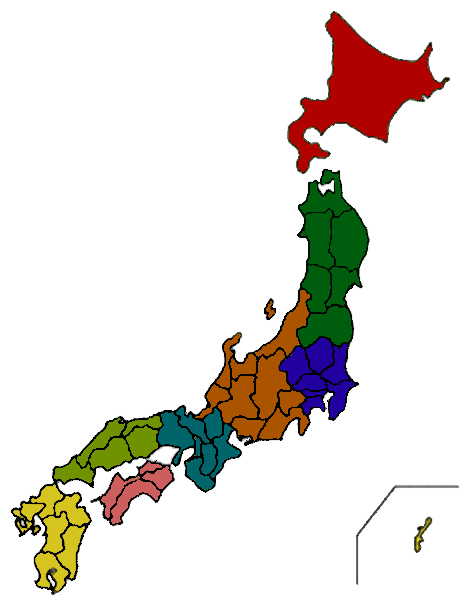
This map shows nine regions, but some people argue that there are actually 13-14 cultural regions within the country (a tough problem to have!). source: wikipedia
This map shows eight cultural areas, but some people argue that there are actually 12-14 cultural regions within the country. source: wikipedia

A cooperative approach to tackling free-riding and imperial expenses would be to reach out to the factions that want fewer administrative states with more autonomy. Adding anywhere from 8 to 14 administrative units into the Madisionian system is much more doable than, say, trying to incorporate 47 administrative units, especially since the latter units have little experience with the autonomous governance that federalism requires of its “states.” At most, there would be 28 additional members of the Senate. The costs associated with free-riding would be gone, and the Japanese people would get the benefits of being a part of the most powerful military the world has ever seen.

Would 28 Senate seats be enough to give up sovereignty? I don’t know, but I do know that the status quo is unsustainable and so, too, are current alternatives.

To finally answer Michelangelo’s question (“From a purely libertarian basis what regions would you offer federation with? Or, if you’d offer federation to all of them, which regions would you offer federation with first?”), I’d start with the Canadian provinces and Mexican states (though I would make it clear that any region is welcome to apply for membership). Then I’d approach the Caribbean islands, the administrative units in Western Europe (including the Baltic states but excluding Ukraine), and the administrative units in Japan and South Korea. Good neighbors and military allies.

My reasoning behind this approach is simply that 1) most of these regions are almost as rich as the United States, 2) they have a good history of actually being representative of their constituents, 3) they have a long history of either interacting with the Madisonian system or acknowledging its tremendous benefits, and 4) they have experience with being somewhat autonomous in a federal system (a federal system that is much less liberal than the one found in the US, but a federal system nonetheless).

Again, I’m not opposed to allowing poor regions to apply and join such a federation, but I think they would be less inclined to do so. Why? Because poorer states are more parochial, more protectionist, and more likely to be uncooperative than rich ones. If regions within these poorer states wanted to apply for membership, we should be open to it, but we’d have to recognize that these poorer regions have a long, hard slog ahead of them. They would, for example, have to market reasons for why they should no longer be a part of a poor state, and they’d have to do it under the harsh watch of the said poor state. Not an easy task, to be sure, but it can be done and the Madisonian federation should be open to the idea of picking apart post-colonial states if it means federating with an oppressed (or poorly governed) region.

Why “post-colonial”? Because of Realpolitik. Entertaining applications from the likes of Tibet or Chechnya is too risky. Entertaining applications from Baluchistan or Biafra? I’d have no problem risking the ire of Pakistan or Nigeria if it meant partnering up with people who want a better life and are willing to cooperate in order to get it.

PS: I think the dialogue in the ‘comments’ thread of this 2014 piece is also worth reading in tandem with my thoughts on Michelangelo’s comment here.

Theory versus Common Sense? The case of the Dutch

Since the fifteenth century, [the Netherlands] has had several features which later liberal thinkers, such as David Hume and Adam Smith, enviously referred to. Compared to other countries, economic freedom was an important issue, just as the larger degree of religious freedom. Trade, tolerance, and cultural developments turned the Dutch into an early manifestation of liberalism. However, with the possible exception of Erasmus, Spinoza, and perhaps the Rotterdam-born but London-based Bernard Mandeville, the Dutch lacked great thinkers who could provide this liberal practice with a theoretical base.

This is from the introduction (page 2) to Dr van de Haar‘s excellent new book, Degrees of Freedom: Liberal Political Philosophy and Ideology, and I think it makes a good argument in favor of the “common sense” approach to the political. This common sense approach, for those of you wondering, is often contrasted in American libertarian circles with the theoretical approach espoused by academics. Common sense libertarians tend to be more socially conservative and more parochial than theoretical libertarians who, in turn, are less socially conservative and more cosmopolitan in outlook. This difference in outlook between the two factions leads to the former camp appealing to “the people” in arguments, whereas the latter often appeal to the authority of a scholar or school of thought. Dudes like Ron Paul and Lew Rockwell are in the former camp; dudes like Steve Horwitz and Eugene Volokh are in the latter. This is not a tension limited to American libertarians, of course. You can find it just about anywhere, but libertarians have made it interesting, mostly because – once they have acquired facts like the one Edwin reports on above – they ask questions like this:

How is it possible for a society like the Netherlands to exist when it had no great thinkers to claim as its own?

The common sense faction will reply with something like this: “That’s easy: because the Dutch people were left alone they were able to prosper. With no busybody do-gooder class of intellectuals around to make rules for the peons, folks were able to thrive thanks largely to personal freedoms and self-interest.” This line of reasoning has a lot of merit to it. In fact I buy it, even though it’s not complete.

I think the Dutch had plenty of good theorists whose work contributed to the peculiar nature of the 15th century Dutch republic, but it is also true that the high theory of guys like Smith and Hume is largely absent from Dutch political thought (I don’t remember reading any Dutch philosophers in my introductory philosophy courses in college, for example). I can clarify this in my own mind by drawing parallels with American political theorists up until the end of World War 2, when the US suddenly became a superpower and has received a great influx of the Really Smart People from around the world. Like the good Dutch political thinkers, nobody outside of the US knows who James Madison or Alexander Hamilton are (specialists excepted, of course). A few quirky weirdos out there might know who Ben Franklin is, but they won’t know him for his political theory.

Maybe this also had to do with the fact that the Dutch (and American) theorists were more concerned with keeping Spain (or other scheming Great Powers) at bay, and this could only be accomplished with a heavy does of pragmatism to supplement ideals; pragmatism is, of course, something that high theory avoids.

The great thinkers, who we all know (even if we have not all read), in contrast, don’t seem to have a lot of experience in policy and diplomacy. Furthermore, these guys all seemed to be in well-integrated outposts of cosmopolitan empires that were largely populated by minorities. Scotland, for example, was part of the British Empire, or Kant’s Prussia, which was technically independent of the Austro-Hungarian Empire but still very much a cultural and economic junior partner to Vienna at the time.

Here is my big question, though: If the Dutch had no Great Thinkers, how were they able to create the richest, most extensive overseas empire the world had ever seen?

Common sense libertarians, 1

Theoretical libertarians, 0

By the way, my answer to that last question goes something like this: the Dutch, as former subjects of the Spanish Empire, had intimate access to Madrid’s trading networks (cultural access as well as economic and political) and this, coupled with the federal republic that Dutch statesmen were able to cobble together, gave lowlanders just enough breathing room to raise the bar of humanity. Again, you can find Dr van de Haar’s new book here.

BC’s weekend reads

  1. The Two Asian Americas
  2. Is Hawai’i an occupied nation?
  3. A federal system for Britain
  4. Capitalists from Outer Space
  5. The Physics of Extraterrestrial Civilizations
  6. Humane Canada

European Union: Creative Destruction Wave?

Some thoughts in reply to Edwin’s recent very interesting piece on the European Union.

The Greek crisis, the refugees crisis and the recently announced German suspension of the Schengen agreement on free movement are all very testing for the European Union. I certainly agree with Edwin that ideas of a highly integrated European Union superstate are in a bad state, but that has been the case for some time now, it is just that some European Commission people and ‘federalist’ enthusiasts have been very slow to realise this. I put ‘federalist’ in the scare quotes because ‘federalist’ can mean so many things as a form of relation between existing states and should not be only identified with highly integrated forms of federation in which the central state is dominant. Any such idea was effectively killed off  years ago by a mixture of British opt outs from the Maastricht Treaty and the Danish referendum rejection of that treaty.

Of course these were thought by some to be secondary events which could be given temporary ad hoc solutions while the integrated superstate juggernaut rolled on. It is worth remembering that the phrase ‘ever closer union’ was in the Maastricht Treaty as a substitute for ‘federalism’ at the insistence of John Major (the then British Prime Minister) as a way of signalling the end of federalist ambitions. Since ‘ever closer union’ is open to not just integrated federalist meanings, but even unitary state interpretation, this is perhaps a bit strange, but the fact is the phrase signalled an end to integrationist federalist dreams in which John Major was probably quietly supported by some other states (including the Netherlands I believe) which did not want to stand out as anti-superstate. All this created the illusion of a process that only the UK and Denmark were standing aside from and they could be expected to join in later.

However, the integrated superstate model of federalism was already a paper tiger, a rhetoric only used as a way of legitimising a Franco-German dominated Europe, in which EU unity was heavily dominated by the wish to keep the French-German partnership going and offer everyone else the hope of a voice in an essentially Franco-German dominated process in which the two key states sought trade offs between individual national goals. Events since then have unravelled the superstate ideology as the French-German partnership has been reduced in importance by German unification, with some help from French failures at internal reform. The emergence of a reality concealed by the older sort of ‘federalist’ language can be seen in the referendum ‘no’ to the Lisbon Constitution in a few countries and the move to a Treaty. The Lisbon process was one of shifting power to the Council, to the place where intergovernmental decisions are made. The Eurozone upheavals have made it clear that Germany has a role in the EU unmatched by France.

On the current refugee crisis, the suspension of Schengen free movement is very disappointing, but an unavoidable response to such a massive tide of refugees. To my mind it may well be possible to integrate them, but clearly it is a challenge and clearly it is a challenge that public opinion does not seek, or not beyond some defined number of the most ‘real’ refugees. Anyway, this is not a completely new problem for the EU, France for example, has previously imposed border controls to deal with migrant influxes and deported unemployed migrants from eastern EU member states. This is a crisis situation which would exist with or without the EU and would lead to exceptional measures with regard to external border controls and internal security measures, including checks on identity papers. So I suggest it is not in itself an end to free movement within the EU, but more an indication that free movement will be subject to qualification in any foreseeable future. That still leaves the very real achievement of the EU in making movement between states easier, with all the attendant benefits for individual liberty and prosperity.

The Greek crisis has emphasised a form of economic integration in the Eurozone dominated by Germany, which is not what anyone would have put on paper as a federalist dream, but the reality is that the Eurozone was always about turning the Deutschmark into a European currency in which all members would benefit from the German reputation for sound finances and a strong currency, and therefore a de facto agreement to be subject to German economic discipline. No one used those words in public and everyone hoped that the crisis situation in which someone would have to impose order would never arise, but it has and we can see what was really been agreed to in the first place. That arrangement has worked at least moderately well so far. Ireland has actually done very well out of going along with German economic discipline. Italy, Spain and Portugal at the very least seem to have got past the worst. Greece is the most dubious case, but wild left populism has now receded in that country and that must be a success for the German led Eurozone. We are waiting to see whether the deal works in the long term in Greece. This does not have to be a complete German hegemony. In defence and foreign affairs, for example France and the UK are still strong compared with Germany.

The current regional tensions make it unlikely to my mind, as Edwin suggests, that the EU will not develop in the foreign and defence spheres. It would be more accurate, I believe, to say that the EU will develop an opt in personality in these areas in which not all states participate, but the core makes the EU more important in that field. Putin’s direct and indirect provocations, the nightmare in Syria and Iraq, and the threat of Islamist fundamentalism in west Africa, have all pushed EU states and previously neutral European states to become more engaged with security and defence issues. Now of course NATO is important here, but US willingness to look after Europe’s security for it is in decline and rightly so.

A response to the dangers I’ve just mentioned requires increased defence spending and and co-operation for European states and we can see this happening. Some of it cuts across the EU, as in co-operation between Nordic countries including Norway, which is outside the EU, but does not separate defence from the EU sphere. The membership of previously neutralist Sweden and Finland in the EU is clearly helping them co-operate with NATO countries. EU states are increasingly working with regard to a total European defence presence in which smaller states will limit the military spheres which the operate so that there is a co-ordinated division of labour. The UK is engaged in co-operation with the EU states on the border and hinterland problems in eastern Europe and the Middle East and this is likely to be a way over time in which the UK becomes more European oriented. This is a gradual process in which we will not see a Euro-army and a treaty in which the EU becomes sovereign in security matters, but we will see the EU mattering more in the defence and security sphere. One of the factors contributing to this is the refugee crisis.

Edwin raises some issue of (classical) liberal thinking in these areas and that is the final topic I will address, hopefully providing a framework for addressing the public policy and institutional issues above. Edwin is correct to say that voters want to see some important issues addressed on the national level and feel remote from the EU level, but let us be clear about what this means in reality. No individual voter has more influence over national policy that EU policy. Even in Luxembourg any one voter has no real voice, does not make a difference, in a community of three hundred thousand. There is no real difference between Luxembourg and the 500 million of the EU on this issue.

What people like when they think of the national level is that decisions are made by people like them, people with whom they can identify. Immigration and other forms of social change which undermine notions of self-contained homogeneity, such as the Internet, increased travel, decreasing identity with national religion, and regionalist movements, do not put am end to national identity, but they do qualify it. The recent EU crises have increased the visibility of European leaders across the continent, Angela Merkel must be more familiar to most Europeans than all but a handful of their own national politicians. The national level will  not disappear and we will probably seem more shifts towards national and inter-governmental decision making, but let us not ignore the qualifications and opposite tendencies.

The point of the above paragraph is that we are not returning to the time of absolutely sovereign national governments in Europe (and of course the sovereignty was always limited in practice, particularly for the smaller and poorer countries) and I dispute what I take to be Edwin’s assumption that this is what is happening and should be welcomed. Apologies for any misunderstanding, but it looks very much to me as if he is saying that classical liberalism has preferred and should continue to prefer interaction between sovereign states over federalisation of any kind. He mentions David Hume, Adam Smith and Friedrich Hayek in this context.

However consider this quotation from Adam Smith: ‘Were all nations to follow the liberal system if free exportation and free importation, the different states into which a great continent was divided would so far resemble the different provinces of a great empire.’ (An Inquiry into the Nature and Causes of the Wealth of Nations. IV.v.b). Surely this contradicts Edwin’s claim. Hayek was the author of ‘The Economic Conditions of Inter-State Federalism’, which advocates federation between democracies to entrench free trade and basic rights. Similar comments can be found in The Road to SerfdomNow maybe Hayek did not mean to advocate something like the EU as it is now, and even less what the most pure advocates for integrationist federalism wish for, but he did offer support to federation and constraints on national sovereignty.

Going back to the Enlightenment, Immanuel Kant, a liberal advocate of market economies, limited government and freedom under law, wrote essays favouring ‘federation’ or ‘confederation’ to enforce world peace. We can take it that Kant meant a kind of European federation as like most of the time he did not really regard non-Europeans as equals, even if he should have according to his own philosophical principles. Anyway, he had liberal arguments for constraints on national sovereignty, even if very limited in scope.

Edwin may perhaps feel that what Smith, Kant and Hayek said fits with what appears to be his desire for a European Union limited to free trade issue. However, it is important to establish that classical liberalism is open to federation or ’empire’ (which for Smith can be a confederation) and furthermore that a federation for very limited purposes is likely to spill over into other spheres. How do you guarantee peace, security and free trade without a lot of other connected  government functions. It could be argued that classical liberal federation is limited to pure minarchist functions of national defence, and enforcement of laws, but why should we expect transnational  federal states to stay limited within such a sphere when national states never do.

Liberal economics leads us to regard upheaval, change and destruction as healthy, within the limits of law and contract, as this is how there can be innovation and prosperity. We can think of politics in the same way. Current crisis conditions will change the EU but are at least as likely to do so in ways which reconstruct its various activities, and the ways in which they are conducted, to the benefit of its health, as to lead to an EU restricted to free trade or in a state of complete collapse.

The death knell of Open Borders?

The world of the 1990s and aughts is now gone. A borderless, wall-less world will be relegated to the musty, threadbare realm of academia and on the white papers of a few brave think tanks. The flood of war refugees from Syria has been overwhelming Europe’s political and cultural sensibilities (Europe’s political sensibilities are quite innovative, but it is stagnating culturally; not a good combination for societies trying to manage large influxes of mostly unwelcome refugees). In the US, demagogues on the Right and the Left have been trashing immigrants and the freedom of movement in the name of the Worker.

The freedom of movement of individuals is a fundamental right that I will advocate on behalf of for the rest of my life, and yet I have been cautious in embracing the trendy calls for Open Borders by technocrats and non-paleo libertarians. My caution had less to do with my disdain for the cultures of those respective factions than it did with my inability to imagine a world of Open Borders as the prominent factions presented it. The Open Borders trend brought too many questions to my mind. For example, what if only a few countries recognize Open Borders? Why should people be free to move to one area but not to another? What is fair about any of that?

Open Borders was, in my mind, a short-sighted cultural campaign aimed at furthering freedom. There is nothing wrong with this, of course, as some such campaigns end up furthering freedom in the long run (though these campaigns can also damage the push for more freedoms, too). In this respect, Open Borders was a big success. It brought technocratic Leftists around to the idea of loosening restrictions not only on labor but capital as well. It brought lots of non-Europeans into the libertarian fold. The Open Borders campaign made the unspoken nationalisms of trade protectionism and immigration restriction taboo for smart people.

Yet, as current events so blatantly illustrate, freedom of movement is not in the same camp as, say, freedom of speech. Freedom of speech is culturally sacred to Westerners. Every individual in the West believes that her freedom of speech is inalienable. This, even though free speech is always under political and legal attacks from factions vying for power over others. (These political and legal attacks, of course, are a necessary evil for a free and open society. If this doesn’t make sense, recall that “freedom of speech” is a right protected so well by states like North Korea and Cuba that the rulers of those countries consider it a crime to claim otherwise.) For those who want a world where freedom of movement is in the same camp as freedom of speech, more hard work and more critical thinking is required. My small contribution is below.

If there had been political bonds – a la (con)federation of some kind – between Syria and EU states (or other Arab states), then the horrific violence that has been tearing Syria apart could have been avoided. The opposing parties would have had to spell out their differences in a parliamentary setting, and if they could not come to any kind of agreement then the opposing parties could have hashed out their differences in a legal setting, either by suing each other in the courts or by pursuing secession options (which would have likely led all parties back into parliamentary negotiations). In fact, the legal and political jostling could have been done simultaneously.

Look at the EU. Just look! Open Borders is possible because the states involved in the confederation are bonded together politically. They had come to an agreement about Open Borders (amongst other policies) and how to recognize, respond, and respect such a policy.

Look at the US. Open Borders is possible because the states involved in the federation are bonded together politically. They had come to an agreement about Open Borders (amongst other policies) and how to recognize, respond, and respect such a policy.

Now look at Syria and the EU. Open Borders is not possible because these states have no political bonds. Instead, people are being murdered and driven from their homes. People are being harassed by policemen and bused from one country to another. People are being barred from riding trains. People are dying at sea.

Open Borders is a watered down policy prescription that is too Western-centric (ask me how). It’s better than nothing, mind you (like free trade agreements), but it’s worth reminding ourselves that it’s not a comprehensive answer to the question of freedom of movement. As such, it’s easier to attack or dismiss when things go wrong. Here is yours truly blabbing at the mouth back in May of 2014:

I think that there is a way to incorporate open borders into a One Big Change-style reform while also leaving room for other improvements such as financial competition in the markets (rather than between governments) and competing tax regimes. I’d dig deeper and go a little more structural. I’d federate the entire world, and I wouldn’t make the federation out of the current agglomeration of nation-states, either. I would destroy the states currently in place and federate the administrative units that currently operate underneath the nation-state.

This, I think, would do a great job of incorporating open borders (everyone is part of the same federal union now), financial competition (no more national banks), tax regimes (you can more easily vote with your feet), and a common legal system that protects individual rights such as private property and freedom of religion.

Now, you wouldn’t want to do this in a ‘top-down’ manner. The best way to get the ball rolling on such a proposal would be to tack on a constitutional clause of some sort that merely opens the door to dialogue on closer political ties between peoples. So, in the case of the US, a clause could be adopted that makes it possible for states or disgruntled sub-states to approach the US about collaborating more intimately. An even better option would be to find an already existing clause in the constitution that allows for such a thing. Maybe nothing comes of it. Maybe people balk at American pomposity. At least, at least that is until their strong man starts bombing their neighborhoods or their social democracy starts adding a few extra zeros to its currency…

Holla back!

UPDATE: Re-reading through this made me realize that I’m addressing a different aspect of freedom of movement than the Open Borders crowd. They’re focused on the ‘why’ whereas I’m focused on the ‘how’.

Myths of Sovereignty and British Isolation, 20. Concluding Remarks

This series (1, 2, 3, 4, 5, 6, 7, 8, 9, 10, 11, 12, 13, 14, 15, 16i, 16.ii17, 18, 19) has explored a number of ways in which those who support a very sovereign United Kingdom completely separate from the European Union, and even other European institutions like the European Court for Human Rights, which is attached to the Council of Europe rather than the European Union, are attached to unsupportable ideas about the separateness and superiority of England, Britain or the UK.

What Britain’s past was does not prove anything about where it should be now with regard to European institutions, but it is at least possible to say that claims according to which Britain has always stood apart from Europe are false, and so is any connected claim that Britain is somehow fated by history, geography and national character to stand aside from arrangements made by European nations to share sovereignty.

Britain was connected to the rest of Europe through Celtic culture and language, then through the Roman Empire, then through the Saxon conquest, then partial Viking conquest, then Norman-French conquest, then ties with the Netherlands, then a union in the person of the joint monarch with the Netherlands, then a union in the person of a series of kings with Hanover in Germany, then through constant British intervention in European affairs, land holdings which go back to the Channel Islands (originally French), the remains of which still exist in Gibraltar and sovereign military bases in Cyprus, then through postwar European institutions like the Council of Europe (which loosely groups all democracies, broadly defined) and then the European Union.

The peoples of the United Kingdom of Great Britain are rather less firmly committed to maintaining the existing state than the peoples of France and Germany are, the two European nations usually taken by British Eurosceptics as the negative opposite of Britain in all its glory. There is a distinct possibility that Scotland will leave, with strong separatist tendencies in Northern Ireland and to a lesser but real extent in Wales. So Britain is not uniquely well formed and self-confident as a nation.

As with all other nations, Britain was built through war, state appropriation and the enforcement of a national state system. It is not a country of unique liberty, neither does the Anglosphere of UK, USA, Canada, Australia and New Zealand exist as a uniquely coherent transnational grouping based on medieval and early modern English institutions. The Anglosphere countries are diverse, with different historical experiences, with Britain as the odd one out in the sense that all the other Anglosphere countries are still dealing with the status of indigenous peoples who lived there before the relatively recent history of the Anglosphere states.

Other European states have links with ex-colonies, where the language of the colonial power is still widely spoken. More French people live in Britain than those from the Anglosphere (300 000 versus 191 000). Links with the Anglosphere are certainly quite real and exist quite happily alongside EU membership, so the whole idea of making the Anglosphere something that excludes a European path is misleading in any case.

The historical interpretations referred to in this and previous posts are not contentious. No educated and fastidious sovereigntist-Eurosceptic is going to deny them, the trouble is that a lot of less fastidious sovereigntist-Eurosceptic assumptions about history are not in happy accord with these historical realities, and even the more fastidious are trying to emphasise an unrealistic counter-narrative of British distinctness that goes beyond the normal level of distinctness between major nations. Britain has certainly made its contribution to the history of liberty, civil and commercial society, but is not obviously more blessed in these respects than the other most advanced European nations.

The case against the United Kingdom’s participation in the European Union can only be the case against the existence of a transnational political union for any large grouping of European nations. There are problems with the EU and I can agree with many sovereigntist-Eurosceptics on many of these problems, but if we reject the more myth making kinds of nationalism these are problems I suggest that can be addressed with better, more decentralised and flexible institutional arrangements. India, which has a greater population than the EU, and at least as much diversity of language and other aspects of human life survives.

It is of course difficult to know what Europe would look like without the EU and what good things in Europe are due to the EU, but I suggest that it is not a complete coincidence that the period of the EU has been a time of growing democracy and peace, with many countries taking EU membership as part of the path from dictatorship to democracy. The Euro crisis and the more recent Mediterranean refugee crisis are bringing strain to the EU, but that is what happens to political communities, they encounter problems and survive them if they have robust institutions. The economic problems of southern Europe precede the EU and tensions round migration exist in other parts of the world. Britain has anyway remained aside from the Euro, as have Sweden and Denmark, suggesting that the EU can accommodate flexibility and allow member states with doubts about the most ambitious schemes to stand aside from them. This is certainly the path to go down if the EU is to be a robust political community.

The basic point in this series has been that nothing makes British history separate from European history, so that questions about membership of a European political community which pools sovereignty are not answered by looking to a supposed distinct and superior history. Britain is part of Europe and always has been and has frequently shared sovereignty in some way with some mainland European state. Past history does not exclude Britain from Europe and trans-national European institutions, which may or may not be appropriate for Britain and other countries, for reasons in the here and now. As far as history determines Britain’s place, the appropriate place is Europe.

Some Quick Facts About Nepal

Dr J suggested I post some thoughts on the recent, devastating earthquake in Nepal, but I don’t know if I have much to add. Over at Policy of Truth, one of Dr Khawaja’s friends was in Nepal when the quake happened and there are some photos that his friend was able to take. And a development economist has some good advice on giving to Nepal.

Instead, I’ll just break down some interesting tidbits about the country. I can’t do any better than Wikipedia (minus most of the links):

Nepal […] is a landlocked country located in South Asia. With an area of 147,181 square kilometres (56,827 sq mi) and a population of approximately 27 million, Nepal is the world’s 93rd largest country by land mass and the 41st most populous country. It is located in the Himalayas and bordered to the north by the People’s Republic of China, and to the south, east, and west by the Republic of India. Nepal is separated from Bangladesh by the narrow Indian Siliguri Corridor and from Bhutan by the Indian state of Sikkim. Kathmandu is the nation’s capital and largest metropolis.

The mountainous north of Nepal has eight of the world’s ten tallest mountains, including the highest point on Earth, Mount Everest, called Sagarmāthā (सगरमाथा) in the Nepali language. More than 240 peaks over 20,000 ft (6,096 m) above sea level are located in Nepal. The southern Terai region is fertile and humid.

Hinduism is practiced by about 81.3% of Nepalis, the highest percentage of any country. Buddhism is linked historically with Nepal and is practiced by 9% of its people, followed by Islam at 4.4%, Kiratism 3.1%, Christianity 1.4%, and animism 0.4%. A large portion of the population, especially in the hill region, may identify themselves as both Hindu and Buddhist, which can be attributed to the syncretic nature of both faiths in Nepal.

A monarchy throughout most of its history, Nepal was ruled by the Shah dynasty of kings from 1768—when Prithvi Narayan Shah unified its many small kingdoms —until 2008. A decade-long Civil War involving the Communist Party of Nepal (Maoist), followed by weeks of mass protests by all major political parties, led to the 12-point agreement of 22 November 2005. The ensuing elections for the 1st Nepalese Constituent Assembly on 28 May 2008 overwhelmingly favored the abolition of the monarchy and the establishment of a federal multiparty representative democratic republic. Despite continuing political challenges, this framework remains in place, with the 2nd Nepalese Constituent Assembly elected in 2013 in an effort to create a new constitution.

Nepal is a developing country with a low income economy, ranking 145th of 187 countries on the Human Development Index (HDI) in 2014. It continues to struggle with high levels of hunger and poverty. Despite these challenges, the country has been making steady progress, with the government making a commitment to graduate the nation from least developed country status by 2022.

Nepal’s GDP (PPP) per capita stands at about Intl$ 2,300 according to the World Bank, which is lower than Bangladesh and on par with Senegal (in west Africa), and Tanzania and South Sudan (both in east Africa). GDP (PPP) per capita is, of course, my favorite unit of measurement for comparing the health and wealth of societies.

I couldn’t find much information on ethnic groups, but the number of religions practiced, plus the number of languages spoken by significant portions of the population and coupled with the decade-long civil war between Maoists and monarchists, is enough to suggest – to me – that the country has no tradition of liberalism whatsoever, and will thus likely remain in poverty for a long, long time – despite the fact that a federal state has recently been implemented from the bottom up.

Ideas matter, though at the same time, the question of federalism versus liberalism seems a lot like the question about the chicken or the egg. If a Maoist insurgency and a reactionary monarchy can give way to a liberal federation in the middle of the Indian-Chinese border I’ll disavow learning altogether and take up the cloth in liberalism’s name!

I am hoping Dr Ranjan – a South Asian specialist – can jump in and provide us with some insight as well, but spring is a busy time for scholars.

From the Comments: Types of Federalisms, Good and Bad

Adrián‘s response to responses by me and Michelangelo on his initial response to a comment by Michelangelo that I highlighted in a post of mine (whew!) deserves a closer look:

Guys, thanks for your comments, and apologies for the delay in responding!

1. I share your love for idle speculation. I’d say my fundamental difference with you lies elsewhere: you grew up/are very familiar with a country where federalism has worked pretty well (with notable exceptions, such as slavery and the Jim Crow laws), while I came from another where federal institutions are full of perverse incentives. So, whenever somebody proposes a federal arrangement, I immediately perceive the costs, while you’re more open to the potential benefits.

2. That said, I think an useful way for thinking about federal structures is to analyze the incentives faced by subnational governments. (a) Some subnational governments are accountable to domestic audiences, and thus they seek a federal structure where subnational governments retain considerable autonomy, including autonomy over taxation. This is the kind of federation that fosters tax competition and experimentation, with the US and the EU as good examples. (b) In other contexts, subnational governments are not fully accountable to domestic audiences (even with elections) and thus they devise federal institutions as mechanisms for extracting and distributing rents among themselves, and they use these rents to perpetuate themselves in power. Rather than keeping authority over taxation, they purposefully delegate their tax authority in the federal government to collect taxes for themselves. In other words, the federal government acts as a enforcer of a cartel: it establishes the same tax rate everywhere, collects the money, and distributes it between the states according to some highly politicized formula. This is the kind of federalism that predominates in Latin America: Argentina, Mexico, and to a lesser extent Brazil.

In sum, my point is that creating a federation among governments that are not responsive to voters will lead to the second type of federation. I don’t see the Middle East creating a fully functional federal system unless governments in the region become fully responsive to voters, which will require much more than competitive elections.

3. Michelangelo: I agree with 95% of what you say about Turkey and Israel, especially the EU part, and I obviously believe that it is a good thing these countries trade more and develop better relationship with each other. That said, the main reason why I don’t see these countries forming a federation is a more fundamental one: (a) that neither Turkish nor Israeli politicians have anything to win by creating a federal arrangement, and (b) given Turkey’s enormous size with respect to Israel, this problem is especially important from the Israeli point of view.

There is more on federalism at NOL here. Check out Adrián’s posts here, and Michelangelo’s are here.

From the Comments: Mass Migration and Open Borders

Fears of mass migration are overblown. Each person who migrates must cover certain costs – one must abandon one’s social network, often must abandon property, must fund transportation and the transition.

For instance, when I crossed America from Pennsylvania to California, I had to pay for transportation expenses, the first month’s rent, a security deposit, and other expenses. Migration, whether within or between countries, tends to be self-limiting.

This is from papalibertarian. Check out his blog. I am still ambivalent about the whole open borders project. Of course I support freedom of movement for individuals (“labor”) to cross arbitrary borders, just as I do for goods (“capital”). Papa L’s comment only bolsters my support for open borders, but what about the people who don’t migrate?

What about the people who, for all the reasons Papa L describes and more, cannot migrate?

Federation or some other form of political union answers this question much better than mere open borders. Think about the old couple in California who would like to move to Mexico because of its lower cost of living. Under open borders, they can do it but they wouldn’t have many rights (tit-for-tat and all that). If that old couple migrated from California to Oregon they’d still have all their rights. Why shouldn’t they have these rights simply for migrating from California to Sonora? Federation would strengthen migrants’ rights whereas mere open borders would only grant migrants the ability to cross borders.

I suspect many open borders advocates are incrementalists, so I can’t fault them for not answering my silly questions, but I do hope that they come to see open borders as an incremental phase leading to a much more politically integrated world (as well as economically and socially integrated).

How the Left Failed France’s Muslims: A Libertarian Response

Walden Bello, a sociologist in the Philippines, has a piece up over at the far-Left Nation titled “How the Left Failed France’s Muslims.” As with everything Leftist, it was packed with mostly nonsense coupled with a couple of really good nuggets of insight. The nonsense can be explained by the Leftist urge to attribute grand theories that don’t involve an understanding of supply-and-demand to problems dealing with oppression. Below is a good example of another weakness of the present-day Left:

Failure of the French Model of Assimilation

In the “French model,” according to analyst Francois Dubet, “the process of migration was supposed to follow three distinct phases leading to the making of ‘excellent French people.’ First, a phase of economic integration into sectors of activities reserved for migrants and characterized by brutal exploitation. Second, a phase of political participation through trade unions and political parties. Third, a phase of cultural assimilation and fusion into the national French entity, with the culture of origin being, over time, maintained solely in the private sphere.”

What the technocrats didn’t face up to was that by the 1990s the mechanism sustaining the model had broken down. In the grip of neoliberal policies, the capitalist economic system had lost the ability to generate the semi-skilled and unskilled jobs for youth that had served as the means of integration into the working class for earlier generations of migrants. Youth unemployment in many of the banlieues reached 40 percent, nearly twice the national average. And with the absence of stable employment, migrant youth lacked the base from which they could be incorporated into trade unions, political parties and cultural institutions.

Impeded by ideological blindness to inequality, political mishandling of the Muslim dress issue and technocratic failure to realize that neoliberalism had disrupted the economic ladder to integration, authorities increasingly used repressive measures to deal with the “migrant problem.” They policed the banlieues even more tightly, with an emphasis on controlling young males—and, most notably, they escalated deportations.

Notice how Bello doesn’t challenge the fact that the French government has a model for integrating human beings into a system it assumes is already in place? That’s the problem in Europe (and Japan/South Korea), but instead of acknowledging this – or even recognizing it as an issue – Leftists throw in terms like “capitalist economic system” and “neoliberalism” to explain away the failures of the French state’s central planning efforts. Naturally the real threat according to Bello is a Right-wing populism rather than the widespread, unchallenged belief (including by Bello) that government can assimilate one group of people with another in stages.

Just keep government off the backs of people, and they’ll associate in peace (peace is not the absence of conflict, of course, but only the ability to handle conflict through peaceful means, such as through elections or boycotts or marches or consumption). Does this make sense? Am I being naive here?

Ceding power to a central government in order to integrate immigrants into a society in a manner that is deemed acceptable to the planners is going to cause conflict rather than temper it. Planners are beholden to special interests (this is not a bug of democracy but a feature; ask me!), and they cannot possibly know how their plans are affecting the individuals being planned for. Immigrants, left largely to their own devices (which include things like communities, religion, and creativity), are beholden to their own interests (again, which include things like communities, religion, and creativity). Which way sounds less likely to cause resentment all around? Again, am I being naive here? Am I knocking down a straw man? Is this really how European governments approach immigration and assimilation? Is this really how the US approaches immigration and assimilation? These are genuine questions.

An even bigger question remains, of course: how can Europe better assimilate immigrants? Open borders, discussed here at NOL in some detail (perhaps better than most places on the web), is one option, but in order for open borders to work you need political cooperation, and political cooperation means more than just cooperation on matters that interest libertarian economists. Thus, I argue for federation instead of plain ol’ open borders. Another option would be to have governments in Europe cease planning the lives of immigrants for them. This option is a very viable short-term policy that probably does not get the attention it deserves because Leftists are currently unable to see the forest for the trees. Exposing neoliberalism and capitalism is, arguably, more important than petty day-to-day politics after all.

Federalizing the Social Sciences

A few days ago I asked whether the social sciences could benefit from being unified. The post was not meant to make an argument in favor or against unification, although I myself favor a form of unification. The post was merely me thinking out loud and asking for feedback from others. In this follow up post I argue that the social sciences are already in the process of unification and a better question is what type of unification type this will be.


What is a social science?

First though allow me to define my terms as commentator Irfan Khawaja suggested. By social sciences I mean those fields whose subjects are acting individuals. For the time being the social sciences deal with human beings, but I see no particular reason why artificial intelligence (e.g. robots in the mold of Isaac Asimov’s fiction) or other sentient beings (e.g. extraterrestrials) could not be studied under the social sciences.

The chief social sciences are:

Economics: The study of acting individuals in the marketplace.

Sociology: The study of acting individuals and the wider society they make up.

Anthropology: The study of the human race in particular.

Political Science: The study of acting individuals in political organizations.

There are of course other social sciences (e.g. Demography, Geography, Criminology) but I believe the above four are those with the strongest traditions and distinctive methodologies. Commentators are more than encouraged to propose their own listings.

In review the social sciences study acting individuals.  A social science (in the singular) is an intellectual tradition that has a differentiating methodology. Arguably the different social sciences are not sciences as much as they are different intellectual schools.


Why do I believe the social sciences will be unified? 

On paper the social sciences have boundaries among themselves.

In practice though the boundaries between the social sciences blurs quickly. Economists in particular are infamous for crossing the line that the term ‘economics imperialism‘ has been coined to refer to the application of economic theory to non-market subjects. This imperialism has arguably been successful with Economists winning the Nobel prize for applying their theory to sociology (Gary Becker), history (Douglass North, Robert Fogel), law (Ronald_Coase) and political science (James M. Buchanan). The social sciences are in the process of being unified via economic imperialism.

Imperialism is a surprisingly proper term to describe the phenomenon taking place. Economists are applying their tools to subjects outside the marketplace, but little exchange is occurring on the other end. As the “Superiority of Economists” discusses, the other social sciences are reading and citing economics journals but the economics profession itself is very insular. The other social sciences are being treated as imperial subjects who must be taught by Economists how to conduct research in their own domains.

To an extent this reflects the fact that the economics profession managed to build a rigorous methodology that can be exported abroad and, with minimal changes, be used in new applications. I think the world is richer in so far that public choice theory has been exported to political science or price theory introduced to sociology. The problem lays in that this exchange has been so unequal that the other social sciences are not taken seriously by Economists.

Sociologists, Political Scientists, and Anthropologists might have good ideas that economics could benefit from, but it is only through great difficulty that these ideas are even heard. It is harder still for these ideas to be adopted.


Towards Federalizing the Social Sciences

My answer to economic imperialism is to propose ‘federalizing’ the social sciences, that is to say to give the social sciences a common set of methodologies so that they can better communicate with one another as equals but still specialize in their respective domains.

In practice this would mean reforming undergraduate education so that social science students take at minimum principle courses in each other’s fields before taking upper division courses in their specializations. These classes would serve the dual purpose of providing a common language for communication and encouraging social interaction between the students. Hopefully social interaction with one another will cause students to respect the work of their peers and discourage any one field from creating a barrier around itself. A common language (in the sense of methodology) meanwhile should better allow students to read each other’s work without the barriers that jargon terminology and other technical tools create. It is awful when a debate devolves into a semantics fight.

Supplementary methodologies will no doubt be introduced in upper division and graduate study, reflecting the different needs that occur from specialization, but the common methodology learned early on should still form the basis.

The unification of the social science need not mean the elimination of specialization. I do however fear that unless some attempt is made in ‘federalizing’ the social sciences we will see economics swallow up its sister sciences through imperialism.

As always I more than encourage thoughts from others and am all too happy to defer to better constructed opinions.

Happy Holidays

Merry Christmas, Happy Hanukkah, and Happy Kwanzaa.

I’ve just been chillin’ with family the past week or so. My brother got home from Paris recently and my sisters arrive in town, from Utah, sometime this weekend.

I’ve been browsing through the Bismark section of Kissinger’s Diplomacy, as well as the Bismark sections of Ozment’s A Mighty Fortress and Tipton’s A History of Modern Germany Since 1815. I’m trying to get a feel not so much for the man himself but for how he created a federal state out of many and called it Germany. I would welcome recommendations on this topic.

I’ve also been reading the Mistborn series by Brandon Sanderson. There is not enough gratuitous sex and violence for me to recommend the series (in fact there has been no sex at all in the series so far, and I’m about halfway through the second book), but the story line has hooked me enough that I’ll read through the entire trilogy. I think I’m done with fantasy though. I mentioned that I read the A Song of Ice and Fire series and really liked it, but apparently that series is considered an anomaly of sorts within the fantasy genre. A damn shame.

Why not world government? Part 2

In Part 1 we gave a general definition to what world government, or ‘monopolis’ as I’ve suggested, was. Key to our definition was that a monopolis was neither inherently libertarian nor anti-libertarian. Some readers might scratch their heads and wonder if such a vague definition is of any helpful. After all if a standard dictionary were written in similar vague terms we would have entries that read like:

Broccoli: noun. A vegetable that can taste nasty except when it doesn’t.

Nonetheless I argue that my definition of monopolis is invaluable in that it clarifies that whether a world government is desirable or not depends on the details. This is an advancement over the extreme positions that world government, or any other ‘large’ government, is inherently bad or good in that it allows us to attempt to reach a middle ground. In other words the size of government has a bell-shaped curve relationship in terms of efficiency. Larger governments benefit from returns to scale, but there is a point where these returns to scale become decreasing or even negative. The ideal size of government is at the middle point – but it is unclear where exactly that middle point is.

Federal government.
What is the optimum level of federal government?

At heart I am an anarchist and would prefer a world composed of countless city-states that freely traded with one another. One would still be part of a government, but which government you were part of would be no more important than what baseball team you rooted for. If possible I’d do away with the city-states as well and allow individuals to contract with one another directly but alas we have not yet reached the conditions necessary for that!

Even in my anarchist utopia though there would be the need for a federal government that promoted inter-city trade. Without a strong federal government local states could easily erect trade barriers to protect themselves from outside competition. A federal government’s chief benefit would be in that it would act to reduce transaction costs between member-states.

At the same time there would be a cost to introducing a federal government in my anarchist utopia. A federal government strong enough to defy member-states can use the same power to give itself more duties. Indeed, the individuals who compose federal governments have strong personal incentives to grant themselves further powers. How else can the growth of the United States federal government be explained? At its inception the United States was little more than a trade and common defense pact – it didn’t even have the power to levy taxes and had to request funds from the constituent states. Compare that to today’s US federal government, whose tentacles can be found in almost every aspect of life.

Federal governments do nonetheless face internal and external constraints to what they can do. Federal governments have the ability to defy individual member-states, but they have less ability to confront several local elites at once. Take for example the Real ID act; passed in the early 2000s the Real ID act would have created a de facto national ID in the United States but it has thus far been stalled due to the opposition of several state governments. Externally federal governments are also constrained by competing federal governments. The United States federal government cannot devote itself entirely to dominating its constituent member-states, it must also pay attention to the actions of Russia, China, India, and other rival powers.

It is due to the latter reason that I do not favor world government; I fear that in the absence of competing federal powers the remaining federal government would be able to devote itself to centralizing power away from local elites.
I concede that there are two scenarios where my concerns would be lessened.

  1. In the first scenario the constituent member-states are strong enough that a small fraction of them can restrain the actions of the federal government. This would require a few member-states to be both significantly larger than the other constituent member-states and to have conflicting views on public policy than the federal government. A world federal government would need a ‘California’ or ‘Texas’ if you would.California and Texas could both become independent nations and safely be great powers. This position has allowed them to defy the federal government on several occasions as there is an implicit understanding that they could secure their independence if their long run interests differ sharply from the United States’ interests. Brandon Christensen has often pointed out the importance of allowing member-states to secede from their federations, and here I agree fully with him.

    The existence of a ‘California’ or ‘Texas’ is tricky though. Member-states will only stay in a federal government if they benefit from doing so and there are several scenarios where a member-state like ‘California’ might actually secede. Secession, done rightly, could induce the federal government to seek compromise or internal reform. Or it might attack ‘California’ and assert that secession is illegitimate. Peaceful secession, such as the break up of Czechoslovakia, is certainly possible but they are rare.

  2. The second scenario would be one where the federal government was constrained by its future self. Let us posit a monopolis, a world government, that was secure in its rule. Would the rulers of such a monopolis set tax rates at 100%? Not if they were concerned about future revenues. A monopolis would likely prefer to smooth its consumption over time and to do this it would have to find a tax rate that did not hinder future economic productivity of its citizenry too much. This scenario however would only arise if the ruling elite at the top of the monopolis governing structure were assured that they and their descendants would continue to be ruling elites for the foreseeable future. A monopolis would have to be a monarchy in essence.

In summary, a monopolis would be desirable if the details were properly adjusted to avoid reaching decreasing or negative returns to scale in efficiency. A monopolis would have to face constraints of some sort, which in the absence of external competitors would have to be either strong member-states that could achieve independence if desired and/or a ruling elite that was strong enough that it had no serious concerns about being overthrown. If these conditions could be met then a monopolis would be well worth it.

I for one am skeptical about our ability to achieve these prerequisites, but the argument is no longer a theoretical one. The question of whether a world government is desirable has become an empirical question as we need to find some way of measuring the likelihood of achieving the above mentioned perquisites.

Thoughts? Comments? Disagreements? Comment below.

Why not world government? Part 1

Since I joined the Notes On Liberty symposium Brandon Christensen and I have had a series of playful back and forth on the issue of world government. I initially intended to offer a comprehensive response on why I disagreed with Christensen, but after reading through older posts and comments I’ve decided that it would be best to clarify what we mean when we mean by world government. The point of this back and forth is not to have a ‘winner’ after all, but to better understand one another’s concerns and hopefully come to agreement after hashing out the details.

By world government I am referring to a polity that has jurisdiction over the practically inhabited universe. If humanity inhabited Mars, the Moon, Earth, and a few asteroids then a government that had jurisdiction over only Mars would not be a ‘world government’ despite it clearly controlling the governance of a planet. Conversely a monopolis needn’t cover a whole planet; the Roman and Chinese empires were both near-monopolis that controlled much of the practically inhabited world at their respective times. I understand that this might be confusing so I propose the term monopolis, “single city”, to refer to this concept.

A monopolis does not necessarily have to be ruled in a given manner. A monopolis could be an intergalactic feudal monarchy, such as the government of the Padishah Emperor and the Landsraad in the Dune series. Or it can be ruled as a decentralized federation of planets such as the Foundation in its title series. For our purposes we are dealing largely with a federal-monopolis, where several smaller polities exist as part of the larger federation that assures a minimum degree of individual rights are enjoyed by all federal citizens and that a reasonably free movement in goods (and people!) exists.

Is world government anti-libertarian? As a libertarian my knee jerk reaction is to view any government with deep suspicion, with an appropriately larger knee jerk as the government in discussion is larger. That is to say that I distrust the United States federal government more than I distrust the city government of my beloved Los Angeles. Christensen has written on this habit of libertarians to fall into this habit before. I agree with Christensen fully that his knee jerk reaction can be troublesome when it leads libertarians to reject large government policies as a matter of principle without further inspection on the details.

For example the North American Free Trade Agreement (NAFTA), the World Trade Organization, the Trans-Pacific Partnership, and others are ‘large’ government policies that I think all libertarians should support because they promote greater trade liberalization. By no means are any of these agreements about genuine free trade, and they contain several trade restrictions, but overall they have led to a reduction in trade barriers across the world.

I disagree with Christensen, or at least disagree in a matter of degree, in that I don’t think this knee jerk reaction is unwarranted. Individuals have less control over government affairs over as the government unit grows in size. I can go find my local councilman and harass him about my city’s poor budget with relative ease, but doing the same with my federal House of Representative is almost impossible. This lack of accountability to their constituents sets up incentives for public officials to indulge their private preferences. On occasion the private preferences of public officials align with the interests of constituents, hence the existence of things like NAFTA. However the latter is an exception, not a rule, in large governments.

In summary; most libertarians view monopolis as being inherently anti-libertarian. I do not believe that monopolis are inherently anti-libertarian and concede that a monopolis could in theory adopt libertarian public policy under specific institutional arrangements that aligned the interests of public officials and their constituents. I am however skeptical about how likely it is that this can be achieved. Christensen is apparently more optimistic on the matter than I.

A monopolis does not necessarily have to allow constituent members to leave freely. A monopolis could very well have arisen as a product of conquest. For our purposes though we assume that the monopolis allows constituent members to leave freely through some sort of referendum process. Christensen has discussed this in his latest post on the issue.

A monopolis has an over-arching form of ‘citizenship’ that guarantees its individual citizens a minimum of liberties. As I discussed in my last post, I prefer local citizenship, but I am willing to imagine a monopolis where an individual has a federal citizenship in addition to sub-level citizenships.

A monopolis in short:

  • Is a government that has jurisdiction over the practically inhabited universe,
  • Not necessarily organized in any specific manner, but for our purposes we assume a loose federation,
  • Not necessarily anti-libertarian in its public policies (but not necessarily libertarian either!),
  • Not necessarily the product of conquest, but not neither is it necessarily the product of members voluntarily joining,
  • And offers a form of federal citizenship that guarantees a minimum degree of liberties.

I ask that Christensen responds on whether he is willing to accept this definition of a monopolis, or world government, or offer his counter-proposal for a definition before we continue further.

“The Lack of Competition/Diversity”: One objection to world government that shouldn’t be made

I have recently come across an old blog post by Ilya Somin at Volokh Conspiracy arguing against world government. Somin’s argument echoed Michelangelo’s here at the consortium, and in particular one aspect of their argument stands out for being especially short-sighted: That of a lack of competition or “diversity in governance” would be the inevitable result of a world government.

Now, a libertarian world government would be federal in nature, so if Somin and Michelangelo are arguing against a different kind of world government they may have a point (I don’t know of many arguments in favor of world government that are not federal in nature, and it wouldn’t be worth my time to read up on any such ludicrous proposals), but when addressing arguments in favor of world government from a libertarian perspective opponents must realize that it is federation they are skeptical of.

Here is how I address the opposition to a world government because competition (and, thus, diversity) would become diminished:

Libertarians generally argue that federalism is the best option we, as humans, have because it allows for competition between administrative units. This competition is enhanced and respected by the people it affects because of the rules set in place and enforced by a federal authority. So, for example, everyone in the US federation generally has their individual rights protected (there are always exceptions, of course, including blacks, Natives, felons, immigrants, and religious minorities), including freedom of movement. Under this general framework different administrative units come up with different policies concerning taxes, education, transportation, etc. This competitive framework makes policies better overall, in all 50 states, without having to resort to a central, one-size-fits-all policy.

It is true that the US could be better, and it is true that federal democracy may be inferior to anarchy, but it is also true that we live in a world of second bests, and comparatively speaking, the US has one of the highest standards of living in the world so I don’t see why this should not be taken as a sort of rough estimate for where libertarians should be aiming.

Is everybody in agreement that federalism is the least worst workable option largely because of the competition it allows for?

Okay then. It somehow follows, for opponents of world federalism, that if the US federal system were to add every administrative unit in the world into its system that competition would suddenly cease.

Huh?

Okay, I am being a jerk about this line of reasoning. It actually goes something like this: Because the US and Russia have different systems of governance, they are competing with each other. Fair enough, but it does not follow that this competition is a good thing. If I recall correctly, there are good kinds of competition and there are bad kinds of competition. Walmart versus Target is good competition. Lobbying for political favors is good competition (consider the alternatives, i.e. Russia). Building up military capabilities is bad competition. Pitting human rights-abusing regimes against liberal democracies is bad competition, too, but this last scenario is precisely what opponents of world federalism argue is desirable about the status quo.

World government wouldn’t eliminate competition, it would enhance it by focusing governmental duties on policy issues and standardizing a regime of rights protection based on the notion of the free and sovereign individual.

Comparing the US to, say, Gabon or China is not competition. It is an injustice, and one that ignores the plight of billions of people living under despotic regimes. Competition is not what happens when 5 million people live in a liberal democracy and 5 million more live in a one party socialist state. Competition is what happens when all 10 million people are free to worship the Flying Spaghetti Monster whenever and wherever they please, but only half of them pay a sales tax (the other half have banned plastic bags through plebiscite, of course).

Even if my competition-is-enhanced-by-federalism argument does not convince the opponent of world government, the fact that his own argument for more competition, through state sovereignty, should.

Consider the following scenario in regards to competition and world federalism: The state of Durango, in the United States of Mexico, is fed up with Mexico City’s corruption and inefficiency. The leaders of Durango, and a significant population of Durango (say, 60-65%), all would be thrilled to leave the Mexican federation. However, Durango knows that independence would be much worse than federation, so it continues to stay within the Mexican federation and simmers with despair and loathing.

Under the status quo – competition through state sovereignty – Duranguense have no options whatsoever, except to keep electing reformers to political office at the federal level and hope for a reform bloc to coalesce. How is this competitive?

Now, consider the scenario outlined above again. The federation of 50 American states has adopted a statute that allows for disgruntled administrative units elsewhere in the world to apply for admission into the union. Duranguense suddenly have an option. Not only that, but Mexico City suddenly has competition, and little of it can be snuffed out through repressive domestic policies.

Does this make sense? Am I knocking down a straw man? If so, please don’t hesitate to take me to task in the ‘comments’ threads!