- Central Saharan rock art Jean-Loïc Le Quellec, Inference
- Indigenous Japanese tattoo cultures are making a comeback Alex Martin, Japan Times
- 3 personality traits in the US, mapped Olga Khazan, Atlantic
- Humanity just had the best decade ever Matt Ridley, Spectator
The Real Meaning of Christmas
…Jesus Christ matters a great deal for this atheist. For Christians, Easter, the Resurrection, is the big date. For us it’s Christmas. When someone wishes me “Good Holidays” in my simplistically minded libprog town, I respond with a cheery, “Merry Christmas.” I don’t do it just to be churlish (though I wouldn’t put this beyond me). No, I mean it.
What happened in Bethlehem is that God became a human, completely, with a conventional birth and all, and a regular upbringing.* This is not another small unimportant religious tale. In time, it’s a world-changing myth.
When God is man, we are only one step removed from Man becoming God. In the long run, it’s the beginning of the end of our collective submission to an often savage Bronze Age divinity. It took about 1500 years but it did happen and only in the parts of the world that had been Christian (plus, maybe, in Japan. Why in Japan? Beats me!).
* By the way, the doctrine of the Immaculate Conception is not what many people think it is. I keep hearing the mistake on the radio. (It takes an atheist to help with Christian theology, N.S.!)
Nightcap
- European courts have ruled in favor of Catalonia over Spain Khan & Mount, Financial Times
- Between God and nature: Pufendorf on power and liberty Knud Haakonssen, Liberty Matters
- The world that Christianity made (but does it matter?) Ross Douthat, New York Times
- How should the United States treat the Palestinian Authority? Michael Koplow, Ottomans & Zionists
Entangling alliances, Donald Trump, and a new libertarian alternative
Some say that Donald Trump’s transactionalism in the realm of geopolitics has gotten out of hand. Tridivesh has actually been saying this for awhile now. Jacques is not pleased with the president’s decision to withdraw American troops from Syria. Of the other Notewriters, only Andre has spoken up for Trump’s withdrawal from Syria.
There are libertarians and leftists who have applauded Trump’s move, but for the most part people are dissatisfied with the way the president of the United States conducts foreign policy. There’s no logic. There’s no strategy. And the incentives don’t quite line up, either: is Trump out for the republic or himself?
This is unfair. Trump’s transactionalism comes with more press, but Obama and the guy before him were transactionalist presidents, too. Just think about Syria to begin with. Getting involved in the butchery there had no logic to it and actually went against the strategy of Obama’s “Pivot to Asia.” Still, Obama mired the republic in another brutal regional scuffle. GWB did the same thing in Iraq, too. Osama bin Laden was hiding out in Afghanistan, so Bush invaded Iraq, a country that had nothing to do with 9/11. Makes sense, right?
Maybe we’re looking at this all wrong. Maybe we should be looking at the incentives and trade-offs available to the executive branch of the American government instead of single individuals.
My contribution to reassessing American foreign policy is to look at the role that formal alliances play in chaining down the executive branch in the American system. Libertarians loathe both alliances and the executive branch, but what if one is useful for off-setting the other? Which one would you rather have? (Trade-offs are more realistic than utopias, my fellow libertarians.)
There are two general types of alliances in the world: formal and informal. Alliances have been with us since the dawn of time, too. Think of the alliances our Stone Age ancestors made, one individual at a time. Elected politicians make alliances and call them political parties. Dictators make alliances and call them bargains. You get the picture. The United States has traditionally made use of informal alliances, so Trump’s abandonment of the Kurds in Syria is really a continuation of American foreign policy and not an aberration as some hawks claim.
In fact, prior to World War II, the United States had signed just one official alliance with another polity: the Treaty of Alliance with France that lasted from 1778-80. So from the start of the Revolutionary War (which was really a secession from the British Empire rather than an actual revolution) in 1776 to America’s entrance into World War II in late 1941, the United States had joined only one alliance, and it was a short-lived alliance that would make or break the existence of the republic. (During World War I, the United States was an “affiliated partner” rather than an official ally.)
This doesn’t mean that the United States was isolationist, or non-interventionist, during this time frame. In fact, it highlights well the fact that the United States has a long history of entering into alliances of convenience, and a short history of building and then leading stable coalitions of military partners around the world. Alliances have shaped the destiny of the republic since its founding. And, more importantly, these alliances of convenience have their intellectual roots in George Washington’s foreign policy. Washington’s foreign policy even has its own name: the Washington Doctrine of Unstable Alliances. According to Washington and other elites of the founding era, the United States should freely enter into, and exit, alliances as necessary (Jefferson was a big fan of this Doctrine, too). This stands in stark contrast to the idea that the United States only soiled its virginal unilateralism once, when it was in dire peril and needed a helping hand from France to fend off an evil empire.
Washingtonian alliances throughout American history
Aside from fighting alongside the Oneida and Tuscarora during its secession from the British Empire, the United States forged alliances with Sweden, in 1801 to fight the Barbary states, and with the Choctaw, Cherokee, and some of the Creek during the ill-fated War of 1812. In fact, one of the reasons the United States got pummeled in the War of 1812 was the lack of Native allies relative to the British, who had secured alliances with at least 10 Native American polities.
The American push westward saw a plethora of shifting alliances with Native peoples, all of which tilted in eventual favor of the United States (and to the detriment of their allies).
The American foray into imperialism in the late 19th century saw alliances with several factions in Cuba and the Philippines that were more interested in extirpating Spain than thinking through an alliance with an expansion-minded United States.
In 1832 the United States entered into a Washingtonian alliance with the Dutch in order to crush some Barbary-esque states along the Sumatran coast. The alliance led to the eventual, brutal conquest of Aceh by the Dutch and a long-lasting mutual friendship between the Americans and the Dutch.
From 1886-94 the United States and its ally in the South Pacific, the Mata’afa clan of Samoa, fought Germany and its Samoan allies for control over the Samoan islands. The Boxer Rebellion in China saw the United States ally with six European states (including Austria-Hungary) and Japan, and affiliate with three more European states and several Qing dynasty governors who refused to follow their emperor’s orders.
NATO’s continued importance
Clearly, the United States has followed its first president’s foreign policy doctrine for centuries. Washington warned that his doctrine was not to be an eternal guideline, though. Indeed, the most-cited case study of the Washington Doctrine of Unstable Alliances is not the American experience in the 19th century, but the Nazi-Soviet one of the 20th, when the Germans turned on the Soviets as soon as it became expedient to do so.
The establishment of NATO has forced the United States to become reciprocal in its alliances with other countries. The republic can no longer take, take, and take some more without giving something in return. This situation of mutually beneficial exchange has tempered not only the United States but everybody else in the world, too (especially in the industrialized part of the world; the part with the deadliest weapons). Free riding will most likely continue to be a problem within NATO. The United States will continue to pay more than its share to keep the alliance afloat. And that’s perfectly okay considering most of the alternatives: imperialism (far more expensive than free riding allies), ethnic cleansing, or oscillating blocs of states looking out for their own interests in a power vacuum, like the situation Europe found itself in during the bloody 20th century.
The forgotten alternative
Unstable alliances lead to an unstable world. The rise of NATO has been a boon to the world, despite its costs. If libertarians want to be taken seriously in the realm of foreign affairs, they would do well to shake off the Rothbardian shackles of isolationism/non-interventionism and embrace Madisonian federalism with a Christensenian twist. The 13 North American colonies that broke away from the British Empire were sovereign states when they banded together. The 29 members of NATO are sovereign states, too, and there’s no reason to believe that Madison’s federal blueprint can’t band them together as well.
If libertarians are comfortable embracing non-interventionism as a foreign policy doctrine, even though it has never been tried and even though it’s based on a shoddy interpretation of history, there’s no reason why they can’t instead embrace federation as their go-to alternative. Federation at least has history on its side, and it’s also got the obscure appeal that libertarians so love to ooze at public gatherings. Will 2020 be the year that libertarians shift from non-interventionism to federation?
Nightcap
- Fighting China: think counterinsurgency, not war John Vrolyk, War on the Rocks
- Learning history Branko Milanovic, globalinequality
- Might disagreement fade like violence? Robin Hanson, Overcoming Bias
- Has “human rights” replaced inequality? Katharine Young, Inference
Nightcap
- A Leftist view of the upcoming SCOTUS religion cases Ian Millhiser, Vox
- Are Chinese students in favor of free speech? Hernández & Zhang, New York Times
- Paul Volcker: The man who vanquished gold Joseph Salerno, Mises Wire
- John Batchelor interviews Richard Epstein on impeachment Podcast
Nightcap
- Interpreting the Ottoman Empire Michael Talbot, History Today
- Throw your testicles (medieval Europe) Tom Shippey, LRB
- Gold standards, fiat money, and resource costs Larry White, Alt-M
- On sovereignty versus empire Michael Anton, Modern Age
Afternoon Tea: Pigeons (1910)
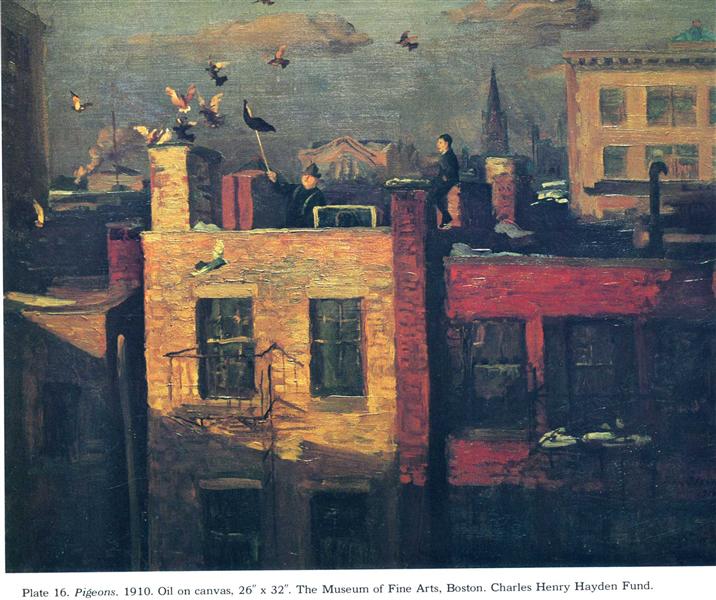
This is from John French Sloan, an American and a socialist. Check out his wiki. Click here to zoom in on this marvelous painting.
Nightcap
- If you want to be welcome, do not demand entry Natalie Solent, Samizdata
- US regionalism and nationalism: the case of the Midwest Halvorson & Reno, Fieldsites
- Heterogeneous drivers of heterogeneous populism Colantone & Stanig, VoxEU
- How talk of witches stirs emotions in Nigeria Adaobi Nwaubani, BBC
Nightcap
- Gulf states and US hostility towards Iran Peter Henne, Duck of Minerva
- NAFTA 2.0 offers promise of stability Milton Ezrati, City Journal
- Free trade isn’t dead yet! Tyler Cowen, Bloomberg
- “All political careers end in failure” Scott Sumner, MoneyIllusion
Nightcap
- China looks like the big winner in new trade negotiations Scott Sumner, MoneyIllusion
- Where does the Asian obsession with white skin come from? Ana Salvá, the Diplomat
- On Steven Pinker and The Blank Slate Arnold Kling, askblog
- In American higher education, hierarchy begets hierarchy Ethan Ris, JHIBlog
Sunday Poetry: Rüstow vs. Mises
One of the bests books I’ve read this year was Serge Audier’s & Jurgen Reinhoudt’s relatively unknown (unfortunately!) translation of the protocols of the Walter-Lippmann-Colloquium. The NOUS-Network organized a wonderful seminar in which we thoroughly discussed the book and the emergence of Neoliberalism. For the preparation of this weekend’s Hayek-Kreis seminar, I reread the book and stood once again in awe of the magnificence of the discussion during the Colloquium.
By the way: If you are an undergraduate, graduate, or PhD scholar, please consider joining the NOUS-Network for Constitutional Economics and Social Philosophy as a Young Affiliate! NOUS is an information platform and a community for interdisciplinary research. The network links all academic fields relevant for thinking about social order and liberty. It spans philosophy, politics, economics and fosters scholarly research, contact and exchange.
In the following excerpt, it becomes clear, that the participant’s opinion on the psychological and sociological causes of the decline of Liberalism differed significantly. Mr Rüstow eloquently captures the standpoints of the two opposing groups (not without bias to be fair) and even cheekily disses Ludwig von Mises.
“Mr Rüstow: ‘All things considered, it is undeniable that here, in our circle, two different points of view are represented. One group does not find anything essential to criticize or to change in traditional liberalism, such as it was and such as it is, apart from, naturally, the adjustments and the current developments that are self-evident.
In their view, the responsibility for all the misfortune falls exclusively on the opposite side, on those who, out of stupidity or out of malice, or through a mixture of both, cannot or do not want to discern and observe the salutary truths of liberalism.
We, on the other hand, we seek the responsibility for the decline of liberalism in liberalism itself; and, therefore, we seek the solution in a fundamental renewal of liberalism. In order to justify in a positive manner this second point of view, I have to refer to what I have said and, especially, to the excellent arguments of Mr Lippmann.
Here, I would only like to draw attention to the fact that if the unwavering representatives of old liberalism were right, the practical prospects [for liberalism] would be almost hopeless. Because it does not really seem that old liberalism has gained in persuasive and in seductive force or that the arguments, no matter how shrewd they may be, of these representatives have the least possibility of bringing about a conversion movement within the realm of Bolshevism, Fascism, or of National Socialism. If they did not listen to Moses and the prophets—Adam Smith and Ricardo—how will they believe Mr. von Mises?'”
As always, I wish you all pleasant Sunday.
Nightcap
- The Left lost yet another election. Its response? Reposting old essays… Chris Bertram, Crooked Timber
- Israel, Syria, and the Kurds Wilkofsky & Zaman, Al-Monitor
- Automation as a colonization wave Robin Hanson, Overcoming Bias
- The geopolitics of liberalism Nicolas Hausdorf, Jacobite
Nightcap
- Coming of age in the CIA Susan Blumberg-Kason, ARB
- Here’s what’s wrong with US foreign policy Peter Henne, Duck of Minerva
- Towards a better globalization Reuven Brenner, American Affairs
- An argument against Richard Dawkins Rupert Shortt, TLS
Despite pressure from Trump, Iran’s world role will continue to be important
Introduction
Ever since taking over as President, Donald Trump’s approach towards Iran has been excessively rash and lacking in nuance. The US withdrawal from JCPOA (Joint Comprehension for Plan of Action), the imposition of sanctions, and brash statements by Trump have heightened tensions between both countries. Allies of the US, including EU member states (especially Germany and France), have expressed their disapproval of Trump’s Iran policy on numerous occasions.
In August 2019, during the G7 Summit at Biarritz (France), it seemed that Trump might have changed his approach towards Iran. The US President expressed his openness to engaging with Iran and dubbed it as a country of immense potential. After the attack on Saudi Oil facilities, there has been a visible shift in the approach of Germany, France, and the UK towards Iran. All three countries blamed Iran for the attacks. In a meeting on the sidelines of the United Nations General Assembly (UNGA) these three countries issued a statement condemning the attack. They also held Iran squarely responsible for the attack. Said the joint statement:
It is clear to us that Iran bears responsibility for this attack
Why China is giving importance to Iran Continue reading

