- The Gospel in a time of social distancing Casey Cep, New Yorker
- China’s misplaced pandemic propaganda Minxin Pei, Japan Times
- City of globalists David Corbin, Modern Age
- Edmund Burke and the American constitution Ofir Haivry, American Affairs
Nightcap
- What George Orwell can still teach the Left George Scialabba, Commonweal
- Why high African fertility persists Jack Goldstone, Hoover Institution
- Malta and the plague of 1813 Andrew Zwilling, War on the Rocks
- The libertarian arguments against democracy Adam Wakeling, Quillette
Nightcap
- Another wasted crisis? Chris Dillow, Stumbling & Mumbling
- Come home America, we’re at war Richard Reinsch II, RealClearPolicy
- Vouchers fight pandemics Robin Hanson, Overcoming Bias
- Singapore: the Sino-Semitic connection Adam Garfinkle, American Interest
Eco’s ‘How to eat ice cream’
A friend recently gifted me a vintage copy of some of Umberto Eco’s essays translated to English. One of the essays, titled “How to eat ice cream,” opened with an anecdote Eco said was based on his childhood. In the story, there was an ice cream vendor who sold regular cones for two cents and ice cream pie cones for four cents. Eco said his parents and grandmother would buy him which ever type he requested, but there was a limit. Young Eco envied the neighbor children who would parade down the street carrying a regular cone in each hand. But whenever he asked for four cents to buy two cones, the adults would flatly refuse and tell him that he could have a pie cone instead. As an adult, he mused:
[…] I realize that those dear and now departed elders were right. Two two-cent cones instead of one at four cents did not signify squandering, economically speaking, but symbolically they surely did. It was for this precise reason that I yearned for them: because two ice creams suggested excess. And this was precisely why they were denied me: because they looked indecent, an insult to poverty, a display of fictitious privilege, a boast of wealth. […] And parents who encouraged this weakness, appropriate to little parvenus, were bringing up their children in the foolish theatre of “I’d like to but I can’t.” They were preparing them to turn up at tourist-class check-in with a fake Gucci bag bought from a street peddler on the beach at Rimini.
The parenting method must have worked because he became Umberto Eco. What Eco recognized was that his parents had inoculated him against false consumerist behavior. The preventative measures were not against the so-called consumerist society but ostentatious display, the process of “keeping up with the Joneses.”
Around January 2018, there was a meme floating around social media. It said something along the lines of “Entrepreneur: someone who lives a few years the way most people won’t so that they can spend the rest of their lives living the way most people can’t.” I very belatedly discovered Carl Schramm’s 2004 book The Entrepreneurial Imperative. Schramm identified the 1950s as the time when American society ceased valorizing business ownership and virtuous risk in favor of material security. As part of the “security first” mentality, children and young people were openly discouraged from seeking independence or from being different in a positive way. The world was one of ossification and stagnation, even as the federal government and media pushed a strong Keynesian message of “consume to grow.” On a side note, now that I think about it, Keynesian economics resemble the children’s video game Snake: one guides the snake to food so that it will grow but eventually it becomes so big that it bites itself – Game over.
Even given the massive propaganda effort put into promoting Keynesian theories, scapegoating “consumerism” or “consumerist society” is a form of escapist thought, a dodging of responsibility. Eco spotted the cause and effect nature of being a parvenu. The desire for “fictitious privilege” creates a set of priorities that cause one to spend his wherewithal thoughtlessly. In turn a “boast of wealth” strategy leads to “’I’d like to but I can’t’” through ensuring that there is no money when real opportunity arrives. The world becomes one of abundant middle as the effort to possess everything spirals.
Nightcap
- Don’t wait for the government, DIY Karen Grépin, Duck of Minerva
- Actually, we need price gouging Antonis Giannakopoulos, Power & Market
- California, slavery, and the Gold Rush Paul Finkelman, LARB
- Wakaliwood, the homegrown Ugandan film industry Richard Whittaker, Austin Chronicle
Again: Never reason from a fatality change

The future isn’t written yet
Last week Richard Epstein predicted around 500 fatalities in the United States (I originally misread his estimate to be 50,000 for the US, not the whole world). His estimate was tragically falsified within days and he has now revised his estimate to 5,000. I still think that’s optimistic but I am hopeful for less than 50,000 deaths in the United States given the social distancing measures currently in place.
Today, several US peers have become excited about a Daily Wire article on comments by a British epidemiologist, Neil Ferguson. He has lowered his UK projections from 500,000 to 20,000 Coronavirus fatalities. The article omits the context of the change. The original New Scientist article (from which the Daily Wire is derivative with little original reporting) explains that the new fatality rate is partly due to a shift in our understanding of existing infections, but also a result of the social distancing measures introduced.
The simple point is:
- Never reason from a fatality rate, and
- Never reason from a change in estimated fatalities
Policy interventions will change infection rates, alter future stresses on the health system, and (when they work) lower future projections of fatalities. When projections are lower, it is not necessarily because the Coranavirus is intrinsically less deadly than believed but because appropriate responses have made it less deadly.
Life
No matter how old, frail or vulnerable it may be, a life isn’t something to take or risk at another’s discretion. Nor does it undermine culpability when someone dies as a result of negligence. The common law ‘eggshell skull’ rule reflects this moral principle.
During the Coronavirus pandemic, some erstwhile defenders of the famous Non-Aggression Principle (NAP) appear to have forgotten that natural rights are conceived to protect life as well as liberty and property. They seem to think that the liberties we ordinarily enjoy have priority over the right to life of others. The environment has changed and, for the time being, many activities that we previously knew to be safe for others are not. They are not part of our set of liberties until a reformed set of rules, norms and habits establishes a sufficiently hygienic public environment. To say that bans on public gatherings violate natural rights a priori is as untenable as G.A. Cohen’s claim that a prohibition on walking onto a train without a valid ticket is a violation of one’s freedom.
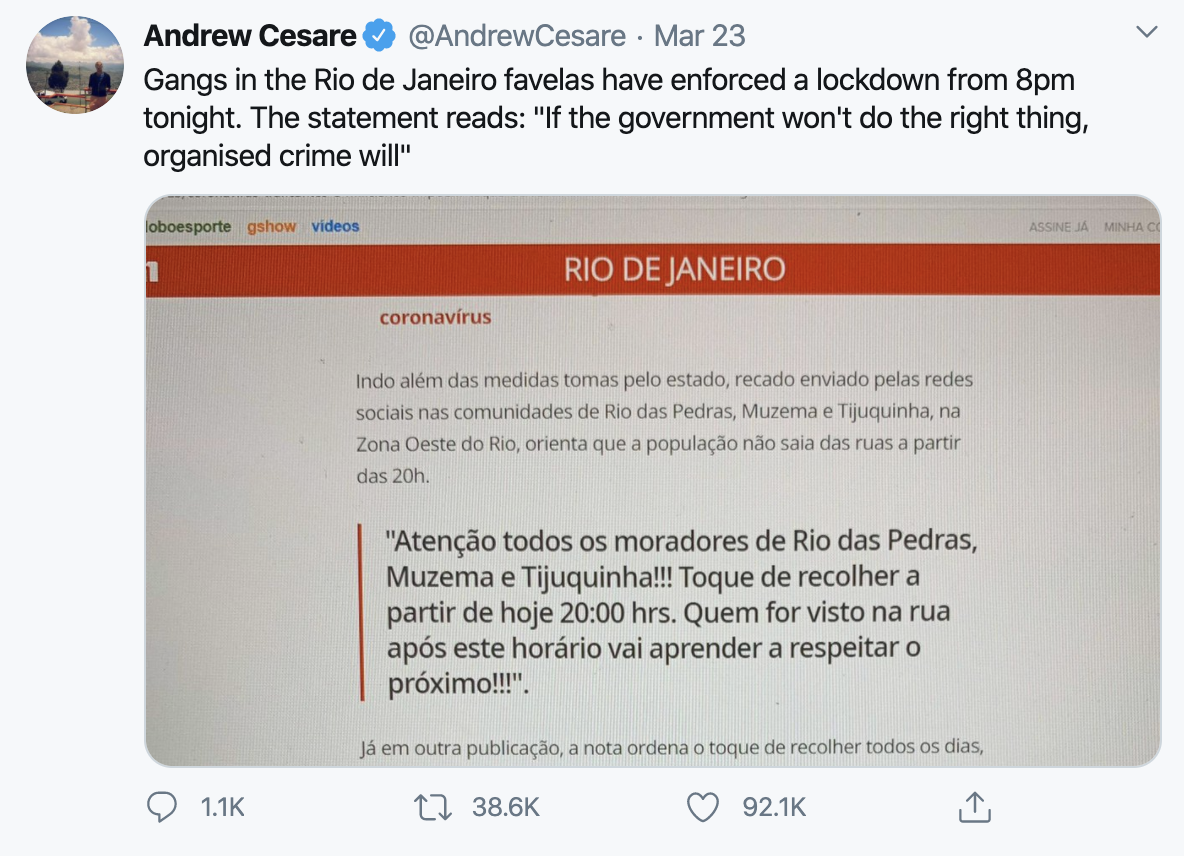
The clue for anarcho-capitalist state-sceptics that this is a genuine shift in social priorities is that even organized criminal gangs are willing to enforce social distancing. You do not have to believe that the state itself is legitimate to see that the need for social distancing is sufficiently morally compelling that it can be enforced absent free agreement, just as one does not need free agreement to exercise a right to self-defense.
Not every restriction is going to be justified, although erring on the restrictive side makes sense while uncertainty about the spread of infection persists. Ultimately, restrictions have to balance genuine costs with plausible benefits. But rejecting restrictions on a priori grounds does not cohere with libertarian principles. Right now, our absolute liberties extend to the right to be alone. Everything else must be negotiated under uncertainty. Someone else’s life, even two-weeks or so in the future, is a valid side-constraint on liberty. People can rightfully be made to stay at home if they are fortunate enough to have one. When people have to travel out of necessity, they can be temporarily exempted, compensated or offered an alternative reasonable means of satisfying their immediate needs.
Nightcap
- Human crap Gabrielle Hecht, Aeon
- “So, as Lenin asked, what is to be done?” Howard Davies, Literary Review
- What the Democrats can learn from a dead libertarian lawyer Damon Root, Reason
- The Silk Road, the Black Death, and Covid-19 Parag Khanna, Wired
A PPE pandemic reading list
I haven’t written for a while – other duties get in the way – but I’d like to suggest this reading list in Philosophy, Politics, and Economics for the present time of crisis and perplexity. The main reason is that everyone seems to be an expert in Economics, Epidemiology, and Political Philosophy these days, assuming that from “facts” we can easily derive “values” and answer the question, “what is to be done?” I think this is at best a naïve attitude and at worst the same rationalistic hubris we experience everytime a political issue is simplified and reduced to a matter of “science”. Yes, there are facts and they shouldn’t be ignored, but it’s not easy to decide what is to be done, morally and politically, in light of those facts.
The first item on the list is Leviathan by Thomas Hobbes. A classic, and a reminder that people choose all the time to sacrifice some degree of liberty in the altar of survival (or a chance to survive), but also a reminder that Leviathan may turn from friend to foe, from protector to persecutor – and there is very little we can do about it. The second item is John Locke’s Second Treatise of Government, which then explores this topic in light of the fact that civil government shouldn’t have absolute power. It makes an attempt to show us how that power can, or should, be limited within a certain sphere of responsibility. Though it’s still there to protect us.
In this time of pandemic, people feel tempted to panic. People and politicians are calling for dramatic measures, and one reason is that the use of government coercion – which, according to Locke, ought to be limited – might be necessary to force people to cooperate, for example, by staying home. This is a proposed solution to the dilemmas of collective action posed by the problem that some may “free-ride” on the rest, and, as a result, the disease will keep spreading, frustrating any attempt to slow it down. Against dramatic, desperate and, perhaps, arrogant, use of political power, and in favor of prudence and wisdom, Edmund Burke’s collection of writings from the period of the French Revolution can be a beacon of light. On the other hand, explaining the dilemmas of collective action and suggesting ways of solving them, Mancur Olson offers an insightful look at incentives and group behavior in The Logic of Collective Action.
However, the idea that government coercion is the only solution to dilemmas of collective action (such as imposing a quarantine, for example) doesn’t hold water. In fact, other economists follow Olson in saying the problem is real and challenges a strict individualist way of thinking, but, adding to Olson’s point, they also acknowledge the role of private action and sanctions in fostering cooperation. Elinor Ostrom’s Governing the Commons is a wonderful study that opens up a number of possibilities for private enforcing of collective action to preserve and promote the frugal allocation of common goods. This can be complemented by The Quest for Community, an overlooked work by sociologist Robert Nisbet, where it becomes clear that, between individuals, the state, and the market, there’s room for other associations and communities that strengthen civil society – particularly in this challenging time. Nisbet’s lesson invites liberty-loving people to reflect on whether a hyper-individualistic view of the world ends up pitting helpess individuals against Leviathan instead of offering the buffer zone of community in between. This is something Alexis de Tocqueville discussed in the 19th century.
And just for the sake of dealing with the issue that “is” doesn’t easily lead to “ought”, and that science might have facts and an explanation for them, but does not easily conduce to a proper discussion on values policy, I must finish this PPE pandemic reading list with F. A. Hayek’s The Constitution of Liberty. On Chapter 4, for example, Hayek introduces a constrast between “rationalist liberalism” and “anti-rationalist liberalism”. Rationalist liberals assume too easily that knowledge of the facts on the ground will give them what they need to re-design a society governed by reason. Hayek warns us against this technocratic assumption and offers a defence of “anti-rationalist liberalism”. Anti-rationalist liberals understand the importance of spontaneous order and of constraining power (even at a time of crisis) while prudently balancing the values of liberty and safety in light of past experience and tradition.
Three Additional readings:
Buzan, Waever and De Wilde, Security: A New Framework for Analysis (1997). In a liberal democracy, the state steps in suspending some civil liberties only if it can persuade citizens that there’s a threat that justifies it. This book offers a framework to interpret how such threats are constructed in official and non-official discourse, and to what extent this construction of a threat can be effective.
Robert Higgs, Crisis and Leviathan (2013). 25th anniversary edition. Looks at US history and how government employed crises to its advantage and the advantage of the ruling elites. In particular, security and economy related issues are dealt with.
Sanford Ikeda, Dynamics of the Mixed Economy (2002). Shows that a time of crisis might be a time for further interventionism in the economy, as Higgs (see above) suggests, but might also be a time for disintervention, as seems to be the case with part of the agenda today (FDA deregulation, etc.) This is based on Ludwig von Mises’ view that interventionist economies are not very stable and are always swinging as a pendulum between socialism and capitalism.
The Vexing Libertarian Issue of Transition
I have appointed myself an old sage to the world. When your knees are creaky and every snotty eighteen-year-old treats you patronizingly, the least you can do to compensate is award yourself wisdom. Anyway, long story short, it’s a good excuse to spend much time on Facebook. I feel I am rendering a public service. I am continuing my teaching career there. It’s unpaid but the conditions are much better and all the students actually want to be in class.
Of course, it’s also true that Facebook is addictive. It’s not a bad addiction. For this old guy, it’s almost incredible to have frequent conversations with an MD in Pakistan, my niece in India, an old girlfriend in Panama, a young friend’s wife in Japan, and of course, many different kinds of French people. I even have a Facebook friend who lives in the mountains of Algeria; we have lively talks in French. Recently, a young woman who described herself as a Myanmar village girl reached out. (I know what you are thinking but if she is really one of those internet sex trolls, I salute the originality of her marketing strategy.) At all times a day and night, I have at least one Facebook friend who is not asleep. It’s pleasant in these days of confinement.
The same confinement, perhaps, slows me down and makes me more likely to tally up everything. As a result, a new impression has pierced my consciousness. Expressing contempt for democracy seems to be in vogue among people who identify as libertarians (with a small “l,” big “L” Libertarians have nearly vanished from my world. It could just be me.) This contempt reminds me that I have been asking the same question of libertarianism for now about fifty years, all with not much success.
I refer to the question of transition. I mean, what is it supposed to look like moving from wherever we are, in terms of governance, to a society with a drastically diminished government interference in individual lives? I have been receiving evasive answers, answers that don’t make even superficial sense, and swift escapes effected by changing the subject.
Let me say right away that I am not looking for a crushing reading assignment (a common punitive, passive-aggressive maneuver among intellectuals). Mine is a simple question. One should be able to sketch a rudimentary answer to it. Then, it would be up to me to follow through. Then, no excuse!
To my mind, there are only two extreme transition scenarios. One is the Somali scenario. The state falls apart under its own incapacity to limit internal aggression. It disappears or nearly so. When the point is reached where government authority extends only three blocks from the presidential palace to the north and east, and one block from the south and west, you pretty much have a stateless society. Goal reached!
The second scenario is a gradual change from the current “democratic” arrangements. I mean by this fair and reasonably honest elections followed by a peaceful transfer of power. I mean freedom of expression. And, disturbingly, this also includes courts of law. This is disturbing because courts without enforcement of their decisions are not really courts. This fact implies the threat of coercion, of course.
Now, I can imagine a situation like right now with the Corona Virus epidemic when governments (plural) demonstrate on a large scale their inability to do the obvious. The citizens often react to this sort of demonstration by asking for better and more government. However, it does not have to be that way. The combination of wide communication through the internet and – like now – of enforced leisure – may switch the dial. It’s conceivable that large numbers will get the idea that government that is at once heavy-handed, expensive, and incapable is not a good answer to much of anything. With that scenario one can imagine a collective demand for less government.
Strangely, this sort of scenario may be on display in France now, as I write. Well, this is not so strange after all. A deeply statist society where govt absorbs 55% of GDP and up may be exactly the best place to figure out that more government is not the answer. From this thought to the idea that less government may be the answer there is but one step. My intuition though is that it’s a big step. That’s because few people understand markets. No one but a handful of college professors seems to have read the moral philosopher Adam Smith. (Tell me that I am wrong.)
So, I would like for those who are more advanced than I am on this issue of transition (a low bar) to engage me. I am not interested in the same old ethical demonstrations though. Yes, the state is an instrument of coercion and therefore, evil. I already know this. In the meantime, the First Amendment to the Constitution of the United States does a fair job of protecting my freedom of speech, my freedom, of thought, my freedom of religion. I am not eager to leave this behind for the complete unknown. Are you? Why? How?
Nightcap
- The role of the libertarian in non-libertarian societies Fabio Rojas, Bleeding Heart Libertarians
- Did I have the coronavirus? Ross Douthat, New York Times
- Hospital bed access across Canada Frances Woolley, Worthwhile Canadian Initiative
- The future of public employee unions Daniel DiSalvo, National Affairs
A History of Plagues
As COVID-19 continues to spread, fears and extraordinary predictions have also gone viral. While facing a new infectious threat, the unknowns of how new traits of our societies worldwide or of this novel coronavirus impact its spread. Though no two pandemics are equivalent, I thought it best to face this new threat armed with knowledge from past infectious episodes. The best inoculation against a plague of panic is to use evidence gained through billions of deaths, thousands of years, and a few vital breakthroughs to prepare our knowledge of today’s biological crises, social prognosis, and choices.
Below, I address three key questions: First, what precedents do we have for infections with catastrophic potential across societies? Second, what are the greatest killers and how do pandemics compare? Lastly, what are our greatest accomplishments in fighting infectious diseases?
As foundation for understanding how threats like COVID-19 come about and how their hosts fight back, I recommend reading The Red Queen concerning the evolutionary impact and mechanisms of host-disease competition and listening to Sam Harris’ “The Plague Years” podcast with Matt McCarthy from August 2019, which predated COVID-19 but had a strangely prophetic discussion of in-hospital strategies to mitigate drug resistance and their direct relation to evolutionary competition.
- The Biggest Killers:
Infectious diseases plagued humanity throughout prehistory and history, with a dramatic decrease in the number of infectious disease deaths coming in the past 200 years. In 1900, the leading killers of people were (1) Influenza, (2) Tuberculosis, and (3) Intestinal diseases, whereas now we die from (1) Heart disease, (2) Cancer, and (3) Stroke, all chronic conditions. This graph shows not that humans have vanquished infectious disease as a threat, but that in the never-ending war of evolutionary one-upmanship, we have won battles consistently since 1920 forward. When paired with Jonathan Haidt’s Most Important Graph in the World, this vindicates humanity’s methods of scientific and economic progress toward human flourishing.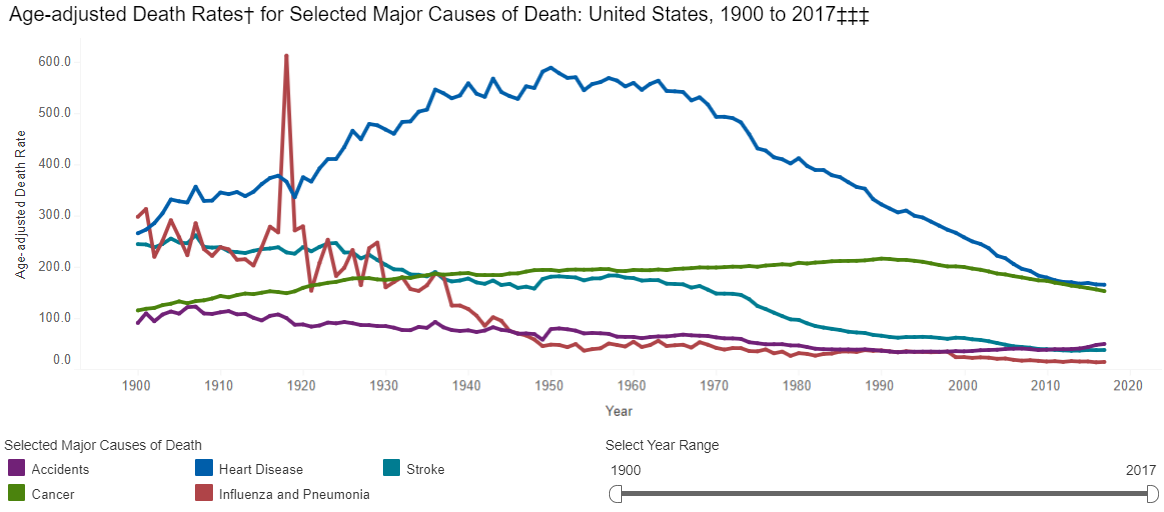
However, if the CDC had earlier data, it would show a huge range of diseases that dwarf wars and famines and dictators as causes of death in the premodern world. If we look to the history of plagues, we are really looking at the history of humanity’s greatest killers.
The sources on the history of pandemics are astonishingly sparse/non-comprehensive. I created the following graphs only by combining evidence and estimates from the WHO, CDC, Wikipedia, Our World in Data, VisualCapitalist, and others (lowest estimates shown where ranges were presented) for both major historic pandemics and for ongoing communicable disease threats. This is not a complete dataset, and I will continue to add to it, but it shows representative death counts from across major infectious disease episodes, as well as the death rate per year based on world population estimates. See the end of this post for the full underlying data. First, the top 12 “plagues” in history:
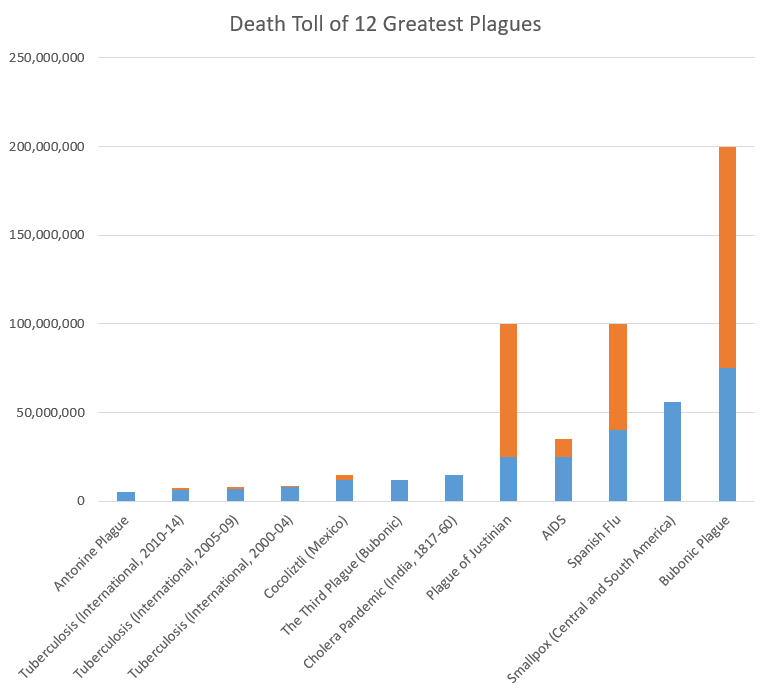
Note: blue=min, orange=max across the sources I examined. For ongoing diseases with year-by-year WHO evidence, like tuberculosis, measles, and cholera, I grouped mortality in 5-year spans (except AIDS, which does not have good estimates from the 1980s-90s, so I reported based on total estimated deaths).
Now, let’s look at the plagues that were lowest on my list (number 55-66). Again, my list was not comprehensive, but this should provide context for COVID-19:
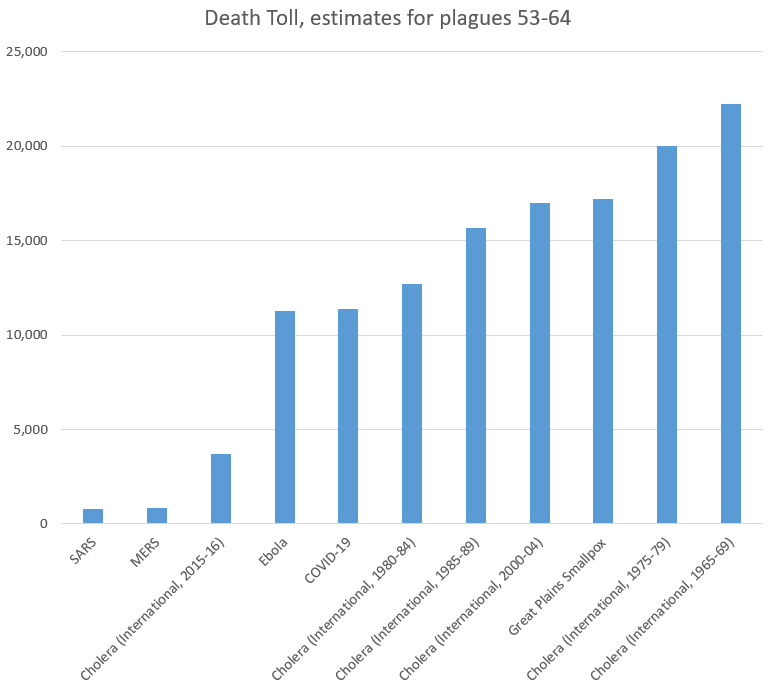
As we can see, the 11,400 people who have died from COVID-19 recently passed Ebola to take the 61st (out of 66) place on our list of plagues. Note again that several ongoing diseases were recorded in 5-year increments, and COVID-19 still comes in under the death rates for cholera. Even more notably, it has 0.015% as many victims as the plague in the 14th Century,
- In Context of Current Infectious Diseases:
For recent/ongoing diseases, it is easier to compare year-by-year data. Adding UNAIDS to our sources, we found the following rates of death across some of the leading infectious causes of death. Again, this is not comprehensive, but helps put COVID-19 (the small red dot, so far in the first 3 months of 2020) in context:
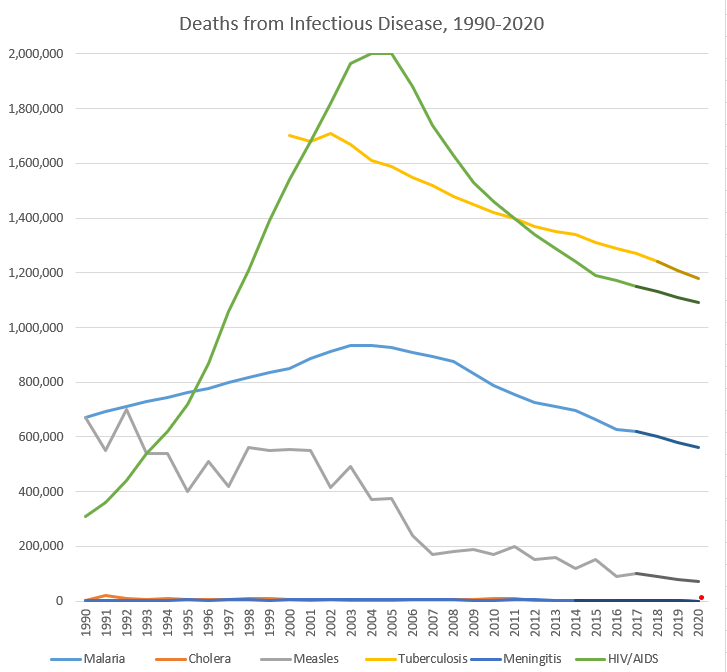
Note: darker segments of lines are my own estimates; full data at bottom of the post. I did not include influenza due to the lack of good sources on a year-by-year basis, but a Lancet article found that 291,000-645,000 deaths from influenza in a year is predictable based on data from 1999-2015.
None of this is to say that COVID-19 is not a major threat to human health globally–it is, and precautions could save lives. However, it should show us that there are major threats to human health globally all the time, that we must continue to fight. These trendlines tend to be going the right direction, but our war for survival has many foes, and will have more emerge in the future, and we should expend our resources in fighting them rationally based on the benefits to human health, not panic or headlines.
- The Eradication List:
As we think about the way to address COVID-19, we should keep in mind that this fight against infectious disease builds upon work so amazing that most internet junkies approach new infectious diseases with fear of the unknown, rather than tired acceptance that most humans succumb to them. That is a recent innovation in the human experience, and the strategies used to fight other diseases can inform our work now to reduce human suffering.
While influenzas may be impossible to eradicate (in part due to an evolved strategy of constantly changing antigens), I wanted to direct everyone to an ever-growing monument to human achievement, the Eradication List. While humans have eradicated only a few infectious diseases, the amazing thing is that we can discuss which diseases may in fact disappear as threats through the work of scientists.
On that happy note, I leave you here. More History of Plagues to come, in Volume 2: Vectors, Vaccines, and Virulence!
| Disease | Start Year | End Year | Death Toll (low) | Death Toll (high) | Deaths per 100,000 people per year (global) |
| Antonine Plague | 165 | 180 | 5,000,000 | 5,000,000 | 164.5 |
| Plague of Justinian | 541 | 542 | 25,000,000 | 100,000,000 | 6,250.0 |
| Japanese Smallpox Epidemic | 735 | 737 | 1,000,000 | 1,000,000 | 158.7 |
| Bubonic Plague | 1347 | 1351 | 75,000,000 | 200,000,000 | 4,166.7 |
| Smallpox (Central and South America) | 1520 | 1591 | 56,000,000 | 56,000,000 | 172.8 |
| Cocoliztli (Mexico) | 1545 | 1545 | 12,000,000 | 15,000,000 | 2,666.7 |
| Cocoliztli resurgence (Mexico) | 1576 | 1576 | 2,000,000 | 2,000,000 | 444.4 |
| 17th Century Plagues | 1600 | 1699 | 3,000,000 | 3,000,000 | 6.0 |
| 18th Century Plagues | 1700 | 1799 | 600,000 | 600,000 | 1.0 |
| New World Measles | 1700 | 1799 | 2,000,000 | 2,000,000 | 3.3 |
| Smallpox (North America) | 1763 | 1782 | 400,000 | 500,000 | 2.6 |
| Cholera Pandemic (India, 1817-60) | 1817 | 1860 | 15,000,000 | 15,000,000 | 34.1 |
| Cholera Pandemic (International, 1824-37) | 1824 | 1837 | 305,000 | 305,000 | 2.2 |
| Great Plains Smallpox | 1837 | 1837 | 17,200 | 17,200 | 1.7 |
| Cholera Pandemic (International, 1846-60) | 1846 | 1860 | 1,488,000 | 1,488,000 | 8.3 |
| Hawaiian Plagues | 1848 | 1849 | 40,000 | 40,000 | 1.7 |
| Yellow Fever | 1850 | 1899 | 100,000 | 150,000 | 0.2 |
| The Third Plague (Bubonic) | 1855 | 1855 | 12,000,000 | 12,000,000 | 1,000.0 |
| Cholera Pandemic (International, 1863-75) | 1863 | 1875 | 170,000 | 170,000 | 1.1 |
| Indian Smallpox | 1868 | 1907 | 4,700,000 | 4,700,000 | 9.8 |
| Franco-Prussian Smallpox | 1870 | 1875 | 500,000 | 500,000 | 6.9 |
| Cholera Pandemic (International, 1881-96) | 1881 | 1896 | 846,000 | 846,000 | 4.4 |
| Russian Flu | 1889 | 1890 | 1,000,000 | 1,000,000 | 41.7 |
| Cholera Pandemic (India and Russia) | 1899 | 1923 | 1,300,000 | 1,300,000 | 3.3 |
| Cholera Pandemic (Philippenes) | 1902 | 1904 | 200,000 | 200,000 | 4.2 |
| Spanish Flu | 1918 | 1919 | 40,000,000 | 100,000,000 | 1,250.0 |
| Cholera (International, 1950-54) | 1950 | 1954 | 316,201 | 316,201 | 2.4 |
| Cholera (International, 1955-59) | 1955 | 1959 | 186,055 | 186,055 | 1.3 |
| Asian Flu | 1957 | 1958 | 1,100,000 | 1,100,000 | 19.1 |
| Cholera (International, 1960-64) | 1960 | 1964 | 110,449 | 110,449 | 0.7 |
| Cholera (International, 1965-69) | 1965 | 1969 | 22,244 | 22,244 | 0.1 |
| Hong Kong Flu | 1968 | 1970 | 1,000,000 | 1,000,000 | 9.4 |
| Cholera (International, 1970-75) | 1970 | 1974 | 62,053 | 62,053 | 0.3 |
| Cholera (International, 1975-79) | 1975 | 1979 | 20,038 | 20,038 | 0.1 |
| Cholera (International, 1980-84) | 1980 | 1984 | 12,714 | 12,714 | 0.1 |
| AIDS | 1981 | 2020 | 25,000,000 | 35,000,000 | 13.8 |
| Measles (International, 1985) | 1985 | 1989 | 4,800,000 | 4,800,000 | 19.7 |
| Cholera (International, 1985-89) | 1985 | 1989 | 15,655 | 15,655 | 0.1 |
| Measles (International, 1990-94) | 1990 | 1994 | 2,900,000 | 2,900,000 | 10.9 |
| Cholera (International, 1990-94) | 1990 | 1994 | 47,829 | 47,829 | 0.2 |
| Malaria (International, 1990-94) | 1990 | 1994 | 3,549,921 | 3,549,921 | 13.3 |
| Measles (International, 1995-99) | 1995 | 1999 | 2,400,000 | 2,400,000 | 8.4 |
| Cholera (International, 1995-99) | 1995 | 1999 | 37,887 | 37,887 | 0.1 |
| Malaria (International, 1995-99) | 1995 | 1999 | 3,987,145 | 3,987,145 | 13.9 |
| Measles (International, 2000-04) | 2000 | 2004 | 2,300,000 | 2,300,000 | 7.5 |
| Malaria (International, 2000-04) | 2000 | 2004 | 4,516,664 | 4,516,664 | 14.7 |
| Tuberculosis (International, 2000-04) | 2000 | 2004 | 7,890,000 | 8,890,000 | 25.7 |
| Cholera (International, 2000-04) | 2000 | 2004 | 16,969 | 16,969 | 0.1 |
| SARS | 2002 | 2003 | 770 | 770 | 0.0 |
| Measles (International, 2005-09) | 2005 | 2009 | 1,300,000 | 1,300,000 | 4.0 |
| Malaria (International, 2005-09) | 2005 | 2009 | 4,438,106 | 4,438,106 | 13.6 |
| Tuberculosis (International, 2005-09) | 2005 | 2009 | 7,210,000 | 8,010,000 | 22.0 |
| Cholera (International, 2005-09) | 2005 | 2009 | 22,694 | 22,694 | 0.1 |
| Swine Flu | 2009 | 2010 | 200,000 | 500,000 | 1.5 |
| Measles (International, 2010-14) | 2010 | 2014 | 700,000 | 700,000 | 2.0 |
| Malaria (International, 2010-14) | 2010 | 2014 | 3,674,781 | 3,674,781 | 10.6 |
| Tuberculosis (International, 2010-14) | 2010 | 2014 | 6,480,000 | 7,250,000 | 18.6 |
| Cholera (International, 2010-14) | 2010 | 2014 | 22,691 | 22,691 | 0.1 |
| MERS | 2012 | 2020 | 850 | 850 | 0.0 |
| Ebola | 2014 | 2016 | 11,300 | 11,300 | 0.1 |
| Malaria (International, 2015-17) | 2015 | 2017 | 1,907,872 | 1,907,872 | 8.6 |
| Tuberculosis (International, 2015-18) | 2015 | 2018 | 4,800,000 | 5,440,000 | 16.3 |
| Cholera (International, 2015-16) | 2015 | 2016 | 3,724 | 3,724 | 0.0 |
| Measles (International, 2019) | 2019 | 2019 | 140,000 | 140,000 | 1.8 |
| COVID-19 | 2019 | 2020 | 11,400 | 11,400 | 0.1 |
| Year | Malaria | Cholera | Measles | Tuberculosis | Meningitis | HIV/AIDS | COVID-19 |
| 1990 | 672,518 | 2,487 | 670,000 | 1,903 | 310,000 | ||
| 1991 | 692,990 | 19,302 | 550,000 | 1,777 | 360,000 | ||
| 1992 | 711,535 | 8,214 | 700,000 | 2,482 | 440,000 | ||
| 1993 | 729,735 | 6,761 | 540,000 | 1,986 | 540,000 | ||
| 1994 | 743,143 | 10,750 | 540,000 | 3,335 | 620,000 | ||
| 1995 | 761,617 | 5,045 | 400,000 | 4,787 | 720,000 | ||
| 1996 | 777,012 | 6,418 | 510,000 | 3,325 | 870,000 | ||
| 1997 | 797,091 | 6,371 | 420,000 | 5,254 | 1,060,000 | ||
| 1998 | 816,733 | 10,832 | 560,000 | 4,929 | 1,210,000 | ||
| 1999 | 834,692 | 9,221 | 550,000 | 2,705 | 1,390,000 | ||
| 2000 | 851,785 | 5,269 | 555,000 | 1,700,000 | 4,298 | 1,540,000 | |
| 2001 | 885,057 | 2,897 | 550,000 | 1,680,000 | 6,398 | 1,680,000 | |
| 2002 | 911,230 | 4,564 | 415,000 | 1,710,000 | 6,122 | 1,820,000 | |
| 2003 | 934,048 | 1,894 | 490,000 | 1,670,000 | 7,441 | 1,965,000 | |
| 2004 | 934,544 | 2,345 | 370,000 | 1,610,000 | 6,428 | 2,003,000 | |
| 2005 | 927,109 | 2,272 | 375,000 | 1,590,000 | 6,671 | 2,000,000 | |
| 2006 | 909,899 | 6,300 | 240,000 | 1,550,000 | 4,720 | 1,880,000 | |
| 2007 | 895,528 | 4,033 | 170,000 | 1,520,000 | 7,028 | 1,740,000 | |
| 2008 | 874,087 | 5,143 | 180,000 | 1,480,000 | 4,363 | 1,630,000 | |
| 2009 | 831,483 | 4,946 | 190,000 | 1,450,000 | 3,187 | 1,530,000 | |
| 2010 | 788,442 | 7,543 | 170,000 | 1,420,000 | 2,198 | 1,460,000 | |
| 2011 | 755,544 | 7,781 | 200,000 | 1,400,000 | 3,726 | 1,400,000 | |
| 2012 | 725,676 | 3,034 | 150,000 | 1,370,000 | 3,926 | 1,340,000 | |
| 2013 | 710,114 | 2,102 | 160,000 | 1,350,000 | 3,453 | 1,290,000 | |
| 2014 | 695,005 | 2,231 | 120,000 | 1,340,000 | 2,992 | 1,240,000 | |
| 2015 | 662,164 | 1,304 | 150,000 | 1,310,000 | 1,190,000 | ||
| 2016 | 625,883 | 2,420 | 90,000 | 1,290,000 | 1,170,000 | ||
| 2017 | 619,825 | 100,000 | 1,270,000 | 1,150,000 | |||
| 2018 | 1,240,000 | ||||||
| 2019 | |||||||
| 2020 | 16,514 |
Nightcap
- The Old Normal Andrew Bacevich, Harper’s
- “Iran Doesn’t Want War but has a big appetite for risk” War on the Rocks
- Nice try, economists Arnold Kling, askblog
- Against “aggregate demand” Chris Dillow, Stumbling and Mumbling
Pandemic responses are beyond Evidence-based Medicine
John Ioannidis, a professor of medicine at Stanford University, fears that the draconian measures to enforce social distancing across Europe and United States could end up causing more harm than the pandemic itself. He believes that governments are acting on exaggerated claims and incomplete data and that a priority must be getting a more representative sample of populations currently suffering corona infections. I agree additional data would be enormously valuable but, following Saloni Dattani, I think we have more warrant for strong measures than Ioannidis implies.
Like Ioannidis’ Stanford colleague Richard Epstein, I agree that estimates of a relatively small overall fatality rate are plausible projections for most of the developed world and especially the United States. Unlike Epstein, I think those estimates are conditional on the radical social distancing (and self-isolation) measures that are currently being pushed rather than something that can be assumed. I am not in a position to challenge Ioannidis’ understanding of epidemiology. Others have used his piece as an opportunity to test and defend the assumptions of the worst-case scenarios.
Nevertheless, I can highlight the epistemic assumptions underlying Ioannidis’ pessimism about social distancing interventions. Ioannidis is a famous proponent (occasionally critic) of Evidence-based Medicine (EBM). Although open to refinement, at its core EBM argues that strict experimental methods (especially randomized controlled trials) and systematic reviews of published experimental studies with sound protocols are required to provide firm evidence for the success of a medical intervention.
The EBM movement was born out of a deep concern of its founder, Archie Cochrane, that clinicians wasted scarce resources on treatments that were often actively harmful for patients. Cochrane was particularly concerned that doctors could be dazzled or manipulated into using a treatment based on some theorized mechanism that had not been subject to rigorous testing. Only randomized controlled trials supposedly prove that an intervention works because only they minimize the possibility of a biased result (where characteristics of a patient or treatment path other than the intervention itself have influenced the result).
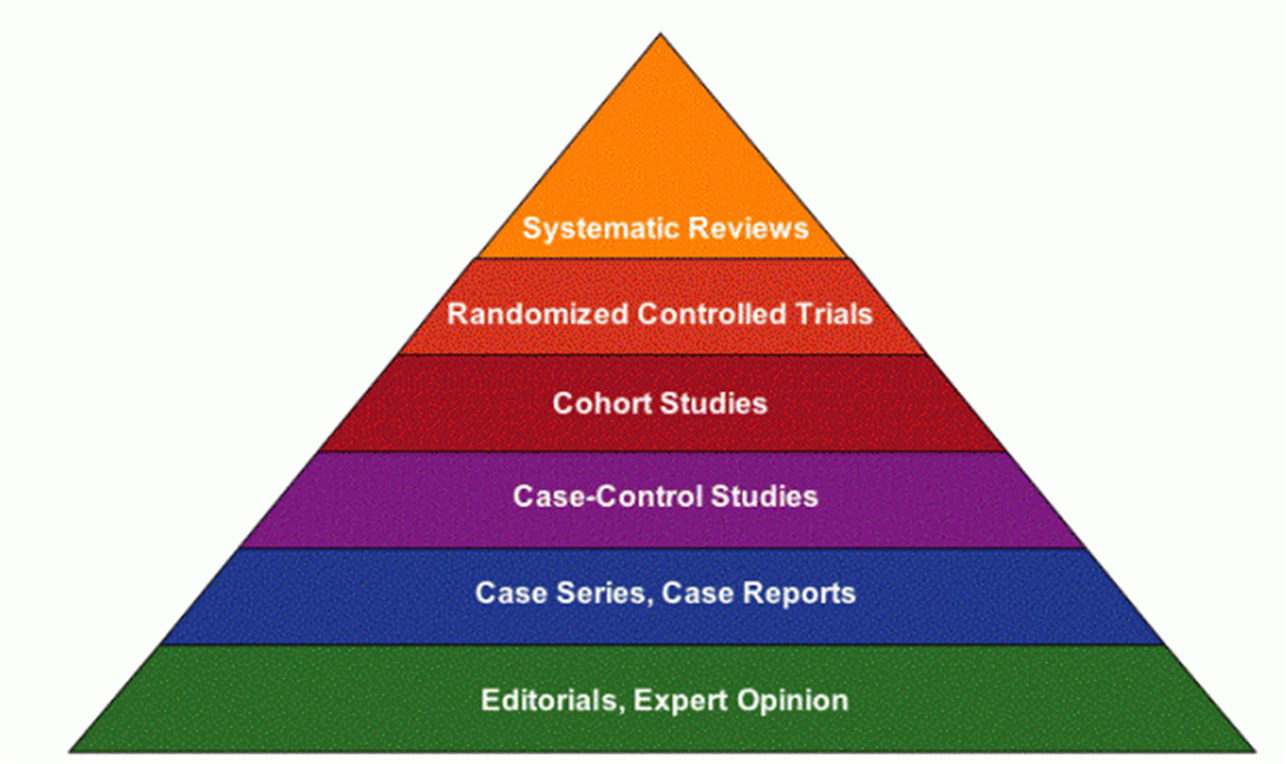
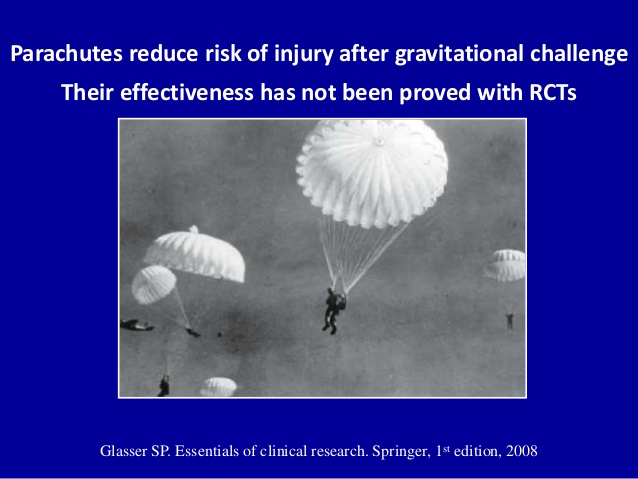
So when Ioannidis looks for evidence that social distancing interventions work, he reaches for a Cochrane Review that emphasizes experimental studies over other research designs. As is often the case for a Cochrane review, many of the results point to uncertainty or relatively small effects from the existing literature. But is this because social distancing doesn’t work, or because RCTs are bad at measuring their effectiveness under pandemic circumstances (the circumstances where they might actually count)? The classic rejoinder to EBM proponents is that we know that parachutes can save lives but we can never subject them to RCT. Effective pandemic interventions could suffer similar problems.
Nancy Cartwright and I have argued that there are flaws in the methodology underlying EBM. A positive result for treatment against control in a randomized controlled trial shows you that an intervention worked in one place, at one time for one set of patients but not why and whether to expect it to work again in a different context. EBM proponents try to solve this problem by synthesizing the results of RCTs from many different contexts, often to derive some average effect size that makes a treatment expected to work overall or typically. The problem is that, without background knowledge of what determined the effect of an intervention, there is little warrant to be confident that this average effect will apply in new circumstances. Without understanding the mechanism of action, or what we call a theory of change, such inferences rely purely on induction.
The opposite problem is also present. An intervention that works for some specific people or in some specific circumstances might look unpromising when it is tested in a variety of cases where it does not work. It might not work ‘on average’. But that does not mean it is ineffective when the mechanism is fit to solve a particular problem such as a pandemic situation. Insistence on a narrow notion of evidence will mean missing these interventions in favor of ones that work marginally in a broad range of cases where the answer is not as important or relevant.
Thus even high-quality experimental evidence needs to be combined with strong background scientific and social scientific knowledge established using a variety of research approaches. Sometimes an RCT is useful to clinch the case for a particular intervention. But sometimes, other sources of information (especially when time is of the essence), can make the case more strongly than a putative RCT can.
In the case of pandemics, there are several reasons to hold back from making RCTs (and study designs that try to imitate them) decisive or required for testing social policy:
- There is no clear boundary between treatment and control groups since, by definition, an infectious disease can spread between and influence groups unless they are artificially segregated (rendering the experiment less useful for making broader inferences).
- The outcome of interest is not for an individual patient but the communal spread of a disease that is fatal to some. The worst-case outcome is not one death, but potentially very many deaths caused by the chain of infection. A marginal intervention at the individual level might be dramatically effective in terms of community outcomes.
- At least some people will behave differently, and be more willing to alter their conduct, during a widely publicized pandemic compared to hygienic interventions during ordinary times. Although this principle might be testable in different circumstances, the actual intervention won’t be known until it is tried in the reality of pandemic.
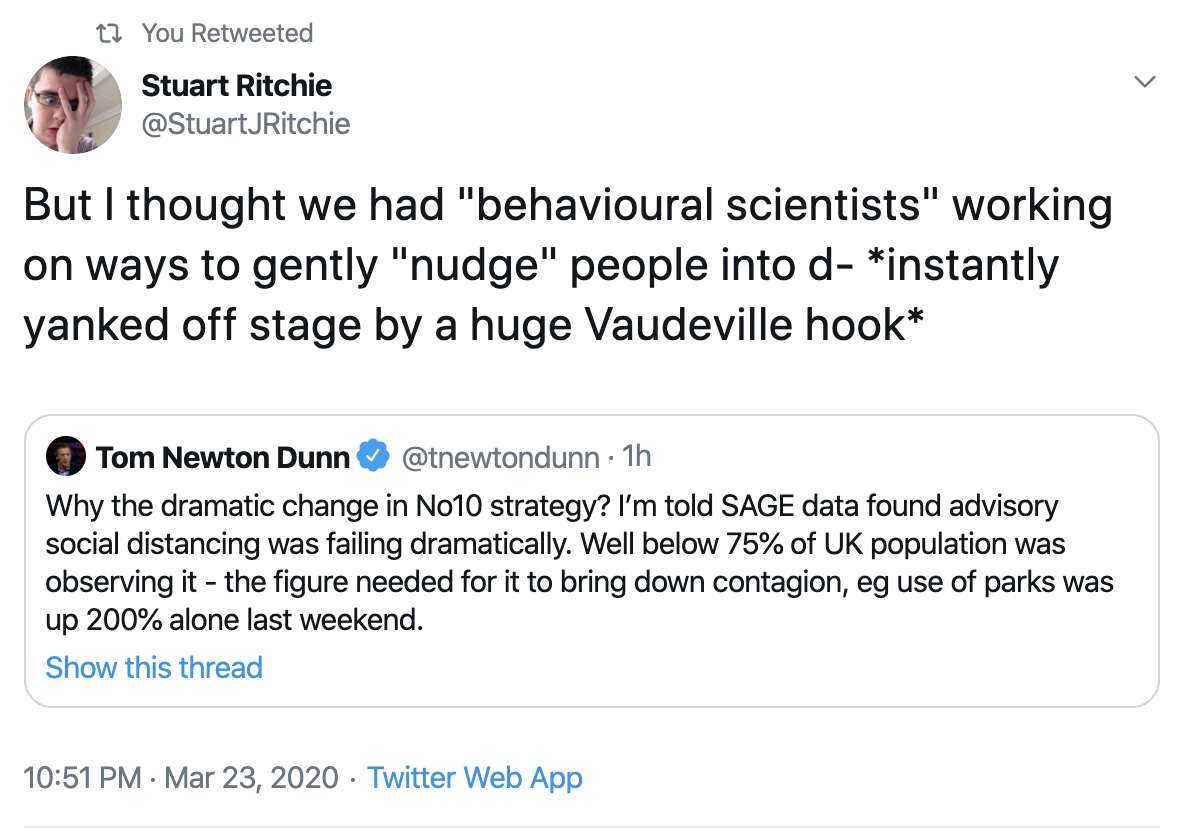
This means that rather than narrowly focusing on evidence from EBM and behavioral psychologists (or ‘nudge’), policymakers responding to pandemics must look to insights from political economy and social psychology, especially how to shift norms towards greater hygiene and social distancing. Without any bright ideas, traditional public health methods of clear guidance and occasionally enforced sanctions are having some effect.
What evidence do we have at the moment? Right now, there is an increasing body of defeasible knowledge of the mechanisms with which the Coronavirus spreads. Our knowledge of existing viruses with comparable characteristics indicates that effectively implemented social distancing is expected to slow its spread and that things like face masks might slow the spread when physical distancing isn’t possible.
We also have some country and city-level policy studies. We saw an exponential growth of cases in China before extreme measures brought the virus under control. We saw immediate quarantine and contact tracing of cases in Singapore and South Korea that was effective without further draconian measures but required excellent public health infrastructure.
We have now also seen what looks like exponential growth in Italy, followed by a lockdown that appears to have slowed the growth of cases though not yet deaths. Some commentators do not believe that Italy is a relevant case for forecasting other countries. Was exponential growth a normal feature of the virus, or something specific to Italy and its aging population that might not be repeated in other parts of Europe? This seems like an odd claim at this stage given China’s similar experience. The nature of case studies is that we do not know with certainty what all the factors are while they are in progress. We are about to learn more as some countries have chosen a more relaxed policy.
Is there an ‘evidence-based’ approach to fighting the Coronavirus? As it is so new: no. This means policymakers must rely on epistemic practices that are more defeasible than the scientific evidence that we are used to hearing. But that does not mean a default to light-touch intervention is prudent during a pandemic response. Instead, the approaches that use models with reasonable assumptions based on evidence from unfolding case-studies are the best we can do. Right now, I think, given my moral commitments, this suggests policymakers should err on the side of caution, physical distancing, and isolation while medical treatments are tested.
[slightly edited to distinguish my personal position from my epistemic standpoint]
Nightcap
- Rand Paul tests positive for coronavirus Bresnahan & Ferris, Politico
- The urgent lessons of World War I Brian Frydenborg, Modern War Institute
- Underestimating China Scott Sumner, MoneyIllusion
- Albania was not a True Communist country during the Cold War Griselda Qosja, Jacobin

