- Ottoman bird palaces Atlas Obscura
- Ottomanism, Nationalism, Republicanism (the 1960s) Barry Stocker, NOL
- Liberalism and sovereignty Edwin van de Haar, NOL
- Why not world government? Michaelangelo Landgrave, NOL
Nightcap
- The challenges of lending to Main Street George Selgin, Alt-M
- What Sweden has done right on Coronavirus Joakim Book, AEIR
- The State Has Seized Many New Powers. It Won’t Let Go of Them Easily. Andrei Znamenski, Mises Wire
- When disease comes, rulers grab power Anne Applebaum, Atlantic
Ron Paul’s Revolution: Looking back
On January 20, 2009, Barack Obama was sworn in as President of the United States. It was a historic moment. The United States of America had elected its first black President. I remember listening to the president’s inaugural speech on the radio. (I was driving from the Lake Tahoe area to Santa Cruz, officially moving to the Monterey Bay along with my girlfriend at the time, who had been accepted into UC Santa Cruz while we were in Ghana.) I got chills that ran down my spine. My nipples got hard. The hair on my arm stood up, revealing goosebumps.
I had enough respect for the republic’s history to know that I was listening to one of its greatest triumphs. A member of an ethnic minority, and a group that had been viciously oppressed at that, had been elected to the republic’s highest-ranking democratic office. American society was evolving in a way that made me proud. It was cool, but my elation was tampered due to a different evolution that was going on in my own way of thinking. My thoughts about how societies worked had been radically altered thanks to the presidential candidacy of a little-known Republican Congressman from Texas: Ron Paul.
I came across Ron Paul via YouTube videos that had been shared on MySpace. I was a product of the California public school system. The public school system has two tiers: a good one for rich people and an awful one for the rest of us. I came from a single parent household. My mother had a college degree and was part of the California public school system, but we were still in the “poor” category. In California’s public schools, a binary way of thinking about civics is introduced and hammered home from the age of 5 to the age of 18. Democrats are liberals who prefer higher taxes, listen to scientists, and believe in change, while Republicans are conservatives who prefer lower taxes, listen to Protestant ministers, and believe in maintaining the status quo. This is not a caricature. I believe this is how most Americans viewed civics up until the moment Ron Paul arrived on the national scene via his back-and-forth with Rudy Guilliani.
In short, I was uneducated but enthusiastic about reading and especially history. I had no career at that point in time (I was an informal carpenter’s apprentice from March through November, and a sandwich maker during the rainy holiday season). I became obsessed with Ron Paul videos online. I watched them over and over. I had never heard arguments like his before. I had no idea that you could be a Republican and be against wars on terrorism and drugs. I had no idea Democrats could be so “pragmatic” when it came to these wars. I watched Ron Paul over and over again. Instead of trying to soundbyte his message, he spoke of responsibility and hard money and corporations taking advantage of regulations to enrich themselves at the expense of everybody else. Never had I heard such ideas before!
I was slow to follow up on his reading suggestions, though. I went almost immediately to the websites of Lew Rockwell and the Mises Institute but what I found there was too radical for me. It was too straightforward. They were speaking of things that I considered, due to my public schooling and religious background, to be taboo. There was a hint of racism in some of the articles I saw at these sights. Perhaps because of the cruddy schooling I got in California, I was at the time of Ron Paul’s revolution a left-wing conspiracist of sorts. I marched against the invasion of Iraq in San Francisco. I marched in 2003 and 2004, when opposition was its zenith. I shared Immortal Technique’s music videos on MySpace (you know the ones). I proudly spouted socialist views online and at parties. Republicans were conservatives, and therefore racists and religious bigots. The whole of the American Right was thus unfit for my company.
Yet, slowly and surely, I kept visiting these two sites. The site I visited most often, though, was Campaign for Liberty, run by Anthony Gregory. It served as Ron Paul’s official campaign website and continued to drum up support and solidarity months after Obama had already been sworn into office. The authors on this site kept imploring me to check out this ‘n’ that from the Mises Institute or lewrockwell.com or Jacob Hornberger’s Future of Freedom Foundation. It was a long, slow process. Some of the things said on these sites never sat well with me. Yet, there were also articles on Native American reservations, anti-war movements in the American past, how property rights could save the environment, and how to bring down big corporations.
I gave in. Once the intellectual floodgates were opened, I found FEE, the Independent Institute, Cato, Reason, Cafe Hayek, EconLog, and Liberty. I read libertarian thought every day. I checked Campaign for Liberty when I woke up. During this time I decided to enroll in college. I enrolled at Cabrillo College near Santa Cruz. Cabrillo is located on the beach. It attracts PhDs. My professors there had doctorates from schools like Columbia, Cal and UCLA, UC San Diego, Washington University in Saint Louis, and a plethora of other good second-tier public universities. Ron Paul inspired me to learn, to think for myself.
Next: A libertarian’s education
Be Our Guest: “Those Astonishing Reversals on the Political Left”
Jack Curtis is back:
The Democrats stood firm for Catholics and Jews while the Protestants who ran things tended to minimize or exclude them; today their Obamacare forces the Catholic Little Sisters of the Poor to fund abortions while Barack Obama was called the most anti–Israel president in America’s history. Regardless, a substantial majority of Catholics and Jews reliably continue to vote for Democratic candidates. Perhaps that’s a clue to the historically temporary nature of democracy?
Read the rest of his “Be Our Guest” article. I’ll be waiting patiently for someone (including Jack, if he;s up for it), to give the same treatment to Republicans. By all means, Be Our Guest.
Crisis, governments and the micro-macro conundrum
Layoffs and salary cuts are individual firm responses to a crisis that may make sense from a micro perspective- it is about saving money – but they will have dire consequences on the macro level.
I lived through this in Greece. Ten years ago, every firm was expecting the worst to come from the memorandum. They started making people redundant, pulling out from planned investment and cutting salaries. Unemployment went up, demand collapsed, public revenue went down, more austerity measures were needed and the downward spiral deepened. The country ended up losing one third of its economy in just four years.
Will it now be Greece on steroids everywhere?
The side effects of myriads of micro adaptations appear on the macro level. This is a key problem for economics and is particularly challenging for Austrian economics. Entrepreneurs creatively respond to a crisis by adopting a cautious and defensive approach long before some of them could spot new opportunities for investment and take positive action to exploit them. But if they all choose to first play ‘defense’, they shape the macro-environment in patterns that keeps telling most of them “keep on protecting yourself”, “there are more risks than opportunities out there”. Both supply and demand are on a continuous downward spiral. While some discerning entrepreneurs will spot some opportunities even in the direst of the circumstances, their plans need time to materialise and some may never come to fruition. In the meantime, most economic actors are not well positioned to start what they know to do well, and many have already lost their money in activities that went downhill.
On the other hand, the side effects of a large top down intervention such as the global lock down confirms the Austrian critique that central planning is also a risky endeavour. In an effort to control a complex reality, radical top-down interventions can divert investment to the specific activities they prop up, which appear sustainable for as long as this diversion lasts. Restrictive measures can also backfire, such as Greece’s shock austerity that was intended to balance the budget in Greece, or can prolong a precarious environment, such as the debt-fuelled bailouts elsewhere to save the banking system.
The problem is that policymakers do not have the tools to gain a full grasp of any potential unintended or undesired consequences from their actions. When they focus on one range of analysis, such as preventing a spike of deaths during the epidemic, the measures they take can generate a cascade of negative side effects in areas off their alarmed radar which they may have no idea how to arrest or fix.
I don’t see this micro-macro antithesis as an automatic validation of post Keynesianism in the sense that capitalism is always inherently unstable. It is unstable in periods of crisis when the micro and the macro can become a contradiction.
Exogenous shocks periodically happen. But it is worth studying what post Keynesians state: a crisis can emerge endogenously as in the financial markets.
The way out may be to think in terms of resilience rather than stability. I am inspired by Hilton Root’s forthcoming book Network Origins of the Global Economy. Resilience is the capacity of a system to accommodate turbulences and absorb shocks in recurrent episodes of instability. The system is unstable but can withstand the stresses.
Are multiple adjustments by adaptive agents able to bring about resilience in a system? Or do we need a central node to gain control and bring about order? Is a centrally-induced order a structure of relations that can be resilient over time, given that it depends on the health of the central node and knowing that the capacity of governments to understand and predict is limited?
Nightcap
- On poverty and famine Frances Woolley, Worthwhile Canadian Initiative
- Lessons from 1918 Michael Shurkin, War on the Rocks
- A history of capitalism via coffee David Pilling, Financial Times
- Urbanization and its discontents Timothy Taylor, Conversable Economist
Nightcap
- Promotions galore for hawkish Chinese diplomats Tian & Zhai, Reuters
- The allocation of essential supplies during a crisis Peter Boettke, Coordination Problem
- Racism and the contamination of freedom Fabio Rojas, Bleeding Heart Libertarians
- Indo-Pacific versus Asia-Pacific Francis Sempa, Asian Review of Books
Nightcap
- The United States signed at least 29 treaties between 1789 and 1815 Rachel Herrmann, Age of Revolutions
- A glimpse of another kind of economy Nick Nielsen, Grand Strategy Annex
- The world after Covid-19 Branko Milanovic, globalinequality
- Old Christian icons in communist Bulgaria Terry Orr, Not Even Past
Nightcap
- The Gospel in a time of social distancing Casey Cep, New Yorker
- China’s misplaced pandemic propaganda Minxin Pei, Japan Times
- City of globalists David Corbin, Modern Age
- Edmund Burke and the American constitution Ofir Haivry, American Affairs
Nightcap
- What George Orwell can still teach the Left George Scialabba, Commonweal
- Why high African fertility persists Jack Goldstone, Hoover Institution
- Malta and the plague of 1813 Andrew Zwilling, War on the Rocks
- The libertarian arguments against democracy Adam Wakeling, Quillette
Nightcap
- Another wasted crisis? Chris Dillow, Stumbling & Mumbling
- Come home America, we’re at war Richard Reinsch II, RealClearPolicy
- Vouchers fight pandemics Robin Hanson, Overcoming Bias
- Singapore: the Sino-Semitic connection Adam Garfinkle, American Interest
Eco’s ‘How to eat ice cream’
A friend recently gifted me a vintage copy of some of Umberto Eco’s essays translated to English. One of the essays, titled “How to eat ice cream,” opened with an anecdote Eco said was based on his childhood. In the story, there was an ice cream vendor who sold regular cones for two cents and ice cream pie cones for four cents. Eco said his parents and grandmother would buy him which ever type he requested, but there was a limit. Young Eco envied the neighbor children who would parade down the street carrying a regular cone in each hand. But whenever he asked for four cents to buy two cones, the adults would flatly refuse and tell him that he could have a pie cone instead. As an adult, he mused:
[…] I realize that those dear and now departed elders were right. Two two-cent cones instead of one at four cents did not signify squandering, economically speaking, but symbolically they surely did. It was for this precise reason that I yearned for them: because two ice creams suggested excess. And this was precisely why they were denied me: because they looked indecent, an insult to poverty, a display of fictitious privilege, a boast of wealth. […] And parents who encouraged this weakness, appropriate to little parvenus, were bringing up their children in the foolish theatre of “I’d like to but I can’t.” They were preparing them to turn up at tourist-class check-in with a fake Gucci bag bought from a street peddler on the beach at Rimini.
The parenting method must have worked because he became Umberto Eco. What Eco recognized was that his parents had inoculated him against false consumerist behavior. The preventative measures were not against the so-called consumerist society but ostentatious display, the process of “keeping up with the Joneses.”
Around January 2018, there was a meme floating around social media. It said something along the lines of “Entrepreneur: someone who lives a few years the way most people won’t so that they can spend the rest of their lives living the way most people can’t.” I very belatedly discovered Carl Schramm’s 2004 book The Entrepreneurial Imperative. Schramm identified the 1950s as the time when American society ceased valorizing business ownership and virtuous risk in favor of material security. As part of the “security first” mentality, children and young people were openly discouraged from seeking independence or from being different in a positive way. The world was one of ossification and stagnation, even as the federal government and media pushed a strong Keynesian message of “consume to grow.” On a side note, now that I think about it, Keynesian economics resemble the children’s video game Snake: one guides the snake to food so that it will grow but eventually it becomes so big that it bites itself – Game over.
Even given the massive propaganda effort put into promoting Keynesian theories, scapegoating “consumerism” or “consumerist society” is a form of escapist thought, a dodging of responsibility. Eco spotted the cause and effect nature of being a parvenu. The desire for “fictitious privilege” creates a set of priorities that cause one to spend his wherewithal thoughtlessly. In turn a “boast of wealth” strategy leads to “’I’d like to but I can’t’” through ensuring that there is no money when real opportunity arrives. The world becomes one of abundant middle as the effort to possess everything spirals.
Nightcap
- Don’t wait for the government, DIY Karen Grépin, Duck of Minerva
- Actually, we need price gouging Antonis Giannakopoulos, Power & Market
- California, slavery, and the Gold Rush Paul Finkelman, LARB
- Wakaliwood, the homegrown Ugandan film industry Richard Whittaker, Austin Chronicle
Again: Never reason from a fatality change
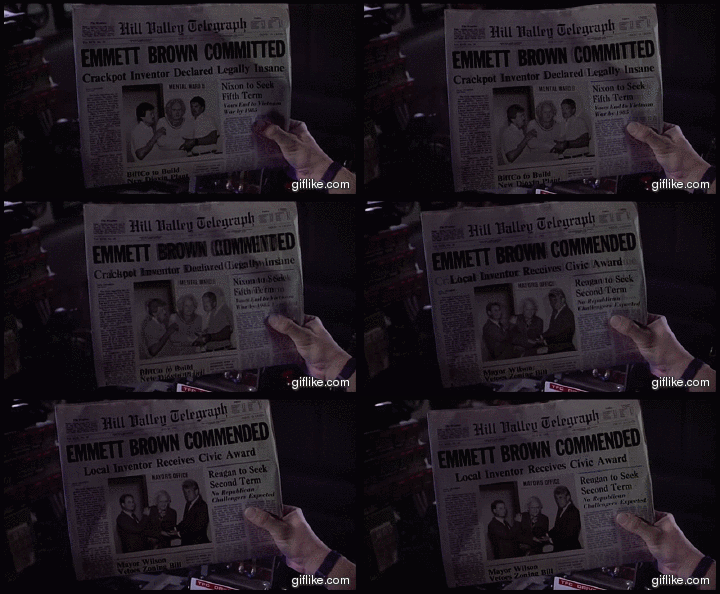
The future isn’t written yet
Last week Richard Epstein predicted around 500 fatalities in the United States (I originally misread his estimate to be 50,000 for the US, not the whole world). His estimate was tragically falsified within days and he has now revised his estimate to 5,000. I still think that’s optimistic but I am hopeful for less than 50,000 deaths in the United States given the social distancing measures currently in place.
Today, several US peers have become excited about a Daily Wire article on comments by a British epidemiologist, Neil Ferguson. He has lowered his UK projections from 500,000 to 20,000 Coronavirus fatalities. The article omits the context of the change. The original New Scientist article (from which the Daily Wire is derivative with little original reporting) explains that the new fatality rate is partly due to a shift in our understanding of existing infections, but also a result of the social distancing measures introduced.
The simple point is:
- Never reason from a fatality rate, and
- Never reason from a change in estimated fatalities
Policy interventions will change infection rates, alter future stresses on the health system, and (when they work) lower future projections of fatalities. When projections are lower, it is not necessarily because the Coranavirus is intrinsically less deadly than believed but because appropriate responses have made it less deadly.
Life
No matter how old, frail or vulnerable it may be, a life isn’t something to take or risk at another’s discretion. Nor does it undermine culpability when someone dies as a result of negligence. The common law ‘eggshell skull’ rule reflects this moral principle.
During the Coronavirus pandemic, some erstwhile defenders of the famous Non-Aggression Principle (NAP) appear to have forgotten that natural rights are conceived to protect life as well as liberty and property. They seem to think that the liberties we ordinarily enjoy have priority over the right to life of others. The environment has changed and, for the time being, many activities that we previously knew to be safe for others are not. They are not part of our set of liberties until a reformed set of rules, norms and habits establishes a sufficiently hygienic public environment. To say that bans on public gatherings violate natural rights a priori is as untenable as G.A. Cohen’s claim that a prohibition on walking onto a train without a valid ticket is a violation of one’s freedom.
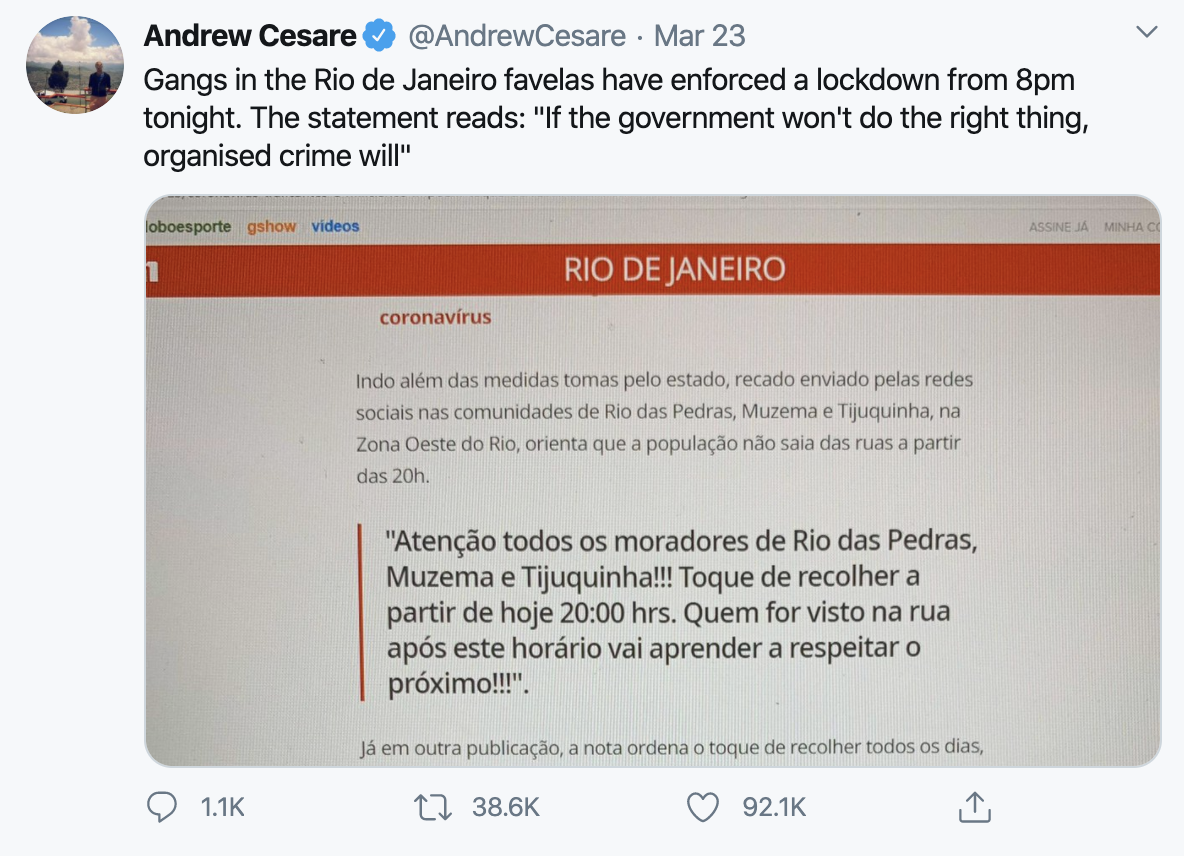
The clue for anarcho-capitalist state-sceptics that this is a genuine shift in social priorities is that even organized criminal gangs are willing to enforce social distancing. You do not have to believe that the state itself is legitimate to see that the need for social distancing is sufficiently morally compelling that it can be enforced absent free agreement, just as one does not need free agreement to exercise a right to self-defense.
Not every restriction is going to be justified, although erring on the restrictive side makes sense while uncertainty about the spread of infection persists. Ultimately, restrictions have to balance genuine costs with plausible benefits. But rejecting restrictions on a priori grounds does not cohere with libertarian principles. Right now, our absolute liberties extend to the right to be alone. Everything else must be negotiated under uncertainty. Someone else’s life, even two-weeks or so in the future, is a valid side-constraint on liberty. People can rightfully be made to stay at home if they are fortunate enough to have one. When people have to travel out of necessity, they can be temporarily exempted, compensated or offered an alternative reasonable means of satisfying their immediate needs.
 Notes On Liberty