Against Libertarian Populism

Over at The Liberty Conservative (which is, in my opinion, something of an oxymoronic name), Alex Witoslawski of the Leadership Institute recently wrote an article defending populism as a strategy for libertarian activists to embrace. I am going to disagree with Alex at almost every turn, but it should be known that I am friends with Alex and mean no ill-will towards him. In fact, he privately asked me for my input and asked that I publish my criticisms publicly.

Alex defines populism as “a political strategy that aims to mobilize a largely alienated base of the populace against out-of-control elites.” In order for a movement to be populist, Alex claims it must use four distinguishing factors:

Messaging: the central message obviously has to revolve around the theme of populism – “the people versus the privileged elites”

Strategy: put simply, the central strategy of populism is to bypass the ruling class – academia, mainstream media, and political establishment – in order to get the message out directly to the masses

Tactics: in order to achieve the strategic goal of bypassing the ruling class, populist candidates and organizations must make use of grassroots organizing, events, digital communication (social media and email), and the alt-media to communicate directly with the masses

Issues: the message of “the people vs. the elites” is closely adhered to on every single issue advocated; in addition to this, the policies advocated for must be sufficiently radical to inspire a core base of supporters who will passionately support the populist campaign/organization as donors and activists.

To cite reasons why libertarians should embrace this populist ethos, Alex cites the recent surprising election of Donald Trump and the relatively successful Ron Paul primary campaigns of 2008 and 2012, and gives the example of Lew Rockwell’s and Murray Rothbard’s infamous paleolibertarian phase in the late eighties and early nineties for inspiration. Let me give eight reasons why principled libertarians–and classical liberals–neither can be nor should be populists:

1. Is Populism even Necessary for Electoral Victory?
It’s not even apparent that populism is always and everywhere the best electoral strategy in the first place. The three best turnouts, for example, in LP history for president were the decidedly non-populist Gary Johnson campaigns and the non-populist, left-leaning Ed Clark/David Koch 1980 campaign, ranking much lower with less than half the votes of Clark/Koch was the much more populist Ron Paul 1988 campaign. For further evidence, there were many similarities between populists and progressive parties in the late nineteenth and early twentieth century, one of the few major differences were the degree of technocracy and even outright elitism that progressives embraced (populists were more Jacksonian, progressives Wilsonian). Which parties and candidates were more popular at polls? Progressives. All this is, of course, anecdotal and casual historical evidence from which no necessary causality can be established, but so are the examples of Trump vs. Cruz and Rand vs. Ron that Alex gives. There’s likely an empirical political science literature on the electoral effectiveness of populist messaging that might shed light on this question, one with which I am admittedly ignorant, but, at any rate, this is an antecedent point to my main argument.

2. The Narrow Focus on Electoral Politics
Even if populism does win elections, it’s not even clear that’s a good goal. As any good anarchist will tell you, electoral victories are not the only, or even a particularly good, measure of a political movement’s accomplishments. Who can cater to a rationally ignorant and irrational voting population has little to do with whether your ideology is actually improving anyone’s lives. In fact, for reasons I’ll get to in a later, if all you’re doing is winning elections, there’s a fair chance you’re making people’s lives worse. The goal should be to minimize the real world importance of elections, to get politics out of people’s lives, not to make electoral politics the end goal. Consistent libertarianism is (or at least should be), in fact, not really a political movement at all; it seeks the abolition of politics to begin with.

3. Populism’s Democratic Ethos Leads to Support for Bad Policies 
Even if you manage to get a majority of voters to vote for ostensibly libertarian politicians, the question of how to implement those principles in real-world policy is much more complex. Populists, because the goal is to “tear down the establishment,” are likely to call for haphazard, potentially dangerous policies which democratize institutions that shouldn’t be controlled by the people (eg., courts, central banks, etc.) and make currently controlled democratic institutions more democratic. It goes without saying that putting coercive institutions in control of rationally ignorant and irrational political actors is pretty rash–be they “elites” like politicians and bankers or “the little guy” like supposedly disenfranchised voters.

Examples of such bad ideas supported by populist libertarians include congressional term limits or auditing the fed. Those policies may have libertarian normative goals, but it requires working technical economics and institutional analysis to know if they’re the best way to work towards those goals. For reasons anyone who knows the first thing about public choice can tell you, the masses will never have such knowledge. In fact, the populist attacks on “the elites” are likely to lead people to detest those who do have such knowledge, exacerbating the Dunning-Kruger effect. (Call me an elitist, but I’d go far as to say that populism of any form is just the political manifestation of the Dunning-Kruger effect.)

4. Populism will Likely Turn into Something Nasty
Because the main thing driving populist movements are “the people vs. the elites” rather than the core principles the movement tries to espouse, there’s good reason to think the base of that movement will abandon many of those principles as it grows simply on the basis that they have something similar to what “the elites” believe. It’s not surprising that many of the younger psuedo-libertarians who supported Ron Paul have since jumped on either the Trump or Sanders bandwagon, or, even worse, have defected into the crypto-fascist, dark corners of the alt-right (Steffan Molyneux and Chris Cantwell’s occultists are examples of this). Even left-wing populist movements often have abandoned leftist principles throughout history (the Jacobins in the French Revolution, for example).

The irrationality of the masses makes it hard for them to have any principles–libertarian or not–for very long. Indeed, even the examples Alex gives are pretty bad examples of libertarians. Rothbard and Rockwell, of course, embraced outright racist and homophobic nonsense to appeal to their culturally conservative base (sometimes using Ron Paul’s name), which is antithetical to the classically liberal ethos of libertarianism which values reducing all forms of coercion–be it through casual institutional forms of oppression or statist coercion.

5. Populism’s Demand for Immediate Change is Likely to Cause Unforeseen Harm
Unlike other methods Alex mentions, populism is a form of immediatism. It really is just a post-enlightenment, first-world, institutionally democratic form of revolution. It’s no coincidence that most populist movements, from Bernie Sanders to Ron Paul rely on the language of revolution to further their appeal. However, there is good reason to be skeptical of any accelerated method of political change–be it “the masses” taking over and overhauling the errors of “the elites,” or violent revolutions like those in late eighteenth century France or early twentieth century Russia.

Institutions and policies often serve tacit functions in society of which we aren’t even focally aware. We are in a radical position of ignorance about what the effects of sudden change that populism demands, such as swapping out entirely who’s in power and changing all policies to the whims of “the masses,” whether those whims are libertarian principles or not. In sum, ironically given the name of the site Alex writes for, populism can never really even be conservative–not in the bastardized tea party or paleo sense, but in the principled Burkean sense. Even if I agree with the ends any political movement aims for, epistemic humility necessitates far more gradualism than populist rhetorical strategy can possibly accommodate.

6. Populism Leads to a Breakdown in Discourse and Awful Praxis
Whether you’re a conservative, libertarian, or liberal, if you are existing in a democracy the main thing you should strive for is to be understood by others. In fact, the alleged raison être for democracy–though famously fails at in its present institutional form–is aiming at better forms of government through arriving at some sort of consensus through open and honest public discourse. In order to have any sort of functional democracy in this sense–which, again, we are already woefully lacking in existing democracies–fulfill the primary function of speech, which is understanding. In order to do this, a necessary norm for discourse to function is the assumption of the good will of all participants in discourse.

The first assumption of populism, much like most crude forms of Marxism, is a violation of what is necessary for such discourse. It assumes, after all, that “the elites” are just an out-of-touch, greedy, mean group of people that “the masses” must depose and everything they’ve done is wrong and must be replaced with the vox populi. Anyone, then, who disagrees–even those within populist movements–is liable of being charged with being “one of the elites” (not unlike accusations of being “bourgeoisie” and “counter-revolutionary” after Lenin’s Vanguard Party took control), and ignored, leading to a communicative breakdown. Discussion is shut off, possible perspectives and principles that could improve the state of affairs are ignored if they bear any even superficial affinity to “the elites,” and one of the few sets of norms–those of communicative action taken from the lifeworld–that make existing democracy at least quasi-functional is replaced with simple partisan hackery. Try talking to your standard dogmatic Trump, Bernie, or even Ron Paul supporter (or really any overly partisan hack, including dogmatic Clinton supporters), and you’ll see exactly what I mean.

7. Populism is Inherently Illiberal and Opposed to Liberty

Populism tells us the problem is that “the elites are in power” and demands that the elites be deposed and replaced with “the masses.” But libertarians say the problem isn’t the fact that the wrong people are in power, the problem is that anyone is in power in the first place. As a consequence, classical liberals have always with good reason been very skeptical of the wisdom of the masses, and have had an ambivalent relationship towards any form of democracy. The radically Jacksonian democratic demeanor of populism, which asserts the masses are equipped to use coercive political institutions, is fundamentally at odds with classical liberalism’s value placed on individual liberty–which asserts that nobody is equipped to use coercive institutions. That’s a fine distinction populist rhetoric necessarily blurs, and you can’t expect “the masses” to understand.

Even if you say you’re just using populist rhetoric to depose those in power, the populist faction of our movement (once “the elites” are out of power) are going to ask, “What’s next?” and are liable to be upset when you say “nothing.” As Hayek tells us, one of the main reasons people get so heavily involved in the political process is that they want to be in charge, that’s true of “the masses” as it is “the elites.”

8. Populist Alliances Often lead to the Destruction of Libertarian Values
Alex mentions the rise of the religious right and other right-wing populist movements as possible fruitful avenues for libertarians to ally with and pursue. However, I’m of the opinion that any sort of fusionism is probably a really bad idea. Not just because many on the religious right want to be unfathomably cruel to me because I’m gay, but because libertarians have philosophical, fundamental disagreements with the people in those movements that cannot be bridged. It is simply not true that the religious right and nationalists are “anti-statist in their nature,” the fact that he cites “forced integration” from immigration supported by nationalists (derived from an infamously bad argument by Hoppe) as common ground is telling. Indeed, if you press most “fusionist” “conservatarians” (including paleos) or “liberaltarians” very far, you’ll find that outside of a few superficial single issues on which they agree with some libertarians, they do not even remotely understand or apply the principles very widely at all. If your movement is composed of walking Dunning-Krugers who do not really understand the extent to which coercive is possible and are not able to engage in constructive dialogue and you’re relying on rhetoric of “take power from the elites” to motivate them, you’re probably not going to have a very libertarian movement.

To illustrate, there’s no reason why “populism” needs to take on a right-wing flair for libertarians at all. In Rothbard’s young years, for example, he attempted to ally with left-wing populist progressives from the anti-war movement. Today, I could say, libertarians should ally with left-wing Sanders supporters. They, after all, share a skepticism towards foreign policy intervention, attacks on social freedom for religious freedom, and corporatist crony capitalism. In fact, there’s a case to be made that Sanders’ supporters are more libertarian than Trump’s, though I don’t necessarily agree with it. Regardless, it is worth noting libertarians have philosophically more in common with those on ‘the left’ in general, but that’s, again, an antecedent point.

Alex would probably reply “But Sanders supporters are socialists, and are fundamentally opposed to libertarians.”  Ignoring the fact that neither Sanders nor most of his supporters are really socialists, he’d mostly be right that they are fundamentally opposed libertarianism. Regardless, Trump supporters are nationalist–which Hayek famously called “the twin brother of socialism”–and are fundamentally opposed to libertarians. Alex might reply, correctly, that some right-wingers can become libertarians by engaging with the populist movement, but so can Sanders supporters. All that point establishes is libertarians should communicate with non-libertarians, and work with non-libertarians on single-issues with which we agree, that need not take on a populist flavor.

The Alternative
If we’re going to forego a focus on electoral politics, and not to populism, what should we replace it with? Alex mentions two possible alternatives:

Hayekian educationism, named after Friedrich Hayek’s theory of social change expounded in his essay “The Intellectuals and Socialism,” relies first on persuading a core group of intellectuals to adopt libertarian ideas. Then, according to Hayek’s model, those intellectuals persuade a growing number of what Hayek calls “second-hand dealers in ideas” like journalists, teachers, and politicians to propagate their ideas among the general populace.

Fabian incrementalism, named after the Fabian socialists of late 19th century Britain, relies on a similar group of individuals – intellectuals, journalists, and policy wonks – to persuade government bureaucrats and politicians to adopt gradual changes in policy. This, performed consistently over a long period of time will, theoretically, lead to the adoption of long-term social changes that the reformers set out to achieve.

First of all, Alex misunderstands Hayek’s theory of social change. The claim is n’t that you “persuade a core group of intellectuals to adopt libertarian ideas,” and completely ignore political actors and everyday people, the idea is that ideas coming from intellectuals filter down into the extended order of society and eventually become actualized. It’s not as if you just convince a bunch of professors and philosopher kings that you’re right and they’ll create a libertarian utopia, it’s that you put the ideas out there and they eventually filter down, a messy process which takes an extremely long time (possibly centuries), and one which libertarians have really only barely started.

A necessary thing that must occur before they actually become actualized is that the general population is at least subsidiarily aware of the ideas, which requires communicating with the general population in some form (which can and should include what Alex calls “grassroots organizing,” like engaging with them through the electronic forms and the alt-media). But that communication cannot take on the populist message for reasons given, it requires education and dialogue, it requires populizers–which can include educators, journalists, communicators, activists, and even to some extent politicians (though they are not acting qua politicians in the ideal typical capacity used in the model when doing this) to communicate with the masses. Contra Rothbard, it’s not about convincing the “ruling class,” it’s about overcoming them.

Regardless, I will agree that the method some beltway libertarians, unfortunately, take from Hayek’s theory of just writing academic journals and white papers is incomplete. You do need to communicate with the masses, but  I am heavily skeptical that this communication needs to be political in nature. Alex’s narrow focus on elections leads him to neglect other, possibly more fruitful, methods of social change. You can engage in direct action, agorism, or entrepreneurial action (eg., what Zak Slayback, et. al. talk about in “Freedom Without Permission“). In these forms, it requires actively defending the masses (in direct action), spreading ideas by improving the lives of real people by providing alternatives (agorism and entrepreneurial action), and making the effects of state intervention felt on people (eg., when entrepreneurial innovations, like Uber and Lyft, are taken away, the hypocrisy of regulation is made clear). They all accomplish the goal of making the ideas known, even if tacitly, among the masses, while adding bonuses of actually doing things that improve their lives without the riskiness inherent in using coercive institutions like elections to do so.

Though those aren’t necessarily at odds with populism (or Hayekian educationalism for that matter; in fact, I think it’s an inherent part of Hayek’s theory of social change), I put far more faith in these than in elections in which irrational, ignorant people only legitimize the state. Socio-political change happens at the micro-level, through everyday social interactions, through lived real-world experiences, through you reading this article, through good discourse and conversation. If you want to change, you need to alter the lifeworld in which individuals live, just focusing on getting “the masses” to turn out the polls is insufficient. Political activism can only get you so far.
Did 89% of American Millionaires Disappear During the Great Depression?

Over the years, I became increasingly skeptical of using tax data to measure inequality. I do not believe that there is no value in computing inequality with those sources (especially after the 1960s, the quality is much better in the case of the US). I simply believe that there is a great need for prudence in not overstretching the results. This is not the first time I make this point (see my paper with Phil Schlosser and John Moore here) and I think it is especially crucial for anything prior to 1943 (the introduction of tax withholding).

One of my main point is that the work of Gene Smiley which ended up published in the Journal of Economic History has generally been ignored. Smiley had highlighted many failings in the way the tax data was computed for measuring inequality. His most important point was that tax avoidance foiled the measurements of top incomes and how well they could transposed on the overall national accounts.

More precisely, Smiley argued that the tax shelters of the 1920s and 1930s would have affected reporting behavior. As long as corporations could issue stock dividends rather than cash dividends, delaying the payment of dividends until shareholders were in lower tax brackets, there would be avoidance. Furthermore, state and municipal securities were exempted from taxation which meant that taxpayers could shelter income and end up in lower brackets. All this combined to wide fluctuations in marginal tax rates conspires to reduce the quality of the tax data in computing inequality. Rather than substantial increases in inequality, Smiley found that his corrected estimates (which kept tax rates constant) suggested no increase in inequality during the 1920s and a minimal decrease when you exclude capital gains.

Alongside John Moore, Phil Schlosser and Phil Magness, I am in the process of attempting to extend the Smiley corrections to include everything up to 1941 (Smiley had ended in 1929). As a result, I had to assemble the tax data and the tax rates and I was surprised to see that, even without regressions, we can see the problem of relying on the tax data for the interwar period.

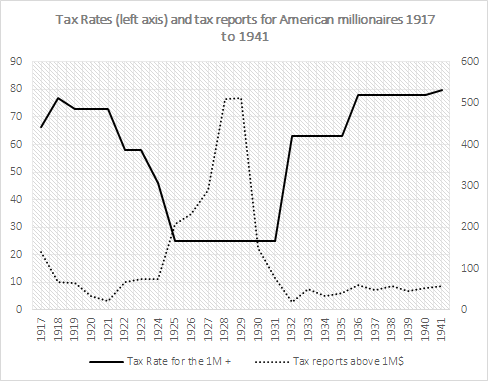
The number of millionaires in the tax reports is displayed below. As one can see, it is very low from 1917 to 1924 – a period of high tax rates. However, as tax rates fell in the 1920s, the number of millionaires quintupled. And then, when the Depression started in synchronicity with the increases in top marginal tax rates, it went back down. It went down by 89% from 1929 to 1941. Now, I am quite willing to entertain that many millionaires were wiped out during the Great Depression. I am not willing to entertain the idea that 9 out of every 10 millionaires disappeared. What I am willing to entertain is that the tax data is clearly and heavily problematic for the pre-withholding era.* This is evidence in favor of caution and prudence in interpreting inequality measures derived from tax data.


taxreports

I am of those who believe that inequality was lower than reported elsewhere in the 1920s, higher than reported in the 1930s and 1940s. Combined together, these would mean that inequality would tend to follow a L-curve or a J-curve from the 1920s up to the present rather than the U-curve often reported.  I will post more on this as my paper with Moore, Schlosser and Magness progresses. 

Joaquim Nabuco, a Brazilian visionary in Washington

During most of the 19th century Brazil and the United States showed little mutual interest. Brazilian foreign policy was initially directed to Europe (mainly England) and then to border problems in South America (particularly with Argentina and Paraguay). Meanwhile, the US was concerned about its expansion to the west and its internal tensions between north and south. With little convergence in these priorities, the two countries basically ignored each other.

However, this picture began to change at the end of the century, especially because Brazilian coffee found in the USA an excellent consumer market. The definitive change occurred in the first decade of the 20th century, when Barão do Rio Branco, Brazil’s foreign minister for 10 years (1902-1912) decided that the country should privilege relations with the US in its foreign policy. The Baron understood that after Africa and Asia, South America (especially the unprotected Amazon) would be the target of European imperialism. Without an army and a navy that could deal with Europeans, Brazil needed US protection.

Fortuitously, this was also the period in which Theodore Roosevelt gave his corollary to the Monroe Doctrine. Roosevelt had already made clear his intention to keep Europeans away from the American continent, particularly in his intervention to build the Panama Canal. An unwritten alliance was formed between the two countries: the convergence of interests caused Brazil and the United States to experience an unprecedented approach in history. To consolidate the new paradigm of foreign policy the Baron elevated the Brazilian diplomatic representation in Washington to the level of embassy. In the diplomatic gesture of the time this was a clear indication of the preference that the country gave to the USA. The Baron chose Joaquim Nabuco to be Brazil’s first ambassador to Washington.

Nabuco is a well-known personage to the scholars of Brazilian history. When he became ambassador to Washington he was already famous for his struggle against slavery in Brazil and for his work as a historian. Like the Baron, Nabuco believed that Brazil would be the target of European imperialism, and that it needed US help to protect itself. Unlike the Baron, however, Nabuco saw an opportunity at the time to do something more: to turn America into a zone of peace, a continent with international relations essentially different from those of Europe.

The Baron saw international relations only as a zero-sum game. He also did diplomacy thinking in terms of a balance of power. Nabuco was not unaware of these aspects, but he believed that through regular international conferences and open trade, America could avoid the wars that were so characteristic of Europe. But for that the US leadership was essential, and should be supported by all. The Baron sought the US punctually: he wanted the protection of a stronger country while Brazil was not able to protect itself. Nabuco wanted a permanent alliance. In his foreign policy the Baron was a kind of conservative: changes do not occur easily. The story simply repeats itself. The 20th century would simply repeat the 19th. Nabuco believed that change is possible. He believed in universal principles linked to classical liberalism.

Nabuco passed away in 1910, only five years after assuming the position of ambassador. Perhaps if he had been more successful in his foreign policy we would have had a very different twentieth century. The United States would not have become involved in Europe, as it did in World War I. America would be a continent of peace, contrasting with the Old World. America would lead by example, not intervention. And many problems we face today, the fruits of American interventionism, would be avoided.

A non-argument against immigration

I often encounter the argument that immigrants, especially Muslims, are so different from the populations of their host countries that they threaten the institutional foundations of these societies. As a result, the logic goes, we must restrict immigration.

I do not accept that argument as valid nor do I accept it as sufficient (in the case I am wrong) to make the case in favor of further restrictions on immigration.

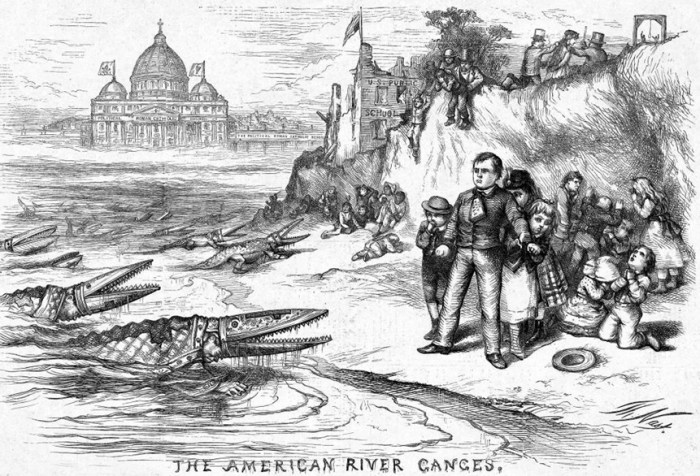
First of all, the “social distance” between immigrants and the hosts society is very subjective. The caricature below offers a glimpse into how “unsuited” were Catholic immigrants to the US in the eyes of 19th century American natives. Back then, Catholics were the papist hordes invading America and threatening the very foundations of US civilization. Somehow, that threat did not materialize (if it ever existed).  This means that many misconceptions will tend to circulate which are very far from the truth. One good example of these misconceptions is illustrated by William Easterly and Sanford Ikeda on the odds of a terrorist being a muslim and the odds of a muslim being a terrorist. Similar tales (especially given the propensity of Italian immigrants to be radical anarchists) were told about Catholics back then. So let’s just minimize the value of this argument regarding going to hell in a hand basket.

nast1

But let us ignore the point made above – just for the sake of argument. Is this a sufficient argument against more immigration? Not really. If the claim is that they hinder “our” institutions, then let them come but don’t let them participate in our institutions. For example, the right to vote could be restricted to individuals who are born in the host country or who have been in the country for more than X-number of years. In fact, restrictions on citizenship are frequent. In Switzerland, there are such restrictions related to “blood” or “length of stay”. I am not a fan of this compromise measure (elsewhere I have advocated the Gary Becker self-selection mechanism through pricing immigration as a compromise position).*

The point is that if you make the argument that immigrants are different than their host societies, you have not made the case against immigration, you have made the case for restrictions against civic participation.

* Another “solution” on this front is to impose user fees on the use of public services. For example, in my native country of Canada, provincial governments could modify the public healthcare insurance card to indicate that the person is an immigrant and must pay a X $ user fee for visiting the hospital. Same thing would apply for vehicle licencing or other policies. Now, I am not a fan of such measures as I believe that restrictions on citizenship (but offering legal status as residents) and curtailements of the welfare state are sufficient to deal with 99% of the “problem”. 

A Bad Teenager

Below is an excerpt from my book I Used to Be French: an Immature Autobiography. You can buy it on amazon here.


…..I repeated my senior year in a high school closer to home that was not nearly as good as the first. I don’t know why I did that. I was like a sheep walking insouciantly and sure-footed to the slaughterhouse. There was no reason to think I would do better the second time than the first. I had not failed from bad luck, or because I did “not test well,” in the mealy-mouthed gobbledygook of today. Rather, it was because vast blank, empty steppes overlaid my mind. I doubt one year would have been long enough to fill up the blanks even if I had tried. At any rate, my heart wasn’t in it. Someone should have yanked me out and sent me to work full-time. I could have learned something useful, like the basics of charcuterie, for example. Perhaps everyone around me got caught short and no one had an alternative plan. At this distance in time, I have trouble evaluating to what extent my parents would have thought such a pragmatic solution to my aimlessness socially unacceptable. I went back to high school as the default solution. I performed just as badly the second time around. That second senior year would have been a total waste except that it changed radically the trajectory of my life. I was the beneficiary of a positive injustice. (I went to California a first time, on a scholarship.)

When (Where and Why) Women Were More Literate than Men

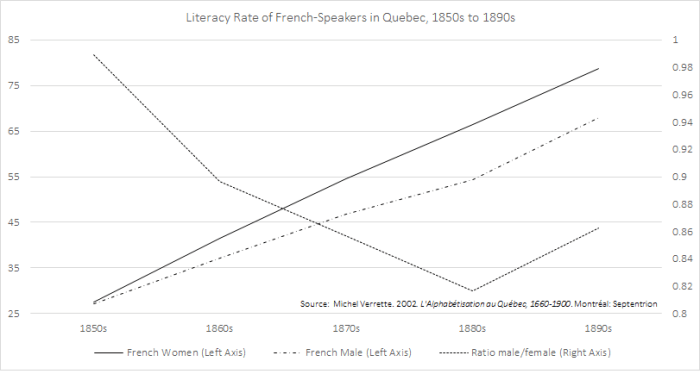
For most of history, men tended to be more literate than women. In essence, illiteracy was widespread but even more so for women. There is one exception: the French-Canadians. For most of the 19th century, literacy rates were greater for French-Canadian women than French-Canadian men.

literacy

This is a fascinating piece of economic history and somewhat of a puzzle (given that it is an oddity). It also shows how important institutions are to determining paths of development. In a 1999 article in the Journal of Economic History, Gillian Hamilton indicates that the more “liberal” institution of marriage contracts for the French-Canadians probably induced this result :

Quebec’s unique legal institutions offered the opportunity to draw up a prenuptial contract to couples who could benefit from a different property structure than the law provided. Not surprisingly, a prenuptial contract was unnecessary for most couples. Within this transaction cost-competitive marriage market framework, contracts generally were desirable only in cases of mismatch, either due to an exceptional woman or a relatively productive husband whose job did not entail a significant component of family participation. Their contracting decisions are consistent with terms that would have provided them with more appropriate incentives for work and the production of jointly produced goods, and at least the potential for greater utility and wealth than they otherwise would have accumulated. The use of contracts likely provided Quebec with higher overall wealth and a wider income distribution than it would have experienced without contracts (because the skilled disproportionately signed agreements).


US Immigration: a Primer

President Trump was elected for a variety of reasons but any observant person knows that the general topic of immigration played a significant role. Mr Trump appears unfamiliar with the current American immigration system and he is ignorant of the economic benefits of immigration, or he downplays them. Below I address modest parts of both topics. I aim for sensationalism rather than for completeness.

First a little bit about the American immigration system such as it is in January 2017. There are two main bizarre ideas among Trump supporters about the real system: One regards who is allowed to come into this country (legally, I mean); the other strange misconception has to do with how aliens become US citizens.

The system by which the US admits immigrants is a little complicated and its description relies on a specialized legal jargon. In my considerable experience, few people have the patience to sit through a lecture on American immigration policy. So, let me cut to the chase:

THE NON-EXISTENT ORDERLY QUEUE

There is no way, zero way, the average married Mexican can legally immigrate into this country.

This is worth mentioning because many are under the impression that illegal immigrants are cheats who cut through the line instead of patiently waiting their turn.

The “average Mexican” does not have American-born children, children who are US citizens by birth. Mexicans who do have such children and the children are minors go to the head of the line. There is no (zero) line for those who don’t have close relatives who are Americans or legal immigrants. This example illustrates the US immigration policy that accounts for most legal immigrants in most years: Family re-unification.  

Sophisticated people noticed long ago that there is an instantaneous way to acquire an American relative. It’s to marry an American. Doing so for the purpose of gaining admission to the US is illegal for both parties involved. I don’t know if anyone ever goes to jail for it but it’s ground for immediate deportation. Nevertheless, I am told by some of my immigrant friends that there is a thriving little cottage industry of visa brides and grooms for a fee in some parts of the country. I cannot verify this rumor but I believe it.

Similarly, there is only one way the average married Irish man or woman may immigrate into this country: Winning a lottery. (You read this right: a lottery which one may play as often as one wishes; it has not entry fee.) In 2015, only about 49,000 people, all from Europe and Africa, gained admission on the basis of winning that lottery.

Some legal immigrants gain admission under the broad category of “employment related reasons.”  This category includes high-level programmers as well as farriers. (Look it up.) It’s a small number. In 2015 they made up about 15% of all one million-plus legal admissions. Our average Mexican and our average Irishman does not qualify here either.

You may have heard of an “investor’s visa” accorded to foreigners who will create employment in the US. That’s always a tiny number, about 10,000 in 2015.  It’s not always open. Congress decides about if every so often.

There is a third main, amorphous way by which foreigners are admitted, “asylum” broadly defined. I call it “amorphous” because the definition of who is a refugee or an asylum seeker can be changed by Congress in a very short time. The President decides how many can be admitted in either category. The number admitted under this category is accordingly highly variable. It was about 150,000 in 2015. It could have become 500,000 in 2016 because of a new crisis anywhere in the world. (It didn’t.) The current, Trump figure of  50,000 seems just about normal historically. Yet, there is wide variation about the average.

There is thus no orderly queue that Felipe or Ahmed could join on their own if they wanted to avoid becoming illegal aliens.

That’s it, folks. If you want to know more about the raw numbers, study the relevant pages in the Statistical Abstract of the US.

So, contrary to what I suspect is a widespread idea among conservatives, it is not the case that there is an orderly, wide-open legal way to immigrate into this country that illegal immigrants perversely ignore. Illegal immigrants are not rudely jumping to the head of the line; they come in through a side-door the US does not seem able to close.

One more thing, a programmatic idea: Instead of the present admission policies (plural)  based on viciously absurd selection we have, we could take a page from the Australian and from the Canadian playbooks. That is, we could coolly decide what kind of immigrants we want and try and tailor a door to those precise dimensions. Presently, we are doing very little of this, however unbelievable it may sound. Such a rational procedure would not not need to eliminate refugee and asylum seekers admissions.

I am personally in favor of such a reform . I also think special policies  should apply  to our proximate neighbors to the north and to the south. I developed this idea with Sergey Nikiforov in an article [pdf] published in the Independent Review several years ago.

Incidentally, I am a product of a rational immigration policy myself. I was admitted on merit alone. I rest my case! Thank you for asking. OK, truth be told, I tried to come in as a spouse of an American citizen but she dumped me.

GAINING CITIZENSHIP

On to the next misconstrued idea. I keep hearing (on talk radio, I confess) irate citizens affirming that foreigners who don’t want to take American citizenship should not be admitted. The case hardly arises.

In fact, in reality, to be allowed to become a US citizen, to take American citizenship, requires several years of residence in this country after being legally admitted. (See above.)

Hence, personal preference plays little role in determining which immigrant does not become a US citizen. I don’t have the numbers but I am sure that, as a rule, the vast majority of legal immigrants adopt American citizenship shortly after they are legally empowered to do so. It is true that, in theory, some hesitation or some problems may arise in connection with some countries of origin who do not wish to recognize dual citizenship. In practice, depriving anyone of his passport is low on the list of priorities of most countries from which new US citizens originate. (India may be an exception – a curious exception – as if the country were facing an unbearable burden of immigrants of all sorts.)

The consequence of this scenario is that, contrary to what I think is a widespread notion, there is no horde of legal immigrants living in this country and peevishly and disloyally refusing to take American citizenship. It also follows that there is no mass of illegal immigrants who obstinately refuse American citizenship. It’s not available to them, period.

I think it’s legitimate to be opposed to illegal immigration and even to legal immigration but it’s best to do on the basis of correct information.

On Minimum Wages, Health Code Violations and Proper Assessment

A few days ago, Tyler Curtis at the Freeman (the Foundation for Economic Education’s flagship publication) posted a short piece on the minimum wage and health code violations in restaurants. Curtis based on a paper (unavailable in full) by Srikant Devaraj who asserted that increases in minimum wages in Seattle had led to increases in health code violations by restaurants (heavily affected by the increases).

Devaraj used a standard difference-in-difference econometric approach. The problem underlined by some was the choice of benchmark for the method : New York City. New York City and Seattle are two very different cities with different health codes. It is hard to make this claim stick even if the uncontrolled results (before statistical tests) show an increase in health code violations. Nonetheless, I have been able to find one other study that shows – based on Californian data – that there was a very small deterioration in health code violations (especially by the top restaurants) following increases.

Now, I am not convinced by the econometric design of both, but I am axiomatically convinced. This is where I think economists have made the error of relying too much on empirical methods. While, as an economic historian, I always favor more data, I also am trained to be skeptical about data does not say.

In the case of the minimum wage, the debate has raged between economists over the employment effects (i.e. the demand for labor). But this is a fraction of everything involved with the production of goods in industries affected by minimum wages. For an employer, a cost is a cost regardless of the form it takes. If an employer is forced to pay somebody above what they produce in value, then something has to give. For a 5% increase in the minimum wage, it is doubtful that an employer with three employees will be willing to sack one third of his workforce (and roughly one third of his output). So, he can cut costs differently. He may ask employees to buy their uniforms, he may refuse to provide them with free lunches, he may also even decide to cut on quality of his service – as is the case with the two studies outlined above.

The problem is that no study of the minimum wage has attempted to measure all these effects at once!  There is no study that looks simultaneously at hours worked, people employed, type of people employed (substitution effects), prices for consumers, quality and marginal benefits (uniforms, free lunch, insurance, etc.) on both the short and long-terms levels and trends (they also rarely adjust the minimum wages for regional purchasing power parities and the under-reporting of tips)

The health code violations papers show how many channels employers can use to adapt – channels which some fail to account for when they proclaim that we can raise the minimum wage without adverse consequences. Maybe its time that we, as economists, try to be more cautious when we make claims about the minimum wage’s minimal effects.

The New Colossus

Not like the brazen giant of Greek fame,
With conquering limbs astride from land to land;
Here at our sea-washed, sunset gates shall stand
A mighty woman with a torch, whose flame
Is the imprisoned lightning, and her name
Mother of Exiles. From her beacon-hand
Glows world-wide welcome; her mild eyes command
The air-bridged harbor that twin cities frame.
“Keep, ancient lands, your storied pomp!” cries she
With silent lips. “Give me your tired, your poor,
Your huddled masses yearning to breathe free,
The wretched refuse of your teeming shore.
Send these, the homeless, tempest-tost to me,
I lift my lamp beside the golden door!”
— poem by Emma Lazarus, 1883

How much has Cuban productivity increased since 1960?

Is it possible for two equally rich countries (on a per capita basis) to have different level of output per worker? The answer is obviously yes, and it matters in the case of measuring growth in Cuba since the revolution.

A country with a very young population will tend to have fewer workers than one with an older (but not too old) population. Let’s say that countries A and B have a median age of 22.5 in year one.  However, in year ten, country A has a median age of 35 but country B has seen a more modest increase to a median age of 25. This will bias any estimates of growth comparison between both country. The increase in the median age suggests that there are more and more workers in country A (people of prime age) than in country B. As a result of that, output per capita will increase faster in country A than in country B even if both countries have equal rates of growth in output per worker.

Well, countries A and B are basically Cuba and most of the rest of Latin America. Since the 1950s, Cuba’s population has aged rapidly but birth rates have plummeted so fast that families shrunk. With fewer kids in the population, it means that the share of the Cuban population that are of prime working age increased rapidly. This is what biases the comparison of Cuban living standards with other Latin American countries.

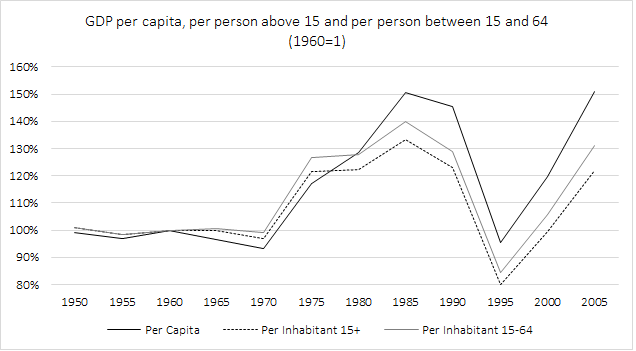
In the figure below, I took the GDP (the Maddison data) of Cuba since 1950 (indexed at 1960 to see the arrival of Castro) and divided it by the total population, the population above 15 years of age and the population between 15 and 64.

cubagdp

As one can see, with the GDP per capita series, Cubans saw a 50% increase in their incomes between 1960 and 2005 (the Maddison data stops at 2008). However, when you look at GDP per working age adult in order to capture the growth in productive capacity, you get moderately different results whereby the cumulative increase is three-fifths to half as small.

In light of this, it seems like Cuba’s living standards are less and less impressive.

Angry? Learn economics!

The election didn’t go your way (and if it did, just think about past elections… at least some of those didn’t go your way) and now you’re itching to do something about it. You’re angry and motivated, and at risk of making things worse

Economics isn’t just about money. In fact, it’s barely about money. It’s mostly about cooperation between strangers. But economists also study competition. Most importantly, we study decision making which is essential to understand if you want people to make different decisions!

More importantly, economics helps us understand how to navigate costs and benefits wisely. It turns out wise decision making isn’t as straight forward as we’d hope. So if you care enough to work hard to make the world better, economics is worth your time.

Still here? You really want to make the world a better place! Let me suggest that you study social science. Something I’ve learned during my first decade of studying economics (Jan. 2018 will by my 10 year mark) is that thinking clearly about something as complex as society requires mental tools that we aren’t born with. Our intuitions will lead us astray. The good news: economics mostly boils down to common sense rigorously applied.

Economics doesn’t have a monopoly on the truth (if we did, this post would be shorter but you’d have to pay to read it). But I think econ is the best place to start in an intellectual exploration of society. It will help you build a robust and modular framework for understanding the world. Economics is the ultimate modular social science; you can plug-and-play with insights from anywhere.

So why econ? Because at the end of the day, economics deals with the most important aspect of life: how to live life well. It boils down to this: every choice comes at the cost of a foregone alternative. Opportunity cost. All (good) economics comes down to this profound truth. Whether your goal is to reduce poverty, pollution, or parenting woes, learning to think of cost in these terms will serve you well.

Let’s take that concept for a test drive… would banning plastic bags reduce environmental harm? The benefit is that you’ll eliminate the problems associated with these bags (litter, use of oil, etc.). But we need to understand the costs before we know if we’re helping or hurting the environment. Notice that link starts with the question “paper or plastic” and goes on to say nothing about paper bags; it’s looking at the silver lining without acknowledging any possibility of a storm cloud. That lack of economic thinking opens us up to new problems: making heavy paper bags also creates pollution and could very well create more.

In other words, this simple concept showed us that it’s possible to do harm by doing something that sounds good (the road to hell is paved with good intentions!).

It’s easy to miss the forest for the trees: economists specialize in researching very specific areas–foreign exchange markets, agricultural futures, political change, pirates–and it’s easy to get bogged down in the details. Studying economics in school means studying under specialists. But once you’ve got the basics of the economic way of thinking down, you’ll see that those specializations are really just applications of the same general concepts and the same basic way of thinking. It’s easier to understand once you speak our language, but there are lots of great resources. Two places I would start:

Now get to it! Start making things better!

The culture that is Argentina

In Argentina, lawyers take vacations in January and physicians in February.

Those months are the hottest of the Summer in the Southern Hemisphere and, thus, are of the lowest productivity. Moreover, every agreement you reach with somebody during January and February goes void in March!

Cheers!

On Gentrification, Inequality and Zoning

On the CityLab blog, Richard Florida posted a piece pointing out that gentrification has virtually no effects on homeowners. I can buy that result, especially since I wrote a policy piece for a think tank back in the summer of 2016 on the issue. The important point that Florida underlines (by citing a paper by Martin and Beck in Urban Affairs Review) is that homeowners are not being displaced, but renters are more likely to be. This will probably fuel some people who are concerned about inequality. I disagree.

I want to point out that my interest in the issue is entirely related to the issue of inequality which some individuals have tried to tie to gentrification (sometimes without understanding that causality can run both ways). If you want to tie the two issues together, then you must realize that there are four “types” of gentrification. First of all, gentrification always appear in an area that is poor and it is always a result of a shift in demand for land in that area. However, that area can be largely unoccupied or heavily inhabited. It can also be in a district where zoning is lax or burdensome. In each of these situations, you will different effects with different interpretations for inequality.

  • Scenario 1 (largely vacant, lax zoning laws): in this situation, demand shifts right but there is slack in the local housing market and in any case, supply can adjust easily. In that case, the effects on rents will be minimal and will probably be smaller than the economic gains in terms of local economic activity. In this situation, there is little displacement and there is in fact a reduction in inequality.
  • Scenario 2 (largely vacant, heavy zoning laws): same happens, except that the restrictions on construction and building conversions put a ceiling on the capacity of a local area to adapt. The effect on rents is ambiguous and depends largely on the relative quantity changes (how many people relative to empty units). There are probably small to moderate gains in the area. There are ambiguous effects on inequality.
  • Scenario 3 (heavily occupied, lax zoning laws): in this situation, the influx of individuals creates a temporary surge in rents. This is because, in the short-term, housing supply is inelastic. In the long-run, the supply is more elastic and new units can be added to counterbalance the price effects. So, there is a long-term benefit that comes after a small bump. More individuals will be displaced than in scenario 1. Overall, a reduction in inequality might occur.
  • Scenario 4 (heavily occupied, heavy zoning laws): in this situation, the influx happens in a market where the supply is highly inelastic (short and long-run). In that case, the shift in demand creates a substantial increase in rents. This is where gentrification can hurt and be tied to inequality.

These four scenarios are important because they show something important that some people have to understand. Gentrification can increase inequality. However, that depends on the context and the institutions (zoning) surrounding the area in which it happens. In all cases, gentrification is a normal process that can’t really be stopped but turns sour because of zoning laws. Thus, if you really want to tie gentrification to inequality, it should twice removed since the first parents are zoning laws and construction limits.

On Sugary Drinks, Taxes and Demand Curves

A few days ago, I discovered a blog post on the website of Jayson Lusk (a very good agricultural economist whose work has often guided some of my own economic history research given that most economic history is also agricultural history). The post relates to a study of the implementation of a sugary drink tax in Berkeley to fight obesity.

Obviously, a tax will reduce the consumption of any good. That is pretty axiomatic and all that we need to know is how much. In other words, how elastic is demand. If all things are held constant, the quantity consumed relative to the price change will give you that measure.* However, the study that Lusk pointed too basically shows that we often do not hold everything constant.

The authors of the study point out that when tax is passed, there is generally a debate that occurs beforehand. This generates publicity about the issue. This alters the behavior of consumers because they face more information. This is an effect that must be isolated from that of the tax itself.  That is what the authors do in their papers and they find that a reduction of soft drinks consumption did occur during the campaign and after the tax was adopted but before it was implemented (they rely on on-campus sales of soft drinks at a “major university” which we can assume is UC-Berkeley). Thus, the reduction in consumption preceded the price change. Lusk himself found something similar in a case related to animal welfare. Using a Californian electoral proposition regarding animal welfare in the production of eggs, he found that the publicity surrounding the proposition changed consumer behavior.

Lusk, rightly in my opinion, points out this suggests that information-based policies are probably more efficient than heavy-handed measures like taxes.

But I think there is a deeper point to make. When you inform consumers, you don’t only change the location of the demand, you also change the slope of the curve. If a consumer is made aware of the costs (and benefits) of his consumption that he had not previously considered, he may become more sensitive to the price. Informing people about the ill-effects of sweet drinks might make them more sensitive to the price they pay. Imagine that the information campaign during the Berkeley vote on the tax caused consumption to become more elastic. That means that the tax’s effects is being amplified by the information effect from the publicity. Had the tax been imposed as a surprise, the effect would have been smaller. Basically, Lusk’s presentation of the argument is understating the effects of information-based policies.


* On a tangential point, I would like to remind that people can reduce their consumption of soft drinks without changing their total calorific intake. Indeed, if I am taxed when I consume a soft drink, I can switch to coffee with cream. Thus, pundits often confuse a reduction in soft drinks consumption after a tax as a step in favor of reducing obesity.

Anarchism

Below is an excerpt from my book I Used to Be French: an Immature Autobiography. You can buy it on amazon here.


I had my first revolutionary encounter at another Cub Scout camp near a different lake. We were organized in squads of six, as I said, each with its appointed leader. One day, my squad leader gave me an order I did not like. Or maybe, I just did not like his tone. I said “No.” He insisted. Our voices rose. His authority contested publicly, he shoved me lightly. I shoved back and I called him out formally. We repaired out of sight to the lakeside. It was not the Clash of the Titans because I must have been nine and he, eleven. The leader must have lacked faith in his own charisma, or else, I got lucky because I gave him a bloody nose. This stopped the fight in accordance with the ancient dueling rule of “first blood drawn.” He washed off the blood in the lake. We walked back to our tent separately. It was sunset; everyone went to bed. Nothing more was said.

I remember the fight clearly and I remember well that the squad leader was the furthest thing from a bully. He was not a bad guy and I did not even dislike him. I just did not like hierarchies. I was a natural anarchist in the true, etymological sense of the term: I did not want to have a chief, or a leader, or whatever you call them these days. This trait never changed. I am just the same as I was at nine in this respect. I have never had any desire to exercise power over others either. Most exercises of power repel me viscerally. I suspect many or most are unnecessary. Moreover, I now think coercion is the worst way to obtain the orderliness that is necessary to a good society. I am pretty sure coercion causes more disorder overall than it eliminates or avoids. Its costs are usually too high.

“Growing up” did not help me in that department either. I never “learned through experience;” life did not “beat it into me.” In this respect, as in many others, I keep marveling at the constancy of individual characters from childhood, perhaps from infancy. I don’t know why there isn’t more mention of this constancy except that it contradicts the namby-pamby liberal faith in environmental determinism. If you believe religiously that societal influences – such as poverty, emotional abuse, being deprived of cookies, being fed the cookies of the wrong color – decide what the adult’s character will be, it’s hard to notice that much of the character was already in the child, or even in the toddler. It’s difficult to even imagine that it was possibly already in the zygote. This possibility was an academic taboo subject for the best part of forty years. Hardly anyone felt free to study it.