The Gradual, Eventual Triumph of Liberty

Today I’d like to write a few words of hope and encouragement to those who already understand liberty’s value. I read a speech from 1853 that stood out to me. It’s easy to be caught up in the daily news cycle and feel that liberty is constantly under attack and threatened at every hand, that every gain is clawed back as liberties are eroded one at a time. At times like that, it is good to step back and took a better look at the broader history of the world.

The speech I read was by a gentleman named Parley P. Pratt, an apostle of the Church of Jesus Christ of Latter-day Saints in the Utah territory. This was just a few years after the Mormons, including Pratt and his family, had been driven from their homes by mobs and by indifferent and sometimes hostile state and federal governments in the United States proper to find freedom and refuge in the Rocky Mountains. There they still held 4th of July celebrations, honoring the sacrifices for liberty their fathers had made. Pratt, by this point in his life, had traveled through England and parts of Europe, much of the US, Canada, and along the Pacific into Mexico, and met with many people from Asia as well – a remarkably well-traveled man.

Despite the very real failures of the government to protect their individual rights or redress their grievances, he spoke in praise of the Constitution. The main thrust of his address was that the cause of liberty would expand and someday fill the world:

The longer I live, and the more acquainted I am with men and things, the more I realize that … the Constitution of American Liberty was certainly dictated by the spirit of wisdom, by a spirit of unparalleled liberality, and by a spirit of political utility. And if that Constitution be carried out by a just and wise administration, it is calculated to benefit not only all the people that are born under its particular jurisdiction, but all the people of the earth … . It seems broad enough, and large enough, to receive and protect all that may be in any way deprived of the common rights of man. …. [The principles of the Constitution] embrace eternal truths, principles of eternal liberty, not the principles of one peculiar country, or the sectional interest of any particular people, but the great, fundamental, eternal principles of liberty to rational beings – liberty of conscience, liberty to do business, liberty to increase in intelligence and in improvement […]

There is a day coming when all mankind upon this earth will be free. When they will no longer be shackled, either by ignorance, by religious or political bondage, by tyranny, [or] by oppression (Journal of Discourses, Vol. 1, p. 137-143)

Pratt claimed this would not happen predominantly by revolution and violence, but by America being a beacon light to the world. He spoke of throngs of people who would sit in his day enjoying to hear of our freedoms, our institutions, and our scientific and cultural progress. He spoke of the immigrants coming to this country from all parts of the world specifically to find that freedom, and that once enlightened by being allowed to think and reason and act for themselves without the bondage of kings, state religions, or other powers they would blossom and rise up in greatness. Whether they eventually returned to their native lands or not, this would act as an “indirect influence … on those despotic nations” of Europe and Asia.

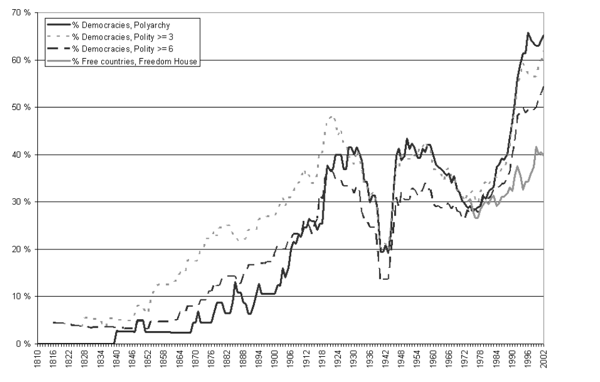
Recognizing that our liberty is remarkably multi-faceted, I will focus on the same categories Pratt mentioned. At the time he spoke, there were exactly 3 nations that were in some measure democracies, where at least some large percentage of the populace had the liberty of choosing their leaders. You can see for yourself how this has grown in the intervening 160+ years:
NOL Watson 1
source: Our World in Data

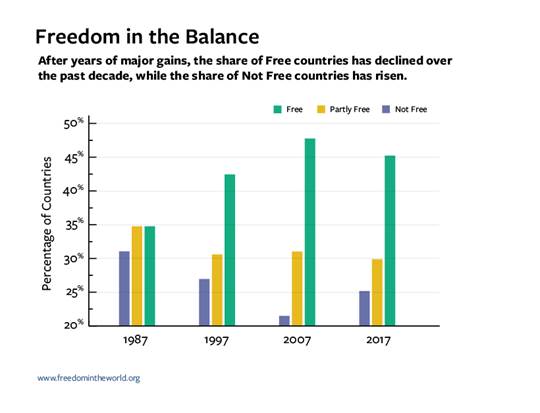
Billias’ 2009 work on how the principles of American constitutionalism were “heard round the world” shows that waves of influence gradually spread the principles of self-determination, liberty, separation of powers, and checks and balances into the freedom movements and constitutions of most of the world. Even while warning that the last ten years have seen declines in liberty overall worldwide, Heritage shows us that the last thirty years still show remarkable improvement:
NOL Watson 2

From a time when the US was one of very few countries to legally protect religious liberty, today nearly three-fourths of all the countries in the world have a constitution that specifically protects freedom of belief, and two-thirds permit some religious proselytism – which preserves freedom of expression (Pew Global Restrictions on Religion). There is still much to do to improve and preserve religious liberty around the world, both in legally acknowledged protections and in fostering an actual peaceful society where religious groups are not subject to violence and persecution.

Despite the distance left to go, the cause of liberty has clearly moved forward in great ways in the last 160 years. Much as Pratt predicted, much of this was accomplished without great revolutions and civil wars, but through the power of example as free nations and free people proved themselves a beacon to the world. There is still good cause to believe in that fundamental converting power from setting the right example and allowing free people to govern themselves.

Secessions that didn’t work out

No, not that secession. It’s the ten most important unsuccessful secessions of the last few decades. That’s the topic of my latest column over at RealClearHistory, anyway. An excerpt:

You already know about Catalonia and its unsuccessful bid to secede from Spain late last year. (Check out our archives if you want to get up to speed.) A comparative approach is useful here. The unsuccessful secession movements in Africa have all been violent. The unsuccessful ones in Europe and North America started out violent but have evolved into democratic movements. The key to understanding this shift is the federative structures that exist, or don’t exist, in different parts of the world. The secessionist movements in Europe and North America are not looking to go it alone any longer. These movements don’t want full sovereignty. Separatists in Europe and North America want more decision-making power in federative structures. In the case of Quebecers, it’s Canada’s unique federation; for Catalonians (and the Scottish, for that matter), it’s the European Union. Once a federative body roots itself in a region of the world, separatist tendencies cease to be violent and they shift to more peaceful forms of resistance. Kurdistan provides a microcosmic example of this evolution, In Turkey, where the Kurds continue to be ignored and oppressed, violence reigns supreme. In Iraq, where the Kurdish region has been given autonomy and self-governance, grievances are aired out in the open, in the form of non-binding referenda and in arguments put forth in a free and open press.

I also spend a good deal of time explaining why the Confederacy is no longer relevant for understanding the world we live in. Please, check it out.

Nightcap

  1. Revisiting Bosnia Elliot Short, War is Boring
  2. Liberals and conservatives are wrong on guns Rick Weber, NOL
  3. Why doesn’t economics progress? Arnold Kling, askblog
  4. The Balance of the Federation: Canada 1870 to 2016 Livio di Matteo, Worthwhile Canadian Initiative

A quote

The most profound technologies are those that disappear. They weave themselves into the fabric of everyday life until they are indistinguishable from it.

Mark Weiser

Hayek would have liked this quote about computers. On his behalf, I’m going to co-opt it as a description of the miracle of markets.

Values quiz (worth taking!)

I’m a big fan of unscientific and undignified online political quizzes. (Remember this?) Michelangelo pointed out the newest one, and I just had to share it here. Take the quiz. My results:

No automatic alt text available.

Here’s Michelangelo’s results:

No automatic alt text available.

Me and Michelangelo match up pretty well, except for our diplomatic axis. Am I the odd man out here at NOL? In libertarian circles more generally? Take the quiz already, and don’t forget to post your results in the ‘comments’ section!

Nightcap

  1. Germany is struggling with its place in the world Ulrike Franke, War on the Rocks
  2. German parents are more laid back than American ones Lenore Skenazy, Hit & Run (Reason)
  3. How to walk through a Berlin park Elnathan John, 1843
  4. How is the world ruled? Branko Milanovic, globalinequality

A short note on Klimt and Schiele

I hope y’all have been enjoying my new “Nightcap” series. Many of the articles eventually end up at RealClearHistory (my bad ass editor has the final say-so), so I thought I’d be doing y’all a favor by sharing them here, in smaller doses, first.

This BBC article on Gustav Klimt and Egon Schiele, a couple of Austrian artists, won’t make the cut (RCH‘s readers don’t really enjoy art history), but I thought you’d love it. Vienna was the center of intellectual life for not only economists and philosophers in the late 19th-early 20th centuries, but also for artists and other academics and critics as well.

Klimt (bio) is my favorite painter, ranking just above Picasso, Chagall, BoschHokusai, and Dalí. Check this out:

[…] a decision was made to permanently display the paintings in a gallery rather than on the ceiling [because they were so scandalous]. Klimt was furious and insisted on returning his advances and keeping the paintings. The request was refused but after a dramatic standoff in which Klimt allegedly held off removal men with a shotgun, the Ministry eventually capitulated.

Tragically the paintings were destroyed by retreating SS forces in 1945 and all that remains are hazy black and white photographs.

How could you not like the guy?

PS: I’ve heard, through the grapevine, that Lode and Derrill have posts on the way. Stay tuned!

Nightcap

  1. In 1948, Israel lost 1% of its population Marcel Surr, War is Boring
  2. How Nazis Celebrated Murdering Jews Edward Westermann, Aeon
  3. Croatia: the Fragile Heart of the Balkans Matthew Engel, New Statesman
  4. How Marvel Comics’ Wakanda Got Its Name Thomas McDow, Origins

Nightcap

  1. The new age of great power politics John Bew, New Statesman
  2. Before We Cure Others of Their False Beliefs, We Must First Cure Our Own Christopher Preble, Cato Unbound
  3. Libertarians (FDP) ruin coalition talks in Germany Christian Hacke, Deutsche Welle
  4. The Rich You Will Always Have With You Brandon Turner, Law & Liberty

Tech’s Ethical Dark Side

An article at the NY Times opens:

The medical profession has an ethic: First, do no harm.

Silicon Valley has an ethos: Build it first and ask for forgiveness later.

Now, in the wake of fake news and other troubles at tech companies, universities that helped produce some of Silicon Valley’s top technologists are hustling to bring a more medicine-like morality to computer science.

Far be it from me to tell people to avoid spending time considering ethics. But something seems a bit silly to me about all this. The “experts” are trying to teach students the consequences of the complex interactions between the services they haven’t yet created and the world as it doesn’t yet exist.

My inner cynic sees this “ethics of tech” movement as a push to have software engineers become nanny-state-like social engineers. “First do no harm” is not the right standard for tech (which isn’t to say “do harm” is). Before 2016 Facebook and Twitter were praised for their positive contribution to the Arab Spring. After our dumb election the educated western elite threw up our hands and said, “it’s an ethical breach to reduce our power!” Freedom is messy, and “do no harm” privileges the status quo.

The root problem is that computer services interact with the public in complex ways. Recognizing this is important and an ethics class ought to grapple with that complexity and the resulting uncertainty in how our decisions (including design decisions) can affect the well being of others. My worry is that a sensible call to think about these issues will be co-opted by power-hungry bureaucrats. (There really ought to be ethics classes on the “Dark Side of Ethical Judgments of Others and Education Policy”.)

I don’t doubt that the motivations of the people involved are basically good, but I’m deeply skeptical of their ability to do much more than offer retrospective analysis as particular events become less relevant. History is important, but let’s not trick ourselves into thinking the lessons of 2016 Facebook will apply neatly to whatever network we’re on in 2026.

It hardly seems reasonable to insist that Facebook be put in charge of what we get to see. Some argue that’s already the world we live in, and they aren’t completely wrong. But that authority is still determined by the voluntary individual decision of users with access to plenty of alternatives. People aren’t always as thoughtful and deliberate as I’d like, but that doesn’t mean I should step in and be a thoughtful and deliberate Orwellian figure on their behalf.

Nightcap

  1. The Persistence of Tyranny Ken White, Popehat
  2. The father of consumer sovereignty Henry Farrell, Crooked Timber
  3. UK’s Labor (Left-wing) Party and the Custom’s Union Chris Dillow, Stumbling and Mumbling
  4. Kosher Salt Stefan Kanfer, City Journal

Free speech and campus conservatives: good news

The Weekly Standard recently posted an open letter from a very brave sociology professor at UCLA that’s worth mentioning here. I have just three things to add.

First, the sociologist, a self-identified conservative, is doing the right thing by urging the Bruin Republicans to cancel its proposed speech by a shock jock. The subject? “10 Things I Hate About Mexico.”

Second, as alumni I’m embarrassed. I’ve never been a fan of Bruin Republicans, but aping the tactics of Republican groups at less selective schools is pathetic.

Third, back to the open letter: it’s amazing and you should read it (link, again). Apparently, it was so convincing that the Bruin Republicans cancelled the event. What Rossman does – subtly, clearly, and powerfully – is point out to not only Bruin Republicans but everybody else involved in this fiasco that being politically conservative is not the same thing as being a member of the Republican Party. More importantly, by defending the right to speak while vehemently opposing the subject matter, Rossman makes an excellent case for moving the Republican Party in a more classically liberal direction.

Sticking up for your beliefs is important. Always has been, always will be. The pen is still mightier than the sword.

Nightcap

  1. How Capitalism Tamed Medieval Europe Ed West, CapX
  2. Guns and the British Empire Priya Satia, Aeon
  3. When Government Drew the Color Line Jason DeParle, NY Review of Books
  4. In Praise of American History Marilynne Robinson, Times Literary Supplement

Nightcap

  1. Iran’s Afghan fighters, in Syria Ahmad Shuja Jamal, War on the Rocks
  2. The Africans of 16th Century Britain David Dabydeen, New Statesman
  3. What Books Did American Blacks Read Before the 1960s? Jonathan Rose, History News Network
  4. Padmaavat loathed by fundamentalists of all stripes Barkha Dutt, Washington Post

WP: Does Bitcoin Have the Right Monetary Rule?

The growing literature on Bitcoin offers little more than passing mentions to Bitcoin’s monetary rule. This is the topic of this short paper.

The growing literature on Bitcoin can be divided in two groups. One performs an economic analysis of Bitcoin focusing on its monetary characteristics. The other one looks takes a financial look at the price of Bitcoin. Interestingly, both of these groups have not given much more than passing comments to the problem whether or not Bitcoin has the right monetary rule. This paper argues that Bitcoin in particular, and cryptocurrencies in general, do not have a good monetary rule, and that this shortcoming seriously limits its prospect of becoming a well-stablished currency.

Download from SSRN.