- Lessons from World War I and British Grand Strategy John Bew, War on the Rocks
- Trump prefers spectacle to strategy Danny Sjursen, the American Conservative
- A better way to talk about politics Conor Friedersdorf, the Atlantic
- It’s not just about big government Scott Sumner, theMoneyIllusion
If causality matters, should the media talk about mass shootings?
My answer to that question is “maybe not” or at the very least “not as much”. Given the sheer amount of fear that can be generated by a shooting, it is understandable to be shocked and the need to talk about it is equally understandable. However, I think this might be an unfortunate opportunity to consider the incentives at play.
I assume that criminals, even crazy ones, are relatively rational. They weigh the pros and cons of potential targets, they assess the most efficient tool or weapon to accomplish the objectives they set etc. That entails that, in their warped view of the world, there are benefits to committing atrocities. In some instances, the benefit is pure revenge as was the case in one of the famous shooting in my hometown of Montreal (i.e. a university professor decided to avenge himself of the slights caused by other professors). In other instances, the benefit is defined in part by the attention that the violent perpetrator attracts for himself. This was the case of another infamous shooting in Montreal where the killer showed up at an engineering school to kill 14 other students and staff. He committed suicide and also left a suicide statement that read like a garbled political manifesto. In other words, killers can be trying to “maximize” media hits.
This “rational approach” to mass shootings opens the door to a question about causality: is the incidence of mass shootings determining the number of media hits or is the number of media hits determining the incidence of mass shootings. In a recent article in the Journal of Public Economics, the possibility of the latter causal link has been explored with regards to terrorism. Using the New York Times‘ coverage of some 60,000 terrorist attacks in 201 countries over 43 years, Michael Jetter used the exogenous shock caused by natural disasters to study they reduced the reporting of terrorist attacks and how this, in turn, reduced attention to terrorism. That way, he could arrive at some idea (by the negative) of causality. He found that one New York Times article increased attacks by 1.4 in the following three weeks. Now, this applies to terrorism, but why would it not apply to mass shooters? After all, there are very similar in their objectives and methods – at the very least with regards to the shooters who seek attention.
If the causality runs in the direction suggested by Jetter, then the full-day coverage offered by CNN or NBC or FOX is making things worse by increasing the likelihood of an additional shooting. For some years now, I have been suggesting this possibility to journalist friends of mine and arguing that maybe the best way to talk about terrorism or mass shooters is to move them from the front page of a newspaper to a one-inch box on page 20 or to move the mention from the interview to the crawler at the bottom. In each discussion, my claim about causality is brushed aside with either incredulity at the logic and its empirical support or I get something like “yes, but we can’t really not talk about it”. And so, the thinking ends there. However, I am quite willing to state that its time for media outlets to deeply reflect upon their role and how to best accomplish the role they want. And that requires thinking about causality and accepting that “splashy” stories may be better left ignored.
Nightcap
- The applied theory of bossing people around Deirdre McCloskey, Reason
- How to survive being swallowed Ed Yong, the Atlantic
- Soviet architecture, then & now Noah Sneider, 1843
- The Atlantic Ocean before Columbus David Abulafia, History Today
Nightcap
- How Men In The Middle Ages Dealt With Gossiping Wives Katie Serena, ATI
- King’s Men & Bum’s-bailiffs Jonathan Healy, Social Historian
- Trump Shouldn’t Talk to Feds. And Neither Should You Ken White, Reason
- Frankenstein in Baghdad Robin Yassin-Kassab, New Statesman
Do risk preferences account for 1.4 percentage points of the gender pay gap?
A few days ago, this study of gender pay differences for Uber drivers came out. The key finding, that women earned 7% less than men, was stunning because Uber uses a gender-blind algorithm. The figure below was the most interesting one from the study as it summarized the differences in pay quite well.
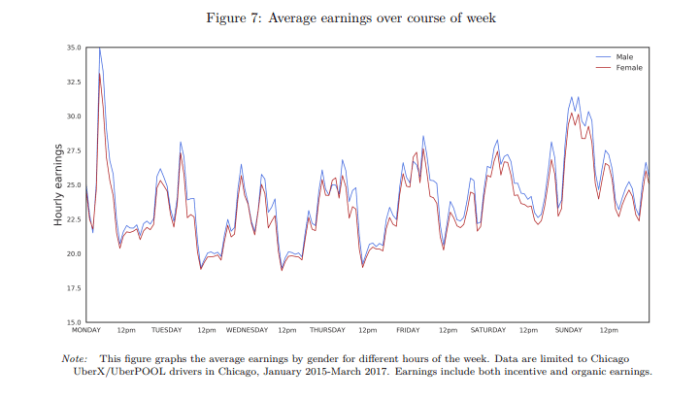
To explain this, the authors highlight a few explanations borne out by the data: men drive faster allowing them to have more clients; men have spent more time working for Uber and have more experience that may be unobserved; choices of where and when to drive matters. It is this latter point that I find fascinating because it speaks to an issue that I keep underlining regarding pay gaps when I teach.
For reasons that may be sociological or biological (I am agnostic on that), men tend to occupy jobs that have high rates of occupational mortality (see notably this British study on the topic) in the forms of accidents (think construction, firemen) or diseases (think miners and trashmen). They also tend to take the jobs in further removed areas in order to gain access to a distance premium (which is a form of risk in the sense that it affects family life etc.). The premiums to taking risky jobs are well documented (see notably the work of Kip Viscusi who measured the wage premium accruing to workers who were employed in bars where smoking was permitted). If these premiums are non-negligible but tend to be preferred by men (who are willing to incur the risk to be injured or fall sick), then risk preferences matter to the gender wage gap.
However, there are hard to properly measure in order to assess the share of the wage gap truly explained by discrimination. Here with the case of Uber, we can get an idea of the amplitude of the differences. Male Uber drivers prefer riskier hours (more risks of having an inebriated and potentially aggressive client), riskier places (high traffic with more risks of accidents) and riskier behavior (driving faster to get more clients per hour). The return to taking these risks is greater earnings. According to the study, 20% of the gap stems from this series of choices or roughly 1.4 percentage points.
I think that this is significantly large to warrant further consideration in the future in the debate. More often than not, the emphasis is on education, experience, marital status, and industry codes (NAICS code) to explain wage differences. The use of industry codes has never convinced me. There is wide variance within industries regarding work accidents and diseases. The NAICS codes industries by wide sectors and then by sub-sectors of activities (see for example the six-digits codes to agriculture, forestry, fishing and hunting here). This does not allow to take account of the risks associated with a job. There are a few study that try to account for this problem, but there are … well … few in numbers. And rarely are they considered in public discussions.
Here, the Uber case shows the necessity to bring back this subtopic in order to properly explain the wage gap.
Nightcap
- Scandinavians and the boons of empire Miles Macallister, Aeon
- Europe’s populists are waltzing into the mainstream the Economist
- Toughing it out in Cairo Yasmine El Rashidi, NY Review of Books
- Knowledge of the Holocaust Bart van der Boom, OUPblog
Nightcap
- Centuries-old German toy shop conquers internet Katrin Terpitz, Handelsblatt
- Interviews with Nazi Filmmakers [pdf] Gary Jason, Reason Papers
- Comparing Mao to Hitler and Stalin Ian Johnson, NY Review of Books
- 10 Weapons That Forged British Empire (my latest at RealClearHistory)
A short note on Rand Paul’s shaming of the GOP
For those who don’t know what I’m talking about, Rand Paul delayed a new, 700-page congressional budget that purportedly adds $300 billion to the deficit. CNN has the money shot:
“When the Democrats are in power, Republicans appear to be the conservative party,” Paul said at one point. “But when Republicans are in power, it seems there is no conservative party. The hypocrisy hangs in the air and chokes anyone with a sense of decency or intellectual honesty.”
Read the rest. The delay lasted a couple of hours. What I found most interesting was the complaining, by Senators and House Representatives alike, about having to stay up until 4 or 5 in the morning to pass the budget.
Good. At first I was incensed that politicians could think of nothing other than getting a good night’s sleep after adding hundreds of billions of dollars to the deficit (these are the same people who have voted to give themselves six-figure salaries for their “public service”), but then I remembered, thanks in part to Rick’s constant reminders, to give my enemies all my faith. Washington’s politicians probably believe they are doing honest work, and that adding to the already massive deficit is okay as long as it achieves a bipartisan consensus.
One other thought: Rand Paul is playing politics when he uses the term “conservative” to describe budget discipline. He knows, like Jacques, that conservatives are unprincipled, middle-of-the-road opportunists, but in today’s public discourse, fiscal discipline is somehow associated with conservatism, so he uses the term “conservative” to describe his libertarian politics.
Does anybody know where the deficit actually stands?
Nightcap
- The Men Who Made the Third Reich Richard Evans, the Nation
- Missionaries Didn’t Ruin Native Cultures John McGreevy, Commonweal
- Gutenberg: the democratizer of knowledge Bettina Baumann, Deutsche Welle
- Richer than Rockefeller? David Henderson, EconLog
Nightcap
- Scenes from a Police Detention Irfan Khawaja, Policy of Truth
- The Weight of Words Jacob T Levy, Niskanen
- Trump’s Making the Liberal World Order Stronger Christopher Preble, National Interest
- Brexiters’ blind spot Chris Dillow, Stumbling and Mumbling
Prices in Canada since 1688
A few days ago, I received goods news that the Canadian Journal of Economics had accepted my paper that constructed a consumer price index for Canada between 1688 and 1850 from homogeneous sources (the account books of religious congregations). I have to format the article to the guidelines of the journal and attach all my data and it will be good to go (I am planning on doing this over the weekend). In the meanwhile, I thought I would share the finalized price index so that others can see it.
First, we have the price index that focuses on the period from 1688 to 1850. Most indexes that exist for pre-1850 Canada (or Quebec since I assume that Quebec is representative of pre-1850 Canadian price trends) are short-term, include mostly agricultural goods and have no expenditures weights to create a basket. Now, my index is the first that uses the same type of sources continuously over such a long period and it is also the first to use a large array of non-agricultural goods. It also has a weights scheme to create a basket.
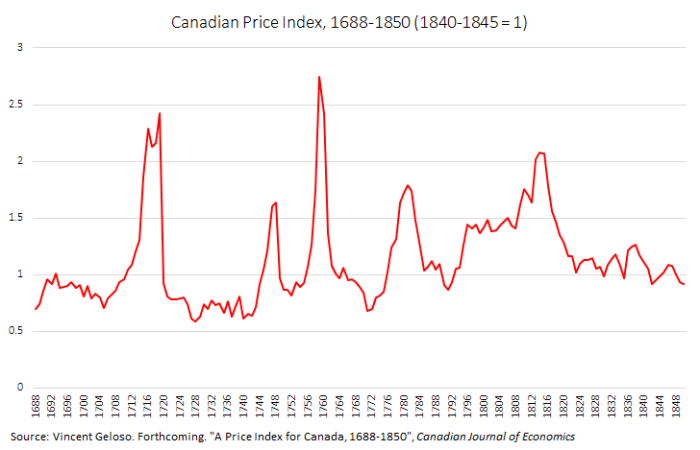
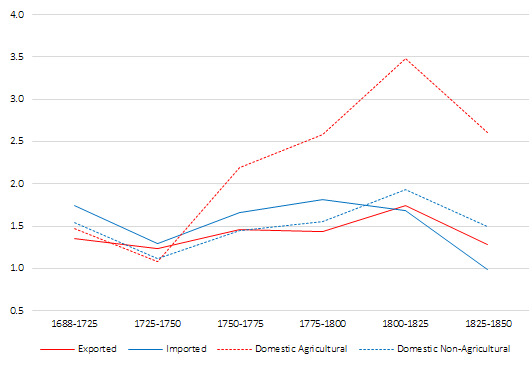
The issue of adding non-agricultural goods was especially important because there were important differences in the evolution of different types of goods. Agricultural goods, see next image, saw their nominal prices continually increase between the 17th and 19th centuries. However, most other prices – imported goods, domestically produced manufactured goods etc. – either fall or remain stable. These are very pronounced changes in relative prices. It shows that reliance on agricultural goods price index will overstate the amount of “deflating” needed to arrive at real wages or incomes. The image below shows the nominal price evolution of groupings of goods as described above.
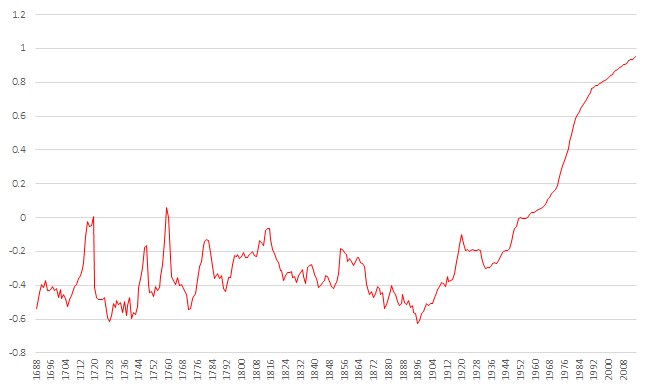
And finally, the pièce de résistance! I link my own index to other existing post-1850 index so as to generate the evolution of prices in Canada since 1688. The figure below shows the evolution of the price index over … 328 years (I ended the series at 2015, but extra years forward can be added). In the years to come, I will probably try to extend this backwards as much as possible at least to 1665 (the first census in Canada) and will probably try to approach Statistics Canada to see if they would like to incorporate this contribution into their wide database of macroeconomic history of Canada.
Nightcap
- Polystates, Geostates, and Anthrostates Rick Weber, NOL
- Flags, Chinese Pirates, and the American Navy Claude Berube, War on the Rocks
- Congress is *Supposed* to be Dysfunctional Philip Wallach, National Affairs
- How Soviet Artists Broke with the Past Francis Vermeylen, 1843
RIP John Perry Barlow – On the right to free information
Sadly, John Perry Barlow, the founder of the Electronic Frontier Foundation has died today. He was – to me – a huge inspiration for the internet anarchy and the cyberlibertarian movement I support.
His vision of the internet was to create “a world that all may enter without privilege or prejudice accorded by race, economic power, military force, or station of birth.”
As a tribute to Barlow, I would like to provide a summary of his speech on The Right To Know at TEDx Marin.
- The first time Barlow got online, he thought the internet would create the collective organism of mind.
- He believed that one day everyone on the planet would be endowed with the right to say whatever they want to say within their hearts, and nobody would be in the position to shut them up. In addition, everybody would have the right to not listen to what was said or written on the internet.
- The internet was going to be the great challenger of dogmatism.
- Having founded the Electronic Frontier Foundation in July 1990, he spent many years thinking about the intersection between Cyberspace and the physical world.
- All the existing power relations in the physical are being renegotiated in Cyberspace.
- We are now at the point where the physical world is starting to become terrified of Cyberspace. This is obviously shown by how governments deal with Wikileaks and the Arab awakening.
- Cyberspace has provided the bloggers, and journalists of Wikileaks and the Arab awakening with the opportunity to question the political structure. They knew that their real power was the ability to speak, and to be heard.
- They also understood that they had the right to know.
- If we play our cards right, the internet will make it possible for everybody on the internet to satisfy his curiosity to the fullest extent that is presently known by our species. Everyone interested, can know what is presently known.
- Nothing like this has had ever happened before.
- To achieve that, we have to realize that we cannot own free speech.
- Copyright is the wrong model for monetizing the expression of the mind. Thought is not a thing, … it is an action. The more a thought is heard and understood, the more powerful it becomes. It’s not like physical goods.
- Because of the old model of thinking of expression as a thing that must be regulated towards scarcity, there are many things going on right now that are militating against Freedom of expression.
- Comcast, yesterday, stopped all of our access to PirateBay. PirateBay is a notorious copyright infringement site, but is also an important cause with different members from European parliaments.
- The other thing is that the Freedom of expression necessarily includes tolerance to the other person’s right to speak up his mind. No matter how abominable his ideas may be.
- The answer to hate speech is love speech, and the answer of the speech you can’t stand is the speech of your own heart. Go out there and stop those who will try to own Freedom of expression.
- Take a look at the Electronic Frontier Foundation.
Nightcap
- Xi Jinping Looking More and More Like Mao Doug Bandow, National Interest
- Fear, Loathing, and Zulm in Iran Mehrad Vaezinejad, History Today
- India, Pakistan, and Balochistan: A History of Trouble Ahsan Butt, the Diplomat
- A History of Craft Beer in America Derek Thompson, the Atlantic
2018 Hayek Essay Contest
The 2018 General Meeting of the Mont Pelerin Society will take place from September 30 – October 6, 2018 at ExpoMeloneras and Lopesan Hotels in Meloneras, Gran Canaria, Canary Islands. As with past general meetings, the Mont Pelerin Society is currently soliciting submissions for Friedrich A. Hayek Fellowships. The fellowships will be awarded through the Hayek Essay Contest.
The Hayek Essay Contest is open to all individuals 36 years old or younger. Entrants should write a 5,000 word (maximum) essay that addresses the quotation(s) and question(s) detailed on the contest announcement (available at the above link). The deadline for submissions is May 31, 2018. The winners will be announced on July 31, 2018. Essays must be submitted in English only. Electronic submissions should be sent in PDF format to this email address (mps.youngscholars@ttu.edu). Authors of winning essays must present their papers at the General Meeting to receive their award. The essays will be judged by an international panel of three members of the Society.
Please feel free to share this announcement with any individuals who may have an interest in submitting an essay for consideration of a fellowship award. All questions may be directed to the MPS Young Scholars Program Committee by email at mps.youngscholars@ttu.edu or phone at +1.806.742.7138.
MPS Young Scholars Program Committee
 Notes On Liberty